스타틴계 고지혈증치료제의 골절치료효과에 대한 분석
최 병 철# 중앙대학교 약학대학
(Received March 17, 2009; Revised June 5, 2009; Accepted June 15, 2009)
Analysis on Statins for The Treatment of Bone Fracture
Byung Chul Choi#
College of Pharmacy, Chung-Ang University, Seoul 156-756, Korea
Abstract— 3-Hydroxy-3-methylglutaryl coenzyme A reductase inhibitors (Statins) are potent inhibitors of cholesterol bio- synthesis. Cholesterol-lowering therapy using statins significantly reduces the risk of coronary heart disease. Various dis- covery of statins as bone anabolic agents has spurred a great deal of interest among both basic and clinical bone researchers.
In-vitro and some animal studies suggest that statins increase the bone mass by enhancing bone morphogenetic protein- 2 (BMP-2)-mediated osteoblast expression. Clinical and animal test results of statins focusing on the prevention and treat- ment of bone fractures was collected. Three independent literature searches were performed by using from January 1, 2002 to September 2008 for clinical and animal test results. Search term included statins, HMG-CoA reductase inhibitors, pleio- tropic effects, fracture, osteoporosis and clinical and animal test. No consensus has been reached whether clinical use of statins has beneficial effects on bone health, partly due to lower statin concentrations because of first-pass metabolism by the liver. Experimental use of statins as stimulators of bone formation suggests that they may have widespread applicability in the field of orthopaedics. With their combined effects on osteoblasts and osteoclasts, statins have the potential to enhance resorption of synthetic materials and improve bone ingrowth. In conclusion, The use of statins in the prevention and treat- ment of bone fractures requires further study. But observational studies suggest that statins for decreasing bone fractures including osteoporosis have to be considered local direct administration like transdermal or subcutaneous type over oral adminstration.
Keywords □statins, HMG-CoA reductase inhibitors, pleiotropic effects, osteoporosis, bone fracture, local application
스타틴계고지혈증치료제(statins)는 1971년일본의 Akira Endo
등이어떤미생물이다른생물체에대해자신을방어하기위한 효소저해제를만들것이라는점에착안하여콜레스테롤합성에
필요한효소인 HMG-CoA reductase를미생물로부터찾고자하
였고, 연구중에 mevalonate가미생물세포벽에있는 ergosterol
혹은 cytoskeleton에있는 isoprenoid의유지에필수적으로요구
되는많은물질의전구체라는것을발견하게된다.1)그후 HMG-
CoA reductase를차단하면인체의콜레스테롤수치가저하된다
는연구로 Penicillium citrinum로부터생산된첫번째 statin류
인 mevastatin이탄생되었으며, 이어 1987년미 FDA로부터처 음으로 콜레스테롤저하제로승인받은 statin류는 Aspergillus
terreus에서생산된 lovastatin이었다.2)현재국내에는 simvastatin, pravastatin, fluvastatin, atorvastatin, rosuvastatin, pitavastatin
이시판중에있다.
Stain류는고콜레스테롤혈증과심혈관질환환자들에게매우효
과적으로일차또는이차허혈성심장질환예방에사용되어왔으 며,3,4)콜레스테롤수치를저하시키는작용외에도여러다른다
면발현성효과(pleiotropic effects)들이밝혀지면서많은연구가 진행되었다.5) Statin류는 HMG CoA reductase inhibitor로서콜
레스테롤생합성경로의초기단계를차단하여혈중콜레스테롤 수치를저하시키는기전을가지고있다. Statin류는콜레스테롤 수치를내리는작용외에도항죽상경화, 항염증(염증반응조절),
혈관내피기능개선, 내항산화, 면역조절및항혈전작용, 항부정
맥작용이 있는 것으로 알려져 있다.6) 또한 simvastatin은
atorvastatin보다치매와파킨슨씨질환의발생을현저히감소시
킨다는보고도있다.7)
#본논문에관한문의는저자에게로
(전화) 02-3426-5664 (팩스) 02-816-7338 (핸드폰) 011-791-2639
(E-mail) [email protected]
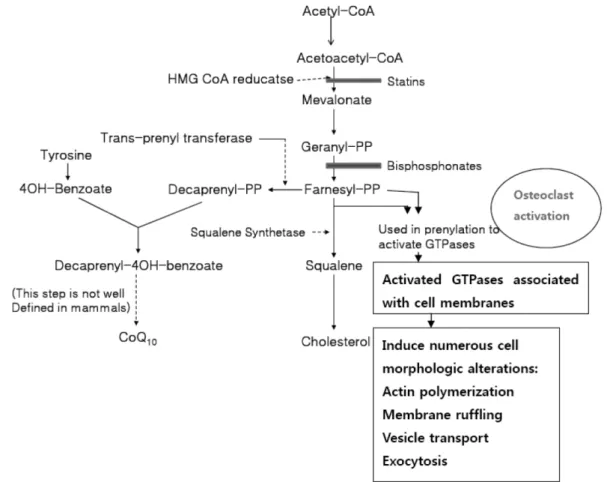
한편 statin류는만성신질환의진행을개선시키며, 이러한기 전은 Ras와 Rho-GTPases의 isoprenylation을저해하여사구체 에서단핵구와대식세포의침투를감소시키고, 혈관사이세포 (mesangial cell)의증식을감소시켜 세포외기질(extracellular matrix)과섬유증(fibrosis)의축적을감소시키기는것으로알려져 있다.8)또한 statin류는파골세포의활성화를억제하여, 뼈형성
촉진및뼈흡수저해를통하여골절의위험도를감소시키는작
용도나타낸다(Fig. 1).9)최근연구에의하면심혈관질환은골밀
도저하및골절과밀접한관련이있으며특히병태생리학적으 로서로유사한점이많은것으로보고되었다. 뼈와혈관의형성 부에는 type 1 collagen, proteoglycan, osteopontin, 그리고
osteonectin이발견되며이들은뼈형성과죽상형성에중요한역
할을한다.12)본연구는 statin류의골절치료효과에관한기초연
구자료및임상연구자료를검토하여보고함으로서, 이와관련한
연구가수행될수있도록하는계기를제시하고자한다.
연구방법
본연구는먼저 statin류의 pleiotropic effect에관한연구결과 를수집하였고다음주로 statin류의골절의예방과치료에관한
임상또는동물시험결과에대한자료를수집하였다. 자료수집 은 PubMed(MeSH)와 MEDLINE를 이용하였다. Statin류의
pleiotropic effect와골절기전등에대한자료는 1990년대부터 2008년 8월까지수집하였으나 statin류의골절치료에대한국소 응용등임상자료들은 2002년 1월부터 2008년 8월까지자료를 수집하였다. 검색어는 statins, HMG-CoA reductase inhibitors, pleiotropic effects, osteoporosis, bone fracture, local application,
그리고 clinical test를사용하였다.
이러한검색어를이용하여총 105편을선정하였으며, 수집된
자료는 (1) statin류의 pleiotropic effect, (2) statin류의골절기
전 (3) statin류의임상자료로나누어분류하였다. 이연구를위
해사용한자료는 67편이였으며, 데이터를추출하는과정은 Fig.
2에나타내었다.
연구 결과 및 고찰
Statin
류와골절치료Statin
류의치료기전 − 뼈의형성과재형성은조골세포에의한골기질의합성과파골세포에의한재흡수에의해조절된다. 조 골세포와파골세포활성의불균형은, 다양한호르몬의변화와염
Fig. 1 −Cholesterol synthesis and osteoclast activation.
증반응을일으키는인자와성장인자의변화에의해일어날수있
다. Statin류의골절치료는조골세포의촉진또는파골세포의억
제기전으로크게나누어볼수있다.
먼저 statin류가조골세포를촉진하여뼈형성한다는점에서
여러기전들이보고되고있다. 고콜레스테롤혈증은인체와동물
실험에서골다공증성뼈손실을일으키는데중요한역할을하지 만고지혈증치료제인 statin류는뼈의 동화작용으로뼈형성을 촉진시킨다.13)뼈형태유전성단백질(bone morphogenetic protein)
은성체중간엽줄기세포(mesenchymal stem cell, MSC)의분
화를자극시켜조골세포분화를촉진하고뼈형성을일으키는
cytokine으로알려져있다.14) Fluvastatin과 lovastatin 투여시,
MSC가신경교(neuroglial) 세포로분화되어조골세포의활성에
도움을주며,15) statin류의동화작용은또한조골세포분화에대
한강력한촉진인자인뼈형태유전성단백질-2(bone morphogenetic
protein-2, BMP-2)의발현을증가시키고, 조골세포에의한뼈의
mineralization을촉진시킨다.16) Ruiz-Gaspa 등17)은 simvastatin
과 atorvastatin을투여한후조골세포활동을연구하였다. 실험
결과 statins는 hOB(primary human osteoblast)의증식을억제
하면서성숙한조골세포의분화를촉진하는작용과뼈형성에관 여하는 collagen, osteocalcin 그리고 BMP-2의발현이증가되는 것을관찰하였다. 최근 simvastatin을마우스에투여하였을때,
골수간질세포(bone marrow stromal cell, BMSC)는뼈형태유
전성 BMP-2의발현을증가시켜조골세포의분화를유도한다는
보고도있다.18)또한 statin류가파골세포를억제하여뼈손실을
막는다는기전에대한보고들이있다. Statin류와동일한기전
으로폐경기성골다공증치료제인 nitrogen 함유비스포스포네이 트약물도 mevalonate pathway를차단하여 isoprenoid의생성
을차단하므로써파골세포의형성과기능을저해한다는보고도 있다.19)
NFkB를 활성화 시키는 자극제는 파골세포 분화
(osteoclastogenesis)에필수적인 cytokine으로기원세포로부터 파골세포생성을시작할수있고성숙한파골세포의활성을유 도할수있다.20)최근 Ahn 등21)등은동물실험에서 simvastatin
이 NFkB를억제하였으며, 특히종양세포에의해유도된파골세
포분화(osteoclastogenesis)를억제하였으므로종양과관련된골
다공증의치료에있어서유용하다는것을제안하였다.
자료조사에의하면, statin류가조골세포를촉진하여뼈형성
에관여한다는기전이 statin류가파골세포를억제하여뼈손실 을방어한다는기전에대한보고보다월등히많았다. 그러므로
파골세포의증가에의한폐경기성골다공증에는효과가미흡할 것으로예상된다.
Statin
류의약동학 − 일반적으로 statin류는대부분초회통과효과(first-pass effect)를거치는약물이므로뼈형성에필요한혈 중농도에도달하는데문제가있다. 간내 cytochrome P-450(CYP-
450) 효소에의해불활성화되므로생물학적으로활성성분들이
말초부위에서적정농도를유지하지못하므로뼈형성효과가감 소된다.22) Lovastatin, simvastatin과 atorvastatins은 cytochrome P-450 3A4 효소에의해매우큰분자로대사되며 fluvastatin과 rosuvastatin은 cytochrome P-450 2C9 효소에의해매우작은 분자로대사되고 pravastatin은간에서 sulfation에의해대사된
다.23)
Statin류중 pitavastatin은초회통과를하지않으므로뼈형성 작용에있어서는다른 statin류보다더효과적이다.24) Lovastatin
을정맥주사로투여한경우경구투여보다뼈에서의약물농도가 현저하게높았으므로뼈흡수(bone resorption)를저해하기위해 서는정맥주사의경로가바람직하다. 이는경구투여시간대사를
거치므로생체이용율이저하되기때문으로사료된다.25)지금까
지의자료조사에의하면, pitavastatin에대한연구는거의드물
게이루어졌기에이에대한효과를언급하기에는아직부족한점
이있다. 많은연구에서 statin류의경구투여에대한연구보다
비경구투여에의한자료가많았으므로, statin류는비경구투여 Fig. 2 −Flow chart of extraction and analysis of the data.
의연구가진행되어야할것이라예상할수있다.
Statin
류의controversial effects
−Statin
류의골절치료에대한긍정적인연구 − 난소를제거한흰쥐에 statin류를 장기간 투여한 결과 골밀도(BMD, bone
mineral density)가현저하게증가하였다.26)최근 Kolanczyk 등27)
은 lovastatin이신체만곡, 돌발적인골절, 정강이뼈의가관절
(pseudarthrosis: 골절부의뼈가잘유합되지않아마치관절처럼
움직이는상태) 등의증상을가진제1형신경섬유종증과관련된 뼈재생불량증상의치료에효과가있음을보고했다. 이러한효
과는 lovastatin이골수강(bone marrow cavity)에서새로운뼈
Table I −Evaluating surrogate markers of fractures
Author Study
design No. of patients Statin
duration
(wks) End points Outcomes
Boneet al.
(2007) O, P, PC
Total: 626
52
Lumbar spine (L1-L4) BMD by DXA, LS mean (95% CI)
Placebo: 0.16 10 mg: -0.26 20 mg: -0.38
Placebo: 119
40 mg: -0.44 80 mg: -0.03 Lumbar spine (L1-L2)
BMD by QCT,b, LS mean (95% CI)
Placebo: 2.36 10 mg: -3.95 20 mg: -1.93 40 mg: 0.11 80 mg: -3.43 Total femoral BMD by
DXA, LS mean (95%
CI)
Placebo: -0.74 10 mg: -0.58 20 mg: -0.5 40 mg: -0.51
Atorvastatin 10 mg: 118
80 mg: -0.06 sNTX, 10% trimmed
mean (95% CI)
Placebo: -3.68 10 mg: -3.50 20 mg: 0.02 40 mg: -6.54 80 mg: -5.04 sCTX, 10% trimmed
mean (95% CI)
Placebo: -4.18 10 mg: -1.92 20 mg: 3.96 40 mg: -4.47 80 mg: -1.14 Atorvastatin 20 mg: 121 Osteocalcin, 10%
trimmed mean (95%
CI)
Placebo: -4.38 10 mg: -4.44 20 mg: -2.88 40 mg: -5.32 80 mg: -10.56 Atorvastatin 40 mg: 124
BSAP, 10% trimmed mean (95% CI)
Placebo: -2.74 10 mg: 0.55 20 mg: -1.34
Atorvastatin 80 mg: 122
40 mg: -0.80 80 mg: -1.18 P1NP, 10% trimmed
mean (95% CI)
Placebo: -7.04 10 mg: -0.25 20 mg: -1.20 40 mg: -1.63 80 mg: -10.29 DPD, 10% trimmed
mean (95% CI)
Placebo: 0.83 10 mg: -3.44 20 mg: 1.88 40 mg: -1.19 80 mg: -5.81
형성을촉진하고, 손상부위의미네랄화및뼈기질을섬유연골성
조직으로교체하여피질골(cortical bone) 재생을가속화시키는
것으로관찰되었다.
Statin
류의골절치료에대한부정적인연구 −Statin류는폐경기성골다공증환자에서골형성과골흡수사이에유의할만한차
이가없었다는여러보고가있다.28-33)난소를적출한동물실험
에서 simvastatin은용량에관계없이골다공증을개선시키지못
했다.34)여러자료조사에서도 statin류는여성호르몬부족과관 련된폐경기성골다공증에는부정적인시각이지배적이었다.
Statin
류와골절에관한임상자료검토1999년 Mundy 등35)이 statin류가뼈형성에영향을미친다는
연구결과를발표한이후로, 이연구결과를지지하는다른논문
들이발표되는가하면이를부정하는논문들도다수발표되어
statin류의뼈형성효과는논란에휩싸이게되었다. Statin류의
뼈 형성 촉진작용은 BMP-2 및 vascular endothelial growth
factor(VEGF)의유전자발현증가와관련이있는것으로알려져
있다. 그러나 statin류의골절예방또는치료효과에관한임상자
료는아직도부족한형편이다.
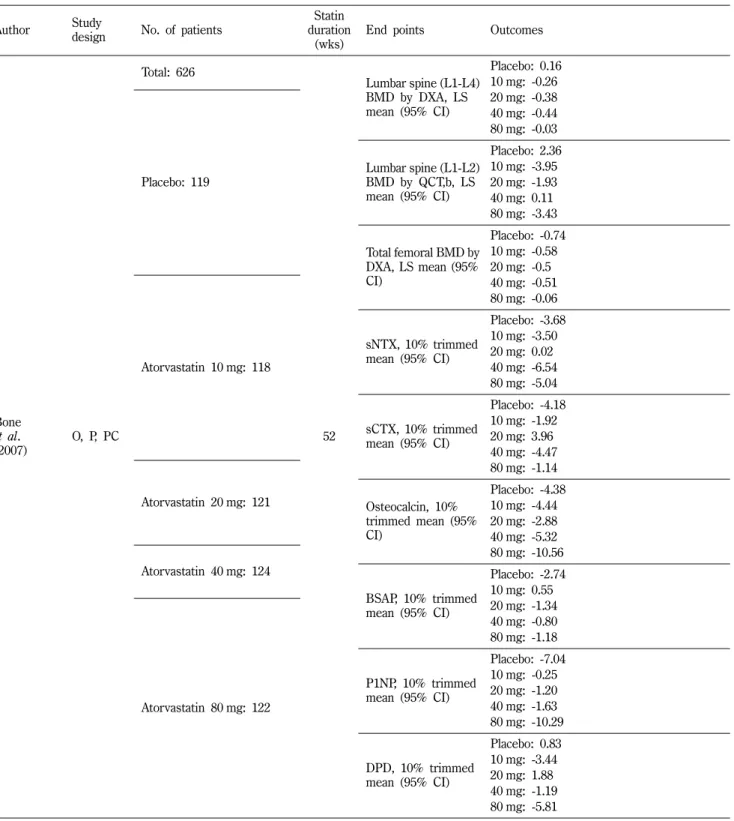
골절의검사표식에대한평가 − 요추(L1-L4)의골밀도가 T- score로서 0.0와 -2.5 사이이면서혈중저밀도지질단백(LDL)이 130~190 mg/dl인 626명의폐경기여성에서 atorvastatin 10, 20,
40, 80 mg 또는위약을 52주간경구로투여한결과, 약투여군
과위약군사이에골밀도또는골대사와관련된생화학적지표 의차이가없었다고보고하였다.36)이는경구용 atorvastatin이
골다공증의예방과치료에효과가없음을의미한다.
골다공증혹은골량감소가있는고콜레스테롤성폐경기여성
120명을대상으로 6개월간 risedronate와 atorvastatin의병용투
여군을같은기간동안 risedronate를단독투여한대조군과비교
하여요추및고관절의골밀도와지질및당대사의변화를측정 Table I −Continued
Author Study
design No. of patients Statin
duration
(wks) End points Outcomes
Tanriverdi et al.
(2005) P, CC Hypercholesterolaemic postmenopausal women with osteoporosis or osteopenia:
120 24 % BMD change at
lumbar and total hip
risedronate vs risedronate plus atorvastatin lumbar spine: 1.58% vs 0.75%, p<0.05 total hip: 1.2% vs 1.1%, p<0.05 Sirola
et al.
(2002) P, CC Statin: 118
54 Annual % BMD change at femoral neck and lumbar spine
Statin vs control BMD (adjusted):
Control: 502 Femoral neck: -0.47% vs -0.33% (p=0.628)
Lumbar spine: -0.20% vs +0.47% (p=0.134)
Funkhouser et al.
(2002) R, O
Statin: 197
48 Osteoporosis, BMD at hip and spine
Prevalence of osteoporosis:
Placebo: 786
Men: OR 0.79, 95% CI 0.51-1.22 Women: OR 0.36, 95% CI 0.12-1.07 Hip BMD (statin vs no statin):
Men: 0.90 vs 0.87 g/cm2 (p=0.194) Women: 0.86 vs 0.87 g/cm2 (p=0.183) Spine BMD (statin vs no statin):
Men: 1.05 vs 0.97 g/cm2 (p=0.004) Women: 1.00 vs 0.99 g/cm2 (p=0.160)
Rejnmark et al.
(2002) P, CS, CC
Statin: 140
36~48
BMD at hip, spine,
forearm All BMD: p=NS
Control: 140
Statin vs control:
Serum osteocalcin
(mg/L): 36 vs 39.5 (p=0.03) Serum CrossLapsa
(mg/L): 0.44 vs 0.51 (p<0.01) Serum bone ALP
(U/L): 98 vs 109 (p<0.01)
O=observational; P=prospective; R=retrospective; CC=case-control; CI=confidence interval: Cr=creatinine; CS=cross-sectional;
OL=open label; NS=not significant; OR=odds ratio; PC=placebo controlled; ALP=alkaline phosphatase: BMD=bone mineral density;
DPD=deoxypyridinoline; BSAP=Bone-specific alkaline phosphatase; uDPD=urinary deoxypyridinoline; P1NP=procollagen type I N propeptide; sCTX=serum C-telopeptide; sNTX=serum N-telopeptide
Table II −Outcome trials for fracture Author Study
design No. of
patients Statin
duration
(Months) End points Outcomes Nichols
et al.
(2008) RCS, LRS 174
Rejnmark et al.
(2006) R, CC 124,655 fracture cases with 373,962 age- and gender-
matched controls 72 Risk of fractures
Any fracture (adjusted): OR 0.87; 95% CI, 0.83~0.92
Hip fractures adjusted): OR 0.57; 95% CI, 0.48~0.69
Patients treated with pravastatin (adjjusted): OR 1.02; 95% CI, 0.89~1.17
Non-statin lipid lowering drugs (adjusted): OR 0.99;
95% CI, 0.86~1.15
Richard et al.
(2005)
R, PHA
Total: 91 052
42 mos
Total fractures (Incidence rate per 10,00person-years)
No medications: 12.2 Statin only: 7.0
Non-statin lipid-lowering medications: 11.3 Vertebral fractures
(Incidence rate per 10,00person-years)
No medications: 0.9 No medications:
60,794 Statin only: 0.7
Non-statin lipid-lowering medications: 1.1 Statin only: 28,063
Hip fractures (Incidence rate per 10,00person-years)
No medications: 1.5 Non-statin ipid-
lowering
medications: 2,195
Statin only: 0.6
Non-statin lipid-lowering medications: 1.3 Other fractures
(Incidence rate per 10,00person-years)
No medications: 9.8 Statin only: 5.8
Non-statin lipid-lowering medications: 8.9
Schoofs et al.
(2004)
Prospective population-based cohort study, Student’s t-test, Pearson’s 2 test, ANOVA
Total: 3,469
78 mos No./Mean BMD(CI 95%)
No statin use: 3014/1,129 (1.122~1.136) 2 years of statin use: 238/1,114 (1.090~1.139) 2~4 years of statin use: 123/1,112 (1.078~1.146)
Men: 1498 4 years of statin use: 150/1,135 (1.104~1.166)
2 years of lipophilic statin use: 190/1.114 (1.087~1.142)
Women: 1971 2~4 years of lipophilic statin use: 84/1.127
(1.085~1.168)
4 years of lipophilic statin use: 122/1.141 (1.106~1.175)
LaCroix et al.
(2003) P, CC
Statin: 1846
36 BMD and rate of hip, lower arm/wrist, or other fractures
Statin vs no statin:
No statin: 85,870
BMD: 0.86 vs 0.84 g/cm2 (p=0.0193) Hip: HR 1.22, 95% CI 0.83~1.81
Lower arm/wrist: HR 1.04, 95% CI 0.85~1.27, Other: HR 1.11, 95% CI 1.00~1.22
Pasco et al.
(2002) R, CC
Statins: 12,506
120 Documented hip fracture
Frequency of hip fracture (RR, 95% CI):
Statin vs control 0.62, 0.45-0.85
Other lipid drugs vs control: 0.44, 0.26~0.72 Other lipid-lowering
drugs: 47,98 Reduction in hip fracture (RR, 95% CI):
Statin vs other lipid drugs: 1.42, 0.83~2.43 Controls: 17,280
Rayet al.
(2002) R, CC, PHA Statin: 69
24 Any documented fracture
Statin vs no statin
Whole body: OR 0.43, 95% CI 0.24~0.78 Spine: OR 0.42, 95% CI 0.24~0.75
No statin: 1,306 Femoral neck: OR 0.45, 95% CI 0.25~0.8
P=prospective; R=retrospective; CC=case-control: CI=confidence interval; CS=cross-sectional; HR=multivariate-adjusted hazard ratio; OR=odds ratio; PC=placebo controlled; RR=adjusted incidence rate ratio; BMD=bone mineral density: LRS=Logistic regression analysis: RCS=retrospective cohort study; PHA=post hoc analysis; HPSCG=Heart Protection Study Collaborative Group;
하였다. 그결과병용투여군의요추골밀도가현저하게증가하
였지만고관절골밀도에는유의성있는차이가없었으며, LDL
및총콜레스테롤치는저하되었지만공복시혈당치및 HbA1c치 에도유의성있는차이는발견되지않았다.37)또한폐경기여성
을대상으로 statin 투여군 118명과위약군 502명을대상으로 4.5
년간고관절과요추의골밀도변화를추적한결과, 약투여군과 위약군사이에유의성있는차이가없음을보고하였다.38)이러
한보고는 statin이초기폐경기여성의뼈손실에영향을주지
못한는것으로사료된다. 또다른보고에의하면폐경기여성을 대상으로 statin 투여군 197명과위약군 796명으로나누고다시
남과여로나누어 4년간실험한결과약투여군은전반적인골 밀도를줄였으나부분적으로고관절과척추의골밀도에는통계
적으로유의하지못했다.39) Statin은폐경기여성에서가장골절
이많이일어나는부위에대한효과는미흡한것으로보인다. Rejnmark 등40)은 statin 투여군 140명과대조군 140명을대상
으로 36~48개월간고관절, 척추및전완의골밀도와골대사의
생화학지표인혈청중 psteocalcin, bone-specific alkaline phos- phatase 및 C-terminal telopeptide of type I collagen를측정하
였다. 그결과 statin 투여군은대조군에비해혈청중 osteocalcin, bone-specific alkaline phosphatase 및 C-terminal telopeptide of type I collagen을 모두 저하시켰고 혈청중 parathyroid hormone(PTH) 수치는 statin 투여군이대조군에비해높았다.
그러나요추, 고관절및전완의골밀도에는별차이가없었다.
이상의 statin류의골절의검사표식에대한평가를토대로볼
때, statin류의골절치료효과는긍정적인결과와부정적인결과
가공존한다. 그러나전반적으로부정적인시각이많았으므로폐 경기성골다공증의경우골절발생을줄이는데는비효과적인것 으로보인다.
성과
(outcome)
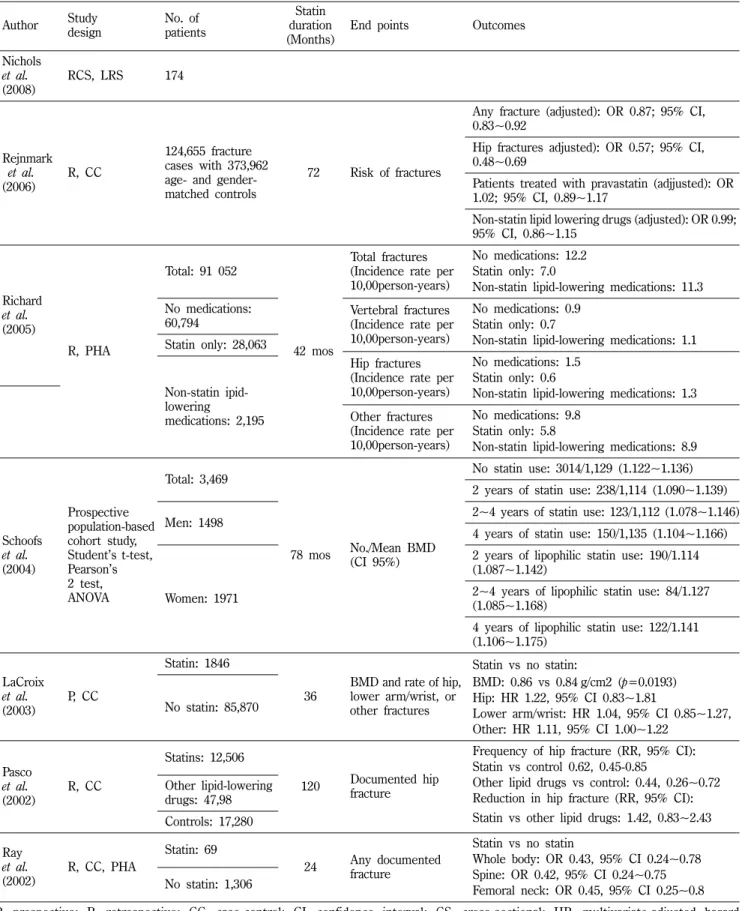
시험 −Nichols 등은혈액투석환자 174명을대상으로 statin 복용군과대조군에서골절빈도를측정한결과
statin의복용군은골절의빈도가감소하는것을관찰하였다.41)
이는뼈에대한 statin의잠재적인동화작용에의한것으로정확
한평가를위해서는더많은연구가요구된다. Rejnmark 등이
나이와성별을조화시킨 373,962명과골절환자 124,655명을대
상으로 pravastatin을 72개월간투여하여골절발생의빈도를실
험한결과, 대조군과비교시골절위험의감소는별차이가없었
다.42)그러나 Richard 등의보고에 의하면 남성퇴역군인총
88,857 중 statin 미투여군 60,794명, statin 투여군 28,063명을
대상으로 42개월간매년 10,000명당척추, 고관절등에관한골
절발생율을조사한결과, statin 복용자가미복용자에비해현저
하게골절발생율이감소하는것을관찰하였다.43)또한남성 1498
명과여성 1971명을대상으로 78개월간 statin 미복용군, 2년간 statin 투여군, 2~4년간 statin 투여군, 4년간 statin 투여군, 2년 간지용성 statin 투여군, 2~4년간지용성 statin 투여군, 4년간
지용성 statin 투여군을대상으로 78개월간척추의골밀도를측
정한결과, 장기간 statin의사용은척추골절의위험성을감소시
킨다는보고도있다.44)이는 statin의복용기간에따라골절의
발생에차이가있음을제시할수있다.
LaCroix 등은 50~79세사이의폐경기여성 93,716명을대상 으로 statin 투여군 7,846명, 미투여군 85,870명을대상으로 3.9
년간고관절, 팔목골절발생과골밀도측정한경우, statin의사
용은골절의위험과골밀도를개선시키지못했다.45)이는골다
공증의예방및치료를위해 statin의사용은의미가없는것으
로 사료된다. 그러나 Pasco 등은 statin 투여군 12,506명, 비 statin계고지혈증치료제투여군 47,98명및대조군 17,280명을
대상으로 120개월간고관절골절발생율을조사한결과 statin
투여군은대조군에비해실제적으로 60% 감소함을보였다.46)한
편 statin 투여군 69명, 미투여군 1,200명을대상으로 24개월간 몸전체, 척추와고관절의골절발생에대해측정한결과두군 사이에별다른차이가나타나지않았다.47)이상의성과시험을
토대로볼때, statin류의골절치료는폐경기성골다공증보다노
년기성골다공증에비교적효과적이며 10년이상장기적으로투
여하는경우효과를기대할수있을것으로예상된다.
골절치료를위한
statin
류의새로운접근Statin
류의병용요법 −Statin류는폐경기성골다공증환자의골절을예방및치료에대해많은의구심을가지게된다. 그러므
로 statin류를다른약물과병용하여골절치료의상승효과를기
대한연구도있다. Simvastatin과황산칼슘을 2주, 4주및 8주
병용투여시 8주경과후현저하게뼈재생이증가되었으며48)폐 경기여성들에게 statin류와호르몬대체요법을병용시켜항파
골세포의작용을감소시켰다.49) Statin류와 bisphosphonates를 6
개월간투여한경우고관절과요추의골밀도가증가되었다.37) Statin류를 vancomycin과 함께 tricalcium phosphate lysine
(TCPL) 전달시스템을이용하여대퇴부을손상시킨동물에투여
후상처회복을측정한결과생식기, 장기및근육에부작용없 이뼈재생작용이현저하게증가하였다.50)여러연구에서 statin
류단독으로골절을예방하거나치료하기보다는다른골다공증 약물과병용하면골다공증치료효과의시너지효과를기대할수 있을것으로예상된다.
Statin
류의 투여방법 −2002년 Skoglund 등은 마우스에게simavastatin을함유한먹이를먹인결과골절의치료를극적으
로개선시켰다는연구결과를발표한바있다.51)그러나이연구
에서사용된 simvastatin의용량은상용량보다 100배높은용량
을사용하였기때문에, statin류를임상에적용하기에는문제가
있다. 특히경구로투여된 simvastatin의대부분은간에축적되
며, 극히일부만이비결합형태(unbound form)로전신순환에도
달하여간외부의세포에전달된것으로나타났다.52-54)결과적
으로임상적으로유효한용량을확보하려면피하주사나국소투 여를통하여간의초회통과효과를피하는수밖에없다. 또한 simvastatin 고용량을다형골수종(MM, multiple myeloma) 환 자에게투여한결과일시적으로파골세포의활성의증가가억제 되었지만위장장애때문에중단했으므로이익보다는손해가더 많았다.22)
이러한문제점을해결하기위해 Skoglund 등은동물실험에서
simvastatin의지속적으로국소투여하면골절치유를향상시킬수
있다고보고하였다.55) Simvastatin의골대사효과가골세포에대
한국소적인효과를가지기위해, simavastatin을골절부위에직
접피하주사를지속적투여방법이좋을것이다. 그러나하루 1
회투여하는경우최고혈중농도에신속하게도달할수있다는 장점이있지만, 곧체외로배설되어버린다는문제점이 있다.
Simvastatin의반감기는인간의경우 2시간이며, 마우스의경우
는이보다더짧기때문이다.56,57)
Garrett IR 등은 statins를고용량혹은지연성인퓨전(infusion)
으로실험쥐의장골(long bone)에투여시, 뼈형성을촉진하고
골절회복과함께생체기능학적강도가증가하는것을관찰하였 다.58)그러나사람에서골절회복을빠르게하기위해고용량혹
은지연성인퓨젼을사용하는것은어려운문제이다. 이러한문 제점을해결하기위하여 lovastarin을생체분해가가능한 polymer
nanobeads에넣어사용한결과뼈형성이증가되었으며, 대퇴부
골절부위에한번주사시회복속도율이증가하였다. Statin류는 정형외과영역에서뼈형성을촉진하는작용으로사용이많아지
므로 statin류를투여시적당한약물수송시스템을고려하여야한
다.59)특히 simvastatin을대퇴부골절부위에직접피하주사시고 용량의경구투여보다적은용량에서효과적이었다.55) Simvastatin
을골절된흰쥐에직접골절부위에주사하였을경우대조군에비
해 simvastain용량에관계없이골에새로운모세혈관의형성과칼
슘화가증가되면서현저하게골절회복에효과적이었다.60)
Simvastatin을경구와국소에직접투여한결과경구투여는뼈
형성과세라믹흡수에효과가없어지만, 국소로직접이식투여 한경우생체이용률의증가로뼈재생에효과적이었으며, 이는
statin류가조골세포와파골세포에작용하여합성물질의흡수를
증진시키고뼈내부성장(ingrowth)을개선시키는것으로보인다.59) Simvastatin gelatin sponge를쥐의하악골에이식한결과골결
손회복을증가시켰으며,61) simvastatin을 ultra-high molecular
weight polyethylene(UHMWPE) 입자를이용하여뇌의두개관
뼈를용해시킨실험쥐에투여했을때, simvastatin은동화작용
으로현저하게뼈형성을증가되었다.62)저농도의 simvastatin를 사람치주에주사하여치주재생에중요한역할을하는치주인 대세포의증식과조골세포분화증식에긍정적인효과를나타 냈으며,63)치과교정학분야에서두개안면부의골이식후골형성 에중요한역할을한다.64)
Fluvastatin을골절부위에타타늄보형물을장치하고그주위
에도포한결과골생성이증가되었다.65)정형외과에서 fluvastatin-
releasing hydrogels의응용은뼈재생의분화를유도하기위해
서뿐만아니라, 뼈기능을조정하여뼈조직의재건에유용하게
사용할수있다.66) Transdermal lovastatin으로투여시경구투여 보다간독성및근육독성없이뼈형성에더욱효과적이었다.67)
이상의연구자료를종합하여볼때 statin류는국소적으로직접
골절부위에투여하는것이골절치료에효과적인것을보여준다.
결 론
Statin류는폐경기성골다공증에는비효과적이라고밝혀졌으며,
이는 statin류의골형성에대한긍정적효과는콜레스테롤강하라
는기전과는무관한국소적현상이었다. Statin류의약물동태학적
인면에서보면, 경구로투여된 statin류는초회통과를거치고대
부분은간에축적되며, 극히일부만이비결합형태로전신순환에
도달하기때문에간외다른조직에는약물이잘전달되지않는다
는점이다. 그러므로경구를통해전신으로투여하는 statin류로
원하는효과를거두기위해서는높은수준의국소농도를장기간
유지해야한다. 일정한농도를유지하기위해서는대량의 statin
류를투여해야하는데부작용으로인해투여에한계가있다.
주로동물시험에서 statin류를국소적으로사용하였다. Statin
류는직접골절부위에적용함으로써골절치유효과가극적으로 개선된다는것을밝혀졌다. Statins류를국소적용하면필요한용
량을낮출수있기때문에, 저용량의 statins류가골절부위로꾸
준히혈중농도를유지하기위해서는약물전달시스템을이용하여 야할것이다. 또한국소에직접투여하는방법도고려할수있
는데 1일 1회투여하는방법보다는지속적으로투여하는방법이
효과적일것으로사료된다.
참고문헌
1) Endo, A. : The discovery and development of HMG-CoA reductase inhibitors. J. Lipid Res. 33, 1569 (1992).
2) Richard, N. M., Glen, B., Jean, K. C., Alan, M. H., Thomas, T. N. and John, C. V. : Biosynthesis of the hypocholesterolemic agent mevinolin by Aspergillus terreus. Determination of the origin of carbon, hydrogen and oxygen by 13C NMR and mass spectrometry. J. Am. Chem. Soc. 107, 3694 (1985).
3) Jones, P. H., Davidson, M. H., Stein, E. A., Bays, H. E., McKenney, J. M., Miller, E., Cain, V. A. and Blasetto, J. W. : Comparison of the efficacy and safety of rosuvastatin versus atorvastatin, simvastatin, and pravastatin across doses (STELLAR* Trial). Am. J. Cardiol. 92, 152 (2003).
4) Jones, P. H., Hunninghake, D. B., Ferdinand, K. C., Stein, E. A.,
Gold, A., Caplan, R. J. and Blasetto, J. W. : : Effects of rosuvastatin versus atorvastatin, simvastatin, and pravastatin on non-high-density lipoprotein cholesterol, apolipoproteins, and lipid ratios in patients with hypercholesterolemia:
additional results from the STELLAR trial. Clin. Ther. 26, 1388 (2004).
5) Bocan, T. M. : Pleiotropic effects of HMG-CoA reductase inhibitors. Curr. Opin. Investig. Drugs 3, 1312 (2002).
6) Shaw, S. M., Fildes, J. E., Yonan, N. and Williams, S. G. : Pleiotropic effects and cholesterol-lowering therapy. Cardiology
112, 4 (2008).
7) Wolozin, B., Wang, S. W., Li, N. C., Lee, A., Lee, T. A. and Kazis, L. E. : Simvastatin is associated with a reduced incidence of dementia and Parkinson's disease. BMC Med. 5, 20 (2007).
8) Fried, L. F. : Effects of HMG-CoA reductase inhibitors(statins) on progression of kidney disease. Kidney Int. 74, 571 (2008).
9) Cruz, A. C. and Gruber, B. L. : Statins and osteoporosis: can these lipid-lowering drugs also bolster bones? Cleve. Clin. J.
Med. 69, 277 (2002).
10) Meier, C. R., Schlienger, R. G., Kraenzlin, M. E., Schlegel, B.
and Jick, H. : HMG-CoA reductase inhibitors and the risk of fractures. JAMA 283, 3205 (2000).
11) Wang, P. S., Solomon, D. H., Mogun, H. and Avorn, J. : HMG- CoA reductase inhibitors and the risk of hip fractures in elderly patients. JAMA 283, 3211 (2000).
12) Baldini, V., Mastropasqua, M., Francucci, C. M. and D'Erasmo, E. : Cardiovascular disease and osteoporosis. J. Endocrinol.
Invest. 28, 69 (2005).
13) Viccica, G., Vignali, E. and Marcocci, C. : Role of the cholesterol biosynthetic pathway in osteoblastic differentiation. J.
Endocrinol. Invest. 30, 8 (2007).
14) Ohnaka, K. and Takayanagi, R. : Statin and BMP. Clin.
Calcium. 14, 286 (2004).
15) Lee, O. K., Ko, Y. C., Kuo, T. K., Chou, S. H., Li, H. J., Chen, W. M., Chen, T. H. and Su, Y. : Fluvastatin and lovastatin but not pravastatin induce neuroglial differentiation in human mesenchymal stem cells. Cell Biochem. 93, 917 (2004).
16) Horiuchi, N. and Maeda, T. : Statins and bone metabolism. Oral Dis. 12, 85 (2006).
17) Ruiz-Gaspa, S., Nogues, X., Enjuanes, A., Monllau, J. C., Blanch, J., Carreras, R., Mellibovsky, L., Grinberg, D., Balcells, S., Dez-Perez, A. and Pedro-Botet, J. : Simvastatin and atorvastatin enhance gene expression of collagen type 1 and osteocalcin in primary human osteoblasts and MG-63 cultures.
J. Cell. Biochem. 101, 1430 (2007).
18) Song, C., Wang, J., Song, Q., Li, X., Chen, Z., Ma, Q., Liu, Z., Jia, H. and Dang, G. : Simvastatin induces estrogen receptor- alpha (ER-alpha) in murine bone marrow stromal cells. J. Bone
Miner. Metab. 26, 213 (2008).
19) Staal, A., Frith, J. C., French, M. H., Swartz, J., Gngr, T., Harrity, T. W., Tamasi, J., Rogers, M. J. and Feyen, J. H. : The ability of statins to inhibit bone resorption is directly related to their inhibitory effect on HMG-CoA reductase activity. J. Bone Miner. Res. 18, 88 (2003).
20) Bharti, A. C., Takada, Y. and Aggarwal, B. B. : Curcumin (diferuloylmethane) inhibits receptor activator of NF-kappa B ligand-induced NF-kappa B activation in osteoclast precursors and suppresses osteoclastogenesis. J. Immunol. 172, 5940 (2004).
21) Ahn, K. S., Sethi, G., Chaturvedi, M. M. and Aggarwal, B. B. : Simvastatin, 3-hydroxy-3-methylglutaryl coenzyme A reductase inhibitor, suppresses osteoclastogenesis induced by receptor activator of nuclear factor-kappaB ligand through modulation of NF-kappaB pathway. Int. J. Cancer 123, 1733 (2008).
22) Gutierrez, G. E., Lalka, D., Garrett, I. R., Rossini, G. and Mundy, G. R. : Transdermal application of lovastatin to rats causes profound increases in bone formation and plasma concentrations. Osteoporos. Int. 17, 1033 (2006).
23) Robert, H. and Knopp. : Drug Treatment of Lipid Disorders. N.
Engl. J. Med. 341, 2020 (1999).
24) Majima, T., Shimatsu, A., Komatsu, Y., Satoh, N., Fukao, A., Ninomiya, K., Matsumura, T. and Nakao, K. : Short-term effects of pitavastatin on biochemical markers of bone turnover in patients with hypercholesterolemia. Intern. Med. 46, 1967 (2007).
25) Jadhav, S. B., Narayana Murthy, P. S., Singh, M. M. and Jain, G. K. : Distribution of lovastatin to bone and its effect on bone turnover in rats. J. Pharm. Pharmacol. 58, 1415 (2006).
26) Bielinska, A. and Gluszko, P. : Statins - are they potentially useful in rheumatology? Pol. Arch. Med. Wewn. 117, 420 (2007).
27) Kolanczyk, M., Khnisch, J., Kossler, N., Osswald, M., Stumpp, S., Thurisch, B., Kornak, U. and Mundlos, S. : Modelling neurofibromatosis type 1 tibial dysplasia and its treatment with lovastatin. BMC Medicine 6, 21 (2008).
28) Yaturu, S. : Skeletal effects of statins. Endocr. Pract. 9, 315 (2003).
29) Svejda, P., Soska, V. and Soucek, M. : The impact of statin therapy on bone density changes in postmenopausal women.
Vnitr. Lek. 53, 1064 (2007).
30) Coons, J. C. : Hydroxymethylglutaryl-coenzyme A reductase inhibitors in osteoporosis management. Ann. Pharmacother.
36, 3260 (2002).
31) Cushenberry, L. M. and de Bittner, M. R. : Potential use of HMG-CoA reductase inhibitors for osteoporosis. Ann.
Pharmacother. 36, 671 (2002).
32) Gonyeau, M. J. : Statins and osteoporosis: a clinical review.
Pharmacotherapy 25, 228 (2005).
33) Schlienger, R. G. and Meier, C. R. : HMG-CoA reductase inhibitors in osteoporosis: do they reduce the risk of fracture?
Drugs Aging 20, 321 (2003).
34) Yao, W., Farmer, R., Cooper, R., Chmielewski, P. A., Tian, X. Y., Setterberg, R. B., Jee, W. S. and Lundy, M. W. : Simvastatin did not prevent nor restore ovariectomy-induced bone loss in adult rats. J. Musculoskelet. Neuronal. Interact. 6, 277 (2006).
35) Mundy, G., Garrett, R., Harris, S., Chan, J., Chen, D., Rossini, G., Boyce, B., Zhao, M. and Gutierrez, G. : Stimulation of bone formation in vitro and in rodents by statins. Science 286,1946 (1999).
36) Bone, H. G., Kiel, D. P., Lindsay, R. S., Lewiecki, E. M., Bolognese, M. A., Leary, E. T., Lowe, W. and McClung, M. R. : Effects of atorvastatin on bone in postmenopausal women with dyslipidemia: A double-blind, placebo-controlled, dose-ranging trial. J. Clin. Endocrinol. Metab. 92, 4671 (2007).
37) Tanriverdi, H. A., Barut, A. and Sarikaya, S. : Statins have additive effects to vertebral bone mineral density in combination with risedronate in hypercholesterolemic postmenopausal women. Eur. J. Obstet. Gynecol. Reprod. Biol.
120, 63 (2005).
38) Sirola, J., Sirola, J., Honkanen, R., Krger, H., Jurvelin, J. S., MenpP. and Saarikoski, S. : Relation of statin use and bone loss: a prospective population-based cohort study in early postmenopausal women. Osteoporos. Int. 13, 537 (2002).
39) Funkhouser, H. L., Adera, T. and Adler, R. A. : Effect of HMG- CoA reductase inhibitors (statins) on bone mineral density. J.
Clin. Densitom. 5, 151 (2002).
40) Rejnmark, L., Buus, N. H., Vestergaard, P., Andreasen, F., Larsen, M. L. and Mosekilde, L. : Statins decrease bone turnover in postmenopausal women: a cross-sectional study.
Eur. J Clin. Invest. 32, 581 (2002).
41) Nichols, R., Hopman, W. M., Morton, A. R., Harman, G. J. and Holden, R. M. : Statins are associated with a reduced risk of bone fracture in hemodialysis (HD) patients. Hemodial. Int. 12, 175 (2008).
42) Rejnmark, L., Vestergaard, P. and Mosekilde, L. : Statin but not non-statin lipid-lowering drugs decrease fracture risk: a nation-wide case-control study. Calcif, Tissue Int. 79, 27 (2006).
43) Richard, E., Scranton, M. D., Melissa, Y., Elizabeth, L., Daniel, S., David, G. and Michael, G. : Statin Use and Fracture Risk.
Arch. Intern. Med. 165, 2007 (2005).
44) Schoofs, M. W., Sturkenboom, M. C., van der Klift, M., Hofman, A., Pols, H. A. and Stricker, B. H. : HMG-CoA reductase inhibitors and the risk of vertebral fracture. J. Bone Miner. Res. 19, 152 (2004).
45) LaCroix, A. Z., Cauley, J. A., Pettinger, M., Hsia, J., Bauer,
D. C., McGowan, J., Chen, Z., Lewis, C. E., McNeeley, S. G., Passaro, M. D. and Jackson, R. D. : Statin use, clinical fracture, and bone density in postmenopausal women: results from the women's health initiative observational study. Ann. Intern.
Med. 139, 97 (2003).
46) Julie, A. P., Mark, A. K., Margaret, J. H., Kerrie, M. S. and Geoffrey, C. N. : Statin use, bone mineral density, and fracture risk: Geelong osteoporosis study. Arch. Intern. Med. 162,537 (2002).
47) Ray, W. A., Daugherty, J. R. and Griffin, M. R. : Lipid-lowering agents and the risk of hip fracture in a Medicaid population.
Inj. Prev. 8, 276 (2002).
48) Nyan, M., Sato, D., Oda, M., Machida, T., Kobayashi, H., Nakamura, T. and Kasugai, S. : Bone formation with the combination of simvastatin and calcium sulfate in critical-sized rat calvarial defect. J. Pharmacol. Sci. 104, 384 (2007).
49) De Leo, V., Morgante, G., la Marca, A., Lanzetta, D., Cobellis, L. and Petraglia, F. : Combination of statins and hormone replacement therapy in postmenopausal women is associated with increased bone mineral density. Gynecol. Endocrinol. 17, 329 (2003).
50) Adah, F., Benghuzzi, H., Tucci, M., Russell, G. and England, B. : Cholesterol production inhibitor (statin) increased bone healing in surgically created femoral defect in an animal model.
Biomed. Sci. Instrum. 43, 95 (2007).
51) Skoglund, B., Forslund, C. and Aspenberg, P. : Simvastatin improves fracture healing in mice. J. Bone Miner. Res. 17,2004 (2002).
52) Vickers, S., Duncan, C. A., Chen, I. W., Rosegay, A. and Duggan, D. E. : Metabolic disposition studies on simvastatin, a cholesterol-lowering prodrug. Drug Metab. Dispos. 18, 138 (1990).
53) Mauro, V. F. : Clinical pharmacokinetics and practical ap- plications of simvastatin. Clin. Pharmacokinet. 24,195 (1993).
54) Mauro, V. F. and MacDonald, J. L. : Simvastatin: a review of its pharmacology and clinical use. Dalian Inst. Chem. Phys. 25, 257 (1991).
55) Skoglund, B. and Aspenberg, P. : Locally applied Simvastatin improves fracture healing in mice.BMC Musculoskelet. Disord.
8, 98 (2007).
56) Gaw, A., Packard, C. J. and Shepherd, J. : Statins; The HMG- CoA Reductase Inhibitors in Perspective. 2nd edition. London, Martin Dunitz, p340 (2004).
57) Lennernas, H. and Fager, G. : Pharmacodynamics and pharmacokinetics of the HMG-CoA reductase inhibitors.
Similarities and differences. Clin. Pharmacokinet. 32, 403 (1997).
58) Garrett, I. R., Gutierrez, G. E., Rossini, G., Nyman, J., McCluskey, B., Flores, A. and Mundy, G. R. : Locally delivered
lovastatin nanoparticles enhance fracture healing in rats. J.
Orthop. Res. 25, 1351 (2007).
59) Ma, B., Clarke, S. A., Brooks, R. A. and Rushton, N. : The effect of simvastatin on bone formation and ceramic resorption in a peri-implant defect model. Acta. Biomater. 4, 149 (2008).
60) Serin-Kilicoglu, S. and Erdemli, E. : New addition to the statin's effect. J. Trauma 63, 187 (2007).
61) OzeI., KiliE., GmC. and Gze, F. : Effect of local simvastatin application on mandibular defects. J. Craniofac. Surg. 18, 546 (2007).
62) von Knoch, F., Wedemeyer, C., Heckelei, A., Saxler, G., Hilken, G., Brankamp, J., Sterner, T., Landgraeber, S., Henschke, F., Ler, F. and von Knoch, M. : Promotion of bone formation by simvastatin in polyethylene particle-induced osteolysis.
Biomaterials 26, 5783 (2005).
63) Yazawa, H., Zimmermann, B., Asami, Y. and Bernimoulin, J. P. : Simvastatin promotes cell metabolism, proliferation, and
osteoblastic differentiation in human periodontal ligament cells. J. Periodontol. 76, 295 (2005).
64) Wong, R. W. and Rabie, A. B. : Statin-induced osteogenesis uses in orthodontics: a scientific review. World J. Orthod. 7, 35 (2006).
65) Moriyama, Y., Ayukawa, Y., Ogino, Y., Atsuta, I. and Koyano, K. : Topical application of statin affects bone healing around implants. Clin. Oral Implants Res. 19, 600 (2008).
66) Benoit, D. S., Nuttelman, C. R., Collins, S. D. and Anseth, K. S. : Synthesis and characterization of a fluvastatin-releasing hydrogel delivery system to modulate hMSC differentiation and function for bone regeneration. Biomaterials 27, 6102 (2006).
67) Gutierrez, G. E., Edwards, J. R., Garrett, I. R., Nyman, J. S., McCluskey, B., Rossini, G., Flores, A., Neidre, D. B. and Mundy, G. R. : Transdermal lovastatin enhances fracture repair in rats. J. Bone Miner. Res. 23, 1722 (2008).