접수일자 : 2013. 10. 01 심사완료일자 : 2013. 10. 25 게재확정일자 : 2013. 11. 06
* Corresponding Author Chan-Yong Jin(E-mail:[email protected], Tel:+82-63-850-6567)
Division of Information and Electronic Commerce, Institute of Convergence and Creativity, Wonkwang University Iksan 570-749, Korea
Open Access
http://dx.doi.org/10.6109/jkiice.2013.17.11.2581
print ISSN: 2234-4772 online ISSN: 2288-4165 한국정보통신학회논문지(J. Korea Inst. Inf. Commun. Eng.) Vol. 17, No. 11 : 2581~2587 Nov. 2013우리나라 정보기술의 행위의도에 관한 메타분석
남수태1 · 김도관2 · 이현창2 · 신성윤3· 진찬용2*
A Meta-analysis on the Behavioral Intention for Information Technology in Korea
Soo-Tai Nam
1· Do-Goan Kim
2· Hyun-Chang Lee
2· Seong-Yoon Shin
3· Chan-Yong Jin
2*1
Dept. of Information Management, Institute of Convergence and Creativity, Wonkwang Univ., Iksan 570-749, Korea
2
Division of Information and Electronic Commerce, Institute of Convergence and Creativity, Wonkwang University, Iksan 570-749, Korea
3
Department of Computer Information Engineering, Kunsan National University, Kunsan, 573-701, Korea
요 약
메타분석은 여러 실증연구의 정량적인 결과를 통합과 분석을 통해 전체 결과를 조망할 기회를 제공하는 통계적 통합 방법이다. 계획된 행동이론을 기반으로 정보기술에 대한 행동의도에 관한 연구들을 메타분석을 실시하였다.
본 연구는 2013년 이전 국내 학술지에 게재된 연구 중 계획된 행동이론의 인과관계를 설정한 총 31편의 연구논문을 대상으로 하였다. 메타분석의 결과, 행위에 대한 태도에서 행동의도의 경로에 효과 크기는 0.571로 보였으며, 주관적 규범에서 행동의도의 경로에 효과 크기는 0.381로 나타났다. 그리고 인지된 행위통제에서 행동의도의 경로에 효과 크기는 0.458로 나타났다. 또한, 행동의도에서 행동의 경로에 효과 크기는 0.421을 보였다.
ABSTRACT
A Meta-analysis is a statistical literature synthesis method that provides the opportunity to view the research context by combining and analyzing the quantitative results of many empirical studies. We conducted a Meta-analysis research on the behavioral intention of information technology based on the theory of planned behavior. This study was targeted a total of 36 research papers that are setting up the causal relationship in the theory of planned behavior among the research papers published in domestic academic journals before 2013. The result of the Meta-analysis, showed that the effect size was 0.571 in the path from attitude toward behavior to behavioral intention, it showed that the effect size was 0.381 in the path from subjective norm to behavioral intention. And, it showed that the effect size was 0.481 in the path from perceived behavioral control to behavioral Intention. Also, it showed that the effect size was 0.421 in the path from behavioral Intention to behavior.
키워드 : 메타분석, 계획된 행동이론, 태도, 주관적 규범, 인지된 행위통제
Key word : Meta analysis, Theory of planned behavior, Attitude, Subjective norm, Perceived behavioral control
. 서 론
사회심리학 분야에서 신념, 태도, 행위의도, 행동 간 에 관계를 설명하기 위해 많은 학자에 의해 연구되어오 고 있다. 이러한 관계를 설명하는 대표적인 모델이 계 획된 행동이론(theory of planned behavior; TPB)는 기 존에 있던 합리적 행위이론(theory of reasoned action;
TRA)이 확장된 것으로 Fishbein and Ajzen[1]에 의해 제안된 이론으로 기대가치이론에 근거하여 개발되었 다. 계획된 행동이론의 인과관계는 행위태도(AT)와 행 동의도(BI) 간의 관계와 주관적 규범(SN)과 행동의도 간의 관계 그리고 인지된 행위통제(PBC)와 행동의도 간의 관계를 설정하고 있다. 또한, 행동의도와 행동(B) 간에 관계로 이루어져 있다. 정보기술 산업계는 애플과 구글 그리고 삼성 등이 전 세계시장을 주도하고 있고 관련 분야의 연구들도 활발하게 이루어지고 있다. 이와 관련된 연구들을 살펴보면 대부분 정보기술의 채택과 수용의도, 사용의도, 구매의도 등을 알아보기 위해 종 속변수를 행동의도나 채택의도를 설정하고 있는 것을 알 수 있다. 정보기술의 수용행위와 관련된 연구모형을 살펴보면 대부분 기술수용모델과 기대가치이론, 계획 된 행동이론 그리고 합리적 행위이론모형 등을 이용하 여 정보기술의 채택이나 수용의도를 알아보고자 하는 연구들이 주를 이루고 있다. 이러한 시점에 계획된 행 동이론이 적용된 연구들을 중심으로 사용자의 행동의 도를 알아보기 위해 메타분석을 실시해 보는 것은 시기 적절한 주제임은 틀림없다. 따라서 계획된 행동이론이 적용된 정보기술과 관련된 연구들을 고찰한 후 메타분 석을 실시하고자 한다. 또한, 분석결과를 바탕으로 계 획된 행동이론 선행연구와 비교를 통해 본 연구와 상이 점을 살펴보고자 한다.
. 선행연구
2.1. 계획된 행동이론에 관한 연구
사회심리학분야에서 신념과 태도, 행동의도 그리고 행동 간의 관계를 설명하는 많은 연구가 수행되고 있으 며 그중 대표적인 모델로 계획된 행동이론과 합리적 행 동이론이다. 계획된 행동이론은 여러 사회적 행동을 설 명하는 이론으로 현재까지 그 타당성과 유용성이 입증
되었으며 최근에는 정보기술을 수용하는 부분에서 많 이 활용되고 있는 이론이다[2]. 기술수용모델 중 계획된 행동이론은 합리적 행동이론에 의해 발전된 모형이다.
두 이론 모두 인간의 정보화 수집능력, 수용 형태 등을 인간의 일반적인 행동양식을 설명하고 있다. 계획된 행 동이론의 개념은 그림 1과 같다.
그림 1. 계획된 행동이론
Fig. 1 Theory of planned behavior
2.2. 계획된 행동이론과 메타분석에 관한 연구
계획된 행동이론을 이용한 다양한 분야의 연구자들 에 의해 연구되어 오고 있다. 또한 계획된 행동이론을 기반으로 한 축적된 연구의 결과를 통해 메타분석도 국 내외적으로 다양한 연구자들에 의해 분석된 논문을 찾 아볼 수 있다. 메타분석 연구를 살펴보면 아래 표 1과 같다. Armitage and Conner[3]의 의료건강 분야에 한정 된 연구로서 1997년까지 출판된 저널 185편을 대상으 로 하였는데 행위에 대한 태도와 행동의도의 경로에 평 균 상관계수(r)=.49로 나타났으며, 주관적 규범과 행동 의도 간의 경로에서는 r=.34를 보였고 인지된 행위통제 와 행동의도 간의 경로에서는 r=.43으로 나타났다. 그 리고 행동의도와 행동 간의 경로에서는 r=.47의 상관계 수에 값을 가지는 것으로 연구되었다.
손영곤과 이병관[4]은 2011년까지 한국연구재단의
등재지 또는 등재후보지에 게재된 저널 중 계획된 행
동이론이 적용된 논문을 분석대상으로 하였는데 120
편의 논문에 48,439명 표본 크기를 가지고 있다. 그런
데 이 연구는 특정분야가 아닌 의학, 경제, 경영학, 스
포츠, 심리학, 관광 분야뿐만 아니라 TPB가 적용된 사
회 모든 분야를 대상으로 하고 있다. 효과 크기를 나타
내는 경로 간의 상관계수 값을 살펴보면 Armitage and
Conner[3]의 연구와 행위에 대한 태도와 인지된 행위
통제의 경로에서 조금 낮게 나타났다. 이외의 경로에 서는 유사한 상관계수의 값을 가지는 것으로 분석된 다. 전반적인 경로에서 유사함으로 해석하는 것에 무 리가 없을 것으로 판단된다.
표 1. TPB 경로 간의 상관계수
Table. 1 Correlations between path on TPB
구분 AB-BI SN-BI PBC-BI BI-B
Armitage and Conner(2001)
[ -1997]
.49 (115)
.34 (137)
.43 (144)
.47 (48)
손영곤과 이병관(2012)
[ -2011]
.45 (139)
.39 (138)
.41 (142)
.48 (67)
. 메타분석
3.1. 메타분석 개념
메타분석(Meta-analysis)은 특정연구 분야의 일반화 된 지식을 체계화하기 위해 개별적 실증연구 결과들을 종합한 접근방법으로 개별적 실증연구 결과들을 통계 적으로 요약하고 분석, 추론하여 연구결과 간의 변동성 을 설명하는 분석방법이다. 메타분석을 분석의 분석으 로 표현하기도 하며 메타분석의 특징은 다음과 같다.
메타분석은 수량적이라는 점에서 단순히 자료를 통합 하는 과정에서 요약통계를 사용하는 것이다. 또한, 효 과 크기를 계산하는 것으로 서로 다른 척도와 방법을 사용한 연구 결과들을 통합과 비교를 할 수 있도록 공 통의 단위로 변환한다. 그리고 메타분석을 통해 일반적 결론을 도출할 수 있다는 점으로 서로 다른 효과 크기 라 할지라도 일반화를 위해서는 연구 간의 작은 차이는 무시될 수 있다[5].
3.2. 연구대상 선정
연구 대상이 되는 국내 논문을 수집하기 위해 사회과 학 논문 데이터베이스인 RISS와 DBpia 및 KISS에서
‘계획된 행동이론’과 ‘계획된 행위이론’ 그리고 ‘태도, 주관적 규범, 인지된 행위통제’ 주제어를 이용하여 검 색하였다. 검색을 통해 RISS 708편, DBpia 105편, KISS 24편 총 837편의 논문이 검색되었다. 먼저 연구제목과
연구모형을 확인한 후 연구모형에 계획된 행동이론의 구성개념을 포함한 논문인지를 선택한 후 다음으로 상 관계수로 변환이 가능한 값이 포함된 논문을 선별하였 으며, 국내 학술지에 게재된 논문만 여과하여 조건에 부합한 총 31편의 논문을 연구에 대상으로 선정하였다.
본 연구는 정보기술의 행동의도에 관한 연구로 한정하 여 최종 분석을 수행한 결과 2007년-2013년 사이에 연 구된 논문이 대다수를 차지하는 것을 알 수 있다.
3.3. 메타분석 결과
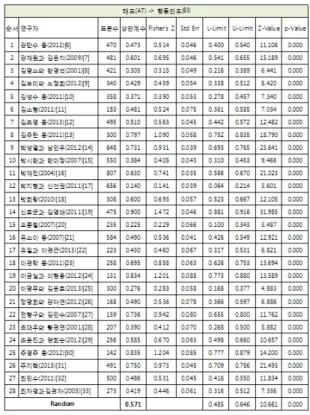
메타분석 방법론을 바탕으로 Biostat에서 개발한 CMA(comprehensive meta analysis) 프로그램을 활용 하여 계획된 행동이론의 경로인 행위에 대한 태도와 행 동의도, 주관적 규범과 행동의도, 인지된 행위통제와 행동의도, 그리고 행동의도와 행동 간의 분석을 한 결 과는 표 2와 같다.
표 2. TPB 경로 간의 효과크기에 대한 요약
Table. 2 Summary of the effect size of path coefficients in TPB
3.4. 동질성 검정
동질성 검정은 연구대상이 되는 개별 연구결과들의 효과 크기가 동일 모집단으로부터 추출되어 나온 값인 지 알아보기 위해 수행하게 된다. 동질성 검정을 위한 통계적 귀무가설은 개별 연구결과들의 효과 크기 추정 치 사이에 나타나는 차이가 없다는 것으로 귀무가설이 입증되면 효과크기 추정치를 통합해서 전반적인 효과 크기 추정치를 구하는 메타분석을 수행할 수 있다는 것 을 의미한다. 동질성 검정의 해석은 검정 통계량 Q 값 에 대한 카이제곱 분포에 근거하게 되는데 Q 값이 카이 제곱 분포와 동일하기 때문이다. 본 연구의 동질성 분 석 검정결과는 아래 표 3과 같다. AT BI, SN BI, PPC BI 그리고 BI B에 이르는 각각 경로의 Q 값 이 1019.01 218.58, 1180.08, 67.55로 나타나 df = 27, 10, 12, 6일 때 p = .05 수준에서 카이제곱의 한계 값은
40.11, 18.31, 21.03, 12.59이 되는데 구해진 Q 값이 한 계 값 보다 크므로 동질성에 대한 귀무가설이 기각하게 된다. 이처럼 동질적이지 못한 경우에는 랜덤효과모형 의 접근방식으로 교정된 역변량 가중치를 사용하여 평 균 효과 크기를 산출하게 된다.
표 3. 동질성 검정걸과
Table. 3 Results of homogeneity test
경로 Q df P
AT BI 1019.01 27 0.000
SN BI 218.58 10 0.000
PBC BI 180.08 12 0.000
BI B 67.55 6 0.000
3.5. 안전계수
특정 분야의 선행연구 결과들을 종합할 때, 그 분야에 서 이루어진 모든 연구를 망라하지 못하고 일부 연구 결 과들만 종합하는 표본의 대표성 문제를 출판 편의 또는 책상 서랍의 문제라고 한다. 선행연구 결과를 수집하는 과정에서 대개 학술지에 게재된 연구들을 대상으로 하 는데 이러한 연구는 긍정적인 결과를 보여줄 가능성은 있지만, 연구의 표본이 편향되는 문제가 발생한다[37].
이와 같은 표본의 대표성 문제를 해결하기 위해 안전계 수를 산출하여 유의하게 나타난 종합결과를 유의하지 않은 것으로 번복시키기 위해 요구되는 연구 총수를 의 미한다[38]. 안전계수를 산출한 결과는 표 4와 같다.
표 4. 안전계수 계산
Table. 4 Results of calculator for fail-safe number
경로 N d Nfs dc
AT BI 28 .571 3.976
SN BI 11 .381 -2.62 0.5
PBC BI 13 .458 -1.10
BI B 7 .421 -1.11
N:논문수, d:효과크기, Nfs:안전계수, dc:신뢰구간
. 분석결과
우리나라 정보기술 분야에서 이루어졌던 계획된 행
동이론을 적용한 연구들을 조사하여 그 결과들을 분류
재분석하는데 본 연구에 목적을 두고 있다. 따라서
2013년까지 국내 학술지에 게재된 정보기술을 연구의 고찰을 통해 흐름을 파악하고 각각의 결과에 대한 메타 분석을 통해 축적된 연구결과들을 체계화하고자 하였 다. 본 연구를 시작한 이후 국내 학술지에 게재된 정보 기술 연구논문 31편 메타분석을 한 결과는 아래 표 5와 같다.
표 5. 계획된 행동이론 경로 간의 효과크기
Table. 5 Effect size between path on TPB constructs
경로 n m k effect size(r)
AT BI 10,419 371 28 .571
SN BI 4,349 395 11 .381
PBC BI 4,333 333 13 .458
BI B 1,563 223 7 .421
n:표본크기, m:표본평균, k:연구 수, r:상관계수
행동에 대한 행동의도의 관계에 대한 메타분석 결과 행동의도가 행동의 유의미한 선행 요인이며 행동에 대 한 태도, 주관적 규범, 지각된 행위통제를 통해 행동의 도가 형성된다는 계획된 행동이론의 기본적인 가정을 입증할 수 있었다. 본 연구의 행위에 대한 태도와 행동 의도 간에 경로에서는 선행연구에서 살펴본 Armitage and Conner[3]와 손영곤과 이병관[4]의 두 연구보다 상 관계수(설명력)이 높게 나타났다. 이러한 결과는 아마 도 타 분야보다 정보기술 분야의 행위에 대한 태도가 행동의도에 크게 미치는 것으로 해석된다. 주관적 규범 과 행동의도 간의 경로에서는 Armitage and Conner[3]
의 연구보다 높게 그리고 손영곤과 이병관[4]의 연구 와는 비슷한 결과를 보였다. 다음으로 인지된 행위통 제와 행동의도 간의 경로에서는 선행연구 두 연구와 유사한 설명력을 가지는 것으로 유추할 때 정보기술의 수용이나 채택에서 개인의 인지된 행위통제가 타 분야 와 유사함으로 해석된다. 끝으로 행동의도와 행동 간 의 경로에서는 Armitage and Conner[3]의 연구와 손영 곤과 이병관[4]의 연구보다 설명력이 낮게 나타났다.
이러한 결과는 정보기술 수용에서 타 분야보다 정보기 술의 유용함은 인지하고 있지만, 사용이나 수용의도로 이어지는 행동에 다른 변인이 존재하는 것으로 판단된 다. 따라서 이러한 변인들이 무엇인지 알 수는 없지만 아마도 정보기술의 수용에서 위험요인이 존재하는 것 으로 해석된다.
감사의 글
본 연구는 2013년도 원광대학교 교내연구비 지 원에 의하여 이루어진 연구로서, 관계부처에 감사 드립니다.
REFERENCES
[ 1 ] M. Fishbein, and I. Ajzen, Belief, Attitude, Intention, and Behavior: An Introduction to Theory and Research.
Reading, MA: Addison-Wesley, 1975.
[ 2 ] N. J. Thompson, and K. E. Thompson, “Reasoned Action Theory: An Application to Alcohol-free Beer,” Journal of Marketing Practice, vol. 2, no. 2, pp. 35-48, 1996.
[ 3 ] C. J. Armitage, and M. Conner, “Efficacy of the Theory of Planned Behaviour: A Meta-analytic Review,” British Journal of Social Psychology, vol. 40, no. 1, pp. 471-499, 2001.
[ 4 ] Y. K. Sohn, and B. K. Lee, “An Efficacy of Social Cognitive Behavior Model based on the Theory of Planned Behavior: A Meta-Analytic Review,” Korean Journal of Journalism & Communication Studies, vol. 56, no. 6, pp.
127-161, 2012.
[ 5 ] G. V. Glass, “Primary, Secondary, and Meta-analysis of Research,” Educational Researcher, vol. 5, no. 10, pp. 3-8, 1976.
[ 6 ] M. S. Kang, Y. N. Kim and S. K. Park, “The Effect of Application on Smart Phone Repurchase Intention,” The Academy of Customer Satisfaction Management Journal, vol. 14, no. 2, pp. 19-40, 2012.
[ 7 ] J. W. Kang and E. J. Kim, “An Exploratory Study on Audio-Visual UCC(User Created Content) Uses of College Students: A TPB-TAM Integrated Model,” Asian communication research, vol. 53, no. 1, pp. 187-209, 2009.
[ 8 ] A. R. Gwon and H. K. Kim, “A Study on the Acceptance of Computerized Accounting Education Using Technology Acceptance Model and Theory of Planned Behavior,”
Journal of accounting and finance, vol. 12, no. 4, pp.
93-113, 2012.
[ 9 ] M. S. Kim and Y. S. Han, “Understanding Consumer Behavior on On - line Shopping,” Korean Journal of Social and Personality Psychology, vol. 15, no. 3, pp. 17-33, 2001.
[10] B. M. Kim and J. H. Noh, “A Study for the Effect about Learning Intention on the University Students’on the Extended Theory of Planned Behavior,” Daehan journal of business, vol. 25, no. 3, pp. 1399-1418, 2012.
[11] S. S. Kim and K. S. Han, B. S. Kim, S. K. Park and S. K.
Ahn, “An Empirical Study on Users' Intention to Use Mobile Applications,” The Journal of Korean Institute of Information Technology, vol. 9, no. 8, pp. 213-228, 2011.
[12] S. H. Kim, “The Study on the Acceptance of Computerized Accounting Education in college used the Theory of Planned Behavior(TPB),” Korea International Accounting Review, vol.38, no. 1, pp. 23-42, 2011.
[13] J. Y. Kim C. G. Lee and J. M. Kim, “Study of Examining the Relationship between Adoption of Smartphone- Based Tourism Information and Use Intention,” Journal of Tourism Sciences, vol. 27, no. 6, pp. 15-38, 2013.
[14] J. R. Kim K. H. Lee and Y. K. Choi, “A Study of Motivations and Intentions to Use Smart Phone Applications as Advertising Media,” Advertising Research, vol. 89, no. 1, pp. 229-254, 2011.
[15] S. Y. Park and M. W. Nam, “An Analysis of Structural Equation Model in Understating University Students Behavioral Intention to Use Mobile Learning based on Technology Acceptance Model,” The Journal of Educational Information and Media, vol. 18, no. 1, pp.
51-75, 2012.
[16] S. H. Park and M. J. Han, “A Survey on User Attitudes and Behavioral Intention for Identifying Preventive Campaign Measures for Illegal Online Downloading,” Journal of Public Relations Research, vol. 11, no. 2, pp. 195-230, 2007.
[17] J. J. Park, “Factors Influencing Consumer Intetion to Shop Online,” The Korean Journal Of Advertising, vol. 15, no. 3, pp. 289-315, 2004.
[18] J. H. Park and G. K. Shin, “The Effect of Smartphone Perceived Functional Attributes and Personal Innovativeness on the Users’ Intention to Adopt and Actual Usage,” Management education review, vol. 69, no. 1. pp.
191-214, 2011.
[19] H. R. Park, “Internet purchase behavior based on anticipated emotion induced theory of planned behavior,” The Korean Journal of Clinical Psychology, vol. 11, no. 4, pp. 661-686, 2010.
[20] H. K. Shin and Y. A. Kim, “A Study on the Factors Affecting Smart Learning-Focusing on the Moderating Effect of Learning Time,” Journal of the Korea industrial
information systems society, vol. 16, no. 5, pp. 93-104, 2011.
[21] J. C. Oh, “A Study on Impulsive Buying of Digital Contents in Internet,” DAEHAN Association of Business Administration Review, vol. 22, no. 1, pp. 261-289, 2009.
[22] S. Y. Yoo, S. J. Park and X. F. Dong, “A Study of Behavioral Intention to use High-tech Products,” Korea Industrial Economics Association, vol. 20, no. 2, pp.
839-859, 2007.
[23] I. Ryu and K. G. Lee, “The Effects of Group Norms and Identification on Continuous Intention of Using University Website,” Journal of Business Research, vol. 28, no. 2, pp.
101-128, 2013.
[24] G. C. Lee, N. H. Chung and J. S. Lee, “Empirical Study about Relationship between Factors Influencing Korean Usur's Internet to Use the Internet Banking Service,” Asia Pacific Journal of Information Systems, vol. 12, no. 3, pp.191-212, 2002.
[25] K. T. Lee, D. M. Koo and M. J. Noh “The Effect of Customer Perceived Value on Social Commerce Usage Intention,” Asia Marketing Journal, vol. 13, no. 3, pp.
135-162, 2011.
[26] K. S. Lee and H. R. Lee, “The Influence of Travelers`
Perception of Smart Phone Services on their Attitude and Intention to Use,” Journal of Tourism Sciences, vol. 35, no.
2, pp. 271-292, 2012.
[27] D. M. Lee, G. H. Lim and S. H. Jang, “A Comparative Analysis on the Usage of Internet Banking Users in Korea and China,” The Journal of Information Systems, vol. 19, no. 4, pp. 111-136, 2010.
[28] M. M. Lee and Y. H. Kim, “An Expectation-Confirmation Approach to the Users’ Continued Use of Smart Phone,”
Korean Journal of Journalism & Communication Studies, vol. 16, no. 1, pp. 67-79, 2013.
[29] M. H. Jang and D. Y. Kang, “A Study on the Intention to Use and the Actual Use of Maritime Logistics Mobile Application,” Journal of Korea Port Economic Association, vol. 28, no. 4, pp. 121-147, 2012.
[30] H. G. Jeon and M. S. Kim, “A Study on the Factors Affecting Internet Banking Usage of Users,” e-Business Review, vol. 8, no. 1, pp. 9-32, 2007.
[31] D. W. Cho and K. Y. Hwang, “Determinants of Internet Banking Usage Behavior : Applying Theory of Planned Behavior,” Korean Management Review, vol. 30, no. 4, pp.
1225-1249, 2001.
[32] Y. J. Cho and H. S. Yang, “The Effect of Characteristics in
Fashion Social Commerce Sites and SNS subjective Norm on Consumer Attitudes towards Social Commerce and Purchase Intention of Fashion Products,” Journal of the Korean Society of Clothing and Textile, vol. 36, no. 11, 2012.
[33] Y. J. Joo, N. H. Kim and E. G. Lim, “Analysis of factors affecting adoption of mobile learning in cyber university,”
Journal of Educational Technology, vol. 28, no. 1, pp.
79-102, 2012.
[34] J. H. Joo, “Comparison on Predictive Model of Intention to Use Smartphones through iPhone User,” Journal of Digital
Policy, vol. 11, no. 1, pp. 89-97, 2012.
[35] M. S. Choi, “An Empirical Study on the Factors of Smart Phone Acceptance,” Journal of Korea Society of Design Forum, vol. 33, no. 1, pp. 189-200, 2011.
[36] J. Y. Choi and K. J. Kim, “A Study of Consumer e-shopping Adoption Behavior,” Journal of Consumer Studies, vol. 14, no. 4, pp. 89-103, 2003.
[37] S. S. Oh, Meta-analysis: theory and Practice, Konkuk University Publication, 2009.
[38] R. G. Orwin, “A fail-safe N for effect size,” Journal of Educational Statistics, vol. 8, no. 2, pp. 157-159, 1983.
남수태(Soo-Tai Nam)
원광대학교 정보관리학과(박사과정)
※관심분야 : 경영정보시스템, 전자상거래, 유비쿼터스기술
김도관(Do-Goan Kim)
원광대학교 정보전자상거래학부 교수
※관심분야 : 경영정보시스템, e-비지니스, 기술창업
이현창(Hyun-Chang Lee)
원광대학교 정보전자상거래학부 교수
※관심분야 : 시맨틱 기술, 비즈니스 인텔리전스, 유비쿼터스 컴퓨팅, 바이오인포메틱스
신성윤(Seong-Yoon Shin)
군산대학교 컴퓨터정보공학과 교수
※관심분야 : 영상처리, 컴퓨터비전, 가상현실, 멀티미디어
진찬용(Chan-Yong Jin)
원광대학교 정보전자상거래학부 교수
※관심분야 : 경영정보시스템, e-비지니스, 정보통신