• 검색 결과가 없습니다.

The effect of information seeking style and news literacy of card news users on recommendation intention: Focused on Technology Acceptance Model (TAM)

N/A
N/A
Protected

Academic year: 2021

Share "The effect of information seeking style and news literacy of card news users on recommendation intention: Focused on Technology Acceptance Model (TAM)"

Copied!
8
0
0

로드 중.... (전체 텍스트 보기)

전체 글

(1)

1. Introduction

Recently, consuming news through smartphones has been increasing. In this sense, card news is attracting

concerns of the audiences because it is “a format that delivers the news intuitively or by storytelling, and is consisted of five to ten page-long content of news and media, such as photos, tables, infographics, images and

The effect of information seeking style and news literacy of card news users on recommendation intention: Focused on Technology

Acceptance Model (TAM)

Myung-Il Choi

Professor, Department of Advertising & Public Relations, Namseoul University

카드뉴스 이용자의 정보추구성향과 뉴스 리터러시가 추천의도에 미치는 영향: 기술수용모델(TAM) 모델을

중심으로

최명일

남서울대학교 광고홍보학과 교수

Abstract In this study, the Technology Acceptance Model (TAM) was applied to explore the process of using card news. Card news users are found to be active in searching and selecting appropriate news for themselves, information seeking style and news literacy were established as antecedent variables that can influence card news usage. A survey of 400 university students with experience of using card news was conducted. For statistical analysis, SEM was conducted. The analysis showed that information seeking style significantly affects perceived ease of use (PEU) and that news literacy influences neither PEU nor PU. PEU was found to have a significant effect on PU, and both PEU and PU had a significant effect on recommendation intention.

Key Words : Card News, Information Seeking Style, News Literacy, Technical Acceptance Model (TAM), Recommendation Intention

요 약 이 연구에서는 기술수용모델(Technology Acceptance Model: TAM)을 적용하여 카드뉴스 이용자의 정보추구성향 과 뉴스 리터러시가 지각된 용이성과 지각된 유용성에 미치는 영향, 지각된 용이성과 지각된 유용성이 추천의도에 미치는 영향을 살펴보았다. 카드 뉴스 이용 경험이 있는 대학생 400명을 대상으로 설문조사를 하였으며, 통계분석은 구조방정식모 델(SEM)을 이용하였다. 분석 결과, 정보추구성향은 지각된 용이성에 유의미한 영향을 미치는 것으로 나타났고, 뉴스 리터 러시는 지각된 용이성과 지각된 유용성 모두에 영향을 미치지 않는 것으로 나타났다. 지각된 용이성은 지각된 유용성에 유의미한 영향을 미치는 것으로 나타났으며 지각된 용이성과 지각된 유용성 모두는 추천의도에 유의미한 영향을 미치는 것으로 나타났다.

주제어 : 카드뉴스, 정보추구성향, 뉴스 리터러시, 기술수용모델(TAM), 추천의도

*Corresponding Author : Myung-Il Choi ([email protected]) Received October 22, 2018

Accepted January 20, 2019

Revised November 22, 2018 Published January 28, 2019

(2)

videos”[1].

Therefore, we believe that card news is a recent news platform that is clearly distinguishable from traditional news delivery models. Previous studies about card news has only been showed the analysis of the characteristic and news value of card news[2].

They have hardly investigated why or how people use card news. In this vein, this study is using Technology Acceptance Model(TAM) as a main theoretical framework. The TAM is useful in explaining the adoption process of new information system or service, based on two beliefs variables: perceived usefulness(PU), and perceived ease of use(PEU)[3].

Perceived usefulness refers to the extent to which users believe that using a new information system or service will improve their work performance, and perceived ease of use refers to the extent to which users believe that using a new information system or service will not require much effort[4]. TAM, however, has been criticized for failing to take into account the diverse context, and only focusing on the PEU and PU[5]. This study attempts to increase the explanatory power of the TAM by considering the nature of the research topic, and adding antecedent variables that may affect PEU and PU. This study aims to set information seeking style and news literacy as antecedent variables among the various variables that may affect card news consumption.

In today's media environment, where smartphones are central, content usage is not limited to the use of individual users alone, but is extende to recommending it to others. This is because the media usage environment based on social media such as Facebook has been focused on spreading the media to people around the users following the recommendation algorithm. This is no exception to card news.

Therefore, in this study, the final dependent variable was set as recommendation rather than the intention to use in the technology acceptance model in explaining the process of using card news. By regarding those theoretical frameworks, this study is to analyze how

news audiences are utilizing card news.

2. Literature review and hypotheses development

Information seeking style refers to the psychological characteristic of an individual when faced with certain situations, and the habitual behavioral patterns shown in the individual from the result of it[6]. In other words, humans constantly find and use information to basically reduce uncertainty about their surroundings and to solve problems. This can also be explained in terms of use and gratification. Since media users are purpose-oriented and are aware of their needs, they actively select and use media to satisfy their desire[7,8]. Thus, it can be expected that information seeking style will affect PU and PEU in card news consumption.

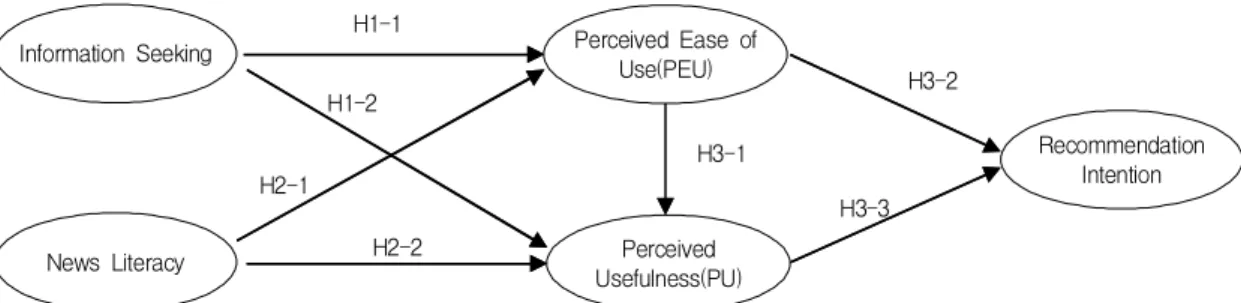
<H1-1> Information seeking style of card news users will have significant impacts on PEU.

<H1-2> Information seeking style of card news users will have significant impacts on PU.

On the other side, news literacy refers to the

knowledge, skills, ability to use and interpret the

news[9] or the ability to access, evaluate, and select

meaningful news in various situations[10]. By applying

this concept of news literacy to the context of card

news usage, the higher the news literacy, the more one

can recognize that the context of card news is

necessary and useful to oneself(perceived usefulness),

and convenient in obtaining various

information(perceived ease of use). This is because

card news delivers the contents, easily and

interestingly, on a wide range of social issues that can

be or is controversial. Therefore, this study offers the

following hypotheses regarding the relationships

among news literacy, PEU, and PU:

(3)

<H2-1> News literacy of card news users will have significant impacts on PEU.

<H2-2> News literacy of card news users will have significant impacts on PU.

Finally, the study investigates the effect of PEU and PU in card news usage on recommendation intention.

The TAM is theoretically conceptualized that PEU and PU are primary elements of theoretical backgrounds because they are antecedent variables for news information system or service selection intention[4].

The results of meta-analysis about the TAM have provided the evidences supporting arguments of this study.[11,12] Based on them, this study suggests a series of research hypotheses below:

<H3-1> The PEU in card news consumption will have significant impacts on PU.

<H3-2> The PEU in card news consumption will have significant impacts on recommendation intention.

<H3-3> The PU in card news consumption will have significant impacts on recommendation intention.

2. Research Methodology

2.1 Sample

The consuming rate of mobile internet news has been highly showed among the people in their 20s and 30s. Considering the fact that card news is produced

most suitably for their use in smart phones, it would be appropriate to survey those who have a lot of experience with such media. In that sense, a survey of 400 university students with experience of using card news was conducted during approximately two weeks, from May 22, 2017 to June 9, 2017.

A total of 370 responses were used in the final analysis, excluding unreliable data. Responses were obtained from 146 males (39.5%) and 224 females (60.5%) The average age of research participants was 20.3 (SD = 1.8).

Using the five-point Likert scale, the average score for card news consumption was 3.04 (SD = 1.23).

Smartphone was the main device for card news consumption (90.8%), followed by desktops and tablets (8.4%).

2.2 Measurement of Variable 2.2.1 Information seeking style

The study defines ‘information seeking style’ as 'a style to actively explore the information one wants to know'. The list of questions follows: ‘I tend to want to know about various social events and issues’, ‘I tend to try to get various information regarding everyday life’,

‘I tend to try to find the data or information I am interested in’, ‘I try to find useful information regarding everyday life’, ‘I tend to try to understand social events and issues’, ‘When finding information, I try to get information through various media’(①strongly disagree, ⑤ strongly agree).

Information Seeking

News Literacy

Recommendation Intention Perceived Ease of

Use(PEU)

Perceived Usefulness(PU) H1-1

H3-1

H3-2

H3-3 H1-2

H2-1

H2-2

Fig. 1. Proposed Research Model

(4)

2.2.2 News Literacy

The study defines ‘news literacy’ as ‘the extent to which news can be understood and interpreted’. The list of questions follows: ‘When I use the news, I am able to understand the content of the news’, ‘When I usually use the news, I am able to catch/understand what is important’, ‘When I usually use the news, I can clearly see what information I want to get’, ‘When I usually use the news, I am able and interpret various perspectives regarding a particular issue’.(①strongly disagree, ⑤ strongly agree).

2.2.3 Perceived Usefulness(PU)

The study defines ‘perceived usefulness(PU)’ as ‘the degree to which card news are useful in obtaining news information’. The list of questions follows: ‘card news itself is useful in grasping the latest information’,

‘card news itself is useful in obtaining the latest information’, ‘using card news is a useful way of obtaining the latest information’, ‘Card news itself is useful in grasping various information’, ‘card news itself is useful in obtaining various information’, ‘using card news is useful in obtaining various information’,

‘card news is a more useful way of using news compared to other methods.’(①strongly disagree, ⑤ strongly agree).

2.2.4 Perceived Ease of Use(PEU)

The study defines ‘perceived ease of use(PEU)’ as

‘the degree of easiness in getting news information’.

The list of questions follows: ‘it is easy and simple to use card news’, ‘it is easy to understand how to use card news’, ‘one can easily get information by using card news’, ‘using card news allows one to easily understand social issues without prior knowledge’.(① strongly disagree, ⑤ strongly agree).

2.2.5 Recommendation Intention

The study defines ‘recommendation intention’ as ‘the degree to which card news should be recommended to others’. The list of questions follows: ‘I will talk

positively about using card news’, ‘I am willing to tell others about using card news’, ‘I intend to recommend others to use card news’.(①strongly disagree, ⑤ strongly agree).

3. Data Analysis

3.1 Analysis of measurement model

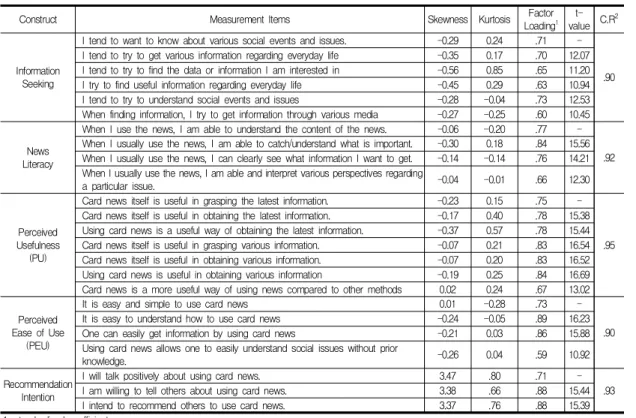
A confirmatory factor analysis(CFA) was conducted to examine the suitability of the measurement model used in this study(information seeking style, news literacy, perceived usefulness, perceived ease of use, and recommendation intention). The LISREL 8.53 program was used, and the Maximum-likelihood estimates(ML) was used for parameter estimation.

There was no problem found regarding the basic assumptions of multivariate analysis, such as multicolinearity and normality. Normality should be evaluated jointly by investigating Kurtosis and Skewness. Rule of thumb is Kurtosis must be between -4 to +4 and Skewness must be between -2 to +2[13].

The results of CFA showed that the model fit index of the measurement model are generally satisfiable (χ

2
(242) = 640.37, p < .01, CFI = .97; NNFI = .96, SRM

= 0.54, RMSEA = .067) because the CFI and NNFI values are higher than 0.90, and RMSEA and SRMR values are lower than .10[14].

In the meantime, convergent validity and discriminant validity were analyzed to check the validity of the construct. Convergent validity refers to the case where parameter estimates for sub-metrics for each construct is significant[15]. As shown in <Table 1>, the values of factor loadings has indicated from .59 to .88 (p <

.01). Those results showed that convergent validity is

secured for each construct. To determine the

discriminant validity, the average variance extracted

(AVE) values of each construct should be greater than

the squared correlation[16]. As shown in <Table 2>,

all AVE values were greater than the squared

correlation between the two constructs, therefore it can

(5)

be determined that the discriminant validity was reasonable.

3.2 Analysis of research model

The structural equation modeling(SEM) was used for the analysis to examine the suitability of the proposed research model. Considering the judgment criteria for model fit index in the previous confirmatory factor analysis, the model fit index proposed in this study was found to be satisfactory(χ

2

(244) = 641.55

p<).01, CFI = .97, NNFI = .96, SRMR = .054, RMSEA

= .066).

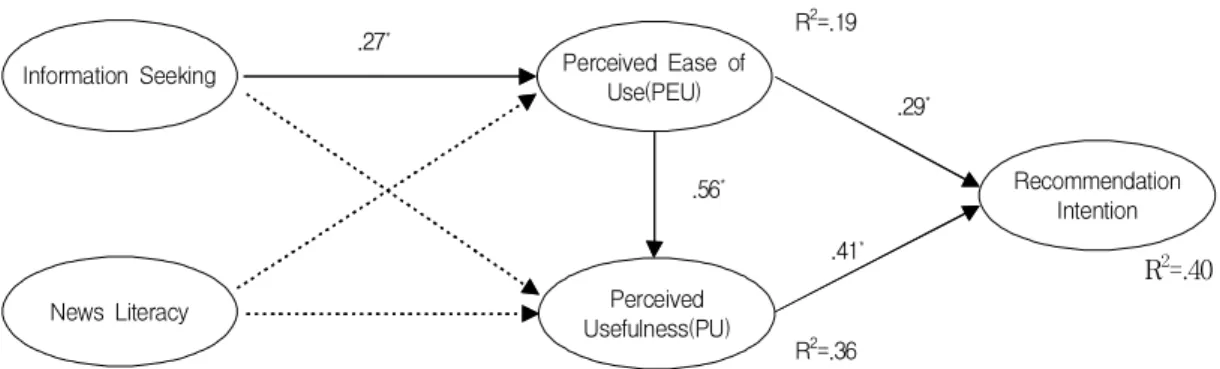
Meanwhile, when looking at the squared multiple correlations(SMC), the research model shows that there is 19% variability in perceived ease of use, 36%

variance in perceived usefulness and 40% variance in recommendation intention. The result is shown in <Fig 2>.

3.3 Result of Hypothesis test

<H1-1>, <H1-2> predicted that information seeking

Construct Measurement Items Skewness Kurtosis Factor

Loading

1

t- value C.R

2

Information Seeking

I tend to want to know about various social events and issues. -0.29 0.24 .71 -

.90 I tend to try to get various information regarding everyday life -0.35 0.17 .70 12.07 I tend to try to find the data or information I am interested in -0.56 0.85 .65 11.20

I try to find useful information regarding everyday life -0.45 0.29 .63 10.94

I tend to try to understand social events and issues -0.28 -0.04 .73 12.53

When finding information, I try to get information through various media -0.27 -0.25 .60 10.45

News Literacy

When I use the news, I am able to understand the content of the news. -0.06 -0.20 .77 -

.92 When I usually use the news, I am able to catch/understand what is important. -0.30 0.18 .84 15.56 When I usually use the news, I can clearly see what information I want to get. -0.14 -0.14 .76 14.21 When I usually use the news, I am able and interpret various perspectives regarding

a particular issue. -0.04 -0.01 .66 12.30

Perceived Usefulness (PU)

Card news itself is useful in grasping the latest information. -0.23 0.15 .75 -

.95 Card news itself is useful in obtaining the latest information. -0.17 0.40 .78 15.38 Using card news is a useful way of obtaining the latest information. -0.37 0.57 .78 15.44 Card news itself is useful in grasping various information. -0.07 0.21 .83 16.54 Card news itself is useful in obtaining various information. -0.07 0.20 .83 16.52 Using card news is useful in obtaining various information -0.19 0.25 .84 16.69 Card news is a more useful way of using news compared to other methods 0.02 0.24 .67 13.02

Perceived Ease of Use

(PEU)

It is easy and simple to use card news 0.01 -0.28 .73 -

.90

It is easy to understand how to use card news -0.24 -0.05 .89 16.23

One can easily get information by using card news -0.21 0.03 .86 15.88

Using card news allows one to easily understand social issues without prior

knowledge. -0.26 0.04 .59 10.92

Recommendation Intention

I will talk positively about using card news. 3.47 .80 .71 -

.93

I am willing to tell others about using card news. 3.38 .66 .88 15.44

I intend to recommend others to use card news. 3.37 .76 .88 15.39

1. standardized coefficient 2. Composite Reliability

Model fit index: χ

2

(242)=640.37, p<.01, CFI=.97, NNFI=.96, SRMR=.054, RMSEA=.067 Table 1. Results of Measurement Model

Factors AVE The squared correlation of constructs

(1) (2) (3) (4) (5)

Information Seeking style(1) .59 1

News Literacy(2) .74 0.34 1

Perceived Usefulness(PU)(3) .75 0.11 0.05 1

Perceived Ease of Use(PEU)(4) .70 0.18 0.11 0.36 1

Recommendation Intention(5) .81 0.09 0.04 0.35 0.29 1

Table 2. Result of Discriminant Validity

(6)

will have significant impacts PEU and PU. According to the analysis, PEU was influenced by information seeking (γ = .27, t = 4.67, p < .01), while PU was insignificantly related with information seeking.

Therefore, <H1-1> was support, while <H1-2> was rejected.

<H2-1> and <H2-2> predicted that the news literacy of card news users will have significant impacts on PEU and PU. The results of this study, however, offered that news literacy did not have any significant impacts on PEU nor PU. Therefore, both

<H2-1> and <H2-2> were rejected.

<H3-1> predicted that PEU will have significant impacts on PU. The results of this study showed that it was statistically significant (β = .56, t = 8.70, p <

.01). Therefore, <H3-1> was supported. As for

<H3-2>, it predicted that PEU will have significant impacts on recommendation intention. The results of this study offered that PEU had statistically significant effects on recommendation intention (β = .29, t = 4.45, p < .01). <Hypothesis 3-3> predicted that PU in using card news will have significant impacts on recommendation intention. It was also found to be statistically significant (β = .41, t = 6.04, p < .01). Thus, both <H3-2> and <H3-3> were accepted.

4. Conclusion and Discussion

4.1 Summary

There is no question that smartphones have changed our everyday life, and this is not an exception to news consumption. Consuming news in one’s spare time, especially during travel time, has become a routine for many people. Therefore, this study has paid attentions to the fact that card news is the easiest and most convenient way of consuming news in such situations.

Since card news is a news platform that can clearly be distinguished from traditional news consumption devices in terms of formality and content, the TAM was applied to analyze how people are consuming card news.

The results of this study suggested that the information seeking style of card news users have significant effects on PEU, but there were no significant impacts on PU. Those results were highly related to the property of card news. That is, card news provides news about a wide range of story and social issues in an easy and interesting manner. In addition, card news are generally produced by minimizing text and focusing on images. Those elements can enhance the user’s understanding of the news. Therefore, card news were mainly perceived as a device for delivering various stories easily and quickly.

Information Seeking

News Literacy

Recommendation Intention Perceived Ease of

Use(PEU)

Perceived Usefulness(PU)

.27

*

R

2

=.19

R

2

=.36

R

2

=.40 .56

*

.29

*

.41

*

Fig. 2. Result of Research Model

1. χ

2

(244) = 641.55 p<.01, CFI = .97, NNFI = .96, SRMR = .054, RMSEA = .066 2. *p <.01.

3. The coefficients for all paths are standardized

4. Non-significant paths are indicated by dotted lines.

(7)

Thus, news literacy in this study was found to have insignificant effect for both PU and PEU. Those results might be related to the recent trend of news consumption. Recently, news audiences have been likely to read easy and simple structure of news rather than long and complicated news structure like a in-depth news style. For such reasons, people have a propensity to only consume news headlines and up-to-date information. In such news-consumption environments, card news is appropriate in that it focuses on easiness and interest. Nevertheless, the consumption of card news has little to do with news literacy, which is one’s ability to understand and interpret news content. With growing number of news channels, the obtaining the necessary information quickly and accurately has become an important ability.

Ironically, PU and PEU for card news consumption showed to have no significant relationships to news literacy, despite card news being optimally made for the mobile environment. Therefore, it might be the dilemma about how hard news contents and structures could be delivered to the news audiences with easy and interesting card news.

Finally, PEU for card news consumption was found to have significant effects on recommendation intention.

Also, PU had a mediation effect between PEU and recommendation intention. These findings were supportive for the fundamental theoretical frameworks of TAM and consistent with the results of the previous meta-analysis. Thus, those results might suggest a potential role of recommendation intention in social media studies. As social media such as Facebook and Instagram become more common in everyday life, it is important to explain the spreading of certain contents to the surrounding people, and it is theoretically meaningful in that applying technology acceptance model allows one to do so.

4.2 Limitations and Suggestions for Future Research

By applying the TAM, this study could provide

theoretical and practical implications about card news consumption. This study, however, have had few limitations. Firstly, this study only focused on utilizing PEU and PU as antecedent variables of this study.

Some previous studies made efforts to improve the model’s explanatory power by adding mediator variables such as perceived pleasure and credibility. By finding new and appropriate variables, future studies could expand the theoretical boundaries of the TAM.

Secondly, this study did not manage and measure potentially-related variables for card news consumption, such as number of card news consumption and preferred news genre. The basic reason did not manage them is the news audiences did not recognize the exact number of card news consumption. Therefore, it is necessary for future studies to design a sophisticated survey that accurately measure card news consumption.

REFERENCES

[1] Y. S. Cho & J. M. Kim. (2017). A Study on Likability, Understanding Level, Reliability, Satisfaction, Continuous Usage Intention According to a Difference in a News Providing Type. Journal of Digital Convergence, 15(7), 383-391.

[2] S. C. Hong & J. K. Pae. (2017). An analysis of card news and deconstructing news values in curated news contents in the digital Era. Journal of internet computing and services, 18(2), 105-111.

[3] N. K. Park. (2010). Adoption and use of computer-based Voice Over Internet Protocol Service. Journal of Communication, 60(1), 40-72.

[4] F. D. Davis. (1989). Perceived usefulness, perceived ease of use, and user acceptance of information technology.

MIS Quarterly, 13(3), 319-339.

[5] V. Venkatesh., F. D. Davis & M. G. Morris. (2007). Dead or alive?: The development, trajectory and future of technology adoption research. Journal of the Association for Information Systems, 8(4), 267-286.

[6] S. M. Miller. (1987). Monitoring and blunting: Validation

of a questionnaire to assess styles of information

seeking under threat. Journal of Personality and Social

Psychology, 52(2), 345-353.

(8)

[7] E. Katz., J. G. Blumler & M. Gurevitch. (1974).

Utilization of Mass Communication by Individual, in E.

Katz & J. G. Blumer.(Ed.). The uses of mass communication: Current perspectives on gratification research(pp. 19-32), Beverly Hills, CA: Sage.

[8] J. D. Rayburn & P. Palmgreen. (1984). Merging uses and gratifications and expectancy-value theory. Communication Research, 11(4), 537-562.

[9] D. Buckingham. (2002). Media education: Literacy, learning and contemporary culture. Cambridge: Polity Press.

[10] R. Hobbs & R. Frost. (2003). Measuring the acquisition of media literacy skills. Reading Research Quarterly, 38(3), 330-355.

[11] W. R. King & J. He.(2005). Understanding the role and methods of meta-analysis in IS research. Communications of the Association for Information Systems, 16(1), 665-686.

[12] J. Wu & A. Lederer. (2009). A meta-analysis of the role of environment-based voluntariness in information technology acceptance. MIS Quarterly, 33(2), 419-432.

[13] S. Hong., M. L. Malik & M. K. Lee.(2003). Testing configural, metric, scalar, and latent mean invariance across genders in sociotropy and autonomy using a non-western Sample. Educational and Psychology Measurement, 63(4), 636-654.

[14] J. Hair., W. Black., B. Babin., R. Anderson & R. Tatham.

(2006). Multivariate Data Analysis(6th ed.). Upper Saddle River, NJ: Pearson Prentice Hall.

[15] R. P. Bagozzi & Y. Yi. (1988). On the evaluation of structural equation models. Journal of the Academy of Marketing Science, 16(1), 74-94.

[16] C. Fornell & D. F. Larcker. (1981). Evaluating structural equation models with unobservable variables and measurement error. Journal of Marketing Research, 18(1), 39-50.

최 명 일(Choi, Myung Il) [정회원]

․2003년 2월 : 한양대학교 신문방송 학과(문학석사)

․2007년 2월 : 한양대학교 신문방송 학과(문학박사)

․2008년 9월 ~ 현재 : 남서울대학 교 광고홍보학과 교수

․관심분야 : 헬스커뮤니케이션, 공공캠페인, 메시지 전 략, 미디어효과

․E-Mail : [email protected]

수치

Fig.  1.  Proposed  Research  Model
Table  2.  Result  of  Discriminant  Validity
Fig.  2.  Result  of  Research  Model

참조

관련 문서