http://www.culinary.re.kr
INTRODUCTION
The recent downward trend of the economy is placing ever more importance on human resource management and “tur- nover intention.” Employees are a crucial factor, especially in the service industry, for the success of a business because their attitudes and behaviors play a very important role in the quality of their work (Chen, Wang, & Chu, 2010). Because of the im- portance of employee behavior, many researchers have studied employees’ job satisfaction and behavioral intention within their work place. Job satisfaction, as one of the most important factors in human resource management, was widely studied in the fields of industrial and organizational behaviors (Spector, 1997). It is widely known in the hospitality industry that employees satisfied with their jobs are willing to stay longer in their current job. Many studies (Mok & Finley, 1986; Hellman, 1997; Schmidt, 2007; Chen, et al., 2010; Lee & way, 2010; Mudor & Tooksonn, 2011) have indicated the importance of employee job satisfaction which, in turn, reduces employees’ turnover intention. The importance of training and job-training satisfaction has also been studied by many researchers (Giangreco, Sebastiano, & Peccei, 2009; Bartlett, 2001; Schmidt, 2010; Santos & Stuart, 2003; Cross & Wyman, 2006). The results of these studies showed that training had a positive relationship with job performance, job satisfaction, and organizational commitment. As stand-alone concepts, job-train- ing satisfaction, job satisfaction, and employees’ turnover in-
tention have been researched extensively. However, there are few studies that analyzed these concepts together and discussed the relationship among three main constructs. Therefore, this study investigated the interrelationship among job-training sa- tisfaction, job satisfaction, and turnover intention in foodservice operations. The specific objectives of this study were (1) to test the impact of job-training satisfaction on job satisfaction and turnover intention, (2) to identify the impact of job satisfaction on turnover intention, and (3) to examine how the frequency of job training provided by the company affects job-training sa- tisfaction.
LITERATURE REVIEW Job-Training Satisfaction
Training refers to a set of planned activities to teach employees job-related knowledge, skills, and behaviors provided by a com- pany (Noe, Hollenbeck, Gerhart, & Wright, 2006) in order to im- prove productivity. Furthermore, continuing education throu- ghout employees’ careers has become very important in keeping their skill sets current to face the challenges of an ever changing global economy. Schmidt (2007) created the term “job-training satisfaction” as a synthesized form of job satisfaction and job training, and defined it as how people perceive the aspects of the job training they receive. In his study, job-training satisfaction examined employees’ feelings about the job training provided by
Conceptual Framework for the Relationships among
Job-Training Satisfaction, Job Satisfaction, and Turnover Intention in Foodservice Operations
Eun-Kyong (Cindy) Choi
1,¶, Jinlin Zhao
2, Hyunwoo (David) Joung
3and Eunju Suh
21Kemmons Wilson School of Hospitality and Resort Management, The University of Memphis, USA
2Chaplin School of Hospitality & Tourism Management, Florida International University, USA
3Dept. of Nutrition and Hospitality Management, The University of Mississippi, USA
ABSTRACT: The current study investigated the interrelationship among job-training satisfaction, job satisfaction, and turnover in-
tention in foodservice operations. The findings suggested that the more satisfied employees were with their job training the more likely they were to be satisfied on their job. Furthermore, improving employees’ job satisfaction led to lower turnover intention.
However, job-training satisfaction by itself did not prove to have a negative relationship with turnover intention. Implications of the findings and future research are discussed.
Keywords: Job-Training Satisfaction, Job Satisfaction, Turnover Intention, Foodservice
§ Corresponding Author: Eun-Kyong (Cindy) Choi, Ph.D., Assistant Professor, Kemmons Wilson School of Hospitality and Resort Management, The University of Memphis, USA, Tel. +1 (901)678-4584, Fax. +1(901)678-0034, E-mail: [email protected]
Received: 14 August, 2014, Revised: 13 October, 2014, Accepted: 20 October, 2014.
the company as a whole rather than as a single course or training program evaluation. Several researchers have found a positive impact of job-training satisfaction on job satisfaction or organiza- tional commitment. Bartlett (2011) investigated the positive re- lationship between training and organizational commitment, and Lowry, Simon, and Kimberley (2002) found that satisfied employees (with their job training) showed significantly higher job satisfaction than those who were not satisfied with their job training. Those findings indicated that attitudes about the tra- ining employees receive play an important part in their percep- tion about the job and the organization (Schmidt, 2007). Despite the importance of job-training satisfaction, most job satisfaction studies did not adopt the concept of job-training satisfaction as an element of job satisfaction. Therefore, the current study uses job-training satisfaction as one of the indicators for job satisfac- tion.
Job Satisfaction
Job satisfaction has been defined in many ways: (1) as the pleasurable or positive emotional state employees get from their job or job experience (Locke, 1969); (2) how employees feel about their jobs in general (Smith, Kendall, & Hulin, 1975); and (3) the gap between employees’ expectation and actual perception about their job (Luthan, 1998). Job satisfaction has been consi- dered as one of the most important factors for employee per- formance as well as reducing turnover rate in the organization because lack of job satisfaction leads to employee turnover (Jamal, 1997). Many studies (Mok & Finley, 1986; Hellman, 1997;
Schmidt, 2007; Chen, et al., 2010; Lee & Way, 2010; Mudor &
Tooksonn, 2011) have found that job satisfaction improved pro- ductivity and negatively influenced employees’ turnover inten- tion.
Turnover Intention
Employee turnover is a critical issue in an organization because this leads to increasing financial costs for hiring and training new employees and possibly has a negative impact on sales growth (Cascio, 2002). Furthermore, because the hospitality industry is highly labor-intensive but has a high turnover rate (Carbery, Ga- ravan, O’Brien, & McDonnell, 2003), the effort to retain qualified employees is crucial to the success of each company. As men- tioned above, previous job satisfaction literature has shown that job satisfaction has a direct effect on employee turnover inten- tion. The hospitality industry needs to retain qualified employees not only because high turnover rate increases financial costs, but also because tenured employees tend to provide better perfor- mance and service to their customers, which is linked to cus- tomer satisfaction (Bedeian, Ferris, & Kacmar, 1992). Turnover in- tention has been frequently used as a dependent variable pre- dicted by job satisfaction in many recent research studies, and thus this study used turnover intention as a following conse- quence of job-training satisfaction and job satisfaction.
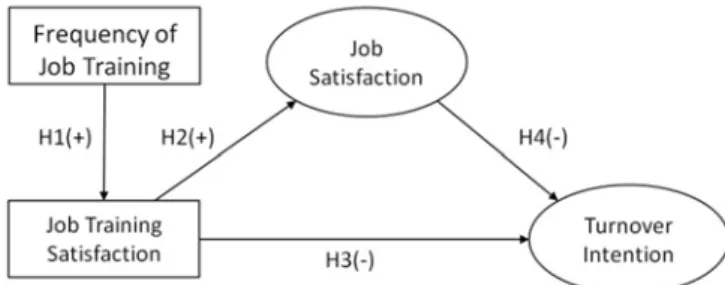
Fig. 1 presents the proposed conceptual framework. The pro- posed model examines the interrelationships among frequency of job training, job-training satisfaction, job satisfaction, and turnover intention. Based on empirical studies, this study pro- posed the following hypotheses:
Fig. 1. A proposed conceptual framework.
H1. Frequency of job training positively influences employees’
job-training satisfaction.
H2. Job-training satisfaction positively influences employees’
job satisfaction.
H3. Job-training satisfaction negatively influences employees’
turnover intention.
H4. Job satisfaction negatively influences employees’ turnover intention.
Methodology
A self-administered questionnaire was developed for this study based on previous job satisfaction research (Santos & Stuart, 2003) to measure employees’ perceptions about the job training provided by the business and their current job and employee turnover intention. The questionnaire was pretested by one part- time employee from one of the companies targeted for this survey and one full-time employee from another targeted com- pany. The questionnaire was then finalized based on comments gathered from the sources. Employees’ perception and intention items were measured using 7-point Likert-type scales ranging from 1 (strongly disagree/dissatisfied) to 7 (strongly agree/satis- fied), and employees’ demographic information was collected to describe respondents’ profile.
Fifteen quick-service restaurants and casual-dining restaurants in the southeastern United States were chosen and surveyed from lists provided by the National Restaurant Association (NRA).
Out of the 264 questionnaires distributed, 205 questionnaires were collected with a response rate of 78%;. There were 192 usable questionnaires analyzed for a response rate of 73%. Out of these 192 questionnaires, fifty-four (28%) were collected at quick- service restaurants and one-hundred-thirty-eight (72%) were collected at casual dining restaurants.
The data were analyzed following Anderson and Gerbing’s (1988) two-step approach: (1) a measurement model; and (2) a subsequent structural model using SPSS and AMOS. The mul- tiple-item scales of constructs were subjected to confirmatory factor analysis (CFA) to determine the hypothesized latent va- riables, and the CFA assessed the overall model fit of the mea- surement model. After the CFA, a structural equation model (SEM) was conducted to test the proposed interrelationships among variables.
RESULTS AND DISCUSSION
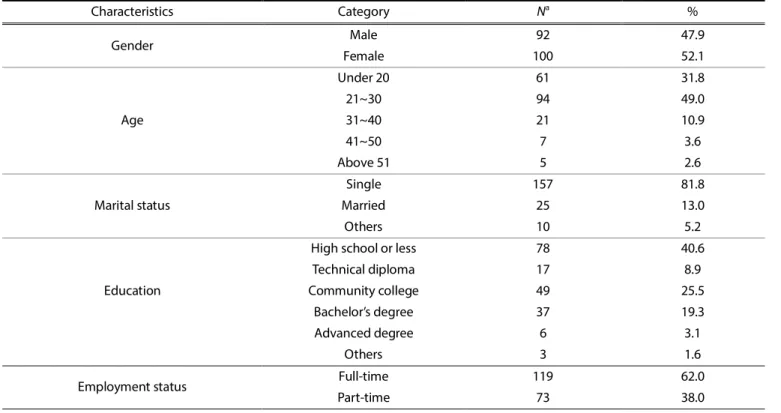
Table 1 presents the demographics. The result indicated that
47.9% of the respondents (n=92) were male and 52.1% (n=100)
were female. The average age was 25.5 years, with almost 80% of
the respondents stating they were under 30 years of age (n=155).
Table 1. Demographic profile of the sample (N=192)
Note:
aSample size was decreased due to missing data.
Table 2. Items and their descriptive analysis
Note:
aStandard deviation.
The majority of the respondents (81.8%) were single. Regarding education level, about 41% of the respondents had a high school education or less and 45% had some college or a bachelor’s de- gree. Out of the total 192 respondents, 62% were full-time em- ployees and 38% worked part-time. Table 2 presents the mean values and standard deviations of items relating to respondents’
perception and intention.
There are four constructs in the proposed conceptual frame- work: (1) frequency of job training, (2) job-training satisfaction, (3) job satisfaction, and (4) employees’ turnover intention. The fre- quency of job training was measured by calculating the number of trainings per year provided by the company. Job-training sa-
tisfaction level was not measured for specific training compo- nents, but rather for overall satisfaction about the training pro- vided. Therefore, it was measured with a single item. A CFA was conducted to assess the overall fit of the measurement model.
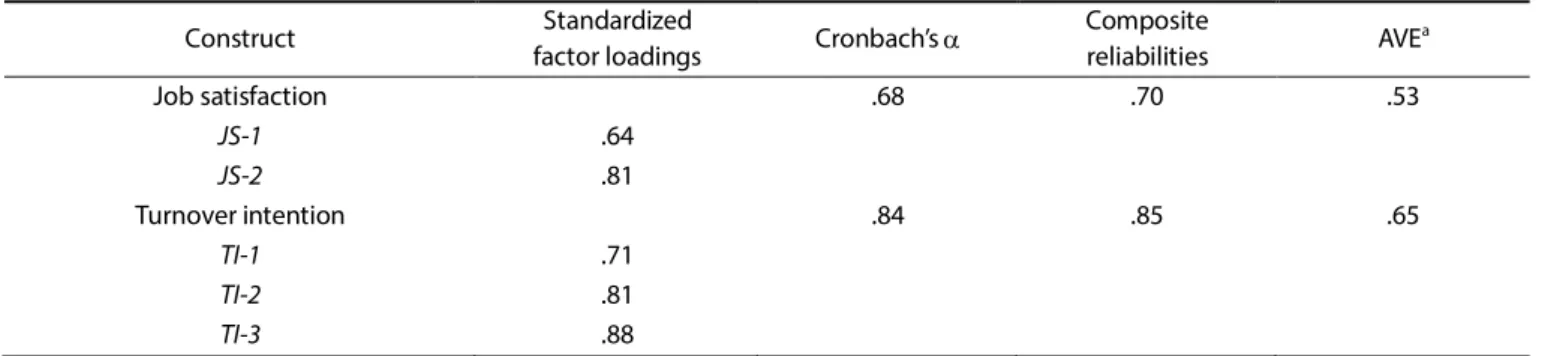
Specifically, two constructs, which were measured with multi- item scales, were introduced to CFA. Table 3 presents the details of the reliabilities and validities of the constructs and the pro- perties of the measurements. The internal reliabilities of the con- structs were acceptable with Cronbach’s alpha values ranging from .68 to .84 (Nunnally, 1978), and composite reliabilities also exceeded the acceptable cut-off level of .7 (Fornell & Larcker, 1981). Convergent validity was examined with factor loadings,
Characteristics Category N
a%
Gender Male 92 47.9
Female 100 52.1
Age
Under 20 61 31.8
21~30 94 49.0
31~40 21 10.9
41~50 7 3.6
Above 51 5 2.6
Marital status
Single 157 81.8
Married 25 13.0
Others 10 5.2
Education
High school or less 78 40.6
Technical diploma 17 8.9
Community college 49 25.5
Bachelor’s degree 37 19.3
Advanced degree 6 3.1
Others 3 1.6
Employment status Full-time 119 62.0
Part-time 73 38.0
Items Mean (SD
a)
Frequency of job training
How often do you regularly receiving training? (per year) 38.83 (78.03)
Job-training satisfaction
Overall, I feel satisfied with training that I have received with this company. 5.79 (1.38) Job satisfaction
(JS-1) Overall, I feel satisfied with my current job. 5.06 (1.75)
(JS-2) I have a sense of fulfillment with my job. 5.44 (1.53)
Turnover intention
(TI-1) I will look for a new job in the next six months. 3.96 (2.28)
(TI-2) People on this job often think of quitting. 4.35 (1.97)
(TI-3) I often think about quitting my job. 3.69 (2.05)
Table 3. Reliabilities and confirmatory factor analysis properties
Note:
aAverage variance extracted.
ranging from .64 to .88 (Anderson & Gerbing, 1988). Discriminant validity was tested by comparing the AVEs with the squared correlation between constructs (Fornell & Larcker, 1981). Because the AVEs were greater than the squared correlation, results ensured discriminant validity.
After validating the measurement model, a structural equation model was conducted to validate the proposed model. The chi- square value with 12 degrees of freedom was 20.27 with a p- value of .06, indicating that the model fit the data well. Several goodness-of-fit indices (chi-square/df=1.69, NFI=.96, TLI=.96, CFI=.98, RMSEA=.06) also indicated that the model fit the data and this is presented with the standardized path coefficients in Fig. 2.
Table 4 summarizes the results of the hypotheses test. Hy- pothesis 1, the relationship between frequency of job training and job-training satisfaction, was supported with the estimate of
Fig. 2. Results for the structural equation model.
Note: ** p<.01, *** p<.001. Solid line=statistically significant, Dashed arrow
=statistically not significant. Model fit indices: χ2 (12)=20.27, p=.062, χ2/df=1.69, Normed Fit Index (NFI)=.96, Tucker Lewis Index (TLI)=.96, Comparative Fit Index (CFI)=.98, Root Mean Square Error of Approxi- mation (RMSEA)=.06.