
콘크리트工學
大 韓 土 木 學 會 論 文 集第29卷 第4A 號·2009年 7月 pp. 373 ~ 384
인공경량골재 콘크리트의 수분이동 특성에 관한 연구
A Study on Moisture Transport of Artificial Lightweight Concrete 이창수*·최상현**·박종혁***·김영욱****
Lee, Chang Soo · Choi, Sang Hyun · Park, Jong Hyok · Kim, Young Ook
···
Abstract
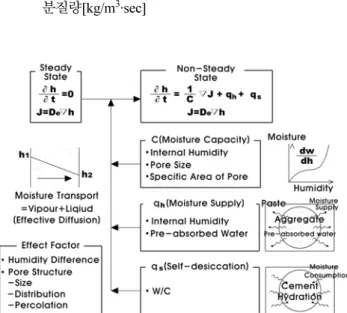
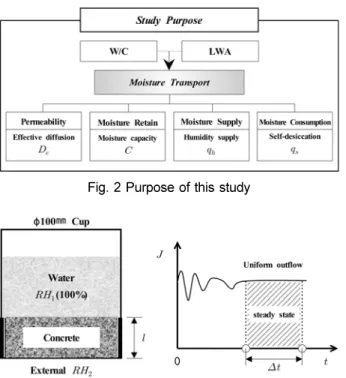
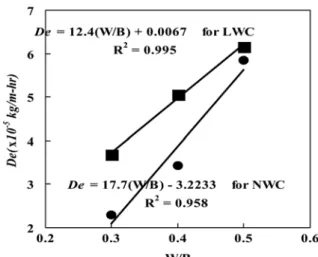
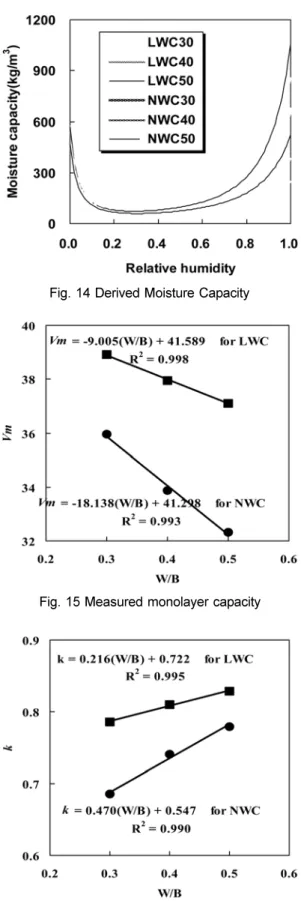
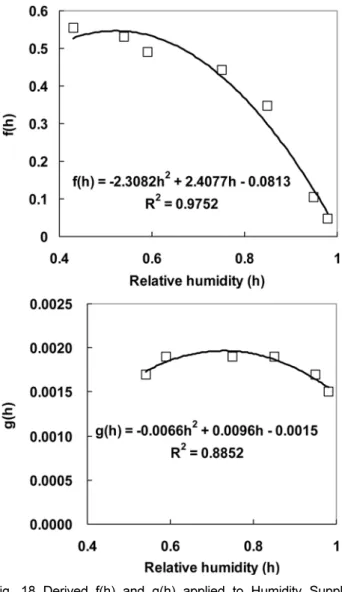
For the first step on the quantitative evaluation of shrinkage reduction and differential shrinkage analysis of lightweight aggregate concrete, this study sets the moisture transport model of concrete by pre-absorbed water of porous lightweight aggre- gates and measured effective moisture diffusion coefficient, moisture capacity, degree of humidity supply and degree of humid- ity consumption by water binder ratio and aggregate type. The effective moisture diffusion coefficient in steady state caused by humidity difference between inside and outside of concrete had low value as low water-binder ratio. And in case of same water-binder ratio, effective moisture diffusion of mixtures used normal aggregates were lower than those used lightweight aggregates. To determine moisture store capability of concrete - moisture capacity, moisture contents were measured in 9 humidity conditions. As a result moisture contents of mixtures used lightweight aggregates was higher than mixtures used nor- mal aggregates in all humidity conditions. This study measured lightweight aggregates' degree of humidity supply that appli- cable to normal atmospheric environment (above RH 50%) and made it quantitatively. Also amount of moisture release was set as a exponential function that represents a clear trend proportion to time and inverse proportion to humidity of the surround- ings. As the result of measurement about degree of moisture consumption inside concrete following the internal consumption caused by cement hydration self-drying, it was showed that rapid decrease of humidity, around 10%, at early ages (7~10 days) when water-binder ratio is 0.3 and slow decrease around 5% and 1% when water-binder ratio is 0.4 and 0.5.
Keywords : lightweight concrete, moisture transport, effective diffusion, moisture capacity, humidity supply
···
요 지
다공성 경량골재의 사전흡수수에 따른 콘크리트 수축 저감 효과의 정량적 평가와 부등수축해석모델 상수 제공을 위한 첫 번째 단계로서, 수분이동모델을 설정하고 이에 따른 수분이동 특성상수인 유효수분확산계수, 수분용량, 습도공급도, 습도소모 도를 물-결합재비, 골재 종류를 변수로 하여 측정하였다. 콘크리트 내, 외부 습도차에 의한 정상상태에서의 유효수분확산계수 는 물-결합재비가 낮을수록 낮은 값을 나타내었으며 동일한 물-결합재비인 경우 일반골재를 사용한 배합이 경량골재를 사용 한 배합보다 낮은 유효수분확산계수값을 나타내었다. 콘크리트 내 수분의 저장 능력 즉, 수분용량을 산정하기 위해 9가지 습도에서 콘크리트의 수분량을 측정하였으며 경량골재를 사용한 배합이 일반골재를 사용한 배합보다 모든 습도조건에서 수 분량이 크게 나타났다. 일반 대기환경 습도 50% 이상 조건에서 적용할 수 있는 경량골재의 습도공급도를 측정하여 정량화 하였으며, 경량골재에서의 수분 방출량은 주변 습도에 반비례하고 시간에 비례하는 뚜렷한 경향을 나타내는 지수함수의 형태 로 설정하였다. 시멘트 수화 자기건조에 의한 수분의 내부소모에 따른 콘크리트 내 습도소모도를 측정하였으며, 측정결과 물 -결합재비 0.3의 경우 7~10일 이내의 초기재령에서 약 10% 내외의 급격한 습도감소를 나타내었으며 물-결합재비 0.4, 0.5의 경우 완만한 형태로 약 5%, 1% 내외의 습도 감소를 나타내었다.
핵심용어 : 경량콘크리트, 수분이동, 유효확산, 수분용량, 습도공급
···
1. 서 론
구조 설계 및 시공 기술 발달에 따라 건물 , 교량 등 건설 구조물은 초고층화 , 장대화 , 세장화하고 있으며 , 대형 구조물 건설을 위한 건설 재료도 고강도 , 경량화하고 있다 . 콘크리
트의 경우도 이러한 흐름에 맞추어 경량골재의 적용을 위한 기술 개발이 활발히 이루어져 특수재료가 아닌 천연골재와 다름없는 일반 건설재료로 인식되고 있다 (Rathby 등 , 1981;
Thomas 등 , 2000; Thomas 등 , 2001; ACI, 2003).
일반적으로 점토 , 혈암 , 플라이애쉬 등을 원료로 하여 사
*정회원·교신저자·서울시립대학교토목공학과교수
(E-mail :[email protected])
**한국철도대학철도시설토목과교수
(E-mail : [email protected])
***정회원·서울시립대학교토목공학과박사과정
(E-mail : [email protected])
****서울시립대학교토목공학과박사과정
![Table 10. Derived Humidity Consumption Function by Mixtures Function Mixture q h R 2 NWC30, LWC30 0.932 NWC40, LWC40 0.915 NWC50, LWC50 0.906qs=–0.095 1 exp 0.61[–(–t0.51)]qs=–0.051 1 exp 0.089[–(–t0.63)]q s = – 0.019 1 exp 0.031[–(– t 0.81 ) ]](https://thumb-ap.123doks.com/thumbv2/123dokinfo/5548988.469827/11.892.81.445.72.193/table-derived-humidity-consumption-function-mixtures-function-mixture.webp)
