• 검색 결과가 없습니다.

Endocrine Profiles and Blood Chemistry Patterns of Cloned Miniature Pigs in the Post-Puberty Period

N/A
N/A
Protected

Academic year: 2021

Share "Endocrine Profiles and Blood Chemistry Patterns of Cloned Miniature Pigs in the Post-Puberty Period"

Copied!
7
0
0

로드 중.... (전체 텍스트 보기)

전체 글

(1)

Endocrine Profiles and Blood Chemistry Patterns of Cloned Miniature Pigs in the Post-Puberty Period

Sung-Lim Lee

College of Veterinary Medicine, Gyeongsang National University, Jinju 660-701, Republic of Korea

ABSTRACT

Although the majority of surviving pigs cloned by somatic cell nuclear transfer (SCNT) appear to be physiologically normal, there is a general lack of detailed hemato-physiologic studies for the period of early adulthood to substantiate this claim. In the present study, we investigated variation in blood chemistry and endocrinological parameters between mesenchymal stem cells (MSCs) derived from cloned and normal age-matched female and male miniature pigs. Cloned females and males showed normal ranges for complete blood count assessments. Biochemical assessments showed that γ-GGT, ALT and cholesterol levels of male and female clones were significantly (P<0.05 or P<0.01, respectively) higher than that of age-matched control miniature pigs. Variations in insulin and IGF-1 were higher in female clones than in male clones and controls. Thus, although female and male cloned miniature pigs may be physiologically similar to normal animals, or at least within normal ranges, a greater degree of physiological and endocrinological variation was found in cloned pigs. The above variation must be taken into account before considering cloned female or male miniature pigs for various biomedical applications.

(Key works : endocrine profile, blood chemistry, post-puberty, cloned animal, miniature pig)

*

This study was supported by Basic Science Research Program through the National Research Foundation of Korea (NRF) funded by the Ministry of Science, ICT and Future Planning (grant No. 2011-0010252).

Correspondence : E-mail : [email protected]

INTRODUCTION

Therapeutic cloning by somatic cell nuclear transfer (SCNT) has the potential to assist in providing repaired cells, tissues, and organs for patients requiring supplementation because of incurable disorders or injury. Several studies have reported that cloned miniature pig are suitable as a donor animal model for tissue or organ xenotransplantation of human (Logan, 2000) because miniature pigs are superior in terms of similarities in gross anatomy, physiology and pathophysiology to humans as well as in terms of critical ethical problems. However, limited research has been performed with the overall information on the physiological health status and the endocrinological para- meters in adult cloned miniature pigs.

Most animal cloning studies have been performed to enhance cloning efficiency by SCNT, and they have investigated genetic or physiological abnormalities in newborn to weaned cloned animals. Various animals have successfully been cloned by SCNT and several reports have conducted intensive follow-up studies of cloned animals to evaluate their epigenetic, behavio- ral and physiological status by SCNT (Chavatte-Palmer et al.,

2002; Heyman et al., 2002; Archer et al., 2003; Dindot et al., 2004; Watanabe et al., 2008). However, the majority of studies were performed using observations of the physiological health of cloned cows (Lanza et al., 2001; Cibelli et al., 2002), or focused on global methylation differences, abnormal gene expre- ssion profiles (Ohgane J et al., 2001; Humpherys et al., 2002), and early death (Renard et al., 1999) of cloned mice.

Comprehensive studies on hematological and endocrinological variation of cloned miniature pigs after sexual maturation are lacking, although the majority of tissues or organs should be taken from adult donors for xenotransplantation. Moreover, pro- longed gestation is common in clones, and live cloned offspring occasionally exhibit several types of abnormalities that may reduce their survival, and that may result in organ disorders or hemato-physiological problems in adulthood.

In the present study, we evaluated the hematological and

biochemical status and endocrinological variation of cloned mi-

niature pigs derived from bone marrow mesenchymal stem cells

(BM-MSCs). In addition, gender-dependent hematological and

physiological variation was observed between adult cloned mini-

ature pigs and age- and gender-matched controls.

(2)

MATERIALS AND METHODS

1. Animals

Cloned female and male miniature pigs generated from the same established line (Lee et al., 2010) were used in this study.

Briefly, one-year-old male and female cloned miniature pigs were produced by SCNT using MSCs derived from BM-MSCs of miniature pigs. Three each of cloned female and male ani- mals, and the same number of age- and gender-matched control animals were used in the study. All animals were maintained under identical conditions in a farm facility.

2. Blood Sample Collection

Blood samples were collected via jugular venipuncture 3 times at 3-month intervals to serve as a baseline for assessment values, especially endocrine values. Blood samples were collec- ted at the same time of day (11:00 am). For blood chemistry and endocrinological assessment, the blood samples were cen- trifuged and the separated serum was stored at —20℃ until further analysis. For analysis of complete blood counts (CBC), blood samples were collected into EDTA-containing tubes.

3. Measurements and Assays

CBC analysis of leukocytes, erythrocytes and thrombocytes was performed using an automated hematology cell counter (MS9-5V; Melet Schloesing Lab, France). Briefly, differential blood cell counts were automatically performed per 100 cells.

Blood chemistry analyses were performed using a bench- top dry chemistry analyzer (Vettest 8008 Chemistry Analyzer;

IDEXX Lab, UK) for the assessment of kidney, liver, and heart functions by examining creatinine, glucose, blood urea nitrogen (BUN), gamma-glutamyl transferase (γ-GGT), albumin, total bilirubin, total protein (TP), alanine aminotransferase (ALT), aspartate aminotransferase (AST), creatine kinase, cholesterol, and amylase.

Assessments of endocrinological values were performed using a 7020 automatic analyzer (Hitachi, Japan) for the determination of plasma growth hormone (GH), insulin, insulin-like growth factor-1 (IGF-1), thyroid (T3), thyroxine (T4), cortisol, aldos- terone, progesterone, testosterone, and estrogen levels.

4. Statistical Analysis

All data were analyzed by one-way analysis of variance (ANOVA; via SPSS). Data are expressed as means ± standard

error of the mean (SEM), and differences were considered sig- nificant when P<0.05 or P<0.01.

RESULTS

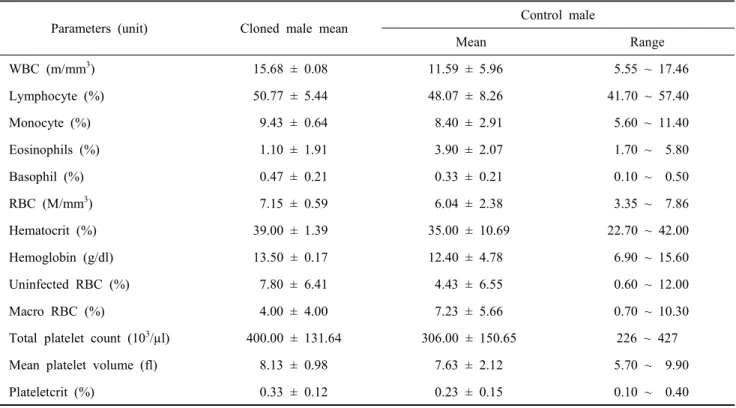
Age and sex-matched cloned and control miniature pigs were successfully maintained in a healthy condition, without any disease during the duration of the experiments. CBC analysis of leukocytes, erythrocytes and thrombocytes was used to mea- sure various parameters such as white blood cells (WBC), lym- phocytes, monocytes, eosinophils, basophils, red blood cells (RBC), hematocrit, hemoglobin, uninfected RBC, macro RBC, total platelet count, mean platelet volume and plateletcrit from the collected whole blood samples 3 times at 3-month intervals (Table 1 and 2). CBC values were similar between cloned pigs and control pigs. The WBC levels were higher in cloned fe- males and males than in controls; however, the observed levels are within the standard range for domestic pigs.

Cloned and control miniature pigs in the period post-puberty period showed some clinically significant differences between females and males serum chemistry parameters, or indicators of serum proteins, metabolic status and heart, liver and kidney function, such as creatinine, glucose, BUN, γ-GGT, albumin, total bilirubin, TP, ALT, AST, creatine kinase, cholesterol and amylase (Fig. 1). We monitored blood chemistry parameters at 3 time points for 9 months, and the majority of the parameters related to the biochemical status of clones were similar to those of control animals. However, in cloned males, the γ-GGT (67.0

± 20.8) and ALT (78.7 ± 24.0) levels were above the normal range (16 ∼30 and 9∼43 U/l, respectively), and significantly (P<0.05 and P<0.01, respectively) higher than cloned females (γ-GGT; 38.7 ± 2.9, ALT; 55.0 ± 16.1) and control female and male pigs (γ-GGT : 27.5 ± 4.8 and 23.0 ± 4.4, ALT; 38.5 ± 7.9 and 32.3 ± 8.5). Cholesterol (85.0 ± 8.2 and 87.33 ± 6.7, respectively) levels of cloned males and females were above the normal range (18 ∼79 mg/dl), and significantly (P<0.05) higher than control females and males (62.8 ± 3.6 and 57.0 ± 14.4, respectively).

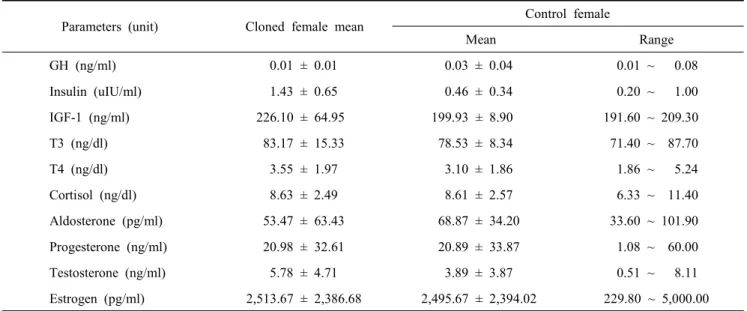
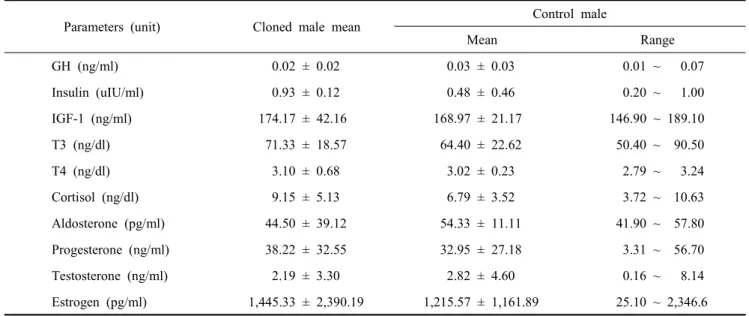
Variation in the endocrine levels of cloned and control

animals was monitored 3 times for 9 months, and results for

GH, T3, T4, cortisol, aldosterone, progesterone, testosterone

and estrogen levels were similar between gender-matched

animals (Table 3 and 4). However, endocrinological variation

in insulin and IGF-1 were higher in cloned females than in

(3)

Table 1. Mean values of complete blood counts for cloned and control female miniature pigs

Parameters (unit) Cloned female mean

Control female

Mean Range

WBC (m/mm

3

) 17.04 ± 2.91 13.85 ± 0.71 13.05 ~ 14.41

Lymphocyte (%) 51.65 ± 8.08 53.33 ± 11.04 40.80 ~ 61.6

Monocyte (%) 7.65 ± 1.99 7.47 ± 1.15 6.80 ~ 8.8

Eosinophils (%) 2.25 ± 1.56 4.57 ± 3.33 2.40 ~ 8.4

Basophil (%) 0.25 ± 0.19 0.37 ± 0.25 0.10 ~ 0.6

RBC (M/mm

3

) 7.94 ± 1.14 6.73 ± 1.50 5.49 ~ 8.4

Hematocrit (%) 43.83 ± 4.42 44.93 ± 1.59 43.10 ~ 45.9

Hemoglobin (g/dl) 14.20 ± 2.67 15.37 ± 2.00 13.10 ~ 16.9

Uninfected RBC (%) 9.10 ± 15.74 3.63 ± 5.08 0.60 ~ 9.5

Macro RBC (%) 5.68 ± 3.78 7.17 ± 6.18 0.30 ~ 12.3

Total platelet count (10

3

/µl) 300.50 ± 100.77 359.00 ± 193.87 265 ~ 541

Mean platelet volume (fl) 7.75 ± 1.06 8.27 ± 2.80 6.50 ~ 11.5

Plateletcrit (%) 0.23 ± 0.13 0.30 ± 0.26 0.10 ~ 0.6

Values are expressed as mean ± SEM, Each group contains 3 animals.

Table 2. Mean values of complete blood counts for cloned and control male miniature pigs

Parameters (unit) Cloned male mean

Control male

Mean Range

WBC (m/mm

3

) 15.68 ± 0.08 11.59 ± 5.96 5.55 ~ 17.46

Lymphocyte (%) 50.77 ± 5.44 48.07 ± 8.26 41.70 ~ 57.40

Monocyte (%) 9.43 ± 0.64 8.40 ± 2.91 5.60 ~ 11.40

Eosinophils (%) 1.10 ± 1.91 3.90 ± 2.07 1.70 ~ 5.80

Basophil (%) 0.47 ± 0.21 0.33 ± 0.21 0.10 ~ 0.50

RBC (M/mm

3

) 7.15 ± 0.59 6.04 ± 2.38 3.35 ~ 7.86

Hematocrit (%) 39.00 ± 1.39 35.00 ± 10.69 22.70 ~ 42.00

Hemoglobin (g/dl) 13.50 ± 0.17 12.40 ± 4.78 6.90 ~ 15.60

Uninfected RBC (%) 7.80 ± 6.41 4.43 ± 6.55 0.60 ~ 12.00

Macro RBC (%) 4.00 ± 4.00 7.23 ± 5.66 0.70 ~ 10.30

Total platelet count (10

3

/µl) 400.00 ± 131.64 306.00 ± 150.65 226 ~ 427

Mean platelet volume (fl) 8.13 ± 0.98 7.63 ± 2.12 5.70 ~ 9.90

Plateletcrit (%) 0.33 ± 0.12 0.23 ± 0.15 0.10 ~ 0.40

Values are expressed as mean ± SEM, Each group contains 3 animals.

(4)

Fig. 1. Mean values of blood chemistry parameters of cloned and control miniature pigs. Data are expressed as the mean ± SEM of 3 pigs. Each group contains 3 animals. Different letters indicate significant differences (

*

P<0.05 or

**

P<0.01). BUN, blood urea nitro- gen; γ-GGT, gamma-glutamyltransferase; ALT, alanine aminotransferase; AST, aspartate aminotransferase.

Table 3. Mean concentration of endocrinological parameters of cloned and control female miniature pigs

Parameters (unit) Cloned female mean

Control female

Mean Range

GH (ng/ml) 0.01 ± 0.01 0.03 ± 0.04 0.01 ~ 0.08

Insulin (uIU/ml) 1.43 ± 0.65 0.46 ± 0.34 0.20 ~ 1.00

IGF-1 (ng/ml) 226.10 ± 64.95 199.93 ± 8.90 191.60 ~ 209.30

T3 (ng/dl) 83.17 ± 15.33 78.53 ± 8.34 71.40 ~ 87.70

T4 (ng/dl) 3.55 ± 1.97 3.10 ± 1.86 1.86 ~ 5.24

Cortisol (ng/dl) 8.63 ± 2.49 8.61 ± 2.57 6.33 ~ 11.40

Aldosterone (pg/ml) 53.47 ± 63.43 68.87 ± 34.20 33.60 ~ 101.90

Progesterone (ng/ml) 20.98 ± 32.61 20.89 ± 33.87 1.08 ~ 60.00 Testosterone (ng/ml) 5.78 ± 4.71 3.89 ± 3.87 0.51 ~ 8.11

Estrogen (pg/ml) 2,513.67 ± 2,386.68 2,495.67 ± 2,394.02 229.80 ~ 5,000.00

Data are expressed as the mean ± SEM of 3pigs. Each group contains 3 animals.

GH, growth hormone and IGF-1, insulin like growth factor 1.

cloned males and controls.

DISCUSSION

Miniature pigs continue to elicit interest as an animal model in the fields of biomedical research (Polejaeva et al., 2000) and disease models for humans (Larsen et al., 2004) because of their suitability as donor animals for xenotransplantation (Xu et al.,

2003). Hence, systematic studies of adult cloned miniature pigs may play an important role in various applications, including the safety of organ or tissue transplants from cloned miniature pigs and their offspring. However, information on the physiological status and endocrinological parameters of cloned miniature pigs is limited, not only for adults but also for prepubescent piglets.

Variation in biochemical and endocrinological parameters of

physiologically and reproductively mature cloned miniature pigs

(5)

Table 4. Mean concentration of endocrinological parameters of cloned and control male miniature pigs

Parameters (unit) Cloned male mean

Control male

Mean Range

GH (ng/ml) 0.02 ± 0.02 0.03 ± 0.03 0.01 ~ 0.07

Insulin (uIU/ml) 0.93 ± 0.12 0.48 ± 0.46 0.20 ~ 1.00

IGF-1 (ng/ml) 174.17 ± 42.16 168.97 ± 21.17 146.90 ~ 189.10

T3 (ng/dl) 71.33 ± 18.57 64.40 ± 22.62 50.40 ~ 90.50

T4 (ng/dl) 3.10 ± 0.68 3.02 ± 0.23 2.79 ~ 3.24

Cortisol (ng/dl) 9.15 ± 5.13 6.79 ± 3.52 3.72 ~ 10.63

Aldosterone (pg/ml) 44.50 ± 39.12 54.33 ± 11.11 41.90 ~ 57.80

Progesterone (ng/ml) 38.22 ± 32.55 32.95 ± 27.18 3.31 ~ 56.70

Testosterone (ng/ml) 2.19 ± 3.30 2.82 ± 4.60 0.16 ~ 8.14

Estrogen (pg/ml) 1,445.33 ± 2,390.19 1,215.57 ± 1,161.89 25.10 ~ 2,346.6

Data are expressed as the mean ± SEM of 3 pigs. Each group contains 3 animals.

GH, growth hormone and IGF-1, insulin like growth factor 1.

should be examined to determine the probable adaptive function or potential side effects of transplanted cells or organs derived from cloned animals. To clarify these issues, we compared gen- der-dependent differences in hematological, biochemical and endocrinological variation to identify organ function and the physiological status of adult cloned miniature pigs.

As shown in Table 1, mean WBC values of cloned pigs tended to be higher than controls, although hematological values remained within normal ranges in all cloned pigs, similar to con- trols. Thus, we confirmed that all animals retained their healthy status under normal conditions, without any infection or disease.

The most common mortality factors in cloned cattle, repre- senting 24% of deaths in the period between weaning and adult- hood, are related to abnormalities of the musculoskeletal system.

Mir (Mir et al., 2005) compared blood profiles between cloned pigs, control pigs, and their progeny to quantify the effect of cloning on several blood parameters and their transmission to the next generation; the variability in all traits in F

1

progeny of clones and the control pigs was similar, with the exception of BUN and ALP. Thus, although cloned animals may be phy- siologically normal or at least within normal ranges, periodic disorders may still occur in adulthood that require treatment.

Moreover, unexpected health complications may not be observed in clones until the animals are stressed or aged. In the present study, the variability in biochemical parameters such as creati-

nine, glucose, BUN, γ-GGT, albumin, TP, AST, creatine kinase, cholesterol and amylase, observed in cloned fe- males and males was similar to that in controls. However, mean values of γ-GGT and ALT were significantly (P<0.05 and P<0.01, respectively) higher in cloned males than in cloned females and control females and males. Mean values of cholesterol were significantly (P<

0.05) higher in cloned females and males than in control females and males. Values of γ-GGT are the functional parameter for the kidney, and values of ALT is one of the functional parameters of the liver. Hence, our results suggest that some parameters of liver and kidney function differed significantly between controls and cloned males and females.

Measurements of endocrinological variation are important to fully understand the physiological status of cloned animals during adulthood. The endocrine profiles of cloned goats have been reported to show greater variability than that of controls for GH, T3 and insulin (Landry et al., 2005). In the present study, we found that insulin and IGF-1 levels were higher in cloned fe- males than in cloned males and controls.

Variation in T3, T4 and insulin levels has been reported in

cloned animals; insulin, T3 and T4 concentrations of cloned

calves differed from controls, measured 10 min following birth

(Garry et al. 1996), and T4 and insulin levels differ between

cloned cows and age- and weight-matched controls (Kyle et al.,

2002). The present study indicates that while cloned miniature

(6)

pigs may be within the normal range for the majority of CBC, biochemical and endocrinological parameters, they do exhibit significant differences in some of parameters of kidney and liver functions, and insulin and IGF-1. We suggest that these results could provide useful hematological and physiological parameters for cloned miniature pigs and normal miniature pigs, although these findings may be due to the effects of micro-manipulation in the in vitro culture environment or post-implantation environ- mental effects.

CONCLUSION

In conclusion, we found a measurable degree of biochemical and endocrinological variation in cloned miniature pigs derived from BM-MSCs, despite similarities in hematological and bio- chemical parameters between cloned male and female miniature pigs and controls. This variation must be taken into account before considering the cloned miniature pigs for application in biomedicine and cell or organ xenotransplantation.

REFERENCES

Archer GS, Friend TH, Piedrahita J, Nevill CH and Walker S.

2003. Behavioral variation among cloned pigs. Appl. Anim.

Behav. Sci. 82: 151-161.

Chavatte-Palmer P, Heyman Y, Richard C, Monget P, LeBourhis D, Kann G, Chilliard Y, Vignon X and Renard JP. 2002.

Clinical, hormonal, and hematologic characteristics of bovine calves derived from nuclei from somatic cells. Biol. Reprod.

66: 1596-1603.

Cibelli JB, Campbell KH, Seidel GE, West MD and Lanza RP. 2002. The health profile of cloned animals. Nat. Bio- technol. 20: 13-14.

Dindot SV, Farin PW, Farin CE, Romano J, Walker S, Long C and Piedrahita JA. 2004. Epigenetic and genomic imprinting analysis in nuclear transfer derived Bos gaurus/Bos taurus hybrid fetuses. Biol. Reprod. 71: 470-478.

Garry FB, Adams R, McCann JP and Odde KG. 1996. Post- natal characteristics of calves produced by nuclear transfer cloning. Theriogenology 45: 141-152.

Heyman Y, Zhou Q, Lebourhis D, Chavatte-Palmer P, Renard JP and Vignon X. 2002. Novel approaches and hurdles to somatic cloning in cattle. Cloning Stem Cells 4: 47-55.

Humpherys D, Eggan K, Akutsu H, Friedman A, Hochedlinger

K, Yanagimachi R, Lender ES, Golub TR and Jaenisch R.

2002. Abnormal gene expression in cloned mice derived from embryonic stem cell and cumulus cell nuclei. Proc.

Natl. Acad. Sci. USA. 99: 2889-2894.

Kyle WB, Collins MG and Landry AM, 2002. Growth and en- docrine patterns of cloned and noncloned Brangus heifers.

Theriogenology 57: 426 (abst.).

Lanza RP, Cibelli JB, Faber D, Sweeney RW, Henderson B, Nevala W, West MD and Wettstein PJ. 2001. Cloned cattle can be healthy and normal. Science 294: 1893-1894.

Landry AM, Landry DJ, Gentry LR, Green HL, Reggio B, Koonce KL, Echelard Y and Godke RA. 2005 Endocrine profiles and growth patterns of cloned goats. Cloning and Stem Cells 7: 214-225.

Larsen MO and Rolin B. 2004. Use of the Gottingen minipig as a model of diabetes, with special focus on type 1 dia- betes research. ILAR. J. 45: 303-313.

Lee SL, Kang EJ, Maeng GH, Kim MJ, Park JK, Kim TS, Hyun SH, Lee ES and Rho GJ. 2010. Developmental ability of miniature pig embryos cloned with mesenchymal stem cells. J. Reprod. Dev. 56 :256-262.

Lee SL, Maeng GH, Lee WJ, Chon RH and Rho GJ. 2011. Phy- siological status of male and female miniature pigs cloned with mesenchymal stem cells. Reprod. Fertil. Dev. 23: 129 (abst.).

Logan JS. 2000. Prospects for xenotransplantation. Curr. Opin.

Immunol. 12: 563-568.

Mir B, Zaunbrecher G, Archer GS, Friend TH and Piedrahita JA. 2005. Progeny of somatic cell nuclear transfer (SCNT) pig clones are phenotypically similar to non-cloned pigs.

Cloning and Stem Cells 7: 119-125.

Ohgane J, Wakayama T, Kogo Y, Senda S, Hattori N, Tanaka S, Yanagimachi R and Shiota K. 2001. DNA methylation variation in cloned mice. Genesis 30: 45-50.

Polejaeva IA, Chen SH, Vaught TD, Page RL, Mullins J, Ball S, Dai Y, Boone J, Walker S, Ayares DL, Colman A and Campbell KH. 2000. Cloned pigs produced by nuclear trans- fer from adult somatic cells. Nature 407: 86-90.

Renard JP, Chastant S, Chesne P, Richard C, Marchal J, Cor- donnier N, Chavatte P and Vignon X. 1999. Lymphoid hypoplasia and somatic cloning. Lancet 353: 1489-1491.

Watanabe S and Nagai T. 2008. Health status and productive

performance of somatic cell cloned cattle and their offspring

produced in Japan. J. Reprod. Dev. 54: 6-17.

(7)

Xu Q, Yu D, Qiu Y, Zhang H and Ding Y. 2003. Function of a new internal bioartificial liver: an in vitro study. Ann.

Clin. Lab. Sci. 33: 306-312.

(Received: 2014. 4. 13/ Reviewed: 2014. 4. 15/ Accepted: 2014. 5. 7)

수치

Table  2.  Mean  values  of  complete  blood  counts  for  cloned  and  control  male  miniature  pigs
Table  3.  Mean  concentration  of  endocrinological  parameters  of  cloned  and  control  female  miniature  pigs
Table  4.  Mean  concentration  of  endocrinological  parameters  of  cloned  and  control  male  miniature  pigs

참조

관련 문서

The index is calculated with the latest 5-year auction data of 400 selected Classic, Modern, and Contemporary Chinese painting artists from major auction houses..

The purpose of this study was to investigate evaluation questions in chemistry I of textbooks and college scholastic aptitude test(CSAT) by Bloom’s new

The purpose of this study was to investigate the appropriateness of the learning sequence of Science(area of matters) and Chemistry contents and

In chemistry, Gibbs' phase rule describes the possible number of degrees of freedom (F) in a closed system at equilibrium, in terms of the number of separate phases (P) and

We investigated upper gastrointestinal tract involvement and characteristic endoscopic findings in scrub typhus, and we also determined the correlation between

In chlorination, the transition state resembles the reactant (small radical character), therefore the tertiary radical is slightly more stable than the primary one. In

We investigated the effects of BIX01294 on cellular senescence in human BM-MSCs (hBM-MSCs), and identified that an optimal treatment of BIX01294 leads to attenuated

The following study qualitatively and quantitatively investigated and analyzed North Korea’s chemistry textbook’s contents and activities in order to