http://dx.doi.org/10.14316/pmp.2016.27.1.8
This research was supported by the Radiation Safety Research Pro- grams (1305033) through the Nuclear Safety and Security Commission.
This research was supported by International Cooperation Program for Industry and Technology funded by the Ministry of Trade, Industry and Energy (No. N032400027).
This research was supported by Basic Science Research Program through the National Research Foundation of Korea (NRF) funded by the Ministry of Education (No. 2015R1D1A1A01060463).
Received 14 March 2016, Revised 25 March 2016, Accepted 28 March 2016
Correspondence: Rena Lee ([email protected])
Tel: 82-2-2650-5337, Fax: 82-2-2654-0363 These corresponding authors contributed equally to this work.
cc This is an Open-Access article distributed under the terms of the Creative Commons Attribution Non-Commercial License (http://creativecommons.org/licenses/by-nc/4.0) which permits unrestricted non-commercial use, distribution, and reproduction in any medium, provided the original work is properly cited.
Analysis of Beam Hardening of Modulation Layers for Dual Energy Cone-beam CT
Sohyun Ahn*, Sam Ju Cho*, Ki Chang Keum*, Sang Gyu Choi†, Rena Lee‡
*Department of Radiation Oncology, College of Medicine, Yonsei University, Seoul,
†Department of Radiation Oncology, Colledge of Medicine, Dankook University, Cheonan,
‡Department of Radiation Oncology, School of Medicine, Ewha Womans University, Seoul, Korea
Dual energy cone-beam CT can distinguish two materials with different atomic compositions. The principle of dual energy cone-beam CT based on modulation layer is that higher energy spectrum can be acquired at blocked x-ray window. To evaluate the possibility of modulation layer based dual energy cone-beam CT, we analyzed x-ray spectrum for various thicknesses of modulation layers by Monte Carlo simulation. To compare with the results of simulation, the experiment was performed on prototype cone-beam CT for 50∼100 kVp with CdTe XR-100T detector. As the result of comparing, the mean energy of energy spectrum for 80 kVp are well matched with that of simulation. The mean energy of energy spectrum for 80 and 120 kVp were increased as 1.67 and 1.52 times by 2.0 mm modulation layer, respectively. We realized that the virtual dual energy x-ray source can be generated by modulation layer.
Key Words: Dual energy cone-beam CT, Beam hardening effect, Modulation layer, Monte Carlo simulation
Introduction
There are several methods to employ dual energy cone-beam CT such as rapid voltage switching, double-layer detector, and sequential acquisition methods.1-3) Recently, Faby et al. have proposed the multi-energy CT, namely MECT, which was equipped with photon counting detector.4)
The concept of modulation layer based dual energy cone-beam CT is that the high- and low-energy spectra can be
acquired with a single scan by blocking half of x-ray window with modulation layer. In this system, various energy spectra can be generated with various thicknesses of modulation lay- ers, as similar as bowtie filters at current cone-beam CT sys- tem, without any additional x-ray tubes and detectors. Another advantage of modulation layer based dual energy cone-beam CT is that monochromatic images which are often necessary to check patients' position can be acquired easily by removing modulation layer.5)
The high-energy spectrum can be acquired with only a single x-ray tube and detector by blocking the x-ray window with the modulation layer made of copper which can produce beam hardening effect. The amount of beam hardening can be de- termined by a thickness of a modulation layer, provided that material and density of a modulation layer are unchanged. In order to evaluate the possibility of modulation layer based dual energy cone-beam CT, we analyze the beam hardening effect by the mean energies of the x-ray spectra for various thicknesses of modulation layers by Monte Carlo simulation. And the x-ray spectra acquired by Monte Carlo simulation are compared with x-ray spectra acquired by CdTe spectrometer experimentally.
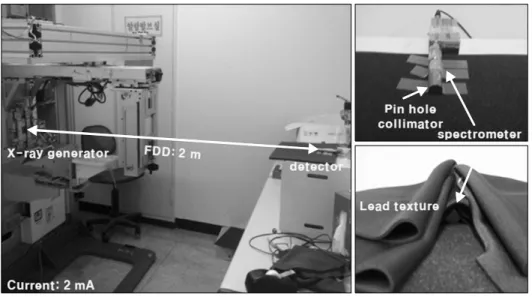
Fig. 2. Experimental setup for measuring the energy spectrum with CdTe XR-100T detector. Pin hole collimator and lead texture were used to prevent saturation.
Pin hole collimator has narrow hole with 0.3 mm diameter.
Fig. 1. Geometrical modeling of Monte Carlo simulation. Modula- tion layer and CdTe spectrometer are located at 20.0 cm and 64.3 cm distances from x-ray window, respectively.
Materials and Methods
In this study, previously developed prototype kV cone-beam CT was modeled by MCNPX 2.7.0 code.6) Source-to-detector, source-to-object, and object-to-detector distances were 90.0, 64.3, and 25.7 cm, respectively. Source energy spectrum was generated by SPEC78 which is a widely used x-ray spectrum generation program with tungsten target and two peak tube voltages as 80 and 120 kVp.7) We assumed that a modulation layer was located at 20.0 cm in front of x-ray window (Fig. 1).
The material and physical density of modulation layer were as- sumed as copper and 8.96 g/cm3. The thicknesses of modu- lation layer were modeled as 0.3, 1.0, and 2.0 mm. The di-
mensions of height and width were 15.0×15.0 cm2 in order to fully cover the x-ray window. We simulated CdTe detector at the position of an object, 64.3 cm apart from the x-ray win- dow, and f8 tally and energy card with interval of 0.5 keV were used to acquire energy spectrum. The beam hardening ef- fects were evaluated by comparing the mean energies of en- ergy spectra. The mean energies of energy spectra acquired by Monte Carlo simulation were compared with that of measured energy spectra by Amptek XR-100T CdTe detector which has detection volume as 5.0×5.0×1.0 mm3. In experimental setup, we used pin hole collimator and lead protector in order to pre- vent signal saturation (Fig. 2). Previously, the CdTe detector was calibrated with isotopes such as Na22, Ba133, Cs137, Co60, and Co57 which emit gamma rays from 14.4 keV to 1.3 MeV
Fig. 4. Five energy spectra for energy calibration of CdTe XR- 100T detector with five isotopes such as Na22, Ba133, Cs137, Co60, and Co57.
Fig. 3. Photography of five isotopes used to calibrate CdTe XR-100T detector. The diameter of isotope is 1.0 mm and is enveloped in 25.0 mm diameter plastic protector.
Table 1. The energies of emitted gamma-rays from the selec- ted five isotopes.
Isotopes Energy of emitted gamma-ray (branching ratio)
Na22 1.275 MeV (100%)
511 keV (181%)
Ba133 81 keV (34%)
276 keV (18%) 303 keV (18%) 356 keV (62%)
Cs137 662 keV (85%)
36 keV (1%) 32 keV (6%)
Co60 1.173 MeV (100%)
1.332 MeV (100%)
Co57 14.4119 keV (9.54%)
122.0612 keV (85.6%) 136.4730 keV (10.6%) (Fig. 3). Table 1 shows the energies of emitted gamma rays
and their branching ratio of five isotopes, respectively.
Results
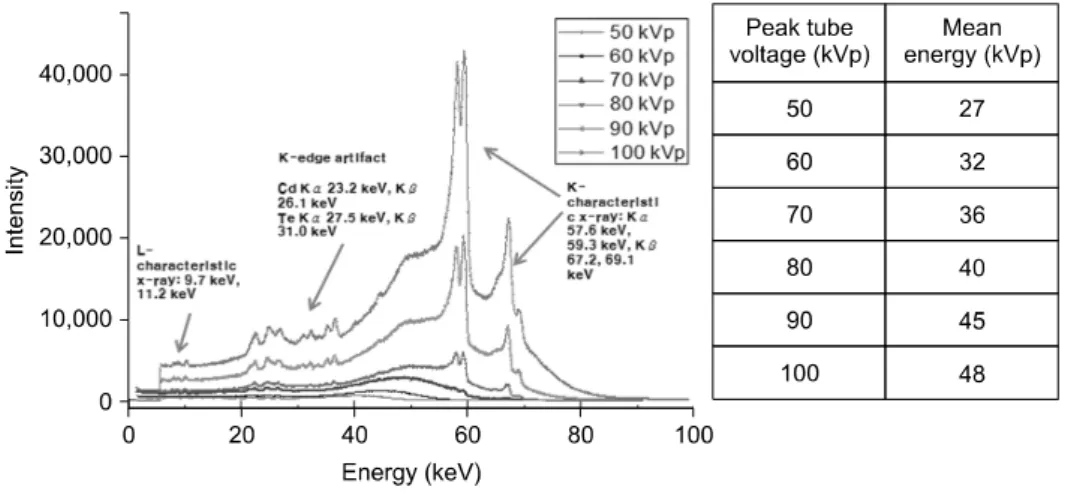
Fig. 4 shows the measured gamma-ray spectra of the five isotopes. We calibrated the XR-100T CdTe detector for the energy range from 14.4 keV to 1.3 MeV with these results.
After the energy calibration, energy spectra were measured for five peak tube voltages as 50∼100 kVp of our prototype cone-beam CT. The characteristic x-ray peaks of detector ma-
terials such as Cadmium and Telluride were shown in the en- ergy spectra for 80 kVp or higher peak tube voltages (Fig. 5).
The mean energies of the measured and simulated energy spectra for 80 kVp were 40 and 37.5 keV, respectively.
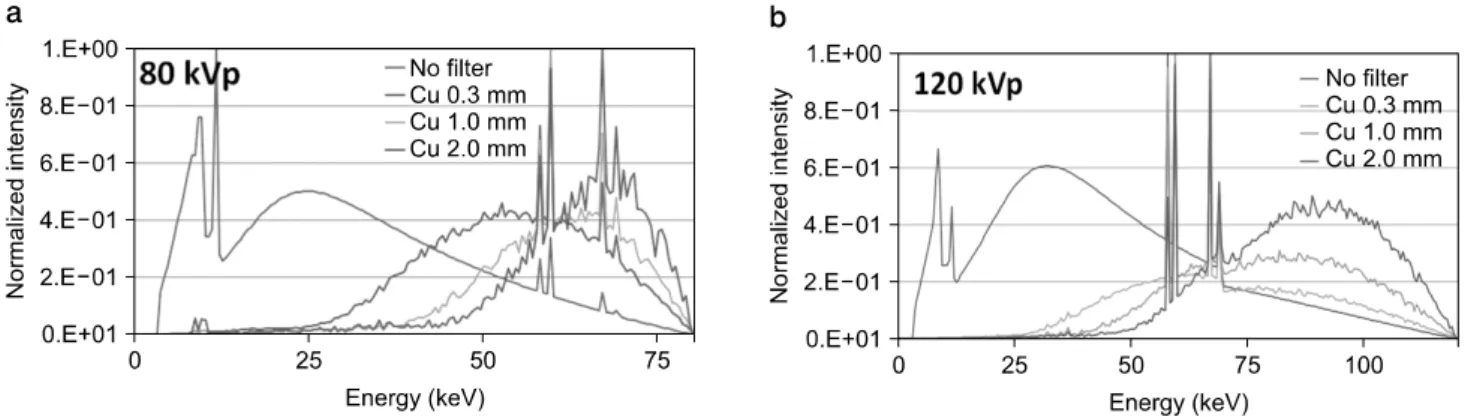
In the simulations, the energy spectra were acquired for two peak tube voltages such as 80 and 120 kVp with x-ray win- dow blocked and unblocked x-ray window by modulation layer. For both peak tube voltages, beam hardening effects were well observed (Fig. 6a and b). The mean energies of en- ergy spectra were 37.5 and 56.2 keV for 80 and 120 kVp with unblocked x-ray window. The mean energies of energy spectra were 53.5, 59.9, and 62.7 keV for 80 kVp, and 69.3, 78.3, and
Fig. 5. Energy spectra acquired by CdTe XR-100T detector and their mean energy. The characteristic x-rays of detector materials, Cadmium and Telluride, are showed for peak tube voltage above 80 kVp.
Fig. 6. Energy spectra acquired by Monte Carlo simulation without modulation filter and with modulation filters for (a) 80 kVp and (b) 120 kVp.
85.4 keV for 120 kVp with blocked x-ray window by the modulation layers of which thicknesses were 0.3, 0.5, and 2.0 mm, respectively.
Discussions
Several publications have handled the distinguishability of dual energy cone-beam CT between two materials with differ-
ent atomic compositions. Liu et al. reported the method for distinguishing three materials by a mass conservation based three-material decomposition dual-energy CT algorithm.8) The authors explained that different materials have different mass attenuation coefficients is the basic principle of dual-energy imaging. Hunemohr et al. have reported that the dual-energy CT can approve the accuracy of mass density prediction for 71 tissues such as adipose tissue, red marrow, and urine et al.,
therefore, dual-energy CT can improve the accuracy of the stopping power prediction.9) Goodsitt et al. have reported the correlation between a phantom size and accuracy of mass den- sity prediction in dual energy cone-beam CT. Their results showed that the root mean square of CT number of red mar- row in bone spongiosa is larger than small phantom as 1.3∼
1.5 times.10)
In this study, the results of beam hardening effect with vari- ous thicknesses of modulation layers could be the basic data on the development of modulation layer based dual energy cone-beam CT. We will perform the next research about the quality of images acquired by modulation layer based dual en- ergy cone-beam CT.
Conclusion
The modulation layer with 2.0 mm thickness can increase mean energies of energy spectra as 1.67 and 1.52 times than original mean energies for 80 and 120 kVp, respectively.
Therefore, we realized that the modulation layer can generate virtual dual-energy x-ray source, one has the original peak tube voltage and the other has higher peak tube voltage than original one as 1.6 times.
References
1. Thorsten R.C. Johnson, Christian Fink Stefan O.
Schonberg, Maximilian F. Reiser: Dual energy CT in clin- ical practice, Springer, (2011), pp.3-9
2. Szczykutowicz, T. P. and G. H. Chen: Dual energy CT
using slow kVp switching acquisition and prior image con- strained compressed sensing. Phys Med Biol 55(21): 6411-6429 (2010)
3. Altman, A. and R. Carmi: A Double‐Layer Detector, Dual‐
Energy CT — Principles, Advantages and Applications. Med.
Phys. 36(6): 2750-2750 (2009)
4. Sebastian Faby, Stefan Kuchenbecker, Stefan Sawall, David Simons, Heinz-Peter Schlemmer, Michael Lell et al: Performance of today’s dual energy CT and future multi en- ergy CT in virtual non-contrast imaging and in iodine quantifica- tion: A simulation study. Med. Phys. 42(7):4349-4366 (2015) 5. Lifeng Yu, Jodie A. Christner, Shuai Leng, Jia Wang,
Joel G. Fletcher, and Cynthia H. McCollough: Virtual monochromatic imaging in dual-source dual-energy CT:
Radiation dose and image quality. Med. Phy. 38(12):6371-6379 (2011)
6. Ahn SH, Choi JH, Lee KC, Kim SY, Lee R, and Shin SY: Development of a beam stop array system with dual scan mode for scatter correction of cone-beam CT. J Korean Phys Soc 64(8), (2014)
7. K. Cranley, B.J. Gilmore, G.W.A. Fogarty, and L.
Desponds: Catalogue of Diagnostic X-ray Spectra and Other Data, Report No. 78, The Institute of Physics and Engineering in Medicine (1997).
8. Xin Liu, Lifeng Yu, Andrew N. Primak, and Cynthia H.
McCollough: Quantitative imaging of element composition and mass fraction using dual-energy CT: Three-material decom- position, Med. Phys. 36(5):1602-1609 (2009)
9. Nora Hunemohr, Harald Paganetti, Steffen Greilich, Oliver Jakel, Joao Seco: Tissue decomposition from dual energy CT data for MC based dose calculation in particle therapy. Med. Phys. 41(6):061714 (2014)
10. Mitchell M. Goodsitt, Apeksha Shenoy, Jincheng Shen, David Howard, Matthew J. Schipper, Scott Wilderman, et al.: Evaluation of dual energy quantitative CT for determining the spatial distributions of red marrow and bone for dosimetry in internal emitter radiation therapy. Med. Phys. 41(5):05190 (2014)
에너지 변조 필터로 구현한 이중 에너지 콘빔 CT의 에너지 스펙트럼 평가 연구
*연세대학교 의과대학 방사선종양학교실, †단국대학교 의과대학 방사선종양학과, ‡이화여자대학교 의과학과
안소현*ㆍ조삼주*ㆍ금기창*ㆍ최상규†ㆍ이레나‡
이중 에너지 콘빔 CT는 원자번호가 다른 두 물질을 구분해낼 수 있다는 장점을 가진다. 이중 에너지 콘빔 CT를 구현하 는 여러 가지 방법 중, 에너지 변조 필터(modulation layer)에 기반한 이중 에너지 콘빔 CT의 원리는 x-선 발생창의 절반 을 구리와 같은 에너지 변조 필터로 차단하면, 차단되지 않은 곳에서는 원래의 관전압에 해당하는 x-선 스펙트럼이 발생 하고 에너지 변조 필터로 가려진 부분에서는 저에너지 x-선이 감소된 x-선 스펙트럼이 발생하여 한 번의 스캔에서 두 가지 스펙트럼을 획득할 수 있다는 것이다. 우리는 에너지 변조 필터를 이용한 이중 에너지 콘빔 CT 구현의 가능성을 평가하기 위하여 다양한 두께의 에너지 변조 필터에 의해 생성되는 x-선 스펙트럼을 몬테칼로 전산모사를 이용하여 획 득하였다. 전산모사 결과를 검증하기 위하여 동일한 콘빔 CT 시스템에서 CdTe 검출기를 이용하여 50∼100 kVp에 대하 여 스펙트럼을 측정하였고, 80 kVp 관전압에 대하여 실험과 전산모사로 획득한 스펙트럼의 평균 에너지가 유사함을 확 인하였다. 또한 에너지 변조 필터의 두께를 2.0 mm로 하였을 때 스펙트럼의 평균 에너지는 80과 120 kVp에 대하여 각각 1.67, 1.52배까지 증가함을 확인하였다. 따라서 에너지 변조 필터를 사용하면 하나의 x-선 발생장치를 이용하여 가상의 이중 에너지 선원을 구현할 수 있음을 확인하였다.
중심단어: 이중 에너지 콘빔 CT, 에너지 강화 효과, 에너지 변조 필터, 몬테칼로 전산모사