ⓒ IEMEK J. Embed. Sys. Appl. 2021 Jun. 16(3) 113-117 ISSN : 1975-5066
http://dx.doi.org/10.14372/IEMEK.2021.16.3.113
Multi-Collector Control for Workload Balancing in Wireless Sensor and Actuator Networks
Yamin Han, Heejung Byun*
Abstract : The data gathering delay and the network lifetime are important indicators to measure the service quality of wireless sensor and actuator networks (WSANs). This study proposes a dynamically cluster head (CH) selection strategy and automatic scheduling scheme of collectors for prolonging the network lifetime and shorting data gathering delay in WSAN. First the monitoring region is equally divided into several subregions and each subregion dynamically selects a sensor node as CH. These can balance the energy consumption of sensor node thereby prolonging the network lifetime. Then a task allocation method based on genetic algorithm is proposed to uniformly assign tasks to actuators. Finally the trajectory of each actuator is optimized by ant colony optimization algorithm. Simulations are conducted to evaluate the effectiveness of the proposed method and the results show that the method performs better to extend network lifetime while also reducing data delay.
Keywords : Large-scale wireless sensor networks, Data gathering delay, Network lifetime
*Corresponding Author ([email protected])
Received: Dec. 3, 2020, Revised: Jan. 13, 2021, Accepted: Mar. 16, 2021.
Yamin Han: National Supercomputing Center, China (Senior Researcher) Heejung Byun: Dept. of ICT, University of Suwon (Assoc. Prof.)
※ This research was supported by Basic Science Research Program through the National Research Foundation of Korea (NRF) funded by the Ministry of Science, ICT & Future Planning (NRF-2020R1A2C1004390).
Ⅰ. Introduction
Wireless sensor and actuator networks [1] contain a large number of sensor nodes and limited actuators. The sensor nodes are generally static and deployed into the monitoring region randomly. They can obtain data (e.g., temperature humidity and light from the physical world.
Actuators can regard as collectors and move in the monitoring region and interact with the environment.
Sensor nodes and collectors can communicate via wireless links and cooperate with each other to perform automated sensing and interaction tasks. WSANs have been applied to many fields such as agricultural automation fire monitoring and smart cities.
In a WSAN system the moving speed of collectors is slow, which makes collectors take a long time to collect data, thereby increasing the data gathering delay. Also, the lifetime of network is mainly affected by sensor nodes unbalanced energy consumption reduces the network lifetime. Therefore an effective data collection strategy should take into account both the gathering delay and network lifetime.
Extensive studies have been conducted on the mobility
management of collectors and balance the energy consumption of sensor nodes to reduce data delay and prolong the network lifetime for WSAN systems. One is that the mobile collectors gathers data directly from the sensor nodes [2, 3]. The other is that the collector only visits the CHs to gather the data of the hole monitoring region [4, 5].
Substantial studies reveal that the adoption of mobile collectors can save energy consumption of sensor nodes to prolong the network lifetime. Also, the introduced CHs can improve the efficiency of data collection. But the unreasonable CHs selection cause nonuniform energy consumption between sensor nodes and unbalanced data collection tasks between multiple mobile collectors increase the data gathering delay. Specifically, if some sensor nodes are always selected as CHs, these sensor nodes will consume more energy to aggregate the data from other sensor nodes within their respective subregion.
Furthermore, if the data collection task of collectors is uneven, the collector with more tasks will spend more time, thereby extending the data gathering delay.
This study proposes a data collection task balanced
and energy consumption uniformed method with the aim
of reducing the data gathering delay and prolonging the
lifetime of the network. First, in order to uniform the
energy consumption between sensor nodes, the monitoring
region is equally divided into several subregions and each
subregion dynamically selects a sensor node as CH based
on the residual energy and the distance between the
sensor nodes and the center of the subregion. Second, the genetic algorithm (GA) method is adopted to optimize the allocation of data collection tasks of collectors, which can balance the amount of data collected by each collector and the time they spend. Finally, the ant colony optimization (ACO) method is introduced to optimize the trajectory of each collector to further reduce data delay.
Ⅱ. Problem description and system modeling
We model a WSAN system in the monitoring region R including m static sensor nodes, n mobile collectors, and a sink node. Each sensor node can communicate with other sensor nodes or collectors within their transmission range. A set of mobile collectors can move freely in the monitored region. The monitored region is divided into k subregions, and each subregion selects a sensor node as the CH to aggregate data of other sensor nodes in their respective subregion. Each CH creates a time division multiple access (TDMA) schedule and then sends the schedule to the sensor nodes within their respective subregion. The TDMA schedule can avoid the collision of data transmission by sensor nodes. One sensor node sends data to its CH only during its allocated time slot, and other sensor nodes of that subregion are in the sleep state. The collector is responsible for data acquisition from a set of subregions by visiting corresponding CHs.
The energy dissipation model [6] is used to calculate the energy loss of sensor nodes. Each sensor node communicates with other sensor nodes or collectors, so the energy loss of sensor nodes includes the energy consumption of sending data Es and receiving data Er.
≥
.
where L is the data length, is a parameter indicating that the hardware circuit drives the transmitter or receiver
and
represent free space and a multipath fading channel model, respectively, d is the distance between the transmitter and the receiver,
is a constant that can be obtained by
.
Data delay [7] is the time required to transmit data from the source (sensor node) to the destination (sink). In this work, the data delay includes the time spent by collectors to travel and gather data from CHs. The maximum time spent by one of collectors is used as the data delay.
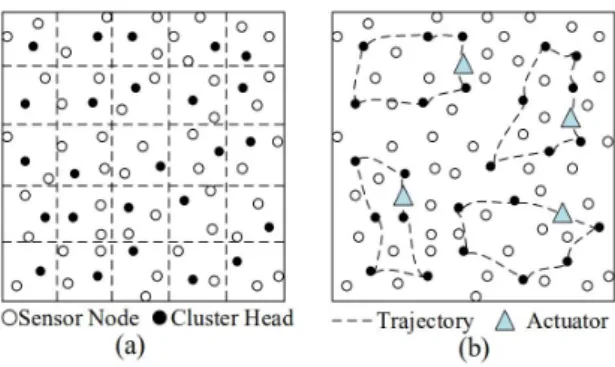
그림 1. 제안 알고리즘 (a) CH 선택 (b) 모바일 컬렉터 스케줄링 Fig. 1. The main idea of the proposed method: (a) CHs selection and (b) mobile collectors scheduling.
Ⅲ. Proposed method
This work aims to propose an efficient scheme for balancing energy consumption of sensor nodes and tasks allocation of collectors in WSAN, such that the lifetime of the network is prolonged and the data delay is reduced.
Thus, for these goals, this research follows an equalization strategy to divide the monitored region. Then allocating the data collection tasks to each collector evenly and planning the trajectory for each collector. The main idea of the proposed method as shown in Fig. 1.
1. Region division and CH selection
In WSAN systems the energy consumption of sensor nodes mainly depends on the size of transmitted data and transmitting distance. As this work is based on partition region and CHs, the energy consumed by a CH is mainly used to receive data from other sensor nodes within the same subregion. The energy consumed by common sensor nodes (i.e., non-CHs) is mainly used to send data to the corresponding CH. To reduce the energy consumption of sensor node and increase the efficiency of data collection this study proposes an equalization strategy to divide the monitoring region. Each subregion dynamically selects one sensor node as CH on each round for each subregion.
2. Allocating tasks with genetic algorithm
Multiple mobile collectors work in parallel to perform
data collection tasks by visiting these CHs. To balance
and reduce data delay, it is crucial to assign tasks to
these collectors reasonably. GA [8] algorithm is a very
popular global optimization method developed by imitating
the biological evolution mechanism of nature. Its
advantage is the characteristics of efficient, parallel and
global search, which can automatically acquire and
accumulate knowledge about the search space during the
search process, and adaptively control the search process to obtain the best solution. Thus, in this study, the GA method is introduced to dynamically divide these CHs into several groups based on the number of CHs in each group and the Euclidean distance between CHs, which makes the number of CHs in each group as same as possible and the distance between CHs in a group as small as possible. Then each group is equipped with a collector. These can balance and shorten the time consumed by collectors when gathering data.
There are many chromosomes in GA, and each chromosome represents a solution. A fitness function considering the distance between CHs and the number of CHs between groups is designed to evaluate the quality of the solution represented by each chromosome. The basic operations on chromosomes include: selection, crossover, and mutation.
(1) Selection: Generally, the selection operation is a process of survival of the fittest based on fitness.
Tournament selection strategy is used to select individuals from the population in this work.
(2) Crossover: The selected chromosomes are cut off at the same position, and then these strings are crossed and combined to form new chromosomes.
(3)Mutation: The mutation operation is performed with a low probability. A new chromosome is generated by changing the value of the randomly selected sites of the chromosome.
The above operations are repeated until the end condition is met or the maximum number of iterations is reached. Finally, an optimal or near optimal solution is obtained.
3. Optimizing the trajectory of collectors with ant colony algorithm
After the CHs are divided into several groups, each group is equipped with a collector to gather data. The trajectory of collectors traversing CHs needs to be optimized, which can reduce the time spent on the movement, thereby reducing the data delay. This study adopts the ACO algorithm [9] to optimize the trajectory of collectors traversing the CHs.
The ACO algorithm mimics the process of ants foraging, which is often used to solve the traveling salesman problem. Each ant provides a trajectory solution after an iteration. Initially, each ant is placed on a randomly selected CH. Then the probability-based action selection rule is used to determine the next CH to visit.
The pheromone trails are updated after all ants have
constructed their trajectory. The concentration of pheromones on all arcs decreases by a constant factor because these pheromones are evaporated, which can avoid the infinite accumulation of the pheromone trails and avoid the strong influence of previous decisions on the future. In addition, the pheromone of the arcs visited by each ant are increased. After all the ants have completed a search, i.e., after one iteration, the pheromone of all arcs are updated. Then ants performs a new round of search. When the maximum number of iterations is reached, among all the current solutions represented by ants, the solution with the shortest path is the optimal solution for the path optimization problem. Finally, each collector visits a group of CHs to aggregate data along the optimized path
Ⅳ. Simulations and results
The proposed approach is evaluated in this section.
Simulations are performed using Matlab to test the proposed approach and compare it with existing method.
The region size is set to 200m * 200m, the number of sensor nodes changed from 100 to 400.
The lifetime of a network is defined as the period from the network startup until the energy of the first sensor node is exhausted. Data delay refers to the duration of the data collection tour, which includes data transmission time and movement time. In this simulation, the maximum time spent by one of all collectors is defined as the data delay. The method proposed in this study is referred to as MCWB.
The proposed method is compared with a virtual grid based dynamic routes adjustment (VGDRA) method [4].
VGDRA is based on cluster heads, and it divides R into several cells equally according to the number of sensor nodes. The mobile collector moves outside the region, and each CH of each cell dynamically adjust their routing according to the position of the collector.
Table I shows the data gathering delay of each actuator with different sensor nodes. We can observe that the data gathering delay of each actuator gradually increases with the number of sensor nodes. Also, the average (Ave) and maximum (Max) data gathering delays are gradually increase. This is because the increase in the number of sensor nodes adds the amount of data, thereby increasing the burden of data collection tasks. For m=100, the data gathering delay is higher than other situations.
Since the random deployment of sensor nodes results in a
higher data gathering delay in the current deployment of
Actuator m=
100
m=
200
m=
300
m=
400 Actuator 1 80.50 92.68 93.32 95.68 Actuator 2 55.23 91.66 71.72 89.85 Actuator 3 83.54 94.97 77.36 84.60
Avg 73.09 93.1 80.8 90.04
Max 83.54 94.97 93.32 93.32
표 1. 센서 노드 수에 따른 각 액추에이터의 데이터 수집 시간 Table 1. Data gathering delay of each actuator with different number of sensor nodes.
Methods m=
100 m=
200 m=
300 m=
400 VGDRA
N et w o r k
Lifetime 5 4 2 2
Gathering
Delay 21.98 62.63 114.8 152.2 MCWB
N et w o r k
Lifetime 95 84 53 50
Gathering
Delay 83.54 94.97 93.32 95.15 표 2. 네트워크 수명과 데이터 수집 지연시간 비교
Table 2. Comparison of the network lifetime and data gathering delay.
sensor nodes. Furthermore, we notice that the data collection delay of each actuator is approximately the same in the case of the same number of sensor nodes.
This is because the proposed method can balance the data collection tasks between the actuators, so that the time consumed by each actuator is balanced. The above results verify the effectiveness of the method proposed in this work to balance the workload of multi-collector in wireless sensor and actuator networks.
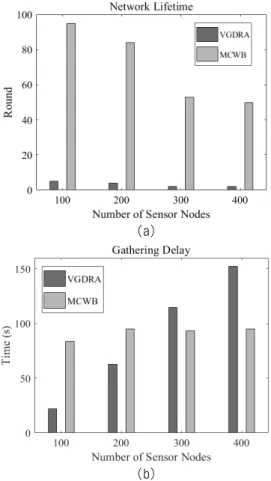
Table II, Fig. 2 (a), and Fig. (b) compare the lifetime of network and data gathering delay, respectively. The longest lifetime and the shortest data gathering delay are bolded in Table II. It is intuitive that network systems with fewer sensor nodes have longer network lifetime and shorter data delay. We can see that the network lifetime of VGDRA is shortest. Note that the data delay of VGDRA is also shortest. This is because CHs that are closer to the collector not only transmit the data of its own subregion but also help transmit the data of other subregions or even the data of the whole region, which lead to these CHs consume much more energy thereby shorten the lifetime. The collector stays in one position and waits for CHs to transmit data to it on each round.
Rather than the collector visiting these CHs to aggregate data. Furthermore, the speed of data transmission is greater than the speed of the collector movement, then the data delay is lower.
However, as the number of sensor nodes increases, i.e.,
(a)
(b)
그림 2. (a) 센서 노드 수에 따른 네트워크 수명 성능 비교 (b) 센서 노드 수에 따른 데이터 수집 시간 성능 비교 Fig. 2 (a) performance comparison of network lifetime with
different number of sensor nodes and
(b) performance comparison of data gathering delay with different number of sensor nodes
the size of data increases, the data delay of VGDRA also increases significantly and is greater than that of the proposed method from m = 300. The proposed MCWB can prolong the network lifetime as well as reduce data delay. Since their cluster heads are only responsible for the data aggregation in their respective subregions, and do not consume additional energy to forward data of other subregions. Also, the data collection tasks of each collector is balanced, and the trajectory of each collector is optimized, which effectively reduces data delay.
V. Conclusions
In this study, we study the multi-collector control for
workload balancing in wireless sensor and actuator
networks, thereby reducing the data gathering delay and
prolonging the network lifetime. First, the monitoring
region is equally divided into several subregions and each
subregion dynamically selects a sensor node as CH.
These can balance the energy consumption of sensor node, thereby prolonging the network lifetime. Then, a task allocation method based on genetic algorithm is proposed to evenly assign tasks to actuators. Finally, the trajectory of each actuator is optimized by ant colony optimization algorithm. These can reduce the data gathering delay. Simulations proved the proposed method performs better to extend network lifetime as well as reduce data gathering delay.
References
[1] N. Primeau, R. Falcon, R. Abielmona, E. M. Petriu. “A Review of Computational Intelligence Techniques in Wireless Sensor and Actuator Networks”. IEEE Communications Surveys Tutorials, Vol. 20, No. 4, pp.
2822–2854, 2018.
[2] David Jea, Arun Somasundara, Mani Srivastava.
“Multiple Controlled Mobile Elements (data mules) for data Collection in Sensor Networks”. International Conference on Distributed Computing in Sensor Systems, pp. 244–257, 2005.
[3] J. Faigl, G. A. Hollinger. “Autonomous data Collection Using a Self-organizing map”. IEEE Transactions on Neural Networks and Learning Systems, Vol. 29, No. 5, pp. 1703–1715, 2018.
[4] Abdul Waheed Khan, Abdul Hanan Abdullah, Mohammad Abdur Razzaque, and Javed Iqbal Bangash.
“VGDRA: a Virtual Grid-based Dynamic Routes Adjustment Scheme for Mobile Sink-based Wireless Sensor Networks”. IEEE Sensors Journal, Vol. 15, No. 1, pp. 526–534, 2014.
[5] M. Abo-Zahhad, S. M. Ahmed, N. Sabor, S. Sasaki.
“Mobile Sink-based Adaptive Immune Energy-efficient Clustering Protocol for Improving the Lifetime and Stability Period of Wireless Sensor Networks”. IEEE Sensors Journal, Vol. 15, No. 8, pp. 4576–4586, 2015.
[6] Olayinka O. Ogundile, Attahiru S. Alfa. “A Survey on
an Energy Efficient and Energy-balanced Routing Protocol for Wireless Sensor Networks”. Sensors, 10;17(5):1084. doi: 10.3390/s17051084, 2017.
[7] M. Zhao, Y. Yang, C. Wang. “Mobile data Gathering with load Balanced Clustering and Dual data Uploading in Wireless Sensor Networks”. IEEE Transactions on Mobile Computing, Vol. 14, No. 4, pp. 770–785, 2015.
[8] S.N. Sivanandam, S.N. Deepa. “Genetic Algorithm Optimization Problems”, pp. 165–209. Springer Berlin Heidelberg, Berlin, Heidelberg, 2008.
[9] Thomas Stutzle, Marco Dorigo. “ACO Algorithms for the Traveling Salesman Problem”. Evolutionary algorithms in engineering and computer science, Vol. 4, pp. 163–183, 1999.
Yamin Han
2017 University of Jinan, China (M.S.) 2021 Dept. Computer Science, University of
Suwon, Korea (Ph. D.)
2021~National Supercomputing Center, China ( Ph. D.)
Field of Interests: Network modeling, Intelligent computing and Machine learning.
Email: [email protected]
Heejung Byun (변 희 정)
2005 Electrical Engineering & Computer Science from KAIST (Ph.D.) 2010 SAIT, Samsung Electronics (Senior
Researcher)
2010~Dept. of ICT, University of Suwon (Associate Professor)
Field of Interests: Wireless sensor actuator network, molecular communication, network controller design & theoretical analysis.
Email: [email protected]