I. Introduction
Soil Moisture (SM) is defined as restrained water within the pores of soil particles against gravity (Engman, 1995). Despite the fact that soil moisture only makes up 0.15% of global fresh water (Dobriyal et al., 2012), it serves as an essential variable for hydrological management (Jackson et al., 1981) and for understanding the energy balance of terrestrial water (Dorigo et al., 2012; Engman, 1995) in both global and regional climate scales models (Anderson and Croft, 2009).
The ground-based direct measurement is the most
reliable approach for determining soil moisture content in terms of its accuracy (Dobriyal et al, 2012). Time Domain Reflectrometry (TDR) is one of the modern techniques for observing water content in the soil using electrical conductivity from coupled metallic rod probes, and the device has ±1% margin of error (Dobriyal et al., 2012; Jackson et al., 1981). However, the limitation of consistency in spatial and temporal variability on a large scale remains a challenge (Engman, 1995). The advent of spaceborne remote sensing and the development of sensors and algorithms since the late 1970s (Wagner et al., 2009) have become
Approximate estimation of soil moisture from NDVI and Land Surface Temperature over Andong region, Korea
Hyunji Kim, Jae-Hyun Ryu, Min Ji Seo, Chang Suk Lee and Kyung-Soo Han
†Department of Spatial Information Engineering, Pukyong National University
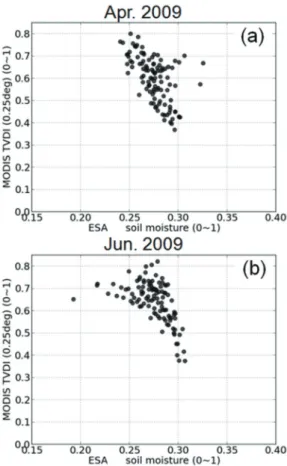
Abstract : Soil moisture is an essential satellite-driven variable for understanding hydrologic, pedologic and geomorphic processes. The European Space Agency (ESA) has endorsed soil moisture as one of Climate Change Initiates (CCI) and had merged multi-satellites over 30 years. The 0.25 ˚ coarse resolution soil moisture satellite data showed correlations with variables of a water stress index, Temperature-Vegetation Dryness Index (TVDI), from a stepwise regression analysis. The ancillary data from TVDI, Land Surface Temperature (LST) and Normalized Difference Vegetation Index (NDVI) from MODIS were inputted to a multi-regression analysis for estimating the surface soil moisture. The estimated soil moisture was validated with in-situ soil moisture data from April, 2012 to March, 2013 at Andong observation sites in South Korea. The soil moisture estimated using satellite-based LST and NDVI showed a good agreement with the observed ground data that this approach is plausible to define spatial distribution of surface soil moisture.
Key Words : Soil Moisture, Temperature-Vegetation Dryness Index (TVDI), NDVI, LST
Received June 19, 2014; Revised June 24, 2014; Accepted June 24, 2014.
†