The Study of social factors toward Academic Satisfaction in E-Learning Education
1)Kyung-Woo Kim *
Abstract
This paper investigates the empirical implications. The research question of this study is to verify the influences of psychological and environmental factors toward performance satisfaction and durability of learning in E-Learning University. For empirical verification, a survey was conducted targeting 500 students in E-learning Universities. The results show that actional environment on academic satisfaction in learning is the most important factor followed by physical environment, internal motivation, and academic burnout. The effect of psychological factors on learning persistence was important in the order of academic vision, internal motivation, actional environment and physical environment. The effect of academic satisfaction on learning durability proved to be statistically significant. The results suggest that actional environment should be considered with top priority to increase the academic satisfaction. learning satisfaction, academic vision, and academic satisfaction to enhance students' intention to continue studies are important. Academic burnout has a negative effect on both academic satisfaction and learning persistence, suggesting that this aspect should be properly addresses. The effects of student background variables in E-learning were explored.
▸Keyword :E-Learning education, psychological and environmental factors , internal motivation and attachment, actional environment, academic satisfaction, academic burnout
I. Introduction
The era of smart, the evolution of e-learning is only expected to speed up. Now is the world where people can meet various forms of educational contents that links around the world through various wired and wireless device.[1] Also, as it will be shared and spread through various SNS, the quality of e-learning contents will be
get better.[2] This study aims to verify the effects of learner's psychological and academic environmental factors on learning satisfaction and is intended to investigate the degree to which interaction and other predictors contribute to student satisfaction in online learning status. Based upon this, to identify the factors affecting academic satisfaction and learning durability.
∙First Author : Kyung-Woo Kim, Corresponding Author: Kyung-Woo Kim
*Kyung-Woo Kim([email protected]), Dept. of Addiction Rehabilitation with Social Welfare, Eulji University
∙Received: 2016. 10. 05, Revised: 2016. 10. 13, Accepted: 2016. 10. 25.
Academic leaders in Korea. indicated that online learning is critical to the long-term growth of long life educational institutions, reporting that the increase in demand for online courses or programs is greater than that for face-to-face courses. It is worthwhile to investigate student satisfaction in online settings because new technologies have altered the way that students interact with instructors and classmates (Kaminski, Switzer, &
Gloeckner, 2009).[3] [7] This study investigated factors (i.e., the influences of psychological and environmental factors toward performance satisfaction and durability of learning in On-Line University.) associated with student satisfaction in fully online learning settings.
II. Related Study
The intrinsic motivation helps learners have enthusiasm and passion for learning, which in turn affect academic performance.[4] [5] In a learning environment, self-efficacy is the confidence and courage to establish academic plans and pursue the goals. Intrinsic and self-efficacy are more important in On-Line learning where learner need
to study for themselves. [6][7] The results of studies demonstrate that may students' learning through cyber classes are likely to decide to quit studying during the course due to personal factors. [8]
Environmental factors have effects on students' cognitive feature, creativity, academic achievement and act as important factor in forming behavioral patterns such as self-concept, attitude, interest, and personality.
[9] academic satisfaction proved to be important factors in evaluating academic performance. Learning attachment refers to learners' continued involvement until they achieve the academic goals in some specific educational institutions or courses or complete them successfully.
[10]
Ⅲ. Research Methods
1. Respondents
This study targeted the students in the first term of 2016, in On-Line learning Universities. A questionnaire survey was conducted through the site of the school June 1 till June 20, 2016. The data collected from respondents were processed. As for the demographics of the respondents, there were more male students (270)than female students(230) in 500 cases.
2. Research measures
The psychological and envionmental factor shown that students’ cognitive engagement can be altered by various elements in the learning environment design such as factors related students’ perceptions of teaching quality, characteristics of tasks and learning activities, teachers’
behaviors during instruction, classroom goal structures, the integration of student oriented learning, action learning, problem-based learning, and constructivist learning, and academic disciplines.
Satisfaction and adhesion of E-learning were to explain adult learners' intrinsic value and academic self-efficacy as predictors of learning persistence, satisfaction, and academic achievement in e-learning environment. This study was based on a web survey 500 of in On-Line learning Universities in 2016. The analysis results of the study are as follows: The results showed that only intrinsic value meaningfully expected academic persistence and satisfaction after the prediction analysis of intrinsic value and academic self-efficacy toward academic persistence, satisfaction and academic achievement. On the other hand, both intrinsic value and academic self-efficacy didn't predict academic achievement. And satisfaction was revealed as a meaningful predictor for academic persistence, while academic achievement didn't predict academic persistence. Based on these results, this study suggested e-learning strategies to improve adult learners' satisfaction, as well as to strengthen intrinsic value. The strategies related with intrinsic value were presented with the categories of objectives, tasks, instructional design and environment, and teaching-learning activities.
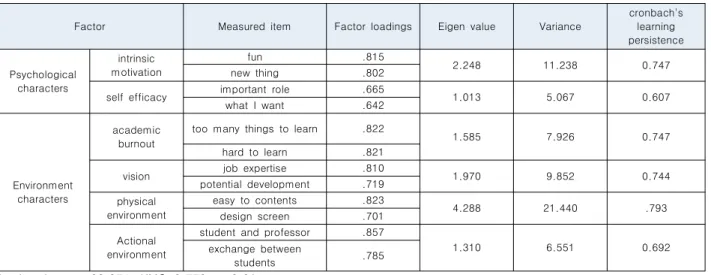
Factor Measured item Factor loadings Eigen value Variance
cronbach's learning persistence
Psychological characters
intrinsic motivation
fun .815
2.248 11.238 0.747
new thing .802
self efficacy important role .665
1.013 5.067 0.607
what I want .642
Environment characters
academic burnout
too many things to learn .822
1.585 7.926 0.747
hard to learn .821
vision job expertise .810
1.970 9.852 0.744
potential development .719 physical
environment
easy to contents .823
4.288 21.440 .793
design screen .701
Actional environment
student and professor .857
1.310 6.551 0.692
exchange between
students .785
Ⅳ. Research Findings
Table 1. Verification of the validity and the reliability of independent variables
Total variance : 62.074, KMO=0.773 *p,0.01
As a result of the exploratory factor analysis of the environmental characteristics, an independent variable of this study, academic burnout, academic vision, physical environment, and actional environment proved to have conceptual validity, respectively. Furthermore, when considering cronbach's learning persistence value(academic value.747, academic vision .744 physucal environment .793, and actional environment .692), it is through that
there is internal consistency. The findings from KMO and Bartlett to identify the suitability of samples for a factor analysis showed they are statistically significant(p<.001)(see Table 1)
Correlation between psychological characters, environmental characters, academic satisfaction and learning persistence was as follows.
The findings of the analysis of the correlation between independent variables(psychological characteristics, scholastic factor of the students in cyber universities) and dependent variables (academic satisfaction and persistence) are exhibites. Intrinsic motivation have correlation with academic
satisfaction(r=.303)and learning
persistence(r=.389)(p<.05)
Table 2. Correlation between independent variables and dependent variables
im se fv ef al ls la
im 1
se .572* 1
fv .267* .340* 1
ef .244* ..246* .278* 1 al .220* .224* .322* .544* 1 ls .312* .295 .296* .538* .678* 1 la .387* .348* .423* .372* .383* .477* 1 (R**2: .436, adjustment R**2: .424, DW: 1.587)
* im(internal motivation), se(self efficacy), fv(future vision), ef(environmental factor), al(actional learning), ls(learning satisfaction), la(learning attachment)
Environmental factor has correlation with learning attachment, especially with satisfaction factor.
Actional factors, in common with environmental factor have the higher correlation with satisfaction
factor than learning attachment.
this study suggested e-learning strategies to improve adult learners' satisfaction, as well as to strengthen intrinsic value. The strategies related with intrinsic value were presented with the categories of objectives, tasks, instructional design and environment, and teaching-learning activities.
Table 3. Effect of psychological and environmental factors on satisfaction
class B S.E ß t p F VIF
Contant -.125 .298 -.421 .674
im .127 .056 .101 2.244 .024*
60.13 1.434
se .100 .064 ..072 1.603 .107 1.544
fv .026 ..043 .025 .574 .566 1.278
ef 2.75 .056 .223 4.773 .000** 1.466
al .572 .052 .523 11.272 .000* 1.478
R2 = .54..Revised R2=.54 *p<0.05, **p<0.01
The results showed the accountability of psychological factor and environmental factors on satisfaction was 54%, of 5 independent variables, motivation influence environment and actional factor influences satisfaction.
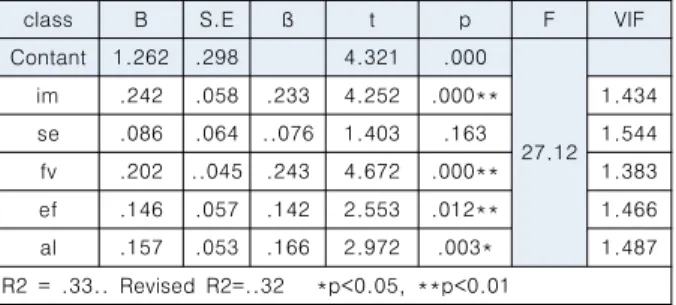
Table 4. Effect of psychological and academic factors on learning attachment factors on satisfaction
class B S.E ß t p F VIF
Contant 1.262 .298 4.321 .000
27.12
im .242 .058 .233 4.252 .000** 1.434
se .086 .064 ..076 1.403 .163 1.544
fv .202 ..045 .243 4.672 .000** 1.383
ef .146 .057 .142 2.553 .012** 1.466
al .157 .053 .166 2.972 .003* 1.487
R2 = .33.. Revised R2=..32 *p<0.05, **p<0.01
The results showed the accountability of psychological factor and academic factors on satisfaction was 33%, of 5 independent variables,
Table 5. Effect of satisfaction factor on learning attachment
B S.E ß t p F
constant 2.72
2 .155 17.4
32 .000
90.93**
l.satisfaction .386 .043 .477 9.55 5
.000*
*
R2 = .23. Revised R2=.23
Ⅴ. Conclusion
This study aims to empirically verify the effects of the psychological factors environmental factors on satisfaction and attachment, targeting cyber or digital
schools. Based on the findings as above, the followings can be suggested to improve the satisfaction factor and learning attachment of the students in cyber education.
First, female students who have low level of satisfaction factor will be the target group to improve the satisfaction in cyber education.
Second, learning vision of psychological factors and environmental factors proved to be a factor that had the greatest effect on attachment, which implies that there is less likelihood the students would quit in the middle if the student have higher future vision. Fourth, this study has significance in that it addressed learning satisfaction which has been seldom delt with as an independent variable affecting academic satisfaction learning attachment in on line education institutions that produce more dropouts than offline educations institutions. The fact has significance in that it has addresses the explanatory variables to be managed to improve the academic satisfaction and learning attachment of the learning students in E-Learning schools comprehensively and identified the importance of interaction, future vision. and Open educational resources have great potential and their use can ensure quality teaching and learning, but the activity has not inspired the great mass of higher education teachers in Universities.
Further the studies that discover a wide range of variables with significance among individual psychological factors and environmental factors and include them are required.
REFERENCES
[1] Aragon, S.R. The influence of learning style preferences on student success in online versus environment .The American Journal of Education Vol. 16, No. 3, pp.
219-232, March 2005.
[2] Chute, A., Thompson The McGraw-Hill Handbook of Distance Learning , NY: McGraw-Hill ,2013.
[3] Lim, y. W., Prediction of Academic Persistence, Satisfaction and Academic Achievement of adult e-learners According to Institute Value and Academic Self-Efficacy, Korea HRD Research, 5(4), pp.49-67, 2010
[4] Khan, B. H. , Web Based training: An instruction , In
B.H. Khan(Ed.) Web-based Instrument Englewood Cliffs, NJ: Educational Technology Publications, pp.5-12, 2001.
[5] Martiinez, M., High attrition rate in e-learning : Challenges, Predictors, and solutions, The e-learning Developers Journal, 1-7, 2009.
[6] Moore, MG., & Kearsley , G. Distance education: A system view : Belmont, CA: Wardsworth Publishing Company, 2000.
[7] Kaminski, K., Switzer, J., & Gloeckner, G.. Workforce readiness: A study of university students’ fluency with information technology. Computers & Education, 53(2), 228-233, 2009.
[8] Pike, G. R.. The relationship between perceived learning and satisfaction with college: An alternative view.
Research in Higher Education, 34(1), 23-40, 2010.
[9] Schunk, D.H.. Goal and self-evaluative influences during children's cognitive skill learning. American Educational Research Journal, 33, 359-382, 2012.
[10] Wilson, K., & Fowler, J.. Assessing the impact of learning environments on students’ approaches to learning:
comparing conventional and action learning designs.
Assessment and Evaluation in Higher Education, 30(1), 87-101, 2009.
Authors
KYung Woo Kim received the B.S., M.S.
and Ph.D. degrees in Public Administration from Kook Min University, Korea, in 1985, 1988 and 1992, respectively.
Dr. Kim joined the faculty of the faculty of the Department of Addiction Rehabilitation with Social Welfare at Eulji University, Seoul, Korea, in 1992.
He is currently a Professor in the Department of Addiction Rehabilitation with Social Welfare, Eulji University. He is interested in welfare information system, internet and mobile game addiction prevention and management Information system.