http://dx.doi.org/10.7471/ikeee.2012.16.2.127 59
(127)
Single Balanced Monolithic Diode Mixer using Marchand Balun for Millimeter-wave Applications
Keun-Kwan Ryu
*, Sung-Chan Kim
*★Abstract
In this paper, we reported on a single balanced monolithic diode mixer using Marchand balun for millimeter-wave applications. The single balanced monolithic mixer was fabricated using drain-source-connected pseudomorphic high electron mobility transistor (PHEMT) diodes considering the PHEMT MMIC full process. The average conversion loss is 16 dB in the RF frequency range of 81 ~ 86 GHz at LO frequency of 75 GHz with LO power of 10 dBm. The RF-to-LO isolation characteristics are greater than -30 dB and the total chip size is 1.0 mm × 1.35 mm.
Key words : diode mixer, marchand balun, single balanced mixer, millimeter-wave, PHEMT
* Dept. of EE, Hanbat National University
★
Corresponding Author : Sung-Chan Kim;
[email protected]
* Manuscript received May 22, 2012;
accepted June 11, 2012 논문번호 12-02-10
I. Introduction
Mixer is one of the fundamental blocks in order to realize various systems in millimeter-wave applications. Although millimeter-wave mixer techniques are well developed, the high performance monolithic mixer is still popular research topic.
Especially, diode mixers with the single balanced configuration have been developed continuously
[1-4]. Even though the single balanced diode mixers have several serious limitations, they are used in many millimeter-wave systems due to their advantages such as simplicity of circuit structure compared with double balanced configuration and good RF-to-LO isolation characteristics. One of the major disadvantages of single balanced mixer is difficulty in injecting LO while still able to isolate the IF signals in the network due to their circuit geometry.
This isolation can be achieved by using filters.
In the single balanced diode mixers, the RF and the LO signals are mutually isolated due to their circuit geometry including 90° hybrid or 180° hybrid structure. Among the various hybrid structures, Marchand baluns are very useful in millimeter-wave applications because they have a wide bandwidth characteristic.
In this paper, we presented the high performance
monolithic single balanced diode mixer which can be
used as an up-converter as well as down-converter
in the RF and LO frequency range of 70 ~ 90 GHz
with IF bandwidth of 15 GHz. For this, we used
two diodes, three-coupled line Marchand balun, and
IF low pass filter. Diodes are conventionally
implemented by drain-source-connected pseudomorphic
high electron mobility transistor (PHEMT) diodes
considering the PHEMT MMIC full process on 2
mil thick GaAs substrate. A lot of core circuits
used various millimeter-wave applications are
microwave monolithic integrated circuits (MMICs)
with microstrip topology on 2 or 4 mil thick GaAs
substrate. Besides, PHEMTs are very attractive for
MMICs and widely used in development of MMIC
for millimeter-wave applications.
60
(128)
전기전자학회 논문지 (Journal of IKEEE) Vol. 16. No.2
II. Circuit Design
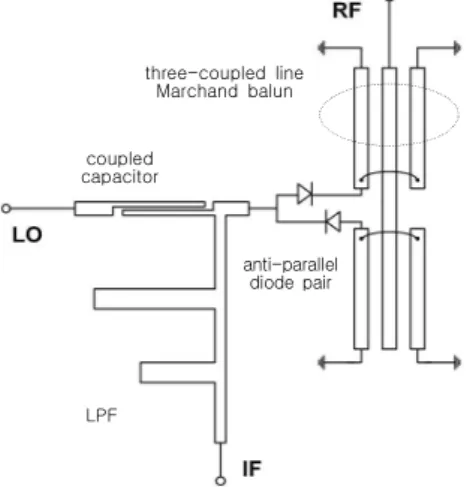
The circuit diagram of the developed single balanced monolithic diode mixer in this work is shown in Fig. 1. The single balanced diode mixer consists of anti-parallel diode pair, three-coupled line Marchand balun, coupled capacitor, and low pass filter. The design requires no external bias and can be used as an up-converter and as a down-converter in the frequency range of 70 ~ 90 GHz.
Conventional Marchand balun with two quarter-wavelength edge-coupled lines has leakage electric field along the outer sides and it causes the performance degradation of the balun. Therefore three-coupled line Marchand balun was used to obtain good RF-to-LO isolation characteristic as well as low loss characteristics compared with conventional Marchand balun
[5]. In the simulation, the three-coupled line Marchand balun was designed on the GaAs substrate with a thickness of 50 ㎛ and a permittivity of 12.9. The widths of the inner and the outer strip are 20 ㎛ and 10 ㎛, respectively. A spacing of 12 ㎛ between coupled lines is chosen to achieve correct odd-mode impedance. The length of the balun is adjusted to achieve the desired center frequency of 80 GHz. Fig.
2 shows simulated insertion loss and phase difference of the balanced ports.
anti-parallel diode pair coupled
capacitor
LPF
three-coupled line Marchand balun