이산화탄소와 온도 그리고 한발 영향에 따른 감자의 생육과 수량반응
이윤호⋅조현숙⋅김준환⋅상완규⋅신평⋅백재경⋅서명철*1) 농촌진흥청 국립식량과학원 작물재배생리과
(2018년 3월 30일 접수; 2018년 5월 29일 수정; 2018년 6월 5일 수락)
Effect of Carbon Dioxide Concentration, Temperature, and Relative Drought on Growth Responses and Yield in Spring
Potato (Solanum tuberosum L.)
Yun-Ho Lee, Hyeoun-Suk Cho, Jun-Hwan Kim, Wan-Gyu Sang, Pyong Shin, Jae-Kyeong Baek and Myung-Chul Seo
*Crop Physiology and Production, National Institute of Crop Science, Rural Development Administration, 181, Hyeoksin-ro, Iseo-myeon, Wanju-gun, Jeollabuk-do 55365, Republic of Korea
(Received March 30, 2018; Revised May 29, 2018; Accepted June 5, 2018)
ABSTRACT
Agriculture is strongly influenced by climate change such as increased temperature and carbon dioxide (CO
2). This study describes the effects of climate change elevated CO
2, temperature, and relative drought on growth responses and yield in potato (Solanum tuberosum L.). The assessment was conducted for spring seasons in Soil-Plant-Atmosphere Research (SPAR) chamber at National Institute of Crop Science (NICS). Potatoes exhibit a positive response to CO
2enrichment but water stress primarily reduces potato canopy and tuber yield. Elevated CO
2and temperature increased both dry weight and tuber yield.
Elevated CO
2and temperature influenced SPAR 2 plants to a larger, and tuber increased yield up to 28% of than in SPAR 1(30-year average temperature at 450 ppm of CO
2). Our study findings indicate that tuber yield increase in potato under high CO
2concentration was due to an increase in the size of individual tubers rather than in the number of the tubers per plant. On other hand, SPAR 3(30-year average temperature +2.8℃ at 700 ppm of CO
2under water stress) was lower than SPAR 2(30-year average temperature +2.8℃ at 700 ppm of CO
2) nearly 56% of tuber yield due to drought. The results confirm potato drought sensitivity in terms of yield response. The experiment also showed that, in the conditions of climate change, climate change scenarios that improve cropping systems with potato.
Key words: Climate change, Carbon Dioxide, Temperature, Drought, SPAR Chamber, Potato
* Corresponding Author : Myung-Chul Seo ([email protected])
DOI: 10.5532/KJAFM.2018.20.2.149
ⓒ Author(s) 2018. CC Attribution 3.0 License.
Ⅰ
. 서 론대기중의 이산화탄소(CO2)농도는 하와이 마우나로 아에서 관측을 시작 이래 계속적으로 증가하고 있는 추세이며 2017년 8월 404 ppm을 기록하였다(NOAA, 2017). 이산화탄소 증가로 인한 적외선의 흡수 증가로 평균기온이 지속적으로 상승하고 있는 가운데 우리나 라의 2016년 평균 기온도 30년 평년보다 1.1℃ 높아 1973년 이래 최고 1위를 기록하였다(CIP, 2017). 이러 한 기후변화로 2017년 봄 고온현상과 무 강수일이 장 기화되면서 30년 평년대비 30%로 28.5 mm의 낮은 강 수량으로 심각한 가뭄이 발생을 하였다(KMA, 2017).
우리나라의 감자(Solanum tuberosum L.)는 봄감자 와 고령지감자(여름감자) 그리고 가을감자로 재배 되 고 있으며, 2016년 전체 재배 면적의 22,000ha중 60%
이상이 봄감자 재배가 차지하고 있다. 그러나 2017년 이상기상으로 인해 봄감자 재배면적은 14,943ha으로 2016년 15,259ha보다 2.1% 감소 하였고, 2017년 생산 량은 321,518ton으로 2016년 393,670ton 대비 18.1%
감소를 하였다(KOSIS, 2017).
감자는 대표적인 C3식물로 CO2농도에 매우 효과적 으로 반응을 하여 단위 엽면적과 단위시간의 건물중인 순동화가 증가한다(Wheeler et al., 1999; Fleisher et
al., 2008a). 특히 CO
2 상승에 따라(370 μmol mol-1대 740 μmol mol-1) 건물중과 수량이 27∼49%가 증가 되었다(Schapendonk et al., 2000; Fleisher et al., 2008a; Fleisher et al., 2008b).일부 연구에서는 현재의 CO2 농도보다 20∼100%
증수 시 건물중과 수량 그리고 수분 이용효율을 향상 시킬 수 있다(Wheeler et al., 1994; Tardieu, 2012).
그러나 C3식물은 고온인 45℃ 이상에서는 루비스코 활동이 저해되면서 광합성이 줄고 광호흡이 증가하게 된다(Yamori et al., 2005; Yamori et al., 2014). 감자 는 가뭄과 같은 비생물적 스트레스에 매우 민감하게 반응하는 작물이다. 봄감자 재배에 있어서 물을 가장 많이 필요로 하는 5월 초순이 괴경비대기이다. 이 기 간에 가뭄이 발생하게 되면 생육 부진하게 되어 괴경 의 생산성이 떨어질 수 있다. 가뭄 피해 받으면 군락형 성과 생산성에 제한을 주어 괴경비대를 지연 시킨다 (Lahlou et al., 2003). 형태적으로 건물중, 괴경 무게 그리고 엽면적이 감소하게 된다. 또한 생리적으로 잎 의 체내에 기공 전도도가 감소하여 CO2의 흡수가 어 려워져 광합성 능력이 낮아지고 질소 흡수와 엽록소
함량이 감소하게 된다(Obidiegwu et al., 2015; Xu et
al., 2009).
기후변화와 관련하여 지난 몇 년 동안 다양한 챔버 로 CO2농도와 온도 그리고 한발처리에 의한 감자 생 육반응과 모형 개발이 활발하게 연구되고 있다 (Miglietta et al., 1998; Long et al., 2004; Fleisher
et al., 2013; Kaminski et al., 2014).
지구온난화에 따른 이상기상 발생 확률이 높아 지면 봄감자의 생육반응과 생산능력은 변화 될 것 이다. 본 연구는 급변하는 기후변화를 대비하기 위 한 한국의 봄감자 재배에 대한 평가로 자연환경과 유사하게 군락을 형성 할 수 있는 옥외환경조절시 설(Soil-Plant-Atmosphere-Research: SPAR)을 활용하 여 CO2농도, 온도, 습도 그리고 수분 등을 제어하였다 (Reddy et al., 2001). 특히, 봄 감자 재배기간 동안 현재 기후와 미래 기후를 가정하여 상승된 CO2농도와 온도에 따른 감자의 발육과 생장 반응 그리고 일정기간 한발을 유발 시켜 수량에 미치는 요인을 평가 하고자 한다.
Ⅱ
. 재료 및 방법2.1. 옥외환경조절시설(SPAR)
본 연구는 국립식량과학원(35°84’34”N, 127°04’84”E) 옥외환경조절시설에서 플렉시 글라스(Evonik Industries, Essen, Germany) 재질로 된 SPAR챔버 2 m × 0.95 m
× 2.25 m(너비 × 넓이 × 높이)에서 수행하였다. 봄감 자 대표 품종인 수미(Superior)로 모래 60%, 미사 30%
점토 10%의 사양토로 채워진 2 m × 0.78 m × 1.42 m (너비 × 넓이 × 높이) 토양 통에 3월 23일에 파종을 하였다. 시비 관리를 위해 파종 전에 각 SPAR챔버와 노지에 N-P2O5-K2O를 10-8.8-13 kg/10a를 전량 시비 하였다. 재배기간 동안 FDR(Soil Moisture Sensor, Senkek, Australia)센서로 토양 수분과 지온을 측정하 였다. 각 SPAR챔버에 CO2센서(LI-820, LI-COR Biosciences, Inc., Lincoln, USA)를 싱글빔인 2파장 비분산형 근적외선분석계(NDIR)를 설치하여 24시간 CO2 흡입과 배출을 측정을 하였다. 대기의 온도 (TRH-300, Rixen, Taiwan)와 일사량(SQ-215, Aporee, Inc., USA) 및 CO2농도(Gas detector, DA-100. EX EXd IIC T5, South Korea)는 SPAR챔버로부터 약 10m 내에 설치하여 실시간 측정을 하였다. 강수량은 농촌진흥청 기상정보서비스(http://weather.rda.go.kr) 자료를 이용하였다.
Treatment Temperature Carbon Dioxide (CO2) Drought stress
SPAR 1z Max: 23.1℃/ Min: 7.6℃ 450 ppm No drought
SPAR 2y Max: 25.9℃/ Min: 10.9℃ 700 ppm No drought
SPAR 3x Max: 25.9℃/ Min: 10.9℃ 700 ppm With drought
Ambient Max: 24.4℃/ Min: 4.9℃ 436 ppm No drought
zSPAR 1: 30-year average (1980-2010 in Jeonju city) temperature at 450 ppm of CO2.
ySPAR 2: 30-year average (1980-2010 in Jeonju city) temperature +2.8℃ at 700 ppm of CO2.
xSPAR 3: 30-year average (1980-2010 in Jeonju city) temperature +2.8℃ at 700 ppm of CO2
under drought stress.
Table 1. Experimental condition of SPAR and ambient during the growing season
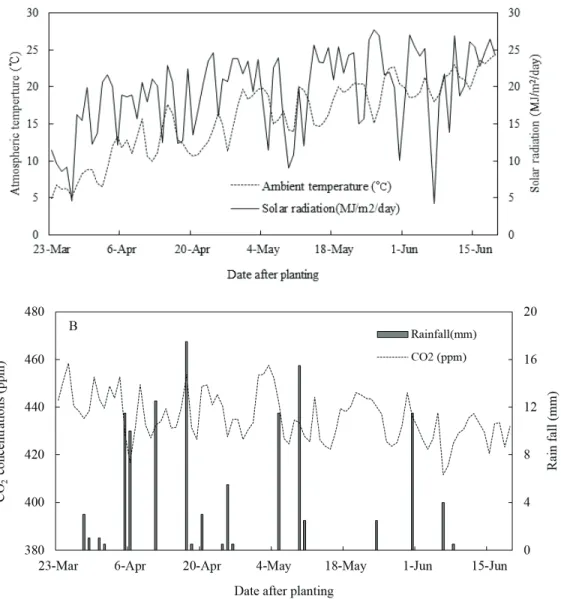
Fig. 1. Daily average atmospheric temperature and solar radiation (A), atmospheric CO
2concentrations and rainfall (B) during the growing season.2.2. SPAR챔버와 노지환경
재배기간 동안 각 SPAR챔버의 환경 제어는 Table 1과 같다. SPAR 1은 전주 30년(1980∼2010) 일일 온 도 평균과 CO2농도 450는 ppm으로 처리하였다.
SPAR 2와 3은 RCP8.5(2050년) 기후변화 시나리오에 근거하여 온도는 전주 30년(1980∼2010) 일일 평균 온도 대비 2.8℃를 높이고 CO2농도는 700 ppm으로 처리하였다. 모든 챔버의 관수는 파종 후 3∼4일 간격 으로 5 L∼10 L씩 공급을 하였으며, SPAR 3은 파종 후 45일 이후부터 약 21일간 단수 처리를 하였다. 노지 는 자연상태로 재배하였다.
재배기간 동안의 노지의 평균 온도는 15.8℃로 SPAR 1은 노지에 비해 0.3℃ 높았고, SPAR 2와 3은 노지보다 3.1℃ 높았다. 재배기간 동안의 평균 일사량 은 19.3(MJ/m2/day)이었고 대기 중의 CO2농도는 평균 436 ppm으로 일변화에 따라 다소 차이를 보였다(Fig.
1A). 총 강수량은 115 mm로 2016년 대비 36.5% 감소 를 하였고 같은 기간 동안 무 강수일은 69일을 기록하 였다(Fig. 1B).
2.3. 생육 조사
생육 반응을 비교하기 위해 파종 후 30일부터 84일 까지 5일∼7일 간격으로 초장과 측지수 그리고 경수 를 10개체씩 조사하였다. 엽록소 분석은 엽록소 측정 기(CCM-300, Opti-sciences, USA)로 이용하였다. 수 량은 주 당 괴경수, 괴경 평균무게, 주당 경엽 무게를 조사하였다. 농촌진흥청 조사 기준에 근거 하여 상서 수량과 가공용 괴경 수량을 구하였고, 괴경 크기는 특 대서(151∼250g), 대서(81∼150g), 중서(51∼80g), 소 서(31∼50g), 설서(30>)로 분류를 하였다. 바이오매스 를 위해 수확된 식물체를 잎, 줄기 그리고 괴경으로
구분하여 70℃ 항온 건조기에 96시간 건조 후 측정을 하였다.
2.4. 탄소와 질소 분석
탄소와 질소분석은 N2O를 N2로 환원시켜 N2가스 의 부피를 측정하여 정량 하는 Dumas법으로 0.2g씩 칭량 후 원소분석기(Elementary, vario MAX cube., Germany)로 분석을 하였다.
2.5. 통계분석
연구 결과의 통계분석은 SAS 9.1(SAS Institute Inc., Cary, NC, USA) 통계패키지를 이용하여 수행하 였으며, ANOVA(P<0.05)로 유의성 분석을 하였다.
Ⅲ
. 결과 및 고찰3.1. 생물계절과 지온 및 수분함량
생물계절은 기온, 지온, 일장, 일사량, 토양 수분 등 다양한 환경 요인들의 상호작용에 의해 결정된다. 파 종 후 출현기까지 SPAR 1과 SPAR 2 그리고 SPAR 3은 12일이 소요 되었으며 노지에 비하여 약 6일 단축 되었다(Table 2). 같은 기간 동안 SPAR 1과 SPAR 2 그리고 SPAR 3의 평균 지온은 12.8℃로 노지보다 약 3.8℃가 높았다(Fig. 2A). 따라서 파종 후 출현기까 지의 소요 일수는 지온이 높을수록 단축되었다.
노지와 SPAR 1은 파종 후 53일에서 54일에 개화를 하였다(Table 2). 이 기간 동안 노지와 SPAR 1의 평균 온도는 각각 13.1℃와 13.2℃이었다. SPAR 2와 SPAR 3은 파종 후 42일에서 45일이 소요되었는데, 이 기간 SPAR 2와 SPAR 3의 평균 온도는 각각 14.8℃와 15.
0℃이었다. 저온 보다 고온의 개화가 약 9일에서 11일
Treatment Date of planting
Date of first emergence
Date to 80%
emergence
Date of flowering
SPAR 1z March.23 April.03 April.09 May.15
SPAR 2y March.23 April.03 April.11 May.03
SPAR 3x March.23 April.03 April.08 May.05
Ambient March.23 April.09 April.13 May.16
zSPAR 1: 30-year average (1980-2010 in Jeonju city) temperature at 450 ppm of CO2.
ySPAR 2: 30-year average (1980-2010 in Jeonju city) temperature +2.8℃ at 700 ppm of CO2.
xSPAR 3: 30-year average (1980-2010 in Jeonju city) temperature +2.8℃ at 700 ppm of CO2
under drought stress.
Table 2. Growth characteristics of potatoes under different growth condition
이 단축 되었다(Table 2). 개화기의 소요 일수는 온도 가 상승 할 수록 단축되었다.
괴경비대기에 토양 수분 부족은 수량 감소를 시킨 다고 하였다(Gudmestad, 2008). 따라서 감자재배에 있어서 토양 수분함량은 매우 중요하다. 재배 기간 동안의 토양 수분 함량은 지상부 발육에 따라 차이를 보였다. SPAR 1과 SPAR 2는 15% 이상 수분 함량
을 유지를 하였고, SPAR 3은 한발의 영향으로 파종 후 50일 이후부터 급속하게 감소를 하였으나 파종 후 75일 이후 재 관수로 수분 함량이 다소 올라 갔다 (Fig. 2B).
3.2. 지상부 생장반응
초장과 측지의 생장과 발달은 군락형성에 주요한
zSPAR 1: 30-year average (1980-2010 in Jeonju city) temperature at 450 ppm of CO2.
ySPAR 2: 30-year average (1980-2010 in Jeonju city) temperature +2.8℃ at 700 ppm of CO2.
xSPAR 3: 30-year average (1980-2010 in Jeonju city) temperature +2.8℃ at 700 ppm of CO2 under drought stress.
Fig. 2. Daily average soil temperature (A) and soil water contents (B) during the growing season.
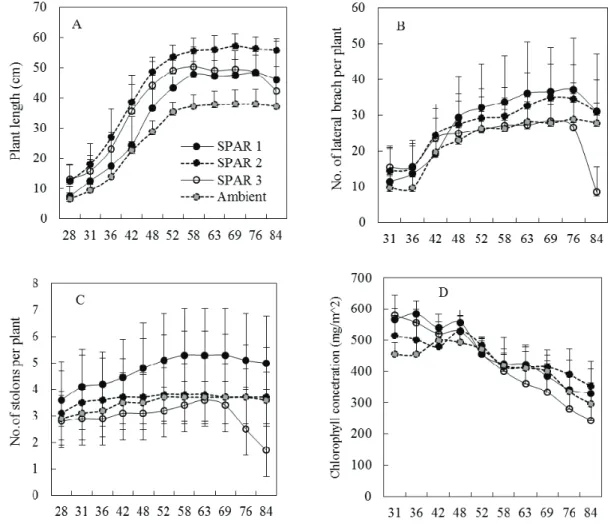
요인 중의 하나이다. 초장은 파종 후 52일 까지 지속적 으로 증가 하여 SPAR 2가 가장 높았고 그 다음 SPAR 3과 SPAR 1 그리고 노지순으로 높았다. 그러나 55일 이후부터 증가 폭이 높지 않았다(Fig. 3A). 감자는 CO2 농도와 충분한 수분을 공급하였을 때 광합성작용 에 의하여 동화산물의 축적으로 측지와 초장과 같은 지상부 발육이 증가 한다고 하였다(Sharkey et al., 2007; Fleisher et al., 2014). 측지 수는 파종 후 36일부 터 급격히 증가하였으나 생육 후기로 갈 수록 증가 폭이 낮았다(Fig. 3B). Choi et al.(2014)에 의하면 파
종 후 31∼50일 사이에 지상부 생육이 빠르게 진행되 는 시기라고 하였다.
경수는 SPAR 1이 다른 처리에 비하여 약 3∼5개 많았는데(Fig. 3C) 이는 파종 할 때 씨 감자의 크기가 커서 많은 것으로 판단된다. 이와 관련하여 씨 감자의 크기에 따라 경수에 영향을 준다고 하였다(Wurr, 1977; Haverkort et al., 1990). SPAR 3은 한발의 영향 으로 파종 후 76일부터 초장과 측지수가 감소하였다 (Fig. 3A and Fig. 3B). 괴경비대기의 한발은 초장과 측지 수를 감소 시키고 장기화로 이어지게 되면 경수
Days after planting
zSPAR 1: 30-year average (1980-2010 in Jeonju city) temperature at 450 ppm of CO2.
ySPAR 2: 30-year average (1980-2010 in Jeonju city) temperature +2.8℃ at 700 ppm of CO2.
xSPAR 3: 30-year average (1980-2010 in Jeonju city) temperature +2.8℃ at 700 ppm of CO2 under drought stress.
Fig. 3. Growth responses of tagged potatoes by growth condition. Plant length (A), the number of lateral branch
per plants (B), number of stolons per plant (C) and chlorophyll concentration (D). Each column and error bar represents the mean ± SD of ten replicates.까지 감소 시키는 것으로 보고된 바 있다(Fleisher et
al., 2008a).
재배기간 동안의 엽록소 변화는 모든 챔버에서 파 종 후 48일 이후에 감소를 하였다(Fig. 3D). 특히 SPAR 3은 파종 후 58일부터 급격히 감소를 하였는데, 수분 스트레스를 받게되면 감자의 엽록소 변화와 광합 성 능력이 빠르게 감소 한다는 보고와 일치하였다 (Anithakumari et al., 2011; Zhenming et al., 2017).
3.3. 건물 생산과 탄소 및 질소 흡수
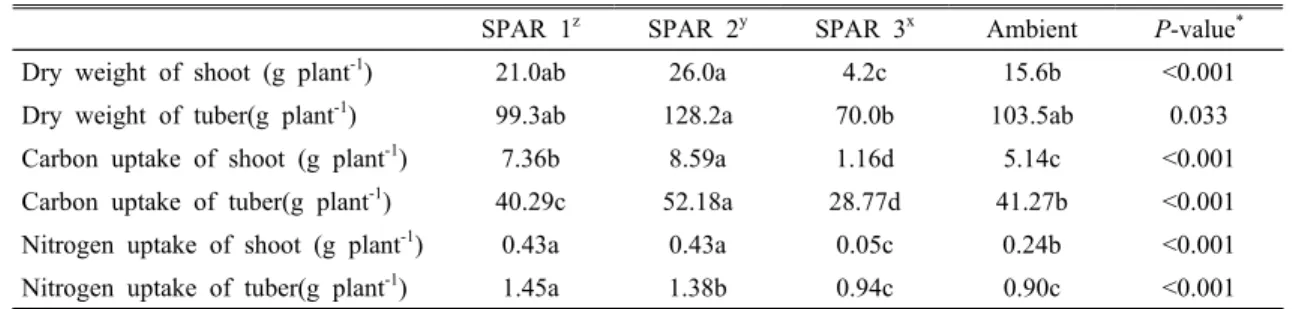
수량은 CO2의 흡수와 CO2 배출간의 차이인 식물체 에 의한 건물 생산으로 알 수 있다. 수확된 지상부와 괴경의 건물 중 결과는 Table 3에서 보는 바와 같이 지상부의 건물 중은 SPAR 2가 가장 높았고 그 다음으 로 SPAR 1과 노지 순이었으며 SPAR 3이 가장 낮았
다. 괴경의 건물중(P=0.033)은 한발을 받은 SPAR 3을 제외하면 통계적으로 큰 차이는 없는 것으로 나타났 다. Miglietta et al.(2006)에 따르면 상승된 CO2농도에 따라 괴경 무게와 건물 중이 증가 한다고 보고하였는 데, 본 연구도 이와 유사하게 상승된 CO2농도와 충분 한 수분공급 조건에서건물중이 증가를 하였다. 그러 나 일부 연구에서는 상승된 CO2농도에서 건물 중 증 가에 대한 효과가 나타나지 않았다고 보고하였다 (Morison and Lawlor, 1999; Sicher and Bunce, 1999;
Long et al., 2004).
식물체의 탄소와 질소 흡수량은 고 CO2농도인 SPAR 2가 가장 높았고 한발을 받은 SPAR 3이 가장 낮았다. 한발을 받게 되면 식물은 잎에서 이산화탄소 농도는 낮아지고 산소의 농도가 높아지면서 이산화탄소 의 고정 능력이 떨어지게 된다(Martin and Ruiztorres, SPAR 1z SPAR 2y SPAR 3x Ambient
P-value
* Dry weight of shoot (g plant-1) 21.0ab 26.0a 4.2c 15.6b <0.001 Dry weight of tuber(g plant-1) 99.3ab 128.2a 70.0b 103.5ab 0.033 Carbon uptake of shoot (g plant-1) 7.36b 8.59a 1.16d 5.14c <0.001 Carbon uptake of tuber(g plant-1) 40.29c 52.18a 28.77d 41.27b <0.001 Nitrogen uptake of shoot (g plant-1) 0.43a 0.43a 0.05c 0.24b <0.001 Nitrogen uptake of tuber(g plant-1) 1.45a 1.38b 0.94c 0.90c <0.001zSPAR 1: 30-year average (1980-2010 in Jeonju city) temperature at 450 ppm of CO2.
ySPAR 2: 30-year average (1980-2010 in Jeonju city) temperature +2.8℃ at 700 ppm of CO2.
xSPAR 3: 30-year average (1980-2010 in Jeonju city) temperature +2.8℃ at 700 ppm of CO2
under drought stress.
*The means in each columns followed by different letters are significant different (P<0.05).
Table 3. Plant dry weight, plant carbon, and nitrogen uptake of harvested potatoes by growth condition
SPAR 1z SPAR 2y SPAR 3x Ambient
P-value
* Tuber yield (g plant-1, A) 466±90 647±207 284±118 426±88 0.0005 Commercial yield (g plant-1, B) 294±159 494±216 171±162 271±96 0.0001 Commercial rate (%, B/ A) 66±15 75±10 55±31 63±13 0.175 Industrial yield (g plant-1) 182±91 350±161 79±98 162±90 <0.001Tuber number (plant-1) 15±8 13±4 10±6 12±3 0.234
Tuber weight (g plant-1) 34±10 52±16 32±11 37±3 0.0009
zSPAR 1: 30-year average (1980-2010 in Jeonju city) temperature at 450 ppm of CO2.
ySPAR 2: 30-year average (1980-2010 in Jeonju city) temperature +2.8℃ at 700 ppm of CO2.
xSPAR 3: 30-year average (1980-2010 in Jeonju city) temperature +2.8℃ at 700 ppm of CO2
under drought stress.
*The means in each columns followed by different letters are significant different (P<0.05).
Table 4. Tuber yield and commercial yield of harvested potatoes by growth condition
1992; Chaves et al., 2002). 이로 인해 광합성 능력이 떨어지고 광호흡이 증가 할 뿐만 아니라 건물중과 엽 면적이 감소를 한다고 하였다(Flesher et al., 2013).
3.4. 괴경 수량
수확된 감자의 수량과 상서 수량 결과는 Table 4와 같다. 주 당 평균 수량(P=0.005)은 SPAR 2가 647g로 가장 높았고 그 다음은 SPAR 1이 466g이고 노지가 426g 그리고 SPAR 3이 284g이었다. 주 당 상서 수량 (P=0.001)은 SPAR 2가 가장 높았고 SPAR 3이 가장 낮았다. 그러나 노지와 SPAR 1은 유의한 차이가 없 었다.
가공용 괴경 수량은 괴경당 81g 이상을 기준으로 SPAR 2(<0.001)가 가장 높았다. 처리간에 주 당 평균 괴경수(P=0.234)는 유의성이 나타나지 않았다. 그러 나 주 당 괴경 무게는 SPAR 2가 가장 높았다.
3.5. 괴경 크기
괴경 크기에 대한 결과는 Table 5와 같다. 모든 처리 에서 중서 개수는 차이가 없었으며, 대서개수는 한발 을 받은 SPAR 3을 제외하면 큰 차이를 보이지 않았다.
그러나 특대서에서 SPAR 2가 다른 처리에 비하여 높 았다. 이러한 결과 수량에 있어서 SPAR 1은 총 괴경 수가 많은데도 불구하고 괴경의 설서 비율이 높아 상 서 수량이 낮았다. 그러나 SPAR 2는 괴경의 중서와 특대서의 높은 비율로 인해 높은 수량을 보였다. 상서 수량의 증가는 CO2농도 상승에 의한 개체 당 괴경수 의 증가보다는 개체 당 괴경 크기에 의해 결정된다는 보고와 일치 하였다(Miglitta et al., 1998; Donnelly
et al., 2001; Högy and Fangmeier, 2009). 감자는 저온
성 작물로서 생장과 발육의 적정 온도는 12∼21℃ 사 이이다(Yamaguchi et al., 1964). 재배기간 동안 SPAR 2는 SPAR 1 대비 2.8℃ 고온인데도 불구하고 수량이 높았는데, 이는 괴경비대기에 적정 온도 범위와 CO2효과로 인해 수량이 증가된 것으로 판단된다.
적 요
본 연구는 지구온난화에 따른 봄 감자에 대한 상승 된 CO2농도, 온도 그리고 한발에 미치는 영향을 평가를 위해 국립식량과학원 옥외환경시설에서 수행을 하였 다. 감자는 C3식물로 상승된 CO2농도와 적정 온도에 효과적인 생육 반응을 하지만, 괴경비대기의 한발은 수량 증가를 억제 시킨다. 괴경 수량은 상승된 CO2농 도와 온도 그리고 한발 처리에 따라 상당히 유의한 차이를 보여 주었다. SAPR 2는 SPAR 1에 비하여 수 량이 28% 증가 되었는데, 생육기간 동안 SPAR 2는 CO2 효과와 적정온도로 주당 괴경수의 증가보다는 개 체당 괴경의 크기에 의해 수량이 결정 된 것으로 판단 된다. 한편 SPAR 3은 SPAR 2에 비하여 약 56% 수량 감소를 하였다. 괴경비대기의 한발은 형태적으로 간장 과 측지수의 감소와 건물중 생산에 저해를 주었다. 생 리적으로 엽록소와 질소 양분흡수을 감소시켜 결국 광 합성률 감소와 괴경으로 전류 되는 동화산물이 낮아지 면서 수량 감소 원인이 된 것으로 판단되었다. 따라서 향후 이상 기후 대응을 위해, 다양한 기후 조건에서 재배되는 감자의 생육을 파악하기 위한 기후변화 시나 리오 및 봄 감자의 작부체계 개선이 필요할 것으로
Treatment No. of tubers per 10 plants
< 30g 31∼50g 51∼80g 81∼150g 151∼250g > 251g
SPAR 1z 98 22 18 15 1 0
SPAR 2y 64 25 16 17 9 1
SPAR 3x 64 14 16 7 0 0
Ambient 63 22 17 11 3 0
P-value
* 0.013 0.425 0.976 0.075 <0.001 <0.001zSPAR 1: 30-year average (1980-2010 in Jeonju city) temperature at 450 ppm of CO2.̄
ySPAR 2: 30-year average (1980-2010 in Jeonju city) temperature +2.8℃ at 700 ppm of CO2.
xSPAR 3: 30-year average (1980-2010 in Jeonju city) temperature +2.8℃ at 700 ppm of CO2
under drought stress.
*The means in each columns followed by different letters are significant different (P<0.05).
Table 5. Distribution of harvested tubers size by growth condition
판단된다.
감사의 글
본 논문은 농촌진흥청 국립식량과학원 농업과학기 술 연구개발사업(과제번호: PJ012062)의 지원에 의해 이루어진 것임.
REFERENCES
Anithakumari, A. M., O. Dolstra, B. Vosman, R. F.
Visser, and G. V. D. Linden, 2011: In vitro screening and QTL analysis for drought tolerance in diploid potato. Euphytica 181, 357-369.
Basu, P. S., A. Sharma, I. D. Garg, and N. P.
Sukumaran, 1999: Tuber sink modifies photosynthetic response in potato under w ater stress.
Environmental and Experimental Botany 42, 25-39.
Bindi, M., F. Miglietta, E. Vaccari, V. Magliulo, and A. Giuntoli, 2006: Growth and quality responses of potato elevated [CO2]. Ecological Studies 187, 105-119.
Chaves, M., J. S. Pereira, J. Maroco, M. L.
Rodrigues, C. P. P. Ricardo, M. L. Osorio, I.
Carvalho, T. Faria, and C.Pinheiro, 2002: How plants cope with water stress in the field.
Photosynthesis and growth. Annals of Botany 89, 907-916.
Choi, S.U., A. S. Lee, S. J. Jeon, K. D. Kim, M.
C. Seo, W. S. Jung, J. H. Maeng, and I. J. Kim, 2014: Estimating the yield of potato Non-Mulched sing Climatic Elements. Korean Journal of Crop
Science 59, 89-96.
CIP (Climate information portal), 2017: The 2016 abnormal climate report. www.climate.go.kr/
Donnelly, A., J. Craigon, C. R. Black, J. J. Colls, and G. Landon, 2001: Elevated CO2 increases biomass and tuber yield in potato even at high ozone concentration. New phycologist 149, 265-274.
ESRL (Earth system research laboratory), 2018: ESRL Global Monitoring Division. (www.esrl.noaa.gov/gmd/
ccgg/trends/global.html)
Fleisher, D. H., D. J. Timlin, and V. R. Reddy, 2008a: Elevated carbon dioxide and water stress effects on potato canopy gas exchange, water use, and productivity. Agricultural and Forest
Meteorology 148, 1109-1122.
Fleisher, D. H., D. J. Timlin, and V. R. Reddy, 2008b: Interactive effects of carbon dioxide and
water stress on potato canopy growth and development. Agronomy Journal 100, 711-719.
Fleisher, D. H., J. Barnaby, R. Sicher, J. P. Resop, D. J. Timlin, and V. R. Reddy, 2013: Effects of elevated CO2 and cyclic drought on potato under varying radiation regimes. Agricultural and Forest
Meteorology 171-172, 270-280.
Fleisher, D. H., J. Barnaby, R. Sicher, J. P. Resop, D. J. Timlin, and V. R. Reddy, 2014: Potato gas exchange response to drought cycles under elevated carbon dioxide. Agronomy Journal 106, 2024-2034.
Gudmestad, N. C., 2008: Potato health from sprouting to harvest. Potato health management, D. A.
Johnson and M. L. Powelson (ed). APS Press, St.
Paul, Minnesota, USA, 67-77.
Haverkort, A., M.Vandewaart, and K. B. A.
Bodlaender, 1990: The effect of early drought stress on numbers of tubers and stolons of potato in controlled and field conditions. Potato Research
33, 89-96.
Högy, P., and A. Fangmeier, 2009: Atmospheric CO2
enrichment affects potatoes: 2. tuber quality traits.
European Journal of Agronomy 30, 85-94.
Kaminski, K. P., K. Korup, K. L. Nielsen., F. Liu, H. B. Topbjerg, H. G. Kirk, and M. N. Andersen, 2014: Gas-exchange, water use efficiency and yield responses of elite potato (Solanum tuberosum L) cultivars to changes in atmospheric carbon dioxide concentration, temperature and relative humidity. Agricultural and Forest Meteorology
187, 36-45.
Kim, Y. U., and B. W. Lee, 2016: Effect of high temperature, day length, and reduced solar radiation on potato growth and yield. Korean
Journal of Agricultural and Forest Meteorology 18, 74-87.
KMA (Korean meteorological administration), 2017:
http://hydro.kma.go.kr/drought/obsAdm.do
KOSIS (Korean statistical information service), 2017:
http://kosis.kr/index/index.jsp
Lahlou, O., S. Ouattar, and J. F. Ledent, 2003: The effect of drought and cultivar on growth parameters, yield and yield components of potato. Agronomie
23, 257-268.
Long, S. P., E. A. Ainsworth, A. Rogers, and D. R.
Ort, 2004: Rising atmospheric carbon dioxide:
plants FACE the future. Annual Review of Plant
Biology 55, 591-628.
Martin, B., and N. A. Ruiztorres, 1992: Effects of water-deficit stress on photosynthesis, its
components, and component limitations, and on water-use efficiency in wheat (triricum-aestivum L.).
Plant Physiology 100, 733-739.
Miglietta, F., V. Magliulo, M. Bindi, L. Cerio, F. P.
Vaccari, and A. Peressottis, 1998: Free air CO2
enrichment of potato (Solanum tuberosum L.):
Development, growth and yield. Global Change
Biology 4, 163-172.
Morison, J. I. L. and D.W. Lawlor, 1999: Interaction between increasing CO2 concentration and temperature on plant growth Plant Cell &
Environment 22, 659-682.
Obidiegwu, J. E., G. B. Bryan, H. G. Jones, and A.
Prashar, 2015: Coping with drought: stress and adaptive responses in potato and perspectives for improvement. Frontiers in Plant Science 6, 1-21.
doi:10.3389/fpls.2015.00542.
RDA (Rural Development Administration), 2018:
Agricultural weather service. (http://weather.rda.go.kr) Reddy. K. R., H. F. Hodges, J. J. Red, J.M.
Mckinion, J. T. Baker, L. Trapley, and V. R.
Redd, 2001: Soil-plant-atmosphere-research (SPAR) facility: A tool for plant research and modelling.
Biotronics 30, 27-50.
Schapendonk, H. C. M., M. van. Oijen, P. Dijkstra, C. S. Pot, W. J. R. M. Jordi, and G. M. Stoopen, 2000: Effects of elevated CO2 concentration on photosynthetic acclimation and productivity of two potato cultivars grown in open-top chambers.
Australian Journal Plant Physiology 27, 1119-1130.
Sicher, R. C., and J. A. Bunce, 1999: Photosynthetic enhancement and conductance to water vapor of filed-grown Solanum tuberosum (L.) in response to CO2 enrichment. Photosynth Research 62, 155-163.
Sharkey, T. D., C. J. Bernacchi, G. D. Farquhar, and E. L. Singsaas, 2007: Fitting photosynthetic carbon dioxide response curves for C3 leaves.
Plant Cell & Environment 30, 1035-1040.
Tardieu, F., 2012: Any trait or trait-related allele can confer drought tolerance: just design the right
drought scenario. Journal of Experimental Botany
63, 25-31.
Wheeler, R. M., C. L. Mackowiak, J. C. Sager, and W. M. Knott, 1994: Growth of soybean and potato at high CO2 partial pressures. Advances in
Space Research 14, 251-255.
Wheeler, R. M., C. L. Mackowiak, N. C. Yorioand, and J. C. Sage, 1999: Effects of CO2 on stomatal conductance: Do stomata open at very high CO2
concentrations? Annals of Botany 83, 243-251.
Xu, F., W. Guo, Y. Wei, and R. Wang, 2009: Leaf morphology correlates with water and light availability: what consequences for simple and compound leaves? Progress in Natural Science 19, 1798-1798.
Wurr, D. C. E., 1977: Some observations of patterns of tuber formation and growth in the potato.
Potato Research 20, 63-75.
Yamaguchi, M., H. Timm, and A. R. Spurr, 1964:
Effects of soil temperature on growth and nutrition of potato plants and tuberization, composition and periderm structure of tubers.
Journal for the American Society for Horticultural Science 84, 412-423.
Yamori, W., K. Noguchi, and I. Terashimal, 2005:
Temperature acclimation of photosynthesis in spinach leaves: analyses of photosynthetic components and temperature dependence of photosynthetic partial reactions. Plant Cell &
Environment 28, 536-547.
Yamori, W., K. Hikosaka, and D. A. Way, 2014:
Temperature response of photosynthesis in C3, C4, and CAM plants: temperature acclimation and temperature adaption. Photosynth Research 119, 101-117.
Zhenming, J. L., C. F. Jiao, X. Bai, D. Zhang, and R. Zhai, 2017: Influence of drought stress o photosynthetic characteristics and protective enzymes of potato at seedling stage. Journal of