307 J. Fd Hyg. Safety
Vol. 24, No. 4, pp. 307~311 (2009) Journal of Food Hygiene
and Safety
Available online at http://www.foodhygiene.or.kr
Comparison of Biochemical Profiles with Biogroups for the Identification of
Cronobacter spp. ( Enterobacter sakazakii )
Jung-Beom Kim * , Yong-Bae Park, Woon-Ho Kim, Ki-Cheol Kim, Hong-Rae Jeong, Dae-Hwan Kim, Suk-Ho Kang, Kum-Chan Yong, Mi-Hye Yoon, and Yong-Chul Park
Division of Health Research & Planning, Gyeonggi-do Research Institute of Health & Environment, Pajang-dong 324-1, Gyeonggi-do, Suwon, 440-290, Republic of Korea
(Received October 16, 2009/Revised October 27, 2009/Accepted November 5, 2009)
ABSTRACT - The objectives of this study were to compare the biochemical profiles with biogroups for the iden- tification of
Cronobacterspp. (formally known as
Enterobacter sakazakii) isolates using biochemical identification kits. A total of 38
Cronobacterspp. contained 5 clinical, 31 food, and 2 environmental isolates were used. All isolates were identified as
Cronobacterspp. with the Vitek II system and ID 32E kit. The API 20E kit identified all isolates as
Cronobacter
spp. but the percentage identification was 51.1% for 16 of 38 isolates. These strains were contained to Biogroup 2, 9, 10, and 11. The utilization of inositol is a factor determining the percentage identification of
Crono-bacter
spp. with the API 20E kit.
Key words:Enterobacter sakazakii
,
Cronobacterspp., Phenotyping methods Enterobacter sakazakii was initially contained to 15
biogroups belonging to the Enterobacteriaceae family
1). E.
sakazakii infection causes life-threatening meningitis, septicemia, and necrotizing enterocolitis in infants im- plicated in worldwide food-borne outbreaks. The mode of transmission of E. sakazakii has not been clearly identified but infant foods may serve as the vehicle for food-borne transmission
2,3,4). To reduce the risk of E. sakazakii , Korea regulations requiring the absence of E. sakazakii in infant foods were implemented in 2007. The Korean Food Code prescribes the following standard method for identification of E. sakazakii : chromogenic Enterobacter sakazakii agar and violet-red bile glucose agar are used as selective mediums after enrichment with enterobacter enrichment broth.
The colony developing a yellow pigment after incubation on TSA is used for biochemical testing
5). This standard method has been modified from E. sakazakii MPN method of the US Food and Drug Administration
6). The API 20E bio- chemical kit is mostly utilized to identify bacteria
7). In Korea, to confirm the identification of bacteria including E. sakazakii , biochemical kits such as API 20E and ID 32E or PCR assay are utilized in most food microbiology laboratories.
E. sakazakii were divided into several genetic groups and
described 16 biogroups
8,9). Iversen et al. suggested that E.
sakazakii be reclassified as Cronobacter sakazakii (biogroup 1, 2, 3, 4, 7, 8, 11, and 13), Cronobacte malonaticus (biogroup 5, 9, and 14), Cronobacte turicensis (biogroup 16), Cro- nobacte dublinensis (biogroup 6, 10, and 12), and Cronobacte muytjensii (biogroup 15) based on the biochemical differentiation, 16S rRNA gene sequencing, and DNA-DNA hybridization
10,11). This report seems to support that Cronobacter spp. ( E. sakazakii ) consist of different species based on genetic and biochemical characterization, and may cause problems in identifying Cronobacter spp. ( E. sakazakii ) and deciding on food contamination. However, the Korean Food Code prohibits the contamination of E. sakazakii in infant foods
5)and biochemical identification kits have currently identified as E. sakazakii . Therefore, it is necessary to evaluate the performance of biochemical kits for the iden- tification of Cronobacter spp. ( E. sakazakii ) Korean isolates.
The objectives of this study were to compare the biochemical profiles with biogroups for the identification of Cronobacter spp. ( E. sakazakii ) Korean isolates using biochemical identification kits.
Materials and Methods
Bacterial strains
A total of 38 Cronobacter spp ( E. sakazakii ) strains including 28 C. sakazakii , 6 C. malinaticus , and 4 C. dublinensis divided by phenotypic and genotypic characterization
10,11)and E.
sakazakii ATCC 51329 as a reference strain were used in
*Correspondence to: Jung-Beom Kim, Division of Health Research
& Planning, Gyeonggi-do Research Institute of Health & Environ- ment, Pajang-dong 324-1, Gyeonggi-do, Suwon, 440-290, Republic of Korea
Tel: 82-31-250-2526; Fax: 82-31-250-2617;
E-mail: [email protected]
308
Jung-Beom Kim
et al.
this study (Table 1). All strains were stored at
−70
oC in tryptone soya broth (TSB; Oxoid, England) with 0.6% yeast extract (Oxoid, England) containing 20% glycerol. All strains were reactivated by transferring 0.1 mL of the stock culture into 10 mL TSB and incubating at 37
oC for 24 h. The cultures were streaked onto Druggan-Forsythe-Iversen (DFI;
Oxoid, England) medium and incubated at 37
oC for 24 h.
One colony exhibiting a blue-green color during culture on DFI medium was selected for culture on tryptone soya agar (TSA; Oxoid, England) at 37
oC for 72 h (10). The colony developing a yellow pigment during culture on TSA
6)was recultured and used for the biochemical testing.
Biochemical identification profile
All strains were grown on TSA at 37
oC for 24 h and suspended in each medium used as inoculates for the biochemical tests. Biochemical kits inoculated with suspended medium were incubated at 37
oC for 24 h. The data obtained with the ID 32E (BioMériux) and API 20E kits (BioMériux) were read manually and interpreted with the database versions 3.0 and 4.1 of the API Web site (http:/ apiweb.
biomerieux.com), respectively. The GNI card was read and interpreted automatically with the Vitek II system, version 02, 01 e. All biochemical kits were used according to the manufacturer’s instructions and biochemical identification testing was performed at least twice.
Results and Discussion
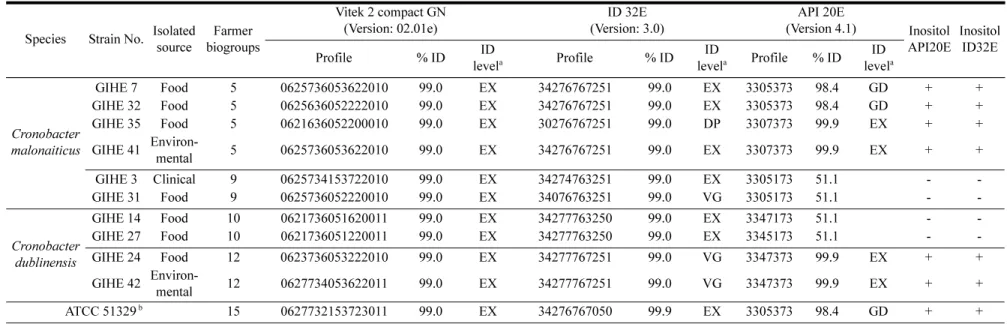
The biochemical identification profiles of each biochemical kits are given in Table 1. All Cronobacter strains were identified to the species level (as E. sakazakii ) with
“excellent” identification using the Vitek II system with version 02.01e database. Using the ID 32E kit with version 3.0 of the apiweb database, all Cronobacter strains were obtained with “very good or excellent” identification level (as E. sakazakii ) except a single strain (GIHE 35) shown doubtful identification level. In the case of GIHE 35 isolate, the identification level obtained with the ID 32E and Rapid ID 32E kits was expressed as “doubtful” and “good”
identification (data not shown), respectively. These results could be due to a difference in the database based on the utilization percentage of galactouronic acid in ID 32E (100%) and Rapid ID 32E kits (92%). The results using the ID 32E kit showed very good identification of Cronobacter spp. ( E. sakazakii ) compared with the previous report
12)because new database (version 3.0) was used in this study
13). The API 20E kit positively identified 38 Cronobacter strains to the species level (as E. sakazakii ) but the percentage identification was 51.1% and identification level was not expressed for 16 of 38 strains (42.1%) that did not ferment
inositol. The utilization of inositol is a factor determining the percentage identification of E. sakazakii with the API 20E kit. Drudy et al. reported that sodium malonate, palatinose, and inositol could be used as indicators to increase discrimination
14). These strains were contained to biogroup 2, 9, 10, and 11 which were originally divided by Farmer et al.
1). Recently, Cronobacter spp. ( E. sakazakii ) has been reclassified as C. sakazakii (biogroup 1-4, 7, 8, 11, and 13), C. malonaticus (biogroup 5, 9, and 14), C. dublinensis (biogroup 6, 10, and 12), C. muytjensii (biogroup 15), and C. turicensis (new biogroup 16) based on the biochemical differentiation, 16S rRNA gene sequencing, and DNA-DNA hybridization
10,11). The result, low percentage identification using API 20E kit, came from that Cronobacter spp. ( E.
sakazakii ) isolates showed diversity biochemical profiles and contained to various biogroups. However, Cronobacter spp. currently identified as E. sakazakii using biochemical identification kits still have the virulence potential and the Korean Food Code
5)prohibit that infant food was contaminated with E. sakazakii . The identifying Cronobacter spp. ( E. sakazakii ) and deciding contamination food is important to reduce the risk of E. sakazakii in infant foods.
Therefore, supplemental tests will be needed to identify E.
sakazakii with the API 20E kit, which showed low percentage identification because some isolates did not ferment inositol.
In conclusion, Cronobacter spp. ( E. sakazakii ) was excellently identified by the Vitek II system and ID 32E kit.
However, 16 of 38 isolates (42.1%) had 51.1% identification of E. sakazakii with the API 20E kit. These strains were contained to biogroup 2, 9, 10, and 11. The utilization of inositol is a factor determining the percentage identification of E. sakazakii with the API 20E kit. The carefulness will be needed to identify Cronobacter spp. ( E. sakazakii ) using biochemical kits.
Reference
1. Farmer III J. J., Asbury M. A., Hickman F. W., Don J. Brenner and The Enterobacteriaceae study group:
Enterobacter saka- zakii: A new species of "Enterobacteriaceae" isolation from clinical specimens.
Int. J. Syst. Bacteriol.,
2, 569-584 (1980).
2. Lehner A. and Stephan R.: Microbiological, epidemical, and food safety aspects of
Enterobacter sakazakii.
J. Food Prot.,
67
, 2850-2857 (2004).
3. Van Acker J., De Smet F., Muyldermans G., Bougatef A., Naessens A., and Lauwers S.: Outbreak of necrotizing entero- colitis associated with
Enterobacter sakazakiiin powdered milk formula.
J. Clin. Microbiol.,
39, 293-297 (2001).
4. Biering G, Karlsson S, Clark NC, Jonsdottir KE, Ludvigsson P, and Steingrimsson O.: Three cases of neonatal meningitis caused by
Enterobacter sakazakiiin powdered milk.
J. Clin.Microbiol
.,
27, 2054-2056 (1989).
Bio che mic al p rofil es o f
Cro noba cter
sp p.
(Ente roba cter s akaza kii)30 9 Table 1.
Comparison of biochemical profiles with biogroups for the identification of
Cronobacterspp. (
Enterobacter sakazakii) isolated in Korea
Species Strain No. Isolated source Farmer biogroups
Vitek 2 compact GN
(Version: 02.01e) ID 32E
(Version: 3.0) API 20E
(Version 4.1) Inositol API20E Inositol
ID32E
Profile % ID ID
level
aProfile % ID ID
level
aProfile % ID ID level
aCronobacter sakazakii
GIHE 1 Clinical 1 0625532051722010 99.0 EX 34276767250 99.0 EX 3305373 98.4 GD + +
GIHE 2 Clinical 1 0625734151722011 99.0 EX 34276767250 99.0 EX 3305373 98.4 GD + +
GIHE 5 Clinical 1 0625636051222010 99.0 EX 34276767250 99.0 EX 3305373 98.4 GD + +
GIHE 10 Food 1 0625636050222010 99.0 EX 34276767250 99.0 EX 3305373 98.4 GD + +
GIHE 13 Food 1 6021636050222010 99.0 EX 34276767250 99.0 EX 3305373 98.4 GD + +
GIHE 15 Food 1 0625636050222010 99.0 EX 34276767250 99.0 EX 3305373 98.4 GD + +
GIHE 16 Food 1 0625636051222010 99.0 EX 34276767250 99.0 EX 3305373 98.4 GD + +
GIHE 18 Food 1 0625636051222010 99.0 EX 34276767250 99.0 EX 3305373 98.4 GD + +
GIHE 20 Food 1 0625636052222010 99.0 EX 34276767250 99.0 EX 3305373 98.4 GD + +
GIHE 22 Food 1 0625636050220010 99.0 EX 34276767250 99.0 EX 3305373 98.4 GD + +
GIHE 23 Food 1 0621636050222010 99.0 EX 34276767250 99.0 EX 3305373 98.4 GD + +
GIHE 26 Food 1 0621736051722011 99.0 EX 34276767250 99.0 EX 3305373 98.4 GD + +
GIHE 28 Food 1 0625636050222010 99.0 EX 34276767250 99.0 EX 3305373 98.4 GD + +
GIHE 34 Food 1 0621636050222010 99.0 EX 34276767250 99.0 EX 3305373 98.4 GD + +
GIHE 36 Food 1 0621636050202010 99.0 EX 34276767250 99.0 EX 3305373 98.4 GD + +
GIHE 4 Clinical 2 0625734151723011 99.0 EX 34276763250 99.0 EX 3305173 51.1 - -
GIHE 6 Food 2 0605732151722011 99.0 EX 34274763250 99.0 EX 3305173 51.1 - -
GIHE 8 Food 2 0621636050222010 99.0 EX 34276763250 99.0 EX 3305173 51.1 - -
GIHE 11 Food 2 0621636050222010 99.0 EX 34276763250 99.0 EX 3305173 51.1 - -
GIHE 12 Food 2 0621636050222010 99.0 EX 34276763250 99.0 EX 3305173 51.1 - -
GIHE 17 Food 2 0621636050222010 99.0 EX 34276763250 99.0 EX 3305173 51.1 - -
GIHE 25 Food 2 0621636050222010 99.0 EX 34276763250 99.0 EX 3305173 51.1 - -
GIHE 30 Food 2 0625636050222010 99.0 EX 34274763250 99.0 EX 3305173 51.1 - -
GIHE 33 Food 2 0625636050222010 99.0 EX 34276763250 99.0 EX 3307173 51.1 - -
GIHE 38 Food 2 0621636050222010 99.0 EX 34276363250 99.0 EX 3305173 51.1 - -
GIHE 40 Food 2 0625636050222010 99.0 EX 34276763250 99.0 EX 3305173 51.1 - -
GIHE 37 Food 4 0605736051620010 99.0 EX 24274767250 99.0 EX 3205373 98.0 GD + +
GIHE 39 Food 11 0621636050222010 99.0 EX 34276763250 99.0 EX 3305173 51.1 - -
310
Jun g-B eom K im
et al.
Table 1.
Comparison of biochemical profiles with biogroups for the identification of
Cronobacterspp. (
Enterobacter sakazakii) isolated in Korea Species Strain No. Isolated source Farmer
biogroups
Vitek 2 compact GN
(Version: 02.01e) ID 32E
(Version: 3.0) API 20E
(Version 4.1) Inositol API20E Inositol
ID32E
Profile % ID ID
level
aProfile % ID ID
level
aProfile % ID ID level
aCronobacter malonaiticus
GIHE 7 Food 5 0625736053622010 99.0 EX 34276767251 99.0 EX 3305373 98.4 GD + +
GIHE 32 Food 5 0625636052222010 99.0 EX 34276767251 99.0 EX 3305373 98.4 GD + +
GIHE 35 Food 5 0621636052200010 99.0 EX 30276767251 99.0 DP 3307373 99.9 EX + +
GIHE 41 Environ- mental 5 0625736053622010 99.0 EX 34276767251 99.0 EX 3307373 99.9 EX + +
GIHE 3 Clinical 9 0625734153722010 99.0 EX 34274763251 99.0 EX 3305173 51.1 - -
GIHE 31 Food 9 0625736052220010 99.0 EX 34076763251 99.0 VG 3305173 51.1 - -
Cronobacter dublinensis
GIHE 14 Food 10 0621736051620011 99.0 EX 34277763250 99.0 EX 3347173 51.1 - -
GIHE 27 Food 10 0621736051220011 99.0 EX 34277763250 99.0 EX 3345173 51.1 - -
GIHE 24 Food 12 0623736053222010 99.0 EX 34277767251 99.0 VG 3347373 99.9 EX + +
GIHE 42 Environ- mental 12 0627734053622011 99.0 EX 34277767251 99.0 VG 3347373 99.9 EX + +
ATCC 51329
b15 0627732153723011 99.0 EX 34276767050 99.9 EX 3305373 98.4 GD + +
a
Identification level abbreviations: EX, excellent; VG, very good; GD, good; DP, doubtful profile
bEnterobacter sakazakii
reference strain
Biochemical profiles of
Cronobacterspp.
(Enterobacter sakazakii) 3115. Korea Food and Drug Administration: KFDA. Food Code, Seoul, p. 10-8-43 (2008).
6. US Food and Drug Administration: Isolation and enumera- tion of Enterobacter sakazakii from dehydrated powdered infant formula, (2002). Available at: http://www.cfsan.fda.gov/
~comm/mmesakaz.html.
7. Gurtler, J.B., L. Kornacki, and L. R. Beuchat: Enterobacter sakazakii : a coliform of increased concern to infant health.
Int. J. Food Microbio .,
104, 1-34 (2005).
8. Iversen C., Waddington M., Stephen L. W. On, and Forsythe S.: Identification and phylogeny of Enterobacter sakazakii relative to Enterobacter and Citrobacter species. J. Clin.
Microbiol .,
42, 5368-5370 (2004).
9. Iversen, C., M., Waddington, S. J. Farmer III, and S. J. For- sythe.: The biochemical differentiation of Enterobacter sakaza- kii genotypes. BMC Microbiol .,
6, 94-100 (2006).
10. Iversen C., Lehner A., Mullane N., Bidlas E., Cleenwerck I., Marugg J., Fanning S. Stephan R., and Joosten H.: The tax- onomy of Enterobacter sakazakii : proposal of new genus Cronobacter gen. nov. and descriptions of Cronobacter sakaza- kii comb. nov. Cronobacter sakazakii subsp. Malonaticus subsp. Nov., Cronobacter turicensis sp. nov., Cronobacter muytjensii sp. nov., Cronobacter dublinensis sp. nov. and Cronobacter genomospecies I. BMC Evolutionary Biology .,
7
, 64-74 (2007).
11. Iversen C., Mullane N., McCardell B., Tall B. D., Bidlas E., Lehner A., Fanning S. Stephan R., and Joosten H.: Cronobacter
gen. nov., a new genus to accommodate the biogroups of Enterobacter sakazakii, and proposal of Cronobacter sakaza- kii gen. nov., comb. nov., Cronobacter Malonaticus sp. Nov., Cronobacter turicensis sp. nov., Cronobacter turicensis sp.
nov., Cronobacter muytjensii sp. nov., Cronobacter dublin- ensis sp. nov., Cronobacter genomospecies I, and of three subspecies, Cronobacter dublinensis subsp. dublinensis subsp.
nov., Cronobacter dublinensis subsp. lausannensis subsp. nov.
and Cronobacter dublinensis subsp. lactaridi subsp. nov.
International Journal of Systematic and Evolutionary Micro- biology ,
58, 1442-1447 (2008).
12. Iversen Carol, Druggan Patrick, and Forsythe Stephen: A selective differential medium for Enterobacter sakazakii , a preliminary study. International Journal of Food Microbiol- ogy ,
96, 133-139 (2004).
13. Nade’ge Fanjat, Alexandre Leclercq, Han Joosten, and Denis Robichon: Comparision of the phenotyping methods ID 32E and Vitek 2 compact GN with 16S rRNA gene sequenceing for the identification of Enterobacter sakazakii . J. Clin.
Microbiol .,
45, 2048-2050 (2007).
14. Drudy D., Michele O’Rourke, Mary Murphy, Niall R Mul- lane, Rebecca O’Mahony, Lorraine Kelly, Matthias Fischer, Suhad Sanjaq, Pauline Shannon, Patrick Wall, Micheal O’Mahony, Paul Whyte, and Seamus Fanning: Characteriza- tion of a collection of Enterobacter sakazakii isolates from environmental and food sources. Int. J. Food Microbiol .,
110