Manuscript received January 23, 2016, revised April 15, 2016, accepted April 29, 2016 ISSN 2465-8111(Print), 2466-0124(Online), DOI http://dx.doi.org/10.18770/KEPCO.2016.02.02.245
Introducing the Latest 3GPP Specifications and their Potential for Future AMI Applications
Koudjo M. Koumadi, Byong-seok Park, Nogil Myoung†
Smart Distribution Lab, Advanced Power Distribution System Group, KEPCO Research Institute, Korea Electric Power Corporation 105 Munji-Ro Yuseong-Gu, Daejeon 34056, Republic of Korea
† [email protected]
Abstract
Despite the exponential throughput improvement in mobile communications systems, their ability to satisfy requirements of state- of-the-art and future applications of advanced metering infrastructure (AMI) is still under investigation. Challenges are mainly due to the inadequacy of third generation partnership project (3GPP) networks to support large amounts of devices simultaneously, while the number of AMI end-devices and the frequency of their data transmission increase with new AMI-based applications. In this introductory survey, innovative and future AMI applications and their communication requirements are first reviewed. Then, we identify challenges of 3GPP long term evolution (LTE) in enabling future AMI applications. More importantly, the latest improvements to LTE-A standard release 12 and 13 are reviewed and analyzed with regards to their potential to improve the quality of LTE-enabled AMI. It is found that 3GPP enhancements on machine type communications (MTC) standards will significantly enhance AMI communications. Beyond MTC specifications, non-MTC-specific enhancements such as carrier aggregation and multi-connectivity for user equipment will also contribute greatly to improving reliability and availability of AMI devices. The paper’s focus is towards improved backhaul support for innovative and future AMI applications, beyond traditional automatic meter reading.
Keywords : 3GPP Long Term Evolution (LTE), Advanced Metering Infrastructure (AMI), backhaul network
I. INTRODUCTION
A. Background
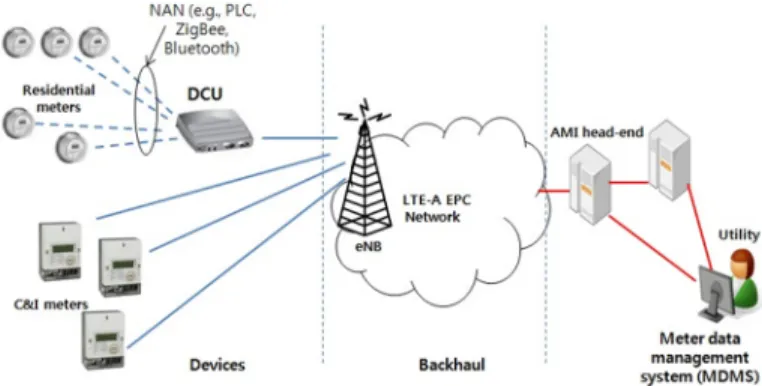
The rate of advanced metering infrastructure (AMI) deployment around the world is increasing exponentially. An AMI is composed of smart meters (SMs) and a meter data management system (MDMS) that are interconnected through a communication backhaul. Applications running on an AMI (i.e., AMI applications) include meter reading, demand response, connect/disconnect service, and others. Optical fiber, power line communications (PLC), and wireless communications [i.e., general packet radio service (GPRS)] seem to be the main backhaul communication media [1][2]. As illustrated in Fig. 1, two types of topologies are generally used: (1) a data concentrator unit (DCU) is used to connect a local/neighborhood/field area network (LAN/NAN/FAN) of SMs to the MDMS, through a wide area network (WAN); and (2) SMs connect to the WAN individual, without any gateway. This latter topology is more suitable for commercial and industrial (C&I) meters, while the former one suites residential meters deployed in close proximity to each other. IEEE 802.15.4g [3] is widely accepted for NAN/FAN connectivity between SMs and their DCU.
B. Motivation
Mobile communications enable speedy and convenient AMI deployment. For current AMI deployments, mobile systems have been supporting low duty cycle applications such as bi-weekly meter reading, data pulling from meters, and occasional system maintenance. For such low data rate applications, GPRS is sufficient to ensure appropriate quality of service (QoS) [2][4][5].
However, upcoming innovative delay-sensitive and bandwidth- demanding applications include real-time pricing, smart distribution applications, and phasor measurements on power distribution networks by enhanced SMs (eSMs) [4]. These applications require much higher bandwidth and higher QoS for large numbers of sensing end-devices and SMs/eSMs [4][6][7]. Third generation partnership project (3GPP) long term evolution advanced (LTE- A) is the mobile WAN with the highest data rates, the lowest latencies, and that can admit largest numbers of user equipments (UEs). Nevertheless, it was demonstrated in [8] that LTE experiences excessive delays for some AMI and phasor measurement applications. Fortunately, enhancements have been made to the 3GPP LTE standards and they improve LTE’s ability to deliver machine type communications (MTC) (e.g., AMI communications) satisfactorily.
In this paper, we analyze the latest 3GPP LTE-A Release 12 and 13 [9-12] from the perspective of AMI communications.
Fig. 1. Basic AMI architecture
Specifically, this contribution (1) provides an overview of AMI applications and communication requirements; (2) identifies the communications issues with LTE-enabled AMI; (3) reviews the evolution of LTE standards in relation with MTC and AMI; and (4) identifies LTE-A Release 12 and 13 system specifications with possible impact on AMI. Their ability to improve AMI communications is also analyzed. Such analysis and discussion lack in the literature and is needed to assist utilities and AMI engineers, not only in the design of future LTE-based AMI devices, but also in the evaluation of mobile network operators (MNOs) for partnership.
C. Related works and organization
The use of wireless communications for MTC, smart grid (SG), and AMI applications has been extensively studied. Here, we provide a general classification of some related literature.
International electrotechnical commission (IEC) specifications for smart grid communications (IEC 61850) are described in [13], while [9][10][12][14]-[20] describe 3GPP LTE specifications.
Although 3GPP LTE-A Rel. 13 is yet to be fully published [12], an insight to the main tasked it involves is given in [11]. IEC and 3GPP sets of standards are so distinct and independent that it is safe to state that no effort was made to inter-relate them.
Requirements for SG/AMI communications are provided in [1][13][21][22]. It is noted that maximum delay and minimum data rate requirements specific to AMI applications vary widely.
In another vein, opportunities [23][24] and challenges [23]-[26]
of wireless/cellular communications for MTC/SG/AMI were also studied. The general point in these articles is that the use of cellular systems for innovative AMI applications presents serious issues that might outweigh the advantage of convenient deployment. Major challenges are related to large numbers of machines/SMs attempting access to delay-prone and bandwidth- limited cellular systems. Using analytic and/or simulation methods [4]-[8][24] unveiled quantified bandwidth and delay limitations of GPRS/LTE when it comes to innovative AMI applications. [27] and many other similar works went further to propose radio resource management techniques that aim at meeting AMI communication requirements over LTE. An attempt was made in [28] to integrate IEC 61850’s manufacturing message specifications (MMS) into LTE standards for AMI communications. Functional and performance requirements for this integration were identified and a solution was proposed based on TCP/IP protocol stack. To our knowledge, no work was dedicated to reviewing the latest advances in 3GPP LTE-A specifications with the objective of identifying and analyzing their potentials in mitigations the challenges of AMI over LTE networks. Providing such analysis is the aim of this article.
Section 2 of the article briefly describes AMI applications and their communication requirements, as well as challenges of LTE-enabled AMI. In section 3, 3GPP Rel. 12 and 13 specifications that address MTC, which include AMI communications, are analyzed. General 3GPP Release 12 and 13 specifications that are not explicitly related to AMI are identified and explained in section 4, along with their potential impact on AMI communications.
Potential implementation challenges are also identified. Section 5 concludes the paper
II. REQUIREMENTS AND CHALLENGES OF AMI APPLICATIONS
A. AMI Applications and Communication Requirements
With regard to the full potential of advanced metering infrastructure, AMI applications that are currently in use by utilities and their partners are limited.
1) Traditional applications
Most traditional AMI applications are non-real-time and delay-tolerant.
Automatic meter reading (AMR): AMR is the basic form of AMI application. SMs send periodic and/or on-demand meter readings to utilities or users for billing and other purposes. The average packet size is around 200 bytes and required transmission data rate is less than 128 kbps [6]. AMR is delay-tolerant and inter-reading time may span between one hour and one month.
Electricity prepayment service: This application allows consumers to prepay their utility usage by acquiring and loading some "credits" on their SMs. Credit usage and status information may be sent to the consumer periodically or on-demand basis.
Connect/disconnect service: This allows utilities to remotely connect or disconnect a consumer.
Non-real-time demand-response: Utilities implement demand-response applications by exchanging pricing signals (transactive incentive signals) and transactive feedback signals (TFS) with load-control devices or other smart devices located at consumer premises. The aim is to incite them to reduce energy consumption during peak hours.
Non-real-time pricing: Pricing information is broadcast to consumers or their smart devices/appliances. Typical information is related to time-of-use, and critical peak pricing.
Onsite maintenance: Periodic or spontaneous onsite maintenance may be needed on SMs in a particular neighborhood.
Because of the non-real-time nature of these traditional applications and their loose delay requirement, current GPRS networks suffice to provide backhaul connectivity between smart meters and MDMS.
2) State-of-the-art and upcoming applications
Recent developments in the energy industry are leading to more data-oriented grid management and innovative applications.
These applications rely on real-time and near real-time measured/sensed data, as well as real-time end-device control and monitoring [4][6][7].
Big data-oriented AMI: Prediction in smart grids has become critical to reliable and efficient power supply. Accurate prediction requires high sampling rate of AMI data. Therefore, the frequency of data sampling has increased drastically over the years. This in turn put a burden on mobile WANs serving as AMI backhaul.
AMI-assisted distribution automation (DA): DA requires
two-way communications with automated switches, capacitor
banks, voltage regulators, and reclosers located on feeders. To
address the lack of suitable communications infrastructure for
continuous monitoring and control on feeders, [7] proposed an
alternative communication for DA devices by connecting them
through the AMI. DA data accuracy is 99.00%, with a delay
tolerance as small as 20 ms [22].
Outage management system (OMS): SMs are able to detect different types of power outage, send alarm messages, and assist in power restoration via specific types of data exchange.
Maximum latency for OMS data is 2 seconds, with an accuracy of 99% and a data rate of 56 kbps [22].
Real-time pricing (RTP): RTP has more stringent latency and frequency (data sampling) requirements than traditional pricing. Latency tolerance is 100 ms only, with packet sizes around 210 bytes, and data rates between 10 and 100 kbps [6].
Real-time demand-response: Real-time demand-response systems are used by some investors to speculate on energy prices.
Unlike traditional demand-response, this application requires maximum latencies of 500 ms in some cases, and a data rate of 100 kbps per SM.
Enhanced smart metering and power quality: Enhanced SMs (eSMs) are SMs used to measure voltage and current phasor on the distribution grid, in the same manner like phasor measurement units (PMUs) [4]. Because eSMs perform a monitoring role, rather than a protection role, eSMs communication is less time-constrained than PMU communications.
Average packet size is 48 bytes, sent as frequently as every 40 ms.
The maximum delay is 10 ms, for data rates between 6 and 24 kbps [6].
Tampering and loss detection: In automated smart grid, tampering-related losses and other technical losses may cause spontaneous outages and/or increase in power generation.
Therefore, they have to be detected and resolved spontaneously, without any delay.
Firmware update: SMs are computing devices and might need periodic or spontaneous software updates. Firmware update is delay-tolerant and rate requirements might vary widely.
Furthermore, smart homes and other applications at customer premises are likely to revolutionize the use of AMI.
B. LTE as AMI backhaul network
[1][5][21][22] gave details on communication characteristics and requirements for AMI applications. These requirements are in terms of traffic/packet size, overhead, and transmission frequency/interval, transmission bit rates, maximum latency, and reliability. Depending on the applications, minimum bit rates vary between a few kbps to a few Mbps, while maximum latencies span between a dozen milliseconds and a few hours. Fortunately, 3GPP LTE-A specifications are well beyond these AMI communication requirements. For instance, 3GPP Rel. 11 requires per site peak data throughputs of at least 500 Mbps and 1 Gbps in uplink and downlink, respectively [14]. Moreover, the 3GPP security architecture guarantees secure communications over LTE [9].
However, LTE was designed for reasonable numbers of user equipments (UEs) per cell; and these aggregated throughputs ignore challenges yielded by large numbers of SMs/eSMs accessing individual eNodeBs (eNBs). Control channel saturation and harsh propagation environment for large portions of SMs/eSMs are examples of such challenges. Moreover, AMI, usual LTE services, and upcoming novel LTE-based services have to compete for the same limited LTE resources.
C. Challenges of LTE-based AMI
Challenges that may jeopardize LTE’s support of AMI
applications are summarized below.
(C1) Prohibitive signaling overhead: This has been identified as one of the key challenges in using LTE for MTC (e.g., SG and AMI applications). To access an LTE network, a UE sends a scheduling request to an evolved Node B (eNB). The eNB then assigns a physical uplink control channel (PUCCH) and a physical downlink control channel (PDCCH) to the UE. With a large number of AMI devices, the eNB runs out of control channels quickly and the network becomes unavailable. It was proven in [8] that phasor measurement and AMI applications are control channel limited. Moreover, every UE has to be authenticated and be assigned security keys by the evolve packet core (EPC). Large numbers of SMs/eSMs would render signaling overheads excessive.
(C2) LTE access, scheduling, and retransmission delay:
This represents a special challenge to delay-sensitive AMI applications. Even if a device is allocated control channels, uplink (UL) transmission is not automatic. After sending its buffer status, the device has to be scheduled for transmission on available resource blocks and the waiting may be long, depending on the eNB’s load. If it finally sends uplink packets, safe delivery of these packets has to be acknowledged (ACK) by the eNB. If an ACK is not received, a retransmission is scheduled. If the packet size is big, transmission over multiple time slots may be required.
Large number of devices trying to access the same eNB will only exacerbate the delay [8].
(C3) Hypothetical QoS: LTE was designed to support heavy resource-hungry real-time multimedia and other Internet applications for mobile users. Because there are generally no radio access network (RAN) resources specifically pre-assigned to AMI traffic, AMI applications have to compete with traditional mobile applications for RAN resources. Furthermore, while most AMI data are in uplink, LTE air interface is generally downlink- biased, so that it can satisfy mobile Internet download traffic requirements. Finally, in order to maximize throughput, most LTE radio resource allocation schemes favor UEs with high channel quality indicator (CQI). This means that AMI end- devices with bad CQI are likely to starve. Because of the above reasons, QoS may not be guaranteed for AMI applications.
(C4) Weak core network support: Because the EPC was not originally designed for MTC, its support for AMI-specific applications is not optimal. Both architectural and functional issues on the EPC result in poor QoS for many AMI applications.
(C5) Harsh propagation environments: SMs and eSMs located in basements experience low CQI [25]. This may prevent some AMI applications from attaining required rates under standard CQI-based scheduling schemes.
(C6) Mutual electromagnetic interference: As described in [23][26], there exists mutual electromagnetic interference between LTE communication modules (modem) and power grid operations, including metering functionalities of SMs/eSMs.
(C7) Device complexity and cost: LTE UEs are required to operate over the bandwidth of 20 MHz, which is the maximum operation bandwidth for LTE systems. This added cost and complexity to LTE modem-equipped AMI devices.
(C8) Lack of harmonized standards: QoS and service classes are defined independently for LTE and SM/AMI communications.
As a consequence, QoS classes for SG/AMI applications defined
by IEC [13] do not match those supported by 3GPP LTE scheduling and resource allocation algorithms.
III. 3GPP LTE-A ENHANCEMENTS FOR MACHINE- TYPE COMMUNICATIONS
A. Prior to 3GPP LTE-A release 12 and 13
The market potential of MTC was officially recognized by the 3GPP about a decade ago [16]. A feasibility study on some security aspects of MTC devices was reported in [20], while service requirements for MTC were defined in [17]. Real solutions to MTC-related issues started in Rel. 11, with the incorporation of MTC interworking function (MTC-IWF) and authentication, authorization and accounting (MTC-AAA) functions to the LTE-A architecture [18]. These functions allow the support of direct, indirect, hybrid, and roaming implementations of MTC. Other important features introduced in [18] include: (1) usage of Internet-like identifiers between the public land mobile network (PLMN) and the service provider domain, to replace the mobile subscriber international subscription directory number MSISDN; (2) utilization of IPv6 for MTC; (3) mobile terminated short message service (SMS) with a standardized interface to the short message service center (SMSC); (4) Optimization for devices with packet-switching-only description; (5) possibility for some applications to override low access priority configuration (also known as dual-priority devices); (6) enhanced access barring (EAB) to restrict network access to low priority devices;
and (7) an architecture option for networks with no 3GPP circuit- switch domain where a direct interface from SMSC to mobility management entity (MME) is deployed for SMS delivery. These features might enable better performance of AMI over LTE. For instance, EAB and dual-priority would allow alarm event packets from SMs/eSMs to be sent in priority, while delay-tolerant meter reading packets are temporarily blocked. Moreover, identifiers, MTC-IWF, MTC-AAA, and mobile-terminated SMS interface to SMSC would simplify and accelerate connection and packet transmission from/to AMI devices. However, these advances could not solve all key issues.
B. MTC-specific enhancements in 3GPP LTE-A release 12 and 13 3GPP LTE-A Rel. 12 and 13 enhancements address MTC explicitly [9][11]. Therein, air interface-related mechanisms are specified in order to: (1) improve the support for low-cost low- complexity device types; (2) provide extended coverage for devices in challenging locations; (3) enable low energy consumption;
and (4) serve large numbers of devices per cell. Along the MTC- specific features, several general features were also added to the 3GPP standards to improve system performance and user experience.
In this section, we analyze MTC-explicit features with regard to their potentials in improving the performance of AMI communication systems.
(M1) Category 0 UE for MTC operations: The definition of this new category of LTE UE equates to the “birth” of low-power low-complexity devices into the LTE world. Category 0 devices may support DL channel bandwidth of 1.4 MHz, instead of the 20 MHz for other categories. A new half duplex type with flexible switching time, reduced data rates through a single antenna, maximum transport block sizes (TBS) of 1,000 bits (unicast) and 2,216 bits (broadcast), as well as many other low-complexity
features are defined.
Potential application to AMI: While electricity meters may enjoy sufficient and continuous power supply, water and gas meters may need to be battery-powered. Therefore, category 0 modems will be very useful in low rate non-electric or/and integrated metering scenarios.
(M2) Coverage improvement: A set of mechanisms are recommended to achieve a coverage improvement corresponding to 15 dB (in FDD mode) for category 0 MTC devices. Various forms of repetition and power boosting techniques are considered.
Potential application to AMI: Coverage improvement recommendations can be implemented by AMI operators or backhaul operators, and are meant for category 0 devices.
However, their implementation will also greatly improve link quality to smart meters that are generally located in harsh propagation environments, such as basements and garages.
(M3) Signaling overhead reduction: EPCs will provide information for the tuning of eNB parameters. This will reduce signaling overhead for MTC.
Potential application to AMI: With expected large numbers of AMI end-devices, signaling overheads are expected to cause packet delay and access delay on backhaul networks. Techniques to reduce overheads will yield significant performance improvements.
(M4) Small data and device triggering enhancements (SDDTE): Connectionless approaches have been recommended to keep devices in connected mode for frequent device-triggered small data transmission.
Potential application to AMI: AMI end-device data is generally small in size. Keeping devices connected and allowing them to send small packets anytime that the need arises will keep access delays and overheads low. This may be particularly useful for alarm and fault detection applications using “PUSH”
operations.
(M5) UE power consumption optimization (UEPCOP):
Recommendations aimed at UEPCOP include reduction of UE transmit/receive time (e.g., extended discontinuous reception (DRX) for up to 10.24 seconds). Other measures include the reduction of measurement and synchronization time.
Potential application to AMI: Similar to (M1), this feature may be useful for non-electric and/or integrated metering infrastructure.
(M6) Dedicated core networks (DECOR): A dedicated core network (DCN) is a set of (virtual) EPC network elements dedicated to specific types of devices (e.g., SMs/eSMs in AMI). DCNs allow specific functions (e.g., fast packet routing to/from devices) within them.
Potential application to AMI: A DCN may be an optimized backhaul network for AMI only. In this regard, enough resources within the DCN will be assigned to fast AMI communications.
(M7) Architecture enhancements for services capability exposure (AESE): This enhancement allows 3GPP mobile network operators (MNO) to offer richer value added services to partners, by exposing standardized application programming interfaces (API) to application developers and businesses.
Potential application to AMI: If implemented for AMI,
AESE will allow applications that are fully developed and
operated by utilities and/or their partners to be fully integrated to
3GPP networks. This will increase flexibility in designing
sophisticated and innovative AMI applications for utilities and their customers.
(M8) High latency communication (HLCom): With this EPC feature, MTC applications can communicate with devices that are temporarily unreachable for diverse reasons (e.g., congestion, weak coverage). Using buffering and other mechanisms, this enhancement permits the support of large numbers of such devices.
Potential application to AMI: This feature will increase packet delivery ratio to SMs/eSMs/DCUs in adverse propagation conditions and/or congested backhaul cells.
(M9) Group based enhancements (GROUPE): Using this enhancement, MTC devices are handled in groups, rather than individually. Therefore, message delivery, EPC congestion control, addressing and identifiers are done in group-based manners.
Among other advantages, GROUPE can reduce traffic load and signaling overheads.
Potential application to AMI: GROUPE communications may be resource-efficient in all AMI scenarios where broadcast and multicasts are frequent (e.g., firmware update). For integrated AMI solutions or DCU-enabled connections, GROUPE may be even leveraged for information security purposes, where a GROUPE leader (e.g., DCU, electric meter) may handle computationally heavy authentication, decryption/encryption, and verification tasks for “weaker” devices.
(M10) Monitoring enhancement (MONTE): This set of generic monitoring mechanisms allows monitoring of various aspects of MTC device operations via different interfaces/nodes.
Specific events and data that are supported include (but are not limited to) loss of connectivity, device accessibility, and continuous reporting of location.
Potential application to AMI: MONTE features may be used in outage management, fraud detection, quality monitoring and many other critical AMI applications.
Similar to other MTC applications, AMI applications will be obviously boosted by MTC-specific enhancements in Rel. 12 and 13. (M1) to (M5) improve air interface efficiency; (M6) through (M8) improve EPC operations; while (M9) and (M10) boost end- to-end performance of LTE-A as AMI communication backhaul.
For instance, AMI-specific applications and servers can be deployed and managed through AESE, while DECOR provides a virtual AMI-only core network with optimized network features.
(M1) reduces the complexity and cost of SM modems, while (M2) enables better signal quality and QoS for SMs/eSMs. Timeliness of “push” operations from eSMs/SMs, such as alarm events, will be greatly enhanced by SDDTE. It is worth noting that UEPCOP’s impact on electric AMI is limited because SMs are connected to the power grid and may not be power-limited.
Nevertheless, improved power efficiency for other types of AMI and reduced carbon footprint are desirable. Finally, many of these MTC-specific enhancements may mitigate challenges linked to network access by large amount of SMs and eSMs.
IV. OTHER 3GPP LTE-A ENHANCEMENTS AND POTENTIAL IMPACTS ON AMI
3GPP LTE-A Release 12 and 13 contain performance enhancement specifications that are not specifically tied to MTC
[10]-[12]. In this section, these new specifications that may have an impact on AMI communications are identified, and their potentials at doing so are analyzed.
A. Active antenna systems, elevation beamforming and full dimension MIMO
Multi-antenna techniques such as beamforming and MIMO have been an integral part of LTE since its inception. In order to exploit both the azimuth and the elevation domain, vertical and horizontal (two-dimensional) eNB antenna arrays with up to 64 antenna ports are considered in Rel. 13. This would allow antenna-based sectorization, and multi-UE MIMO. In active antenna systems (AAS), radio frequency (RF) components (e.g., power amplifiers and transceivers) are integrated with an array of antenna elements. As compared to passive antennas (connected to RF through feeders), AAS offer faster, more flexible and more intelligent signal processing. Additional strengths include interference mitigation, and efficient antenna resource allocation.
Furthermore, coordinated multi-point (CoMP) enhancements reduce system interference and improve spectral efficiency through coordination between neighboring eNBs.
These features are meant to reduce interference in the system and improve signal quality and spectral efficiency. They are implemented by mobile backhaul operators and should benefit AMI access. Specifically, challenges (C5) and (C6) are mitigated.
Ultimately, data throughput, delay, and other QoS performance should be improved. Therefore, effects of challenges (C2) and (C3) may also diminish. All AMI applications should be positively affected by these channel improvement features.
B. Mission critical push-to-talk and Proximity Services
Proximity Services (ProSe) allow devices located near each other to communicate directly (Device-to-device), rather than through the cellular network. Device-to-device communication functionalities include in-coverage discovery, out-of-coverage discovery, and multi-carrier support for ProSe [11]. For public safety use, priorities are introduced to handle congestion scenarios.
Network support is used when available. Furthermore, mission critical push-to-talk (MCPTT) capabilities adds group calls, group management, security, off-network mode, and other useful functionalities to ProSe, especially during public safety or disaster rescue missions.
ProSe may allow a unified AMI communication platform for NAN/FAN and WAN, instead of using a different radio access technology (e.g., IEEE 802.15.4g) for NAN/FAN. For all AMI applications, this may increase efficiency and reduce modem cost and delays at DCUs. Additionally, MCPTT may assist staff communications during on-site maintenance.
C. Evolved multimedia broadcast/multicast services
Evolved Multimedia broadcast/multicast services (eMBMS) uses the same radio resources to deliver common packets to multiple UEs in the same broadcast group. Support for MBMS has been introduced in 3GPP Rel. 9 [16] but Rel. 12 and 13 enhancements (eMBMS) add UE measurement reporting for the purpose of monitor signal quality at UEs. Other important mechanisms introduced in the latest releases include group call congestion management, MBMS sessions re-establishment, and MME take-over.
eMBMS should provide resource efficiency and delay
reduction for AMI applications such as firmware update, demand-response, pricing, and outage management. More specifically, instead of individual firmware updates, HES (clients) can schedule a broadcast/multicast update, sending image files to all SMs simultaneously, using resource-efficient eMBMS. Real- time pricing and demand-response information can also be broadcast or multicast to SMs. Status report requests may also be broadcast to assist in outage management. Challenges (C1), (C2), and (C3) may be mitigated at different extents.
D. Simultaneous multi-connectivity for UEs
Multi-connectivity refers to the ability of a UE to utilize radio resources provided by two or more network access points that are connected via non-ideal backhaul. Multi-connectivity is enabled by a conjunction of several interrelated schemes.
Streaming control transfer protocol (SCTP) is a transport layer protocol that allows multiple simultaneous flows at a UE. Multi- homing is a functionality by which a UE can be served simultaneously through multiple ports configured with different IP addresses. Simultaneous multi-connectivity using SCTP multi- homing [19] is supported by Rel. 12 and 13. Licensed spectrum owned by MNOs allows them to manage intra-system interference and achieve high spectral efficiency. Licensed assisted access (LAA) [11] provides mechanisms for MNOs to opportunistically utilize unlicensed spectrum (e.g., WiFi
spectrum) in addition to their licensed spectrum, via secondary cells (SCells) integration. Carrier aggregation (CA) was first introduced in [17] and allows a UE to connect to different eNBs using up to five different frequency carriers (i.e., up to 100 MHz).
Rel. 12 and 13 extend CA to carriers that are configured in two different duplexing modes (i.e., TDD and FDD), as well as unlicensed spectrum. In principle, LAA, CA, SCTP, and multi- homing should allow a UE to handle bandwidth up to 640 MHz and enjoy tremendously high data rates.
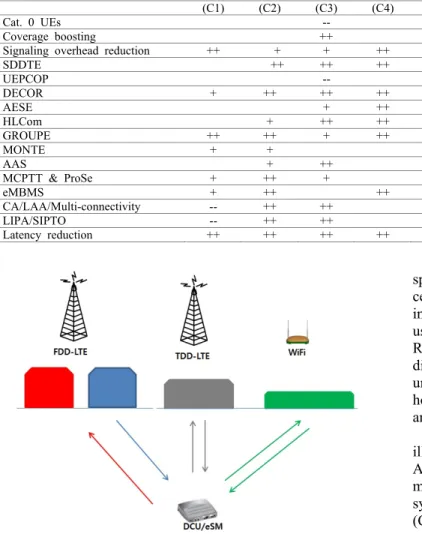
Thanks to all IP operations in LTE, multi-connectivity (as illustrated in Fig. 2) shall provide high rate communications to AMI end-devices. Enabling DCUs/gateways to connect to multiple WANs would boost the total AMI throughput and system availability, and reduce latency. Therefore, impacts of (C1), (C2), (C3), (C5), and (C7) would be reduced. Finally, multi- connectivity may offer an opportunity to enhance AMI security features by providing out-of-band options for key exchange and key agreement schemes.
E. Local Internet protocol access & selected Internet protocol traffic offload
Local Internet protocol access & selected Internet protocol traffic offload (LIPA/SIPTO) enhancements enable offloading of Internet traffic from RAN nodes (e.g., eNB, NodeB+) to private networks using functionalities of an embedded public data network gateway (P-GW). Within a set of RAN nodes served by the same P-GW (i.e., local home network), seamless offloading is offered to UEs.
LIPA/SIPTO is complementary to multi-connectivity and therefore tackles similar AMI-related challenges.
F. Latency reduction enhancements
Latency reduction has always been an important issue in 3GPP networks. To reduce latency in LTE, several techniques are under consideration in Rel. 13 and beyond. They include instant uplink access, shortened transmission time interval, and reduced processing time at both UEs and eNBs.
With increasing numbers of deployed end-devices and high data sampling frequencies, assess delay is becoming a great challenge. LTE latency reduction enhancements should reduce delay for AMI-applications. Obviously, effects of (C2) should be mitigated.
Table 1 summarizes potential impacts of LTE-A Rel. 12 and
Fig. 2. CA-enabled multi-connectivity for AMI end-devices.
Table 1. Summary of impacts of LTE Rel. 12 and 13 enhancements on AMI
(C1) (C2) (C3) (C4) (C5) (C6) (C7) (C8) Negative effect
Cat. 0 UEs -- -- + ++ No QoS guarantee
Coverage boosting ++ ++ ++ ++ Interference to meters
Signaling overhead reduction ++ + + ++
SDDTE ++ ++ ++
UEPCOP -- - ++ + No QoS guaranty
DECOR + ++ ++ ++
AESE + ++
HLCom + ++ ++ +
GROUPE ++ ++ + ++ ++ ++ +
MONTE + + +
AAS + ++ ++ ++ +
MCPTT & ProSe + ++ + ++ ++ +
eMBMS + ++ ++
CA/LAA/Multi-connectivity -- ++ ++ + + -- Complexity, interference
LIPA/SIPTO -- ++ ++ + + -- Complexity, interference
Latency reduction ++ ++ ++ ++