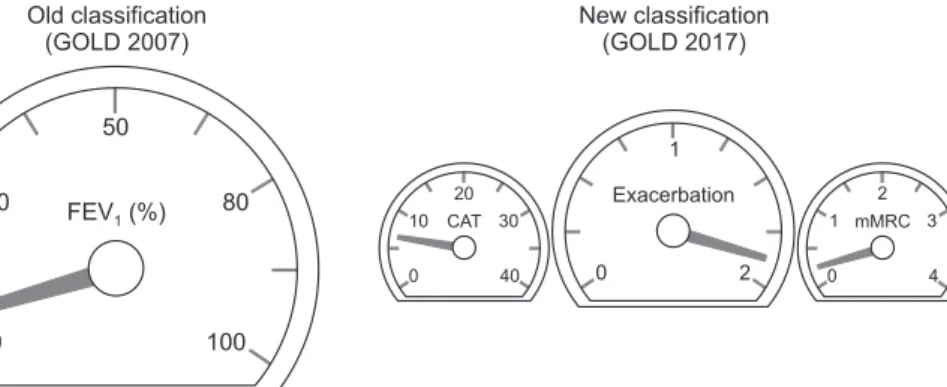
347 debates whether GOLD 2017 classification is better than old spirometric classification. Gedebjerg et al.
5showed that GOLD 2017 classification does not predict mortality more accurately than 2007. Data from PLATINO study showed that GOLD 2007 classification shows more stability over time compared with GOLD 2013.
6Recently, Candemir et al.
7investigated whether there was a difference between GOLD 2017 classification and 2007 in clinical variables in patients with COPD. Interestingly, similar values of FEV
1were found between group A and C. Also, mean FEV
1was not different at all between B and D. Moreover, group A and C showed similar result of incremental shuttle walk test (ISWT). On the contrary, GOLD 2007 classification was well correlated with many clinically important variables such as dyspnea, quality of life, anxiety scores, body mass index, fat free mass index, and ISWT.
These previous results showed that still FEV
1(%) is good and useful markers for classification of COPD. It is not yet concluded whether removal of FEV
1in GOLD 2017 was good decision or not. However, as the Candemir et al.
7mentioned, GOLD 2017 classification might not represent the severity of COPD sufficiently well. Probably the combination of both spirometric stage and combined assessment of GOLD 2017 is important, especially for estimating clinical variables.
Conflicts of Interest
No potential conflict of interest relevant to this article was reported.
References
1. Vogelmeier CF, Criner GJ, Martinez FJ, Anzueto A, Barnes PJ, Bourbeau J, et al. Global strategy for the diagnosis, manage- ment, and prevention of Chronic Obstructive Lung Disease 2017 report. GOLD executive summary. Am J Respir Crit Care Med 2017;195:557-82.
2. Rabe KF, Hurd S, Anzueto A, Barnes PJ, Buist SA, Calverley P, Chronic obstructive pulmonary disease (COPD) is a pre-
ventable and treatable disease which is characterized by respi- ratory symptoms and airflow limitation
1. It is a leading cause of death in worldwide. Classification of COPD is very impor- tant since treatment is recommended by classification. Old COPD classification is based on spirometry result. In Global Initiative for Chronic Obstructive Lung Disease (GOLD) 2007 document
2, post bronchodilator forced expiratory volume in 1 second (FEV
1) measured by spirometry was used to classify COPD. FEV
1is easy to measure and result is quite consistent.
Moreover, measurement of FEV
1is standardized worldwide.
There is no room for bias in measuring FEV
1. GOLD 2007 classified COPD as stage I to IV based on post bronchodilator FEV
1(%).
In 2011, GOLD committee changed classification of COPD from I–IV to ABCD. Main reason for this change is that there was some discrepancy between lung function and quality of life
3. Moreover, history of exacerbation is more powerful pre- dictor for future exacerbation than FEV1 (%)
4. Later in 2017, FEV
1(%) was removed from criteria for classification between high and low risk groups
1. Spirometry result is still mandatory when diagnose of COPD. However, it is no longer considered when classifying COPD patients (Figure 1).
Since the release 2017 GOLD documents, there have been
Old Friends, Old Wine, and Old COPD Classification Are Best
Chin Kook Rhee, M.D., Ph.D.
Division of Pulmonary, Allergy and Critical Care Medicine, Department of Internal Medicine, Seoul St. Mary’s Hospital, College of Medicine, The Catholic University of Korea, Seoul, Korea
Address for correspondence: Chin Kook Rhee, M.D., Ph.D.
Division of Pulmonary, Allergy and Critical Care Medicine, Department of Internal Medicine, Seoul St. Mary’s Hospital, College of Medicine, The Catholic University of Korea, 222 Banpo-daero, Seocho-gu, Seoul 06591, Korea
Phone: 82-2-2258-6067, Fax: 82-2-599-3589 E-mail: [email protected]
Received: Aug. 26, 2018 Revised: Aug. 29, 2018 Accepted: Aug. 30, 2018
cc
It is identical to the Creative Commons Attribution Non-Commercial License (http://creativecommons.org/licenses/by-nc/4.0/).
EDITORIAL
https://doi.org/10.4046/trd.2018.0071ISSN: 1738-3536(Print)/2005-6184(Online) • Tuberc Respir Dis 2018;81:347-348
Copyright © 2018
The Korean Academy of Tuberculosis and Respiratory Diseases.
CK Rhee
348 Tuberc Respir Dis 2018;81:347-348 www.e-trd.org
et al. Global strategy for the diagnosis, management, and pre- vention of chronic obstructive pulmonary disease: GOLD ex- ecutive summary. Am J Respir Crit Care Med 2007;176:532- 55.
3. Agusti A, Calverley PM, Celli B, Coxson HO, Edwards LD, Lo- mas DA, et al. Characterisation of COPD heterogeneity in the ECLIPSE cohort. Respir Res 2010;11:122.
4. Hurst JR, Vestbo J, Anzueto A, Locantore N, Mullerova H, Tal- Singer R, et al. Susceptibility to exacerbation in chronic ob- structive pulmonary disease. N Engl J Med 2010;363:1128-38.
5. Gedebjerg A, Szepligeti SK, Wackerhausen LH, Horvath-Puho E, Dahl R, Hansen JG, et al. Prediction of mortality in patients with chronic obstructive pulmonary disease with the new Global Initiative for Chronic Obstructive Lung Disease 2017
classification: a cohort study. Lancet Respir Med 2018;6:204- 12.
6. Menezes AM, Wehrmeister FC, Perez-Padilla R, Viana KP, Soares C, Mullerova H, et al. The PLATINO study: description of the distribution, stability, and mortality according to the Global Initiative for Chronic Obstructive Lung Disease classi- fication from 2007 to 2017. Int J Chron Obstruct Pulmon Dis 2017;12:1491-501.
7. Candemir I, Ergun P, Kaymaz D, Tasdemir F, Egesel N. The comparison of clinical variables in two classifications:
GOLD 2017 combined assessment and spirometric stage of chronic obstructive pulmonary disease. Tuberc Respir Dis 2018;81:281-8.
50
30 80
0 100
FEV (%)1 10 20 30
0 40
CAT
1
0 2
Exacerbation 2
1 3
0 4
mMRC Old classification
(GOLD 2007)
New classification (GOLD 2017)