서 론 I.
오늘날 국민 건강증진에 대한 중요성이 강조되면서 다양한 건강증진 프로그램이 개발 및 적용되고 있다.
하지만 대부분의 건강증진 프로그램은 개인의 특성을 고려하지 않고 집단을 대상으로 획일적인 중재를 제공 하고 있기 때문에 커다란 효과가 없는 것으로 평가되 고 있다(Werch, 1997). 따라서 건강증진을 위한 좀 더
다양한 접근방법들을 찾으려는 노력들이 이루어지고 있다 그 중 개인의 건강행위 단계를 파악하여 단계별. 적합한 맞춤중재를 제공함으로써 건강증진을 유도할 수 있다는 단계이론(stage theories)이 주목을 받게 되었 고 최근에 건강증진분야에서 이 이론의 적용이 점진, 적으로 증가하고 있는 추세이다(Adams & White, 이러한 변 2005; Weinstein, Rothman, & Sutton, 1998).
화에 있어 대표적으로 주목을 받는 단계이론이 범이론
을 적용한 국내 간호연구 분석 Transtheoretical Model
이은현
1
․ 김진선2
․ 정영해3
1아주대학교 보건대학원, 2조선대학교 의과대학 간호학과, 3동신대학교 한의과대학 간호학과
Analysis of Korean Nursing Studies Applied for the Transtheoretical Model
Lee, Eun-Hyun1․Kim, Jin Sun2․Jung, Young Hae3
1
Assistant Professor, Graduate School of Public Health, Ajou University,
2
Assistant Professor, Department of Nursing, Chosun University,
3Professor, Department of Nursing, Dongshin University
Purpose: The purpose of this study was to explore the utilization of the Transtheoretical Model(TTM) for Korean
nursing studies on health behaviors and identify the strategies for improvement of further studies. Methods: From a main and seven branch journals on the Korean Society of Nursing Science, a total of 26 studies, which had been conducted based upon the TTM, were selected. The selected studies were analyzed from the September of 2006 to the February of 2007 by the criteria; name of journal, year of publication, health behavior, population, sampling, sample size, research design, instrument (translation process, reliability and validity), and statistical analysis. Results: TTM on the Korean nursing studies was mainly applied for smoking cessation or exercise with elderly or middle aged women. The research findings could not be generalized with the limitation of the use of non representative samples. The most frequently used research design was a cross-sectional survey. Some studies had a lack of reliable and valid instruments, so that the internal validity of the study findings may be threatened.Statistically related problems increased type I error and decreased power. Conclusion: Korean nursing studies based on TTM can be the beginning stage in quality and quantity.
Key Words : Health behavior, Model, Nursing research, Analysis
Corresponding address: Lee, Eun-Hyun, Graduate School of Public Health, Ajou University, San-5 Woncheon-dong, Yeongtong-gu, Suwon
443-721, Korea. Tel: 82-31-219-5296, Fax: 82-31-219-5084, E-mail: [email protected]투고일 2007년 월 일5 1 심사의뢰일 2007년 월 일5 1 심사완료일 2007년 월 일7 3
적모델 (transtheoretical model: TTM)이다.
은 왜 행동변화가 일어나는지 보다는 어떻게 TTM
행동변화가 일어나는지를 설명하기 위해 여러 이론들 로부터 행위변화와 관련된 주요변수를 도출하여 통합 한 모델로 기존의 행동모델과는 달리 어떻게 대상자, 들이 그들의 행동을 변화하도록 도울 수 있는지에 대 해 실질적이고 명백한 제안을 하였다고 평가되고 있다 이와 같은 의 주요 개념 (Adams & White, 2005). TTM
은 변화단계(stage of change). 변화과정(processes of
의사결정균형 그리고 자
change), (decisional balance),
아효능감(self-efficacy)/상황적 유혹(situational tempta- 으로 구성되어 있다
tion) (Prochaska & Velicer, 1997).
변화단계는 어떤 건강관련 행위변화를 위한 준비성 의 정도를 시간적 차원에서 단계로 구분한 것이다 개. 인이 건강행위를 하는지 또는 안 하는지와 같이 정체적 인 이분법적 차원으로 보는 기존의 행위 패러다임 에서 개인의 행동이 변화하는데 단계 (action paradigm)
가 있음을 전제하는 단계 패러다임(stage paradigm)으로 보았고 행동변화를 하나의 사건이라기보다는 하나의, 과정으로 보며 개인은 비건강 에서 건강 으로 그들의‘ ’ ‘ ’ 행동을 변화시키는데 다섯 가지 주요단계를 거친다고 하였다 즉 건강행위 실천의도와 실천정도에 따라 계. , 획전단계(precontemplation stage), 계획단계(contempla-
준비단계 행동단계
tion stage), (preparation stage), (action stage), 그리고 유지단계(maintenance stage)로 구분하 였다 이. 와 같은 단계 패러다임에서는 각 개인의 변화 단계별로 가장 영향력이 있는 변수들을 바탕으로 단 계별 맞춤중재 프로그램을 제공하는 것이 중요하다 (Prochaska & DiClemente, 1983; Prochaska, DiClemenete
& Norcross, 1992; Prochaska & Velicer, 1997).
변화과정은 대상자들이 변화단계를 거치면서 자신 의 행위를 변화시키기 위해 사용하는 인지적 또는 행 동적 대처전략 기술을 의미한다 인지적 변화과정에는/ . 의식상승 자아재평가 극적전환 환경재평가 사회적, , , , 해방의 다섯 가지 하위영역이 포함되며 행위적 변화, 과정에는 역조건 형성 조력관계 자극통제 강화관리, , , , 자아해방의 다섯 가지 영역이 포함된다(Prochaska &
Velicer, 1997).
의사결정균형은 행위에 대해 인지된 이득요인(pros) 과 장애요인(cons)의 중요성에 대한 중량을 말한다 건. 강행위와 관련된 선행연구에 의하면(Procheska et al., 흡연과 같은 행위에 있어 이득요인은 변화단계 1994),
에 따라 점점 감소하고 장애요인은 증가하기 때문에, 계획전단계에 있는 사람에서는 흡연의 이득요인이 장 애요인보다 더 지배적이고 계획단계나 준비단계에 있, 는 사람은 이득요인과 장애요인이 서로 비슷하여 양가 감정을 느끼게 되며 변화단계 후기에 있는 사람일수, 록 장애요인이 이득요인보다 지배적으로 나타난다고 하였다.
의 자아효능감은 의 자아효능감
TTM Bandura(1982)
이론에서 도출된 개념으로서 자신의 건강하지 않은 습 관으로 되돌아가지 않고 고 위험상황에 대처할 수 있, 다는 자신감을 의미한다 때로 이와 같은 자기효능감. 은 반대 개념인 상황적 유혹으로 표현되기도 한다.
국외에서는TTM을 다양한 건강행위에 적용하여 모 델의 타당성과 각 건강행위에 대한 적용의 유용성을 검증하기 위해 많은 연구가 진행되고 있다 실제로. 년 사이에 예방의학 건강교육학 행동과학
1999-2000 , ,
등12개의 학술지에 게재된 논문을 고찰한 결과, TTM 은 세 번째로 가장 많이 사용된 건강증진 모델로 나타 났다(Glans, Rimer, & Lewis, 2002). 이러한 국제적 추 세를 반영하듯 최근10년 동안에 국내에서도 TTM을 적용하여 실시된 연구들이 연속적으로 진행되고 있다.
학문체계를 정립하는데 있어 여러 연구논문 결과를 종합하는 작업은 매우 중요하며 특히 어떤 특정현상, 에 대해 일정기간 동안 시행된 연구논문을 분석하고 평가하는 것은 불필요한 반복연구를 피하고 선행연구 의 단점을 보완한 후속 연구의 방향을 제시할 수 있다 이와 같은 장점으로 인해 국 (Lee, Im, & Park, 1998). , 외에서도 최근TTM을 적용한 중재연구 신체활동 흡, , 연 및 음주에 대한 연구논문들을 종합, · 분석해 오고 있다(Adams & White, 2004, 2005; Shutton, 2000). 같 은 맥락으로 국내의 건강행위연구 특히 간호학에 있, 어 TTM이 실제적으로 연구에 어떻게 적용되고 있는 지 그 실태를 탐구해볼 필요가 있다 따라서 본 연구의. 목적은 TTM을 적용한 국내 간호학 연구논문을 분석
함으로서TTM적용실태를 파악하여 향후 간호연구에, 서 TTM 적용을 위한 방향을 모색하고자 함이다.
연구방법 II.
연구설계 1.
본 연구는 국내 간호학 연구에TTM이 어떻게 적용 되고 있는지 그 동향을 탐구하기 위해 시도된 서술적 연구(descriptive study)이다.
연구대상 2.
본 연구 대상의 기본단위(unit)는 연구논문이고 근, 접모집단으로는 간호학술지를 대표하는 대한간호학회 지와 회원학회지 성인간호학회지 기본간호학회지 지( , , 역사회간호학회지 아동간호학회지 정신간호학회지, , , 여성건강간호학회지 간호행정학회지 로 정하였다 대, ) . 상 선정기준은TTM이 개발된1983년도부터2005년까 지 한국간호과학회지와 회원학회지에 게재된 논문으 로서TTM을 기틀로 적용한 연구논문으로 정하여 최, 종적으로 총 26편을 선출하였다.
분석기준 3.
선정된 연구논문을 학회지명 게재년도 관심 건강, , 행위 연구대상 표본추출방법 표본 수 연구설계 측, , , , , 정도구 번역과정 및 타당성( ), 그리고 통계분석방법으 로 분류하여 분석하였다 이와 같은 기준은 간호학회. 지 연구논문을 분석한 선행연구(Kim, Lee, Lee, & Lee, 에서 사용되 1994; Kim et al., 2002; Lee & Kim, 2000)
었던 분석기준들을 기초로 구성되었다.
연구결과 III.
본 연구의 결과는Table 1과 같다 논문이 게재된 학. 회지명과 편수를 살펴보면 대한간호학회지에, 15 ,편 성인간호학회지에 편 기본간호학회지에 편 정신간7 , 2 ,
호학회지 편 그리고 지역사회학회지에 편이 게재되1 , 1 었다(Fig. 1). 연도별 논문편수는 1996년과 1997년에 각 편1 , 2000년도에 편5 , 2001년도에 편4 , 2002년도에 편 년도에 편 년도에 편 그리고 년 2 , 2003 3 , 2004 5 , 2005 도에 편이 게재되었다5 .
이 가장 많이 적용되었던 건강행위는 운동과 TTM
금연이 각각11편씩으로 전체의84.6%를 차지하였고, 이외에 유방촬영검진 편 금주 편 그리고 여러 건강2 , 1 행위가 혼합된 논문이 편으로 나타났다1 . TTM을 적용 한 대상자로는22편에서 건강인을 대상으로 실시하였 으며 나머지는 만성질환자 뇌졸중 편 관상동맥질환, ( 1 , 편 당뇨 편 를 대상으로 실시하였다 건강인을 대상
2 , 1 ) .
으로 실시된 연구대상자 연령대를 살펴보면 노인과, 중년 기혼여성으로 실시된 논문이 약/ 40%로 가장 많 이 나타났다 연구대상자와 관련해서 선정 상의 문제. 도 있었다 기혼여성을 대상으로 유방촬영검진 수행. 단계를 구분하였던 논문은 대상자 선정기준과 관련된 문제를 포함하고 있었다 유방촬영검진 행위에 관련된. 연구에서는 대상자가 유방촬영검진 적용에 해당되는 연령인지를 고려해야 했었음에도 불구하고 나이에 상, 관없이 기혼여성 모두를 근접모집단으로 대상자를 선 정하였다 그 결과 연구 참여자의. 30.8%가 40세 이하 로 매년 유방촬영검진을 받지 않아도 되는 기혼여성까 지 연구대상자로 포함하고 있었다 이외에도 중년남성. 금연에 관한 연구를 보면 실질적으로 연구에 포함되,
Ta bl e 1. A nalys is of th e T T M st ud ies in nu rs ing journ als Journal Y ear H ealt h be havi or Subjects Sam pli ng Sam pl e si ze D es ign M ea sured vari able: de vel ope r or revis er of an inst rum ent (year) Transl ati on R eli ab ility / va lid ity Ana lys is M is cel laneous 1 1996 Sm oki ng ce ss at io n Univers ity st ude nt s C onveni ence 155
aM ethodol og ic al Process es of change : Prochaska et al. (1988) Transl ati on Fa ct ori al vali di ty, Cronbac h’ s α
Fa ct or ana lys is , co rr ela tio n
Sm all sam ple si ze for a fa ct or analys is . Low rel iabi lit y of two subs cal es . 1 1997 Sm oki ng ce ss at io n Univers ity st ude nt s C onveni ence 155
aCros s se ct ional su rv ey
Process es of change : re vi se d ins trum ent developed by Pr oc has ka et al. (1988)
Transl ati on Fa ct ori al vali di ty, Cronbac h’ s α
MAN OVA , AN OVA (pos t-hoc) 1 2000 Exe rc is e El derl y C onveni ence 198
bCros s se ct ional su rv ey (includi ng m ethodol og ic al desi gn)
St age of cha nge: M arcus et al. (1992) Process es of change : re vi se d ins trum ent developed by M ar cus et al .(1992)
Transl ati on Fa ct ori al vali di ty, Cronbac h’ s α
AN OVA , MAN OVA , descri m ina te ana lys is
Sm all sam ple si ze. Si nce the smal l sam pl es in the stages of pr eparat ion and acti on, the pa rtic ip an ts in th e st ag es we re de leted in the data analys is . 1 2000 Exe rc is e El derl y C onveni ence 198
bCros s se ct ional st ru ct ur al m odeli ng
St age of cha nge: M arcus et al . (1992) Process es of change : re vise d instrum en t de velo pe d by M ar cus et al. (1992) De ci si onal ba lanc e: revi sed ins trum ent developed by M arcus and O we n( 1992) Self -effi ca cy: revi sed ins trum ent developed by M arcus et al .(1992)
Transl ati on C ronbac h’ s α V ali dity : vali di ty tes ts w ere done, but the res ult s w ere
not m enti oned or cit ed.
C or re la tio n LISREL Categori ca l vari able (s tage of change ) w as us ed as a de pendent vari able for the LISREL 1 2001 Exe rc is e El derl y C onveni ence Expe rim ent al gr ou p: 60 cont rol group: 53
No n equival ent contr ol group w ith repea ted me as ur e
St age of cha nge: M arcus et al . (1992) Process es of change : M arcus et al . (1992) Self -effi ca cy: M arcus et al . (1992) De ci si onal ba lanc e: Lee & Chang(2001)
Transl ati on excepted the ins trum ent by Lee & Ch an g (2001)
Cronbac h’ s α Re peated Me as ur e AN OVA
There w as no post hoc-pai red com pa ris ons about the int erac tion of tim e and groups .
Ta bl e 1. A nalys is of th e T T M st ud ies in nu rs ing journ als (co nt.) Journal Y ear H ealt h be havi or Subjects Sam pli ng Sam pl e si ze D es ign M ea sured vari able: de vel ope r or revis er of an inst rum ent (year) Tr an sl at io n Reli abil ity/ vali di ty A nal ysi s M iscell ane ous 1 2000 Exe rc is e, sm oki ng ce ss at io n mammo gr
aphy, Ke ge l’s ex erci se
El derl y (e xe rc is e) , m iddl e aged m en (s m oki ng cess ati on), m iddl e
aged wom
en (m am m ogr a
phy, Ke gel ’s exercis e)
C onveni ence To ta l 2, 47 7: 191 elderl y aged over 60 , 169
dm iddl e ag ed me n
(30-60 ye ars ol d),
c1, 903 , m iddl e ag ed wo me n( ma m m ograpy), 211 m iddle ag e w om en (K egel’ s exerci se)
Cros s se ct ional su rv ey ,
(included m ethodol og ic al desi gn)
De ci si onal ba lanc e: M arcus and O w en(1992) for exercis e, V eli ce r et al . (1985) for sm oki ng cess ati on, Ra kowski et al .(1992) for m am m ography, Li m (1999) for K egal’ s exercis e St age of cha nge: M arcus et al . (1992) for exerci se, DiCl em ent e et al .(1991) for sm oki ng ce ss at ion, R aj ow ski et al. (1992) for m am m ography, Li m (1999) fo r K eg el ’s ex er ci se
Tr an sl at io n exce pt ion te d th e in st ru m en t
developed by
Lim (1999)
Factor ial va lid ity
Low reli
abil ity of
the de ci si onal ba lanc e for exerci se and sm oki ng ce ss at io n
Factor an al ys is ANO VA dis cri m inant an al ys is
Pa rtso ff iv e st ag e w er e an al yz ed . There w as no pos t-hoc te st s af te r ANO VA 1 2002 Exe rc is e El derl y C onveni ence 246 Cros s se ct ional st ru ct ur al m odeli ng
St age of cha nge: M arcus et al . (1992) Self -effi ca cy: M arcus et al .(1992) De ci si onal ba lanc e: Lee and
Chang(2001) Pr oces ses of chan ge: Marcu s et al. (1992)
Tr an sl at io n exce pt ed the in st ru m en t by Le e and
Chang (2001)
C ronba ch’s α LISR EL Ca tegori cal vari abl e(s tage of change ) w as us ed as a depe ndent vari abl e. Th es am pl es iz ei nt he st age of act ion w as only 3. 1 2005 Sm oki ng ce ss at io n Pati ents wit h
coronary art ery di se as e
C onveni ence 59 Longi tudi na l des cri pt ive su rv ey
Self -effi ca cy: W ill em sen et al . (1996) St age of cha nge: Procha ska and V el ic er( 1997)
Tr ans la tion C ronba ch’s α ANO VA Sm al l samp le si ze 1 2001 M am m og raphy Wo me n
(41-65 years
ol d)
C onveni ence 1, 903
cCros s se ct ional su rv ey (includi ng m ethodel og ic al desi gn)
De ci si onal ba lanc e: Rakow ski et al . (1992) St age of cha nge: R akowski et al. (1992)
Tr an sl at io n
and back-t
ransl a tio n
Factor ial va lid ity, C ronba ch’s α
ANO VA, fac tor an al ys is
Sc or ing of decis iona l balance : raw sc or e of pr o m inus raw score of con
Ta bl e 1. A nalys is of th e T T M st ud ies in nu rs ing journ als (co nt.) Journal Y ear H ealt h be havi or Subjects Sam pli ng Sam pl e si ze D es ign M ea sured vari able: de vel ope r or revis er of an inst rum ent (year) Tr an sl at io n Reli abil ity/ vali di ty A nal ysi s M iscell ane ous 1 2003 Exe rc is e Pati ents wit h st roke C onveni ence Trea tm ent group: 21 cont rol group: 21
No n equival ent contr ol group pre
and pos
t-tes t
St age of cha nge: M arcus et al. (1992) Self -effi ca cy: revi sed ins trum ent developed by M arcus et al .(1992) decis iona l bal ance: Le e and C hang(2001)
Tr an sl at io n exce pt ion fo r th e in st ru m en t
developed by
Le e and
Chang (2001)
C ronba ch’s α t-tes t, W ilc oxon rank sum tes t, ANC OV A 1 2003 Sm oki ng ce ss at io n Hi gh sc ho ol st ude nt s St ra tif ie d
random cl us te r sam pl ing
297 Cros s se ct ional su rv ey
St age of cha nge: Pa llone n et al. (1998) Process es of change : Prochaska et al .(1988) Tem pt at ion/s elf -effi ca cy: Pl um m er et al. (2001) De ci si onal ba lanc e: Pall onen et al . (1988)
Tr an sl at io n
and back-t
ransl a tio n
C ronba ch’s α ANO VA, dis cri m inant an al ys is
La ck of ex plan ation abou t w hy ef fe ct si ze=0 .2a nd po w er = 0. 75w er eu se d fo r a sa m ple si ze . 1 2004 Exe rc is e M iddl e
aged wom
en
C onveni ence 317 Cros s se ct ional su rv ey
St age of cha nge: M arcus et al. (1992) Process es of change : N igg et al. (1999) De ci si onal ba lanc e: N igg et al. (1998) Self -effi ca cy: M arcus et al .(1992)
Tr ans la tion C ronba ch’s α ANO VA, dis cri m inant an al ys is
Sc or ing of decis iona l balance : raw sc or e of pr o m inus raw score of con Row scores w ere pr es en te di nat ab le , bu t T-s cores w ere show n in a graph for decis iona l balance . 1 2005 Sm oki ng ce ss at io n M al e adul ts C onveni ence 270 Cros s se ct ional su rv ey
St age of cha nge: Proche ska & G ol dst ein( 1991) Process es of change : rev is ed in st rumen t devel op ed by Pr oc has ka et al .(1988) decis iona l bal ance: V eli ce et al (1985) Te m pta tio n: V el ic er et al .(1990)
Tra nsla tio n Pro ce ss es of
change: fac
tori al va lid ity, C ronba ch’s α de ci si onal ba lanc e/ tem p tat ion: C ronba ch’s α
A N O V A Th es am pl es iz ei nt he st age of act ion w as only 3. Thus , the part ic ipants w ere del et ed in the da ta ana lys is
Ta bl e 1. A nalys is of th e T T M st ud ies in nu rs ing journ als (co nt.) Journal Y ear H ealt h be havi or Subjects Sam pli ng Sam pl e si ze D es ign M ea sured vari able: de vel ope r or revis er of an inst rum ent (year) Tr an sl at io n Reli abil ity/ vali di ty A nal ysi s M iscell ane ous 1 2005 Sm oki ng ce ss at io n Adult s C onveni ence 484 Cros s se ct ional su rv ey
St age of cha nge: D iClem ents et al (1991) Process es of change : Fava , R oss i, V eli ce r, &
Prochaska(1991) Si tuat ional tem ptat ion: Fava, R oss i, V eli ce r, &
Prochaska(1991) D ec is io na l bal an ce : Fav a, R oss i, V eli ce r, & Prochaska(1991)
Not m C ronba ch’s ANO VA ent ioned α 1 2005 Sm oki ng Adult s, No t A dol es ce nc ce ss at io n adol es ce nce m ent ione d e: 376 adul ts : 451
Cros s se ct ional su rv ey
St age of cha nge: D iec lem ent et al. (1991) Tem pt at ion(adult s):
Chang(2004), tem
ptat ion( adol escenc e):
Jung(2005) Self
-effi ca cy: V el icer et al .(1990) De ci si onal ba lanc e(adul ts ): Ve lic er et al .(1985) De ci si onal bal ance(adoles cence ): K im
(2005) Process
es of change : Prochaska et al. (1988)
St age of change , te m pt ati on , se lf-confi de nce: not m ent ioned pr oc es s of change : trans lat ion
St ag e of
change, te m pta tio n/ sel f-eff icac y: C ronba ch’s α proce ss es of
change: va lida ted, but not shown.
D iscri m ina nt an al ys is The stages of precontem pl at ion and contem pl at ion and the st ages of acti on and m aint ena nce w ere eac h com bined wit hout a clear defi nit ion. 2 2000 Exe rc is e El derl y C onveni ence 198
bCros s se ct ional survey(i nc l
uded m ethodol og ic al desi gn)
St age of cha nge: M arcus et al . (1992). De ci si onal ba lanc e: M arcus & O w en(1992)
Tr an sl at io n Fa ct or ia l va lid ity, C ronba ch’s α
Factor an al ys is ANO VA, dis cri m inant an al ys is
Lo w re lia bi lit y of th e dec is ional balance Sm al l sa m pl es iz ei nt he st ages of preparati on and ac tion. Thus, the pa rti ci pan t w er e del et ed . 2 2003 Sm oki ng ce ss at io n Indust rial ma le workers
C onveni ence 146 Cros s se ct ional su rv ey
St age of cha nge: D iClem ents et al. (1991). Process es of change : Prochaska et al. (1988) Self -effi ca cy: D iCl em ent e et al . (1985) De ci si onal ba lanc e: revi sed ins trum ent developed by Ve lic er et al .(1985)
Tr ans la tion C ronba ch’s α ANO VA, dis cri m inant an al ys is
Se ven subj ec ts in the st ag e of m aint enan ce w er e com bined wit h the those in th e sta ge of ac tio n bec aus e of the sm al l sa m ple si ze . Sc or in g of dec is ional balance : ra w sc or e of pr o m inus raw sc or e of con
Ta bl e 1. A nalys is of th e T T M st ud ies in nu rs ing journ als (co nt.) Journal Y ear H ealt h be havi or Subjects Sam pli ng Sam pl e si ze D es ign M ea sured vari able: de vel ope r or revis er of an inst rum ent (year) Tr an sl at io n Reli abil ity/ vali di ty A nal ysi s M iscell ane ous 2 2004 M am m og raphy Ma rr ie d wom en C onveni ence 143 Cros s se ct ional su rv ey
De ci si onal ba lanc e: Rakow ski et al . (1992) St age of cha nge: R akowski et al. (1992)
Tr ans la tion C ronba ch’s α ANO VA, m ul tip le regress ion
Pa rti cipant s: m arr ied w om en aged below 40 w ere 30. 8% . Sc or ing of decis iona l balance : raw sc or e of pr o m inus raw score of con La ck of sa m pl e siz e fo r AN OVA inst ea d of a depende nt va ria ble w as a ca te go ric al vari ab le (f ive st age of cha nge), a m ul tipl e regres si on wa s us ed. 2 2004 Exe rc is e Adult s N on propos iti ona l quota
1, 266 Cros s se ct ional su rv ey
St age of change : Lafor ge et al . (1999).
Not m No t ANO VA, ent ioned m ent ione d two-w ay ANO VA 2 2004 Exe rc is e M iddl e
aged wom
en
C onveni ence 434 Cros s se ct ional su rv ey
St age of cha nge: M arcus et al .(1992) Process es of change : N igg et al . (1999) De ci si onal ba lanc e: N igg et al . (1998) Self -effi ca cy: M arcus et al .(1992)
Tr ans la tion C ronba ch’s α Logis tic regress ion 2 2005 Sm oki ng ce ss at io n
Coronary art ery di se as e
C onveni ence 97 Cros s se ct ional su rv ey
St age of cha nge: Procha ska & V eli ce r(1997) Self -effi ca cy: W ill em sen et al .(1996)
Not m C ronba ch’s A N O V A La ck of sa m pl e siz e fo r ent ioned α AN OVA 3 2000 Sm oki ng M iddl e ce ss at io n aged m en
(30-60 years
ol d)
C onveni ence 169
dCros s se ct ional survey(i nc l
uded m ethodol og ic al desi gn)
St ag e of ch ange: D iCl ement e et al. (1991) De ci si onal ba lanc e: V el icer et al. (1985)
Tr an sl at io n Fa ct or an al ys is , C ronba ch’s α
ANO VA, dis cri m inant an al ys is
Lo w re lia bi lit y of th e dec is ional balance La ck of sa m pl e siz e fo r AN OVA
Ta bl e 1. A nalys is of th e T T M st ud ies in nu rs ing journ als (co nt.) Journal Y ear H ealt h be havi or Subjects Sam pli ng Sam pl e si ze D es ign M ea sured vari able: de vel ope r or revis er of an inst rum ent (year) Tr an sl at io n Reli abil ity/ vali di ty A nal ysi s M iscell ane ous 3 2001 Sm oki ng ce ss at io n M al e adul ts C onveni ence 176 C ro ss ct io na l su rv ey St ag e of ch ange: D iCl ement e et al. (1991) De ci si onal ba lanc e: V el icer et al. (1985) Te m pta tio n: V el ic er et al.
(1990) pr oc es ses of change: Prochaska et al. (1988)
Not m C ronba ch’s ent ioned α
Logit an Conti nuati on-r at io n or al ys is adjace nt -category logi t is bett er th an a basel ine logit . Sm al l samp le si ze . 4 2001 Exe rc is e El derl y C onveni ence 249 M ethodol og De ci si onal ba lanc e for ic al desi gn el de rly
Non appl
icable C ont ent, fac tori al, and dis cri m inant va lid ity
Factor an al ys is , t-tes t C ronba ch α
Sc or ing of decis iona l balance : raw sc or e of pr o m inus raw score of con. 5 2004 D rinki ng Indust rial worker C onveni ence 216 Cros s se ct ional su rv ey
St age of change : Lafor ge et al .(1998) Pr oce ss es of change: Laf org e et al. (1998) Self -effi ca cy: Proche ska & DiCl em ent e( 1983) De ci si onal ba lanc e: Laforge et al. (1998)
Tr ans la tion C ronba ch’s α ANO VA, C or relat ion The stage of act ion and m aint ena nce w ere m ixed. La ck of sa m pl e siz e fo r AN OVA Sc or ing of decis iona l balance : raw sc or e of pr o m inus raw score of con.
1Jo ur na l of K or ean A ca de m y of N ur sin g
2Jo ur na l of K or ean A ca de m y of A dul t N ur si ng
3Jo ur na l of K or ean Fu nda m ent al N ur sin g
4Jo ur na l of K or ea n A ca de m y of Ps yc hia tr ic and M en ta l H eal th N urs ing
5Jo ur na l of K or ea n C om m unit y H eal th N urs ing
a,b,c,dsa m e sa m pl es w ere us ed two or th ree tim es in di ff er en t st ud ies .
었던 대상자의 연령은30-60세로 중년을 대표하는 대 상자로 보기 어려운 경우도 있었다.
사용된 표본추출방법을 살펴보면 전체 논문 중, 24 편이 편의추출을 통해 대상자가 선정되었으며 나머지, 편은 각각 무작위추출과 층화무작위군집표집을 통해 2
대상자를 선정하였다 이러한 표본추출방법에 의해 연. 구에 포함된 대상자 수는22 (84.6%)편 의 논문에서500 명 미만인 것으로 나타났다(100명 미만은 편3 , 100-199 명은 11 , 200-299편 명은 편5 , 300-399명은 편1 , 400-
명은 편 이외에 명 명
499 2 ). 500-999 , 1,000-1,499 , 1,500- 명 명이 각각 편씩이었다 또한 같은 1,999 , 2,500-2,999 1 .
표본이2-3편의 연구에서 반복 사용된 것들도 있었다. 사용된 연구설계를 보면, 15편의 논문은 횡단적 조 사연구였으며, 1편은 종단적 조사연구, 2편은 방법론 적 연구, 4편은 횡단적 조사연구에 일부 방법론적 연 구를 포함하였고, 2편은 구조모형 나머지 편은 유사, 2
실험연구이었다(Table 2).
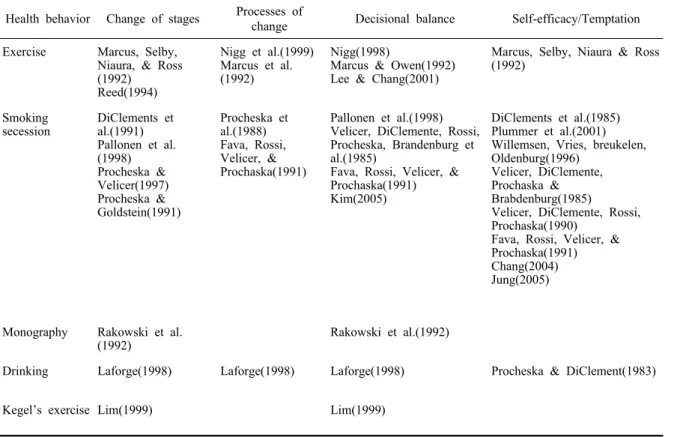
관련 변수를 측정하기 위해 국내연구에서 사용 TTM
된 측정도구는 대부분이 국외에서 개발된 것을 사용하 였다(Table 3).국외에서 개발된 질문지를 한국어로 번
Table 2. Research designs (N=26)
Type n %
Cross-sectional survey design 15 57.69
Longitudinal survey design 1 3.85
Methodological design 2 7.69
Longitudinal survey design + methodological design
4 15.39
Structural equational design 2 7.69
Quasi-experimental design 2 7.69
Total 26 100
Table 3. TTM related variables and instruments Health behavior Change of stages Processes of
change Decisional balance Self-efficacy/Temptation Exercise Marcus, Selby,
Niaura, & Ross (1992)
Reed(1994)
Nigg et al.(1999) Marcus et al.
(1992)
Nigg(1998)
Marcus & Owen(1992) Lee & Chang(2001)
Marcus, Selby, Niaura & Ross (1992)
Smoking
secession DiClements et al.(1991) Pallonen et al.
(1998) Procheska &
Velicer(1997) Procheska &
Goldstein(1991)
Procheska et al.(1988) Fava, Rossi, Velicer, &
Prochaska(1991)
Pallonen et al.(1998) Velicer, DiClemente, Rossi, Procheska, Brandenburg et al.(1985)
Fava, Rossi, Velicer, &
Prochaska(1991) Kim(2005)
DiClements et al.(1985) Plummer et al.(2001) Willemsen, Vries, breukelen, Oldenburg(1996)
Velicer, DiClemente, Prochaska &
Brabdenburg(1985) Velicer, DiClemente, Rossi, Prochaska(1990)
Fava, Rossi, Velicer, &
Prochaska(1991) Chang(2004) Jung(2005)
Monography Rakowski et al.
(1992) Rakowski et al.(1992)
Drinking Laforge(1998) Laforge(1998) Laforge(1998) Procheska & DiClement(1983)
Kegel’s exercise Lim(1999) Lim(1999)
역한 과정으로는 두 편의 연구에서만 번역 역번역 과- 정을 거쳐 한국어로 번역되었고 나머지는 역번역 과, 정 없이 번역만 되었거나 또는 어떻게 번역되었는지 서술되어 있지 않았다.
번역된 측정도구에 대한 도구검증 결과를 보면 신, 뢰도와 타당도 검증을 위한 독자적인 연구는 단지 편1 이었던 것으로 나타났다 대부분의 연구에서는 관계조. 사연구를 실시하는 과정에서 사용된 측정도구의 신뢰 도 또는 타당도를 부분적으로 보고하였다. 7편의 논문 에서 부분적으로 요인구성타당도 결과를 제시하였고, 두 편의 논문에서는 요인분석을 하였다고 하였으나 그 결과를 제시하지 않았다 이에 반해 대부분의 연구. 에서는 사용된 도구의 내적일관성 신뢰도를 검증하였 지만 대학생 금연에 대한 변화과정을 측정하기 위해 사용된 Procheska, Velicer, DiClement와 Fava(1988)의 도구 노인운동에 대한 의사결정균형을 측정하기 위, 해 사용된Marcus와Owen(1992)의 도구 중년남성 금, 연에 대한 의사결정균형을 측정하기 위해 사용된 Velicer, DiClemente, Rossi, Prochaska와 Brandenburg 의 도구는 일부 하부척도의 계수 (1985) Cronbach’s α 가0.70보다 낮아 내적일관성 신뢰도를 수립하지 못한 것으로 나타났다.
수집된 자료를 통계분석하는 과정에는 몇 가지 공통 적인 특징이 나타났다 연구설계가 유사실험연구 구. , 조모형 방법론적 연구를 제외한 나머지 연구에서의, 자료분석은 크게 변화단계에 대한 집단별 변화과정, 의사결정균형 또는 자기효능감에 차이가 있는지를 분, 석하기 위해ANOVA나MANOVA를 사용하여 분석한 것과 변화과정 의사결정균형 또는 자기효능감이 변, , 화단계에 대한 집단을 판별하는가를 분석하기 위해 판 별분석이나 로지스틱 회귀분석을 사용한 것으로 나눌 수 있다 이외에 편의 논문에서는 유방촬영검진에 대. 1 한 다섯 변화단계를 연속변수인 종속변수로 취급하고 다중회귀분석을 사용하여 분석하였다.
자료분석에 있어 두 번째 특징은 위와 같은 통계분 석을 실시할 때 각 변화단계 집단에 포함된 표본 수에, 관한 것이다 연구 전체 표본 수는 충분한 표본크기 일. 지라도 건강행위와 관련된 다섯 변화단계 중 변화단계
별 표본 수를 볼 때 대부분의 대상자가 계획전단계나, 계획단계에 분포하였고 활동단계나 유지단계에 분포 한 표본 수는 극히 적었다 이와 같이 활동단계 또는. 유지단계에 속한다고 응답한 대상자의 수가 매우 적었 기 때문에 TTM에서 의미하는 변화단계라는 개념에 대한 이론적 및 조작적 정의와 상관없이 통계분석을 위해 연구자 임의로 활동단계 및 유지단계에 속한 대 상자를 한 단계로 묶어 통계처리 한 것으로 나타났다.
이와 같이 연구자 임의로 변화단계 일부를 통합하지 않은 경우에는 표본 수가 매우 적게 분포된 변화단계, 를 연구자 임의로 삭제하고 나머지 단계의 자료만 분 석 한 것으로 나타났다.
세 번째 특징은 의사결정균형에 대한 점수계산이다.
의사결정 균형은 행위에 대한 이득요인과 장애요인으 로 구성되어 있으며 이득요인과 장애요인의 중요성에 대한 상대적인 비중을 반영한 것이다 총. 26편의 논문 중 19편의 논문(73.0%)은 이와 같은 의사결정균형을 연구변수로 포함하고 있었다 이 중. 16편의 논문에서 는 의사결정균형에 대한 하부척도인 이득요인과 장애 요인을 따로 구분하여 계산하였고 나머지 편의 논문, 3 에서는 분포가 다른 두개의 하부척도인 이익점수에서 장애점수를 빼서 계산하였다 후자에 속한 어떤 연구. 에서는 의사결정균형에 대한 원점수(raw score)를 가지 고 추론통계분석을 실시하였음에도 불구하고 단계별 의사결정균형에 대한 평균점수는 T점수로 제시한 것 도 있었다.
논 의 IV.
국내 간호연구 중TTM을 적용한 논문은 총26편으 로 많은 편은 아니지만 건강증진을 위한 건강행위관련 연구에 꾸준히 사용되어 오고 있다 이러한 논문은 국. 내 간호학술지를 대표하는 대한간호학회지와 회원학 회지중 성인간호학회지에 편중되어 게재된 것으로 나 타났다 편중성향은. TTM이 적용된 건강행위 주제나 연구대상자에서도 찾아볼 수 있다 대부분의 연구에서. 운동과 금연이라는 주제에 편중해 TTM이 적용된 것 으로 나타났고 건강한 사람 특히 그중에서도 주로 노,
인 및 중년 기혼 여성을 대상으로 연구가 실시되었다( ) . 따라서 앞으로는 좀 더 다양한 건강행위 주제와 대상 자로 확대 적용해 볼 필요가 있다.
연구를 통해 궁극적으로 추구하는 것은 개인 TTM
의 변화단계에 따라 알맞은 중재 프로그램을 계획하는 것이다 따라서 기초적으로 변화단계에 따른 분포를. 정확히 파악하는 것은 매우 중요하다 그러므로 연구. 의 표적집단을 대표할 수 있는 확률표본추출법을 사용 하는 것이 바람직하다(Fava, Velicer, & Procheska, 하지만 국내 간호연구에서는 대부분이 편의추 1995).
출방법이 사용되었으므로TTM의 기초라 할 수 있는 변화단계별 분포에 대한 연구결과의 대표성이 결여되 었다고 할 수 있다.
연구에서는 표본의 대표성 이외에도 충분한 TTM
표본수가 필요하다 단계별 분포를 보면 행동단계나. , 유지단계에 분포한 대상자 수는 계획전단계나 계획단 계에 분포한 대상자 수 보다 훨씬 적게 분포한다 따라. 서 표본의 수를 구하고자 할 때는 단계별 분포에 대한 기초정보를 바탕으로 총 표본 수 뿐 아니라 단계별로 특히 행동단계나 유지단계에 충분한 수가 포함될 수 있도록 고려해야 한다 예를 들면. , TTM을 적용한 고등 학생의 금연 변화단계별 관련요인 분석에 대한 연구에 서 경기도에 소재한 총303개 고등학교를 대상으로 비 례적 층화 무작위표출법을 사용하여 최종적으로 721 명의 학생을 연구대상자로 선정하여 금연단계별 분포 를 조사한 결과, 50.9%의 고등학생이 계획전단계와 계 획단계에 있는 것으로 나타났고 준비단계가, 22.4%, 행동단계가 11.6%, 그리고 유지단계가 14.9%로 나타 났다(Chun & Lee, 2003).그러므로 고등학생들을 대상 으로 금연단계별 연구를 시도하고자 한다면 이와 같, 은 금연단계별 분포에 대한 정보를 기초로 표본수를 고려해야 한다 무작위표출법을 사용한 위의 연구에서. 행동단계에 속한 학생들의 수가11.6%로 가장 적게 나 타났으므로 연구자가 시도하려는 연구의 총 표본 수 중 약 12%가 유지단계에 분포할 것이라는 것을 예상 하고 이12%가 통계적으로 충분한 수가 될 수 있도록 계획해야 한다.
가장 많이 사용된 연구설계는 횡단적 조사연구인 것
으로 나타났다 하지만 이러한 연구설계는 행위변화에. 대한 시간적 단계 이동에 변화과정 의사결정균형 및, 자기효능감이 어떻게 작용하는지 정확히 파악할 수 없 다는 단점을 가지도 있다 따라서 종적 연구의 수행이. 필요하다.
국외에서 개발된 측정도구를 사용하고자 할 때는 번 역 역번역 과정을 거친 후 사용하고자 하는 모집단에- , 서 신뢰도와 타당도가 수립되었는지를 확인해야 한다 하지만 국내 간호연구 (Lee, Lee, Song, & An, 2006).
에서 TTM을 구성하는 변수를 측정하기 위해 사용된 도구를 보면 번역과정의 문제뿐 아니라 신뢰도 또는, 타당도의 문제가 있는 것으로 나타났다 즉 외국에서. , 개발된 측정도구를 사용하기에 앞서 그 도구가 한국인 에서도 신뢰도와 타당도가 수립되는지를 파악하기 위 한 노력이 거의 없었다 이와 같이. psychometric pro- 가 수립되지 않은 측정도구의 사용은 국내 간호 perties
연구결과의 내적 타당도를 위협하는 요인으로 작용하 고 있는 것으로 나타났다 국내에서 개발된 측정도구. 또한 내적일관성 신뢰도와 요인구성타당도만을 위주 로 검증한 것으로 나타났는데 이외에도 충분한 표본 수를 포함해 준거타당도 수렴타당도 판별타당도 반, , , 응정도(responsiveness) 등의 다양한 검증을 해볼 필요 가 있다.
변화단계별 변화과정 의사결정균형 또는 자기효능, , 감의 차이가 있는지를 분석한 연구에서 주로 사용된 통계방법은ANOVA인 것으로 나타났다 즉 변화단계. , 별 열 가지 하부척도의 변화과정 평균점수의 차이가 있는지 변화단계별 두 가지 하부척도의 의사결정균형, 평균점수의 차이가 있는지 변화단계별 몇 가지 측정, ( 도구에 따라 다름 하부척도 평균점수의 차이가 있는) 지를 분석하기 위해 ANOVA를 사용하였다 하지만. 는 범주형 변수인 하나의 독립변수에 따른 연 ANOVA
속형 종속변수의 평균의 차이를 분석하기 위해 사용되 는 통계방법이다 만약 종속변수가 두 개 이상이며 이. , 변수들이 관계가 있을 경우에는 MANOVA를 사용해 야 한다. MANOVA의 사용은 제 종 오류의 증가를1 막을 수 있고 여러 번의, ANOVA를 수행하는 것보다 검정력을 증가시킬 수 있으며 결과의 해석 면에서도,
결과변수들의 관계를 동시에 고려할 수 있는 장점을 갖게 된다(Lee, Jung, Kim, Song, & Hwang, 2006).
의 변화과정 의사결정균형 또는 자기효능감을
TTM , ,
측정하는 도구 각각의 하부구조들은 서로 관련이 있으 므로ANOVA를 사용하는 것보다MANOVA를 사용하 는 것이 더 바람직하다고 할 수 있다 연구문제가 변. “ 화과정 의사결정균형 또는 자기효능감은 변화단계를, , 구분하는가?” 일 경우는 판별분석을 사용할 수 있다. 연구에 포함된 총 표본의 수가 충분함에도 불구하고 행동단계별 표본의 수를 고려하지 않은 연구의 문제점 은 직접적으로 통계분석에 영향을 미쳤다 즉 어떤 특. , 정 행동단계 특히 행동단계나 유지단계 에 포함된 표( ) 본 수는 모수통계를 적용하기에 부족함에도 불구하고 정규분포에 대한 가정을 무시하고 사용되었다 그 결. 과 분석결과의 편향이 심각할 수 있다.
분석방법에서 특징적으로 나타난 것은 의사결정균 형에 대한 계산이었다. TTM에서 의사결정 균형은 행 위에 대한 이득요인과 장애요인으로 구성되어 있으며 이득요인과 장애요인의 중요성에 대한 상대적인 비중 을 반영한 것이라고 하였기 때문에 몇몇의 연구에서는 이득요인인 하부척도의 점수에서 장애요인인 하부척 도의 점수를 빼서 의사결정균형 점수를 구하였다 하. 지만 이득요인 및 장애요인의 하부척도의 분포가 서로 다르므로 원점수(raw score)를 빼는 것보다는 표준화 점수로 전환한 후 이득요인의 점수에서 장애요인 점수 를 빼는 것이 바람직하다고 할 수 있다 표준화 점수는. 또는 점수로 만들 수 있지만 소수점이 많이 나오는
Z T
점수 보다는 점수로 표준화 하는 것이 편리하다고
Z T
할 수 있다.
결론 및 제언 V.
본 연구는 TTM을 적용한 국내 간호학 연구논문을 분석함으로써TTM적용실태를 파악하여 향후 간호학 연구에서 TTM을 적용한 연구의 방향을 모색하고자 대한간호학회지 및 회원학회지에 게재된TTM을 적용 한26편의 논문을 선정하여 학회지명 게재년도 관심, , 건강행위 연구대상 표본추출방법 표본 수 연구설계, , , , ,
측정도구 번역과정 및 타당성( ), 그리고 통계분석방법 으로 분류하여 분석하였다 그 결과. TTM을 적용한 간 호연구는 그 양적인 면이나 질적인 면에서 아직 초기 단계에 머물러 있다고 할 수 있다 따라서 본 연구결과. 를 토대로TTM을 적용한 간호연구 방향을 다음과 제 언하고자 한다.
을 다양한 건강행위 주제와 대상자로 확대 1. TTM
적용할 것을 제언한다.
을 적용할 경우 대표성을 확보할 수 있는 표 2. TTM ,
본추출방법의 사용과 총 표본 수 및 변화단계별 표본 수를 고려할 것을 제언한다.
행위변화에 대한 시간적 단계 이동에 변화과정
3. ,
의사결정균형 및 자기효능감이 어떻게 작용하는 지 파악할 수 있는 종적연구가 필요하다.
연구결과의 내적 타당성을 위해 신뢰도와 타당도 4.
가 수립된 측정도구를 사용해야 한다.
제 종 오류의 증가를 막고 검정력을 감소시키지
5. 1 ,
않으며 결과의 해석면에서도 용이한 통계방법을, 사용할 것을 제언한다.
References
Adams, J. & White, M. (2004). Are activity promotion inter- ventions based on the transtheoretical model effectivity? A critical review. Br J Sports Med, 37, 106-114.
Adams, J. & White, M. (2005). Why don’t stage-based activity promotion interventions work? Health Educ Res, 20(2), 237-243.
Bandura, A. (1982). Self-efficacy mechanism in human aging.
Am Psychol, 87, 122-147.
Chun, K. H. & Lee, E-H. (2003). Change of stages for smoking
cessation in adolescents: Application for the Transtheore- tical Model. Report for the Korean National Cancer Center.
Fava, J. L., Velicer, W. F., & Procheska, J. O. (1995). Applying the transtheoretical model to a representative sample of smoking. Addict Behav, 20(2), 189-203.
Glanz, K., Rimer, B. K., & Lewis, F. M. (2002). Health
Behavior and Health Education: Theory, research, practice.
Jossey-bass: San Francisco.
Kim, M. J., Lee, N. S., Lee, M. H., & Lee H. I. (1994). Analysis of experimental studies on master’s and doctoral theses in nursing. J Korean Acad Nurs, 24(1), 96-114.
Kim, S. J., Kim, K. B., Yi, M. S., Lee, K. J., Ahn, Y. H., Kim, H. S., et al. (2002). The trends of nursing research in the journals of seven branches of the Korean academy of
nursing. J Korean Acad Nurs, 32(1), 114-130.
Lee, E-H. & Kim, J. S. (2000). Major effect models of social support and its statistical methods in Korean nursing resear- ch. J Korean Acad Nurs, 30(6), 1503-1520.
Lee, E-H., Jung, Y. H., Kim, J. S., Song, R. Y., & Hwang, K.
Y. (2006). Statistical methods for health care research.
Seoul: Koonja.
Lee, E. O., Im, N. Y., & Park, H. A. (1998). Nursing and
medical research and statistical analysis. Seoul: Soomoon.
Lee, H. J., Lee, E-H., Song, R. Y., & An, S. H. (2006).
Research methods for health professionals. Seoul: Koonja.
Marcus, B. H. & Owen, N. (1992). Motivational readiness, self-efficacy, and decision making for exercise. J Appl Soc
Psychol, 22(3), 3-16.
Prochaska, J. O. & DiClemente, C. C. (1983). Stages and pro- cesses of self-change of smoking: Toward an integrative model of change. J Consult Clin Psychol, 51, 390-395.
Prochaska, J, O., DiClemenete, C. C., & Norcross, J. C. (1992).
In search of how people change: Application to addictive behaviors. Health Psychol, 47(9), 1102-1114.
Prochaska, J. O. & Velicer, W. F. (1997). The transtheoretical model of health behavior change. Am J Health Promot,
12(1), 38-48.
Procheska, J. O., Velicer, W. F., DiClemente, C. C., & Fava, J.
L. (1988). Measuring process of change: Application to the cessation of smoking. J Consult Clin Psychol, 56, 520-528.
Prochaska, J. O., Velicer, W. F., Rossi, J. S., Goldstein, M. G., Marcus, B. H., Rakowski, W., et al. (1994). Stage of change and decisional balance for twelve problem behaviors. Health Psychol, 13(1), 39-46.
Sutton, S. (2001). Back to the draw board? A review of appli- cation of the transtheoretical model to substance use.
Addiction, 96, 175-186.
Valicer, W. F., DiClemente, C. C., Rossi, J. S., Prochaska, J. O.,
& Brandenburg, N. (1985). A decisional balance measure for assessing and predicting smoking status. J Pers Soc
Psychol, 48(5), 1279-1289.
Weinstein, N. D., Rothman, A. J., & Sutton, S. R. (1998). Stage theories of health behavior: Conceptual and methodological issues. Health Psychol, 17(3), 290-299.
Werch, C. E. (1997). Expanding the stages of change: A pro- gram matched to the stages of alcohol acquisition. Am J
Health Promot, 12(1), 34-37.
연구대상 논문 목록
Ahn, O. H., Yeun, E., Kwon, S. B., Chung, H. K., & Ryu, E.
(2005). Predictive factors of aspects of the transtheoretical model on smoking cessation in a rural community. J
Korean Acad Nurs, 35(7), 1285-1294.
Chang, S. O., Kim, E. J., Kil, S. Y., Seomun, G. A., & Lee S.
J. (2005). Influential variables on intention and action to quit smoking between adolescent smokers and adult smokers-based on the transtheoretical model. J Korean
Acad Nurs, 35(7), 1410-1419.
Chang, S. O., Lee, P. S., & Park, E. Y. (2002). A study on the relationships among the influential variable on stage of change of exercise in the elderly. J Korean Acad Nurs,
32(5), 609-623.
Chang, S. O., Park, C. S., & Min, I. S. (2000). Decisional balance corresponding to the stage of change of smoking cessation in middle aged men. J Korean Fundam Nurs,
7(2), 164-176.
Chang, S. O. & Park, C. S. (2001). A study on the variables that influence stages of change in smoking cessation. J Korean
Fundam Nurs, 8(3), 391-401.
Chang, S. O., Park, Y. J., Park, C. S., & Lim, Y. J. (2000). A study of the stage of change and decisional balance: Exer- cise acquisition, smoking cessation, mammography screen- ing and Kegel's exercise acquisition in Korea. J Korean
Acad Nurs, 30(5), 1265-1278.
Choi, H., Lee, E. O., Kim B. W., & Kim, I. J. (2004). Stage of change for exercise and health-related quality of life in Korean adults. J Korean Acad Adult Nurs, 16(2), 191-201.
Chun, Y. J., Kim, S. I., Lee P. S., Kim, S. Y., Lee, S. J., Park E. S., et al. (2000). Process of change corresponding to the state of change of exercise in elderly. J Korean Acad Nurs,
30(2), 354-365.
Hur, H-K., Park, S-M., & Kim, G-Y. (2004). Factors related to the stage of mammography screening in married Korean women. J Korean Acad Adult Nurs, 16(1), 72-81.
Kim, C. J. (2002). Process of change, decisional balance and self-efficacy corresponding to the stage of exercise behavior in patients with type 2 Diabetes mellitus. J Korean Acad
Adult Nurs, 14(1), 83-92.
Kim, H. S. (2005). Features related to smoking and psy- chological characteristics of coronary artery patients asso- ciated with the stage of change in smoking cessation. J
Korean Acad Adult Nurs, 17(4), 592-599.
Kim, H. S. (2005). Prospective study on the relating factors to the stages of change in smoking cessation and barriers in coronary artery disease patients. J Korean Acad Nurs,
35(1), 27-36.
Kim, H. S., Kim, K. E., & Kwon, M. S. (2004). Factors associated with the stages of changes in drinking behavior among industrial workers, an application of the trans- theretical model. J Korean Comm Nurs, 15(1), 110-121.
Kim, S. I., Chun, Y. J., Lee, P. S., Kim, S. Y., Lee, S. J., Park, E. S., et al. (2000). Decisional balance corresponding to the stage of change of exercise in elderly. J Korean Acad Adult
Nurs, 12(1), 40-51.
Kim, S. Y., Kim, S. I., Chun, Y. J., Lee, P. S., Lee, S. J., Park, E. S.. & Chang, S. O. (2000). A prediction model for stage of change of exercise in the Korean elderly: Based on the Transtheoretical model. J Korean Acad Nurs, 30(2), 366 -379.
Lee, P. S. & Chang, S. O. (2001). The study on the effect on the effect of stage based exercise motivational intervention
program for the elderly. J Korean Acad Nurs, 31(5), 818-834.
Lee, P. S. & Chang, S. O. (2001). Development of a tool to measure decisional balance of exercise in the elderly. J
Korean Acad Psychiatr Ment Health Nurs, 10(1), 43-52.
Lee, Y. M. (2004). Predictors of stage of change for exercise behaviors among middle aged women based on the trans- theoretical model. J Korean Acad Adult Nurs, 16(3), 421 -431.
Lee, Y. M. (2004). Process of change, decisional balance and self efficacy corresponding to stages of change in exercise behaviors in middle aged women. J Korean Acad Nurs,
34(2), 362-371.
Lee, Y. M., Park, N-H., & Seo, J-M. (2003). Process of change, self efficacy and decisional balance corresponding to stage of change in smoking cessation in industrial workers. J
Korean Acad Adult Nurs, 15(3), 483-492.
Oh, H. S. & Kim, Y. R. (1996). Factor analysis on behavior change mechanism in self-help smoking cessation. J Korean
Acad Nurs, 26(3), 678-687.
Oh, H. S. & Kim, Y. R. (1997). Exploratory study on developing model smoking cessation process. J Korean Acad Nurs,
27(1), 71-82.
Park, N. H., Kim, J. S., & Lee, Y. M. (2003). Factors associated with the stage of change of smoking cessation behavior in adolescents. J Korean Acad Nurs, 33(8), 1101-1110.
Park, Y. J., Chang, S. O., & Kang, H. C. (2001). Assessing decisional balance toward mammography screening in Korean women. J Korean Acad Nurs, 31(7), 1174-1180.
Seo, N. S. (2003). The effects of stage based exercise program on the physical and psychological variables in stroke sur- vivors. J Korean Acad Nurs, 33(7), 954-964.
Son, H. M. (2005). Differences in processes of change, deci- sional balance, and temptation across the stages of change for smoking cessation. J Korean Acad Nurs, 35(5), 904 -913.
표에 인용된 참고문헌 목록
Chang, S. O. (2004). Development of a scale to measure Korean smoking temptation. J Korean Acad Nurs, 34(5), 849-858.
Diclimente, C. C., Prochaska, J. O., & Giberini, M. (1985). Self- efficacy and stages of self-change of smoking. Cognit ther
Res, 9(2), 181-200.
Diclements, C. C., Prochaska, J. O., Fairhust, S., Velicer, W. F., Velasquez, M., & Rossi, J. (1991). The process of smoking cessation: An analysis of precontemplation, contemplation and preparation stage of change. J Consult Clin Psychol,
59, 295-304.
Fava, J. L., Rossi, J. S., Velicer, W. F., & Prochaska, J. O.
(1991). Structural confirmation of short form instruments for
the transtheoretical model. Paper presentation at the 99th
annual meeting of the American Psychological Association, San Francisco.Fava, J. L., Velicer, W. F., & Procheska, J. O. (1995). Applying the transtheoretical model to a representative sample of smoking. Addict Behav, 20(2), 189-203.
Jung, K. H. (2005). The development of smoking temptation
scale of the adolescent in Korea. Unpublished master thesis,
Korea University, Korea.Kim, J. E. (2005). A study on development of a tool to measure
decisional balance for smoking of adolescent smokers in Korea. Unpublished master thesis, Korea University, Korea.
Laforge, R. G., Rossi, J. S., Prochaska, J. O., Velicer, W. F., Levesque, D. A., & McHorney, C. A. (1999). Stage of regular exercise and health-related quality of life. Prev Med,
28, 349-360.
Lee, P. S. & Chang, S. O. (2001). Development of a tool to measure decisional balance of exercise in the elderly. J
Korean Acad Psychiatr Ment Health Nurs, 10(1), 43-52.
Lim, Y. J. (1999). A study on the characteristics of the stage
based change of Kegel's exercise on middle-aged women.
Unpublished master's thesis, Korea university, Seoul, Marcus, B. H. & Owen, N. (1992). Motivational readiness,
self-efficacy, and decision making for exercise. J Appl Soc
Psychol, 22(3), 3-16.
Marcus, B. H., Rakowski, W., & Rossi, J. S. (1992). Assessing motivational readiness and decision-making for exercise.
Health Psychol, 11(4), 257-261.
Marcus, B. H., Selby, V. C., Niaura, R. S., & Rossi, J. P.
(1992). Self-efficacy and the stage of exercise behavior change. Res Quarter Exercise Sports, 63(1), 60-66.
Nigg, C. R., Norman, G. S., Rossi, J. S., & Benisovich, S. V.
(1999). Process of exercise behaviors change: Redeveloping
the scale. Post presentation at SBM, San Diego, CA.
Nigg, C. R., Rossi, J. S., Norman, G. J., & Benisovich, S. V.
(1998). Structure of decisional balance for exercise adop- tion. Am Behav Med, 20, S211.
Pallonen, U. E., Velicer, W. F., Procheska, J. O., Rossi, J. S., Bellis, J. M., Tsoh, J. Y., et al. (1998). Computer-based smoking cessation interventions in adolescents: description, feasibility, and six-month follow-up findings. Subst Use
Misuse, 33(4), 935-65.
Plummer, B. A., Velicer, W. F., Redding, C. A., Procheska, J.
O., Rossi, J. S., Pallonen, U. E., et al. (2001). Stage of change, decisional balance and temptation for smoking measurement and validation in large school-based population of adolescents. Addict Behav, 26, 551-571.
Prochaska, J. O. & DiClemente, C. C. (1983). Stages and processes of self-change of smoking: Toward an integrative model of change. J Consult Clin Psychol, 51, 390-395.
Prochaska, J. O. & Goldstein, M. G. (1991). Process of smoking cessation: Implications for clinicians. Clin Chest Med,
12(4), 727-735.
Prochaska, J. O. & Velicer, W. F. (1997). The transtheoretical model of health behavior change. Am J Health Promot,
12(1), 38-48.
Procheska, J. O., Velicer, W. F., DiClemente, C. C., & Fava, J.