Antimicrobial Effect, Antioxidant and Tyrosinase Inhibitory Activity of the Extract from Different Parts of Phytolacca americana L.
Hee-Ock Boo*, Jeong-Hun Park*, Sun-Hee Woo**, and Hyeon-Yong Park*
†*Department of Biology, College of Natural Science, Chosun University, Gwangju 501-759, Korea
**Department of Crop Science, Chungbuk National University, Cheongju 361-763, Korea
†
Corresponding author: (Phone) +82-62-230-6652 (E-mail) [email protected]
<Received 6 August, 2015; Accepted 25 August, 2015>
DOI : http://dx.doi.org/10.7740/kjcs.2015.60.3.366
Original Research Article
ⓒ 본 학회지의 저작권은 한국작물학회지에 있으며, 이의 무단전재나 복제를 금합니다.
This is an Open-Access article distributed under the terms of the Creative Commons Attribution Non-Commercial License (http://creativecommons.org/licenses/by-nc/3.0) which permits unrestricted non-commercial use, distribution, and reproduction in any medium, provided the original work is properly cited.
ABSTRACT This study was conducted to clarify the anti- microbial effect, antioxidant and tyrosinase inhibitory activities of the biological composition having the Phytolacca americana, and to enhance the natural materials utilization of foods and cosmetics. The antimicrobial activities of the different parts of P. americana were evaluated using the agar diffusion test. The antimicrobial activity of P. americana was relatively high in Malassezia furfur known as a skin fungi and Vibrio parahaemolyticus compared to Escherichia coli and Staphy- lococcus epidermidis. However, the antimicrobial activity in Vibrio parahaemolyticus did not show at all parts of P.
americana. Both the DPPH radical scavenging activity and ABTS radical scavenging activity have been increased with the higher concentration of methanol extract. In particular, leaf extract of P. americana exhibited the highest activity both ABTS radical scavenging activity and DPPH radical scavenging activity. The nitrite scavenging activity was decreased when the pH was changed from pH 1.2 to pH 6.0. The highest nitrite scavenging activity was exhibited from the methanol extract of fruit, followed by root, stem, and leaf at pH 1.2. However, the nitrite scavenging activity at pH of 6.0 was not almost detected. All plant parts of P. americana showed tyrosinase inhibitory activity. The highest activity was found in the stem, and followed by root, leaf, and fruit in order. These tyrosinase inhibitory activity was progressively increased in a concentration-dependent manner. In this experiment on the methanol extracts of different organ from P. americana, we confirmed that the extract of P. americana showed potent tyrosinase inhibitory activity. Taken together, we conjectured that the P. americana had the potent biological activities, therefore this plant having various functional components could be a good material for development into source of natural food additives and cosmetics.
Keywords : antimicrobial, DPPH, ABTS, nitrite, tyrosinase, Phytolacca americana
Phytolacca americana L. is a perennial plant belonging to the family Phytolaccaceae and is a native plant of North America. This plant was introduced to Korea from the native country, now found in both grassland and forest. P. americana have a toxic in all parts of stem, leaf, fruit, and root. Especially, the root has the highest toxic, but ripe fruit is known to have relatively low toxicity. In addition, its root has been used as a traditional crude diuretic drug, therapeutic purposes of rheumatoid arthritis and swelling in spite of having a strong toxicity. And the pigment extracted from the fruit has been used as additive material of foods and coloring material on the nails of women. P.
americana poisoning is a benign plant intoxication that causes gastrointestinal symptoms, including abdominal cramps, vomiting, diarrhea, and gastrointestinal bleeding (Kim et al., 2008). The biological activities of P. americana have been investigated by many researchers with their substance research (Shao et al., 1999; Bylka and Matlawska, 2001; Wang et al., 2008). Recently, plant and plant-derived products are treated a part of the healthcare system by applying the bioactive phytochemicals.
Medicinal plants, including P. americana are good sources of antimicrobial agents. Many infectious diseases have been known to be treated with herbal extracts. The clinical efficacy of many existing antibiotics is being threatened by the emergence of multidrug-resistant pathogens (Goveas and Abraham, 2013).
The evaluation of antimicrobial property of P. americana is of
great interest and importance. Antioxidant compounds in food
play an important role as a health protecting factor. Scientific
evidence suggests that antioxidants reduce the risk for chronic
diseases, including cancer and heart disease. Most of the antioxidant
compounds in a typical diet are derived from plant sources and
belong to various classes of compounds with a wide variety of
physical and chemical properties. The main characteristic of an
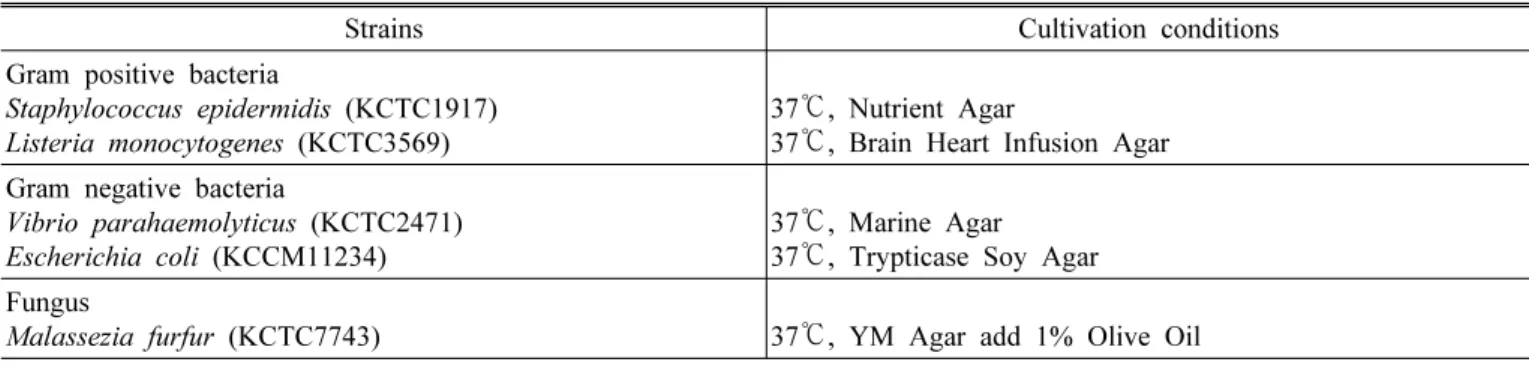
Table 1. List of strains and cultivation conditions used for the screening of antimicrobial activity.
Strains Cultivation conditions
Gram positive bacteria
Staphylococcus epidermidis (KCTC1917) Listeria monocytogenes (KCTC3569)
37℃, Nutrient Agar
37℃, Brain Heart Infusion Agar Gram negative bacteria
Vibrio parahaemolyticus (KCTC2471) Escherichia coli (KCCM11234)
37℃, Marine Agar 37℃, Trypticase Soy Agar Fungus
Malassezia furfur (KCTC7743) 37 ℃, YM Agar add 1% Olive Oil
antioxidant is its ability to trap free radicals. Highly reactive free radicals and oxygen species are present in biological systems from a wide variety of sources. These free radicals may oxidize nucleic acids, proteins, lipids or DNA and can initiate degenerative disease. Antioxidant compounds like phenolic acids, polyphenols and flavonoids scavenge free radicals such as peroxide, hydro- peroxide or lipid peroxyl and thus inhibit the oxidative mechanisms that lead to degenerative diseases (Prakash et al., 2001; Boo et al., 2012). In response to the increased production of oxygen radicals the capacity of the antioxidant defense system is increased, but in most situations the response is moderate (Foyer et al., 1994). Tyrosinase is known to be a key enzyme for melanin biosynthesis in plants, microorganisms and mammalian cells.
Many tyrosinase inhibitors have been tested on cosmetics and pharmaceuticals as a way of preventing overproduction of melanin in the epidermal layers (Shimizu et al., 2003). Many reports have been found about the tyrosinase inhibitory activity of medicinal plants. P. americana is well known to affect various pharmacological effects for human health. The present study was focused to evaluate of antimicrobial effect, antioxidant and tyrosinase inhibitory activities of the different parts in P. americana.
Materials and Methods Plant material
The sample of Phytolacca americana was collected from Jogye mountain area of Jeonnam province in 2014. Plant part materials (root, stem, leaf and fruit) were freeze-dried, and powdered in a grinder. Each sample powder was stored at -20 ℃ for experiments. The plant powder was extracted with methanol for 24 hrs. The extracts were freeze-dried after evaporating the solvent under vacuum at temperature below 50 ℃.
Antimicrobial screening test Strains and media
For the purpose of antimicrobial evaluation, two positive bacteria, two negative bacteria, and one fungus were employed.
These microorganisms were purchased from KCTC (Korean Collection for Type Culture, Daejeon, Korea) and KCCM (Korean Culture Center of Microorganisms, Seoul, Korea), and cultured in nutrient agar. Table 1 presents the test microorganisms and culture media.
Agar diffusion method
The effects of P. americana extracts on five microorganisms (Escherichia coli, Malassezia furfur, Staphylococcus epidermidis, Vibrio parahaemolyticus and Listeria monocytogenes) were evaluated using the agar diffusion method. Inocula of approximately 10
7CFU were inoculated onto the surface of pre-dried agar.
Sterile 8-mm filter paper discs were placed on the plates and impregnated with 40 µL of sample extract. After allowing 1 h at room temperature for the extracts to facilitate diffusion across the surface, the plates were incubated at 37 ℃ for 24 h for the bacteria. The antimicrobial activity was measured as the size of the clear zone of growth inhibition. The kanamycin was used as the control.
Assay of DPPH radical scavenging rate
100 µL of various concentrations (100, 250, 500, 1000, 2500, 5000 and 10000 mg L
-1) of extracts of P. americana were added to 900 µL of 100% methanol containing 100 µM DPPH, and the reaction mixture was shaken for 5 min in the slight vortex.
Leaving room temperature for 30 min under darkness, the
absorbance of DPPH was determined by spectrophotometer at
517 nm. The DPPH radical scavenging activity was calculated
according to the following equation: Scavenging effect on DPPH
radical (%) = [(A-B)/A]x100, Where A is the absorbance at 517 nm without pigment compositions and B is the change in absorbance at 517 nm with pigment compositions incubation (Brand-Williams et al., 1995).
Assay of Nitrite scavenging rate
The nitrite scavenging activity (NSA) was determined according to a method using Griess reagent (Kato et al., 1987). First, 40 μL of each sample was mixed with 20 μL of 1 mM nitrite sodium.
Then the mixture was added to 140 μL of 0.2 M citrate buffer (pH 1.2, 4.2, or 6.0). The final volume of each sample wad adjusted to 200 μL. After, the mixtures had been incubated for 1 h at 37℃, and added to 1000 μL of 2% acetic acid and 80 μL of Griess reagent (1% sulfanilic acid and 1% naphthylamine in a methanol solution containing 30% acetic acid). After vigorous mixing with a vortex, the mixture was placed at room temperature for 15 min, and absorbance was measured at 520 nm. The nitrite scavenging activity was determined based on the following formula:
NSA (%) = ((1-A-C)/B)*100 (1)
Where A is the absorbance of the mixture sample during a reation with 1 mM NaNO
2after a 1 h reaction, B is the absorbance of a mixture of distilled water and 1 mM NaNO
2after a 1 h reaction and C is the absorbance of the sample.
Assay of ABTS radical scavenging rate
The spectrophotomeric analysis of ABTS (2,2'-azinbis-(3- ethyl-benzothiazoline-6-sulfonic acid) radical cation (ABTS
•+) scavenging activity of Lactuca indica was determined according to the method described previously (Re et al., 1999) Re et al., 1999). 7 mM ABTS solution with 2.45 mM potassium persulfate was mixed, and the mixture was incubated in the dark at room temperature for 15 hours, and then was diluted to the absorbance 0.7 at 734 nm. 50 μL of each sample prepared in different concentrations with 950 μL diluted solution was added, and was shaken for 10 seconds by vortex mixer, and then was reacted for 5 min at room temperature, and the absorbance was read at 734 nm using a spectrophotometer (Biochrom Co., England). The ABTS
•+scavenging activity showed as RAEAC (relative ascorbic acid equivalent antioxidant capacity), was calculated by the following equation:
RAEAC = Caa
× Δ As
ΔAaa Cs (2)
ΔAaa : change of the absorbance after addition of ascorbic acid
Caa : concentration of ascorbic acid
ΔAs : change of the absorbance after addition of sample solution
Cs : concentration of sample
Assay of the tyrosinase inhibitory activity
The assay was performed with slight modifications of Flurkey et al. (2008) method. 0.2 mL of mushroom tyrosinase solution (100 units/mL), 0.6 mL of a 10 mM 3,4-Dihydroxy-L-phe- nylalanine (DOPA) solution in 0.1 M potassium phosphate buffer (pH 6.8) and 0.2 mL of dimethyl sulfoxide (DMSO) with a sample were mixed. The assay mixture was incubated at 37 ℃ for 20 min. Following incubation, the amount of dopachrome produced in the reaction mixture was determined spectropho- tometrically at 475 nm. The percentage of inhibition of tyrosinase activity was calculated as inhibition (%) = (1 – A/B) x 100, where A represents the absorbance of control solution, and B represents the absorbance of test substance solution.
Data analysis
All experiments were conducted for three to five independent replicates. The data are expressed in terms of mean and standard error. Data were performed using the procedures of the Statistical Analysis System (SAS version 9.1). ANOVA procedure followed by Duncan Multiple Range Test was used to determine the significant difference at the P < 0.05 level.
Results and Discussion Antimicrobial activity
The comparative analysis results of the antimicrobial activity
of selected microbes (Escherichia coli, Malassezia furfur,
Staphylococcus epidermidis, Vibrio parahaemolyticus and Listeria
monocytogenes) using the agar diffusion test in the extracts from
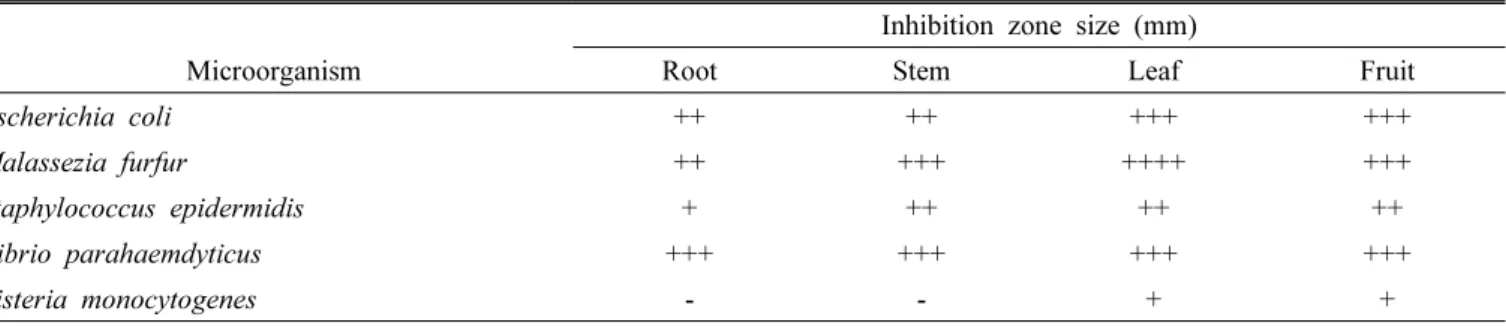
P. americana are shown in Table 2 and Fig. 1. The antimicrobial
activity of P. americana was relatively high in Malassezia furfur
known as a skin fungi and Vibrio parahaemolyticus compared to
Escherichia coli and Staphylococcus epidermidis. However, the
Table 2. Inhibitory activity against the microorganisms by agar diffusion method of methanol extracts in different parts from Phytolacca Americana.
Inhibition zone size (mm)
Microorganism Root Stem Leaf Fruit
Escherichia coli ++ ++ +++ +++
Malassezia furfur ++ +++ ++++ +++
Staphylococcus epidermidis + ++ ++ ++
Vibrio parahaemdyticus +++ +++ +++ +++
Listeria monocytogenes - - + +
Z
+++++ : lager than 20mm, ++++ : 20 ∼25mm, +++ : 15∼20mm, ++ : 10∼15,
+ : mm smaller than 10mm, - : not detected. The treatment concentration of each sample was 100mg/mL.
[Escherichia coli] [Malassezia furfur] [Staphylococcus epidermidis]
[vibrio parahaemdyticus] [Listeria monocytogenes]
Fig. 1. Inhibition activity of methanol extracts in different parts from Phytolacca Americana against five microorganisms in paper disc diffusion assay. A:Root, B:Stem, C:Leaf, D:Fruit.
antimicrobial activity in Vibrio parahaemolyticus did not show at all parts of P. americana. The antimicrobial activity in different plant parts was relatively the highest in the leaf. The antimicrobial activity of P. americana is thought to look different depending on the bacterial strains and the different plant parts.
Overall, the extracts of P. americana were more antimicrobial activity on fungus and gram positive bacteria than gram negative bacteria. Currently a wide range of natural substances known to have antimicrobial activity (Chan et al., 2008; Goveas and
Abraham, 2013; Modaressi et al., 2013), but there is little
research on related to the antimicrobial efficacy and the application
of P. americana. It is not surprising that there are differences in
the antimicrobial effects of plant species, due to the phytochemical
properties and differences among species. Some of plant extracts
may have contained antibacterial constituents, just not in sufficient
concentrations so as to be effective. It is also possible that the
active chemical constituents were not soluble in methanol or
water (Stainer et al., 1986; Parekh and Chanda, 2007). The
Table 3. DPPH radical scavenging activities of Phytolacca americana at different plant parts.
Plant Plant
Part
DPPH radical scavenging activity, % of control Concentration (mg/L)
500 1000 2500 5000 10000 20000 IC50
Phytolacca americana
Root 8.54±0.20
c9.42±0.14
c11.27±0.12
c13.09±0.17
c16.53±0.10
c27.10±0.40
d46264.22 Stem 9.39±0.21
b10.46±0.09
b11.36±0.23
bc12.61±0.21
c16.28±0.15
c29.34±0.77
c41496.50 Leaf 11.78±0.17
a14.18±0.19
a24.15±0.15
a29.38±0.23
a49.78±1.34
a78.45±0.89
a10991.76 Fruit 8.72±0.29
bc9.13±0.14
d11.85±0.06
b13.96±0.24
b24.06±0.14
b48.27±0.72
b21915.45
Z
Data represent the mean values±SE of three independent experiments. Means with the same letter in column are not significantly different at p<0.05 level by Duncan’s multiple range test.
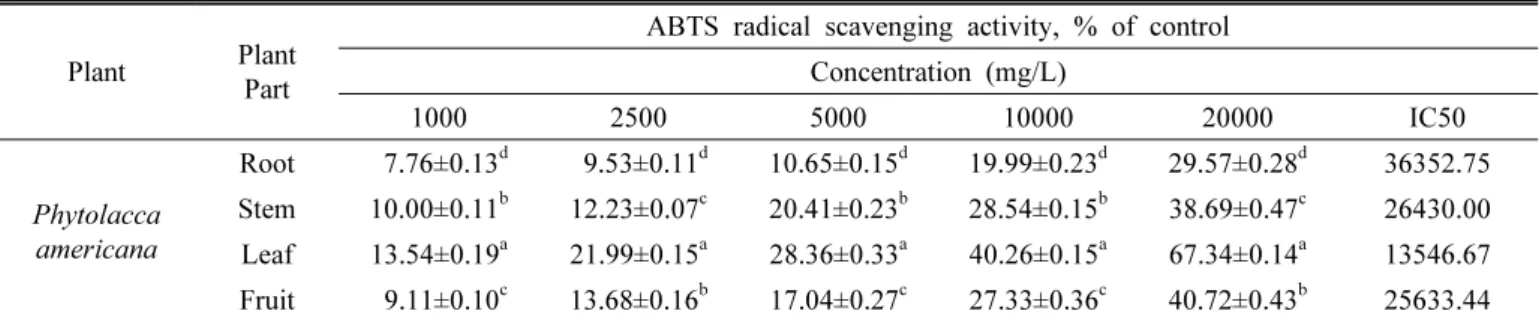
Table 4. ABTS radical scavenging activities of Phytolacca americana at different plant parts.
Plant Plant
Part
ABTS radical scavenging activity, % of control Concentration (mg/L)
1000 2500 5000 10000 20000 IC50
Phytolacca americana
Root 7.76±0.13
d9.53±0.11
d10.65±0.15
d19.99±0.23
d29.57±0.28
d36352.75 Stem 10.00±0.11
b12.23±0.07
c20.41±0.23
b28.54±0.15
b38.69±0.47
c26430.00 Leaf 13.54±0.19
a21.99±0.15
a28.36±0.33
a40.26±0.15
a67.34±0.14
a13546.67 Fruit 9.11±0.10
c13.68±0.16
b17.04±0.27
c27.33±0.36
c40.72±0.43
b25633.44
Z
Data represent the mean values±SE of three independent experiments. Means with the same letter in column are not significantly different at p<0.05 level by Duncan’s multiple range test.
potential for developing antimicrobials from higher plants appears rewarding as it will lead to the development of a phytomedicine to act against microbes. Plant-based antimicrobials have enormous therapeutic potential as they can serve the purpose with lesser side effects that are often associated with synthetic antimicrobials (Iwu et al., 1999). Further research is necessary to determine the identity of the antibacterial compounds from within P. americana and also to determine their full spectrum of efficacy.
DPPH radical scavenging activity
Free radical scavenging is one of the most important accepted mechanisms for antioxidant activity. DPPH stable free radical scavenging method can be used to evaluate the antioxidant activity of a extracts in a short time (Tiwari, 2001; Hosseinimehr et al., 2007). The values of the 50% inhibition concentration (IC
50) of leaf, fruit, stem and root extracts of P. americana for the DPPH radical were 10991.76 mg L
-1, 21915.45 mg L
-1, 41496.50 mg L
-1and 46264.22 mg L
-1, respectively (Table 3). As it is shown in Table 3, leaf demonstrated the highest DPPH scavenging capacity compared to other plant parts. The investigation of the
antioxidant activity of natural substances is based on the mea- suring of the electron donor capacity of DPPH with the ability to inhibit the oxidation by donating electrons in free radicals causing this lipid peroxidation. Active oxygen caused by in vivo metabolism removed by the body's antioxidant system, but excessive free radicals induced stress, causing the lipid peroxidation by combining with unsaturated fatty acids in the cell membrane, and brought intracellular structural and functional damage.
Looking at the results, the DPPH scavenging capacity of the extracts of P. americana showed that the increase was proportional to the concentration. Cells are oxidized and damaged by the free radical, depending on the growth of cells. It has been reported that phenolic compounds have antioxidant capacity to inhibit the oxidation by donating electrons to the free radical due to a strong reduction (Sanchez et al., 2007; Saija et al., 1998). In this study, the DPPH radical scavenging activity appeared to concentration dependent, and depending on the different plant parts, there were significant differences in the results.
ABTS radical scavenging activity
Table 5. Nitrite scavenging activities of Phytolacca americana at different plant parts.
plant Plant part
Nitrite scavenging activity (%)
pH 1.2 pH 4.2 pH 6.0
Phytolacca americana
Root 63.30±1.87
b50.25±1.07
bND Stem 59.00±0.84
c51.77±0.56
bND Leaf 32.87±0.51
d10.54±1.23
cND Fruit 71.31±1.11
a56.03±1.23
aND
Z