약학회 지 제35권 제5호 416〜 426(1991) Yakhak Hoeji Vol. 35,No. 5
내피세포를 제거한 횐쥐 대동맥에서 Phenylephrine이 일으킨 수축반응에 대한 a - 수용체 길항제의 영향
홍 승 철•강 맹 회•박 상 일•박 미 선. 최 수 경•정준기* • 서석수
부산대학교 약학대학
,
*수산대학교 수산해양대학 (Received September 26, 1991)Effects of a-Adrenoceptor Antagonists on Phenylephrine-induced Contraction in the Endothelium-denuded Rat Aorta
S u ng Cheul Hong, M aeng Hee Kang, Sang II Park, M i Sun Park, S u K yung Choi, Joon Ki C hung* and Suk Soo Suh
College of Pharmacy, Pusan National University, Pusan 609-735, Korea
* College of fisheries and ocean, National fisheries University of Pusan, Pusan 608-737,Korea
Abstract—The effects of an irreversible or a reversible cti-adrenoceptor antagonist (dibenamine or prazosin) on ai-adrenoceptor-mediated vasoconstrictions were studied in the endothelium-denu
ded rat aorta. In these experiments, the mobilization of intracelluler calcium and translocation of extracellular calcium were also studied. To exclude the modulation of endothelium releasing EDRF and EDCF, the endothelium was removed in all rat aortas. Contraction induced by phenyle
phrine (a full ai-adrenoceptor agonist) was separated into a fast phasic component of the response due to the release of intracellular calcium and a slow tonic one due to the influx of extracellular calcium. Pretreatments with increasing doses of reversible cti-adrenoceptor antagonist prazosin, as well as irreversible cti-adrenoceptor antagonist dibenamine, inhibited the phasic component of phenylephrine-induced contraction more effectively than the tonic one. Pretreatment of dibenamine (0.2
|iM )
or prazosin (10 nM) to the rat aorta abolished phasic response but remained tonic one about 41% and 51%, respectively. These results suggest that as the efficiency of phenylephrine was progressively reduced by pretreatments with increasing doses of an irreversible or a reversible cti-adrenoceptor antagonist (dibenamine or prazosin), the contraction induced by phenylephrine became progressively more dependent on the influx of extracellular calcium.Keywords □ Endothelium-denuded rat aorta, phenylephrine, phasic and tonic vasoconstriction, a r adrenoceptor antagonists, efficiency.
대부분의 혈관에서 ct-수용체를 매개한 수축반응은 세포내의
calcium의 농도를 중가시켜 일어나는 반응 으로 알려져 있다. 이러한 수축반응은 초기에 빨리 수축하는
phasic반응과 뒤이어 서서히 수축하는
to- nic반응으로 이루어진 이상성반응
(biphasic respo- n se )을 나타내고 있다.1〉빨리 수축하는
phasic반응은 세포내의
calcium을 이용한 수축반응이고,서서히 수축하는
tonic반응은 세포외의
calcium을 이용한 수 축반응임이 입증되었다가 B o h P 는 혈관평활근의 수
축반응과
calcium이용과의 관계는 총 수축반응의 관점에서가 아니라
tonic반응과
phasic반응의 각각에 서 분석되어져야 한다고 주장하였고
Godfraind둥3〉 과
Scarborough와
Carrier45) 등의 많은 연구자들이
ct-수용체 효능약의 혈관수축반응의 기전을 연구하는데 이와같은 방법을 사용하였다.
한편,
Furchgott와
Zawadzki6)등이 토끼 대동맥에 서
acetylcholine에 의한 혈관이완반응에 대한 내피 세포
(endothelium )의 역할을 밝힌 이래,
calcium io-416
내피세포를 제거한 횐쥐 대동맥에서 phenylephrine이 일으킨 수축반응에 대한 a-수용체 길항제의 영향 417
nophore A23187,ATP, bradykinin,substance P, th
rombin, histamine, serotonin 및 norepinephrine 등 의 많은 물질들이 endothelium-derived relaxing fac-
to r(E D R F )e f는 내피세포유래이완인자를 매개로 혈 관이완반응을 일으킨다고 알려졌으며, 7" 16) a-수용체 효능약의 혈관수축반응이 내피세포가 없는 혈관에 비하여 내피세포가 있는 혈관에서 억제된다는 많은 보고가 있다.17-22) 또한 a -수용체 효능약의 혈관수축 반응을 억 제 하는데 관여 하는 내 피 세포유래 이 완인자는 내피세포에서 저절로 유리되어 혈관의 긴장도를 조 절하는 것으로 알려져 있다.1423_25) 최근의 연구에 따르면 내피세포에서는 EDRF 이외에도 endothelin,
thromboxane과 같은 내피세포유래수축인자(Endo
thelium-derived contracting factor ; EDCF) 가 유리 된다는
보 고 도있다.26ᅳ撕
또한,비가역적인 ctr수용체 길항제인 phenoxyben- zamine이 a -수용체 효능약의 혈압상승반응에 대하여 calcium 유입 차단제의 억제효과를 증가시킨다는 것 이 보고되고 있다.31—36) Ruffolo 등34》 은
in vivo실험 에서 효능(efficacy) 이 큰 a r 수용체 효능약이 일으킨 혈압상승반응이 소량의 calcium 유입 차단제에 의해 영향을 받지 않는다고 보고하였으며,이는 calcium 유입 차단제의 억제반응을 완충하는 receptor rese- rve가 있기 때문이라고 주장하였다. 따라서 phenoxy- benzamine을 전처치하면 receptor reserve가 줄거나 없어져 calcium 유입 차단제의 효과가 증가된다고 주장하였다. 이에 반하여 Timmermans 등32〉 은 효능이 큰 ctr■수용체 효능약의 혈관 수축반응에서 세포내의 calcium을 이용하는 수축반응이 phenoxybenzamine 에 의해서 더 선택적으로 억제되므로 ctr수용체 효 능약의 혈관수축반응의 calcium유입차단제에 의한 억제효과가 더 증가된다고 주장하였다.
본 연구에서는 혈관수축반응에 영향을 미치는 인 자들을 유리하는 내피세포를 제거한 혈관에서 비가 역적 cti-수용체 길항제인 dibenamine과 가역적인 ctr 수용체 길항제인 prazosin을 각각 전처치 하였을 때 a-수용체 효능약인 phenylephrine에 의한 수축반응의 phasic반응과 tonic반응에 미치는 영향을 검토하고,
이때 수축반응에 이용되는 세포내 • 외의 calcium의 이용방법에 대하여 고찰하였다.
실험방법
횐쥐 대동맥 혈관표본의 제조와 장력 측정 ᅳ체중 300〜 400g의 웅성 횐쥐(Sprague-Dawley계)의 후두 부를 강타하여 출혈사시키고 개복한 후 대동맥궁과 횡경막 사이의 흉부대동맥을 적출하였다. 적출한 대 동맥 혈관을,주위 지방과 결체조직을 조심스럽게 제거한 뒤 길이 2.5 mm로 횡단하여 ring형태로 잘랐 다. 혈관 내피세포의 제거는 둥근 막대로 혈관 내벽을 부드럽게 문질러서 행하였으며,내피세포의 존재유무 는 acetylcholine에 의한 혈관이완반응의 유무로써 판정하였다.6) 혈관 표본은 두개의 L 자 모양의 고리 (30 gauge stainless-steel 주사바늘로써 만들었음)로 아래 위를 걸어 Kreb’s solution이 담긴 2 0
ml용적의 반응조(organ bath) 에 장치하고,
37°C에서 1.5g의 기 본 장력 (resting tension) 을 부하하였다. Kreb’s solu- tion의 조성 (m M ) 은 NaCl, 118 ; KC1, 4.8 ; CaCl2, 2.5 ; M gS04, 1.2 ; KH
2PO
4, 1.2 ; NaHCOs, 24 ; glu
cose, 11 ; Na2EDTA, 0.03이었고, 이 영양액을 95%
0 2와 5% CO
2의 혼합 gas로 포화시켰다. Calcium이 없는 영양액 (calcium-free solution) 은 Kreb’s solu- tion의 조성 에 서 calcium만을 제 외 시 키 고 0.5 mM EGTA를 첨가하여 만들었다.37) 수축반응은 physiog- raph 기록계(Narco M K IV)에 연결된 Myograph Fo
rce Transducer (Narco F-60) 를 사용하여 isometric tension으로 측정하였다. 약물을 주가하기 전에 혈관 표본을 90분간 방치하여 평형을 유지시켰으며,이때 15분 마다 영양액을 바꾸어 주었다.
D ib e n a m in e 에 의한 ct r 수용체의 비가역적인 봉쇄
와 c a lc iu m 이 없는 영양액의 처치一강한 효능약(full
agonist) 인 phenylephrine의 효력 (efficiency) 을 점차 적으로 감소시키기 위하여 비가역적인 a r 수용체 길 항제인 dibenamine의 농도를 점차적으로 증가시켜 처치하여 a r 수용체를 비가역적으로 봉쇄하였다.38ᅳ^
각 실험에서는 하나의 대동맥에서 얻어진 네개의 혈 관표본을 사용하여 phenylephrine( 10_6 M ) 에 의한 수축반응을 얻은 후,각 혈관 표본을 세 척하고 60분간 방치하여 평형을 유지시킨 뒤 각각 다른 농도의 dibe- namine(0.02
\xM,0.1 |iM, 0.15 !jM,0.2 |iM 및 1 (jM) 으로 12분간 처치하고 20분간 여러번 세척한 다음 phenylephrine(10一6 M ) 에 의한 수축반응을 얻었다.
계속해서 dibenamine 처치 후의 반응에 대한 cal
cium 이 없는 영양액의 영향을 고찰하기 위하여 혈 관표본을 세척하고 60분간 평형을 유지시킨 후, cal-
Vol. 35,No. 5,1991
418 홍 승 철
•강 맹 회
•박 상 일
•박 미 선
•최 수 경
•정준기• 서석수
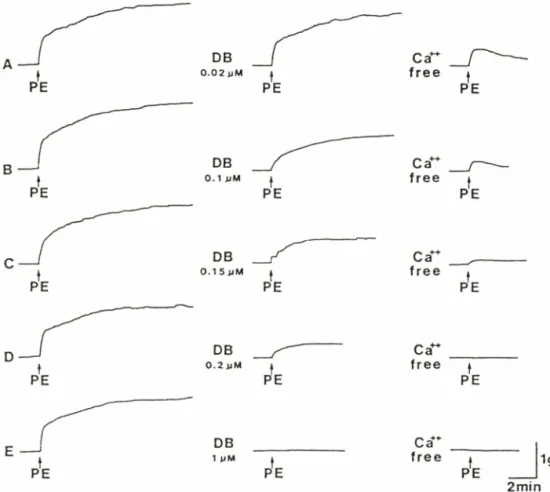
Fig. 1—Typical recordings of contractile responses of endothelium-denuded rat aortas by phenylephrine(10-6 M).
The left panel illustrates responses in the absence of dibenamine (control) and the middle panel illustrates responses in the increasing concentrations of dibenamine: (A) 0.02
\iM,(B) 0.1
\xM,(C) 0.15 |iM, (D) 0.2 pM.
(E) 1 fiM. The right panel represents responses in Ca++-free solution. PE, phenylephrine; DB,dibenamine.
cium이 없는 영양액으로 세번 연속 세척하고 5분 방치한 다음 phenylephrine(1으 6M ) 에 의한 수축반 응을 얻었다.
한편,calcium이 없는 영양액에서의 영향을 보기 전에 calcium이 없는 영양액에서의 방치시간에 따른 수축 반응의 변화를 고찰하기 위하여,phenylephrine ( l ( r 6M ) 에 의한 수축반응을 얻은 후 각 혈관표본을 세척하고 60분간 평형을 유지한 뒤, calcium이 없는 영양액으로 세번 세척하고 2분,5분 또는 10분간 방 치한 후 phenylephrine(l으 6M ) 에 의한 수축반응을 각각 얻었다.41)
P ra z o s in 에 의한 a i-수용체의 가역적인 봉쇄와 c a l
c iu m 이 없는 영양액의 처치一Phenylephrine의 효력
을 점차적으로 감소시키기 위하여 가역적인 ctr 수용체
길항제인 prazosin의 농도를 점차적으로 증가시켜 처치하여 ctr수용체를 가역적으로 봉쇄하였다. Dibe
namine 의 전처치 때처럼,phenylephrine( 10-6M ) 에 의한 수축 반응을 얻은 후 각각 다른 농도의 prazosin ( I n M ,1.5 nM ,2 nM, 10 nM 및 20nM ) 을 주가하고 15분간 방치한 다음,phenylephrine(10一6M ) 에 의한 수축반응을 얻었다. 계속해서 prazosin 존재하에서 calcium이 없는 영양액의 영향을 고찰하기 위하여 혈관표본을 세척하고 60분간 평형을 유지시켰다. 그 후 prazosin을 처치하고 10분 후 prazosin을 가한 cal
cium 이 없는 영양액으로 세번 세척하여 5분 방치한 다음 phenylephrine(1으 6 M ) 에 의한 수축반응을 얻 었다.
J. Pharm. Soc. Korea
내피세포를 제거한 횐쥐 대동맥에서 phenylephrine이 일으킨 수축반응에 대한 ct-수용체 길항제의 영향 419
O o
o
o
5 0
2 5
05 0
2 5
★
f l j L 노
P H A S I C
Fig.
0 0 . 0 2 0.1 0.1 5 0 .2 1
D i b e n a m i n e ( j J M )
2 —Effects of increasing concentrations of dibena
mine on the total(A), phasic(B), and tonic(C) components of phenylephrine(10 6 M)-induced contractions. Columns represent mean values
± S.E. and are expressed as percentages of the control value obtained in the absence of dibenamine. Number of experiments is shown in parenthesis. ★P<0.01. Significantly different from total, phasic and tonic contraction in the absence of dibenamine, respectively.
Phenylephrine의 수축반응에서 phasic반응과 tonic 반응의 분리一Phasic반응은 초기에 빨리 일어나는 반응으로 phenylephrine을 반응조에 주입한 후 약 20 초 내에 거의 직선으로 나타났고,tonic반응은 그 후에 서서히 나타나는 반응으로 5분 경과하면 약 95%의 반응을 일으켰다. Phasic반응에서 tonic반응으로의 전이점은 각 성분의 직선 부분을 연장하였을 때 만 나는 점으로 정하였다.1A5)
Data의 분석ᅳ수축반응은 최대수축반응에 대한
%로 나타내었다. 측정치는 평균값:t 표준오차(mean土 S.E.)로 나타내었고, 유의성 검정은 Student’s
ttest로 하였다. P의 값이 0.05 이하일 때 유의성이 있는 것
으로 하였다.
실험 약물ᅳ본 실험에 사용된 약물은 다음과 같다
! acetylcholine chloride, phenylephrine hydrochlo
ride (Sigma Chemical Co.) ; prazosin hydrochloride (Pfizer Inc.) ; dibenamine hydrochloride (Tokyo kasei Chemical Co.).
실험결과
비가역적 ctr
수용체 길항제인
dibenamine처치
후phenylephrine
의 혈 관수축 반응
ᅳ내피세 포를 제 거 한 횐쥐 대동맥에서 ctr수용체 효능약인 phenylephrine (10 6M )은 초기에 빠른 phasic반응과 뒤이어 느리고 지속적인 tonic반응으로 이루어진 이상성 수축반응을 일으켰다(Fig. 1). Phasic반응은 총수축반응의 44.67土 0.64%이었으며, tonic반응은 총수축반응의 55.33士 0.64%에 해당하였다(n = 35)(Fig.2). ctr 수용체를 비 가역적으로 불활성화시키는 dibenamine의 농도를 점 차적으로 증가시키면서 처치하여 phenylephrine의 효력을 점차적으로 감소시켰을 때의 phenylephrine이 일으킨 혈관수축반응을 phasic반응과 tonic반응으로 분리하여 고찰하였다(Fig. 1과 2). 0.02 pM 의 dibena- mine을 전처치하였을 때 phenylephrine이 일으킨 to- nic반응은 거의 영향이 없었으나(1.38± 8.22% 감소 되었으나 유의성이 없음) phasic반응은 17.05± 3.20%
감소되었다(Fig. 2). Dibenamine의 농도를 0.1 (iM 및 0.15 nM로 각각 증가시켰을 때는 tonic반응과 pha
sic 반응이 각각 농도 의존적으로 감소되었으나,to- nic반응(27.86土 7.26% 및 48.61±3.79% 감소)보다 phasic반응(55.83± 4.58% 및 89.28± 3.97% 감소) 이 더욱 현저하게 감소되었다(Fig. 2). 그리고 0.2 (iM의 dibenamine을 전처치하였을 때는 phasic반응은 소실 되었고(98.78±1.13%의 감소로 남아 있는 phasic반 응은 유의성이 없음), tonic반응은 약 41% 남아 있 었다(59.37士 5.94% 감소) (Fig. 1과 2). Dibenamine의 농도를 더욱 증가시켜서 lf iM 을 전처치하였을 때는 tonic반응도 소실되어 수축반응이 나타나지 않았다 (Fig. 1과 2).
이상의 결과에 따르면 dibenamine의 처치농도를 증가시킴에 따라 phenylephrine의 혈관수축반응은 tonic반응에 비하여 phasic반응이 더 많이 억제되는 경 향을 나타내 었으며,0.2 (iM의 dibenamine을 전처
Vol. 35, No. 5, 1991
420 홍 승 철 • 강맹희 • 박 상 일 • 박 미 선 • 최수 경 • 정준기 • 서석수
P R A Z
P R A Z
P R A Z P E
c r f r e e
P E
P R A Z
1 0 n M
P E
c r f r e e
P E
P R A Z P E
c r f r e e
P E
2 m in
Fig. 3 — Typical recordings of contractile responses of endothelium-denuded rat aortas by phenylephrine(10—6 M).
The left panel illustrates responses in the absence of prazosin (control) and the middle panel illustrates responses in the increasing concentrations of prazosin: (A) 1 nM, (B) 1.5 nM, (C) 2 nM, (D) 10 nM, (E) 20 nM. The right panel represents responses in Ca++-free solution containing the same concentrations of prazosin of middle panel, respectively. PE, phenylephrine: PRAZ, prazosin
치하였을 때는, phenylephrine(10 6 M )은 전적으로 세포외의 calcium을 이용하는 tonic반응만으로 된수 축반응을 일으켰다.
가역적 ctr수용체 길항제인
prazosin처치 후
phenylephrine
의 혈관수축반응
ᅳ내피세포를 제거한 혈관에서 p he ny le phrin e(l으6M )의 phasic반응은총수축 반응의 42.83± 1.01%이었으며,tonic반응은 총수축반 응의 57.17±1.01%에 해당하였다( n = 25) (Fig. 4). 1 n M 의 prazosin을 전처치하였을 때 phenylephrine 이
일으킨 phasic반응은 prazosin을처치하기 전에 비하 여 35.78± 5.29%의 현저한 감소를 나타내었으며,to
nic 반응은 11.59±3.55% 감소되었으나 유의성이 없
었다(Fig. 4). Prazosin의 농도를 1.5 nM 및 2 n M로
각각증가시켰을 때도 phasic반응은 각각 45.65土 5.58
% 및 63.03± 7.14%의 현저한 감소를 나타내었으며, tonic반응은 각각 14.43± 8.60% 및 19.70± 8.24% 감 소되었으나유의성은없었다(Fig. 4). 그리고 1 0 n M의 prazosin을 전처치하였을 때는 phasic반응은 소실되 었고(95.41± 3.97%의 감소로 남아있는 phasic반응은
유의성이 없음) tonic반응은 약 51% 남아있었다
(49.04± 2.75% 감소) (Fig. 3과 4). Prazosin의농도를 더욱 증가시켜서 2 0 n M을 전처치하였을 때는 tonic 반응도 소실되었다(Fig. 3과 4).
이상의 결과에 따르면 prazosin의 처치농도를 증
가시킴에 따라 phenylephrine 의 혈관수축반응은 di-
benamine을 전처치하였을 때 처럼 tonic반응에 비하
/
Pharm. Soc. Korea내피세포를 제거한 횐쥐 대동맥에서 phenylephrine이 일으킨 수축반응에 대한 a-수용체 길항제의 영향 421
0 1 1.5 2 10 2 0
P r a z o s in ( nM )
Fig. 4 — Effects of increasing contractions of prazosin on the total (A), phasic (B), and tonic (C) com
ponents of phenylephrine (10-6 M)-induced contractions. Columns represent mean values
± S.E. and are expressed as percentages of the control value obtained in the absence of prazosin. Number of experiments is shown in parenthesis. ★P<0.01. Significantly different from total, phasic and tonic contraction in the absence of prazosin, respectively.
여 phasic반응이 더욱 많이 억제되는 경향을 나타내 었으며, 10nM 의 prazosin을 전처치하였을 때는,phe- nylephrine(l(r6M ) 의 혈관수축반응은 전적으로 세 포외의 calcium을 이용하는 tonic반응만으로 된 수축 반응을 일으켰다.
Phenylephrine의 혈관수축반응에 대한 calcium 이 없는 영양액의 영향
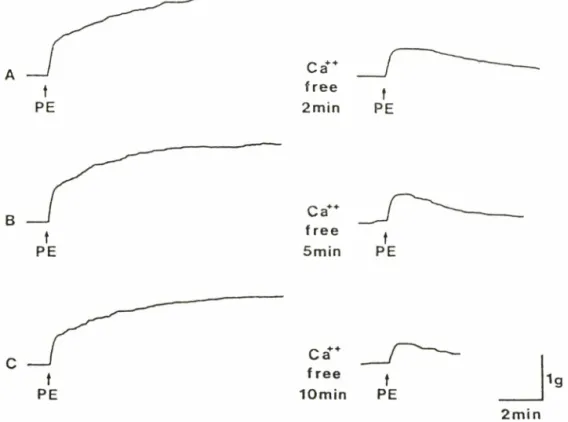
ᅳPhenylephrine이 일으킨 혈관 수축반응의 세포외의 calcium에 대한 의존도를 고찰 하기 위하여, 혈관표본을 calcium이 없는 영양액에 2분, 5분 또는 10분 동안 방치한 다음 phenyleph- rine을 가하여 수축반응을 관찰하였다(Fig. 5). 정상 영양액에서 phenylephrine이 일으킨 phasic반응은 총수축반응의 42.41± 0.81%에 해 당하였으며 (Fig. 6) ,
calcium이 없는 영양액에서 2분,5분 또는 10분 동안 방치후 phenylephrine이 일으킨 수축반응은 모두 phasic반응으로,총수축반응에 대하여 각각 37.29土 1.18%, 32.77± 1.06% 및 27.73± 1.30%의 수축반응을 나타내 었고(Fig. 6) ,이는 정 상 영 양액 에 서 phenyle- phrine이 일으킨 phasic반응을 100%로 하였을 때는 각각 87.93土 2.78%, 77.26士 2.56% 및 65.39士 3.06% 에 해당하였다(Fig. 6). 이와같은 결과로 phasic반응은 세포내의 calcium을 이용하는 수축반응임을 보여 주 었고, calcium이 없는 영양액에서 phasic반응도 어느 정도 감소되며,감소되는 정도는 방치시간이 길어짐에 따라 증가되는 것으로 나타났다(Fig. 5와 6).
한편, dibenamine 또는 prazosin 처치후에 나타나 는 phenylephrine의 수축반응의 세포외의 calcium에 대한 의존도를 검토하기 위하여 dibenamine 전처치 또는 prazosin 존재하에서 calcium이 없는 영양액에 5분간 방치한 뒤 phenylephrine의 수축반응을 검토 하였다(Fig. 1과 3). Dibenamine과 prazosin의 농도를 점차적으로 증가시키면서 각각 ᄌ d 처치한 후에,phen
ylephrine 이 일으킨 수축반응은 calcium이 없는 영 양액으로 바꾸었을 때 tonic반응은 소실되고 phasic 반응만 남아 있었으며, dibenamine 0.2 fjM과 prazo
sin 10nM 을 각각 전처치하였을 때는,tonic반응만이 각각 약 41% 및 51%(dibenamine 또는 prazosin을 처치하기 전의 phenylephrine의 tonic반응을 100%로 하였을 때) 남아 있었고(F ig.2와 4) ,이러한 tonic반 응은 calcium이 없는 영양액에서는 완전히 소실되었 다(Fig. 1과 3).
고 찰
비가역적인 ctr 수용체 길항제인 phenoxybenza- mine이 a r 수용체 효능약의 혈압상승반응에 대하여 calcium 유입차단제의 억제효과를 증가시킨다는 것이 보고되고 있다.31ᅳ회 이에 대하여 Ruffolo 등34〕 은 in vivo 실험에서 효능이 큰 a r 수용체 효능약이 일으킨 혈압상승반응이 소량의 calcium유입 차단제에 의해 영향을 받지 않는다고 하였으며,이는 calcium유입 차단제의 억제반응을 완충하는 receptor reserve가 있기 때문에 비가역적 a r 수용체 길항제인 phenoxy- benzamine을 전처치하면 receptor reserve가 줄거나 없어져 calcium유입 차단제의 효과가 증가된다고 주
Vol. 35, No. 5’ 1991
422 홍 승 철
•강 맹 희
•박 상 일
•박 미 선
•최 수 경
•정 준 기 • 서석수
B
PE
C
PE
192 m in
Fig. 5
— Typical recordings of contractile responses of endothelium-denuded rat aortas by phenylephrine(l으 6 M).
The left panel illustrates responses in normal physiological saline solution (PSS) and the right panel illustrates responses after successive incubation in Ca++-free solution for 2 min (A), 5 min (B) and 10 min (C),respectively. PE, phenylephrine.
2 5 10
T i m e ( m i n )
Fig. 6
—Effect of incubation time of Ca++-free solution on phasic component of phenylephrine (1 으 6 M)-induced contraction. Columns represent mean values士 S.E. and expressed as percenta
ges of the total contraction abtained in nor
mal physiological saline solution (Ca++ PSS).
Number of experiments is shown in parenthe
sis. ★P<0.01. Significantly different from pha
sic contraction in the normal PSS (control).
장하였다.42ᅳ^ 이에 반하여 Timmermans 등32〉 은 효 능이 큰 a !-수용체 효능약의 혈압상승반응에서 cal
cium 유입 차단제의 억제효과가 phenoxybenzamine에 의하여 증가되었으나,다른 비가역적인 ct-수용체 길 항제인 benextramine에 의해서는 증가되지 않으므로 효능이 큰 ctr수용체 효능약의 혈압상승반응에 대한 phenoxybenzamine에 의한 calcium유입 차단제의 억 제작용의 증가효과는 phenoxybenzamine 이 세포내의 calcium을 이용하는 혈압상승반응을 선택적으로 억 제하기 때문이라고 제의하였다.32’45) 그러나 그 후 be
nextramine 에 의해서도 효능이 큰 ctr수용체 효능약 의 혈압상승반응에 대한 calcium유입 차단제의 억제 작용이 증가되므로, phenoxybenzamine 에 의한 cti-수 용체 효능약의 혈압상숭반응에 대한 calcium유입 차 단제의 억제작용의 증가효과가 비가역적인 a i-수용체 차단작용과 무관한 약물자체의 특성에 의한 것은 아 니라고 제의하였다.36’씨
/
Pharm. Soc. Korea내피세포를 제거한 횐쥐 대동맥에서 phenylephrine이 일으킨 수축반응에 대한 a-수용체 길항제의 영향 423
본 연구에서는 phenylephrine의 혈관수축반응에 대한 내피세포의 영향을 배제하기 위하여 내피세포 유래인자들(EDRF,EDCF 등)을 유리하는 내피세포 를 제거한 혈관을 사용하여,효능이 큰 ctr수용체 효 능약인 phenylephrine의 수축반응을 세포내의 cal
cium 을 이용하는 phasic반응과 세포외의 calcium을 이용하는 tonic반응으로 분리하여, 12) 비가역적인 a r 수용체 길항제인 dibenamine과 가역적인 ctr수용체 길항제인 prazosin의 영향을 검토하였다. 내피세포를 제거한 횐쥐 대동맥에서 phenylephrine은 초기에 빠 른 phasic반응과 뒤이어 느리고 지속적인 tonic반응 으로 이루어진 이상성반응을 일으켰다(Fig. 1, 2, 3과 4). 비가역적인 ctr수용체 길항제인 dibenamine의 농도를 증가시키면서 처치하였을 때 phenylephrine이 일으킨 혈관수축반응에 대한 영 향을 phasic반응과 to
nic 반응으로 분리 하여 관찰한 결과, 0.02 )aM의 dibe
namine 을 전처치하였을 때 phenylephrine이 일으킨 tonic반응에는 영 향이 없었으나 phasic반응은 약 17%
감소되었으며, dibenamine 농도를 0.1 fiM 및 0.15 jiM로 각각 증가시켜 전처치하였을 때는 tonic반응(약 28% 및 49% 감소)에 비하여 phasic반응(약 56% 및 89% 감소)이 더욱 현저하게 감소되었고, 0.2|iM의 dibenamine을 전처치하였을 때는 phasic반응은 소실 되고 tonic반응만 약 41% 남게 되었다(Fig. 1과 2).
Martin 등24)은 비가역적인 ctr수용체 길항제인 dibe
namine 0.2|iM을 전처치하여 cti-수용체의 약 98%를 봉쇄하였을 때 효능이 큰 효능약인 phenylephrine의 혈관수축반응이 부분효능약인 clonidine의 혈관수축 반응과 비슷한 농도반응곡선을 나타낸다고 하였다.
저자 등은 전보에 서 단일농도의 dibenamine(0.2 |iM) 을 전처치하였을 때 phenylephrine의 혈관수축반응이 tonic반응만을 일으켰으며, 이 반응은 영양액을 cal
cium 이 없는 영양액으로 바꾸거나,정상 영양액에 ca
lcium 유입 차단제인 verapamil을 전처치 하였을 때는 소실됨을 관찰한 바 있다.25) 이상의 결과로서 ctr•수 용체를 점차적으로 비가역적으로 불활성화시켜 효능 이 큰 효능약의 효력을 점차적으로 낮추었을 때 phe
nylephrine 의 수축반응은 세포외의 calcium의 이용에 더욱 의존하며,phenylephrine의 효력을 더욱 낮추 었을 때에는 전적으로 세포외액의 calcium만을 이용 하여 혈관수축반응을 일으키는 것으로 사료된다. 이 와같은 현상에 대하여 Nichols와 Ruffolo4^ 는 세포내
의 calcium을 이용하는 반응은 생물학적 자극(biolo
gical stimulus) 과 반응 사이의 연결효율(efficiency of coupling) 이 낮아 receptor reserve가 없는 반면 세포외의 calcium을 이용하는 반응은 연결효율이 높 아 receptor reserve를 가지기 때문이라고 주장하였 다. 한편,Timmermans 등은 phenoxybenzamine이 저농도에서 세포내의 calcium을 이용하는 반응을 선 택적으로 억제하는 특성이 있어, 31-33.45) 세포내의 cal_
cium을 이용하는 혈압상승반응을 선택적으로 억제한 다고 주장하였
으 므 로 ^ ’46) 비가역적인 ctr수용체 길항 제인 dibenamine의 실험 결과(Fig. 1과 2) 가 비가역 적인 ctr수용체 길항제인 phenoxybenzamine처럼 di- benamine의 약물특성에 의한 것인지를 검토하기 위 하여, phenylephrine의 혈관수축반응에 대하여 가역 적인 cti-수용체 길항제인 prazosin의 영향을 검토하 였다. Prazosin의 농도를 1 nM ,1.5 nM 및 2 nM 로 증가시키면서 처치하였을 때 phenylephrine이 일으킨 phasic반응은 prazosin을 처치하기 전에 비하여 현저 하게 감소되 었으나( 각각 약 36%, 46%, 및 63% 감소),
tonic반응은 유의성있는 변화를 나타내지 않았다. 그 리고 10nM 의 prazosin을 전처치하였을 때는 pha
sic 반응은 소실되었으나 tonic반응은 약 51% 남아 있었으며, 이 반응은 calcium이 없는 영양액으로 바 꾸었을 때 소실되었다(Fig. 3과 4). 이와 같은 결과로 ctr수용체를 가역적으로 불활성화시켜 효능이 큰 효 능약의 효력을 점차적으로 낮추었을 때에는 phenyle
phrine 의 수축반응은 세포외의 calcium의 이용에 더 욱 의존하는 경향을 나타내며, phenylephrine의 효 력을 어느정도(prazosin 10 nM 을 전처치했을 때의 phenylephrine의 효력)까지 낮추었을 때는 전적으로 세포외의 calcium만을 이용하여 수축반응을 일으킨 다고 사료된다. 따라서 dibenamine을 전처치하였을 때 phenylephrine의 혈관수축반응이 세포외의 cal- cium에 더 의존하는 것은 dibenamine의 약물특성에 의한 것이 아니라 ctr수용체를 감소시킴으로써 효력을 감소시키기 때문이라 사료된다.
이상의 결과로서 ctr수용체를 ctr수용체 길항제(비 가역적인 ctr수용체 길항제인 dibenamine 또는 가역 적인 cti-수용체 길항제인 prazosin) 로써 점차적으로 불활성화하였을 때는 효능이 큰 이-수용체 효능약인 phenylephrine의 혈관수축반응이 세포내의 calcium에 비하여 세포외의 calcium의 이용에 더욱 의존하는
Vol. 35, No. 5, 1991
424 홍 승 철 • 강 맹 희 • 박 상 일 • 박 미 선 • 최 수 경 • 정준기• 서석수
경향을 나타내고,이-수용체를 어느정도까지 불활성 화하였을 때는 세포외의
calcium만을 이용하여 혈관 수축반응을 일으킨다고 사료된다.
결 론
본 연구에서는 내피세포를 제거한 횐쥐 대동맥 혈 관에서
oti-수용체 효능약인
phenylephrine의 혈관수 축반응에 대한 비가역적인 a r 수용체 길항제와 가역 적인 ctr수용체 길항제의 영향과 이때 수축반응에 이용된 세포내 • 외의
calcium의 이용방법에 대하여 검토하여 다음과 같은 결과를 얻었다.
1
. 내피세포를 제거한 혈관에서
phenylephrine이 일으킨 수축반응은 세포내의
calcium을 이용하는
phasic반응과 세포외의
calcium을 이용하는
tonic반 응으로 이루어진 이상성반응을 일으켰다.
2.
비가역적인
a r수용체 길항제인
dibenam ine의 농도를 점차로 증가시키면서 전처치하였을 때는
phenylephrine
이 일으킨 수축반응은
phasic반응이
tonic반응보다 더 현저하게 억제되었다.
3. Dibenam ine
의 농도를 어느 정도
(0.2 |iM)증가 시켰을 때는
phe nyle phrin e(l으 6
M )이 일으킨 수축 반응은 전적으로 세포외의
calcium의 유입에 의존하
는
tonic반응만을 나타내었다.
4.
가역적인
ctr수용체 길항제인
prazosin의 농도를 점차로 증가시키면서 전처치하였을 때도
phenyleph- rine이 일으킨 수축반응은
phasic반응이
tonic반응 보다 더 현저하게 억제되었다.
5. Prazosin
의 농도를 어느정도
(10 n M )로 증가시 켰을 때도
phenylephrine(10一6 M )이 일으킨 수축반 응은 전적으로 세포외의
calcium의 유입에 의존하는
tonic
반응만을 나타내었다.
이상의 결과로서 ctr수용체를 Ctr수용체 길항제(비 가역적인
ctr수용체 길항제인
dibenamine또는 가역 적인
ctr수용체 길항제인
prazosin)로써 점차적으로 불활성화하였을 때는 효능이 큰 a r 수용체 효능약인
phenylephrine의 혈관수축반응이 세포내의
calcium에 비하여 세포외의
calcium의 이용에 더욱 의존하는 경향을 나타내고,ctr 수용체를 어느 정도까지 불활성 화하였을 때는 세포외의
calcium만을 이용하여 혈관 수축반응을 일으킨다고 사료된다.
감사의 말씀
이 논문은 1990년도 교육부 지원 한국학술진흥재 단의 자유공모과제 학술연구조성비의 지원으로 이루 어졌으므로 이에 감사를 드립니다.
문 헌
1) Deth, R. and Van Breeman, C.: Relative contribu
tions of Ca2+ influx and cellular Ca2+ release du
ring drug induced activation of rabbit aorta. Pflu- gers Arch. Pharmacol 348, 13(1974).
2) Bohr, D.F.: Vascular smooth muscle: Dual effects of calcium. Science(Wash. DC) 139,597(1963).
3) Godfraind, T.,Miller, R.C. and Lima, J.S.: Selective ctr and a 2-adrenoceptor agonist-induced contrac
tions and 45Ca fluxes in the rat isolated aorta. Br.
J. Pharmacol. 77,597(1982).
4) Scarborough, N.L. and Carrier, G.O.: Nifedipine and alpha adrenoceptors in rat aorta. I. Role of extracellular calcium in alpha-1 and alpha-2 adre
noceptor-mediated contraction. / Pharmacol Exp.
Ther. 231, 597(1984a).
5) Scarborough, N.L. and Carrier, G.O.: Nifedipine and alpha adrenoceptors in rat aorta. II. Role of extracellular calcium in enhanced alpha-2 adreno
ceptor-mediated contraction in diabetes. J. Phar
macol Exp. Ther. 231,603(1984b).
6) Furchgott, R.F. and Zawadzki, J.V.: The obligatory role of endothelial cells in the relaxation of arte
rial smooth muscle by acetylcholine. Nature (Lond.) 288,373(1980).
7) De Mey, J.G. and Vanhoutte, P.M.: Role of the intima in cholinergic and purinergic relaxation of isolated canine femoral arteries. J. Physiol (Lond.) 316,347(1981).
8) Cherry, P.D., Furchgott, R.F. and Zawadzki, J.V.:
The endothelial cells in relaxation of isolated arte
ries by bradykinin. Proc. Natl. Acad. Sci. U.S.A.
72, 2106(1982).
9) Cocks, T.M. and Angus, J.A.: Endothelium-depen- dent relaxation of coronary arteries by noradrena
line and serotonin. Nature {Lond.) 305, 627(1983).
J. Pharm. Soc. Korea
내피세포를 제거한 횐쥐 대동맥에서 phenylephrine이 일으킨 수축반응에 대한 a-수용체 길항제의 영향 42^
10) Cohen, R.A., Shepherd, J.T. and Vanhoutte, P.M.:
5-Hydroxytryptamine can mediate endothelium- dependent relaxation of coronary arteries. Am. J.
Physiol. 245,H1077(1983).
11) Furchgott,R.F.: Role of endothelium in responses of vascular smooth muscle. Circ. Res. 53,557(19 83).
12) Angus, J.A., Cocks, T.M. and Satoh, K.: a2-adreno- ceptors and endothelium-dependent relaxation in canine large arteries. Br. J. Pharmacol. 88, 767 (1986a).
13) Angus, J.A., Cocks, T.M. and Satoh, K.: The a-ad- renoceptors on endothelial cells. Federation Proc.
45, 2355(1986b).
14) Cohen, R.A., Zitnay, K.M., Weisbrod, R.M. and Fe- sfamariam, B.: Influence of the endothelium on tone and response of isolated pig coronary artery to norepinephrine. J. Pharmacol Exp. Ther. 244,
550(1988).
15) Molderings, G.J., Engel, G.,Roth, E. and Gothert, M.: Characterization of an endothelial 5-hydroxytr- yptamine (5-HT) receptor mediating relaxation on the porcine coronary artery. Naunyn-Schmiedeberg1 s Arch. Pharmacol 340,300(1989).
16) Schoeffter, P. and Hoyer, D.: 5-Hydroxytryptamine (5-HT)-induced endothelium-dependent relaxation of pig coronary arteries is mediated by 5-HT rece
ptors similar to the 5-HTm receptor subtype. J.
Pharmacol Exp. Ther, 252,387(1990).
17) Allan, G.,Brook, C.D.,Cambridge, D. and Hladkwi- skyi, J.: Enhanced responsiveness of vascular smooth muscle to vasoconstrictor agents after re
moval of endothelial cells. Br. J. Pharmacol 79(su- ppl.), 334p(1983).
18) Egleme, C.,Godfraind, T. and Miller, R.C.: enhan
ced responsiveness of rat isolated aorta to cloni- dine after removal of the endothelial cells. Br. J.
Pharmacol 81,16(1984a).
19) Egleme, C.,Godfraind, T. and Miller, R.C.: Role of endothelium in the rat aorta response to vaso
constrictors. Arch. Int. Pharmacodyn. 268, 116(1984 b).
20) Lues, I. and Schumann, H.H.: Effect of removing the endothelial cells on the reactivity of rat aortic
segments of different a-adrenoceptor agonists.
Naunyn-Schmiedeberg’s Arch. Pharmacol. 328,160 (1984).
21) Carrier, G.O. and White, R.E.: Enhancement of alpha-1 and alph-2 adrenergic agonist-induced va
soconstriction by removal of endothelium in rat aorta. / Pharmacol Exp. Ther. 232,682(1985).
22) Godfraind, T. Egleme, C. and Osachie, I.A.: Role of endothelium in the contractile response of rat aorta to a-adrenoceptor agonists. Clinical Science (Lond.) 68 (suppl. 10), 65s(1985).
23) Malta, E., Schini, V. and Miller, R.C.: Role of effi
cacy in the assesment of the actions of a-adreno
ceptor agonists in rat aorta with endothelium. J.
Pharm. Pharmacol 38,209(1986).
24) Martin, W., Furchgott, R.F., Villani, G.M. and Jo- thianandan, D.: Depression of contractile respon
ses in rat aorta by spontaneously released endo
thelium-derived relaxing factor. J. Pharmacol Exp.
Ther. 237,529(1986).
25) 정준기,홍승철,최수경,강맹회, 구미경,박상일,
윤 일 : 횐쥐 적출 대동맥에서 ctr수용체 효능약과 ctr수용체 효능약의 혈관 수축반응에 대한 내피세 포의 영향. 藥學會誌, 34, 180(1990).
26) Coleman, R.A., Humphrey, P.P.A., Kennedy, I., Levy, G.P. and Lumley, P.: Comparison of the ac
tions of U-46619,a prostaglandin H2-analogue, with those of prostaglandin H2 and thromboxane A2 on some isolated smooth muscle preparations. Br. J.
Pharmacol 73, 773(1981).
27) Rubanyi, G.M.: Endothelium-dependent pres
sure-induced contraction of isolated canine carotid arteries. Am. J. Physiol 255,H783(1988).
28) Yanagisawa, M.’ Kurihara, H.,Kimura,S., Tomobe, Y., Kobayashi, M., Mitsui, Y.,Yazaki, Y.’ Goto, K.
and Masaki, T.: A novel potent vasoconstrictor pe
ptide produced by vascular endothelial cells. Na
ture 332, 411(1988).
29) Saito, A., Shiba, R.,Kimura, S., Yanagisawa, M .,
Goto, K. and Masaki, T.: Vasoconstrictor response of large cerebral arteries of cats to endothelin, an endothelium-derived vasoactive peptide. Eur.
J. Pharmacol 162, 353(1989).
30) Yanagisawa, M. and Masaki, T.: Molecular biology
Vol. 35, No. 5’ 1991
426 홍 승 철 • 강 맹 회 • 박 상 일 • 박 미 선 • 최수 경• 정 준 기 • 서석수
and biochemistry of the endothelins. Trends Phar
macol. Sci. 10,374(1989).
31) Timmermans, P.B.M.W.M., Mathy,M J., Korstanje, C., Thoolen, Wilffert, B., De Jonge, A.
and Van Zwieten, P.A.: Phenoxybenzamine identi
fies calcium influx dependent and independent mechanisms of vasoconstriction in vivo to cirazo- line. Naunyn-Schmiedeberg's Arch. Pharmacol 324, suppl.,R 54(1983).
32) Timmermans, P.B.M.W.M., Thoolen,
Mathy, M.J., Wilffert, B., De Jonge, A. and Van Zwieten, P.A.: Effects of the irreversible a-adre- noceptor antagonists phenoxybenzamine and be
nextramine on the effectiveness of nifedipine in inhibiting cti and a2-adrenoceptor mediated vaso
constriction in pithed rats. Naunyn-Schmiedeberg’s Arch. Pharmacol 329,404(1985).
33) De Jonge, A., Mathy, M J., Thoolen, M J.M .C.,Ti
mmermans, P.B.M.W.M., Wilffert, B., and Van Zwieten, P.A.: Inhibition of vasoconstriction to ci- razoline in pithed rats by nifedipine after phenox
ybenzamine. Br. J. Pharmacol. 81,80p(1984).
34) Ruffolo, R.R., Jr., Morgan, E.L. and Messick, K.:
Possible relationship between receptor reserve and the differential antagonism of alpha-1 and al
pha-2 adrenoceptor-mediated pressor responses by calcium channel antagonists in the pithed rat.
J. Pharmacol. Exp. Ther. 230, 587(1984).
35) Jim. K.F.,Macia, R.A. and Matthews W.D.: Role of receptor reserve in the inhibition of alpha-1 adrenoceptor-mediated pressor responses by cal
cium antagonists in the pithed rat. J. Pharmacol.
Exp. Ther. 238,89(1986).
36) Nichols, A J. and Ruffolo, R.R., Jr.: The relation
ship between alterations in a r adrenoceptor rese
rve by phenoxybenzamine and benextramine and the sensitivity of cirazoline induced pressor respo
nses to inhibition by nifedipine. Eur. J. Pharmacol 126,297(1986).
37) Marriott, J.F.: A comparison of the effects of the calcium entry blockers, verapamil, diltiazem and flunarizine against contractions of the rat isolated aorta and portal vein. Br. J. Pharmacol. 95,145 (1988).
38) Furchgott, R.F. and Bursztyn, P.: Comparison of dissociation constants and of relative efficacies of selective agonists acting on parasympathetic rece
ptors. Ann. N.Y. Acad. Sci. 144, 882(1967).
39) Besse, J.C. and Furchgott, R.F.: Dissociation cons
tants and relative efficacies of agonists acting on a-adrenergic receptors in rabbit aorta. J. Pharma
col. Exp. Ther. 197, 66(1976).
40) Ruffolo, R.R., Jr., Rosing, E.L. and Waddel, J.E.:
Receptor interactions of imidazolines. I. Affinity and efficacy for alpha adrenergic receptors in rat aorta. J. Pharmacol. Exp. Ther. 209, 429(1979).
41) Cauvin, C. and Malik, S.: Induction of Ca++ influx and intracellular Ca++ release in isolated rat aorta and mesenteric resistance vessels by norepineph
rine activation of alpha-1 receptors. J. Pharmacol.
Exp. Ther. 230,413(1984).
42) Hamilton, CA., Reid, J.L. and Sumner, DJ.: Acute effects of phenoxybenzamine on a-adrenoceptor re
sponses in vivo and in vitro: Relation of in vivo pressor responses to the number of specific adre
noceptor binding sites. / Cardiovas. Pharmacol. 5,
868(1983).
43) Ruffolo, R.R., Jr. and Yaden, E .L: The existence of spare ai-adrenoceptors, but not a2-adrenocep- tors, for the respective vasopressor effects of cira
zoline and B-HT 933 in pithed rat. J. Cardiovas.
Pharmacol 6, 1011(1984).
44) Nichols, A J. and Ruffolo, R.R., Jr.: The relation
ship of a-adrenoceptor reserve and agonist intrin
sic efficacy to calcium utilization in the vascula
ture. Trends Pharmacol. Sci. 9, 236(1988).
45) Timmermans, P.B.M.W.M., Beckeringh, JJ., Van Zwieten, P.A. and Thoolen, MJ.M.C.: Sensitivity of alpha-1 adrenoceptor mediated pressor respon
ses to inhibition by Ca++ blockers in the pithed rats: Arguments against the role of receptor rese
rve. J. Pharmacol Exp. Ther. 240,864(1987).
46) Chiu, A.T., Wong, P.S. and Timmermans, P.B.M.W.
M.: Alpha-1 adrenoceptor-induced Ca++ moveme
nts in rat aorta: Antagonism by phenoxybenzamine and N-Ethoxycarbonyl-2-Ethxy-l,2-Dihydroquino- line. /• Pharmacol Exp. Ther. 243, 577(1987).
J. Pharm. Soc. Korea