Burdens, Needs and Satisfaction of Terminal Cancer Patients and Caregivers
RESEARCH ARTICLE
Burdens, Needs and Satisfaction of Terminal Cancer Patients and their Caregivers
Yoon-Jung Chang
1&, Yong Chol Kwon
1&, Woo Jin Lee
2, Young Rok Do
3, Lee Keun Seok
2, Heung Tae Kim
2, Sook Ryun Park
2, Young Seon Hong
4, Ik-Joo Chung
5, Young Ho Yun
2,6*
Abstract
Objectives: Terminal cancer patients and their caregivers often experience traumatic stress and need many types of assistance. In the present study we interviewed terminally ill cancer patients and caregivers to determine how much burden they experienced and to find out what factors are most important for satisfaction. Design: We constructed a questionnaire including overall care burden and needs experienced, and administered it to 659 terminal cancer patients and 659 important caregivers at 11 university hospitals and 1 national cancer center in Korea. Results: Finally, 481 terminal cancer patients and 381 caregivers completed the questionnaire. Care burden was not insubstantial in both and the caregiver group felt more burden than the patient group (P<0.001). While the patient group needed financial support most (39.0%), the caregiver group placed greatest emphasis on discussion about further treatment plans (44.8%). Stepwise multiple logistic regression analyses showed that in the patient group, patient’s health status (OR, 2.03;
95%CI, 1.16-3.56) and burden (OR, 2.82; 95%CI, 1.76-4.50) influenced satisfaction about overall care, while in the caregiver group, high education level (OR, 1.84; 95%CI, 1.76-4.50), burden (OR, 2.94; 95%CI, 1.75-4.93) and good family function (OR, 1.94; 95%CI, 1.24-3.04) were important. Conclusions: Our study showed that burden was great in both terminal cancer patients and their caregivers and was perceived to be more severe by caregivers. Our study also showed that burden was the factor most predicting satisfaction about overall care in both groups.
Key words: Burden of terminal illness - caregivers - cancer patients - financial support - treatment plans
1National Cancer Control institute and Hospital, 2Cancer Research Institute and Hospital, National Cancer Center, Goyang,
3Division of Hematooncology, Department of Internal Medicine, Dongsan Medical Center, Keimyung University School of Medicine, 5Department of Internal Medicine, Chonnam National University Hwasun Hospital, Daejeon, 4Department of Medicine, Kangnam St. Mary’s Hospital, the Catholic University of Korea, 6Seoul National University hospital and College of Medicine, Seoul, Korea &Equal contributors *For correspondence: [email protected]
Asian Pacific J Cancer Prev, 14 (1), 209-215
Introduction
Serious illness has an adverse effect on patients, family, and friends (Cora et al., 2012). Terminal cancer patients suffer from multidimentional experience related to physical symptoms, psychological distress, existential concerns, and social-relational worries (Snowdon et al., 2010; Ugur and Fadiloglu, 2010). They require assistance, including home nursing care, help with transportation, homemaking services, and personal care;
that the families of terminal cancer patients take on substantial burdens in caring for them (Yang et al., 2004;
Dy et al., 2011; Kimman et al., 2012). In one study, 5%
of caregivers had quit their job or declined advancement, and a large proportion lost work hours or used special
leave or holidays to fulfill their caregiving responsibilities (Xian et al., 2011). The Study to Understand Prognoses and Preferences for Outcomes and Risks of Treatment (SUPPORT) reported that families of seriously ill patients experienced substantial economic losses. In 20% of families, a family member had to stop working; 31%
of families lost most of their savings (Abernethy et al., 2011).
Terminal cancer patients need various support about
symptom control, occupational functioning, emotional
support, information, financial support, and so on (Smith
andHillner, 2010; Wang andGuo, 2012). And caregivers
of terminal cancer patients need higher levels of
available support for the patient, too (McLaughlin et al.,
2011). However, there are few studies which compared
supports terminal cancer patients and their caregivers respectively needed. And there are few studies which compared burden the two groups had, too. In this study, we investigated burden and need of terminal cancer patients and their caregivers and those differences, which is important for caregivers have critical role in palliative care (Bekelman et al., 2011).
It appears that there is still a considerable way to go before all patients dying of cancer receive the best quality of palliative care, according to their needs (Kallen et al., 2012). Satisfaction with services provided for people in their last year of life is useful to examine quality of palliative care, and clarifying factors influencing satisfaction is useful for increasing quality of palliative care.
The primary purpose of this study was to describe how much burden terminal cancer patients and their caregivers had experienced and what support they most needed and those differences. Burden in this study was defined as the situation in which an individual or his/her family member experiences trouble from medical care, nursing, finance, and psychological stress. We also sought to identify the correlates with the satisfaction of terminal cancer patients and their caregivers.
Materials and Methods
Participants and procedures
The Study to Understand Risks, Priority and Issues at End-of-Life (SURPRISE), a multicenter study designed to identify important ethical issues, care burden, and quality of care at the end of life in Korea, recruited terminal cancer patients for this prospective cohort study from 11 university hospitals and the National Cancer Center. Details of the study design have been published previously.
In the SURPRISE, patients were eligible to participate if they were aged 18 years or older, diagnosed as terminal at an outpatient clinic, or inpatient room, capable of filling out questionnaires or communicating with an interviewer, and competent enough to understand the intent of the study and provide informed consent. We defined a terminal cancer patient as someone with progressive advanced disease that, in the physicians’
judgment, was refractory to conventional anticancer therapy (surgery, radiotherapy, chemotherapy, or hormone therapy) and who was likely to die within months. The patients were asked to identify their primary family caregiver, defined as the relative who provided them with the most assistance. The family caregivers were invited to participate in the study but were ineligible if they were not well enough to fill out questionnaires, not able to communicate with an interviewer, or not able to understand the intent of this study well enough to provide informed consent. They were given information explaining the study and asked to participate. All patients and caregivers provided informed consent to participate in this study, and our institutional review boards approved
the protocol.
The SURPRISE collected demographic data for the patients and the caregivers and clinical information [primary cancer site, date of diagnosis, presence of metastases, basis of terminal status, and Eastern Cooperative Oncology Group performance status (ECOG PS)] for the patients. We administered the questionnaires in person at an outpatient clinic or inpatient room, to both group at the same time within days of diagnosis of terminal cancer. Both groups were followed for 2 months by mail, and the family caregivers were interviewed by telephone about 3 months after the patient died.
Materials
The SURPRISE constructed one questionnaire for both groups to examine their emotional responses to, and attitudes toward, disclosure of the terminal diagnosis.
Questions covered the following topics: awareness that the illness was terminal, how the awareness was acquired, feelings upon learning the diagnosis, and attitudes toward disclosure of the terminal status. The questionnaire of the SURPRISE also (1) gathered demographic information (age, sex, relationship of caregiver to patient, level of education, income, and religiousness), (2) included the Quality Care Questionnaire-End of Life (QCQ-EOL) (3) evaluated care burden and care needs, and (5) overall satisfaction with care. The patient and family caregiver questionnaires were similar. We administered the questionnaires to both group at the same time within days of diagnosis of terminal cancer, one month, and two months after the diagnosis of terminal cancer, and we followed-up patients’ death through the procedure.
We interviewed caregivers by telephone about 3 months post-bereavement.
Data analysis
The primary outcome was burden of terminal cancer patients and their caregivers when the satisfaction about overall care was the dependent variable. We used chi-square test to determine significant differences in dependent and independent variables between the patient and family groups. To evaluate the strength of agreement of burden, need, and satisfaction between the two groups, we used the Spearman correlation coefficient. We used univariate logistic regression analysis to estimate the odds ratio (OR) for each independent variable (The OR is the extent to which being a member of a specific group increased or decreased the probability of agreeing with the model of satisfaction about overall care).
We dichotomized the score distributions of all the
SURPRISE questionnaire items based on distribution of
each items. We used indicator variables for independent
variables that were categorical. In addition, for factors
significantly associated in univariate analysis, we
performed multivariable logistic regression analysis
with stepwise selection for each dependent variable to
assess which of the independent variables best predicted
satisfaction about overall care of terminal cancer. We
Burdens, Needs and Satisfaction of Terminal Cancer Patients and Caregivers
set the significance level at P<0.05 and used the SAS
statistical package, version 9.1.
Results
Sample characteristics
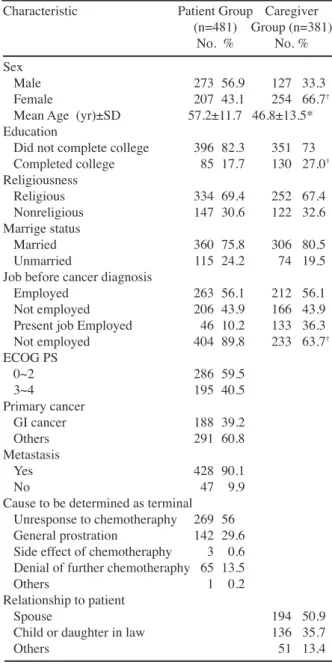
481 of the patients and 381 of the caregivers completed the questionnaire with informed consent. The most common reasons given for non-participation were a lack of time and poor eye-sight. Table 1 gives the subject characteristics. The patient group consisted of more men (P<0.001), was older (P<0.001), had a lower education level (P<0.001), and had fewer present job (P<.001) than the caregiver group.
Difference in burden felt between terminal cancer Patients and Their Caregivers The caregiver group felt more burden than the patient group (P<.001). (Figure 1) The questionnaire of burden was composed of 4 point scale (much trouble, quite a trouble, a little trouble, and no trouble) and the caregiver group was more than the patient group to choose much trouble (40.7% vs.
31.0%) and quite a trouble (34.9% vs. 31.0%). Response pattern of the two groups were not strongly correlative (Spearman Coefficient: 0.363) and corresponding (Kappa Coefficient: 0.282).
Difference of needs in between terminal cancer patients and their caregivers
The patient group needed financial support most (39.0%) and the caregiver group needed discussion about further treatment plan most (44.8%) (Figure 2).
The patient group needed financial support to a greater extent than the caregiver group (39.0% vs. 36.2%), and the caregiver group needed discussion about further treatment more than did the patient group (44.8% vs.
38.3%). Response patterns of the two groups weakly corresponded with one another (Kappa Coefficient:
0.328).
Difference of satisfaction that terminal cancer patients and their caregivers felt toward overall care
The patient group and the caregiver group were satisfactory with overall treatment not differently
Table 1. Characteristics of Study Subjects
Characteristic Patient Group Caregiver (n=481) Group (n=381)
No. % No. %
Sex Male 273 56.9 127 33.3
Female 207 43.1 254 66.7†
Mean Age (yr)±SD 57.2±11.7 46.8±13.5*
Education
Did not complete college 396 82.3 351 73 Completed college 85 17.7 130 27.0† Religiousness
Religious 334 69.4 252 67.4
Nonreligious 147 30.6 122 32.6 Marrige status
Married 360 75.8 306 80.5
Unmarried 115 24.2 74 19.5
Job before cancer diagnosis
Employed 263 56.1 212 56.1
Not employed 206 43.9 166 43.9 Present job Employed 46 10.2 133 36.3 Not employed 404 89.8 233 63.7† ECOG PS
0~2 286 59.5
3~4 195 40.5
Primary cancer
GI cancer 188 39.2
Others 291 60.8
Metastasis
Yes 428 90.1
No 47 9.9
Cause to be determined as terminal Unresponse to chemotheraphy 269 56 General prostration 142 29.6 Side effect of chemotheraphy 3 0.6 Denial of further chemotheraphy 65 13.5
Others 1 0.2
Relationship to patient
Spouse 194 50.9
Child or daughter in law 136 35.7
Others 51 13.4
SD, Standard Deviation; ECOG PS, Eastern Cooperative Oncology Group performance status; *Comparison between patient group and caregiver group (using t-test for mean or χ2 test for other variables); P was derived by the chi- square test (†<.001)
�
�
� �
� �
� �
� �
� �
� �
� �
� �
� � � �
��� � � ��
� � ��� �
��� � � ��
� ������
��� � � ��
� �
��� � � ��
� � ��� � � � �� � �
� � �� � � �
� � �� � �� � � � �� � �
� � �� � � �
�� �
� � � � �� � � � � � � � �
� � � � �� � � � � � � � �� �� � �� � � � � �
Figure 1. The Percentage of Subjects that Answered:
How much Trouble Are You Experiencing Now?
(P=0.816) (Figure 3). The questionnaire of satisfaction was composed of 6 point scale (much satisfactory, satisfactory, so so, unsatisfactory on the whole, unsatisfactory, and much unsatisfactory) and each distribution of response of the two groups were nearly similar. Response pattern of the two groups were intermediately correlative (Spearman Coefficient: 0.417) and corresponding (Kappa Coefficient: 0.433).
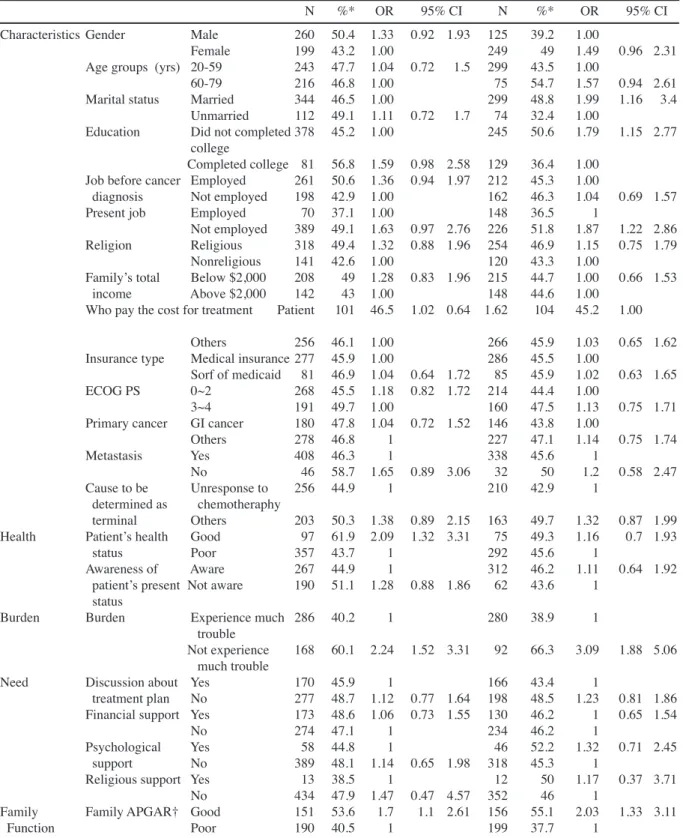
Univariate logistic regression analyses of factors related to satisfaction about overall care
In the patient group, patient’s health status, burden,
family apgar were likely to influence satisfaction about
overall care, while in caregiver group, .marital status,
education level, present job, burden, family apgar were
likely to influence satisfaction about overall care.
Stepwise multiple logistic regression analyses
In stepwise multiple logistic regression analyses, we excluded factors that were not associated in univariate analysis with attitude satisfaction about overall care.
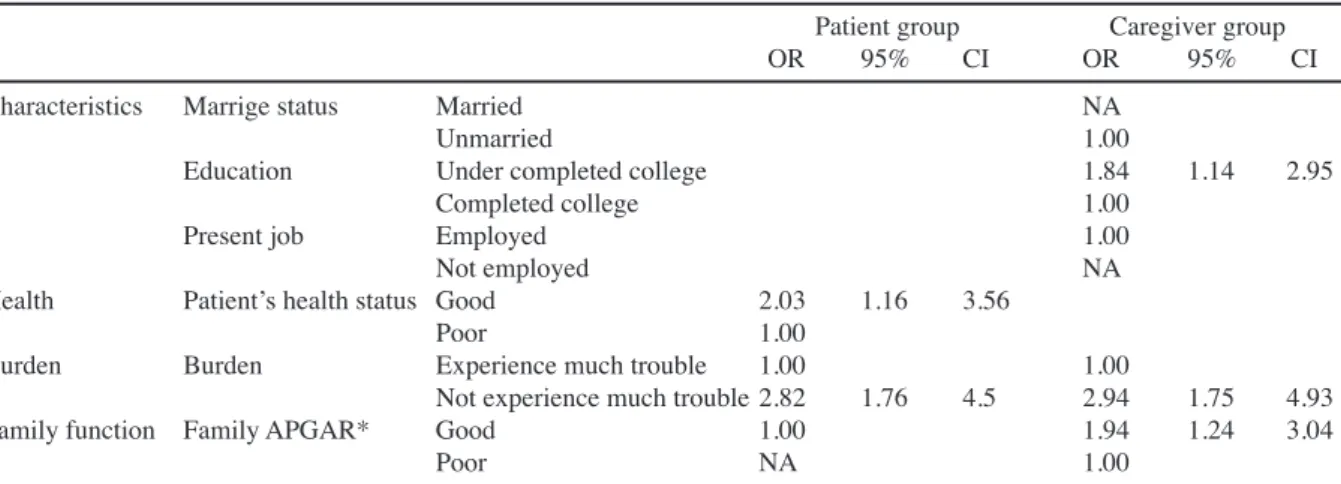
In the patient group, burden was the strongest factor predicting satisfaction about overall care (OR, 2.82;
Table 2. Odds Ratios and 95% CIs from Univariate Logistic Regression Analysis Predicting Satisfaction
about Overall Care
N %* OR 95% CI N %* OR 95% CI Characteristics Gender Male 260 50.4 1.33 0.92 1.93 125 39.2 1.00
Female 199 43.2 1.00 249 49 1.49 0.96 2.31 Age groups (yrs) 20-59 243 47.7 1.04 0.72 1.5 299 43.5 1.00
60-79 216 46.8 1.00 75 54.7 1.57 0.94 2.61
Marital status Married 344 46.5 1.00 299 48.8 1.99 1.16 3.4 Unmarried 112 49.1 1.11 0.72 1.7 74 32.4 1.00
Education Did not completed 378 45.2 1.00 245 50.6 1.79 1.15 2.77 college
Completed college 81 56.8 1.59 0.98 2.58 129 36.4 1.00 Job before cancer Employed 261 50.6 1.36 0.94 1.97 212 45.3 1.00
diagnosis Not employed 198 42.9 1.00 162 46.3 1.04 0.69 1.57
Present job Employed 70 37.1 1.00 148 36.5 1
Not employed 389 49.1 1.63 0.97 2.76 226 51.8 1.87 1.22 2.86 Religion Religious 318 49.4 1.32 0.88 1.96 254 46.9 1.15 0.75 1.79
Nonreligious 141 42.6 1.00 120 43.3 1.00
Family’s total Below $2,000 208 49 1.28 0.83 1.96 215 44.7 1.00 0.66 1.53 income Above $2,000 142 43 1.00 148 44.6 1.00
Who pay the cost for treatment Patient 101 46.5 1.02 0.64 1.62 104 45.2 1.00 Others 256 46.1 1.00 266 45.9 1.03 0.65 1.62 Insurance type Medical insurance 277 45.9 1.00 286 45.5 1.00
Sorf of medicaid 81 46.9 1.04 0.64 1.72 85 45.9 1.02 0.63 1.65 ECOG PS 0~2 268 45.5 1.18 0.82 1.72 214 44.4 1.00
3~4 191 49.7 1.00 160 47.5 1.13 0.75 1.71
Primary cancer GI cancer 180 47.8 1.04 0.72 1.52 146 43.8 1.00
Others 278 46.8 1 227 47.1 1.14 0.75 1.74
Metastasis Yes 408 46.3 1 338 45.6 1
No 46 58.7 1.65 0.89 3.06 32 50 1.2 0.58 2.47 Cause to be Unresponse to 256 44.9 1 210 42.9 1 determined as chemotheraphy
terminal Others 203 50.3 1.38 0.89 2.15 163 49.7 1.32 0.87 1.99 Health Patient’s health Good 97 61.9 2.09 1.32 3.31 75 49.3 1.16 0.7 1.93
status Poor 357 43.7 1 292 45.6 1
Awareness of Aware 267 44.9 1 312 46.2 1.11 0.64 1.92 patient’s present Not aware 190 51.1 1.28 0.88 1.86 62 43.6 1
status
Burden Burden Experience much 286 40.2 1 280 38.9 1
trouble
Not experience 168 60.1 2.24 1.52 3.31 92 66.3 3.09 1.88 5.06 much trouble
Need Discussion about Yes 170 45.9 1 166 43.4 1
treatment plan No 277 48.7 1.12 0.77 1.64 198 48.5 1.23 0.81 1.86 Financial support Yes 173 48.6 1.06 0.73 1.55 130 46.2 1 0.65 1.54
No 274 47.1 1 234 46.2 1
Psychological Yes 58 44.8 1 46 52.2 1.32 0.71 2.45
support No 389 48.1 1.14 0.65 1.98 318 45.3 1
Religious support Yes 13 38.5 1 12 50 1.17 0.37 3.71
No 434 47.9 1.47 0.47 4.57 352 46 1
Family Family APGAR† Good 151 53.6 1.7 1.1 2.61 156 55.1 2.03 1.33 3.11
Function Poor 190 40.5 1 199 37.7 1
ECOG PS, Eastern Cooperative Oncology Group performance status; OR, Odds Ratio; CI, Confidential Interval; Burden in this study was defined as the situation in which an individual or his/her family member experiences trouble from medical care, attendance, economics, and psychological stress; * %: percentage of people who replied they are satisfactory with overall treatment and ‘so so’ was regarded as unsatisfactory ; †Family APGAR is a validated scale of family function based on adaptability, partnership, growth, affection, and resolution
95%CI, 1.76-4.50) and patient’s good health status was
the next factor predicting satisfaction about overall
care (OR, 2.03; 95%CI, 1.16-3.56). The patients who
experienced much trouble were less satisfactory than the
patients who did not experienced much trouble. In the
caregiver group, burden was the factor most predicting
Burdens, Needs and Satisfaction of Terminal Cancer Patients and Caregivers
Table 3. Stepwise Multiple Logistic Regression Analysis: Predicting Satisfaction about Overall Care
Patient group Caregiver group
OR 95% CI OR 95% CI
Characteristics Marrige status Married NA
Unmarried 1.00
Education Under completed college 1.84 1.14 2.95
Completed college 1.00
Present job Employed 1.00
Not employed NA
Health Patient’s health status Good 2.03 1.16 3.56
Poor 1.00
Burden Burden Experience much trouble 1.00 1.00
Not experience much trouble 2.82 1.76 4.5 2.94 1.75 4.93
Family function Family APGAR* Good 1.00 1.94 1.24 3.04
Poor NA 1.00
OR, Odds Ratio; CI, Confidential Interval; Burden in this study was defined as the situation in which an individual or his/her family member experiences trouble from medical care, attendance, economics, and psychological stress; *Family APGAR is a validated scale of family function based on adaptability, partnership, growth, affection, and resolution
�
�
� �
� �
� �
� �
� �
� �
� �
� �
� �
A dis cus s ion about further treatment plan
Financial s upport
Ps y chological s upport
Religious s upport
Others
� � ��� � �
� �� � �
� � �� � � �
� � �� � �� � �
� �� � �
� � �� � � �
�� �
� � � � �� � � � � � � �
Figure 2. The Percentage of Subjects that Answered:
What Help Do You Need?
� � � �
� � ��� � � � �� ��
� � ��� � � � �� ��
� � � �
� � � � ��� � � � �� ��
� � � � � � ��
� � � � ��� � � � �� ��
� � � �
� � � � ��� � � � �� ��
� � �� � ��� �
� �� � �
�� �� � � �
� � ��� � �
� �� � �
�� �� � � �
� � � � �� � � � � � � �
� � � � �� � � � � � ���� �� � �� �� � � �
Figure 3. The Percentage of Subjects that Answered:
How Much Are You Satisfied with Overall Care?
satisfaction about overall care (OR, 2.94; 95%CI, 1.75- 4.93). And good family relationship (OR, 1.94; 95%CI, 1.24-3.04), and low level of education (OR, 1.84;
95%CI, 1.14-2.95) were factors significantly predicting satisfaction about overall care, too.
Discussion
There were two key findings in this study: 1) the caregiver group felt more burden than the patient group (P<0.001); 2) burden was the factor most predicting satisfaction about overall care in both the patient group
and the caregiver group.
There were some studies about burden of caregivers of terminally ill patients (Bekelman et al., 2011; Nelson et al., 2011; Rittenberger et al., 2011; Xian et al., 2011).
However, to our knowledge, there had been few studies to compare burden of terminal cancer patients and their caregivers.
In our study, a number of terminal cancer patients and their caregivers replied that they experienced much trouble and the caregiver group felt burden more than the patient group (Figure 1). Because terminal cancer patients are on the verge of death and frequently suffer from various symptoms like pain or fatigue (physical), (Casadio et al., 2010; Minnock et al., 2010; Smith and Hillner, 2010) it might be natural that they feel burden more than their caregivers. However, in our study, the caregiver group experienced burden more than the patient group. This result suggests that care burden might be more serious than disease burden in palliative care. Our finding is consistent with a previous study in which caregiver’s psychological morbidity was equal to or greater than the patient’s (Xian et al., 2011). In another previous study, almost 40% of the spouse caregivers reported depressive symptoms in a range that was likely to be clinically significant, a prevalence that was almost two-fold than their ill partners (Rittenberger et al., 2011).
Previous studies have demonstrated that caregivers of patients with cancer have increased health problems and psychosocial stress (Bergen-Jackson et al., 2009;
Kiely et al., 2010; Zhou et al., 2010; Bell et al., 2011;
Gilbertson-White et al., 2011; Legler et al., 2011; Stevens et al., 2011). Therefore, in palliative care, care burden could have a bad impact on caregivers.
From a different standpoint, as terminal cancer
patients usually feel themselves a burden to others
(Konski et al., 2011; Chhabra et al., 2012), they might
have underestimated their burden due to feeling sorry to
their caregivers. In our study, terminal cancer patients
needed financial support more than their caregivers and
this suggests that patients might have felt sorry to their
caregivers (Figure 2). In order to analyze the precise
reason that the caregiver group felt burden more than the patient group, further study will be needed.
In our study, the patient group needed financial support more than the caregiver group and the caregiver group needed discussion about further treatment plan more than the patient group. This result corresponded with a previous study, in which the caregiver required more detailed information than the patient about the dying process (Zeppetella et al., 2010).
In a previous study, unmet needs of patient and caregiver was the independent predictor of satisfaction (Rheims et al., 2011). However, in our study, need was not correlated with satisfaction in both the patient group and the caregiver group. It might be due to our classification of unmet need which was composed of just 4 items or due to interview method of our study that we requested participants to choose only 1 item which they thought most needed. Terminal cancer patients and their caregivers frequently need available support. In one study, caregivers and patients with advanced cancer consistently needed much available support for the patient but unmet needs were high, and this was associated with high level of caregiver burden (McLaughlin et al., 2011). Other study showed that nearly two-thirds of 614 cancer patients reported experiencing at least 1 unmet psychosocial need, particularly emotional, physical, and treatment-related needs (Sekeres et al., 2011).
In previous studies, patient perspectives on quality end-of-life care were influenced by physical and emotional symptoms, psychosocial elements, spiritual wellbeing, a sense of autonomy, and the strength of relationships (Capewell et al., 2010; Angelo et al., 2011;
Loiselle and Sterling, 2012). In our study, patient’s satisfaction on quality end-of-life care was influenced by physical symptoms (patient’s health status), patient’s burden, and the strength of relationship of family members. In multivariate analysis, burden was the strongest factor predicting attitude toward satisfaction about overall care in both the patient group and the caregiver group. In a previous study, caregiver burden was the most important predictor of both caregiver anxiety and depression (Xian et al., 2011). Economic burdens of terminal cancer patients could induce patient or caregiver to sell assets, take out a loan, or take an additional job and other burdens of terminal cancer patients induce them to consider euthanasia or physician- assisted suicide (Cora et al., 2012). Therefore, in order to increase well-being of terminal cancer patients and their caregiver, health care providers of palliative care unit should understand and be more concerned about burden of terminal cancer patients and their caregivers.
Our study has some limitations. First, the participants might not represent the general population of terminally ill patients and their family caregivers. Our study dealt with hospital outpatients and inpatients, but home- bound patients may be unaware of their prognosis or have different attitudes toward disclosure. And we can’t exclude the possibility of selection bias introduced
by eliminating patients who elected to get more chemotherapy. Our large multicenter-based setting and high participation rate, however, should have minimized selection bias.
Second, because the questionnaire was not anonymous, we cannot exclude the possibility that patients answered according to family expectations, leading to an underestimation of the problems regarding disclosure of terminal illness. We minimized that risk, however, by not allowing patients and family caregivers to share information about their experiences or their attitudes about disclosure during completion of the questionnaire.
Third, we did not gather information about subscales of burden like finances, esteem, and schedules.
Instead, we used a question ‘How much trouble are you experiencing now?’ for measuring burden of both terminal cancer patients and their caregivers. Because we intended to compare burden of terminal cancer patients and burden of their caregivers, we were not able to use previous developed instruments to measure burden of caregivers like ‘The Caregiver Reaction Assessment’
(Choi et al., 2012). Subscales of patient’s burden and caregiver’s may be different. So we chose the single question which was somewhat comprehensive in order to compare both of them. And the results of our study remind health care professionals of importance of a viewpoint that caregiver’s burden is very serious in terminal cancer care and caregiver as well as terminal cancer patient should be cared in order to increase quality of terminal cancer care.
In summary, our study showed that burden was much in terminal cancer patients and their caregivers and burden of caregiver was especially important. And our study also showed that burden was the factor most predicting satisfaction about overall care of terminal cancer in both the patient group and the caregiver group.
Difference of burden and need in between terminal cancer patients and their caregivers shows that not only terminal cancer patients but also their caregivers are vulnerable and need concern from health care professionals. And additional studies including multiple aspects of burdens in terminal cancer patients and their caregivers, will be needed to strengthen our results.
Acknowledgement
This work was supported by National Cancer Center Grants 0410160, 0710420 and 1310241-1.
References
Abernethy AP, Wheeler JL, Bull J (2011). Development of a health information technology-based data system in community-based hospice and palliative care. Am J Prev Med, 40, S217-24.
Angelo M, Ruchalski C, Sproge BJ (2011). An approach to diabetes mellitus in hospice and palliative medicine. J
Burdens, Needs and Satisfaction of Terminal Cancer Patients and Caregivers Palliat Med, 14, 83-7.
Bekelman DB, Nowels CT, Allen LA, et al (2011). Outpatient palliative care for chronic heart failure: a case series. J Palliat Med, 14, 815-21.
Bell CL, Kuriya M, Fischberg D (2011). Hospice referrals and code status: outcomes of inpatient palliative care consultations among Asian Americans and Pacific Islanders with cancer. J Pain Symptom Manage, 42, 557- Bergen-Jackson K, Sanders S, Herr K, et al (2009). 64.
Determining Community Provider Practices in Hospices:
The Challenges of Documentation. J Hosp Palliat Nurs, 11, 334-41.
Capewell C, Gregory W, Closs S, et al (2010). Brief DVD- based educational intervention for patients with cancer pain: feasibility study. Palliat Med, 24, 616-22.
Casadio M, Biasco G, Abernethy A, et al (2010). The National Tumor Association Foundation (ANT): A 30 year old model of home palliative care. BMC Palliat Care, 9, 12.
Chhabra PT, Rattinger GB, Dutcher SK, et al (2012).
Medication reconciliation during the transition to and from long-term care settings: a systematic review. Res Social Adm Pharm, 8, 60-75.
Choi JY, Shin DW, Kang J, et al (2012). Variations in process and outcome in inpatient palliative care services in Korea.
Support Care Cancer, 20, 539-47.
Cora A, Partinico M, Munafo M, et al (2012). Health risk factors in caregivers of terminal cancer patients: a pilot study. Cancer Nurs, 35, 38-47.
Dy SM, Roy J, Ott GE, et al (2011). Tell Us: a Web-based tool for improving communication among patients, families, and providers in hospice and palliative care through systematic data specification, collection, and use. J Pain Symptom Manage, 42, 526-34.
Gilbertson-White S, Aouizerat BE, Jahan T, et al (2011).
A review of the literature on multiple symptoms, their predictors, and associated outcomes in patients with advanced cancer. Palliat Support Care, 9, 81-102.
Kallen MA, Yang D, Haas N (2012). A technical solution to improving palliative and hospice care. Support Care Cancer, 20, 167-74.
Kiely DK, Givens JL, Shaffer ML, et al (2010). Hospice use and outcomes in nursing home residents with advanced dementia. J Am Geriatr Soc, 58, 2284-91.
Kimman M, Norman R, Jan S, et al (2012). The burden of cancer in member countries of the Association of Southeast Asian Nations (ASEAN). Asian Pac J Cancer Prev, 13, 411-20.
Konski A, Bhargavan M, Owen J, et al (2011). Feasibility of economic analysis of Radiation Therapy Oncology Group (RTOG) 91-11 using Medicare data. Int J Radiat Oncol Biol Phys, 79, 436-42.
Legler A, Bradley EH, Carlson MD (2011). The effect of comorbidity burden on health care utilization for patients with cancer using hospice. J Palliat Med, 14, 751-6.
Loiselle CG, Sterling MM (2012). Views on death and dying among health care workers in an Indian cancer care hospice: balancing individual and collective perspectives.
Palliat Med, 26, 250-6.
McLaughlin D, Hasson F, Kernohan WG, et al (2011). Living and coping with Parkinson’s disease: perceptions of informal carers. Palliat Med, 25, 177-82.
Minnock P, Kirwan J, Veale D, et al (2010). Fatigue is an independent outcome measure and is sensitive to change in patients with psoriatic arthritis. Clin Exp Rheumatol,
28, 401-4.
Nelson JE, Gay EB, Berman AR, et al (2011). Patients rate physician communication about lung cancer. Cancer, 117, 5212-20.
Rheims S, Perucca E, Cucherat M, et al (2011). Factors determining response to antiepileptic drugs in randomized controlled trials. A systematic review and meta-analysis.
Epilepsia, 52, 219-33.
Rittenberger JC, Raina K, Holm MB, et al (2011). Association between Cerebral Performance Category, Modified Rankin Scale, and discharge disposition after cardiac arrest. Resuscitation, 82, 1036-40.
Sekeres MA, Gundacker H, Lancet J, et al (2011). A phase 2 study of lenalidomide monotherapy in patients with deletion 5q acute myeloid leukemia: Southwest Oncology Group Study S0605. Blood, 118, 523-8.
Smith TJ, Hillner BE (2010). Explaining marginal benefits to patients, when “marginal” means additional but not necessarily small. Clin Cancer Res, 16, 5981-6.
Snowdon C, Harvey SE, Brocklehurst P, et al (2010). The BRACELET Study: surveys of mortality in UK neonatal and paediatric intensive care trials. Trials, 11, 65.
Stevens E, Martin CR,White CA (2011). The outcomes of palliative care day services: a systematic review. Palliat Med, 25, 153-69.
Ugur O, Fadiloglu C (2010). “Caregiver Strain Index”
validity and reliability in Turkish society. Asian Pac J Cancer Prev, 11, 1669-75.
Wang YM, Guo HQ (2012). Follow-up study of survival of patients with advanced cancer in a hospice setting. Asian Pac J Cancer Prev, 13, 3357-60.
Xian Y, Holloway RG, Noyes K, et al (2011). Racial differences in mortality among patients with acute ischemic stroke: an observational study. Ann Intern Med, 154, 152-9.
Yang BH, Parkin DM, Cai L, et al (2004). Cancer burden and trends in the Asian Pacific Rim region. Asian Pac J Cancer Prev, 5, 96-117.
Zeppetella G, Messina J, Xie F, et al (2010). Consistent and clinically relevant effects with fentanyl buccal tablet in the treatment of patients receiving maintenance opioid therapy and experiencing cancer-related breakthrough pain. Pain Pract, 10, 287-93.
Zhou G, Stoltzfus JC, Houldin AD, et al (2010). Knowledge, attitudes, and practice behaviors of oncology advanced practice nurses regarding advanced care planning for patients with cancer. Oncol Nurs Forum, 37, E400-10.