Abstract
BACKGROUND: Mixed cropping of hairy vetch and Barley is widely used as a green manure for reducing chemical fertilizers while maintaining soil fertility in paddy soil. We investigated the effect of Molybdenum (Mo) fertilizer on vetch N2 fixation, biomass production and transfer N from vetch to barley under a hairy vetch-barley mixed cropping system.
METHODS AND RESULTS: The barley and hairy vetch were sowed at a rate of 135 and 23 kg/ha, respectively, without chemical fertilizer application but with Mo fertilizer at 0, 0.5, 1.0, 2.0, and 4.0 kg/ha as a treatment. The percentage of hairy vetch N derived from air N2 fixation (%Ndfa) and N transfer from hairy vetch to barley (%Ndfv) was determined by the 15N natural abundance method.
Although application of Mo at 2.0 kg/ha significantly increased biomass of both barley and hairy vetch, the biomass was decreased at application of Mo 4.0 kg/ha. At the application of Mo 2.0 kg/ha, the percentage of Ndfa and Ndfv was 81.7 and 53.9, respectively, which are significantly
higher than that of the treatments without Mo.
CONCLUSION: These results highlight that application of Mo fertilizer can be an effective measures to improve N fixation in hairy vetch and biomass production in both barley and hairy vetch.
Key words: Green manure, Natural 15N, Nitrogen fixation, Nitrogen transfer
서 론
논에서 동절기 풋거름 작물 재배 후 농경지 환원은 양분수 지 저감(Kim et al., 2012), 질소 유출 저감(Tosti et al., 2014), 토양 침식 방지 및 논토양 비옥도 개선 등과 같은 많 은 농학적 이점을 가지고 있다(Kim et al., 2013). 특히, 우리 나라는 OECD 회원국 중에서 국가단위 양분수지가 높은 나 라로 분류되어 있으며 이를 개선하기 위해서 다각적인 정책 을 수행하고 있으며, 동절기 풋거름 작물 재배 후 환원에 의 한 벼 재배는 무기질 비료 절감에 가장 효율적인 방안으로 추 천되고 있다(Jeon et al., 2009, 2012).
풋거름 작물은 화본과와 두과로 구분할 수 있으며 최근 논에 서 가장 활용성이 높은 풋거름 작물은 풋거름보리(Hordeum vulgare)와 헤어리베치(Vicia villosa Roth)이다. 헤어리베 치는 두과 풋거름 작물로 공중질소를 고정하여 후작물에 대
*Corresponding author: Yong Bok Lee Phone: +82-55772-1967; Fax: +82-55-772-1969;
E-mail: [email protected]
Korean J Environ Agric. 2019;38(4):291-295. Korean Online ISSN: 2233-4173
Published online 2019 November 19. https://doi.org/10.5338/KJEA.2019.38.4.39 Print ISSN: 1225-3537
풋거름 보리-헤어리베치 혼파 작부체계에서 몰리브덴 시용이 질소 고정, 이동 및 수량에 미치는 영향
김태영1, 김송엽1, 윤영은1, 김장환1, 이용복1,2*
1경상대학교 응용생명과학부(BK21 Plus), 2경상대학교 농업생명과학연구원
Application of Molybdenum Enhances Nitrogen Fixation and Transfer, and Biomass Production under a Hairy Vetch/Barley Mixture Cropping System
Tae-Young Kim1, Song-Yeob Kim1, Young Eun Yoon1, Jang Hwan Kim1 and Yong Bok Lee1,2* (1Division of Applied Life Science (BK21 Plus), Gyeongsang National University, Jinju 52828, Korea, 2Institute of Agriculture and Life Science, Gyeongsang National University, Jinju 52828, Korea)
Received: 31 October 2019/ Revised: 7 November 2019/ Accepted: 12 November 2019 Copyright ⓒ 2019 The Korean Society of Environmental Agriculture
This is an Open-Access article distributed under the terms of the Creative Commons Attribution Non-Commercial License (http://creativecommons.org/licenses/by-nc/3.0) which permits unrestricted non-commercial use, distribution, and reproduction in any medium, provided the original work is properly cited.
ORCID Yong Bok Lee
https://orcid.org/0000-0002-7651-4556
291
Short Communication Open Access
한 질소 공급력이 우수하다(Campiglia et al., 2010). Jeon 등(2009)은 논에서 벼 재배에 대한 헤어리베치 환원은 무기 질 질소 비료를 100% 대체 할 수 있다고 보고하였다. 풋거름 보리는 논토양에서 유기물 공급에 의한 토양 지력증진에 크 게 기여하는 것으로 알려져 있다.
화본과 풋거름 보리는 C/N율이 높아서 질소 공급력이 낮 고, 두과 헤어리베치는 토양중 무기화율이 높아서 유기물 축 적량이 낮은 단점을 가지고 있다. 따라서 보완하기 위해서 최 근 혼파재배법에 많은 연구가 수행되고 있다. 포복 식물인 헤 어리베치의 경우 풋거름 보리가 지지대 역할을 하기 때문에 광 이용율이 증가되어 생산성이 향상된다(Jeon et al., 2009).
Kim 등(2012)에 의하면 논에서 풋거름 보리와 헤어리베치의 혼파 비율은 75:25에서 최대 생산성을 보였다고 보고하였다.
혼파에 의한 풋거름 작물 생산량 증대는 농경지 이용효율 증 대에서 기인한 것이며 이는 농경지 이용율 제고를 통한 양분수 지 저감에 크게 기여하고 있다(Yoon et al., 2019). 헤어리베 치 생육 과정에서 고정된 질소는 풋거름 보리로 이동되어 풋거 름 보리의 C/N율을 감소시키는 효과도 보고되고(Hwang et al., 2015) 있지만 이에 대한 정량적 평가는 아직까지 수행되 지 않고 있다.
공중질소 고정량은 두과 풋거름 작물의 생산성에 중요한 요인 으로 알려져 있다. 몰리브덴(Mo)은 질소 고정효소(nitrogenase) 가 대기중 질소(N2)를 암모니아(NH3)로 전환하는데 보조인 자(co-factor)로 작용하며(Shah et al., 1984), 식물의 질소와 황 대사에도 중요한 역할을 하는 것으로 알려져 있다(Kaiser et al., 2005). Campo 등(2009)에 의하면 Mo 함량이 높은 콩 종자가 질소 고정량과 수량이 높았으며 추가적인 Mo 시용이 필요 없다고 하였다. 헤어리베치에 대한 몰리브덴 시용 효과는 뿌리혹(Nodule)의 수와 크기를 증가시켰으며 Nitrogenase와 Nitrate reductase 활성을 증가시키는 것으로 평가되고 있다 (Alam et al., 2015). 그러나 몰리브덴 시용이 헤어리베치의 생산량 및 질소고정에 미치는 영향에 대한 연구는 아직까지 이루어지지 않고 있다.
본 연구는 풋거름 보리와 헤어리베치 혼파지에서 몰리브 덴 시용이 두과작물 생산성, 공중질소 고정량 그리고 헤어리 베치가 풋거름 보리에 대한 질소 기여도를 정량적으로 평가 하였다.
재료 및 방법
논에서 동절기 풋거름 작물에 대한 Mo 시용 효과 시험은 총탄소가 10.9 g/kg, 유효인산이 13.7 mg/kg인 미사질 양 토에서 완전임의 배치법 3반복으로 수행하였다(Table 1). 풋
거름 작물은 2015년 11월 16일에 산파(135 kg/ha와 헤어리 베치 22.5 kg/ha) 하여 2016년 5월 24일 수확하였다. 이 두 풋거름 파종량은 화본과-두과 풋거름 작물의 혼파시 추천 파종 량이다(Kim et al., 2013; Yoon et al., 2019). 몰리브덴은 0.5 (Mo-0.5), 1.0 (Mo-1.0), 2.0 (Mo-2.0), 4.0 (Mo-4.0) kg/ha 를 각각 물에 용해 후 시비하였고 그 외 무기질 비료는 시비 하지 않았다. 풋거름 작물의 수량은 처리구당 1 m2 (1 m x 1 m) 수확하여 풋거름 보리와 헤어리베치를 분리하여 조사하 였고 건물중은 72℃에서 2일간 건조 후 측정하였다. 식물체 무기성분과 토양의 이화학적 분석은 농촌진흥청 농사시험연 구 기준에 따라 수행하였다(RDA, 2003).
몰리브덴 시비량에 따른 헤어리베치의 질소 고정율(%Ndfa) 은 안전동위원소 자연 존재비를 이용하여 다음과 같이 추정하 였다(Rochester and Peoples, 2005).
× (1)
여기서 δ15Nref는 단일 파종 풋거름 보리 지상부의 δ15N 값, δ15Nhv는 헤어리베치 지상부의 δ15N 값, 그리고 B (background)는 대기중의 질소 고정만으로 생육한 헤어리베 치의 δ15N 값이다. 본 논문에서 B 값은 Yoneyama 등(1986) 이 제시한 –1.630/00을 적용하였다.
헤어리베치에서 풋거름 보리로 이동된 질소(Ndfv)는 다 음과 같이 계산하였다(Ledgard, 1991).
× (2)
여기서 δ15NB는 풋거름 보리 지상부의 δ15N 값, δ15NNS
은 토양에서 흡수한 δ15N 값, δ15NNV는 헤어리베치에서 유래 한 δ15N 값 이다. 몰리브덴 시용에 대한 지상부 생산량 및 공 중질소 고정율의 통계분석은 SAS (version 9.1.3)을 이용하였 다. 처리간의 차이를 비교하기 위해 조사된 자료는 ANOVA, 검증을 통하여 분석하였다.
결과 및 고찰
Mo 시용에 의한 풋거름 작물의 수량은 헤어리베치가 1398 – 1656 kg/ha, 풋거름 보리가 3089 – 3474 kg/ha 였으며 이는 헤어리베치와 풋거름보리의 동일한 혼파 비율에서 보고 된 수량에는 미치지 못하였다(Kim et al., 2102, 2013; Jeon et al., 2012). 본 연구에서 풋거름 작물 재배는 무기질 비료 시
pH (1:5)
EC (dS/m)
OM (g/kg)
T-N (g/kg)
Av. P2O5
(mg/kg)
Ex. Cations (cmol+/kg)
K Ca Mg
5.6 0.038 10.9 1.1 13.7 0.97 3.89 0.15
Table 1. Soil properties at the beginning of the experiment
비 없이 수행되었고, 시험지 토양의 유기물 함량이 10.9 g/kg, 유효인산 함량이 13.7 mg/kg으로 비옥도가 매우 낮은 포장 에서 재배한 결과로 판단된다. 그러나 Mo 시용량에 따라서 헤어리베치 수량은 증가 되었으며 Mo 1.0 – 2.0 kg/ha 시용 에서 최대 수량을 보였다(Table 2). 그리고 비두과 작물인 풋 거름 보리에서도 동일한 결과를 나타내었다. Mao 등(2018) 은 Mo 300 g/m 시용에서 알팔파(Alfalfa) 수량이 무시용에 비해 17% 증가를 보고하였으며, Hirpara 등(2019)에 의하면 Mo 1.0 kg/ha 시용에서 최대 콩 수량을 나타내었다. Mo 시용 에 의한 두과작물의 수량 증가는 공중질소 고정량 향상 (Movalia Janaki et al., 2018; Hegazi et al., 2011), 분얼 수 증가(Hirpara et al., 2019), 단백질 대사 향상(Adkine et al., 2011) 등으로 이해되고 있다.
Mo 시용과 무시용에서 헤어리베치의 공중 질소 고정율은 차이를 보였다(Table 3). Mo 무시용구의 Ndfa는 76.8% 이 며 Mo 시용구의 Ndfa 는 평균 81%였다. 그리고 Mo 시용 수준에 따른 Ndfa는 큰 차이를 보이지 않았다. Mo은 미량 원소로서 무시용과 시용(1 kg/ha) 간에는 두과 작물의 공중 질소 효율, 질소대사 등에 차이를 나타내지만 Mo 시비 수준 (1 kg/ha, 2kg/ha)간에는 큰 차이가 없다고 보고 하였다 (Hirpara et al., 2019). Haydce 등(2014) 호밀과 헤어리베 치 혼파(33:67) 재배지에서 헤어리베치의 Ndfa는 1년, 2년차 에서 각각 87.56%, 82.8%이었으며 헤어리베치 단일 파종지 는 80.9%로 보고 하였다. Burity 등(1989)은 알팔파와 브롬
그래스(Bromegrass) 및 티모시(Timothy)의 혼파에서 알팔 파의 공중질소 고정율을 60-82%로 보고 하였다. 두과-화본과 혼파 및 단파에서 공중질소 고정량 차이는 혼파에 의한 두과 작물의 공중 질소 고정율 증가는 토양중 질소이용에 대한 경 쟁에서 기인된 것으로 설명하고 있다(Haydce et al., 2014;
Brainard et al., 2011).
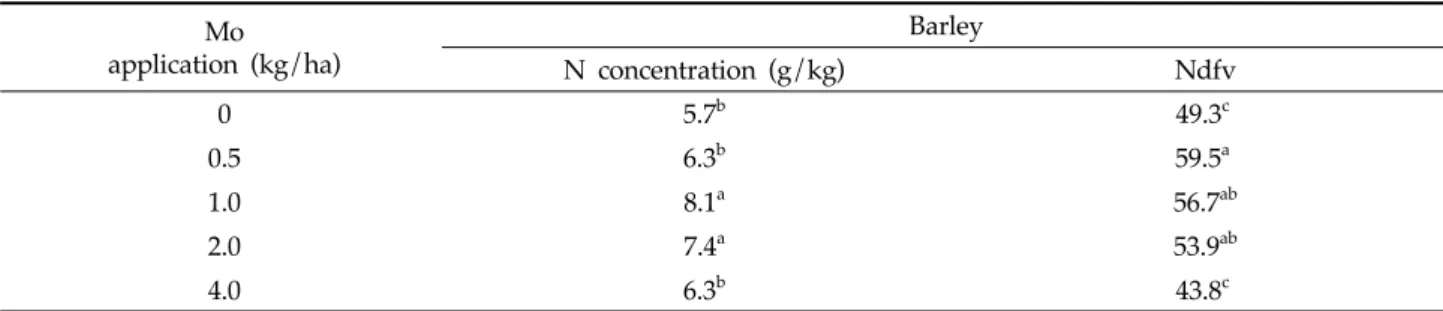
두과-화본과 작물의 혼파지에서 두과 작물에 의해 고정된 질소가 화본과 작물로 이동되는 방법은 크게 두 가지로 설명 되고 있다. 두과 작물에 의해 고정된 질소가 균근 균사 (mycorrhizal fungal hyphae) 네트워크에 의해서 화본과 작물로 직접이동 되는 것과(Sierra and Nygren, 2006) 두과 작물 뿌리의 무기화와 삼출물에 의해서 이동되는 것이다 (Johansen and Jensen, 1996). 본 연구에서 Mo 시용량에 따른 풋거름 보리의 질소 함량은 Mo 1.0 kg/ha 에서 최대 값을 보였으며 Mo 4.0 kg/ha에서 최소값을 나타내었다 (Table 4). Mo 4.0 kg/ha 시용에서 풋거름 작물의 수량 감 소(Table 2)와 공중질소 고정량 감소는 Mo 독성으로 Mo과 연관된 효소 활성 감소와 세포 독성에서 기인된 것으로 판단 된다(Nautiyal and Chatterije, 2004).
안전동위원소 기법에 의한 두과 작물에서 화본과 작물로 의 질소 이동율은 최대 86%로 보고되고 있다(Broadbent et al., 1982; Ledgard, 1991). 알팔파에서 티모시 혼파 목초지 의 질소 이동율은 1차 예취에서 27%, 2차 예취에서 34%, 3 차 예취에서 57%로 예취시기에 따른 생육과 무기화 기간에
Mo application (kg/ha)
Aboveground biomass (kg/ha)
Hairy vetch Barley Total
0 1231b 1636d 2867d
0.5 1398ab 3089b 4486b
1.0 1616a 3078b 4694b
2.0 1656a 3474a 5130a
4.0 1315ab 2376c 3691c
Means within a column followed by the same letter are not significantly different (p=0.05) by Duncan multiple range test.
Table 2. Dry weight accumulation of the cover crops aboveground biomass at the harvesting stage
Mo application (kg/ha)
Hairy vetch
N concentration (g/kg) Ndfa
0 22.8b 76.8b
0.5 24.1ab 80.3ab
1.0 24.3ab 80.9a
2.0 27.1a 81.7a
4.0 25.2ab 81.3a
Means within a column followed by the same letter are not significantly different (p=0.05) by Duncan multiple range test.
Table 3. Hairy vetch N concentration and percentage of N derived from the atmosphere (Ndfa) across Mo application rate under vetch-barley mixture cultivation
Mo application (kg/ha)
Barley
N concentration (g/kg) Ndfv
0 5.7b 49.3c
0.5 6.3b 59.5a
1.0 8.1a 56.7ab
2.0 7.4a 53.9ab
4.0 6.3b 43.8c
Means within a column followed by the same letter are not significantly different (p=0.05) by Duncan multiple range test.
Table 4. Nitrogen concentration and percentage of N transferred from hairy vetch (Ndfv) in barley across Mo application rate under vetch-barley mixture cultivation
영향을 받는 것으로 설명하고 있다(Burity et al., 1989). 본 연구에서 Mo 시용량에 따른 헤어리베치에서 풋거름보리로 이동된 질소는 55%내외로 나타났으며 Mo 무시용 처리구와 는 유의적 차이를 보였다. 그리고 풋거름 작물의 최대 생산량 을 나타낸 Mo 2.0 kg/ha에서 질소 이동율은 약 54%이었다.
Lee 등(2005)은 풋거름 보리와 헤어리베치 혼파에서 질소 이 동율은 58% - 39.7%로 질소 시비량 증가에 따라 감소된다고 보고 하였으며, 호밀과 헤어리베치 혼파에서는 61%의 질소가 이동된다고 하였다(Lee, 2007). 따라서 두과 화본과 혼파 작 부체계에서 두과 작물에 의한 공중질소가 화본과 작물로의 질소 이동율은 작물의 종류, 생육기간, 토양온도 등의 환경에 많은 영향을 받는 것으로 생각된다.
요 약
본 연구는 풋거름보리와 헤어리베치 혼파 작부체계에서 Mo 시용이 풋거름 작물의 수량, 헤어리베치의 공중질소 고 정율 및 헤어리베치에서 풋거름보리로 질소 이동율에 대한 정량적 평가를 실시하였다. Mo 2.0 kg/ha 시용에서 풋거름 작물의 최대수량을 나타내었다. 그리고 풋거름 작물의 최대수 량을 나타낸 Mo 2.0 kg/ha 처리에서 헤어리베치의 공중질 소 고정율은 81.7% 이었으며, 이때 헤어리베치에서 풋거름 보리로 이동된 질소는 풋거름 보리 질소함량의 53.9% 이었 다. 따라서, Mo 2.0 kg/ha 처리가 풋거름 보리-헤어리베치 혼파 작부체계에서 가장 적절한 수준으로 나타났다. 본 연구 는 국내에서 보고되지 않았던 헤어리베치로부터 보리로의 질 소 이동을 정량화하였다는 점에서 의미가 있는 것으로 판단 된다.
Note
The authors declare no conflict of interest.
Acknowledgement
This study was supported by Rural Development
Administration (RDA), Republic of Korea (Project No.
PJ013401).
References
Adkine, P. M., Mankar, D. D., Khandait, V. M., Bhandare, V. L., & Nawlakhe, S. M. (2011). Effect of boron, molybdenum and potassium nitrate on growth, yield and economics of soybean. Journal of Soils and Crops, 21(1), 116-123.
Alam, F., Kim, T. Y., Kim, S. Y., Alam, S. S., Pramanik, P., Kim, P. J., & Lee, Y. B. (2015). Effect of molybdenum on nodulation, plant yield and nitrogen uptake in hairy vetch (Vicia villosa Roth). Soil Science and Plant Nutrition, 61(4), 664-675.
Brainard, D. C., Bellinder, R. R., & Kumar, V. (2011).
Grass–legume mixtures and soil fertility affect cover crop performance and weed seed production. Weed Technology, 25(3), 473-479.
Broadbent, F. E., Nakashima, T., & Chang, G. Y. (1982).
Estimation of nitrogen fixation by isotope dilution in field and greenhouse experiments. Agronomy Journal, 74(4), 625-628.
Burity, H. A., Ta, T. C., Faris, M. A., & Coulman, B. E.
(1989). Estimation of nitrogen fixation and transfer from alfalfa to associated grasses in mixed swards under field conditions. Plant and Soil, 114(2), 249-255.
Campiglia, E., Caporali, F., Radicetti, E., & Mancinelli, R.
(2010). Hairy vetch (Vicia villosa Roth.) cover crop residue management for improving weed control and yield in no-tillage tomato (Lycopersicon esculentum Mill.) production. European Journal of Agronomy, 33(2), 94-102.
Campo, R. J., Araujo, R. S., & Hungria, M. (2009).
Molybdenum-enriched soybean seeds enhance N accumulation, seed yield, and seed protein content in
Brazil. Field Crops Research, 110(3), 219-224.
Hayden, Z. D., Ngouajio, M., & Brainard, D. C. (2014).
Rye–vetch mixture proportion tradeoffs: Cover crop productivity, nitrogen accumulation, and weed suppression.
Agronomy Journal, 106(3), 904-914.
Hegazi, A., Mohamed, M. A., Ahmed, G. S. S., Elsherif, M. H., & Gad, N. (2011). Reducing N doses by enhancing nodule formation in groundnut plants via Co and Mo. Australian Journal of Basic and Applied Sciences, 5(12), 2568-2577.
Hirpara, D. V., Sakarvadia, H. L., Jadeja, A. S., Vekaria, L. C., & Ponkia, H. P. (2019). Response of boron and molybdenum on groundnut (Arachis hypogaea L.) under medium black calcareous soil. Journal of Pharmacognosy and Phytochemistry, 8(5), 671-677.
Hwang, H. Y., Kim, G. W., Lee, Y. B., Kim, P. J., & Kim, S. Y. (2015). Improvement of the value of green manure via mixed hairy vetch and barley cultivation in temperate paddy soil. Field Crops Research, 183, 138-146.
Jeon, W. T., Seong, K. Y., Lee, J. K., Kim, M. T., & Cho, H. S. (2009). Effects of seeding rate on hairy vetch (Vicia villosa)-rye (Secale cereale) mixtures for green manure production in upland soil. Korean Journal of Crop Science, 54(3), 327-331.
Jeon, W. T., Seong, K. Y., Oh, G. J., Kim, M. T., Lee, Y.
H., Kang, U. G., Lee, H. B., & Kang, H. W. (2012).
Changes of biomass of green manure and rice growth and yield using leguminous crops and barley mixtures by cutting heights at paddy. Korean Journal of Soil Science and Fertilizer, 45(2), 192-197.
Johansen, A., & Jensen, E. S. (1996). Transfer of N and P from intact or decomposing roots of pea to barley interconnected by an arbuscular mycorrhizal fungus.
Soil Biology and Biochemistry, 28(1), 73-81.
Kaiser, B. N., Gridley, K. L., Ngaire Brady, J., Phillips, T.,
& Tyerman, S. D. (2005). The role of molybdenum in agricultural plant production. Annals of Botany, 96(5), 745-754.
Kim, T. Y., Kim, S. Y., Alam, F., & Lee, Y. B. (2013).
Green manuring effect of pure and mixed barley-hairy vetch on rice production. Korean Journal of Environmental Agriculture, 32(4), 268-272.
Kim, T., Daquiado, A. R., Alam, F., & Lee, Y. (2012).
Evaluation of nitrogen and phosphorus balance in green manure-rice cropping systems without incorporation of green manure crops. Korean Journal of Environmental Agriculture, 31(4), 308-312.
Ledgard, S. F. (1991). Transfer of fixed nitrogen from white clover to associated grasses in swards grazed by
dairy cows, estimated using 15N methods. Plant and Soil, 131(2), 215-223.
Lee, H. W. (2007). Nitrogen fixation of legumes and transfer to grasses in spring paddy soil. Journal of The Korean Society of Grassland and Forage Science, 27(3), 167-172.
Lee, H. W., Kim, W. H., Park, H. S., Ko, H. J., & Kim, S.
G. (2005). Effect of N application rate on fixation and transfer from vetch to barley in mixed stands. Journal of The Korean Society of Grassland Science. 25(1), 1-6 Mao, X., Li, Q., Ren, L., Bai, W., & Zhang, W. H. (2018).
Application of molybdenum fertilizer enhanced quality and production of alfalfa in northern China under non-irrigated conditions. Journal of plant nutrition, 41(8), 1009-1019.
Movalia Janaki, A., Parmar, K. B., & Vekaria, L. C.
(2018). Effect of boron and molybdenum on yield and yield attributes of summer green gram (Vigna radiata L.) under medium black calcareous soils. International Journal of Chemical Studies, 6(1), 321-323.
Nautiyal, N., & Chatterjee, C. (2004). Molybdenum stress- induced changes in growth and yield of chickpea.
Journal of plant nutrition, 27(1), 173-181.
Rochester, I., & Peoples, M. (2005). Growing vetches (Vicia villosa Roth) in irrigated cotton systems: Inputs of fixed N, N fertiliser savings and cotton productivity.
Plant Soil. 271, 251-264.
Shah,m V., Ugalde, R. A., Imperial, J., & Brill, W. J.
(1984). Molybdenum in nitrogenase. Annual Review of Biochemistry, 53, 231-257.
Sierra, J., & Nygren, P. (2006). Transfer of N fixed by a legume tree to the associated grass in a tropical silvopastoral system. Soil Biology and Biochemistry, 38(7), 1893-1903.
Tosti, G., Benincasa, P., Farneselli, M., Tei, F., & Guiducci, M. (2014). Barley–hairy vetch mixture as cover crop for green manuring and the mitigation of N leaching risk. European Journal of Agronomy, 54, 34-39.
Yoneyama, T., Fujita, K., Yoshida, T., Matsumoto, T., Kambayashi, I., & Yazaki, J. (1986). Variation in natural abundance of 15N among plant parts and in 15N/14N fractionation during N2 fixation in the legume- rhizobia symbiotic system. Plant and Cell Physiology, 27(5), 791-799.
Yoon, Y. E., Kim, J. H., & Lee, Y. B. (2019). Evaluation of barley-hairy vetch mixed cropping as green manure for biomass and nitrogen production. Korean Journal of Soil Science and Fertilizer, 52(1), 70-75.