Print ISSN: 2288-4637 / Online ISSN 2288-4645 doi:10.13106/jafeb.2020.vol7.no12.795
Determinants of Stock Liquidity: Forward-Looking Information, Corporate Governance, and Asymmetric Information
Wiwik UTAMI
1, Putri Dwi WAHYUNI
2, Lucky NUGROHO
3Received: September 10, 2020 Revised: November 02, 2020 Accepted: November 16, 2020
Abstract
The more liquid the capital market, the more attractive it will be for investors to place their money in the capital market. Therefore, the purpose of this study is to investigate the factors that influence stock liquidity of manufacturing sector companies listed on the stock exchange in Indonesia.
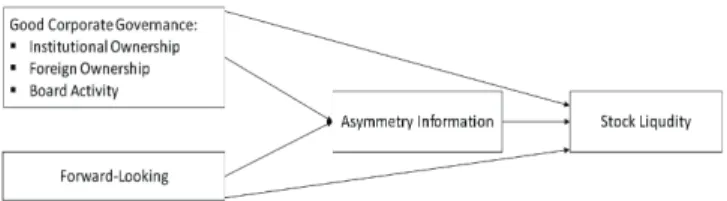
The independent variables used in this study are forward-looking information disclosure, institutional ownership, foreign ownership, and board activity with information asymmetry as an intervening variable and stock liquidity as the dependent variable. The population of this study is manufacturing sector companies listed on the Indonesian stock exchange (IDX). Samples are selected based on the random sampling method, and the number of samples is calculated based on the Slovin formula. The sample was 59 manufacturers, and data was annual reports (for 2 years) and stock transactions from 2016 to 2017. The results of the study showed that forward-looking information disclosure had a significant effect on information asymmetry. Information asymmetry and foreign ownership have a significant impact on stock liquidity, whereas information asymmetry mediates the relationship between forward-looking disclosures and stock liquidity. Furthermore, the accuracy of information about the certainty of business activity both now and in the future can instill confidence in stakeholders in interacting and cooperating.
Keywords: Forward-Looking, Disclosure, Corporate Governance, Asymmetry Information, Stock Liquidity, Indonesia Stock Exchange JEL Classification Code: G10, G20, M21, M41
Stock liquidity can be measured by trading frequency, transaction volume, and transaction value of a stock. Stock liquidity is one of the key criteria that must be considered by investors before conducting stock analysis from both the technical aspect and fundamental aspect (Utami et al., 2017).
In 2017, local capital market liquidity was relatively low.
There are more than 500 shares listed on the Indonesia Stock Exchange (IDX). However, only a small percentage of shares have a daily transaction value above Rp10 billion. Of the 500 plus shares, only 20% or approximately 115 shares have daily transaction values above Rp10 billion. IDX Director of Corporate Valuation, Samsul Hidayat, said that one way to increase stock liquidity is to improve the mechanism of the Initial Public Offering (IPO) for companies that want to market their stock (IPOTNews, 2017). The liquidity of the stock market in Indonesia has long been considered not optimal. There were many stocks listed on the IDX that were not actively traded or immovable until March 2017. Since 2013, around 27 companies have been delisted from the IDX after being suspended for months and debarred from trading.
One reason for suspension or termination of trade is because there is no stock movement and no financial reporting.
According to Susi Melina (Chairman of the Indonesian
1
First Author. Full Professor, Department of Accounting, Universitas Mercu Buana, Jakarta, Indonesia.
Email: [email protected]
2
Assistant Professor, Department of Accounting, Universitas Mercu Buana, Jakarta, Indonesia. Email: [email protected]
3
Correspondence Author. Assistant Professor, Department of Accounting, Universitas Mercu Buana, Indonesia [Postal Address:
Komplek Merpati Blok D No.13, Pegadungan, Kalideres, Jakarta Baray, Indonesia] Email: [email protected]
© Copyright: The Author(s)
This is an Open Access article distributed under the terms of the Creative Commons Attribution Non-Commercial License (https://creativecommons.org/licenses/by-nc/4.0/) which permits unrestricted non-commercial use, distribution, and reproduction in any medium, provided the original work is properly cited.