Print ISSN: 2288-4637 / Online ISSN 2288-4645 doi:10.13106/jafeb.2020.vol7.no10.119
1
First Author and Corresponding Author. Assistant Professor, Accounting Department, Faculty of Economics, Universitas Negeri Semarang, Indonesia [Postal Address: L1 Building, Sekaran, Gunugpati, Semarang, Central Java, 50229, Indonesia]
2
Associate Professor, Accounting Department, Faculty of Economics, Universitas Negeri Semarang, Indonesia.
3
Researcher, Accounting Department, Faculty of Economics, Universitas Negeri Semarang, Indonesia. Email: [email protected]
© Copyright: The Author(s)
This is an Open Access article distributed under the terms of the Creative Commons Attribution
Non-Commercial License (https://creativecommons.org/licenses/by-nc/4.0/) which permits
unrestricted non-commercial use, distribution, and reproduction in any medium, provided the
original work is properly cited.
The Extent of Intellectual Capital Disclosure and Corporate Governance Mechanism to Increase Market Value
Badingatus SOLIKHAH
1, Agus WAHYUDIN
2, Anggraeni Anisa Wara RAHMAYANTI
3
Received: July 25, 2020 Revised: August 23, 2020 Accepted: September 03, 2020
Abstract
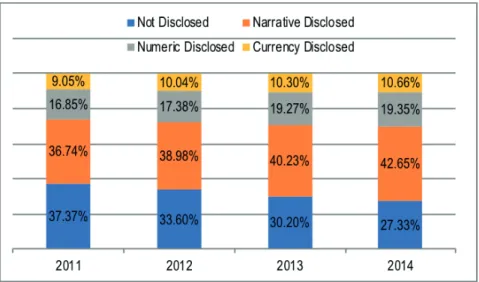
The aim of this paper is to investigate the level of intellectual capital disclosure (ICD) in commercial banks listed on the Indonesian Stock Exchange. This paper also observed the effects of ICD and corporate governance mechanism on market value. This study uses content analysis techniques to measure ICD. The paper provides a novel approach to measure the ICD quality in developing countries using a four- numerical coding system. Secondary data were obtained from the financial statements and annual reports of the banks for the period 2011- 2014. The data from 31 banks were analyzed using ordinary least square regression. The study reports that the quality of intellectual capital disclosure in Indonesian commercial banks increase steadily. Narrative disclosure dominates the report of intellectual capital in Indonesian banks. The results indicate that the size of audit committee, frequency of audit committee meeting, and intellectual capital disclosure affect positively the market value. Overall, the results indicate intellectual capital disclosure is associated with the market capitalization; these findings indicate that the ICD is a consideration in a stock investment decision. While regulations in Indonesia regarding intellectual capital reporting are not conclusive yet, the information needs of stakeholders have encouraged companies to expand voluntary disclosure.
Keywords: Intellectual Capital Disclosure, Share Ownership, Independent Commissioner, Audit Committee, Market Capitalization JEL Classification Code: G32, G34, M41, O34
financial capital. Intellectual capital is an organizational capability to create, transfer, and implement knowledge.
Bontis et al. (2000), who examined companies in Malaysia, found that IC has a significant and substantive relationship to firm performance. Meanwhile, Solikhah et al. (2010) also obtained a similar finding in her research in Indonesia that IC has a significant effect on financial performance, growth and market value of the company. Intellectual capital disclosure (ICD) is interesting to study because there are no standard guidelines regarding the measurement and reporting of intellectual capital in Indonesia. ICD, which the company delivers annually to the capital market, describes the overall intangible assets managed by the company (Widarjo, 2011).
The IC reports become very importance information for the (potential) investor, so that the disclosure of intangible assets, which is more widely known as ICD, needs to be improved.
One of the company’s goals is to improve the welfare of the owner or shareholder by increasing the value of the company (Berzkalne & Zelgalve, 2014). The value of the company is the worth of a business showing the company’s performance and representation of public trust. Firm value is also often associated with how a company manages its business, implements policies, enforces business ethics, and manages the situations and conditions in the work environment facing the company. The rise in company’s
1. Introduction
In the current era of economic disruption, business management is shifting with greater potency to intangible things such as intellectual capital (IC). Conversely, financial reports oftentimes fail to report ICs as a significant proportion of the total value of the organization (Ousama et al., 2020).
As a result, companies with high ICs may look less valuable
than their true value (Petty & Guthrie, 2000). A resource-
based approach states that IC is a company resource that
plays an important role, as well as physical capital and