205
잣나무 임분밀도에 따른 피톤치드 농도 및 임내환경 특성에 관한 연구
조예슬* · 박수진*
†· 정미애** · 이정희* · 유리화* · 김철민* · 이상태***
*국립산림과학원 산림정책연구부 산림복지연구과,
**서울대학교 조경·지역시스템공학부, ***국립산림과학원 산림기술경영연구소
Analysis of Phytoncide Concentration and Micrometeorology Factors by Pinus Koraiensis Stand Density
Yeseul Jo*, Sujin Park*
†, Miae Jeong**, Jeonghee Lee*, Rheehwa Yoo*, Cheolmin Kim*, and Sangtae Lee***
*Forest Welfare Division, Forest Policy and Economics Department, National Institute of Forest Science
**Department of Landscape Architecture and Rural System Engineering, Seoul National University
***Forest Technology and Management Research Center, National Institute of Forest science ABSTRACT
Objectives: Scientific verification for health effects has been constantly demanded through the forest healing factors. In this study, phytoncide concentration which is one of the forest healing factors, was investigated according to stand density, season and visiting time, and analyzed correlation with micrometeorology factors.
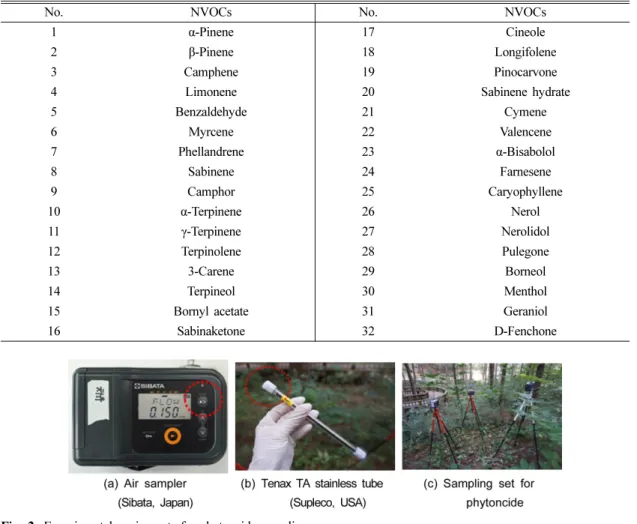
Methods: Total volatile organic compounds (TVOCs) and Natural volatile organic compounds (NVOCs) were collected using a measuring instrument which is connected to an air pump with the Tenax TA tube. The 32NVOCs were selected through the detailed criteria of adequacy assessment for recreational forest. The statistical analysis (correlation and stepwise regression analysis) was conducted between phytoncide concentration and micrometeorology factors.
Results: NVOCs concentration linearly increased according to stand density. The high level showed in the summer (p<0.05), and there is no significant difference according to visiting hours of the Healing forest. NVOCs is a negative correlation with solar radiation, PAR and wind direction, and a positive correlation with relative humidity and temperature (p<0.01). NVOCs increased following the increase of humidity and temperature (R
2=0.55).
Conclusions: Phytoncide linearly increased according to stand density, and showed the correlation significantly with microclimate factors. In future, these results will be utilized as a basic material to promote the generation of phytoncide, which positively influences human health promotion and manage the forest welfare space.
Keywords: Natural volatile organic compounds (NVOCs), phytoncide, Pinus Koraiensis, stand density
I. 서 론
국내 산림산업은 산림자원의 경제적 생산성을 중
시하여 1970년대 이래로 임목축적이 지속적으로 증 가하고 있으나,
1)최근 환경 자본의 증가와 산림의 활용성이 강조된 정책이 더불어 요구됨에 따라 산림
†
Corresponding author: Forest Welfare Division, Forest Policy and Economics Department, National Institute of Forest Science, 57 Hoegiro, Dongdaemun-gu, Seoul 02455, Korea, Tel: +82-2-961-2853, E-mail: [email protected] Received: 10 July 2017, Revised: 28 September 2017, Accepted: 23 May 2018
원 저 Original articles