ABSTRACT
This study conducted health assessment and multivariate vegetation analysis using the riparian vegetation index in 30 sites of the Geumgang mainstream and Mihocheon to obtain practical data on the river management of the Geumgang. The result showed that the number of plant communities was 54. The flora was 75 families, 185 genera, 243 species, 2 subspecies, 21 varieties, 2 varieties, and 268 taxa. The riparian vegetation index was 38.3 (3.3; G-D1 ~ 66.7; G-U2, G-U4, and G-M3), and the health of the rivers in this area was evaluated as normal (grade C). The health of rivers was the highest in the upper stream of Geumgang mainstream and lowest in the
수변식생지수를 이용한 금강본류와 미호천의 건강성 평가 및 식생분석
1a이승연2⋅장래하3⋅한영섭4⋅정영호2⋅이수인2⋅이응필2⋅유영한2*
Health Condition Assessment Using the Riparian Vegetation Index and Vegetation Analysis of Geumgang mainstream and Mihocheon
1aSeung-Yeon Lee2, Rae-Ha Jang3, Young-Sub Han4, Young-Ho Jung2, Soo-In Lee2, Eung-Pill Lee2, Young-Han You2*
요 약
금강의 하천관리의 실질적인 자료를 얻고자 본류와 미호천의 30지소에서 수변식생지수를 이용하여 건강성평가와 다변량식생분석을 하였다. 그 결과 금강본류와 미호천에서 출현한 식물군락은 54개이었고, 식물상은 75과 185속 243종 2아종 21변종 2품종 268분류군이었다. 수변식생지수는 평균 38.3(3.3;G-D1 ~ 66.7;G-U2, G-U4, G-M3)으로 이 지역 의 하천의 건강성은 보통(C등급)으로 평가되었다. 하천의 건강성은 금강본류의 상류가 가장 높았고, 금강본류의 하류에 서 가장 낮았다. 수변식생지수와 수질의 클로로필-a의 함량과의 관계는 관련성이 낮게 나타났다. 집락분석결과, 식생은 바랭이군락 그룹, 갯버들군락 그룹, 개망초군락 그룹, 환삼덩굴, 버드나무, 물억새 그리고 달뿌리풀 군락이 우점하는 그룹, 망초와 물피 군락이 우점하는 그룹 등의 5개 집단으로 나누어졌고, 지소들은 비슷한 건강상태를 갖는 것들끼리 가까이 나타났다. CCA분석결과, 식생의 분포에 영향을 주는 환경요인은 식생면적, 인공구조물 면적, 수로면적, 지점폭, 수로폭, 제방높이 등의 물리적인 조건과 생물학적 요인의 출현종수였다. 이상과 같이 하천의 건강성이 높은 지역은 모니터링을 통하여 하천 식생의 지속적인 유지관리가 필요하고 건강성이 낮은 지역은 생태복원과 같은 적극적인 시행이 필요하다 고 판단된다.
주요어: 수변식생지수, 하천관리, 서열법
1 접수 2017년 10월 30일, 수정 (1차: 2017년 12월 11일, 2차: 2018년 1월 2일, 3차: 2018년 1월 17일), 게재확정 2018년 1월 17일 Received 30 October 2017; Revised (1st: 11 December 2017, 2nd: 2 January 2018, 3rd: 17 January 2018); Accepted 17 January 2018 2 공주대학교 생명과학과 Dept. of Life Science, Kongju National University, Gongju 32588, Korea
3 국립멸종위기종복원센터건립추진단 Task Force for Construction of National Center for Endangered Species Restoration, Building#6, Government Complex-Sejong, 11 Doum6-ro, Sejong, 30103, Rep. Korea.
4 국립생태원 생태조사평가본부 생태조사연구실 National Institute of Ecology, Division of Ecological Monitoring, Bureau of Ecological Research & Assessment, 1210 Geumgang-ro, Maseo-myeon, Seocheon-gun, Chungcheongnam-do, 33654, Republic of Korea.
a 이 논문은 2014년 하천 수생태계 현황조사 및 건강성 평가(VII)에 의하여 연구되었음.
* 교신저자 Corresponding author: [email protected]
downstream of Geumgang mainstream. The relationship between riparian vegetation index and chlorophyll-a content was low. The riparian vegetation was divided into five groups of Digitaria ciliaris colony group, Salix gracilistyla colony group, Erigeron annuus colony group, the group dominated by Humulus japonicus, Salix koreensis, Miscanthus sacchariflorus, and Phragmites japonica colonies, and the group dominated by Conyza canadensis and Echinochloa crusgalli var. echinata colonies. They had the similar health conditions. The CCA analysis showed that the environmental factors affecting the distribution of vegetation were physical factors such as vegetation area, artificial structure area, waterway area, branch width, channel width, and bank height and the biological factors such as the number of species. As such, it is necessary to maintain the health condition through continuous monitoring where the health condition is high and to apply active measures such as ecological restoration where the health condition is low.
KEY WORDS: RIPARIAN VEGETATION INDEX, RIVER MANAGEMENT, ORDINATION
서 론
우리나라 하천생태계는 지난 40년 동안 댐, 보 건설에 의한 물리적 환경의 변화와 산업화로 인한 오염 물질의 증 가 및 부영양화로 인하여 수질오염이 가속화되었을 뿐 아니 라 생물상이 변하고 있다(Joo et al., 1997). 또한, 환경부 (Ministry of Environment, 2007)조사에 의하면, 전국 지방 하천 중 자연하천의 모습을 유지하고 있는 하천구간은 전체 하천의 약 55%에 불과하다. 정부는 이런 하천생태계의 파 괴 현상을 파악하고 복원하고자 하천 생태네트워크 구축을 계획하고 있다. 하지만 이 계획들은 어류, 저서무척추동물 등의 식물을 제외한 생물종을 대상으로만 한다. 하천복원이 제대로 이루어지기 위해서는 지역의 풍토에 적합한 식생을 조성하여야 하고, 그러기 위해서는 그 지역의 자연 및 물리 적 환경을 알아야 하고, 현재 그 지역의 식물상을 제대로 파악하여야 한다.
선진 외국의 경우는 하천의 질적 평가를 위해 하천식물 자료들을 시스템화 하는 것은 1980년대 후반부터 수생식물 전문가들과 보존 과학자들에게 중요한 사안으로 꼽혀왔다 (Francisca et al., 2011). 이러한 연구들은 식생군집의 풍부도 (Stromberg et al., 2006), 종과 군락 자체의 기능(González del Tánago and García de Jalón 2006) 그리고 수질에 따른 지표종 선정(Rothrock et al., 2008) 등 다양하게 진행되었다.
하지만 환경 및 식물종이 다른 선진 외국의 기준은 우리나라 에 적합하지 않다. 우리보다 앞선 연구가 진행된 일본의 기준 또한 우리나라에 적합하다고 할 수 없다. 현재 하천에 관한 논문들은 주로 식생을 이용하여 단순히 하천을 평가하였거나 하천식생을 서열분석(ordination analysis)을 한 연구가 대부 분이지만 하천의 건강성 등급에 따른 적합한 식물군락의 특징에 대한 논문은 미비한 실정이다.
본 연구에서는 하천 건강성 평가기법 중 하나인 수변식생
지수(riparian vegetation index, RVI)를 이용하였다. 또한 수변식생지수 연구내용 중 하나인 식생조사 데이터를 서열 분석하여 건강성 등급에 따른 식물군락 및 종의 정착하는 환경을 연구하였다. 따라서 이와 같은 연구를 통해 식물종 과 환경요인간의 관계를 이해하고, 본 연구를 이용하여 자 료를 활용하여 건강성이 높은 하천은 지속적인 관리를 통하 여 유지하고 건강성이 낮은 하천은 건강성이 높은 하천의 식물군락 및 종과 유사하게 조성하여 복원 및 관리하고자 한다.
연구방법
1. 연구대상지
본 연구의 연구지 정보는 국립환경과학원으로부터 2008년 도에 조사한 금강본류와 미호천수계의 각각 15개 지점정보를 제공받았다. 두 개의 하천을 고도에 따라 상류(upper stream), 중류(middle stream), 하류(down stream)로 각각 5개씩 나누 었고, 고도가 같을 경우 흐르는 방향으로 더 아래에 있는 지점을 아래 수위로 구분하였다(Fig. 1, Appendix 1).
2. 현장조사 및 데이터화
본 연구는 국립환경과학원에서 발주한 용역의 일환으로 환경부(Ministry of Environment, 2014)에서 제시한 방법을 이용하여 실시하였다. 연구지점의 정점(주로 교각)을 기준 으로 금강 본류의 종적범위는 상ꞏ하 250m씩 총 500m, 지류 인 미호천은 상ꞏ하 100m씩 총 200m를 조사하였다. 횡적범 위는 유로폭으로 제방과 제방사이를 조사하였다. 조사항목 은 하천단면 식생조사, 식물상조사 그리고 식생도작성 세 가지였다. 연구시기는 2014년 6월부터 9월까지 정확한 식
물종 동정을 위해 대부분의 하천식생이 나타나는 식생번성 기에 수행하였다.
하천단면 식생조사는 조사지점의 대상 분포가 뚜렷이 관찰 되는 곳에서 제방과 제방사이에 띠조사구(belt transect)를 설치하였다. 식생과 지형이 바뀌는 곳마다 방형구를 설치하 여 Braun-Blanquet(Braun-Blanquet, 1964)에 따라 조사하였 다. 기타 조사지의 환경정보(방위, 경위도 좌표, 해발고도, 하천 폭, 수로 폭 등)는 GPS 등의 측정장치를 사용하였다.
식물상 조사는 띠 조사구 좌우 10m 이내 지역에서 조사하였 다. 종의 동정은 이창복(Lee, 2003)의 원색대한식물도감, 이영노(Lee, 1997)의 원색한국식물도감, 이우철(Lee, 1996) 의 원색한국기준식물도감 그리고 박수현(Park, 2009)의 한국 의 귀화식물도감을 참고하였다. 현장에서 동정하지 못한 종 은 채집 및 사진을 통하여 실내에서 동정하였다. 그 후 하천식 물을 그 습성에 따라서 정수식물(emergent hydrophytes), 부엽식물(leaf-floating hydrophytes), 부유식물(free-floating hydrophytes), 침수식물(submerged hydrophytes) 그리고 건 성 및 중생식물(Mesophyte & Xerophyte)로 생활형을 구분하 였다(Choi, 1985; Ministry of Environment, 2006). 식생도는
항공사진을 이용하여 조사지점의 식생이 가장 잘 보이는 곳을 선택하여(주로 교량) 우점군락의 면적을 정확하게 그리 도록 하였다. 그 후 내부로 들어와 지리정보시스템을 이용하 여 식생별 면적을 산출하였다.
3. 하천 건강성 평가
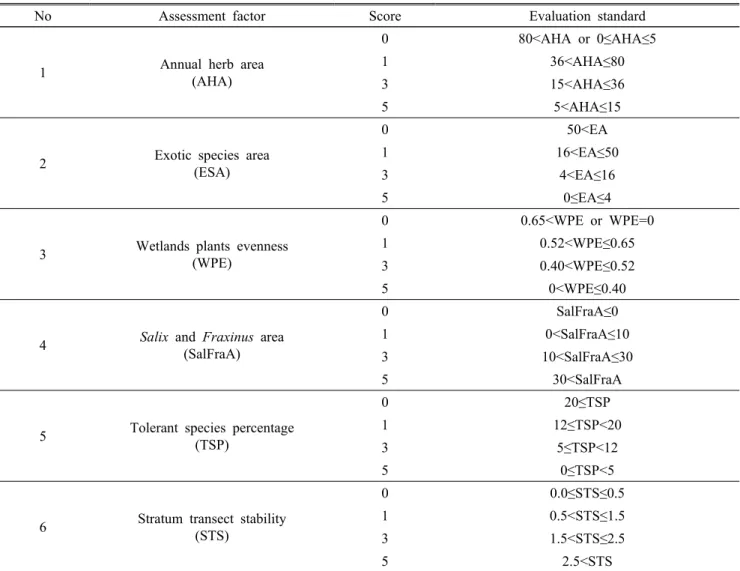
환경부(Ministry of Environment, 2014)에서 사용한 수 변식생지수(riparian vegetation index)를 이용하여 하천의 건강성을 평가하였다. 수변식생지수는 다음과 같이 산출하 였다. 하천단면 식생조사를 통해 식생단면안정성(stratum transect stability)을 구하였고, 식물상 조사를 통해 내성종 출현종수 비율(tolerant species percentage)을 구하였으며 식생도를 통해 일년생 우점면적 비율(annual herb area), 외 래종 우점면적 비율(ecotic species area), 습지식물 균등도 (wetland plants evenness), 버드나무 및 물푸레나무속 우점 면적 비율(Salix and Fraxinius area)을 구하였다. 6개의 평 가요소에 대한 평가값은 0, 1, 3, 5점으로 구분되고(Table 1), 조사지점별 6개 평가요소의 점수를 총합하여 10/3을 곱 하여 100점 만점으로 계산하였다. 그 후 평가된 수변식생지 수를 4등급으로 구분하였다(Table 2).
RVI = (AHA + ESA + WPE + SalFraA + TSP + STS)
* 10/3 ꞏꞏꞏꞏꞏꞏꞏꞏꞏꞏꞏꞏꞏꞏꞏꞏꞏꞏꞏꞏꞏꞏꞏꞏꞏꞏꞏꞏꞏꞏꞏꞏꞏꞏꞏꞏꞏꞏꞏꞏꞏꞏꞏꞏꞏꞏꞏꞏꞏꞏꞏꞏꞏꞏꞏ (식 1) 4. 통계분석
이 연구에서는 금강 본류와 미호천 간의 수변식생지수 차이를 알아보기 위해 분산분석(analysis of variance, ANOVA)을 사용하였다. 수변식생지수와 국립환경과학원 으로부터 제공받은 조사지점의 클로로필-a(Chl-a)의 상관 관계를 알아보기 위해 상관분석(correlation analysis)을 사 용하였다. 집락분석(cluster analysis)을 이용하여 각 지점의 군락유사성을 확인하였다. 각 지점의 군락과 출현한 식물종 이 어떤 환경요인에 의해 분포하는지 확인하고자 정준대응 분석(canonical correspondence analysis; CCA)을 실시하 였다.
결과 및 고찰
1. 하천 건강성 평가 결과 1) 조사지역 식물상
조사지역에서 확인된 식물상은 총 75과 185속 243종 2아종 21변종 2품종 268분류군이었다(Data not shown, Ministry Fig 1. Map of study site in korea(1, 2, 3, 4, 5,
Geumgang mainstream upper stream; 6, 7, 8, 9, 10, Geumgang mainstream middle stream; 11, 12, 13, 14, 15 Geumgang mainstream down stream;
16, 17, 18, 19, 20, Mihocheon upper stream; 21, 22, 23, 24, 25, Mihocheon middle stream; 26, 27, 28, 29, 30, Mihocheon down stream).
of environment, 2014). 그 중 건성 및 중생식물은 236종이 출현하였고, 수생식물은 제2차 전국내륙습지 조사지침 (Ministry of Environment, 2006)에서 지정한 218종 중에서 32종이 출현하였다. 하천식물을 습성에 따라 분류한 결과 정수식물은 26종(81.25%), 부엽식물은 2종(6.25%), 부수식 물은 2종(6.25%), 침수식물은 2종(6.25%)이 관찰되었다 (Table 3, Appendix 2). 수변식생지수가 B등급 이상인 지역에
서 관찰된 식물종수는 27종이며 그 중 50%이상 발견 된 종은 고마리, 여뀌, 달뿌리풀, 부들이었으며, C등급 이하인 지역에서 관찰된 식물종수는 32종이며 그 중 50%이상 발견 된 종은 고마리, 달뿌리풀, 갈대이었다(Data not shown, Ministry of environment, 2014). 따라서 이를 종합해 보면 수생식물인 고마리와 달뿌리풀은 하천의 건강성과 상관없이 발견되는 것으로 판단된다.
No Assessment factor Score Evaluation standard
1 Annual herb area (AHA)
0 80<AHA or 0≤AHA≤5
1 36<AHA≤80
3 15<AHA≤36
5 5<AHA≤15
2 Exotic species area (ESA)
0 50<EA
1 16<EA≤50
3 4<EA≤16
5 0≤EA≤4
3 Wetlands plants evenness (WPE)
0 0.65<WPE or WPE=0
1 0.52<WPE≤0.65
3 0.40<WPE≤0.52
5 0<WPE≤0.40
4 Salix and Fraxinus area
(SalFraA)
0 SalFraA≤0
1 0<SalFraA≤10
3 10<SalFraA≤30
5 30<SalFraA
5 Tolerant species percentage (TSP)
0 20≤TSP
1 12≤TSP<20
3 5≤TSP<12
5 0≤TSP<5
6 Stratum transect stability (STS)
0 0.0≤STS≤0.5
1 0.5<STS≤1.5
3 1.5<STS≤2.5
5 2.5<STS
Table 1. Score calculation of six assessment factors
Grade RVI range
A 65 < RVI ≦ 100
B 40 < RVI ≦ 65
C 15 < RVI ≦ 40
D 0 ≦ RVI ≦ 15
Table 2. Grade of RVI
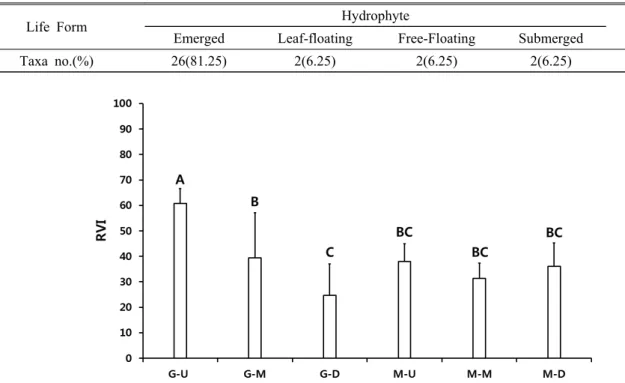
2) 하천 수계와 유역에 따른 수변식생지수 비교 연구지역에서 수변식생지수의 평균은 38.3으로 평가되 었다. 금강본류의 상류는 60.7(53.3;G-U5~66.7;G-U2, G-U4), 중류는 39.3(23.3;G-M2~66.7;G-M3), 하류는 24.7 (3.3;G-D1~33.3;G-D3, G-D4)이었으며, 미호천의 상류는 38.0(30.0;M-U5~46.7;M-U3), 중류는 31.3(23.3;M-M5~40.0;
M-M3) 하류는 36.0(26.7;M-D5~50.0;M-D1)이었다(Fig. 2, Appendix 1). 이들의 차이를 비교한 결과 금강본류의 상류 에서 가장 높았고, 금강본류의 중류 그리고 금강본류의 하 류 순이었으며, 미호천은 금강본류의 상류를 제외하고 나머 지 구간과 통계적 유의성이 없었지만 금강본류의 중류와 하류 사이에 위치하고 있었다(Fig. 2).
수변식생지수는 일년생 초본 우점면적 비율, 외래종 우점 면적 비율, 습지식물 균등도 그리고 내성종 출현비율이 낮 거나 버드나무속 및 물푸레나무속과 식생단면안정성이 높 을수록 높다(Table 1). 본 연구에서 지수가 높은 구간은 금 강본류의 상류였으며, 이 구간은 버드나무속 및 물푸레나무 속 그리고 갈대류 같은 다년생 초본 우점면적 비율이 높았 다. 버드나무속의 식물종은 넓은 생태적 범위를 가지고, 영 양번식이 가능하며, 척박한 토양에서도 가지와 뿌리의 생장
이 빠르다(Kim and Lee, 1998). 이러한 선구 식물적 특성은 교란이 불규칙하게 진행되는 하천환경에서 우점할 수 있는 원동력이 된다(Lee and Kim, 2006). 또한 버드나무속과 물 푸레나무속은 하천에서 대표적인 연ꞏ경목으로 하천 수변의 물리적 환경이 교란될 경우 우점면적 비율이 감소한다 (Ministry of Environment, 2013). 갈대류는 번식속도가 빨 라 다른 식물의 생육을 저해하기도 한다(Chung et al., 2008). 하지만 수변 지역에서 뿌리를 내려 하안의 침식을 방지하는 역할을 하고(Kim, 2004), 생태계교란종 같은 외 래종의 종자발아 억제 기능을 한다(You et al., 2010). 이러 한 특성 때문에 버드나무속 및 물푸레나무속 그리고 갈대류 의 우점면적 비율이 높을수록 물리적 교란이 적고 외래종의 침입을 막을 수 있음을 의미하기 때문에 수변식생지수가 높게 평가되는 것이다.
수변식생지수가 낮은 구간은 도심하천인 미호천 수계와 금강본류의 하류였다. 이 구간들은 하천의 직강화를 위한 제방사면의 콘크리트화, 치수를 위한 댐 건설, 하상 정리 등의 하천정비공사가 진행되어 생태적 기능을 상실하고 있 었다. 또한 둔치가 경작지나 체육공원시설 등으로 운영되거 나 외래종이 식재되는 등의 인위적 교란이 매우 심하였다.
Life Form Hydrophyte
Total Emerged Leaf-floating Free-Floating Submerged
Taxa no.(%) 26(81.25) 2(6.25) 2(6.25) 2(6.25) 32(100)
Table 3. Flora of hydrophyte plant in study sites
Fig 2. Riparian vegetation index under upper stream, middle stream, down stream in Geumgang mainstream and Mihocheon(G-U: Geumgang mainstream's upper stream; G-M: Geumgang mainstream's middle stream; G-D:
Geumgang mainstream's down stream; M-U: Mihocheon's upper stream; M-M: Mihocheon's middle stream;
M-D: Mihocheon's down stream). Alphabets on the bars mean significant different among streams level(Fisher's least significant difference, p<0.05).
이로 인해 하천의 식생면적이 낮아지고 인공구조물 면적과 외래종 우점면적 비율이 높아져 수변식생지수가 낮게 평가 되었다. 이러한 인공적 정비공사는 하천의 특성들을 변질시 켜 버리기 때문에 하천생태 기능에 안 좋은 영향을 끼친다 (Shin et al., 2009). 또한 일반적인 하천의 경우 상류에서 하류로 갈수록 외래종이 증가하여 하류 쪽에서 생물적 교란 이 많이 일어난다(Han et al., 2007).
따라서 건강성이 높은 지역은 지속적인 모니터링을 통하 여 하천식생의 유지관리가 필요하고 건강성이 낮은 지역은 건강성이 높은 지역과 환경이 비슷하게 조성하는 적극적인 생태복원이 필요하다고 판단된다.
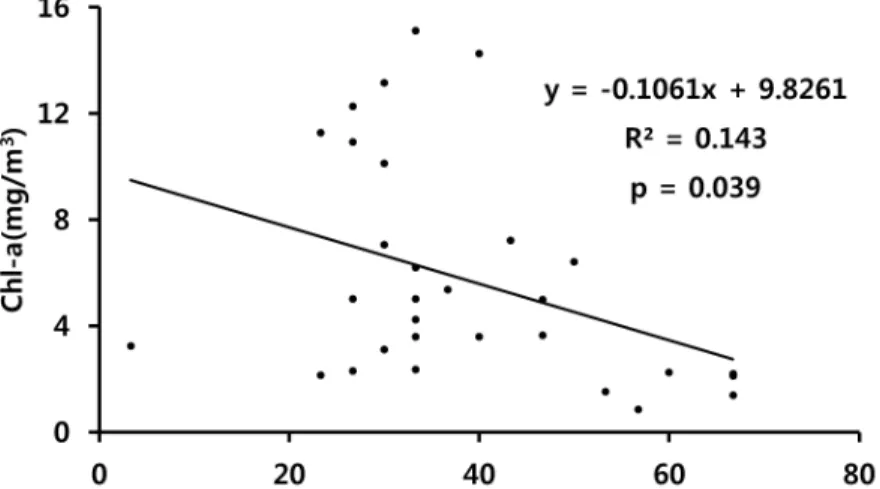
3) 수변식생지수와 클로로필-a(Chl-a) 간의 상관분석 클로로필-a(Chl-a)는 대부분의 조류(Algae)와 육상식물 에서 광계Ⅰ과 Ⅱ의 반응중심을 이루는 광합성 색소로 (Linda et al., 2008), 하천환경에서는 클로로필-a가 높을수 록 녹조 생성량 높다는 것을 의미한다. 수변식생지수와 클 로로필-a는 유의한 음의 상관관계가 있었다(Fig. 3). 수변식 생지수(RVI)가 높을수록 클로로필-a가 낮고 반대로 수변식 생지수가 낮을수록 클로로필-a가 높아지는 반비례 관계가 있다는 것을 의미한다. 하지만 독립변수가 종속변수에 대해 얼마만큼의 설명력을 가지게 되는지를 나타내는 수치인 R2 값이 0.143으로 매우 낮게 나타났다. 따라서 수변식생지수 와 클로로필-a는 유의성이 있었으나 설명력이 매우 낮아 상 관성이 없는 것으로 판단된다.
2. 서열법을 이용한 하천식생 분석
1) 집락분석(Cluster Analysis)
집락분석에서 비유사성 또는 거리는 각기 유사성(similarity)
또는 가까운 정도(closeness)의 상반된 개념으로 두 방형구 사이의 거리가 멀면, 비유사성은 크게 된다. 반대로, 거리가 가까우면 비유사성은 작아지고 유사성은 커진다. 이러한 기 준으로 볼 때 각 조사지점의 피도에 의한 반응을 집락분석한 결과, 크게 다섯 개의 그룹으로 구분되었다.
그룹I은 금강본류의 중류1(G-M1), 그룹II는 금강본류의 하류5(G-D5), 그리고 그룹III은 금강본류의 하류1(G-D1) 과 미호천 하류5(M-D5)로 구분되었다. 그룹IV는 금강본류 의 상류2, 3, 4, 5(G-U2, G-U3, G-U4, G-U5), 금강본류의 중류2, 3, 4, 5(G-M2, G-M3, G-M4, G-M5), 금강본류의 하류2, 3, 4(G-D2, G-D3, G-D4), 미호천 상류1, 3, 4(M-U1, M-U3, M-U4), 미호천 중류3, 4, 5(M-M3, M-M4, M-M5) 그리고 미호천 하류1, 2, 3, 4(M-D1, M-D2, M-D3, M-D4) 로 구분되었고, 그룹V는 금강본류의 상류1(G-U1), 미호천 상류2, 5(M-U2, M-U5) 그리고 미호천 중류1, 2(M-M1, M-M2)로 구분되었다(Fig. 4). 그룹I는 바랭이군락, 그룹II 는 갯버들군락 그리고 그룹III은 개망초군락이 우점하는 그 룹이었다. 그룹IV는 환삼덩굴, 버드나무, 물억새 그리고 달 뿌리풀 군락이 우점하는 그룹이었으며, 그룹V는 망초와 물 피 군락이 우점하는 그룹이었다. 바랭이는 일년생 초본식물 로 군락 내에서 다른 식물종의 생육을 제한하기 때문에 (Shim et al., 2013), 단일 군락을 형성한다. 갯버들은 수충 부와 사주부에서 단일 군락으로 우점하며(Chun et al., 1999), 해당 조사지점(G-M1)이 갯버들로 단일 우점 할 수 있는 환경과 유사하였다. 환삼덩굴, 버드나무, 물억새 그리 고 달뿌리풀은 수계에 상관없이 관찰되는 식물이다. 따라서 이러한 특성 때문에 같은 우점종을 갖는 지점으로 그룹 지 어지는 경향이 있는 것으로 판단된다.
또한 분할계층분류법의 관점에서 볼 때 분할되는 마지막 단계에서 건강성 점수가 비슷한 군락이 가까이 형성되는
Fig 3. Correlation graph between riparian vegetation index and Chl-a in 30 study sites.
것을 볼 수 있다. 이러한 결과는 하천변 산림군락에서도 같 은 우점종을 갖는 군락끼리 그룹 지어진다는 결과와 같았으 며(Heo, 2010; Han, 2011; Cho et al., 2015), 건강성 등급이 유사한 지점끼리 그룹 지어진다는 결과와 같았다(Kang, 2004). 하지만 이러한 그룹들이 수계별로 구분되어지지 않 는 것은 하나의 하천이 다양한 환경을 포함하고 있어 생활 형 역시 매우 다양하기 때문으로 판단된다(Lee and Kim, 2006).
2) 정준대응분석(Canonical Correspondence Analysis, CCA)
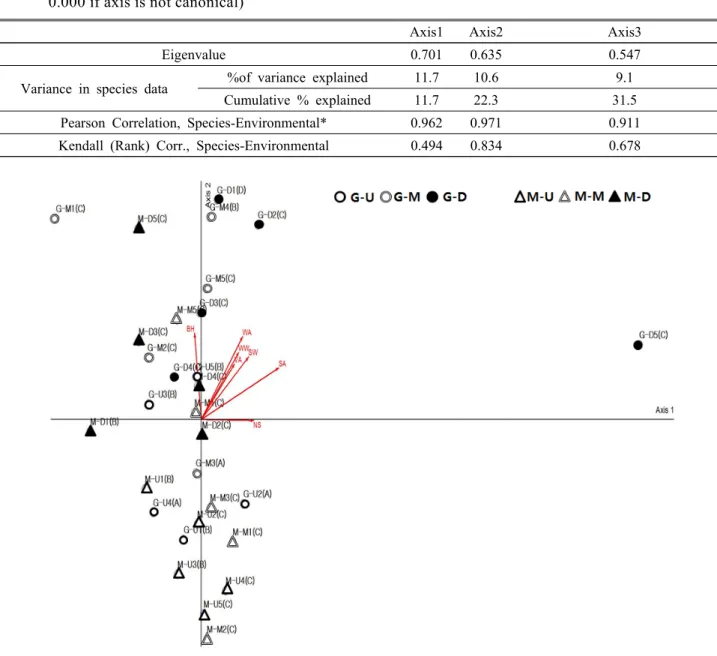
식생의 분포는 환경 변수들과의 다양한 분석을 통해 상관 관계를 알아볼 수 있다. 또한 식생의 분포는 각 식생 종의 종자확산(semination) 방식이나 종간경쟁(competition),공 생(symbiosis) 등과 같은 여러 가지 메커니즘을 일으켜서 공간적인 변이를 야기 시킬 수 있다(Wedin and Tilman, 1993; McClanahan and Wolfe, 1993; Callaway and Walker, 1997). CCA결과 30개 군락과 17개의 환경요인간 (Appendix 1) 분산 고유치 값은 1축이 0.701, 2축이 0.635, 기여도 값은 1축이 11.7%, 2축이 10.6%, 피어슨 상관관계 (Pearson Correlation)는 1축이 0.962, 2축이 0.971 그리고 켄달의 순위 상관관계(Kendall Rank Correlation)는 1축이
0.494, 2축이 0.834였다(Table 5).
조사지점의 군락에 영향을 주는 환경요인은 식생면적 (Vegetation Area), 인공구조물 면적(Structure Area), 수로면 적(Waterway Area), 지점폭(Spot Width), 수로폭(Waterway Width), 제방높이(Bank Height) 그리고 총 종수(Number of Species) 였다(Fig. 5). 1축을 기준으로 위쪽은 식생면적, 인공구조물 면적, 수로면적, 지점폭, 수로폭 그리고 제방높이 가 영향력이 컸고, 아래쪽은 총종수가 영향력이 큰 것으로 나타났다. 2축을 기준으로 우측에 식생면적, 인공구조물, 면 적, 수로면적, 지점폭, 수로폭 그리고 총종수가 영향력이 컸고, 좌측은 제방높이가 영향력이 큰 것으로 나타났다(Fig. 5).
1축과 2축을 각각 X축과 Y축으로 봤을 때 식생면적, 수로면 적, 지점폭, 수로폭 그리고 인공구조물 면적은 1사분면에 위치한 지점들과 양의 상관관계를 보였으며 2사분면에 위치 한 지점들은 제방높이와 양의 상관관계를 보였으며 4사분면 에 위치한 지점들은 총 종수와 양의 상관관계를 보였다. 또한 각 환경요인의 방향과 반대 사분면에 위치한 지점들은 음의 상관관계를 갖는다(Fig. 5).
일반적으로 하천은 잘 발달하고 보존이 양호한 생태계에 서도 지형과 환경요인의 공간적 이질성은 매우 복잡하고 분포하고 또한 그러한 공간적 이질성이 실물 군집의 구성과 각 식물의 분포에 크게 영향을 미친다. 또한 하천은 하천유 Fig 4. Unweighted pair-group average clustering of 30 sites using species dominance(G-U: Geumgang mainstream's upper stream; G-M: Geumgang mainstream's middle stream; G-D: Geumgang mainstream's down stream; M-U: Mihocheon's upper stream; M-M: Mihocheon's middle stream; M-D: Mihocheon's down stream). Alphabet in the parenthesis means RVI grade (A=best, B=good, C=normal and D=bad).
형, 하천의 규모, 입지적 특성, 하천차수 등 물리적인 환경이 다양하며, 오염원 유입여부, 종적, 횡적구배에 따른 물리적 환경이 변화함에 따라서 그 곳에 서식하는 생물서식 유형도 매우 다르게 나타난다(Pyo, 2009). 하천의 횡단은 크게 수 로 및 하상(수생역), 물의 변화구역(추수 또는 변화구역) 그 리고 물의 영향을 받는 주변구역(홍수터 또는 제외지)으로 나눌 수 있다(Kim, 2004). 지점폭에 따라 식생면적이 달라 질 수 있는데, 식생면적에 크기에 따라 군락 수와 나타나는 출현 종수에 영향을 끼칠 수 있다. 따라서 지점폭은 지점의
종 분포에 영향을 주는 환경요인이라고 할 수 있다. 버드나 무속 및 여러 습지식물들은 하천에서 고유의 살아가는 습성 과 서식공간이 조금씩 다르며, 식물종에 따라 제한적으로 분포하기도 하고 광역적으로 분포하기도 한다(Lee and Kim 2006). 따라서 버드나무속 및 습지식물의 출현비율에 따라 종 분포가 달라지기 때문에 이러한 결과가 나타난 것 으로 판단된다. 하천에서의 귀화식물은 식생의 빠른 성장, 무성생식을 통한 재생산 능력, 부영양화를 통한 확산, 인간 활동에 의한 확산, 자연적인 서식공간을 초월한 확산 등 다
Axis1 Axis2 Axis3
Eigenvalue 0.701 0.635 0.547
Variance in species data %of variance explained 11.7 10.6 9.1 Cumulative % explained 11.7 22.3 31.5 Pearson Correlation, Species-Environmental* 0.962 0.971 0.911 Kendall (Rank) Corr., Species-Environmental 0.494 0.834 0.678
Table 5. Total variance in the species data(* means the correlation between sample scores for an axis derived from the species data and the sample scores that are linear combinations of the environmental variables. Set to 0.000 if axis is not canonical)
Fig 5. CCA ordination between species dominance of 30 sites and environmental variables.
Alphabet in the parenthesis means RVI grade(A=best, B=good, C=normal and D=bad).
양하고 독특한 특성을 통해 정해 나간다(Pieterse, 1993).
국내의 대부분의 하천은 고유의 생물다양성 유지 목적이 전혀 고려되지 않은 비생태적 운영의 결과로 귀화식물의 정착과 확산이 매우 쉽게 이루어지고 있다(Lee and Kim, 2006). 이러한 귀화식물은 고유의 식물군락에 비해 상대적 으로 식생구조가 단순하며, 한 식물종에 의한 단순우점을 형성하기 때문에(Lee and Kim, 2006) 하천의 종우점 분포 에 영향을 줄 수 있다.
REFERENCES
Braun-Blanquet J. (1964). Planzensozilogie. 3rd ed. WienꞏNewYork;
Springer.
Callaway RM, and Walker LR. (1997). Competition and facili- tation: A synthetic approach to interations in plant communities. Ecology. 78(7): 1958-1965.
Cho KT, Jang RH and You YH. (2015). Analysis for the relationship of environmental factors and vegetation structure at natural streamside valley and riparian forest in South Korea. Journal of Ecology and Environment. 38(4):405-413.
Choi HG. (1985). Monograph of vascular hydrophyte in Korea.
Seoul National University Press.(in Korea)
Chun SH, Hyun JY, and Choi JK. (1991). A study on the distribition patterns of Salix gracilistyla and Phragmites japonica com- munities according to micro-landforms and substrates of the stream corridor. Journal of the Korean Institute of Landscape Architecture. 27(2): 58-68.
Chung YH, Sung KJ, Kang DS, Lee SM, and Park SY. (2008).
Environmental factors and Phragmites distribution at various habitats in Eulsukdo ecological park. Journal of Korean Restoration. 11(3): 50-61.
Francisca CA, Maria JF, and Maria TF. (2011). Choosing the best method for stream bioassessment using macrophyte commun- ities: Indices and predictive models. Ecological Indicators. 11:
379-388.
Gonzalez del Tanago M, and Garcia de Jalon G. (2006). Attributes for assessing the environmental quality of riparian zone.
Limnetica. 25: 389–402.
Han JE, Kim SY, Kim WH, Lee JY, Kim JH, Ro TH, and Choi BH.
(2007). Distribution of naturalized plants at stream in middle part of Korea. Korean Journal of Environment Biology. 25(2):
115-123.
Han SJ. (2011). Studies on the woody vegetation and B-diversity tn the edge of natural river for ecological restoration in Korea.
Kongju National University Press.(in Korea)
Heo EB. (2010). Studies on the woody vegetation in the edge of nat- ural river for ecological restoration in Korea. Kongju National University Press.(in Korea)
Joo KJ, Kim HW and Ha K. (1997). The development of stream ecology and current status. Korean Journal of Ecology. 20(1):
69-78.
Kang SJ. (2004). Development and application of a method for rap- id wetland assessment considering functions of wetlands in Korea. Ehwa Women's University Press.(in Korea)
Kim HJ. (2004). Natural river planning and design. Taerim Publisher Seoul. pp. 347.
Kim HJ, and Lee JH. (1998). A study on the Salix's biotechnical application. Journal of Korean institute of landscape architecture. 26(3): 143-151.
Lee TB. (2003). Coloured flora of Korea. Hyangmun Publisher Seoul. pp. 910.
Lee WC. (1996). Korean flora. Academic Publisher Seoul. pp. 624.
Lee YK, and Kim JW. (2006). Riparian vegetation of South Korea.
Gyemyoung University Publisher Daegu. pp. 293.
Lee YN. (1997). New flora of korea. Kyohak Publisher Seoul. pp.
1238.
Linda EG, James MG, and Lee WW. (2008). Algae. Benjamin- Cummings Publishing Company. pp. 618.
McClanahan TR, and Wolfe RW. (1993). Acceleration forest suc- cession in a fragmented landscape: the role of birds and perches.
Conservation Biology. 7(2): 279-288.
Ministry of Environment. (2006). The 2nd investigation guide on National Inland Wetlands. pp. 384.
Ministry of Environment. (2007). Model of river restoration for re- storation of ecological health, criteria, research plan establish- ment research final report model and plan. Ministry of Environment. pp. 334.
Ministry of Environment. (2013). River riparian vegetation health condition investigation and assessment(I). pp. 172.
Ministry of Environment. (2014). Survey and assessment of stream/river ecosystem health(VII). pp. 549.
Park SH. (2009). New illustrations and photographs of naturalized plants of Korea. Iljogak Publisher Seoul. pp.575.
Piterse AH. (1993). Concepts, ecology and characteristic of aquatic weeds: introduction. Pieterse et Murphy (eds). Aquatic weeds:
the ecology management of nuisance aquatic vegetation.
Oxford University Press.(in New York)
Pyo JH. (2009). A study on development of the naturalness assess- ment system based on the intergrated mapping of abiotic and bi- otic fators in stream ecosystem. Kongju National University Press.(in Korea)
Rothrock PE, Simon TP, and Stewart PM. (2008). Development, calibration, and validation of a littoral zone plant index of biotic integrity (PIBI) for lacustrine wetlands. Ecological Indicaor. 8:
79–.88.
Shim IS, Kim HB, and Cho KJ, (2013). Syntaxonomical character- istics of abandoned paddy fields by seral stages in South Korea.
Korean Journal of Environmental Agriculture. 32(3): 185-192.
Shin HS, Shin DS, Shon TS, and Kang DK. (2009). A study on urban streams in Busan through application of multilateral stream assessment. Journal of Korean Society on Water Quality. 25(2):
235-244.
Stromberg JC, Lite SJ, Rychener TJ, Levick LR, Dixon MD, and Watts JM. (2006). Status of the Riparian ecosystem in the upper
San Pedro River, Arizona: application of an assessment model.
Environment Monit Assessment. 115: 145–173.
Wedin D, and Tilman D. (1993). Competition among grasses along a nitrogen gradient: Initial conditions and mechanical of competition. Ecological Monigrahs. 63(2): 199-299.
You JH, Park KH, and Yoon YC. (2010). Distributional character- istics and management device of naturalized plants in Naedong stream, Changwon-si. Journal of the Korean Institute of Landscape Architecture. 38(4): 96-105.
APPENDIX
Characteristics Waster system
River basin
Study sites
RVI (Grade) Chl-a
Stream width
(m)
Waterway width
(m)
Bank height (m)
Altitude (m)
Vegetation area((m2)
Structure area(m2)
Waterway area(m2)
Geumgang
upper river
G-U1 60.0(B) 2.3 74 14 7.6 397 16,903 12,863 2,395
G-U2 66.7(A) 2.2 102 48 4.3 283 23,939 19,890 14,396
G-U3 56.7(B) 0.9 177 128 10.5 211 25,327 66,829 3,441
G-U4 66.7(A) 1.4 255 31 10 176 80,021 22,573 7,998
G-U5 53.3(B) 1.5 259 113 6.7 125 61,477 55,246 11,578
middle river
G-M1 26.7(C) 2.3 432 314 30 71 43,867 153,741 22,489
G-M2 23.3(C) 2.2 245 142 12.6 24 30,262 60,239 13,222
G-M3 66.7(A) 2.1 690 278 17 15 50,699 91,744 1,115
G-M4 46.7(B) 3.6 760 357 21.7 13 148,812 166,625 44,182
G-M5 33.3(C) 3.6 530 220 15 8 80,795 123,475 22,487
down river
G-D1 3.3(D) 3.2 375 247 14.6 8 57,768 150,673 13,221
G-D2 26.7(C) 10.9 809 342 18 4 190,373 171,639 80,048
G-D3 33.3(C) 5.0 930 296 14 5 249,851 144,704 32,670
G-D4 33.3(C) 6.2 990 504 17 2 309,886 230,525 7,101
G-D5 26.7(C) 5.0 1060 448 14.5 4 174,839 237,877 120,747
Miho stream
upper river
M-U1 43.3(B) 7.2 52 28 5.7 74 7,135 5,292 221
M-U2 33.3(C) 15.1 267 54 10 53 21,408 7,406 2,523
M-U3 46.7(B) 5.0 180 109 5 60 20,654 8,556 2,862
M-U4 36.7(C) 5.4 98 49 4 67 9,481 7,867 1,079
M-U5 30.0(C) 13.1 81 57 7.5 56 2,537 10,877 0
middle river
M-M1 30.0(C) 7.0 207 43 10 55 22,108 8,810 13,282
M-M2 30.0(C) 10.1 223 82 9 42 22,765 14,785 1,852
M-M3 40.0(C) 3.6 213 68 9 52 21,818 13,851 7,939
M-M4 33.3(C) 4.2 138 20 10.5 47 11,604 5,095 14,143
M-M5 23.3(C) 11.3 358 107 7.8 29 9,839 17,301 1,336
down river
M-D1 50.0(B) 6.4 132 92 15 30 47,303 22,626 3,094
M-D2 30.0(C) 3.1 136 21 10 27 14,723 4,547 9,394
M-D3 40.0(C) 14.3 410 140 14 24 47,718 24,088 13,229
M-D4 33.3(C) 2.4 118 15 10 26 11,970 2,424 1,509
M-D5 26.7(C) 12.3 140 10 12.2 16 28,942 62,609 3,246
Appendix 1. Information of study sites
Characteristics
Waster system
River basin
Study sites
Number of community
Number of species
Percent of tolerant species
Percent of Salix
Percent of Gramineae
Percent of naturalized
plant
Percent of invasive
alien species
Percent of Cyperaceae
Percent of Obligate wetland plants
Percent of Facultative wetland
plants
Geumgang
upper river
G-U1 10 57 14.0 7.0 17.5 22.8 1.8 5.3 5.3 17.5
G-U2 9 76 13.2 2.6 11.8 21.1 1.3 3.9 3.9 10.5
G-U3 5 64 12.5 4.7 12.5 20.3 1.6 4.7 6.3 9.4
G-U4 10 71 7.0 5.6 11.3 18.3 2.8 7.0 7.0 9.9
G-U5 11 58 13.8 5.2 17.2 24.1 1.7 6.9 10.3 19.0
middle river
G-M1 3 33 12.1 9.1 21.2 15.2 0.0 0.0 9.1 21.2
G-M2 7 54 14.8 5.6 11.1 27.8 0.0 3.7 1.9 11.1
G-M3 6 60 16.7 6.7 20.0 23.3 3.3 3.3 8.3 16.7
G-M4 12 75 14.7 4.0 17.3 22.7 2.7 4.0 12.0 14.7
G-M5 6 56 16.1 0.0 16.1 23.2 5.4 7.1 8.9 12.5
down river
G-D1 2 50 16.0 2.0 20.0 20.0 0.0 4.0 2.0 16.0
G-D2 7 34 23.5 2.9 17.6 32.4 0.0 2.9 8.8 11.8
G-D3 8 57 21.1 1.8 14.0 31.6 1.8 5.3 3.5 12.3
G-D4 12 56 16.1 1.8 17.9 23.2 0.0 5.4 7.1 14.3
G-D5 12 86 12.8 3.5 24.4 19.8 1.2 8.1 5.8 14.0
Miho stream
upper river
M-U1 6 36 8.3 2.8 16.7 22.2 2.8 2.8 11.1 16.7
M-U2 7 51 17.6 3.9 19.6 19.6 2.0 3.9 7.8 11.8
M-U3 9 52 15.4 1.9 13.5 17.3 0.0 1.9 15.4 9.6
M-U4 8 44 13.6 4.5 20.5 13.6 0.0 2.3 15.9 13.6
M-U5 3 47 6.4 2.1 12.8 12.8 0.0 2.1 0.0 12.8
middle river
M-M1 11 50 18.0 4.0 18.0 28.0 4.0 2.0 6.0 12.0
M-M2 11 39 20.5 2.6 15.4 30.8 7.7 0.0 10.3 12.8
M-M3 14 65 15.4 4.6 13.8 23.1 1.5 3.1 9.2 13.8
M-M4 7 59 16.9 5.1 16.9 23.7 0.0 1.7 3.4 8.5
M-M5 3 43 24.4 0.0 24.4 36.6 4.9 0.0 11.6 16.3
down river
M-D1 8 41 23.3 4.7 16.3 20.9 4.7 4.9 2.4 12.2
M-D2 8 60 18.3 3.3 16.7 28.3 8.3 3.3 3.3 13.3
M-D3 7 56 17.9 1.8 17.9 23.2 1.8 5.4 3.6 17.9
M-D4 7 34 26.5 0.0 26.5 29.4 5.9 0.0 5.9 17.6
M-D5 5 33 24.2 3.0 18.2 36.4 3.0 0.0 6.1 9.1
Appendix 1. Information of study sites(continue)
Family name Scientific name Korean name Type of hydrophyte*
Polygonaceae
Persicaria thunbergii (Siebold & Zucc.) H. Gross 고마리 EP
Persicaria maackiana (Regel) Nakai ex Mori 나도미꾸리낚시 EP
Persicaria hydropiper (L.) Delarbre 여뀌 EP
Ceratophyllaceae Ceratophyllum demersum L. 붕어마름 SP
Hydrocaryaceae Trapa japonica Flerov 마름 LP
Umbelliferae Oenanthe javanica (Blume) DC. 미나리 EP
Gentianaceae Nymphoides indica (L.) Kuntze 어리연꽃 LP
Compositae Bidens tripartita L. 가막사리 EP
Alismataceae Alisma orientale (Sam.) Juz. 질경이택사 EP
Potamogetonaceae Potamogeton crispus L. 말즘 SP
Juncaceae Juncus effusus L. var. decipiens Buchenau 골풀 EP
Commelinaceae Aneilema keisak Hassk. 사마귀풀 EP
Gramineae
Beckmannia syzigachne (Steud.) Fernald 개피 EP
Echinochloa crus-galli (L.) P. Beauv. 돌피 EP
Echinochloa crus-galli (L.) P. Beauv. var. oryzicola Ohwi 물피 EP
Echinochloa utilis Ohwi & Yabuno 피 EP
Leersia japonica (Honda) Honda 나도겨풀 EP
Phalaris arundinacea L. 갈풀 EP
Phragmites communis Trin. 갈대 EP
Phragmites japonica Steud. 달뿌리풀 EP
Lemnaceae Lemna paucicostata Hegelm. 좀개구리밥 FP
Spirodela polyrhiza (L.) Schleid. 개구리밥 FP
Typhaceae Typha orientalis C. Presl 부들 EP
Typha angustata Bory & Chaub. 애기부들 EP
Cyperaceae
Carex thunbergii Steud. var. appendiculata (Trautv.) Ohwi 뚝사초 EP
Cyperus difformis L. 알방동사니 EP
Fimbristylis dichotoma Vahl 하늘지기 EP
Kyllinga brevifolia Rottb. var. leiolepis Hara 파대가리 EP
Scirpus radicans Schkuhr 도루박이 EP
Scirpus triqueter L. 세모고랭이 EP
Scirpus maritimus L. 좀매자기 EP
Scirpus lacustris subsp. creber (Fern.) T.Koyama 큰고랭이 EP
Appendix 2. The list of hydrophyte plant in study sites
*EP: Emerged plant, LP: Leaf-floating plant, FP: Free-floating plant, SP: Submerged plant