Vol. 46, No. 4, pp. 526 - 531, 2005
Capecitabine and gemcitabine are used in the treatment of a variety of solid tumors including pancreatic and biliary tract carcinomas. The authors evaluated survival, response, and toxi- city associated with using a combination of capecitabine and gemcitabine to treat patients with unresectable or metastatic gallbladder adenocarcinoma (GBC). Eligible patients had histo- logically- or cytologically-confirmed GBC, no prior systemic therapy with capecitabine or gemcitabine, Karnofsky Perfor- mance Status 70%, serum total bilirubin up to three times nor- mal, and measurable disease. Treatment consisted of gemcita- bine 1000 mg/m2IV on Days 1 and 8 concurrent with admini- stration of capecitabine 1000 mg/m2 PO BID on Days 1 through 14, on a 3-week cycle. Tumor response was assessed by the response evaluation criteria in solid tumors (RECIST criteria) and survival was calculated from initiation of CapGem therapy. A total of 24 patients were enrolled. Median age at the time of diagnosis was 62 years (range, 41-78 years). Four- teen patients had undergone prior surgery. Results showed that eight patients achieved partial response (33%) with an additio- nal 10 patients achieving stable disease (42%). The overall median time to disease progression was 6.0 months (95% CI, 3.8-8.1 months) and overall survival was 16 months (95% CI, 13.8-18.3 months). The one-year survival rate was 58%. No Grade 4 toxicity was seen. Transient Grade 3 neutropenia/
thrombocytopenia and manageable nausea, hand-foot syndrome and anorexia were the most common toxicities. Our study shows that CapGem is an active and well-tolerated chemo- therapy regimen in patients with advanced GBC.
Key Words: Capecitabine, gemcitabine, gallbladder cancer
INTRODUCTION
Most patients with GBC present with invasive, inoperable disease. Chemotherapeutic agents in- cluding 5-fluorouracil (5-FU), mitomycin C, cispla- tin, methotrexate, etoposide, and doxorubicin have been tried alone, and in combination, for this patient group. Partial responses lasting from weeks to several months have been observed only in about 10-20% of the cases, and the median survival for patients with gallbladder cancer is dismal at around four months.
1Chemo-immuno- therapy has shown encouraging results,
2,3but the data are limited to a few case reports only. Simi- larly, isolated reports of intra-arterial chemother- apy
4and intra-lesional therapy
5have been pub- lished. The poor therapeutic results, along with small sample sizes in the trials, preclude the sup- port of any particular chemotherapeutic regimen for unresectable disease. Therefore, newer, more effective treatment strategies must be evaluated.
Several reports have suggested that gemcitabine (Gemzar ; Eli Lilly, Indianapolis, IN, USA) may act on biliary tract tumors and GBC.
6,7A sub- sequent Phase II studies using a weekly dose of 1000 mg/m
2of gemcitabine for three out of four weeks showed a 36% partial response rate in a group of 26 patients with metastatic or unresec- table GBC.
8In a Phase II trial of 1,200 mg/m
2of gemcitabine given weekly for three weeks fol- lowed by a two-week rest period, 3 of 19 patients with biliary tract cancer or GBC (16%) achieved a
A Phase II Study of Capecitabine Combined with Gemcitabine in Patients with Advanced Gallbladder Carcinoma
Jae-Yong Cho,
1Ji-Sun Nam,
1Mi-Suk Park,
2Jeong-Sik Yu,
2Yong-Han Paik,
1Se-Joon Lee,
1Dong-Ki Lee,
1and Dong-Sup Yoon
3Departments of 1Internal Medicine, 2Diagnostic Radiology, 3Surgery, Yongdong Severance Hospital Pancreatobiliary Clinic, Yonsei University College of Medicine, Seoul, Korea.
Received March 24, 2005 Accepted May 13, 2005
Reprint address: requests to Dr. Jae Yong Cho, Department of Internal Medicine, Yongdong Severance Hospital, Yonsei Univer- sity College of Medicine, 146-92 Dogok-dong, Kangnam-gu, Seoul 135-720, Korea. Tel: 82-2-3497-3310, Fax: 82-2-3463-3882, E-mail:
partial response.
9The median survival period was 6.5 months and the time to disease progression was 2.5 months. A Phase II trial of gemcitabine given every other week at a dose of 2,200 mg/m
2reported a response rate of 22% and a median survival period of 11.5 months.
10The combina- tion of gemcitabine, 5-FU, and leucovorin (LV) has been evaluated in several Phase I trials, building on preclinical studies demonstrating synergistic and additive effects in an ex vivo tumor model.
11Three Phase I studies evaluating the combination of gemcitabine, 5-FU, and LV have been com- pleted to date.
12,13All these studies showed evi- dence of meaningful antitumor activity and few significant side effects. Capecitabine (Xeloda ; Hoffman La Roche, Basel, Switzerland) is a selec- tive, oral fluoropyrimidine carbamate that gener- ates 5-FU selectively in tumor tissues. This selec- tivity is achieved by the enzyme thymidine phos- phorylase, which is responsible for the final conversion of capecitabine to 5-FU and is found at much higher levels in cancers compared with normal tissues.
14-16Capecitabine offers the pos- sibility of continuous tumor exposure to 5-FU by preferential activation at the tumor site, while potentially minimizing the exposure of healthy body tissues to systemic 5- FU.
17,18We performed this study to further investigate the potential of CapGem in previously untreated patients with advanced and/or metastatic GBC.
MATERIALS AND METHODS Eligibility
Patients with histologically confirmed unresec- table or metastatic GBC, who were at least 18 years of age and who had a Karnofsky Perform- ance Status of > 70% were included. The fol- lowing hematologic and chemistry parameters were recommended: neutrophils > 1.5 × 10
9/L, platelet count > 100 × 10
9/L, total bilirubin level <
three times the upper limit of normal, aspartate aminotransferase (AST) level < five times the upper limit of normal, and creatinine level < one and a half times the upper limit of normal.
Previous use of capecitabine or gemcitabine, and previous receipt of radiation therapy to more than
25% of the bone marrow were the exclusion cri- teria. Pregnant or lactating patients were excluded from the study. Female participants were required to use adequate contraceptive methods to prevent pregnancy during treatment. Other contraindica- tions included a history of brain or other central nervous system metastases. Previous biologic or immunologic therapy was not allowed within four weeks of study entry. Any history of a previous malignancy diagnosed within five years was not allowed, with the exception of basal or squamous cell carcinoma or skin and cervical carcinoma in situ.
Treatment and dose modification
Capecitabine (1,000 mg/m
2) was administered orally twice a day for 14 consecutive days fol- lowed by one week of rest. Gemcitabine was given as a 30 min IV infusion on Days 1 and 8 of each cycle at a dose of 1,000 mg/m
2. Cycles were repeated every 21 days provided that patients had recovered sufficiently from the drug- related side effects. Prophylactic administration of recombinant human granulocyte colony-stimu- lating factor (rhG-CSF) was not allowed. In cases where the patient had Grade 3 or 4 afebrile neu- tropenia, subsequent cycles were repeated with rhG-CSF prophylactic administration. If the patient had febrile neutropenia or Grade 3 or 4 neutropenia despite the prophylactic administra- tion of rhG-CSF, capecitabine and gemcitabine doses were reduced by 25%. In cases of Grade 3 or 4 thrombocytopenia lasting for more than 5 days, the doses of both drugs were also reduced by 25%. The dose of capecitabine was reduced by 25% in cases of Grade 3 or 4 diarrhea or hand-foot syndrome.
Efficacy and safety evaluation
Tumor assessments according to RECIST crite-
ria were performed at six-week intervals by the
investigators. Tumor lesions were assessed by
computed tomography (CT) scanning, X-rays or
magnetic resonance imaging (MRI); objective tu-
mor response was based on the dimensions of
measurable marker lesions, measured by the same
radiologist throughout the study. Time to progres-
sion (TTP) was calculated as the time from the first treatment to the time the patient was first recorded as having progressive disease (PD), or the date of death if the patient died before PD was demonstrated. Survival was monitored every three months after the patient completed treat- ment. Safety was monitored throughout the study and for 28 days after the last study treatment.
Adverse events were graded according to the Na- tional Cancer Institute-Common Toxicity Criteria (NCI-CTC). Hand-foot syndrome was graded as in previous capecitabine studies.
19TTP and sur- vival were analyzed by the Kaplan-Meier product limit method. Those who did not receive at least one dose of study medication or for whom no follow-up safety information was available were excluded from the safety analysis.
RESULTS
Patient characteristics
Twenty-four patients (18 women and 6 men) were enrolled between June 2001 and December 2004. Patients who received at least one dose of CapGem were considered evaluable for efficacy and safety. As shown in Table 1, the majority of patients (75%) had Stage IV disease and the most commonly affected metastatic sites were the liver (67%) and the lymph nodes (54%). Fourteen patients had undergone one or more type of sur- gery.
Treatment administration
A median of four courses of treatment (range, 1-16 courses) were given. Reasons for discon- tinuing study treatment included disease progres- sion (79%), toxicity (10%), or other reasons (11%).
During Cycle 1, 96.7% (range, 86-100%) and 98.7%
(range, 87-100%) of the planned dose of capecita- bine and gemcitabine, respectively, were given.
During Cycle 2, 95.1% (range, 83-100%) and 96.3%
(range, 85-100%) of the planned doses of capeci- tabine and gemcitabine, respectively, were given.
Despite the need for dose modifications, 90% of patients received all three weeks of treatment with both drugs during the first two cycles of therapy.
Efficacy
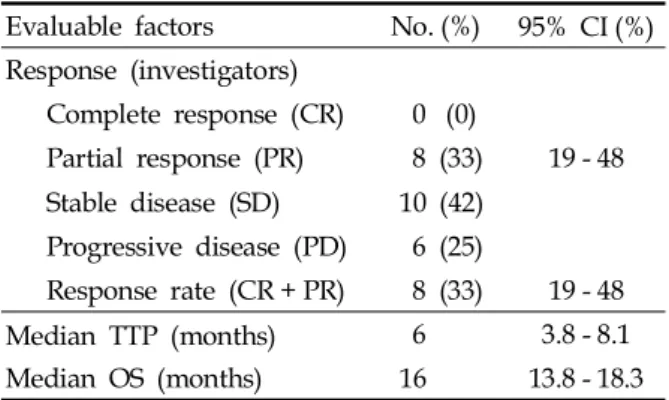
Eight of the 24 patients (33%, 95% CI, 19-48%) had a partial response (PR) and ten patients (42%) had stable disease (SD) (investigator-determined responses, Table 2). The median TTP was 6.0 months (95% CI, 3.0-8.1 months), and the median overall survival was 16 months (95% CI, 13.8-18.3 months). The 1-year actuarial survival rate was 58% (Fig. 1). Efficacy data are shown in Table 2.
Table 1. Patient Characteristics
Variables No. (%)
Total No. of patients treated 24 Age (yrs)
Median Range
62 41 - 78 Sex
Male Female
6 (25) 18 (75) Karnofsky performance status (%)
Median Range
90 70 - 100 Disease stage
Locally advanced Metastatic
12 (50) 18 (75) Metastatic sites
Liver
Lymph nodes Peritoneal seeding Lung
Bone
16 (67) 13 (54) 6 (25) 4 (17) 2 (8) Patients with 1 surgical intervention 14 (60)
Table 2. Efficacy Data
Evaluable factors No. (%) 95% CI (%) Response (investigators)
Complete response (CR) 0 (0)
Partial response (PR) 8 (33) 19 - 48 Stable disease (SD) 10 (42)
Progressive disease (PD) 6 (25)
Response rate (CR + PR) 8 (33) 19 - 48
Median TTP (months) 6 3.8 - 8.1
Median OS (months) 16 13.8 - 18.3
*RECIST criteria.
TTP, time to progression; OS, overall survival.
Safety
Table 3 summarizes the toxicity observations.
Non-hematological adverse events (Grade 2 per- centage/Grade 3 percentage) were: nausea (25%/
8%), hand-foot syndrome (17%/8%), general weakness (17%/8%), anorexia (17%/4%), stoma- titis (13%/4%), vomiting (13%/4%), constipation (4%/4%), and diarrhea (4%/4%). Grade 3 neutr- openia, anemia, and thrombocytopenia occurred
in 13%, 8% and 8% of patients, respectively. Two patients developed febrile episodes. Grade 2 and Grade 3 hepatotoxicity developed in 8% and 8%
of patients, respectively. No Grade 4 toxicity was seen. No patient discontinued treatment because of abnormal laboratory values. No deaths attri- buted to toxicity occurred during the study. There were 13 deaths reported during the study, the majority of which occurred more than 28 days after the end of the planned treatment schedule.
All of the deaths were related to disease progres- sion.
DISCUSSION
A modest response was observed in the current Phase II study of CapGem combination chemo- therapy for patients with locally advanced or metastatic GBC. The drug combination was gene- rally well-tolerated. Overall, there were eight confirmed partial responses (PR) observed, with an estimated PR rate of 33% (95% CI, 19-48%).
This compares with published PR rates of 16-30%
reported for the use of gemcitabine alone.
8,19The median survival in our trial was 16 months, which is better than the 6.5-11.5 months in the single-
Fig. I. The median TTP was 6.0 months (95% CI, 3.0-8.1 months), and the median overall survival was 16 months (95% CI, 13.8-18.3 months). The 1-year actuarial survival rate was 58%.
Table 3. Toxicities of Chemotherapy (N=24)
Toxicity (NCI-CTC) Grade 1-2 (%) Grade 3 (%) Grade 4
Hematologic Neutropenia Anemia
Thrombocytopenia Nonhematologic
Nausea HFS*
General weakness Anorexia
Stomatitis Vomiting Constipation Diarrhea Hepatic
AST/ALT elevation Bilirubin elevation
4 (17) 4 (17) 3 (13)
6 (25) 4 (17) 4 (17) 4 (17) 3 (13) 3 (13) 1 (4) 1 (4)
1 (4) 1 (4)
3 (13) 2 (8) 2 (8)
2 (8) 2 (8) 2 (8) 1 (4) 1 (4) 1 (4) 1 (4) 1 (4)
1 (4) 1 (4)
- - - -
- - - - - - - -
- -
*HFS, hand-foot syndrome.
agent gemcitabine trials. The combination of capecitabine and gemcitabine, based on the dose and schedule as used in our trial, has better activity than gemcitabine alone. It is possible that capecitabine may enhance the activity of the com- bination. In a recent single-arm study of oral capecitabine therapy, a 50% treatment response was reported in patients with GBC.
20Further, in an interim report of a trial using capecitabine and gemcitabine, five of 15 patients with biliary tract cancers achieved a PR.
21These results suggest that capecitabine and gemcitabine may be a reasonable treatment combination for biliary tract cancers, in- cluding GBC. In human tumor xenograft models, oral administration of capecitabine yielded sub- stantially higher concentrations of 5-FU in tumor specimens than in specimens of plasma or normal tissue. It is noteworthy that levels of 5-FU after administration of capecitabine were much higher than those achieved by IV administration of 5-FU at doses producing equal levels of toxicity. The susceptibility of the xenografts to capecitabine was correlated with levels of the enzyme thymi- dine phosphorylase in tumor tissue specimens.
Therefore, the efficacy of capecitabine may be optimized by selecting candidates for treatment on the basis of thymidine phosphorylase expres- sion or by combining this agent with other agents that can upregulate thymidine phosphorylase ex- pression within tumor tissue.
15,16Phase II trials of approximately 130 patients treated with a chemotherapy regimen of gemcita- bine in combination with other agents show response rates ranging from 9 to 53%, with a tolerable toxicity profile.
22-27Overall survival in these studies ranged from 6.3 to 16 months. Most of these studies have included all biliary tract cancers. A recent Phase II study using the com- bination of gemcitabine and cisplatin in advanced GBC has reported high activity (64% response rate) with a tolerable toxicity profile.
28The present data and literature review, however, do not address the question whether this combination is superior or equivalent to single-agent gemcitabine or CapGem combination. Thus, further confirma- tive Phase III trials will be needed.
Nausea and hand-foot syndrome were the most common side effects of treatment, and hema- tologic toxicity was limited to Grades 2 and 3. The
mildness of the observed toxicity may be attribu- table to the less aggressive starting dose of cape- citabine (1,000 mg/m
2) used for this group of patients. The use of 1,000 mg/m
2capecitabine has become common in the treatment of patients with other malignancies, such as colorectal carcinoma;
this reduced dose was suggested by Borner et al.,
29who also recommended the use of 1,000 mg/
m
2twice daily when capecitabine is used in com- bination with oxaliplatin. Although impaired hepatic function can exacerbate toxicity or inhibit the efficacy of many agents, the presence of mild- to-moderate hepatic dysfunction had no clinically significant effect on the pharmacokinetics of capecitabine and its metabolites.
17This finding suggests that the CapGem regimen may be useful for patients with hepatobiliary carcinoma, in- cluding patients with mildly-to-moderately im- paired hepatic function.
Further research in this area should be directed at finding the best cytotoxic agent for combination with capecitabine or gemcitabine, or altering the dose intensity or route of administration in ad- vanced gallbladder cancer. A larger trial of gem- citabine combined with cisplatin compared with CapGem needs to be conducted. Also, the role of the CapGem combination as an adjuvant treat- ment for suboptimally resected patients should be further pursued.
REFERENCES
1. Verderame F, Mandina P, Abruzzo F, Scarpulla M, Di Leo R. Biliary tract cancer: our experience with gemci- tabine treatment. Anticancer Drugs 2000;11:707-8.
2. Murakami K, Tanimura H, Yamaue H, Mizobata S, Noguchi K, Nakamori M, et al. Clinical effect of im- munochemotherapy for a patient with advanced gal- lbladder cancer: report of a case. Surg Today 1998;28:
923-8.
3. Hasegawa H, Ueo H, Nanbara S, Tsuji K, Mori M, Akiyoshi T. An effective pre-operative chemoimmuno- therapy regimen against advanced gallbladder carci- noma: a case report. Hepatogastroenterology 1999;46:
1639-42.
4. Hara Y, Kawasaki T, Yabata E, Gen T, Jibiki M, Kudoh A, et al. A case of unresectable gallbladder cancer responding to combination therapy with hyperthermia and local chemotherapy. Jpn J Cancer Chemother 2000;
27:117-20.
5. Makower D, Rozenblit A, Kaufman H, Edelman M,
Lane ME, Zwiebel J, et al. Phase II clinical trial of in- tralesional administration of the oncolytic adenovirus ONYX-015 in patients with hepatobiliary tumors with correlative p53 studies. Clin Cancer Res 2003;9:693-702.
6. Gallardo J, Fodor M, Gamargo C, Orlandi L. Efficacy of gemcitabine in the treatment of patients with gallbladder carcinoma: a case report. Cancer 1998;83:
2419-21.
7. Castro MP. Efficacy of gemcitabine in the treatment of patients with gallbladder carcinoma: a case report.
Cancer 1998;82:639-41.
8. Gallardo JO, Rubio B, Fodor M, Orlandi L, Yanez M, Gamargo C, et al. A phase II study of gemcitabine in gallbladder carcinoma. Ann Oncol 2001;12:1403-36.
9. Raderer M, Hejna MH, Valencak JB, Kornek GV, Weinlander GS, Bareck E, et al. Two consecutive phase II studies of 5 -fluorouracil/leucovorin/mitomycin C and of gemcitabine in patients with advanced biliary cancer. Oncology 1999;56:177-80.
10. Penz M, Kornek GV, Raderer M, Ulrich-Pur H, Fiebiger W, Lenauer A, et al. Phase II trial of two-weekly gemcitabine in patients with advanced biliary tract cancer. Ann Oncol 2001;12:183-6.
11. Bruckner HW, Zhou G, Haenel P. Ex vivo ATP tumor testing of gemcitabine for combination chemotherapy and biochemical modulation. Proc Am Assoc Cancer Res 1998;39:310.
12. Poplin E, Roberts J, Tombs M, Grant S, Rubin E.
Leucovorin, 5-fluorouracil, and gemcitabine: a phase I study. Invest New Drugs 1999;17:57-62.
13. Hidalgo M, Castellano D, Paz-Ares L, Gravalos C, Diaz-Puente M, Hitt R, et al. Phase I-II study of gemcitabine and fluorouracil as a continuous infusion in patients with pancreatic cancer. J Clin Oncol 1999;17:
585-92.
14. Schuller J, Cassidy J, Dumont E, Roos B, Durston S, Banken L, et al. Preferential activation of capecitabine in tumor following oral administration to colorectal cancer patients. Cancer Chemother Pharmacol 2000;45:
291-7.
15. Miwa M, Ura M, Nishida M, Sawada N, Ishikawa T, Mori K, et al. Design of a novel oral fluoropyrimidine carbamate, capecitabine, which generates 5-fluorouracil selectively in tumours by enzymes concentrated in human liver and cancer tissue. Eur J Cancer 1998;34:
1274-81.
16. Endo M, Miwa M, Eda H, Ura M, Tanimura H, Ishikawa T, et al. Induction of thymidine phosphory- lase expression and enhancement of efficacy of cape- citabine or 5-deoxy-5-fluoroudine by cyclophospha- mide in mammary tumor models. Int J Cancer 1999;83:
127-34.
17. Twelves C, Glynne-Jones R, Cassidy J, Schuller J, Goggin T, Roos B, et al. Effect of hepatic dysfunction due to liver metastases on the pharmacokinetics of capecitabine and its metabolites. Clin Cancer Res 1999;
5:1696-702.
18. Hoff PM, Ansari R, Batist G, Cox J, Kocha W, Kuperminc M, et al. Comparison of oral capecitabine versus intravenous fluorouracil plus leucovorin as first-line treatment in 605 patients with metastatic colorectal cancer: results of a randomized Phase III study. J Clin Oncol 2001;19:2282-92.
19. Rudi J. Chemotherapy with gemcitabine in patients with gall-bladder carcinoma. Ann Oncol 2002;13:807.
20. Patt YZ, Hassan MM, Aguayo A, Nooka AK, Lozano RD, Curley SA, et al. Oral capecitabine for the treat- ment of hepatocellular carcinoma, cholangiocarcinoma, and gallbladder carcinoma. Cancer 2004;101:578-86.
21. Knox JJ, Hedley D, Oza A, Siu E, Chen R, Feld M, et al. Phase II trial of gemcitabine plus capecitabine (GemCap) in patients with advanced or metastatic adenocarcinoma of the biliary tract. Proc Am Soc Clin Oncol 2003;22:317.
22. Carraro S, Servienio PJ, Bruno MF, Castillo Odena MDS, Roca E, Jovtis S, et al. Gemcitabine and cisplatin in locally advanced or metastatic gallbladder and bile duct adenocarcinomas. Proc Am Soc Clin Oncol 2001;
20:A2333.
23. Gebbia V, Giuliani F, Maiello E, Colucci G, Verderame F, Borsellino N, et al. Treatment of inoperable and/or metastatic biliary tree carcinomas with single agent gemcitabine or in combination with levofolinic acid and infusional fluorouracil: results of a multicenter phase II study. J Clin Oncol 2001;19:4089-91.
24. Kuhn R, Ridwelski K, Eichelmann K, Rudolph S, Fahlke J, Ridwelski K. Outpatient combination chemo- therapy with gemcitabine and docetaxel in patients (Pts) with cancer of the biliary system. Proc Am Soc Clin Oncol 2001;20:A2272.
25. Kornek GV, Schuell B, Laengle F, Gruenberger T, Penz M, Karall K, et al. Mitomycin C in combination with capecitabine or biweekly high dose gemcitabine in patients with advanced biliary tract cancer: a rando- mised phase II trial. Ann Oncol 2004;15:478-83.
26. Scheithauer W. Review of gemcitabine in biliary tract carcinoma. Semin Oncol 2002;29:40-5.
27. Murad AM, Guimara RC, Aragao BC, Rodrigues VH, Scalabrini-Neto AO, Padua CA, et al. Phase II trial of the use of gemcitabine and 5-fluorouracil in the treat- ment of advanced pancreatic and biliary tract cancer.
Am J Clin Oncol 2003;26:151-4.
28. Malik IA, Aziz Z, Zaidi SHM, Sethuraman G. Gem- citabine and cisplatin is a highly effective combination chemotherapy in patients with advanced cancer of the gall bladder. Am J Clin Oncol 2003;26:174-7.
29. Borner MM, Dietrich D, Stupp R, Morant R, Honegger H, Wernli M, et al. Phase II study of capecitabine and oxaliplatin in first- and second-line treatment of ad- vanced or metastatic colorectal cancer. J Clin Oncol 2002;20:1759-66.