Evaluation of the food safety training for food handlers in restaurant operations
Sung-Hee Park
1, Tong-Kyung Kwak
2and Hye-Ja Chang
3§1
Imported Food Analysis Division Center for Food and Drug Analysis, Gyeongin Regional Food and Drug Administration, Incheon 402-825, Korea
2
Department of Food and Nutrition, Yonsei University, Seoul 120-749, Korea
3
Department of Food Science and Nutrition, College of Natural Science, Dankook University, Jukjeon-dong, Suji-gu, Youngin 448-701, Korea
Abstract
This study examined the extent of improvement of food safety knowledge and practices of employee through food safety training. Employee knowledge and practice for food safety were evaluated before and after the food safety training program. The training program and questionnaires for evaluating employee knowledge and practices concerning food safety, and a checklist for determining food safety performance of restaurants were developed. Data were analyzed using the SPSS program. Twelve restaurants participated in this study. We split them into two groups: the intervention group with training, and the control group without food safety training. Employee knowledge of the intervention group also showed a significant improvement in their score, increasing from 49.3 before the training to 66.6 after training. But in terms of employee practices and the sanitation performance, there were no significant increases after the training. From these results, we recommended that the more job-specific and hand-on training materials for restaurant employees should be developed and more continuous implementation of the food safety training and integration of employee appraisal program with the outcome of safety training were needed.
Key Words: Restaurants, effectiveness of the food safety training, hygiene knowledge, hygiene practice, on-site safety inspection
Introduction
9)The hospitality industry, in Korea, has been dramatically expanded since 1970, with market sales showing 51 trillion Won in 2006 [1]. With the increase in national income, economic activities of women, and various demands for diet, Korea consumers experienced an enormous change in dietary life and have increasingly dined out more often [2]. The expenditure on eating out has been rapidly increasing with an annual average increase of 18.5 percent from 1982 to 2004 [3]. Despite this rapid expansion of the market, sanitation management lags behind the growth compared with other markets such as school foodservice or health-care foodservice establishments [4].
When selecting restaurants, customers increasingly perceive the hygiene and price as the critical determinant. Similar to customers, the owners of restaurants also pointed out that, in selecting the strategic plans for surviving the competitive markets, food quality and hygiene have been regarded as the top priority [5]. In fact, according to the Korean Food and Drug Administration in 2007, 510 foodborne disease outbreaks with 9,686 patients were reported, of which approximately 75.9 percent (387 outbreaks) were attributed to food service establishments.
In particular, outbreaks in the foodservice sector reached 108
commercial foodservice settings and 93 institutional foodservice operations [6]. Now that these food safety problems in the foodservice operation sectors can lead to detrimental results on the customers’ health as well as enormous economic loss when improperly managed, sanitation matters have received continuous attention and now require high standards for improvement.
The previous studies pointed out that the factors most commonly associated with foodborne illness outbreaks include food purchases from unsafe sources; inadequate cooking or reheating; holding at room temperature in advance service;
cross-contamination from other foods or food contact surfaces;
poor personal hygiene; or improper food handling practices [7-8].
In Korea, 56.0 percent of the foodborne outbreaks (286 out of 510 cases) was caused by the microbial infection [6]. In the case of microbial substances, time and temperature control and prevention of cross-contamination could be effective methods for the prevention of foodborne illness. Therefore the reinforcement of safety education for food handlers and manager in foodservice establishments is on the rise. Due to, in Korea, having small scale facilities and capital [9], low education/low technical skill of employees [10], and a high turnover rate of employees, effective safety training programming should be developed.
Studies for testing the effectiveness of hygiene education pointed
§Corresponding Author: Hye-Ja Chang, Tel. 82-10-2253-4715, Fax. 82-31-8005-3170, Email. [email protected] Received: November 26, 2009, Revised: February 12, 2010, Accepted: February 16, 2010
ⓒ2010 The Korean Nutrition Society and the Korean Society of Community Nutrition
This is an Open Access article distributed under the terms of the Creative Commons Attribution Non-Commercial License (http://creativecommons.org/licenses/by-nc/3.0/) which permits unrestricted non-commercial use, distribution, and reproduction in any medium, provided the original work is properly cited.
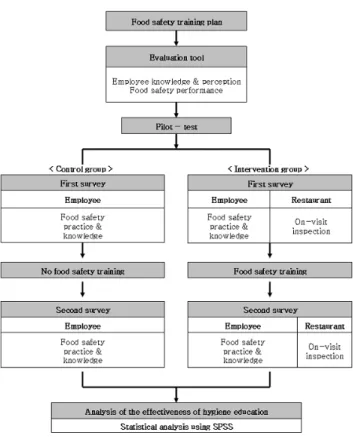
Fig. 1. Procedures of the study
out that hygiene knowledge education alone was not sufficient to improve the hygiene attitude and practices of foodservice worker [11-12] and a discrepancy between hygiene attitudes and practices existed [13]. For inducing foodservice workers to positive changes in hygiene attitude and behavior through the safety training, hands-on training materials should be equipped and the training program should be angled towards worker viewers with various activities. A design for planning, implementing, and evaluating a safety training program appropriate for employees’
characteristics in the organization is necessary.
On these points, this paper proposed the sanitation education plans with demonstration techniques and hands-on activities (e.g.:
microbial plate kit, testing sanitizer concentration) and examined the extent that food safety knowledge and practices of employees improved before and after a food safety training program.
Specifically, the purposes of the study were as follows: [1] the effectiveness of the safety training programs was tested in terms of food safety knowledge and practices of employees, and the inspection of food safety performance. Employee knowledge and practice for food safety were evaluated before and after a food safety training program, and [2] the relationships among food safety knowledge, food safety practice, and food safety scores were determined. For this we set the hypothesis as follows:
1) Hypothesis 1: Employee received the sanitation training will have a more knowledge on food safety than no-trained group.
2) Hypothesis 2: Employees’ hygiene practices will be increased more after training than no-trained group.
3) Hypothesis 3: Sanitation management performances in restaurants which employees received sanitation trainings will be improved.
4) Hypothesis 4: There will be positive correlations among employees’ sanitation knowledge and practices, and sanitation performance score of restaurant.
Materials and Methods
Research design and samples
Research design was the nonequivalent pretest and posttest control group method [14]. A control group and an intervention group were used for the test of internal validity for the training effect. Seven small franchise restaurants were invited to participate voluntarily as the intervention group which received our sanitation trainings. Five other Korean style restaurants also were invited as the control group which was not given the training. The procedures of the study are depicted at Fig 1. One hour safety trainings were carried out, with an interval 2 weeks.
Two types of questionnaires for measuring employees’ food safety knowledge and safety practices were administrated to the control and the intervention group before and after food safety training. Food safety performances of the restaurants were also
evaluated by the trained panelists through the on-site inspection with the food safety monitoring tool.
The pilot tests of the sanitation management evaluation sheet and a questionnaire for this study were conducted by distributing the evaluation sheet and questionnaire to restaurant managers and food handlers, 12 in all, as the study subjects. Questionnaire and the evaluation sheet were revised for clarity.
A pre-test was implemented from September 1 to September 30, 2006 with 41 food handlers from 7 restaurants (6 Korean style restaurants, 1 Japanese style restaurant) in Seoul who had accepted the training program as the intervention group and 49 food handlers from 5 restaurants as the uneducated control group.
The post test was carried out from October 1 to October 31, 2006.
In case of the control group, to enhance the respondent rates (100%), the panel directly visited the restaurants and asked the employees to finish the two types of questionnaires. Education to the intervention group was given with an interval of 2 weeks, for the purpose of evaluating the sanitary education effect on food handlers.
Food safety training plan and training materials
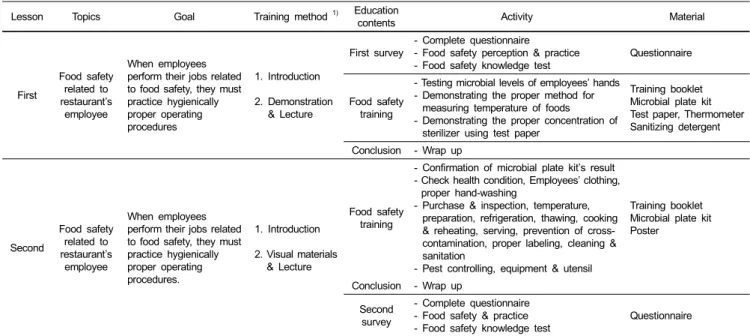
The education plan was presented at Table 1. Lecture and
demonstration techniques were selected as the training method
for the intervention group. The safety training material was made
based on previous works such as “the hygiene education manual
Table 1. Food safety training plan
Lesson Topics Goal Training method 1) Education
contents Activity Material
First
Food safety related to restaurant’s employee
When employees perform their jobs related to food safety, they must practice hygienically proper operating procedures
1. Introduction 2. Demonstration
& Lecture
First survey
- Complete questionnaire - Food safety perception & practice
- Food safety knowledge test Questionnaire
Food safety training
- Testing microbial levels of employees’ hands - Demonstrating the proper method for
measuring temperature of foods
- Demonstrating the proper concentration of sterilizer using test paper
Training booklet Microbial plate kit Test paper, Thermometer Sanitizing detergent Conclusion - Wrap up
Second
Food safety related to restaurant’s employee
When employees perform their jobs related to food safety, they must practice hygienically proper operating procedures.
1. Introduction 2. Visual materials
& Lecture
Food safety training
- Confirmation of microbial plate kit’s result - Check health condition, Employees’ clothing,
proper hand-washing
- Purchase & inspection, temperature, preparation, refrigeration, thawing, cooking
& reheating, serving, prevention of cross- contamination, proper labeling, cleaning &
sanitation
- Pest controlling, equipment & utensil
Training booklet Microbial plate kit Poster
Conclusion - Wrap up Second
survey
- Complete questionnaire - Food safety & practice - Food safety knowledge test
Questionnaire
1)Participants: intervention group of 41 subjects, control group of 49 subjects
for restaurant food handlers” [15], “self-managed sanitation module for Korean food restaurants” [10,16] and other materials [8,17]. Demonstrations of “microbial plate kit” and “adjustment for the proper concentration of sanitizer” to employees were carried out during the training.
At the first visit, the pre-test was conducted. The observational food safety inspection was completed, and then the managers were asked to fill out the survey and the evaluation sheets. After that, we asked the food handlers to fill out the survey, and then 30-minute food safety training was done. After the training, the managers were asked for feedback on how to improve tailor- make the training materials for their specific needs. Approximately 2 weeks after that, a retraining-program was implemented, using the hygiene management posters which had the same contents as the first one. The post-test using the questionnaire was done after training.
In the case of the control group, a pre-test was carried out by distributing evaluation papers and questionnaires through the on-site visits. After 2 weeks, the post-test was done without implementing a training program. An observational food inspection was not carried out.
Questionnaire for food safety knowledge
The questionnaire for examining the knowledge of food safety consisted of 20 multiple choice questions and was comprised of 3 sections: personal hygiene (4 items); food hygiene (11 items); and environmental hygiene (5 items). It was set up with 5 points for correct answers and 0 points for wrong answers, with a total possible score of 100 points. Through the pilot test carried out using this questionnaire, 56 percent answered the
question correctly. This gave the support for the questionnaire being not easy as well as not difficult, and being an adoptable tool for research.
Questionnaire for food safety practices
Questionnaires used in this study were made based on the training material for the restaurant food handlers and previous studies [18-19]. Safety management performance was measured using a 5-point Likert scale, from 1 point for very poor practice of food safety to 5 points for excellence in meeting food safety standards. Possible total score for 25 questions was 125 points which were given when all were answered correctly. The content of the questionnaire consisted of 3 divisions: personal hygiene (Cronbach α=0.381), food hygiene (Cronbach α=0.803), and environmental hygiene (Cronbach α=0.825).
Sanitation performance by on-site observational inspection For the evaluation the performance of food sanitation manage- ment of restaurants the sanitation audit tool for restaurant operators was developed using literature reviews of previous works [15,20-23].
The sanitation inspection tool was divided into 3 sections:
personal hygiene; food hygiene; and environmental hygiene.
Food hygiene and environmental hygiene are divided again into the specific areas: 4 sub-sections of “approved food source”,
“food storage”, “safe handling of food”, and “serving” in the
food hygiene section; and 3 sub-sections of “cleaning and
sanitation”, “physical facilities in kitchen”, and “physical
facilities in other places” in the environmental hygiene.
Table 2. Demographic characteristics of respondents Category
N (%)
χ2 Category
N (%)
χ2 Intervention
Group Control Group Intervention
Group Control Group
Gender Male 15 (36.6) 16 (32.7)
0.153 Restaurant type Korean-style food 31 (75.6) 49 (100)
13.445***
Female 26 (63.4) 33 (67.3) Japanese-style food 10 (24.4) -
Age
25 years less 10 (24.4) 3 (6.1)
1.603
Hygiene education experience
Yes 41 (100) 42 (85.7)
6.351*
25~30 years 6 (14.6) 7 (14.3) No - 7 (14.3)
30~35 years 3 (7.3) 4 (8.2)
Education frequency
Once a month 20 (48.8) -
23.851***
35~40 years 1 (2.4) 3 (6.1) Once a 3 months 7 (17.1) -
40~45 years 3 (7.3) 8 (16.3) Once a 6 months 8 (19.5) 27 (55.1)
45~50 years 7 (17.1) 8 (16.3) Once a year 6 (14.6) 8 (16.3)
50 years over 11 (26.8) 16 (32.7) Others -
Education level
Elementary school 4 (9.8) 6 (12.2)
3.554 Working experience
1 years or less 16 (39) 9 (18.4)
5.557
Middle school 6 (14.6) 8 (16.3) 1~2 years 7 (17.1) 8 (16.3)
High school 17 (41.5) 26 (53.1) 2~3 years 3 (7.3) 7 (14.3)
College 9 (22.0) 8 (16.3) 3~4 years 3 (7.3) 4 (8.2)
University 4 (9.8) 1 (2.0) More than 4 years 12 (29.3) 21 (42.9)
Position Cook 10 (24.4) 16 (32.7)
3.987 Employment type Full-time workers 37 (90.2) 41 (83.7) 2.626
Assistant cook 31 (75.6) 33 (67.4) Part-time workers 4 (9.8) 8 (16.3)
*P< 0.05 ***P< 0.001
The number of items for each area and their grading are composed of a total of 34 items with 100 points: 18 points from 5 items for the personal hygiene, 50 points from 16 items for the food hygiene, and 32 points from 13 items for the environ- mental hygiene. Items were also weighted higher (1, 2, or 3), based on importance.
Statistical analysis
Statistical analyses were performed using the statistical package for the social sciences (SPSS version 12.0). The average and the standard deviation were calculated as the general hygiene management performance. For the evaluation of food handlers’
pre/post food safety knowledge and performance, the average and the standard deviation were calculated, and t-test was carried out for testing levels of significance. Pearson correlation test was done to identify the correlation among food handlers’ food safety knowledge, behavior and on-visit inspection scores.
Results
Characteristics of the respondents
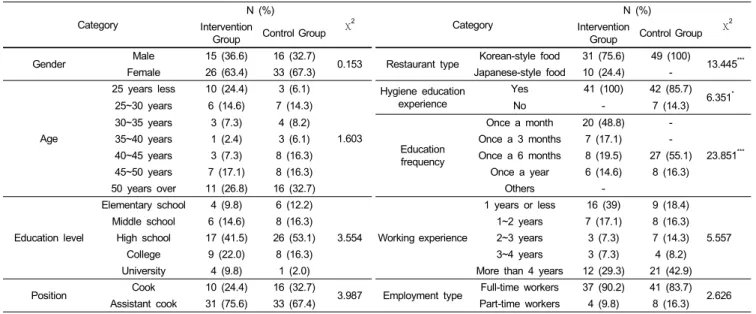
The general characteristics of the control and intervention groups are presented at Table 2. There were no significant differences in terms of profiles of the control and intervention groups except restaurant type, hygiene education experience and education frequency, partially supporting that the intervention and the control groups have similar characteristics. These results come from including of one Japanese restaurant in the intervention group and employees of one restaurant have never given hygiene education. The ratio of males to females was approximately 1:2.
A significant point was that the group aged over 50 showed the highest proportion of respondents, showing 11 persons (26.8%) of the intervention group, and 16 persons (32.7%) of the control group. In the case of education levels, 17 persons (41.5%) of the intervention group and 26 persons (53.1%) of the control group had high school graduation certification, followed by college degree, and middle school, respectively.
The majority of the respondents listed their working experience as either one year or less or more than 4 years. In the case of the intervention group, 31 persons engaged in Korean-style food cooking, and 10 employees in Japanese style cooking. Among them, ten cooks (24.4%) had a chef certificate and the remainders who did not have qualifications supported the cook or conducted less skillful tasks such as washing dishes, serving, and so on.
In the case of employment status of the intervention group, 37 persons (90.2%) belonged to regular full-time job employees, and only 4 workers were part-time employees. All of intervention group of 41 persons had experienced hygiene training, and among them 48.8% of the respondents answered training frequencies as once a month.
In respect of the restaurants features for the intervention group, the average space of the restaurants was 548.8㎡; average amount spent per customer was 15,500 Won, equivalent of $14; and the average number of customers was 574 persons. The number of employees was 25 persons on average.
Food safety knowledge
The scores from food safety knowledge testing before and after
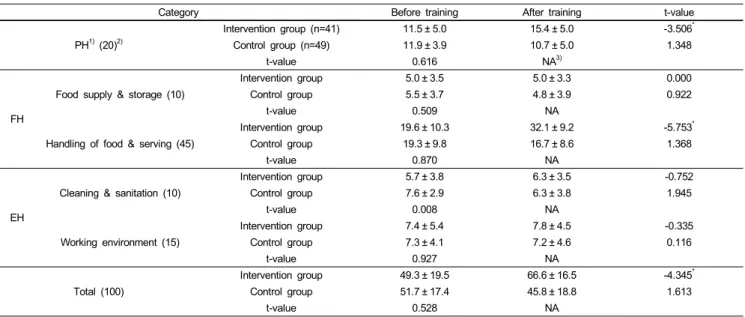
the training are presented at Table 3. On comparison of the
pre-test scores between the intervention and the control group,
the t-test analysis showed no significant difference in the level
of food safety knowledge between the two groups. Test scores
Table 4. Comparison of employees’ hygiene knowledge scores before and after food safety training
Category Total
Before After t-value
PH2)
Q1. Which of the following is needed for handwashing? 78.0 ± 42.93) 78.0 ± 41.9 0.0001)
Q2. Which of the following is the most outbreaks of food-borne illness? 12.2 ± 33.6 68.3 ± 47.1 -6.237*
Q3. Which of the following is not a proper activity of employee before work? 61.0 ± 48.5 63.4 ± 48.8 -0.225 Q4. What do you need to do when workers have a fever and cough severely? 78.0 ± 37.3 97.6 ± 15.6 -2.794*
Sub - total (20 points) 11.5 ± 5.03) 15.4 ± 5.0 -3.506*
FH FS
Q5. Which of the following is proper method for refrigerator? 56.1 ± 50.1 78.0 ± 41.9 -2.148*
Q6. Which of the following is the item needed for proper labeling? 43.9 ± 50.3 22.0 ± 41.9 2.148
Sub - total (10 points) 5.0 ± 3.5 5.0 ± 3.3 0.000
HS
Q7. Which of the following is necessarily needed for wearing disposable gloves? 26.8 ± 44..9 75.6 ± 43.5 -5.000*
Q8. Which of the following is the temperature affecting the most rapid growth of bacteria? 22.0 ± 42.9 78.0 ± 41.9 -6.061*
Q9. Which of the following is the proper internal temperature in cooking ? 46.3 ± 50.4 70.7 ± 46.1 -2.285*
Q10. Which of the following is the proper holding temperature of cooked foods? 58.5 ± 49.8 58.5 ± 49.9 0.000 Q11. Which of the following is the proper thawing method of frozen foods? 58.5 ± 48.5 75.6 ± 43.4 -1.652 Q12. Which of the following is not a potentially hazardous food? 68.3 ± 45.8 80.5 ± 40.1 -1.262 Q13. What is that germ is transmitted from uncooked food to cooked food by through employees’
hand or food contact surfaces? 26.8 ± 46.6 80.5 ± 40.1 -5.709*
Q14. Which of the following is a improper practices of employees in preparation process? 63.4 ± 48.5 73.2 ± 44.9 -0.943 Q15. Which of the following is a proper cleaning method of vegetables and fruits? 22.0 ± 42.9 48.8 ± 50.6 -2.615*
Sub - total (45 points) 19.6 ± 10.3 32.1 ± 9.2 -5.753*
EH CS
Q16. Which is not a proper practice in cleaning and sterilizing of equipments and utensils? 56.1 ± 49.0 56.1 ± 50.2 0.000 Q17. Which of the following is an improper in methods of sterilization? 58.5 ± 49.8 70.7 ± 46.1 -1.150
Sub - total (10 points) 5.7 ± 3.8 6.3 ± 3.5 -0.752
WE
Q18. Which of the following is the improper activity for controlling pests in restaurant? 61.0 ± 49.0 58.5 ± 49.9 0.222 Q19. Which of the following is not the proper method for equipment and facility management about
hygiene supervision of equipment/utensils?
39.0 ± 49.4 26.8 ± 44.9 1.170
Q20. Which statement below describes the improper method for equipment/facility management? 48.8 ± 50.3 70.7 ± 46.1 -2.054*
Sub - total (15 points) 7.4 ± 5.4 7.8 ± 4.5 -4.345*
Total (100 points) 49.3 ± 19.5 66.6 ± 16.5 -4.345*
*P< 0.05
1)T value was not computed because the standard error of the difference was zero.
2)PH: Personal Hygiene; FH: Food Hygiene; EH: Environmental Hygiene; PH: Personal Hygiene; FS: Food supply & Storage; HS: Handling of food & Serving; CS: Cleaning and Sanitation; WE: Working Environment
3)Question items: correction rate; Sub-total and total: scores (Mean ± SD)
Table 3. Effects of food safety training on food safety knowledge scores (Mean ± SD)
Category Before training After training t-value
PH1) (20)2)
Intervention group (n=41) 11.5 ± 5.0 15.4 ± 5.0 -3.506*
Control group (n=49) 11.9 ± 3.9 10.7 ± 5.0 1.348
t-value 0.616 NA3)
FH
Food supply & storage (10)
Intervention group 5.0 ± 3.5 5.0 ± 3.3 0.000
Control group 5.5 ± 3.7 4.8 ± 3.9 0.922
t-value 0.509 NA
Handling of food & serving (45)
Intervention group 19.6 ± 10.3 32.1 ± 9.2 -5.753*
Control group 19.3 ± 9.8 16.7 ± 8.6 1.368
t-value 0.870 NA
EH
Cleaning & sanitation (10)
Intervention group 5.7 ± 3.8 6.3 ± 3.5 -0.752
Control group 7.6 ± 2.9 6.3 ± 3.8 1.945
t-value 0.008 NA
Working environment (15)
Intervention group 7.4 ± 5.4 7.8 ± 4.5 -0.335
Control group 7.3 ± 4.1 7.2 ± 4.6 0.116
t-value 0.927 NA
Total (100)
Intervention group 49.3 ± 19.5 66.6 ± 16.5 -4.345*
Control group 51.7 ± 17.4 45.8 ± 18.8 1.613
t-value 0.528 NA
*P< 0.05
1)PH: Personal Hygiene; FH: Food Hygiene; EH: Environmental Hygiene
2)Possible score 3)NA : not applicable
Table 5. Effects of food safety training on food safety practices (Mean ± SD)
Category Food safety practice score
t value Before training After training
Personal hygiene (15)1)
Intervention group (n=41) 13.1 ± 2.3 13.1 ± 2.2 0.000
Control group2) (n=49) 13.2 ± 2.1 12.2 ± 2.6 2.064
t value 0.825 NA3)
Food hygiene (65)
Food supply & storage (30)
Intervention group 23.3 ± 4.6 22.4 ± 4.5 0.970
Control group 25.9 ± 13.6 27.9 ± 27.1 -0.447
t value 0.240 NA
Handling of food & serving (35)
Intervention group 29.8 ± 4.5 29.4 ± 4.3 0.327
Control group 29.3 ± 5.5 28.6 ± 6.2 0.552
t value 0.663 NA
Environmental hygiene (45)
Cleaning & sanitation (20)
Intervention group 16.9 ± 2.7 16.8 ± 3.3 0.182
Control group 17.8 ± 2.8 16.4 ± 3.7 2.135
t value 0.155 NA
Working environment (25)
Intervention group 20.0 ± 4.2 20.6 ± 3.8 -0.653
Control group 21.3 ± 3.8 20.3 ± 4.5 1.224
t value 0.137 NA
Total (125)
Intervention group 103.2 ± 14.7 102.4 ± 16.4 0.241
Control group 107.5 ± 20.4 105.4 ± 32.2 0.397
t value 0.252 NA
1)Possible score 2)No hygiene education 3)NA: Not applicable
between pre and post tests of the control group, in addition, showed no significant differences. These results gave support that this research was well-designed for finding the training effects of the intervention.
In the case of the intervention group, after training, sanitation knowledge of employees increased to a total score of 66.6 points at post-test; up from 49.3 points at pre-test. However, there was still room for improvement. Specifically, the section on personal hygiene, and handling of food and serving in food hygiene showed significant increases of knowledge (P < 0.05).
In the total score, the intervention group showed the greater increase with the score of 49 and 66 in the pre/post training respectively. As shown at Table 4, the total 8 items showed significant increases in score of “Q2: outbreaks of food-borne illness” and “Q4: a first action for sick workers” in the personal hygiene, food supply and storage area of “Q5: proper refrigera- tion method”, handling of food and serving area “Q7: proper use of disposable gloves”, “Q8: bacteria growth temperature”,
“Q9: cooking temperature”, “Q13: cross-contamination”, “Q15:
proper cleaning method for vegetables and fruits”, and working environment area “Q20: proper maintenance method for equipment/facility”. Based on this study, we accepted the hypothesis 1 that the trained group would have a more knowledge on food safety than no-trained group.
Food safety practices
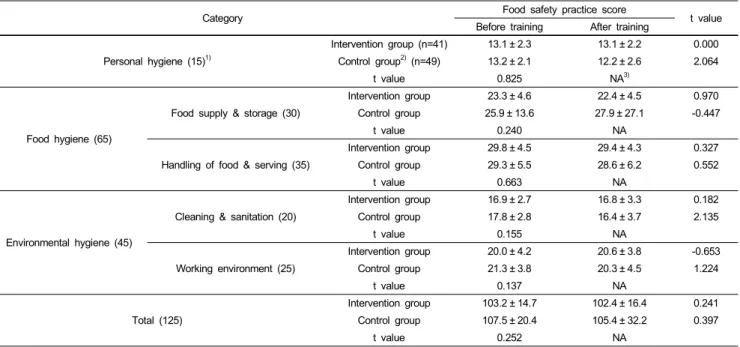
The scores of food handlers' food safety practice before and after treatment are presented at Table 5. In the case of the food safety practices evaluation, the first time showed similar levels
of practices on food safety between the intervention group and control group before the training. Food safety practices of the control group in the post-test did not improve, compared to that of the pre-test (P > 0.05).
Contrary to our expectations, the intervention group didn't show any significant changes in the practices after training.
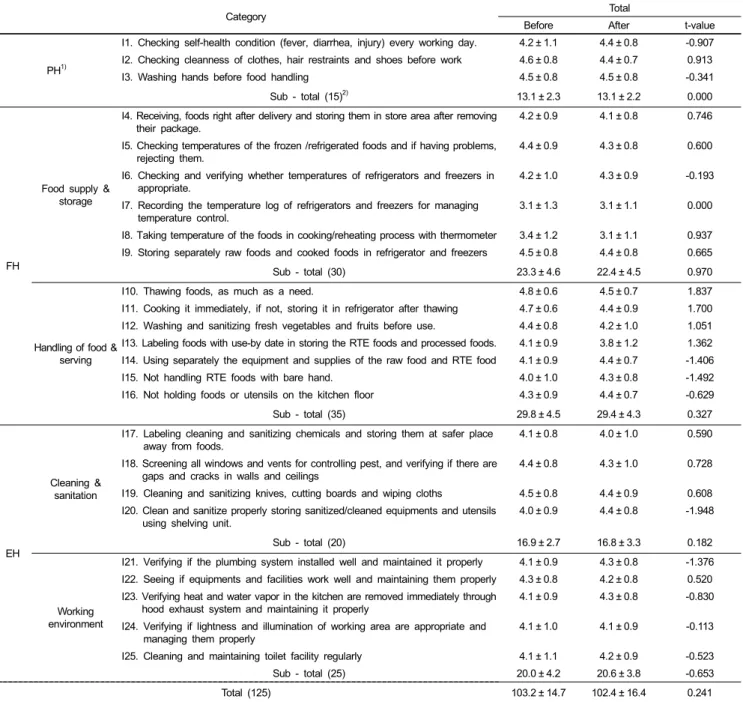
Safety practices showed minor positive changes, but non- significant: indicated as ‘health checking before work (4.4, t=0.907)’, ‘washing hands before work’(4.5, t=0.341), ‘separate handling of raw materials and cooked foods’(4.4, t=1.406),
‘handling methods of cooked foods (4.3 t=1.492)’, ‘proper storage of sanitizer and cleaner’ (4.3, t=1.376), ‘proper ventilation’
(4.3 t=0.830), and ‘cleaning and maintaining toilet facilities’ (4.2, t=0.523).
In the total score, it appeared that, there was not any significant increase in the intervention group, showing 103 points in the pre-test and 102 points in the post-test (Table 6). From this result, the hypothesis 2 that the food handlers' hygiene practices would be increased after training according to the increases of hygiene knowledge in the trained group was rejected.
Sanitation management performances rated by the on-site inspection
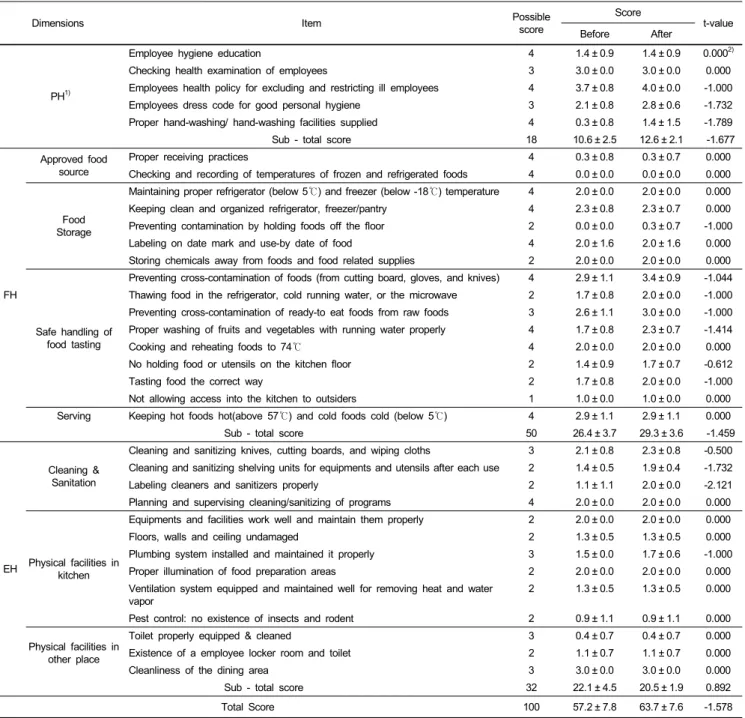
The result of observational inspection on sanitation management
is presented at Table 7. According to the result of the observa-
tional inspection by the trained evaluators, the score of the
sanitation performance of the intervention group before training
was a low 57.2 out of 100 points. The scores were, in particular,
low in the items of “employees food safety training (1.4)” and
Table 6. Comparison of employees’ hygiene practices score before and after food safety training (Mean ± SD)
Category Total
Before After t-value
PH1)
I1. Checking self-health condition (fever, diarrhea, injury) every working day. 4.2 ± 1.1 4.4 ± 0.8 -0.907 I2. Checking cleanness of clothes, hair restraints and shoes before work 4.6 ± 0.8 4.4 ± 0.7 0.913
I3. Washing hands before food handling 4.5 ± 0.8 4.5 ± 0.8 -0.341
Sub - total (15)2) 13.1 ± 2.3 13.1 ± 2.2 0.000
FH
Food supply &
storage
I4. Receiving, foods right after delivery and storing them in store area after removing their package.
4.2 ± 0.9 4.1 ± 0.8 0.746
I5. Checking temperatures of the frozen /refrigerated foods and if having problems,
rejecting them. 4.4 ± 0.9 4.3 ± 0.8 0.600
I6. Checking and verifying whether temperatures of refrigerators and freezers in
appropriate. 4.2 ± 1.0 4.3 ± 0.9 -0.193
I7. Recording the temperature log of refrigerators and freezers for managing
temperature control. 3.1 ± 1.3 3.1 ± 1.1 0.000
I8. Taking temperature of the foods in cooking/reheating process with thermometer 3.4 ± 1.2 3.1 ± 1.1 0.937 I9. Storing separately raw foods and cooked foods in refrigerator and freezers 4.5 ± 0.8 4.4 ± 0.8 0.665
Sub - total (30) 23.3 ± 4.6 22.4 ± 4.5 0.970
Handling of food &
serving
I10. Thawing foods, as much as a need. 4.8 ± 0.6 4.5 ± 0.7 1.837
I11. Cooking it immediately, if not, storing it in refrigerator after thawing 4.7 ± 0.6 4.4 ± 0.9 1.700 I12. Washing and sanitizing fresh vegetables and fruits before use. 4.4 ± 0.8 4.2 ± 1.0 1.051 I13. Labeling foods with use-by date in storing the RTE foods and processed foods. 4.1 ± 0.9 3.8 ± 1.2 1.362 I14. Using separately the equipment and supplies of the raw food and RTE food 4.1 ± 0.9 4.4 ± 0.7 -1.406
I15. Not handling RTE foods with bare hand. 4.0 ± 1.0 4.3 ± 0.8 -1.492
I16. Not holding foods or utensils on the kitchen floor 4.3 ± 0.9 4.4 ± 0.7 -0.629
Sub - total (35) 29.8 ± 4.5 29.4 ± 4.3 0.327
EH
Cleaning &
sanitation
I17. Labeling cleaning and sanitizing chemicals and storing them at safer place away from foods.
4.1 ± 0.8 4.0 ± 1.0 0.590
I18. Screening all windows and vents for controlling pest, and verifying if there are gaps and cracks in walls and ceilings
4.4 ± 0.8 4.3 ± 1.0 0.728
I19. Cleaning and sanitizing knives, cutting boards and wiping cloths 4.5 ± 0.8 4.4 ± 0.9 0.608 I20. Clean and sanitize properly storing sanitized/cleaned equipments and utensils
using shelving unit.
4.0 ± 0.9 4.4 ± 0.8 -1.948
Sub - total (20) 16.9 ± 2.7 16.8 ± 3.3 0.182
Working environment
I21. Verifying if the plumbing system installed well and maintained it properly 4.1 ± 0.9 4.3 ± 0.8 -1.376 I22. Seeing if equipments and facilities work well and maintaining them properly 4.3 ± 0.8 4.2 ± 0.8 0.520 I23. Verifying heat and water vapor in the kitchen are removed immediately through
hood exhaust system and maintaining it properly
4.1 ± 0.9 4.3 ± 0.8 -0.830
I24. Verifying if lightness and illumination of working area are appropriate and managing them properly
4.1 ± 1.0 4.1 ± 0.9 -0.113
I25. Cleaning and maintaining toilet facility regularly 4.1 ± 1.1 4.2 ± 0.9 -0.523
Sub - total (25) 20.0 ± 4.2 20.6 ± 3.8 -0.653
Total (125) 103.2 ± 14.7 102.4 ± 16.4 0.241
1)PH: Personal Hygiene; FH: Food Hygiene; EH: Environmental Hygiene
2)Possible score
“proper hand washing/hand washing facilities supplied (1.4)” in personal hygiene. In the dimension of food hygiene, “proper receiving practices (0.3)”, “checking and recording of temperatures of food (0.0)”, and “preventing contamination by holding foods off the floor (0.3)” were needed to improve the practices. Lastly, environmental hygiene: of most importance, the items “floors, walls and ceiling undamaged (1.3)”, “pest control: no existence of insects and rodent (0.9)”, and “toilet properly equipped and cleaned (0.4)” were urgently needed to improve.
As for the result from examining pre/post score change, after
training the score was increase as 63.7 points, but no significant difference indicated. Little improvement was indicated in the following 14 items, and there were not significant differences between two. Therefore the hypothesis 3 was rejected.
Correlations among knowledge, practices and performances on food safety
Correlations among hygiene knowledge, practice and the
inspection scores are presented at Table 8. According to the
Table 7. Effects of food safety training on sanitation management performance (Mean ± SD)
Dimensions Item Possible
score
Score
t-value
Before After
PH1)
Employee hygiene education 4 1.4 ± 0.9 1.4 ± 0.9 0.0002)
Checking health examination of employees 3 3.0 ± 0.0 3.0 ± 0.0 0.000
Employees health policy for excluding and restricting ill employees 4 3.7 ± 0.8 4.0 ± 0.0 -1.000
Employees dress code for good personal hygiene 3 2.1 ± 0.8 2.8 ± 0.6 -1.732
Proper hand-washing/ hand-washing facilities supplied 4 0.3 ± 0.8 1.4 ± 1.5 -1.789
Sub - total score 18 10.6 ± 2.5 12.6 ± 2.1 -1.677
FH
Approved food source
Proper receiving practices 4 0.3 ± 0.8 0.3 ± 0.7 0.000
Checking and recording of temperatures of frozen and refrigerated foods 4 0.0 ± 0.0 0.0 ± 0.0 0.000
Food Storage
Maintaining proper refrigerator (below 5℃) and freezer (below -18℃) temperature 4 2.0 ± 0.0 2.0 ± 0.0 0.000 Keeping clean and organized refrigerator, freezer/pantry 4 2.3 ± 0.8 2.3 ± 0.7 0.000 Preventing contamination by holding foods off the floor 2 0.0 ± 0.0 0.3 ± 0.7 -1.000
Labeling on date mark and use-by date of food 4 2.0 ± 1.6 2.0 ± 1.6 0.000
Storing chemicals away from foods and food related supplies 2 2.0 ± 0.0 2.0 ± 0.0 0.000
Safe handling of food tasting
Preventing cross-contamination of foods (from cutting board, gloves, and knives) 4 2.9 ± 1.1 3.4 ± 0.9 -1.044 Thawing food in the refrigerator, cold running water, or the microwave 2 1.7 ± 0.8 2.0 ± 0.0 -1.000 Preventing cross-contamination of ready-to eat foods from raw foods 3 2.6 ± 1.1 3.0 ± 0.0 -1.000 Proper washing of fruits and vegetables with running water properly 4 1.7 ± 0.8 2.3 ± 0.7 -1.414
Cooking and reheating foods to 74℃ 4 2.0 ± 0.0 2.0 ± 0.0 0.000
No holding food or utensils on the kitchen floor 2 1.4 ± 0.9 1.7 ± 0.7 -0.612
Tasting food the correct way 2 1.7 ± 0.8 2.0 ± 0.0 -1.000
Not allowing access into the kitchen to outsiders 1 1.0 ± 0.0 1.0 ± 0.0 0.000
Serving Keeping hot foods hot(above 57℃) and cold foods cold (below 5℃) 4 2.9 ± 1.1 2.9 ± 1.1 0.000
Sub - total score 50 26.4 ± 3.7 29.3 ± 3.6 -1.459
EH
Cleaning &
Sanitation
Cleaning and sanitizing knives, cutting boards, and wiping cloths 3 2.1 ± 0.8 2.3 ± 0.8 -0.500 Cleaning and sanitizing shelving units for equipments and utensils after each use 2 1.4 ± 0.5 1.9 ± 0.4 -1.732
Labeling cleaners and sanitizers properly 2 1.1 ± 1.1 2.0 ± 0.0 -2.121
Planning and supervising cleaning/sanitizing of programs 4 2.0 ± 0.0 2.0 ± 0.0 0.000
Physical facilities in kitchen
Equipments and facilities work well and maintain them properly 2 2.0 ± 0.0 2.0 ± 0.0 0.000
Floors, walls and ceiling undamaged 2 1.3 ± 0.5 1.3 ± 0.5 0.000
Plumbing system installed and maintained it properly 3 1.5 ± 0.0 1.7 ± 0.6 -1.000
Proper illumination of food preparation areas 2 2.0 ± 0.0 2.0 ± 0.0 0.000
Ventilation system equipped and maintained well for removing heat and water
vapor 2 1.3 ± 0.5 1.3 ± 0.5 0.000
Pest control: no existence of insects and rodent 2 0.9 ± 1.1 0.9 ± 1.1 0.000
Physical facilities in other place
Toilet properly equipped & cleaned 3 0.4 ± 0.7 0.4 ± 0.7 0.000
Existence of a employee locker room and toilet 2 1.1 ± 0.7 1.1 ± 0.7 0.000
Cleanliness of the dining area 3 3.0 ± 0.0 3.0 ± 0.0 0.000
Sub - total score 32 22.1 ± 4.5 20.5 ± 1.9 0.892
Total Score 100 57.2 ± 7.8 63.7 ± 7.6 -1.578
1)PH: Personal Hygiene; FH: Food Hygiene; EH: Environmental Hygiene
2)Value could not compute because the standard deviations of both groups were zero
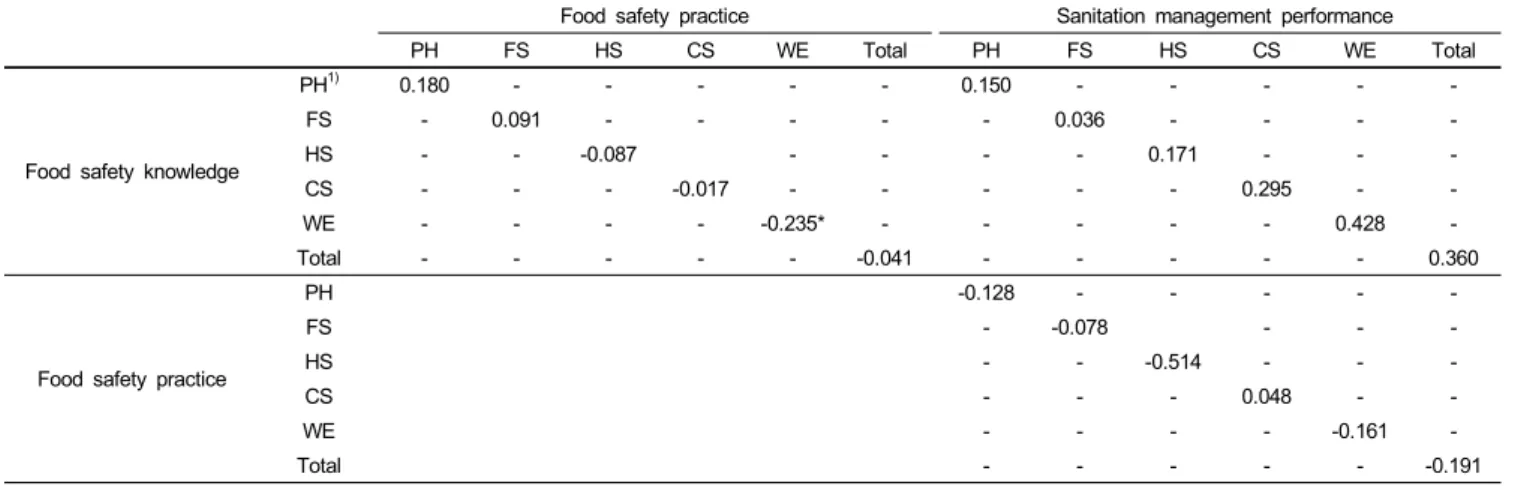
statistics, first, the correlation between the food safety knowledge score and food safety practices showed negative correlation in the working environment (r=-0.235, P < 0.05). This meant that employees tended to evaluate their food safety practices as high regardless of their sanitation knowledge. Second, the correlation between food safety knowledge and sanitation management performances did not show a significantly positive correlations (r=0.360, P > 0.05). Third, the correlation between food safety practice and observational food inspection proved to be negative,
but showed no significant differences (r=-0.191, P > 0.05). It is
presumably because the food safety professionals evaluated
personal hygiene, food hygiene during the production process,
and environmental hygiene of food facilities at a low level, while
food handlers themselves scored their food safety practices as
high. Therefore, hypothesis 4 was rejected.
Table 8. Correlation of employees' food safety knowledge, practices and on-visit inspection scores
Food safety practice Sanitation management performance
PH FS HS CS WE Total PH FS HS CS WE Total
Food safety knowledge
PH1) 0.180 - - - - - 0.150 - - - - -
FS - 0.091 - - - - - 0.036 - - - -
HS - - -0.087 - - - - 0.171 - - -
CS - - - -0.017 - - - - - 0.295 - -
WE - - - - -0.235* - - - - - 0.428 -
Total - - - - - -0.041 - - - - - 0.360
Food safety practice
PH -0.128 - - - - -
FS - -0.078 - - -
HS - - -0.514 - - -
CS - - - 0.048 - -
WE - - - - -0.161 -
Total - - - - - -0.191
*P< .05
1)PH: Personal Hygiene; FS: Food supply & Storage; HS: Handling of food & Serving; CS: Cleaning and Sanitation; WE: Working Environment
Discussion
With food safety knowledge after training, our results showed that the level of knowledge on food safety from the trained group improved more than that of the no-trained group. According to the precedent study [24-25], it was reported that after training, the considerable increase of knowledge from the intervention group showed. The study conducted at the day-care centers also reported that hygiene knowledge effects appeared only in the dimension of “kitchen equipment and suppliers”, but not in other dimensions of the hygiene training effect [26].
During the food safety practice evaluation, self-evaluation by food handlers was conducted. The scores for the sanitation practices rated highly at 102.4 out of 125 points, equivalent to 81.9 percent, and no significant difference between the pre and post training. Hence, this result supported the possibility that employees evaluated their food safety practices as higher than their actual practices deserved. The similar result reported that foodservice workers responded their practice toward food-borne disease prevention as always in terms of washing hands, use of gloves and use of protective clothing in work [13].
In the case of the intervention group, there was a significant increase in knowledge in the personal hygiene dimension, and handling methods on finished products and service in food hygiene dimension, while in the safety practices of the hygiene- related work, no improved behaviors were found in spite of the high scores in sanitation behavior. This pointed out that employees evaluated themselves as having high sanitation practices regardless of their level of sanitation knowledge.
In our study, even though no significant changes in the practices were detected, the potential effect of training was verified. If continuous and specific-goal oriented training is provided to employees, sanitation practices such as health checking, proper hand-washing, observation of uniform code, prevention of cross-contamination, or proper sanitation techniques could be easily improved.
In the evaluation of sanitation performance for the intervention group, performance scores increased from 57.2 to 63.7 after training, but did not show statistically significant differences between the two. Especially, “proper receiving practices (0.3)”,
“checking and recording of temperatures of food (0.0)”,
“preventing contamination by holding foods off the floor (0.3)”,
“pest control: no existence of insects and rodent (0.9)”, and “toilet properly equipped and cleaned (0.4)” urgently needed to improve.
The result from the FDA’s inspection reports [27] showed that the violation rate of “improper and insufficient hand washing”
was the highest at 31%, and Noh’s study [15] also pointed to low performances of hygiene management of "proper hand- washing and its facilities supplied". In our study, employees stated they do wash their hands properly, but the panels evaluated them as having a low score of 1.4 points. This means that for the formation of proper procedures for employees’ job performance, more concrete standards or guideline should be given.
In the evaluation of the correlation among sanitation knowledge, sanitation practice, and sanitation inspection results, sanitation practice and sanitation inspection results had the tendency negatively correlate to sanitation knowledge. In fact, only one dimension in the work environment between food safety practices and food safety knowledge showed significant negative correlation (r=-0.235, P < 0.05). However, this fact gave us a very important managerial implication. This pointed out the problem that employees had a misperception regarding their own sanitation practices. Employees felt their practices were sound, but in fact their knowledge was substantially lacking. To solve this problem, management activities and a hands-on training approach are needed for informing employees about sanitation knowledge and practices where there are gaps between them. One possible method for management is for sanitation practice outcomes such as the sanitation knowledge and on-site sanitation performance to be included in the employees’ performance appraisal system to positively promote advances in safety practices.
Even though no statistical significance was shown, the fact
that sanitation management performance had a positive correlation with sanitation knowledge of work employees, meant that the change of behavior came from acquiring knowledge. Considering that 100% of the subjects in the intervention group had received hygiene education and 48% of them received training once a month, it is concluded that the education implemented in the restaurants was no more than a knowledge-delivery; and therefore did not bringing about behavioral change. Similar results were found in two other studies. One was from the comparative study on the hygiene practice and hygiene knowledge of the food handlers from the non-commercial foodservices in Incheon [28], finding no significant correlations between them. The other is in the study evaluating an effect of the HACCP training; no significant changes in knowledge resulted after training [29]. In addition, the result from the study on the hygiene management practice and hygiene knowledge with the hospital food handlers showed that the effect of hygiene knowledge on food safety management practice was minor [11,30-31].
It is concluded from this study, that due to the limitation on the training time and frequency of training, an education effect could affect the improvement of hygiene knowledge, but the food safety practice and hygiene management performances were not improved. However, considering the fact that there were some significant increases in knowledge, it is concluded that practicing continual and repetitive hygiene education could be effective even in improving the sanitation management level as well as the hygiene knowledge and sanitation practices. To do this, the frequency of food safety training reinforced through specific goal setting, and more concrete training programs suitable for the employees’ educational background should be designed. In addition, designing the program to motivate employees to maintain and self-regulate proper practices should be required.
This study has two limitations. First, we designed this study as the nonequivalent pretest and posttest using the control and intervention group. The assumption was that the control group had the similiar characteristics as the intervention, but our study partially supported it. The two groups in this study showed different feature in terms of hygiene education experience and frequency due to the participation of subjects from diffident type and scale of restaurants. Another limitation was that t-test instead of paired t-test was employed for the testing of the training validity of knowledge between before and after training, because of the withdrawal of employee and, with the consequence of that, small sample size. Ideally future research need to build on the conclusion with the larger sample size and the analysis of paired t-test.
References
1. Korea Foodservice Information. Korea Foodservice Statistical Yearbook. Seoul: Korea Foodservice Information; 2006. p.525- 40.
2. Institute of Korea Rural Economics. Current Status and Improve- ment Plan of Statistics in Foodservice Industry. Seoul: Institute of Korea Rural Economics; 2005. p.91-97.
3. Korea Foodservice Information [Internet]. Seoul: Foodservice statistics and ways for its improvement; 2006 [cited 2009 November 25]. Available from: http://www.foodbank.co.kr/news/
print.php?seclnclex=1676.
4. Ko HS, Kim SK, Kim DK, Kim BJ. Importance perception on the sanitation and cleanliness of family restaurant employees.
Korean Journal of Society of Food and Cookery Science 2005;21:
155-62.
5. Yoon JY, Moon HK. Job satisfaction and business attitude of restaurant owners - focused mainly in the Gyeongnam area -.
Korean Journal of Community Nutrition 2003;8:610-20.
6. The Korea Food Drug and Administration. Strategic Plans for Preventing Foodborne Illness. Seoul: The Korea Food Drug and Administration; 2008. p.1-80
7. Bryan FL. Factors that contribute to outbreaks of foodborne disease. J Food Prot 1978;41:816-27.
8. Koopmans M, Duizer E. Foodborne viruses: an emerging problem. Int J Food Microbiol 2004;90:23-41.
9. Kim YH, Choi HJ. The effects of job training service recovery, job satisfaction and turnover intention among service industry employees in Daegu and Daejeon. Tourism Science Studies 2009;33:317-42.
10. Kim ST, Park JY, Kam S, Han CH. Knowledge and attitude toward restaurant-related sanitation of new restaurateurs. Journal of Korean Society for Health Education and promotion 1998;
15:79-95.
11. Chang HJ, Lee JS, Kwak TK. Effectiveness of HACCP-based training on the food safety knowledge and behavior of hospital foodservice employees. Nutritional Sci 2003;6:118-26.
12. Walker E, Pritchard C, Forsythe S. Food handlers’ hygiene knowledge in small food businesses. Food Control 2003;14:339-43.
13. Tokuc B, Ekuklu G, Berberoglu U, Bilge E, Dedeler H.
Knowledge, attitudes and self-reported practices of food service staff regarding food hygiene in Edirne, Turkey. Food Control 2009;20:565-8.
14. Howes M, McEwen S, Griffiths M, Harris L. Food handling certification by home study: Measuring changes in knowledge and behavior. Dairy, Food and Environment sanitation 1996;16:
737-44.
15. Noh JM. Field assessment of microbiological quality of restaurant operations and development of a sanitation training manual (master’s thesis). Seoul: Yonsei University; 2006.
16. Kim SJ. Assessment of sanitation management and development of self-managed sanitation module for Korean food restaurants (master’s thesis). Seoul: Yonsei University; 2005.
17. Choi, JH. An education and training cases study for the implementation of HACCP system for school foodservice operations (master’s thesis). Seoul: Yonsei University; 2000.
18. Ryu ES, Chang HJ. Food sanitary practices of the employees in university and industry foodservices. Journal of Korean Society Food Science. 1995;11:274-81.
19. Eo GH, Ryu K, Park SJ, Kwak TK. Need assessments of HACCP-based sanitation training program in elementary school foodservice operations based on sanitation knowledge test of Employees. Journal of the Korean Diet Association 2001;7:56-64.
20. Giampaoli J, Cluskeym M, Sneed J [Internet]. Seoul: Developing a practical audit tool for assessing employee food-handling
practices; 2002 [cited 2006 October 10]. Available from:
http://docs.schoolnutrition.org/newsroom/Jcnm/-02spring/giampao li2/.
21. The Korean Food and Drug Administration. The Korean Food Code: HACCP. Seoul: The Korean Food and Drug Administra- tion; 2005. p.1-50.
22. Kwak TK, Lee KM, Chang HJ, Kang YJ, Hong WS, Moon HK.
Analysis of critical control points through field assessment of sanitation management practices in foodservice establishments.
Korean Journal of food and cookery Science 2005;21:290-300.
23. Ministry of Education and Human Resources Development.
Guidelines of Sanitation Management for School Foodservice Operations. Seoul: Ministry of Education and Human Resources Development; 2004. p.1-90
24. Rivas KD, Canter DD. Effectiveness of talent for training school foodservice employee. School Foodservice Research Review 1982;6:113.
25. McCartan C, Perryman, S. Evaluation of a nutrition education and training (NET) workshop for school personnel. School Food Service Research Review 1982;6:109.
26. Kwak TK, Cho YS, Lee HY. Evaluation of the food sanitation training program in child-care centers. Journal of the Korean Society of Food Culture 1994;9:251-7.
27. Collins JE. Impact of changing consumer lifestyles on the emergence/
reemergence of foodborne pathogens. Emerg Infect Dis 1997;3:
1-13.
28. Lee YJ. A comparative study on sanitary practices and perception of employees in elementary school hospital and industry food service in the Inchon area. Journal of the Korean Diet Association 2003;9:22-31.
29. Ehiri JE, Morris GP. Evaluation of food hygiene training course in Scotland. Food Control 1997;8:137-47.
30. Angelillo IF, Viggiani NMA, Rizzo L, Bianco A. Food handlers and foodborne disease-knowledge, attitudes, and reported behavior in Italy. J Food Prot 2000;63:381-5.
31. Kim SJ, Yi NY, Chang HJ, Kwak TK. Current status of sanitation management performance in Korean-Food restaurants and development of the sanitary training posters based on their risk factors. Journal of the Korean Society of Food Culture 2008;23:582-94.