322 ORIGINAL ARTICLE
DOI 10.4070 / kcj.2009.39.8.322
Print ISSN 1738-5520 / On-line ISSN 1738-5555 Copyright ⓒ 2009 The Korean Society of Cardiology
Age is an Independent Risk Factor for the Early Morning Blood Pressure Surge in Patients Never-Treated for Hypertension
Dong-Hyeon Lee, MD, Sang-Hyun Ihm, MD, Ho-Joong Youn, MD, Yun-Seok Choi, MD, Chan-Seok Park, MD, Chul-Soo Park, MD, Jong-Min Lee, MD, Hee-Youl Kim, MD, Yong-Seog Oh, MD, Wook-Sung Chung, MD, Ki-Bae Seung, MD and Jae-Hyung Kim, MD
Division of Cardiology, Department of Internal Medicine, College of Medicine, The Catholic University of Korea, Seoul, Korea ABSTRACT
Background and Objectives:The early morning blood pressure surge (EMBPS) has been reported to be associated with cardiovascular events. The aim of this study was to investigate the relationship between 24-hour ambulatory BP monitoring (ABPM) parameters and conventional cardiovascular risk factors. Subjects and Methods: Patients (n=346) never-treated for essential hypertension with no other cardiovascular risk factors, such as diabetes, dysli- pidemia, and nephropathy were enrolled. The EMBPS was defined as the early morning systolic BP minus the lowest night systolic BP. We compared the 24-hour ABPM parameters in two groups divided by age (<60 and ≥60 years) and examined the association between the 24-hour ABPM parameters and cardiovascular risk factor. Results:
The EMBPS (18±14 vs. 24±14 mmHg, p=0.002), 24-hour mean blood pressure {MBP; 102±9 vs. 105±11 mmHg, p=0.044}, and 24-hour mean pulse pressure (PP; 52±10 vs. 58±11 mmHg, p<0.001) were significantly increased in the elderly subjects compared to the younger subjects. The degree of decrease was less in the elderly su- bjects (10±8 vs. 7±10%, p=0.002). Based on multivariate analysis, age was an independent risk factor for the highest quartile of EMBPS (>28 mmHg) after adjusting for gender differences, body mass index, and various 24- hour ABPM parameters (odds ratio, 1.051; 95% confidence interval, 1.028-1.075; p<0.001). Conclusion:Age is an independent risk factor for EMBPS in patients with never-treated hypertension. BP control in the early morning period is more important in elderly patients so as to prevent cardiovascular events. (Korean Circ J 2009;39:322-327) KEY WORDS: Age factors; Blood pressure monitoring, ambulatory; Hypertension.
Introduction
Twenty-four-hour ambulatory blood pressure moni- toring (24-hour ABPM) provides more accurate informa- tion on the diurnal variation of blood pressure (BP) than office- or home-monitored BP, and allows more accu- rate predictions of target organ damage (TOD) than BP measurements taken in an office. In cases in which the 24-hour mean systolic BP (SBP) is >135 mmHg, the risk of developing cardiovascular complications is 2 times higher than in other cases.1)2)
Generally, the mean BP at night is lower (by at least 10-20%) than during the day, and is referred to as “the
dipper.” It has been reported that in cases without noc- turnal BP reduction (non-dippers), the risk of cardiova- scular events is 3 times higher than in dippers. However, in cases with marked nocturnal BP reduction (≥20%;
extreme dippers), transient ischemic attacks (TIA) are more prevalent.1)2) In a study of hypertensive patients,3) it was demonstrated that BP is generally lowest at 3 a.m., begins to rise at 6 a.m., and exhibits the highest values at 10 a.m. In addition, in hypertensive patients, SBP rises by 3 mmHg per hour and diastolic BP (DBP) rises by 2 mmHg per hour in each of the 4-6 hours after awa- kening.3) Based on multivariate analysis, the waking mor- ning BP surge is significantly associated with cardiovas- cular risk, independent of age and 24-hour BP level.4)
There are 3 pathophysiologic mechanisms associated with the increased risk of cardiovascular events in the early morning period. The first is increased intra-arterial pressure and vasoconstriction of the coronary artery due to the activation of the sympathetic nerve system in the early morning. The second is the elevation of BP itself, which promotes an increase in cardiac stroke work, re-
Received: January 8, 2009 Revision Received: April 8, 2009 Accepted: April 10, 2009
Correspondence: Sang-Hyun Ihm, MD,Division of Cardiology, Department of Internal Medicine, College of Medicine, The Catholic University of Korea, 2 Sosa-dong, Wonmi-gu, Bucheon 420-717, Korea
Tel: 82-32-340-7027, Fax: 82-32-340-2669 E-mail: [email protected]
Dong-Hyeon Lee, et al.·323
sulting in increasing shear stress on blood vessels and an increased risk of plaque rupture. The third, hypercoagu- lability in the early morning, is induced by an increase in platelet aggregation and reduces the function of the fibrinolytic system. As a consequence of these 3 mecha- nisms, the threshold for myocardial infarction becomes low, promoting plaque rupture in the coronary arteries, and causing vessel occlusion and infarction.5)6)
With aging, not only the elevation of BP,7-9) but also excessive early morning BP surges (EMBPS), are associa- ted with cardiovascular events, such as myocardial infarc- tion, stroke, and sudden cardiac death; consequently, excessive EMBPS are considered to be an independent risk factor for various cardiovascular events.10-12) Additi- onally, beyond the approximate age of 60 years, SBP continues to increase, but DBP reaches a plateau or gra- dually falls, and this leads to an accelerated rise in pulse pressure (PP).9)
Thus, the aim of this study was to examine the age- related changes among the parameters determined by 24-hour ABPM, including EMBPS, and conventional cardiovascular risk factors, and examine the association between 24-hour ABPM parameters and cardiovascular risk factors.
Subjects and Methods
Participants
All subjects were older than 21 years of age who visited the Cardiology Outpatient Unit of the Catholic Univer- sity St. Mary’s Hospital or Holy Family Hospital for the first time between 1 January and 31 December 2005. The subjects were referred for evaluation and management of hypertension on the basis of a persistently elevated BP in the outpatient clinic of the Department of Inter- nal Medicine under suspicion of hypertension. We iden- tified all patients who had 1) essential hypertension, defined as an office SBP >140 mmHg and/or an office DBP >90 mmHg, according to the guidelines of the Joint National Committee VII,13) the British Hyperten- sion Society,14) and the European Society of Hyperten- sion,15)16) 2) a 24-hour mean SBP >125 mmHg or a 24- hour mean DBP >80 mmHg15)16) for the exclusion of white coat hypertension; and 3) never previously taken antihypertensive drugs. Patients with diabetes mellitus (DM), hyperlipidemia, and nephropathy (serum creati- nine of >1.3 mg/dL in women and >1.5 mg/dL in men) were excluded from the study, as were pregnant women.
All eligible patients underwent 24-hour ABPM. Even- tually, we studied 346 patients (mean age, 48±12 years;
M:F ratio, 175:171).
This study was approved by our Institutional Review Committee. Patients were informed of the investigative nature of the study and written informed consent was obtained before enrollment.
Measurement of office blood pressure and 24- hour ambulatory blood pressure monitoring
Office BP readings were taken twice in the morning (between 8 and 10 a.m.) by trained nurses using an app- ropriate sized arm cuff and a mercury sphygmomano- meter after a 10-minute rest in the sitting position. The office BP was the average of two consecutive readings.
Twenty-four-hour ABPM was measured using a Pre- ssurometer IV (model 1990A/1991; Del Mar Avionics, Irvine, CA, USA). A cuff for adults was applied to the patient’s non-dominant upper arm and the SBP, DBP, and heart rate (HR) were measured automatically every 30 minutes between 6 a.m. and 10 p.m. and every hour between 10 p.m. and 6 a.m. the next day. It was recom- mended that routine daily life be continued during the ABPM measurement period. All subjects underwent 24- hour ABPM in the morning (between 8 and 10 a.m.) within 3 days after office BP measurement.
Early morning SBP was defined as the mean SBP read- ing during the first 2 hours after awakening and the lowest night SBP was the mean SBP reading across 3 consecutive measurements, including the middle value as the lowest SBP reading recorded during the night, as described previously (Fig. 1).10) The morning BP surge was defined as the early morning SBP minus the lowest night SBP >28 mmHg (highest quartile of morning BP surge) in this study.
The subjects were divided into 2 groups based on age (<60 and ≥60 years), and traditional cardiovascular risk factors, such as age, gender, and body mass index {BMI=
weight (kg)/height2 (m2); a BMI >25 kg/m2 is considered overweight} were compared with the parameters from the 24-hour ABPM, such as EMBPS, 24-hour mean SBP, 24-hour mean DBP, 24-hour mean mean blood pres- sure (MBP), 24-hour mean PP, 24-hour mean HR, day- time mean SBP, day-time mean DBP, day-time MAP, day-time PP, day-time HR, night-time mean SBP, night-
Blood pressure (mm Hg)
180 160 140 120 100
80
6 p.m. 10 p.m. 2 a.m. 6 a.m. 10 a.m. 2 p.m. 6 p.m.
Time of day
Time of arising Sleep
Fig. 1. The early morning surge (EMBPS) is the early morning SBP minus the lowest night SBP. The early morning SBP is the mean SBP during the first 2 hours after awakening. The lowest night SBP is the mean SBP reading across three consecutive measurements, with the middle value the lowest SBP reading recorded during the night. EMBPS: early morning blood pressure surge, SBP: systolic blood pressure.
324·Age and Early Morning BP Surge
time mean DBP, night-time MBBP, night-time PP, and night-time HR. The degree of dipping {degree of no- cturnal BP dip (%)} was calculated as {(mean day-time MBP-mean night-time MBP)/mean daytime MBP}×
100.17)
Statistical analysis
All data are presented as the means and standard de- viations, and statistical analysis was performed using SPSS (version 13.0; SPSS Inc., Chicago, IL, USA). Stu- dent’s t-test was used for comparison of the measured values from the two groups divided according to age. For correlation of the variables from the 24-hour ABPM, linear and multivariate regression analyses were used. In order to compare the significance among the groups, a chi-square test was used. A p<0.05 was considered statis- tically significant.
Results
Baseline clinical characteristics
In the groups divided by age, there were 278 subjects
<60 years of age (mean, 44±10 years) and 68 subjects
≥60 years of age (mean, 65±4 years) (Table 1). There were no significant differences between the 2 groups in baseline clinical characteristics with respect to traditio- nal cardiovascular risk factors, such as gender, BMI (obe- sity), and smoking. There were no significant differences between the 2 groups in baseline clinical characteristics with respect to blood chemistry, except serum trigly- cerides (p<0.05). The younger subjects (<60 years of age) had higher serum triglyceride levels than the older subjects.
The results of 24-hour ambulatory blood pressure monitoring
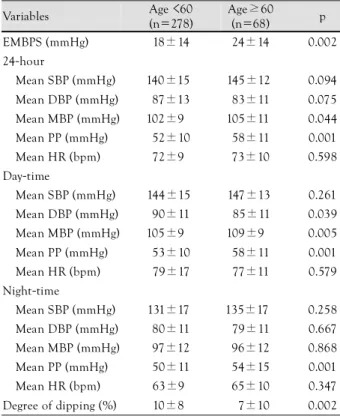
The significant differences in 24-hour ABPM para- meters for the <60 and ≥60 year-old subject groups were as follows: EMBPS, 18±14 and 24±14 mmHg (p=0.002); 24-hour mean MBP, 102±9 and 105±11
mmHg (p=0.044); 24-hour mean PP, 52±10 and 58
±11 mmHg (p<0.001); day-time mean DBP, 90±11 and 85±11 mmHg (p=0.039); day-time mean MBP, 105±9 and 109±11 mmHg (p=0.005); day-time mean PP, 53±10 and 58±11 mmHg (p<0.001); and night- time mean PP, 50±11 and 54±15 mmHg (p<0.001), respectively. These parameters were significantly increa- sed in the older group compared to the younger group.
However, the degree of dipping was significantly de- creased in the older group (10±8% vs. 7±10%, p=
0.002) (Table 2).
The relationship between early morning blood pre- ssure surge and conventional cardiovascular risk factors
The study subjects exhibited a circadian pattern of BP variation similar to that observed in other studies (Fig.
1).1)2) There was a positive correlation between EMBPS and age (r=0.213, p<0.001) (Fig. 2). However, there was no gender difference in EMBPS (p=0.325) (Fig. 3), and the correlation between EMBPS and BMI was weak and not statistically significant (r=-0.086, p=0.131).
After adjusting for gender, BMI, and the various 24- hour ABPM parameters, age was shown to be an inde- pendent risk factor for the highest quartile (>28 mmHg) of EMBPS values (odds ratio, 1.051; 95% confidence interval, 1.028-1.075; p<0.001) (Table 3).
Table 1. Baseline clinical characteristics
Variables Age <60
(n=278)
Age≥60 (n=68) p
Age (years) 44±10 65±4 0.001
Male gender (%) 136 (48.9) 39 (57.4) 0.325 BMI (kg/m2) 24.9±3.3 24.1±2.8 0.131 BMI >25 kg/m2 (%) 107 (38.5) 25 (36.8) 0.471 Smoker (%) 61 (21.9) 13 (21.7) 0.667 Fasting blood glucose (mg/dL) 97±18 94±9 0.420 Serum creatinine (mg/dL) 0.86±0.20 0.86±0.19 0.982 Total cholesterol (mg/dL) 201±86 199±39 0.881 Triglycerides (mg/dL) 138±74 106±42 0.008 High-density-cholesterol (mg/dL) 52±14 52±9 0.811 Low-density-cholesterol (mg/dL) 122±91 126±34 0.653 BMI: body mass index
Table 2. 24-hour ambulatory blood pressure monitoring parameters Variables Age <60
(n=278)
Age≥60
(n=68) p
EMBPS (mmHg) 18±14 24±14 0.002
24-hour Mean SBP (mmHg) 140±15 145±12 0.094 Mean DBP (mmHg) 87±13 83±11 0.075 Mean MBP (mmHg) 102±9 105±11 0.044 Mean PP (mmHg) 52±10 58±11 0.001
Mean HR (bpm) 72±9 73±10 0.598
Day-time
Mean SBP (mmHg) 144±15 147±13 0.261 Mean DBP (mmHg) 90±11 85±11 0.039 Mean MBP (mmHg) 105±9 109±9 0.005 Mean PP (mmHg) 53±10 58±11 0.001
Mean HR (bpm) 79±17 77±11 0.579
Night-time
Mean SBP (mmHg) 131±17 135±17 0.258 Mean DBP (mmHg) 80±11 79±11 0.667 Mean MBP (mmHg) 97±12 96±12 0.868 Mean PP (mmHg) 50±11 54±15 0.001
Mean HR (bpm) 63±9 65±10 0.347
Degree of dipping (%) 10±8 7±10 0.002 Degree of dipping (%): {(mean daytime MBP-mean night-time MBP) /mean daytime MBP}×100. EMBPS: early morning blood pressure surge, SBP: systolic blood pressure, DBP: diastolic blood pressure, MBP: mean blood pressure, PP: pulse pressure, HR: heart rate
Dong-Hyeon Lee, et al.·325
Discussion
This study is the first to demonstrate that age is cor- related with EMBPS (r=0.213, p<0.001) (Fig. 2) and is an independent predictor of EMBPS in patients never- treated for hypertension, after adjusting for gender dif- ferences, BMI, and various 24-hour ABPM parameters (odds ratio, 1.051; 95% confidence interval, 1.028-1.075;
p< 0.001) (Table 3).
24-hour ambulatory blood pressure monitoring cha- racteristics of elderly patients with hypertension
The vascular factors that contribute to an increase in cardiovascular events with increasing age, including ar- terial stiffness, BP, and baroreflex sensitivity, should also be considered from a physiologic perspective. Najjar et al.18) have reported that increasing arterial stiffness and impaired endothelial function are two factors that occur with vascular aging in humans.
Aging is strongly associated with the development of
isolated systolic hypertension (widened PP), and is also a stronger predictor of cardiovascular risk in older adu- lts than either DBP or MAP.19) In addition, Laurent et al.20)21) reported that pulse wave velocity, a marker re- flecting arterial stiffness that increases with age, is associ- ated with hypertension, and is a cardiovascular risk fac- tor. As SBP rises and DBP falls with stiffness, the increase in PP is an important factor reflecting arterial stiffness.
Many observational studies evaluating the changing pattern of BP with the aging process have shown a concomitant increase in SBP and PP until middle adult life.22) Khattar et al.22) reported that the relative prog- nostic significance of 24-hour ABPM parameters depends on age; DBP provided the best prognostic value in mi- ddle-aged subjects, whereas PP was the most predictive in the elderly (≥60 years of age).
Our data also revealed that PP in particular was sig- nificantly increased in the older group compared with the younger group (24-hour mean PP, p<0.001; day- time mean PP, p<0.001; and night-time mean PP, p<
0.001) (Table 2).
Clinical aspects of early morning blood pressure surge
The relationship between EMBPS and cardiovascular risk has recently become a subject of increasing interest.
Although differing in the types of patients assessed and the results obtained, several previous studies have also demonstrated an association between EMBPS and car- diovascular events.10-12)
EMBPS also appears to increase hypertensive heart disease.4) EMBPS was associated with cardiac hypertro- phy and common carotid artery intima-media thickenss independent of 24-hour ABPM parameters.23)24)
We investigated the association between 24-hour ABPM parameters, including EMBPS and conventional cardio- vascular risk factors. The results (Table 3) (Fig. 2) showed
Table 3. Multiple logistic regression analysis of an independent risk factor of 24-hour ambulatory blood pressure monitoring data for the highest quartile of the early morning blood pressure surge (EMBPS) values (>28 mmHg)
Variables Odds ratio
(95% confidence interval) p Age (years) 1.051 (1.028-1.075) <0.001 Male gender (%) 0.656 (0.362-1.190) <0.165 BMI (kg/m2) 0.931 (0.847-1.023) <0.135 24-hour mean MBP (mmHg) 0.942 (0.716-1.238) <0.666 24-hour mean PP (mmHg) 1.254 (0.980-1.603) <0.072 Day-time mean MBP (mmHg) 1.228 (0.941-1.603) <0.131 Day-time mean PP (mmHg) 0.921 (0.755-1.123) <0.416 Night-time mean MBP (mmHg) 0.855 (0.721-1.013) <0.071 Night-time mean PP (mmHg) 0.892 (0.777-1.024) <0.106 Degree of dipping 0.805 (0.640-1.012) <0.064 BMI: body mass index, MBP: mean blood pressure, PP: pulse pressure
EMBPS (mmHg)
80
60
40
20
0
-20
10 20 30 40 50 60 70 80 Age (year)
N=346 y=0.02×-0.46 r=.213 p<.001
Fig. 2. The relationship between early morning blood pressure surge (EMBPS) and age.
EMBPS (mmHg)
80
60
40
20
0
-20
F M Gender
p=.185 n=346
Fig. 3. The relationship between early morning blood pressure surge (EMBPS) and gender.
326·Age and Early Morning BP Surge
that only EMBPS was associated with age after adju- sting for other cardiovascular risk factors and other 24- hour ABPM parameters. Thus, we can exclude the effect of other BP parameters.
Strategy for early morning blood pressure surge An EMBPS is linked to increased target organ damage, as well as stroke and other cardiovascular complications, particularly in elderly patients with hypertension and impaired autoregulation of hypertensive target organ damage.25-28) Once-daily antihypertensive drugs are now widely used. However, even though the medicated hyper- tensive is well-controlled, it is difficult to know whether the morning hypertension is controlled in the current clinical practice for hypertension. Therefore, 24-hour ABPM or self-measured home BP monitoring targeting EMBPS will achieve more beneficial cardiovascular out- come in elderly patients with hypertension.25) In addition, controlling the EMBPS with antihypertensive drugs mi- ght prevent various cardiovascular complications and improve stroke prognosis.10) To reduce the magnitude of the EMBPS notably, it may be necessary for some per- sonalized therapeutic strategies, such as the use of long- acting drugs and the other medications that specially antagonize the morning surge (such as alpha-blockers or blockers of the rennin-angiotensin-aldosterone sys- tem).29)30)
Further experimental and clinical studies are necessary to control the EMBPS effectively in elderly patients with hypertension.
This study showed that age is the most important risk factor for EMBPS in 24-hour ABPM. Therefore, we suggest that 24-hour ABPM is needed in elderly pati- ents with hypertension and specific studies targeting EMBPS should be a particular focus for the future.
Acknowledgments
This study was supported by a grant of the Seoul R & BD Program, Republic of Korea (#10526).
REFERENCES
1) Verdecchia P, Clement D, Fagard R, Palatini P, Parati G. Blood Pressure Monitoring. Task Force III. Target organ damage, mor- bidity and mortality. Blood Press Monit 1999;4:303-17.
2) Mancia G, Zanchetti A, Agabiti-Rosei E, et al. Ambulatory blood pressure is superior to clinic blood pressure in predicting treat- ment-induced regression of left ventricular hypertrophy. Circula- tion 1997;95:1464-70.
3) Millar-Craig MW, Bishop CN, Raftery EB. Circadian variation of blood pressure. Lancet 1978;1:795-7.
4) Kario K. Caution for winter morning surge in blood pressure: a possible link with cardiovascular risk in the elderly. Hypertension 2006;47:139-40.
5) Tofler GH, Brezinski D, Schafer AI, et al. Concurrent morning increase in platelet aggregability and the risk of myocardial in- farction and sudden cardiac death. N Engl J Med 1987;316:
1514-8.
6) Anwar YA, White WB. Chronotherapeutics for cardiovascular disease. Drugs 1998;55:631-43.
7) Clement DL, De Buyzere ML, De Bacquer DA, et al. Prognostic value of ambulatory blood-pressure recordings in patients with treated hypertension. N Engl J Med 2003;348:2407-15.
8) Lewington S, Clarke R, Qizilbash N, Peto R, Collins R. Age- specific relevance of usual blood pressure to vascular mortality:
a meta-analysis of individual data for one million adults in 61 prospective studies. Lancet 2002;360:1903-13.
9) Franklin SS, Larson MG, Khan SA, et al. Does the relation of blood pressure to coronary heart disease risk change with ag- ing? Circulation 2001;103:1245-9.
10) Kario K, Pickering TG, Umeda Y, et al. Morning surge in blood pressure as a predictor of silent and clinical cerebrovascular disease in elderly hypertensives: a prospective study. Circulation 2003;107:1401-6.
11) Elliott WJ. Circadian variation in the timing of stroke onset: a meta-analysis. Stroke 1998;29:992-6.
12) Cohen MC, Rohtla KM, Lavery CE, Muller JE, Mittleman MA.
Meta-analysis of the morning excess of acute myocardial infarc- tion and sudden cardiac death. Am J Cardiol 1997;79:1512-6.
13) Chobanian AV, Bakris GL, Black HR, et al. Seventh report of the Joint National Committee on Prevention, Detection, Evaluation, and Treatment of High Blood Pressure. Hypertension 2003;42:
1206-52.
14) Williams B, Poulter NR, Brown MJ, et al. British Hypertension Society guidelines for hypertension management 2004 (BHS-IV): summary. BMJ 2004;328:634-40.
15) European Society of Hypertension-European Society of Cardio- logy Guidelines Committee. 2003 European Society of Hyperten- sion-European Society of Cardiology guidelines for the mana- gement of arterial hypertension. J Hypertens 2003;21:1011-53.
16) O’Brien E, Asmar R, Beilin L, et al. European Society of Hyper- tension recommendations for conventional, ambulatory and home blood pressure measurement. J Hypertens 2003;21:821-48.
17) O’Brien E, Scheridan J, O’Malley K. Dippers and non-dippers.
Lancet 1988;2:397.
18) Najjar SS, Scuteri A, Lakatta EG. Arterial aging: is it an immu- table cardiovascular risk factor? Hypertension 2005;46:454-62.
19) Franklin SS. Pulse pressure as a risk factor. Clin Exp Hypertens 2004;26:645-52.
20) Laurent S, Katsahian S, Fassot C, et al. Aortic stiffness is an in- dependent predictor of fatal stroke in essential hypertension. St- roke 2003;34:1203-6.
21) Laurent S, Boutouyrie P, Asmar R, et al. Aortic stiffness is an independent predictor of all-cause and cardiovascular mortality in hypertensive patients. Hypertension 2001;37:1236-41.
22) Khattar RS, Swales JD, Dore C, Senior R, Lahiri A. Effect of ag- ing on the prognostic significance of ambulatory systolic, diastolic, and pulse pressure in essential hypertension. Circulation 2001;
104:783-9.
23) Kaneda R, Kario K, Hoshide S, Umeda Y, Hoshide Y, Shimada K. Morning blood pressure hyper-reactivity is an independent predictor for hypertensive cardiac hypertrophy in a community- dwelling population. Am J Hypertens 2005;18:1528-33.
24) Zakopoulos NA, Tsivgoulis G, Barlas G, et al. Time rate of blood pressure variation is associated with increased common carotid artery intima-media thickness. Hypertension 2005;45:505-12.
25) Kario K. Time for focus on morning hypertension: pitfall of cur- rent antihypertensive medication. Am J Hypertens 2005;18:149- 51.
26) Kim CH. Ambulatory blood pressure monitoring. Korean Circ J 1997;27:1218-21.
27) Lee SM, Kang HS, Song JS, et al. Study of 24 hour ambulatory
Dong-Hyeon Lee, et al.·327
blood pressure monitoring in acute stroke patients. Korean Circ J 1999;29:1212-8.
28) Jeon HC, Kim YK, Kim KY, et al. Determinants of left ventricular mass in healthy adults: a study using echocardiography and 24 hour ambulatory blood pressure monitiring. Korean Circ J 1995;
25:811-9.
29) Head GA, Reid CM, Shiel LM, Jennings GL, Lukoshkova EV.
Rate of morning increase in blood pressure is elevated in hyper- tensives. Am J Hypertens 2006;19:1010-7.
30) Kario K. Morning surge and variability in blood pressure: a new therapeutic target? Hypertension 2005;45:485-6.