J. S. Im ( ) ・ K. S. Cho ・ J. H. Cho ・ Y. E. Park ・ C. G. Cheun H, J. Kim ・ H. M. Cho ・ J. N. Lee ・ Y. I. Jin
Highland Agriculture Research Center, NICS, RDA, Pyeongchang 232-955, Korea
e-mail: [email protected] M. O. Byun ・ D. Y. Kim
National Academy of Agricultural Science, RDA, Suwon 441-857, Korea
M. J. Kim
Pepper Institute of Imsilgun Agricultural Technology Center, Imsil Jeonbuk 566-822, Korea
Growth, quality, and yield characteristics of transgenic potato (Solanum tuberosum L.) overexpressing StMyb1R-1 under water deficit
Ju Sung Im ・ Kwang Soo Cho ・ Ji Hong Cho ・ Young Eun Park ・ Chung Gi Cheun ・ Hyun Jun Kim ・ Hyun Mook Cho ・ Jong Nam Lee ・ Yong Ik Jin ・ Myung Ok Byun ・ Dool Yi Kim ・ Myeong Jun Kim
Received: 22 June 2011 / Accepted: 20 July 2011
ⓒKorean Society for Plant Biotechnology
Abstract This study was conducted to evaluate agronomic characteristics such as growth, quality, and yields of StMyb1R-1 transgenic potato and also to obtain the basic data for establishing assessment guidelines of transgenic potato.
Three transgenic lines (Myb 1, Myb 2, and Myb 8) were cultivated under conventional irrigation, drought condition, and severe drought condition and were analyzed by com- paring with wild type, non-transgenic cv. Superior. Myb 2 showed a different flower color from wild type and Myb 1 had much bigger secondary leaflets than wild type. Myb 1 and Myb 2 showed higher P2O5 content in both top and root zone and longer shaped tubers than wild type. In yield factors, transgenic lines had more tubers than wild type, however their yield decreases were severe because of the poor enlargement of tuber under water deficit condition.
This tendency was noticeable in Myb 1 and Myb 2. In TR ratio, chlorophyll content, dry matter rate, and relative water content, there were no big differences between transgenic lines and wild type. Meanwhile, in phenotype, growth, quality, and yield factors, substantial equivalent was confirmed between Myb 8 and wild type. Then, Myb 8 showed the highest marketable tuber yield under conventional irrigation, while showed lower level than wild type under
water deficit. Judged by this result, the enhancing drought- tolerance by StMyb1R-1 gene might actually not mean the enhancement of photosynthesis or starch accumulation in tuber and, furthermore, not the yield improvement. More detailed research will be required to accurately understand the relationship between StMyb1R-1 and yield factors.
Keywords transgenic potato, Myb, relative water content, TR ratio
Introduction
Potato (Solamum tuberosum L.) is a tuberous crop belonging to the perennial Solanaceae family and originated from the Andes, South America (Cho et al. 2003; Hanneman 1989).
As the world’s fourth-largest food crop following maize, rice, and wheat (FAOSTAT 2012; Li 1985), potato is cultivated in over 120 countries in different climatic zones, including temperate, tropical and sub-tropical regions (Burton 1989; Otroshy 2006).
Because of the importance of potato as a main food all over the world, to enhance yield and quality despite adverse biotic or abiotic factors, numerous researches on potato variety improvement have been carried out using genetic transformation as well as conventional breeding. Especially, potato is well known that transformation is relatively easy, so, including insect-resistant transgenic potato (Douches et al. 2002; Grafius and Douches 2008), various transgenic potatoes with herbicide-resistance (Choi et al. 1996) or virus-resistance (Riechman et al. 1992; Smith et al. 1995) had been developed. In recent, in contrast to global warming and desertification as main factors threatening the stability of food production including potato (WBGU 2008), drought-tolerance transgenic potato was developed DOI:http://dx.doi.org/10.5010/JPB.2012.39.3.154
Research Article
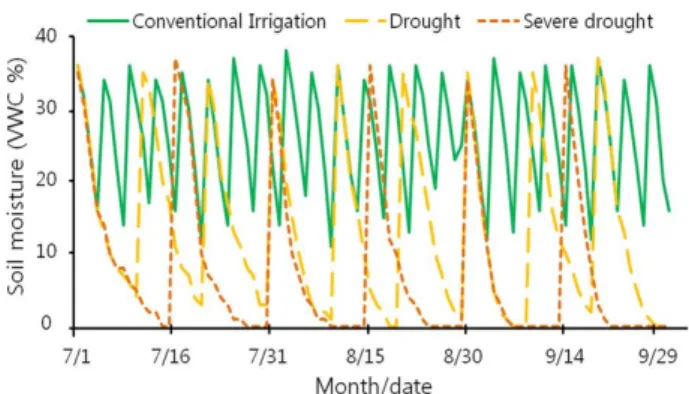
Fig. 1 Soil moisture condition according to the water-supply control in this study. Drip-irrigation was conducted every 4th day for conventional moisture condition, every 10th day for drought condition, and every 15th day for severe drought condition through the overexpression of Myb (StMyb1R-1) gene
(Shin et al. 2011). Among the Myb family, the R1R2R3, R2R3, and Myb related were known as the main stress-response gene (Fujii et al. 2009; Liao et al. 2008;
Villalobos et al. 2004). Myb genes were reported to play important roles in dehydration or osmotic stress condition (Denekamp and Smeekens 2003; Lippold et al. 2009) and to enhance the tolerance against abiotic stresses such as drought or salt by improving stomatal closure in an ABA signaling system (Ding et al. 2009; Jung et al. 2008). And also, Shin et al. (2011) reported that, in StMyb1R-1 transgenic potato, drought-tolerance was improved by reducing water loss rates and more rapid stomatal closing under drought stress. Then, in spite that many transgenic potatoes were developed, there were few practical cases. To produce transgenic crops practically and commercially, the assessments of biosafety and environmental risks have to be needed.
Especially, field trial of transgenic crop is absolutely necessary because of unpredicted and unintended effects under the outside environments that could result directly or indirectly from the inserted gene or adjacent native genes (Cellini et al. 2004; Craig 2008; Kim and Kim 2003). In the case of previously mentioned StMyb1R-1 potato (Shin et al. 2011), additional research is required to better understand the effect of drought-tolerance enhancement by overexpression of StMyb1R-1 on agriculturally important traits such as shape, quality, and yield. Therefore, this study was conducted to determine shape trait and growth response and yield characteristics of pBIN35S::StMyb1R-1 potato as compared with wild type under drought condition and also to obtain the basic data for establishing assessment guidelines of transgenic potato.
Materials and methods
Plant materials and cultivation
Micro tubers of three pBIN35S::StMyb1R-1 potato lines (Myb 1, Myb 2, and Myb 8) were provided by the National Academy of Agricultural Science of RDA (Suwon, Korea). These micro tubers were propagated at the Highland Agriculture Research Center (HARC) in 2009 and 2010. Tubers of transgenic potato (TP) lines which were harvested in 2010 were used for this examination.
Three transgenic lines and cv. Superior as wild type were grown in polyethylene tunnel house (600 × 2500 × 250 cm) in the GMO (genetically modified organism) field of HARC (Pyeongchang, 800 m above sea level). Tuber was sown on June 1, 2011 in a plastic pot (50 × 35 × 40 cm)
filled with 25 L of horticulture soil and 32 g of compound fertilizer for potato cultivation (N:P:K=10:10:11, Potato 1ho, Nam-hae Chem.).
Soil moisture treatment
Water was supplied conventionally until 30 days after sowing (DAS). Subsequently, water-supply by dripping- irrigation was conducted every fourth day for conventional irrigation (adequate soil moisture condition for potato) and every tenth day for drought condition and every fifteenth day for severe drought condition. Volumetric soil moisture content was measured at 15cm depth under the soil surface using data loggers (WatchDog-1000 series, Spectrum Technologies, Inc., USA). In this study, soil moisture conditions by water-supply control during the growth of potato were shown at Figure 1 and the average levels were 26.0% at conventional irrigation treatment, 13.5% at drought treatment, and 8.1% at severe drought treatment.
Sample preparation
Five plants in each plot were sampled at 40, 80, and 120 DAS to investigate growth, quality, and yield factors.
After sampling, the plants were separated into top part and root zone part. They were cut into small pieces and the pieces were frozen at -80℃ for 24 hours. And then, they were lyophilized at -70℃ using freeze dryer system (PVTFD 20R, Il Shin Co. Ltd., Korea). Dried samples were ground to fine powders and then stored at -20℃
until used for nutrients and starch analysis.
Growth, quality, and yield evaluation
Nutrients of top and root zone were analyzed following
Fig. 2 Phenotype and color in flowers and leaves of wild type (cv. Superior (A)) and transgenic potato lines (Myb 1 (B), Myb 2 (C), and Myb 8 (D)). Red arrows indicate secondary leaflets the method for chemical analysis of plant (RDA 1988)
after wet digestion by H2O2-H2SO4 method. Chlorophyll content was expressed as SPAD by measuring the middle leaf using Chlorophyll Meter (SPAD-502, Minolta, USA).
Specific gravity was determined by using the equation of [specific gravity = (a weight in air) / (a weight in air – a weight in water)] within one day of harvest (Kleinkopf et al. 1987). Dry matter rate (%) was calculated using the weight before drying minus the weight after drying. Starch content was determined by using the method of Miller (1959) with 3,5-dinitrosalicylic acid. At first, 1 g of potato powder was put into the flask (250 ml) and distilled water (60 ml) and 5 % (v/v) HCl (100 ml) were added into the flask. The flask was heated for two hours and the solution in the flask was neutralized by using 28 % (w/v) NaOH after cooling. The solution was diluted and reducing sugar was analyzed by using 3,5-dinitrosalicylic acid and then starch content was calculated. Tuber shape was measured by the ratio of ‘a length / a width’ of the tuber (van Eck et al. 1994). In this measurement, the length was the distance between the apex and the place of stolon attachment and the width was a length of the transversal axis perpendicular to the vertical axis. Relative water content (RWC) was analyzed by modified method of Stalham (2008) and Galmes et al. (2007). Fresh weight (FW), turgid weight (TW), and dry weight (DW) were used to calculate RWC by the following equation, RWC (%) = [(FW-DW) / (TW-DW)] × 100. Yield and other characteri- stics were investigated according to the analysis standard of agricultural test and research (RDA 2003) and healthy tubers over 50 g were measured for marketable tuber yield.
Data analysis
A randomized complete block design with 3 replications was used for this experiment.
Data were analyzed by analysis of variance (ANOVA) using SAS enterprise guide 4.3 (SAS Institute Inc., Cary, NC, USA) and mean separation was determined by Duncan’s multiple range test (DMRT) at 5% level.
Results and discussion
Phenotypic characteristics
In flower shape, there was no difference between wild type and three TP lines (Fig. 2). However, in flower color, Myb 2 had only white petals while wild type and other TP lines had two colors (white and pink) on a petal. Myb
1 also had much bigger secondary leaflets (as shown by the red arrows on Figure 2 (B)) than wild type and other TP lines. Kim et al. (2007) reported that Myb gene’s activities (AmMYBML2, PhMYB1 and AtMYB16) were shown at floral organs and at flower shape. And also, they suggested that the color in tobacco plants was modified by that the inner epidermal cells of petal grow to a greater length. In this study, it was assumed that insertion of StMyb1R-1, at the molecular level, might have affected to the formation process of petals or leaves. However, the activity of StMyb1R-1 in tissues or organs of potato has not been clearly identified, so more detailed study is needed to better understand these results.
Table 1 Nutrient contents in top part of wild type (cv. Superior) and transgenic potato lines (Myb 1, Myb 2, and Myb 8) grown under conventional irrigation, drought, and severe drought condition
Treatments Lines T-N P205 K Ca Mg Na
(%) Conventional
irrigation
Superior 2.688±0.079z 0.177±0.038 6.593±0.273 1.389±0.088 0.330±0.022 0.041±0.006 Myb 1 2.666±0.389 0.176±0.034 6.816±0.500 1.228±0.089 0.361±0.046 0.045±0.009 Myb 2 2.773±0.147 0.182±0.032 6.870±0.111 1.444±0.065 0.380±0.068 0.039±0.009 Myb 8 2.730±0.138 0.175±0.030 6.926±0.392 1.292±0.172 0.460±0.024 0.035±0.008 Drought Superior 1.696±0.131 0.181±0.009 7.198±1.164 1.901±0.274 0.476±0.148 0.063±0.012 Myb 1 1.692±0.130 0.346±0.022 8.217±1.798 1.872±0.227 0.427±0.189 0.078±0.008 Myb 2 1.841±0.086 0.475±0.156 7.026±1.907 1.878±0.241 0.405±0.120 0.063±0.011 Myb 8 1.662±0.309 0.208±0.047 8.796±0.954 1.812±0.385 0.412±0.194 0.072±0.022 Severe drought Superior 1.565±0.185 0.223±0.070 7.963±0.600 1.712±0.255 0.517±0.085 0.073±0.010 Myb 1 1.782±0.176 0.310±0.031 9.410±0.540 1.541±0.042 0.664±0.070 0.086±0.028 Myb 2 1.889±0.176 0.340±0.014 8.759±1.236 1.542±0.199 0.562±0.047 0.071±0.009 Myb 8 1.619±0.055 0.198±0.028 8.175±0.858 1.525±0.006 0.604±0.042 0.060±0.012 Treatments
Lines
Treatments x Lines
***
NS NS
***
***
**
**
NS NS
***
NS NS
***
NS NS
***
NS NS
zEach value represents the mean and standard deviation of three replicates.
NS,**,*** Non-significant or significant at P≤ 0.01, or 0.001, respectively.
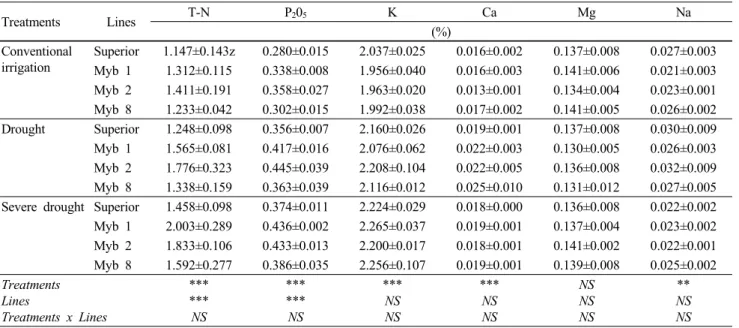
Table 2 Nutrient contents in root zone part of wild type (cv. Superior) and transgenic potato lines (Myb 1, Myb 2, and Myb 8) grown under conventional irrigation, drought, and severe drought condition
Treatments Lines T-N P205 K Ca Mg Na
(%) Conventional
irrigation
Superior 1.147±0.143z 0.280±0.015 2.037±0.025 0.016±0.002 0.137±0.008 0.027±0.003 Myb 1 1.312±0.115 0.338±0.008 1.956±0.040 0.016±0.003 0.141±0.006 0.021±0.003 Myb 2 1.411±0.191 0.358±0.027 1.963±0.020 0.013±0.001 0.134±0.004 0.023±0.001 Myb 8 1.233±0.042 0.302±0.015 1.992±0.038 0.017±0.002 0.141±0.005 0.026±0.002 Drought Superior 1.248±0.098 0.356±0.007 2.160±0.026 0.019±0.001 0.137±0.008 0.030±0.009 Myb 1 1.565±0.081 0.417±0.016 2.076±0.062 0.022±0.003 0.130±0.005 0.026±0.003 Myb 2 1.776±0.323 0.445±0.039 2.208±0.104 0.022±0.005 0.136±0.008 0.032±0.009 Myb 8 1.338±0.159 0.363±0.039 2.116±0.012 0.025±0.010 0.131±0.012 0.027±0.005 Severe drought Superior 1.458±0.098 0.374±0.011 2.224±0.029 0.018±0.000 0.136±0.008 0.022±0.002 Myb 1 2.003±0.289 0.436±0.002 2.265±0.037 0.019±0.001 0.137±0.004 0.023±0.002 Myb 2 1.833±0.106 0.433±0.013 2.200±0.017 0.018±0.001 0.141±0.002 0.022±0.001 Myb 8 1.592±0.277 0.386±0.035 2.256±0.107 0.019±0.001 0.139±0.008 0.025±0.002 Treatments
Lines
Treatments x Lines
***
***
NS
***
***
NS
***
NS NS
***
NS NS
NS NS NS
**
NS NS
zEach value represents the mean and standard deviation of three replicates.
NS,**,*** Non-significant or significant at P≤ 0.01, or 0.001, respectively.
Nutrient contents in top and root zone
Nutrient content of top part was shown at Table 1. Among nutrients, only P205 showed significant difference as affected by lines (P ≤ 0.001) and by treatments × lines interaction (P ≤ 0.01). P205 content was increased by water deficit treatments and the increase was much bigger in TP lines (Myb 1 and Myb 2) than in wild type.
Meanwhile, in root zone (Table 2), both total N (T-N) and P205 showed statistically significant differences by lines (P
≤ 0.001). All TP lines showed higher levels in T-N and P205 contents than wild type.
Myb gene’s role related to phosphorus was studied in Arabidopsis by Devaiah et al. (2009). They reported that Myb gene (Myb62) showed a specific response to phosphorus stress and the Myb gene’s overexpression resulted
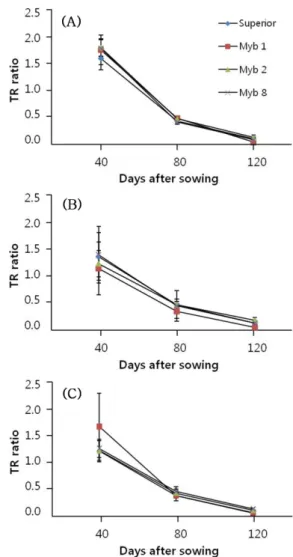
Fig. 4 Changes in TR ratios of wild type (cv. Superior) and transgenic potato lines (Myb 1, Myb 2, and Myb 8) grown under conventional irrigation (A), drought (B), and severe drought (C) conditions. Vertical bars indicate standard deviation of the means of three replicates
Fig. 3 Stem length (A), top weight (B), and root zone weight (C) of wild type (cv. Superior) and transgenic potato lines (Myb 1, Myb 2, and Myb 8) grown under conventional irrigation, drought, and severe drought condition. Vertical bars indicate standard deviation of the means of three replicates in improvement of phosphorous uptake in root. In potato, StMyb1R-1 also seemed to be involved in phosphate metabolism like in the case of Arabidopsis. On Myb gene’s role in terms of nutrition of potato, additional studies will be required.
Growth and quality characteristics
In stem length, although slight decrease was shown by drought or severe drought, there was no difference between wild type and TP lines (Fig. 3 (A)). In top weight, Myb 2 and Myb 8 showed similar patterns to wild type under conventional irrigation and drought condition.
However, by severe water deficit, wild type and Myb 2 showed abrupt decreases and, as the result, Myb 8 showed the heaviest top weight. In root zone’ weight, there was no difference under conventional irrigation or drought.
However, under severe drought, both Myb 1 and Myb 2
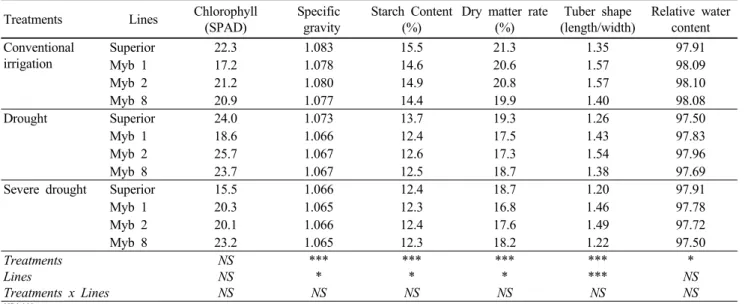
showed lighter weights than wild type or Myb 8. In TR ratio according to DAS (Fig. 4), under conventional irrigation, any difference was not shown between wild type and TP lines, but, under severe water deficit, Myb 1 showed more abrupt decrease than the others. In chlorophyll content (SPAD), although Myb 1 showed the lowest under conventional irrigation, there was no difference between wild type and TP lines by water deficit (Table 3). Similar result was reported by Qiang et al. (2009). That was, in Myb gene’s effect on chlorophyll content, Qiang et al.
(2009) said that there was no significant difference between wild type and mutant type (In Myb gene’s expression level, it had 7.1 fold higher than wild type.).
Starch content (SC) and dry matter rate (DMR) were generally known as important qualities of potato and specific gravity (SG) was closely related to SC and DMR
Table 3 Quality characteristic of wild type (cv. Superior) and transgenic potato lines (Myb 1, Myb 2, and Myb 8) grown under conventional irrigation, drought, and severe drought condition
Treatments Lines Chlorophyll (SPAD)
Specific gravity
Starch Content (%)
Dry matter rate (%)
Tuber shape (length/width)
Relative water content Conventional
irrigation
Superior 22.3 1.083 15.5 21.3 1.35 97.91
Myb 1 17.2 1.078 14.6 20.6 1.57 98.09
Myb 2 21.2 1.080 14.9 20.8 1.57 98.10
Myb 8 20.9 1.077 14.4 19.9 1.40 98.08
Drought Superior 24.0 1.073 13.7 19.3 1.26 97.50
Myb 1 18.6 1.066 12.4 17.5 1.43 97.83
Myb 2 25.7 1.067 12.6 17.3 1.54 97.96
Myb 8 23.7 1.067 12.5 18.7 1.38 97.69
Severe drought Superior 15.5 1.066 12.4 18.7 1.20 97.91
Myb 1 20.3 1.065 12.3 16.8 1.46 97.78
Myb 2 20.1 1.066 12.4 17.6 1.49 97.72
Myb 8 23.2 1.065 12.3 18.2 1.22 97.50
Treatments Lines
Treatments x Lines
NS NS NS
***
* NS
***
* NS
***
* NS
***
***
NS
* NS NS
NS,*,*** Non-significant or significant at P≤ 0.05, or 0.001, respectively.
Fig. 5 Changes in dry matter rate of wild type (cv. Superior) and transgenic potato lines (Myb 1, Myb 2, and Myb 8) grown under conventional irrigation (A), drought (B), and severe drought (C) conditions. Vertical bars indicate standard deviation of the means of three replicates
(Lisinska and Leszczynski 1989; Kolbe and Stefan-Beckmann 1997). Also, many previous studies reported on high positive correlations among SG, DMR, and SC (Ekin 2011; Ezekiel et al. 2003; van Es and Hartmans 1987;
Verma et al. 1971). In this study, SG, SC, and DMR generally showed similar patterns and were significantly influenced by treatments (P ≤ 0.001) as well as by lines (P ≤ 0.05). In SG and SC, under conventional irrigation, TP lines showed slightly lower level than wild type, but, under water deficit, any difference was not shown. In DMR, under water deficit, there was statistically significant difference between wild type and TP lines. Especially, considerable decrease of DMR was shown in Myb 1 and Myb 2 according to water deficit. According to DAS (Fig.
5), DMRs of TP lines showed similar patterns to wild type under conventional irrigation. However, under water deficit, DMR of wild type showed a dramatic increase after an abrupt decrease at 80 DAS, while DMRs of TP lines were steadily increased. By severe water deficit, big differences among DMRs of TP lines were shown at 80 DAS. Tuber shape (Table 3) was most significantly influenced by treatments as well as by lines. TP lines (especially, Myb 1 and Myb 2) showed longer shaped tubers than wild type among all treatments. In relative water content, there was no significant difference between wild type and TP lines.
Yield characteristics
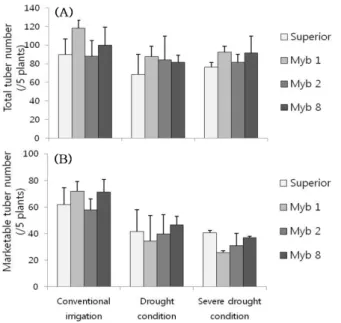
In total tuber number (Fig. 6 (A)), there was a tendency that TP lines had more tubers than wild type. In
Fig. 6 Total tuber number (A) and marketable tuber number (B) in wild type (cv. Superior) and transgenic potato lines (Myb 1, Myb 2, and Myb 8) grown under conventional irrigation, drought, and severe drought condition. Vertical bars indicate standard deviation of the means of three replicates
Fig. 7 Rate of tuber under 50 g (A) and marketable tuber rate (B) in wild type (cv. Superior) and transgenic potato lines (Myb 1, Myb 2, and Myb 8) grown under conventional irrigation, drought, and severe drought condition. Rate of tuber under 50 g was determined by using the equation of [rate of tuber under 50 g (%) = (number of tuber under 50 g / total tuber number)
× 100]. Marketable tuber rate (MTR) was determined by using the equation of [MTR (%) = (marketable tuber yield / total tuber yield) × 100]
Fig. 8 Marketable tuber yield in wild type (cv. Superior) and transgenic potato lines (Myb 1, Myb 2, and Myb 8) grown under conventional irrigation, drought, and severe drought condition. Vertical bars indicate standard deviation of the means of three replicates
marketable tuber number (MTN, Fig. 6 (B)), according to water deficit treatment, decrease of MTN was more severe in TP lines than in wild type. As that result, under severe water deficit, TP lines showed lower MTN than wild type.
Meanwhile, the rate of tuber under 50 g, by severe water deficit, became much higher in TP lines than in wild type (Fig. 7 (A)). This tendency was noticeable in Myb 1 which showed the most total tuber number. In marketable tuber rate (MTR), TP lines, according to water deficit, showed bigger decrease than wild type and, especially, the decrease in Myb 1 was the biggest. It was assumed that the severe decrease of MTN and MTR in TP lines according to water deficit treatment mainly resulted from the increase of number of tuber under 50 g. In marketable tuber yield (MTY, Fig. 8), under conventional irrigation, there was no significant difference between wild type and TP lines. However, by water deficit treatment, TP lines showed bigger reduction than wild type. As the result, under severe water deficit condition, MTYs of Myb 1 and Myb 2 were much lower than that of wild type. Myb 8 showed similar MTY to wild type. Struik et al. (1990) reported that yield of large potatoes was closely related to the total tuber yield. In this study, TP lines had more light tubers than wild type under water deficit condition and it gave rise to low MTY in TP lines. As the cause of many light tubers in TP lines, it could be assumed that, after forming many tubers, the enlargement of formed tubers was poorly conducted because water was deficit. And also,
the energy for tuber enlargement might be consumed by the expression of StMyb1R-1 gene.
In conclusion, two TP lines (Myb 1 and Myb 2) showed differences in phenotypes and also inferior yield level to wild type under water deficit condition as well as under adequate water condition by conventional irrigation. So, they were not substantially equivalent to wild type and were not appropriate for breeding or practical use. Then, Myb 8, as compared with wild type, showed not any
significant difference in phenotype, growth, qualities, or yield. Substantial equivalent was confirmed between Myb 8 and wild type. Meanwhile, the increasing of tuber number and poor enlargement of tuber in TP lines unfavorably affected marketable tuber yield. That was, the enhancing drought-tolerance by StMyb1R-1 gene might actually not mean the enhancement of photosynthesis or starch accumul- ation in tuber and, furthermore, not yield improvement. Of course, more detailed research will be required to accurately confirm the relationship between StMyb1R-1 and yield factors. The possibility estimation as a new cultivar of transgenic line is generally similar to the selection process of new cultivar in conventional breeding program.
Therefore, in order that the development of new transgenic cultivar should be effective, it is thought that cooperation of breeder has to be accompanied from the beginning of the study.
Acknowledgments
This study was supported from 2011 ‘Development of transformants to enhance abiotic stress tolerance in horti- cultural crops’ of biogreen 21 project, Rural Development Administration.
References
Burton WG (1989) The potato. Lontransgenican Scientific &
Technical Lontransgenican Group UK Limited England Third Edition pp 742
Cellini F, Chesson A, Colquhoun I, Constable A, Davies HV, Engel KH, Gatehouse AMR, Karenlampi S, Kok EJ, Leguay JJ, Lehesranta S, Noteborn HPJM, Pedersen J, Smith M (2004) Unintended effects and their detection in genetically modified crops. Food and Chemical Toxicology 42:1089-1125 Cho HH, Park YE, Cho JH, Kim SY (2003) Historical review of
land race potatoes in Korea. J Kor Soc Hort Sci 44:838-845 Choi KH, Jeon JH, Kim HS, Joung YH, Cho SJ, Lim YP, Joung H
(1996) Development of herbicide-resistant transgenic potato.
Korean J Plant Tissue culture 23:161-165
Craig H (2008) Unintended effects of genetic manipulation. The nature institute. http://natureinstitute.org/txt/ch/nontarget.php Denekamp M, Smeekens SC (2003) Integration of wounding and
osmotic stress signals determines the expression of the AtMYB102 transcription factor gene. Plant Physiology 132:
1415–1423
Devaiah BN, Madhuvantihi R, Karthikeyan AS, Raghothama KG (2009) Phosphate starvation responses and gibberellic acid biosynthesis are regulated by the MYB62 transcription factor in Arabidopsis. Mol Plant 2:43-58
Ding Z, Li S, An X, Liu X, Qin H, Wang D (2009) Transgenic expression of MYB15 confers enhanced sensitivity to abscisic acid and improved drought tolerance in Arabidopsis thaliana.
Journal of Genetics & Genomics 36:17-29
Douches DS, Li W, Zarka K, Coombs J, Pett W, Grafius E, El-Nasr T (2002) Development of Bt-cry5 insect-resistant potato lines
‘Spunta-G2’ and ‘Spunta-G3’. HortScience 37:1103-1107 Ekin Z (2011) Some analytical quality characteristics for
evaluating the utilization and consumption of potato (Solanum tuberosum L.) tubers. African J of Biotech 10:6001-6010 Ezekiel R, Singh B, Gopal J (2003) Relationship between under
water weight and specific gravity, dry matter and starch content of potatoes grown in India. Potato J 30:233-239 FAOSTAT (2012) http://faostat.fao.org/site/339/default.aspx Fujii H, Chinnusamy V, Rodrigues A, Rubio S, Antoni R, Park SY,
Cutler SR, Sheen J, Rodriguez PL, Zhu JK (2009) In vitro reconstitution of an abscisic acid signalling pathway. Nature 462:660-664
Galmes J, Flexas J, Save R, Medrano H (2007) Water relations and stomatal characteristics of Mediterranean plants with different growth forms and leaf habits: responses to water stress and recovery. Plant Soil 290:139-155
Grafius EJ, Douches DS (2008) The present and future role of insect-resistant genetically modified potato cultivars in IPM.
Integration of Insect-Resistant Genetically Modified Crops within IPM Programs Progress in Biological Control. Romeis J, Shelton AM, Kennedy GG, Eds. Springer Berlin Germany pp 195-221
Hanneman JrRE (1989) The potato germplasm resource. Amer Potato J 66:655-667
Jung C, Seo JS, Han SW, Koo YJ, Kim CH, Song SI, Nahm BH, Choi YD, Cheong JJ (2008) Overexpression of AtMYB44 enhances stomatal closure to confer abiotic stress tolerance in transgenic arabidopsis. Plant Physiology 146:623-635 Kim HC, Kim HM (2003) Risk assessment of genetically modified
organisms. J Toxicol Pub Health 19:1-12
Kim B, Maria PR, Desmond B, Julien V, Paul B, Hailing J, Ronald K, Keith R, Cathie M (2007) Wild-type of cell and petal morphogenesis by R2R3 MYB transcription factors. Development 134:1691-1701
Kleinkopf GE, Westermann DT, Wille MJ, Kleinshmidt GD (1987) Specific gravity of russet burbank potatoes. Amer Potato J 64:579-587
Kolbe H, Stefan-Beckmann S (1997) Development, growth and chemical composition of the potato crop (Solanum tuberosum L.). II. Tuber and whole plant. Potato Res 40:135-153 Li PH (1985) Potato physiology. Academic Press Inc London pp
586
Liao Y, Zou HF, Wang HW, Zhang WK, Ma B, Zhang JS, Chen SY (2008) Soybean transgenicMYB76, transgenicMYB92, and transgenicMYB177 genes confer stress tolerance in transgenic Arabidopsis plants. Cell Res 18:1047-1060
Lippold F, Sanchez DH, Musialak M, Schlereth A, Scheible WR, Hincha DK, Udvardi MK (2009) AtMyb41 regulates transcriptional and metabolic responses to osmotic stress in
arabidopsis. Plant Physiology 149:1761-1772
Lisinska G, Leszczynski W (1989) Potato science and technology.
Elsevier Applied Science London UK pp 16-43, 166-233 Miller GL (1959) Use of dinitrosalicylic acid reagent for
determination of reducing sugars. Analytical Chemistry 31:426-428
Otroshy M (2006) Utilization of tissue culture techniques in a seed potato tuber production scheme. PhD Thesis, Wageningen University pp 14
Qiang X, Keqin Y, Andan Z, Junli Y, Qing L, Jianchen Z, Xiuxin D (2009) Comparative transcripts profiling reveals new insight into molecular processes regulating lycopene accumulation in a sweet orange (Citrus sinensis) red-flesh mutant. BMC Genomics 10:540. doi:10.1186/1471-2164-10-540 Riechman JL, Lain S, Garcia JA (1992) Highlights and prospects
of potyvirus molecular biology. J Gen Virol 73:1-16 Rural Development Administration (RDA) (1988) Methods for
chemical analysis of soil and plant. Agricultural Research Institute
Rural Development Administration (RDA) (2003) A standard research and investigation analysis method of agricultural science technology
Shin DJ, Moon SJ, Han SY, Kim BG, Park SR, Lee SK, Yoon HJ, Lee HE, Kwon HB, Baek DW, Yi BY, Byun MO (2011) Expression of StMYB1R-1, a novel potato single MYB-Like domain transcription factor, increases drought tolerance.
Plant Physiology 155:421-432
Smith HA, Powers H, Swaney S, Brown C, Dougherty WG (1995) Transgenic potato virus Y resistance in potato: Evidence for an RNA-mediated cellular response. Phytopathology 85:864-870 Stalham MA (Agriculture & Horticulture Development Board)
(2008) Management of tuber water status to reduce bruising.
http://www.potato.org.uk/sites/default/files/%5Bcurrent-pag e%3Aarg%3A%3F%5D/20088%20Tuber%20water%20Bru ising%20Final%20Report%20R263.pdf
Struik PC, Haverkort AJ, Vreugdenhil D, Bus CB, Dankert R (1990) Manipulation of tuber-size distribution of a potato crop. Potato Res 33:417-432
van Eck HJ, Jeanne MEJ, Piet S, Jacqueline T, Willem JS, Jacobsen E (1994) Multiple alleles for tuber shape in diploid potato detected by qualitative and quantitative genetic analysis using RFLPs. Genetics Society of America 137:303-309
van Es A, Hartmans KJ (1987) Structure and chemical composition of the potato, in storage of potatoes (eds. A. Rastovski, A. Van Es et al.), Pudoc Wageningen pp 15-78
Verma SC, Malhotra VP, Joshi KC, Sharma TR (1971) Specific gravity and dry matter content of potato. Potato Res 14:94-95 Villalobos MA, Bartels D, Iturriaga G (2004) Stress tolerance and glucose insensitive phenotypes in Arabidopsis overexpressing the CpMYB10 transcription factor gene. Plant Physiol 135:309-324
WBGU (German Advisory Council on Global Change) (2008) Climate change as a security risk. Springer-Verlag Berlin Heidelberg New York pp 93-102