Tuberc Respir Dis 2012;72:30-36
CopyrightⒸ2012. The Korean Academy of Tuberculosis and Respiratory Diseases. All rights reserved.
인공호흡기연관 폐렴의 경험적 항생제 선택 시 이전 호흡기검체의 유용성
건양대학교 의과대학 내과학교실
김지혜, 윤성철, 이유미, 손지웅, 최유진, 나문준, 권선중
Role of Microbiologic Culture Results of Specimens Prior to Onset of Ventilator-Associated Pneumonia in the Patients Admitted to Intensive Care Unit
Ji Hye Kim, M.D., Sung-Chul Yoon, M.D., Yu-Mi Lee, M.D., Ji-Woong Son, M.D., Ph.D., Eu-Gene Choi, M.D., Ph.D., Moon-Jun Na, M.D., Ph.D., Sun-Jung Kwon, M.D.
Department of Internal Medicine, Konyang University College of Medicine, Daejon, Korea
Background: Patients with ventilator-associated pneumonia (VAP) in intensive care unit (ICU) have a high mortality rate. The routine surveillance cultures obtained previously or an ATS guideline for hospital-acquired pneumonia was used in selecting initial antimicrobials. The object of this study was to compare the respiratory samples before VAP and bronchoalveolar lavage (BAL) culture.
Methods: 54 patients underwent fiberoptic bronchoscopy to obtain BAL samples. We reviewed microbiologic specimen results of prior respiratory specimens (pre-VAP) and BAL.
Results: Among 51 patients with 54 VAP episodes, 52 microorganisms of pre-VAP and 56 BAL samples were isolated. Pre-VAP included 21.2% of MRSA, and 32.6% of multidrug resistant-Acinetobacter baumannii (MDR-AB).
BAL samples comprised 25.0% of MRSA, 26.7% of MDR-AB, 14.3% of Stenotrophomonas maltophilia and 3.6%
of Klebsiella pneumonia in order. In pre-VAP samples compared to BAL samples, only 35.2% were identical. In BAL samples compared to pre-VAP samples obtained in 5 days before the onset of VAP, only 43.6% were identical.
However, among BAL samples compared to pre-VAP samples obtained after more than 5 days, 13.3% were identical (p=0.037).
Conclusion: Based on these data, pre-VAP samples obtained prior to 5 day onset of VAP may help to predict the causative microorganisms and to select appropriate initial antimicrobials.
Key Words: Pneumonia, Ventilator-Associated; Bronchoalveolar Lavage; Anti-Bacterial Agents
Address for correspondence: Sun-Jung Kwon, M.D.
Department of Internal Medicine, Konyang University Hospital, 685, Gasuwon-dong, Seo-gu, Daejeon 302-718, Korea
Phone: 82-42-600-8820, Fax: 82-42-600-9090 E-mail: [email protected]
Received: Agu. 22, 2011 Revised: Oct. 31, 2011 Accepted: Nov. 18, 2011
서 론
인공호흡기연관 폐렴(ventilator-associated pneumo- nia, VAP)은 인공호흡기 사용 후 48시간 이후에 발생하는
폐렴으로 정의한다. VAP는 9∼27%의 환자에서 발생하며 원내 감염 중 두 번째로 흔하다1-3. VAP는 사망률이 높고 생존하더라도 인공호흡기 기간과 중환자실 재실기간을 증가시키는 요인이 되고 있는 바, 조기에 적절한 항생제 투여가 매우 중요하다3-5.
VAP에서 적절한 항생제의 투여가 지연된 경우와 사망 률의 증가는 매우 밀접한 관계가 있고 지연 시 사망률은 무려 69.7%로 증가한다6. 한편, 폐렴의 치료에 있어서 항 생제의 투여시기는 매우 중요하므로 하기도검체의 미생 물학적 검사결과가 보고될 때까지 광범위 항생제의 투여 는 불가피하다. 이러한 이유로 미국 흉부학회와 감염학회
에서는 경험적 치료를 조기에 시작하고 이후 침습적 혹은 비침습적 방법을 통한 하기도검체의 미생물학적 검사와 임상경과에 따라 항생제를 조정할 것을 권고하고 있다7.
VAP에 대한 항생제 선택을 용이하게 하기 위해 VAP 발생 전 시행된 기관 내 튜브흡인액의 미생물학적인 검사 (routine surveillance culture, 감시배양)가 도움이 되는지 에 대해서는 아직까지 논란이 있다8-11. 몇몇 보고들에 따 르면 1주에 2회 반복적으로 시행하는 감시배양으로 95%
의 VAP에서 적절한 항생제처방을 할 수 있었지만 이전 검체에서의 미생물학적 검사결과가 VAP발생시점과 시간 적 차이가 많이 날수록 유용성은 더욱 감소한다12-14. VAP 의 초기 항생제 선택을 위해 시행하는 감시배양의 단점은 단순집락화 되어 있는 균을 치료하기 위해 항생제의 남용 을 유발할 수 있고, 인공호흡기연관 폐렴이 발생했을 경우 이전 감시배양에서 동정되었던 미생물과 동일한 원인균 이라고 판단할 수 없다는 점이다.
본 연구는 1) VAP발생 시 bronchoalveolar lavage (BAL)과 VAP발생 전의 채취된 호흡기 검체들(Pre-VAP) 에서 동정된 균주들을 비교하였고, 2) VAP발생시점과 pre-VAP의 시간적 간격에 따라 미생물학적 검사결과의 일치율이 어떻게 다른지 검증하고자 하였다.
대상 및 방법
1. 환자군 선정
18세 이상의 성인으로 건양대학교병원의 중환자실에 입원하여 48시간 이상 인공호흡기치료를 받았던 환자 중 임상적으로 VAP가 의심되어 기관지내시경을 시행하였고 BAL에서 104 CFU/mL 이상 균이 동정된 환자였다. VAP의 진단기준은 48시간 이상 인공호흡기치료를 받고, 흉부 X- 선상 새로운 혹은 진행하는 폐침윤이 있으면서 감염을 시 사하는 상황으로 1) 38.0oC 이상의 발열, 2) 화농성객담, 3) 12,000 이상의 백혈구 증다증이나 4,000 미만의 백혈구 감소증 중 2가지 이상이 있을 때로 정의하였다7.
면역저하자에서 발생한 폐렴, 임산부, 흡입산소농도가 70% 이상으로 검사 시 저산소증 발생이 우려되는 경우, 혈역 학적 불안정, 조절되지 않는 부정맥, 국소마취제 과민반응 및 기관지내시경 검사 동의를 거부한 경우는 제외하였다.
2. 자료수집
본 연구는 후향적 의무기록의 분석 및 미생물학적 검사 결과를 분석하였고 환자의 일반적 특성, 인공호흡기치료
를 받는 원인, 항생제 사용의 유무 및 종류와 BAL 검사를 시행한 시기 및 시행 시 동맥혈산소분압/흡입산소농도 및 합병증 등을 조사하였다.
3. 검사 방법
1) 검체 수집: VAP발생 이전에 폐렴이 의심되거나 발열 등의 이유로 sputum group 4∼6의 객담, 기관 내 흡인 및 기관지세척액(Pre-VAP)을 채취하여 미생물학적 검사 및 약제감수성 검사를 시행하였다. VAP로 의심된 환자는 VAP 의심 후 24시간 이내에 기관지내시경을 통한 BAL을 시행하였다. 검체는 단순 흉부사진상 새로 생긴 병변이나 악화된 폐분절에 기관지내시경의 말단을 위치시키고 구 역 이하의 기관지에서 Meduri와 Chastre15의 BAL방법을 시행하였다.
2) 균 동정과 일치의 정의: 검체 채취 직후 4시간 이내에 검사실로 이송 후 검체 0.001 mL를 정량 백금이나 1μL pipett를 사용하여 blood agar, chocolate agar, MacConkey agar에 접종 후 35oC 5% CO2에서 24시간 동안 배양 후 균 증식이 있으면 생화학적 검사와 MicroScan Walk Away 96 SI analyzer (Dade Behring, West Sacramento, CA, USA)로 균동정 및 항생제감수성 검사를 시행하였다.
객담 및 기관 내 흡인은 반정량 검사에서 some 이상 동정 된 균주만을 포함하였고 BAL은 정량적 배양 검사상 104 CFU/mL 이상 동정된 균주만을 분석하였다.
BAL과 이전 호흡기검체에서 동정된 균주간의 일치는 같은 속, 같은 종과 항생제감수성 결과가 같을 때 “일치 (identical)”로 정의하였다.
3) 검체간 동정된 균주의 비교: BAL과 Pre-VAP 일치의 차이는 Hayon 등의 연구에서 적용한 방법을 변형하여 4 가지 경우로 구분하였고 이는 1) 이전 검체에서는 무균상 태(Prior specimens sterile), 2) 이전 검체에서 동정된 균 주와 일치하는 균주가 없음(All isolated bacteria shown non-identical), 3) 모두는 아니지만 최소 한 가지 균주는 일치(At least one but not all isolated bacteria shown non-identical), 4) 모든 균주가 일치(All VAP-causative bacteria shown identical)하는 경우다13. 본 연구에서는 1), 2)의 경우를 불일치(non-identical), 3), 4)의 경우를 일 치로 분석하였다. Pre-VAP와 BAL과의 균주비교 시 BAL 시행 시점에서 가장 간격이 짧은 pre-VAP에서 동정된 균 주를 비교하였다.
VAP발생 시점과 pre-VAP시행 시점으로부터 VAP발생 까지 경과된 시간을 48시간 이내, 3∼5일, 6∼7일, 8일
Table 1. ICU admission characteristics of 51 patients with 54 VAP episodes retrospectively studied for comparing microorganisms
Characteristics Value
Age, yr* 61.0±17.3
Sex, male 40 (74)
Surgery 22 (40.7)
Medical conditions 32 (59.3)
Indication for mechanical ventilation
Pulmonary disease 31 (57.4)
Neurologic condition 5 (9.3)
Postoperative respiratory failure 1 (1.9)
Drug overdose 12 (22.2)
Miscellaneous 5 (9.3)
Antibiotics history
Patients received prior therapy 51/54 (94.4)
Prior therapy, n 148
Glycopepetide 30 (20.3)
Anti-pseudomonal penicillin/cephalosporin
†23 (15.5)
Imipenem/Meropenem 21 (14.2)
Second/Third-generation cephalosporin
‡15 (10.1)
Fluoroquinolone
§15 (10.1)
Metronidazole/Clindamycin 12 (8.1)
Aminoglycosides 8 (5.4)
Others
∥24 (16.2)
On the day of bronchoalveolar lavage*
Hospital days 19±32
Days of ICU stay 15±24
Days receiving artificial airway 15±31
FiO
20.54±0.17
PaO
2/FiO
2ratio, mm Hg 203.5±97.9 Data are presented as number (%) u n less otherwise in- dicated.
*Data are presented as mean±SD.
†Anti-pseudomonal pen- icillin/cephalosporin; Piperacillin/Tazobactam, Ceftazidime, Cefepime.
‡Second/Third-generation cephalosporin; Cefoxitin, Cefotetan, Ceftriaxone, Cefotaxime, Cefbuperazon.
§Fluor- oquinolone; Ciprofloxacn, Levofloxacin, Moxifloxacin.
∥Others;
Clarithromycin, Colistin, Trimethoprim/sulfamethoxazole, Am- photericin-B.
ICU: intensive care unit; VAP: ventilator-associated pneumonia;
SD: standard deviation.
Figure 1. Contribution of prior microbiologic respiratory specimensn to identification of causative microorganisms in VAP. Black bars correspond to 54 episodes for which prior respiratory specimen was obtained before VAP onset. VAP: ventilator-associated pneumonia.
이상으로 나누어 균 일치율의 차이가 있는지 분석하였다.
BAL과 Pre-VAP에서 동정된 균주의 비교 후 빈도가 높은 MRSA,
Acinetobacter baumanii
와 Colistin 이외의 대부분 의 항생제내성을 갖는 Multidrug resistant–Acinetobacter baumanii
(MDR-AB),Stenotrophomonas maltophilia
는 두 검체간 일치율을 비교하였다.4. 통계처리
측정값의 비교는 통계프로그램 SPSS version 18.0 (SPSS Inc., Chicago, IL, USA)을 이용하였으며, 검체 간의 일치율 비교 시 χ2검정으로 유의한 차이의 유무를 검증 하였다. p값이 0.05 미만인 경우 유의한 차이로 간주하였 다. VAP의 균주 중 빈도와 사망률이 높은 MRSA,
Acineto- bacter baumanii
는 McNemar test로 유의한 Kappa값을 구하였다.결 과
1. 환자들에 대한 일반적 정보
2009년 3월부터 2010년 3월까지 건양대학교병원 내과 계, 외과계, 신경계와 심혈관계 중환자실에서 VAP가 의심 되어 BAL을 시행한 환자는 총 51명으로 이 중 54건의 VAP를 분석하였고 3명은 2건의 VAP를 겪었다(Table 1).
내과적 질환으로 인공호흡기치료를 받은 환자는 59.3%였 고, 인공호흡기를 적용한 주요 원인으로는 폐렴과 같은 폐실질 질환, 농약음독과 같은 약물중독 및 신경학적 손상 이었으며 각각 57.4%, 22.2%, 9.3%였다. 94.4%에서 VAP 발생 15일 이내에 여러 계열의 항생제를 투여 받고 있었 는데 glycopeptide, anti-pseudomonal β-lactam/β- actamase inhibitor, anti-pseudomonal cephalospor- ones, carbapenem, fluoroquinolone 등이었으며 이들
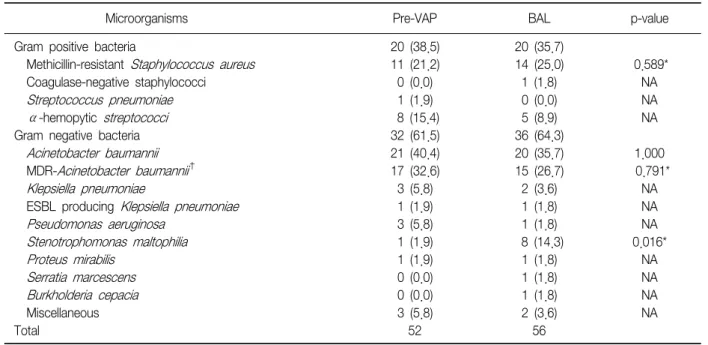
Table 2. Microbiologic results of BAL fluid and prior respiratory specimens
Microorganisms Pre-VAP BAL p-value
Gram positive bacteria 20 (38.5) 20 (35.7)
Methicillin-resistant Staphylococcus aureus 11 (21.2) 14 (25.0) 0.589*
Coagulase-negative staphylococci 0 (0.0) 1 (1.8) NA
Streptococcus pneumoniae 1 (1.9) 0 (0.0) NA
α-hemopytic streptococci 8 (15.4) 5 (8.9) NA
Gram negative bacteria 32 (61.5) 36 (64.3)
Acinetobacter baumannii 21 (40.4) 20 (35.7) 1.000
MDR- Acinetobacter baumannii
†17 (32.6) 15 (26.7) 0.791*
Klepsiella pneumoniae 3 (5.8) 2 (3.6) NA
ESBL producing Klepsiella pneumoniae 1 (1.9) 1 (1.8) NA
Pseudomonas aeruginosa 3 (5.8) 1 (1.8) NA
Stenotrophomonas maltophilia 1 (1.9) 8 (14.3) 0.016*
Proteus mirabilis 1 (1.9) 1 (1.8) NA
Serratia marcescens 0 (0.0) 1 (1.8) NA
Burkholderia cepacia 0 (0.0) 1 (1.8) NA
Miscellaneous 3 (5.8) 2 (3.6) NA
Total 52 56
Data are presented as number of isolated pathogen (%) unless otherwise indicated.
*p-value; calculated by McNemar test. Kappa index was statistically significant.
†MDR- Acinetobacter baumannii was defined as re- sistant to all antibiotic agents excluding polymyxin E (colistin).
VAP: ventilator-associated pneumonia; BAL: bronchoalveolar lavage; ESBL: extended-spectrum β-lactamase; MDR: multidrug resistant.
이 전체 항생제 사용의 60.1%를 차지하였다. BAL시행 시 중환자실 재원기간은 평균 15일이었고 인공호흡기치료를 시작한 후 평균 15일째에 검사를 시행하였다. BAL 검사 시행 시 흡입산소농도는 평균 54%, 동맥혈산소분압/흡입 산소농도는 평균 203.5 mm Hg였으며 BAL시행으로 인한 특이 합병증은 발생하지 않았다.
2. BAL과 Pre-VAP에서 동정된 균주의 비교
VAP발생 시점과 pre-VAP시행 시점으로부터 VAP발생 까지 경과된 시간은 평균 4.2일이었다. Pre-VAP의 검체 수는 객담, 기관지세척액 및 기관 내 흡인이 각각 8개, 4개, 42개였다. BAL과 pre-VAP와 일치를 보인 경우는 35.2%였고 이 중 완전한 일치를 보인 경우는 25.9%였다 (Figure 1).
VAP발생 시 BAL에서 동정된 병원체로
Acinetobacter baumanii
가 35.7%로 가장 많았고 MRSA가 25%였다.Pre-VAP에서 동정된 균주 중
Acinetobacter baumanii
가 40.4%, MRSA가 21.2%였다(Table 2).Pseudomonas spp.
와Klepsiella penumoniae
는 본원에서는 빈도가 낮았다. BAL에 서 높은 빈도를 보인 MRSA,Acinetobacter baumanii
,MDR-AB,
Stenotrophomonas maltophilia
등이 pre- VAP 와 일치하는지 분석하였는데 각각의 Kappa값이 0.43, 0.253, 0.379, 0.196이었다. 이외의 균주는 동정된 수가 작아 분석이 불가능하였다. MRSA가 병원체였던 14건의 VAP에 대한 분석 시 50% (7/14)에서 MRSA가 pre-VAP에 서 동정되었고, 7개의 pre-VAP와 BAL과의 검체채취 간격 은 2.7±2.5일이었다. 15건의 VAP는 MDR-AB가 병원체 였는데 pre-VAP의 60% (9/15)에서 MDR-AB가 동정되었 고, 9개의 pre-VAP와 BAL과의 검체채취 간격은 3.1±2.8 일이었다.Stenotrophomonas maltophilia
는 12.5% (1/8) 에서만 pre-VAP에서 동정되었다.3. VAP와 Pre-VAP 채취시기에 따른 일치의 차이
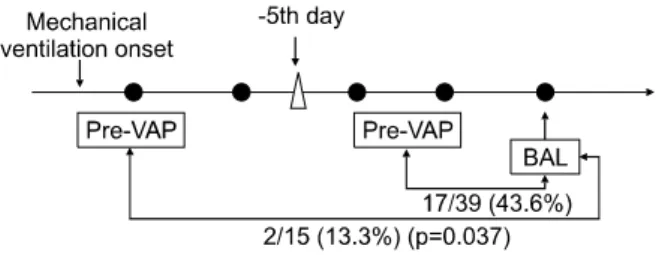
54건의 VAP에서 54개의 Pre-VAP에서 동정된 균주들을 VAP발생 시점에서 경과된 시간간격으로 나누어 분석했을 때 48시간 이내는 50.0% (11/22), 3일 이상에서 5일 이내 는 35.2% (6/17), 6일 이상 7일 이내는 0% (0/8), 8일 이상 은 28.6% (2/7)에서 BAL과 일치하였다. Pre-VAP를 VAP 발생 전 5일 이내와 5일 이상으로 나누어 분석했을 때 5일 이내에 시행된 검체에서 통계적으로 좀더 유의하게 일치Figure 2. Pre-VAP had been obtained within 5 d was the more identical than it had been obtained greater than 5 d (43.6% vs. 13.3%, p=0.037). VAP: ventilator-associated pneumonia; BAL: bronchoalveolar lavage.
하였다(43.6% vs. 13.3%, p=0.037) (Figure 2). VAP 발생 전 48시간 이내와 48시간 이전에 시행된 검체에서도 일치 율에 차이가 있는지 비교하였으나 통계적으로 유의하지 않았다(50% vs. 25%, p>0.05). 4)의 경우만 일치로 분석 하였을 경우 5일 이전에 시행된 검체가 5일 이상된 검체 보다 통계적으로 유의한 차이를 보였다(33.3% vs. 6.7%, p=0.042).
고 찰
VAP의 발생 시 조기에 적절한 항생제를 선택하기 위해 서 병원체를 미리 예측할 수 있는 방법은 없었으므로 발생 시기, 위험인자와 이전 항생제치료력 등을 고려하여 경험 적 항생제치료 후 배양 및 감수성 검사 결과에 따라 항생 제를 조정하였다7. 여러 연구에서 호흡기검체나 타 부위 에서 채취된 검체로 정기적 감시배양을 시행하여 VAP발 생 시 병원체를 미리 예측하고 항생제를 선택하는 방법이 기존의 지침에 따른 방법보다 좀 더 정확한지 증명하려 했으나 이의 유용성에 대해서는 논란의 여지가 있고 좀 더 많은 연구가 필요하다. 본 연구에서도 VAP시 BAL과 pre-VAP와 일치를 보이는 경우는 35.2%이었고 이 중 완 전한 일치를 보이는 경우는 25.9%로 낮았다13.
비록 pre-VAP가 일치율이 낮았지만 타 연구에서처럼 VAP가 발생한 시점과 가까운 검체를 BAL과 비교하면 일 치율을 높일 수 있다. 본 연구에서 Pre-VAP가 VAP발생 시점과 근접할수록 일치율은 상승하였고 BAL과 일치하는 pre-VAP의 85.2%는 5일 이내에 채취된 것이었다. Hayon 등13의 연구에서도 이전 검체의 35%에서 일치를 보였으나 72시간 이내에 시행된 검체와 비교 시 52%로 좀 더 높았 다. 본 연구에서도 5일 이내에 채취된 pre-VAP의 일치율 은 43.6%로 VAP발생 시점과의 시간 간격이 짧으면 일치
율을 높일 수 있었다. 본 연구에서는 VAP발생 시점에서 검체가 채취된 기간이 8일 이상은 28.6%, 3∼5일에 채취 된 pre-VAP는 35.2% 및 48시간 이내의 경우, pre-VAP는 50%에서 일치율을 보였는데 통계적으로 검증할 수는 없 었지만 VAP발생시점과 근접할수록 일치율은 증가하는 경 향을 보였다. 기관 및 상기도에 집락화된 균주의 흡인이 VAP발생에 주병인으로 알려져 있는데 VAP발생과 근접하 여 집락화된 균주는 VAP의 병원체가 될 수 있다7,13,16,17. 3∼5일의 기간은 배양 및 감수성 검사결과를 확인할 수 있는 시간으로 실제 치료에 있어 5일 이내 검체의 미생물 학적 검사결과를 항생제선택 시 참고하는 것은 가능할 수 있으며 내성 균주의 경우 더욱 유용할 수 있다18.
여러 연구 및 본 연구에서의 결과에서 보듯 검체의 채 취시기에 따른 일치율의 차이를 고려하면 1주에 1회 시행 하는 감시배양은 Hayon 등13의 연구에서처럼 이전 검체가 불일치할 확률이 높아 유용하지 않을 수 있으므로, Michel 등12의 연구에서처럼 1주 2회 시행하는 감시배양이 항생 제 선택에 유용할 것이다. Jung 등10의 연구에서는 1주 1 회의 기관흡인액의 감시배양이 항생제선택에 도움이 된 다고 하였으나 기관흡인액과 BAL시행의 간격이 평균 3일 이나 5일 이내였다.
중환자실에서 치료를 받는 환자에서 VAP의 사망률에 대한 기여위험도는 33∼50%로 균혈증이나
Pseudomo-
nas aeruginosa, Acinetobacter
종 등 내성 균주에 의한 폐 렴 시 사망률이 더욱 높다4,19. 단일기관에서의 분석으로 제 한점이 있지만 본 기관에서 분석한 미생물학적 검사결과 MRSA가 25%이고 MDR-AB는 26.7%로 가장 빈도가 높았 으며Pseudomonas aeruginosa
는 낮았다. pre-VAP와 BAL 모두에서 MDR-AB의 빈도가 높았는데 이는 본 기관 에서 carbapenem계, cefepime, piperacillin/tazobactam의 사용력이 37.3%로 비교적 높았기 때문으로 추측된다20. MDR-AB가 병원체였던 15건의 VAP에 대한 분석 시 pre-VAP의 60% (9/15)에서 MDR-AB가 이미 동정되었고 감수성이 있는Acinetobacter baumanii
는 단 한 건에 불 과하였다. MRSA의 경우 14건 중 7건(50%)에서 pre-VAP 에서 균이 이미 동정되었고, MDR-AB와 MRSA는 pre-VAP 와 BAL간에 동정된 경우 일치율이 통계적으로 유의하여 이들이 pre-VAP에서 의미 있게 동정되었다면 병원체의 가능성이 있으므로 항생제선택 시 고려해야 한다. 이전 연구에서 한 가지 항생제의 제한은 이에 대한 내성을 감소 시킬 수는 있지만 다른 내성 균주의 증가를 초래하였다21. 아직 MDR-AB에 대한 치료율이 높지 않고 carbapenem내성 시 사용할 수 있는 colistin의 무분별한 사용은 colistin 내성 균주의 출현이나
E.coli, Klepsiella, Stenotropho- monas
등 다른 내성 균주의 증가를 야기할 수 있다. 적절 한 항생제의 선택은 잘못된 항생제선택으로 인한 사망이 나 과잉치료로 인한 내성 균의 출현 및 부작용을 감소시킬 수 있다22,23.본 연구에서 MDR-AB가 원인균주였던 15건 중 pre-VAP 에서 이미 동정된 9건에서 7건은 5일 이내였고 검체채취 간격은 평균 3.1일이었다. 14건의 VAP의 병원체였던 MRSA가 원인균주였던 14건 중 pre-VAP에서 7건이 이미 동정되었고 이중 6건은 모두 5일 이내에 채취되었고 검체 채취간격은 평균 2.7일이었다. 본 연구결과에서 보듯 MRSA, MDR-AB와 같은 내성균주 시 pre-VAP에서 동정되 고 검체를 채취한 간격이 5일 이내라면 이들이 VAP의 병 원체일 수 있어 항생제선택 시 도움이 될 수 있다.
본 연구의 제한점은 첫째, pre-VAP의 결과에 따른 항생 제선택에 대한 전향적 연구는 아니었으므로 항생제선택 의 적절성을 논할 수는 없었다는 것이다. 미생물학적 검 사의 일치보다는 적절한 항생제선택이 VAP치료에 있어 더욱 중요하므로 Michel 등12의 연구에서처럼 이전 검체 의 결과에 따른 환자 개개인의 항생제 적절성 여부에 대한 분석이 요구된다. 둘째로, pre-VAP가 객담, 기관흡인액, 기관지세척액 등이 모두 포함되어 이들 검체의 균일한 정 량적 분석은 아니므로 BAL과의 일치율 비교가 부정확할 수 있었다는 점이다. 셋째로, 적은 수의 VAP건을 비교하 여 시간에 따른 일치율의 변화 등 통계적 의미를 갖지 못 한 분석이었다는 점이다. 넷째로 단일기관 연구로 병원체 가 기관이나 지역마다 차이가 있어 일반적으로 적용하기 는 어려워 다기관 전향적 연구로 증명이 되어야 한다는 점을 들 수 있다.
본 연구에서 이전 호흡기검체의 미생물학적 검사결과 가 낮은 일치율로 항생제선택에 도움을 줄 수는 없으나 VAP의 발생 시점과 검체를 채취한 시간 간격이 5일 이내 이고 MRSA나 MDR-AB가 미리 동정되었다면 이에 대한 경험적 항생제를 선택하는 것은 가능하리라 판단된다.
참 고 문 헌
1. National Nosocomial Infections Surveillance (NNIS) system report, data summary from January 1992-April 2000, issued June 2000. Am J Infect Control 2000;28:
429-48.
2. Richards MJ, Edwards JR, Culver DH, Gaynes RP.
Nosocomial infections in medical intensive care units in the United States. National Nosocomial Infections Surveillance System. Crit Care Med 1999;27:887-92.
3. Fagon JY, Chastre J, Vuagnat A, Trouillet JL, Novara A, Gibert C. Nosocomial pneumonia and mortality among patients in intensive care units. JAMA 1996;275:
866-9.
4. Papazian L, Bregeon F, Thirion X, Gregoire R, Saux P, Denis JP, et al. Effect of ventilator-associated pneumo- nia on mortality and morbidity. Am J Respir Crit Care Med 1996;154:91-7.
5. Rello J, Quintana E, Ausina V, Castella J, Luquin M, Net A, et al. Incidence, etiology, and outcome of noso- comial pneumonia in mechanically ventilated patients.
Chest 1991;100:439-44.
6. Iregui M, Ward S, Sherman G, Fraser VJ, Kollef MH.
Clinical importance of delays in the initiation of appro- priate antibiotic treatment for ventilator-associated pneumonia. Chest 2002;122:262-8.
7. American Thoracic Society; Infectious Diseases Society of America. Guidelines for the management of adults with hospital-acquired, ventilator-associated, and healthcare-associated pneumonia. Am J Respir Crit Care Med 2005;171:388-416.
8. Bouza E, Pérez A, Muñoz P, Jesús Pérez M, Rincón C, Sánchez C, et al. Ventilator-associated pneumonia after heart surgery: a prospective analysis and the value of surveillance. Crit Care Med 2003;31:1964-70.
9. Joseph NM, Sistla S, Dutta TK, Badhe AS, Parija SC.
Ventilator-associated pneumonia: role of colonizers and value of routine endotracheal aspirate cultures. Int J Infect Dis 2010;14:e723-9.
10. Jung B, Sebbane M, Chanques G, Courouble P, Verzilli D, Perrigault PF, et al. Previous endotracheal aspirate allows guiding the initial treatment of ventilator-asso- ciated pneumonia. Intensive Care Med 2009;35:101-7.
11. Sanders KM, Adhikari NK, Friedrich JO, Day A, Jiang X, Heyland D, et al. Previous cultures are not clinically useful for guiding empiric antibiotics in suspected ven- tilator-associated pneumonia: secondary analysis from a randomized trial. J Crit Care 2008;23:58-63.
12. Michel F, Franceschini B, Berger P, Arnal JM, Gainnier M, SaintyJM, et al. Early antibiotic treatment for BAL- con- firmed ventilator-associated pneumonia: a role for routine endotracheal aspirate cultures. Chest 2005;127:589-97.
13. Hayon J, Figliolini C, Combes A, Trouillet JL, Kassis N, Dombret MC, et al. Role of serial routine microbiologic culture results in the initial management of venti-
lator-associated pneumonia. Am J Respir Crit Care Med 2002;165:41-6.
14. Lucet JC, Decré D, Fichelle A, Joly-Guillou ML, Pernet M, Deblangy C, et al. Control of a prolonged outbreak of extended-spectrum beta-lactamase-producing enter- obacteriaceae in a university hospital. Clin Infect Dis 1999;29:1411-8.
15. Meduri GU, Chastre J. The standardization of broncho- scopic techniques for ventilator-associated pneumonia.
Chest 1992;102(5 Suppl 1):557S-564S.
16. Delclaux C, Roupie E, Blot F, Brochard L, Lemaire F, Brun-Buisson C. Lower respiratory tract colonization and infection during severe acute respiratory distress syndrome: incidence and diagnosis. Am J Respir Crit Care Med 1997;156:1092-8.
17. Sirvent JM, Torres A, Vidaur L, Armengol J, de Batlle J, Bonet A. Tracheal colonisation within 24 h of in- tubation in patients with head trauma: risk factor for developing early-onset ventilator-associated pneu- monia. Intensive Care Med 2000;26:1369-72.
18. Hospital-acquired pneumonia in adults: diagnosis, as- sessment of severity, initial antimicrobial therapy, and preventive strategies. A consensus statement, American
Thoracic Society, November 1995. Am J Respir Crit Care Med 1996;153:1711-25.
19. Heyland DK, Cook DJ, Griffith L, Keenan SP, Brun-Buisson C. The attributable morbidity and mortal- ity of ventilator-associated pneumonia in the critically ill patient. The Canadian Critical Trials Group. Am J Respir Crit Care Med 1999;159:1249-56.
20. Garnacho-Montero J, Ortiz-Leyba C, Fernández- Hino- josa E, Aldabó-Pallás T, Cayuela A, Marquez-Vácaro JA, et al. Acinetobacter baumannii ventilator-associated pneumonia: epidemiological and clinical findings. In- tensive Care Med 2005;31:649-55.
21. Rahal JJ, Urban C, Horn D, Freeman K, Segal-Maurer S, Maurer J, et al. Class restriction of cephalosporin use to control total cephalosporin resistance in nosocomial Klebsiella. JAMA 1998;280:1233-7.
22. rouillet JL, Chastre J, Vuagnat A, Joly-Guillou ML, Combaux D, Dombret MC, et al. Ventilator-associated pneumonia caused by potentially drug-resistant bacteria. Am J Respir Crit Care Med 1998;157:531-9.
23. Kollef MH, Fraser VJ. Antibiotic resistance in the in- tensive care unit. Ann Intern Med 2001;134:298-314.