Copyright © 2021 Korean Stroke Society
This is an Open Access article distributed under the terms of the Creative Commons Attribution Non-Commercial License (http://creativecommons.org/licenses/by-nc/4.0/) which permits unrestricted non-commercial use, distribution, and reproduction in any medium, provided the original work is properly cited.
Original Article
Long-Term Changes in Post-Stroke Depression, Emotional Incontinence, and Anger
Boseong Kwon,
aEun-Jae Lee,
aSeongho Park,
bJi Sung Lee,
cMin Hwan Lee,
aDaeun Jeong,
dDongwhane Lee,
e,* Hyuk Sung Kwon,
fDae-Il Chang,
gJong-Ho Park,
hJae-Kwan Cha,
iJi Hoe Heo,
jSung-Il Sohn,
kDong-Eog Kim,
lSmi Choi-Kwon,
mJong S. Kim
aaDepartment of Neurology, Asan Medical Center, University of Ulsan College of Medicine, Seoul, Korea
bDepartment of Neurology, Inje University Haeundae Paik Hospital, Busan, Korea
cClinical Research Center, Asan Medical Center, Seoul, Korea
dDepartment of Neurology, Veterans Health Service Medical Center, Seoul, Korea
eDepartment of Neurology, Gachon University Gil Medical Center, Incheon, Korea
fDepartment of Neurology, Hanyang University Guri Hospital, Hanyang University College of Medicine, Guri, Korea
gDepartment of Neurology, Kyung Hee University Hospital, Seoul, Korea
hDepartment of Neurology, Myongji Hospital, Hanyang University College of Medicine, Goyang, Korea
iDepartment of Neurology, Dong-A University Hospital, Busan, Korea
jDepartment of Neurology, Severance Hospital, Yonsei University College of Medicine, Seoul, Korea
kDepartment of Neurology, Keimyung University Dongsan Medical Center, Daegu, Korea
lDepartment of Neurology, Dongguk University Ilsan Hospital, Goyang, Korea
mCollege of Nursing, Seoul National University, Seoul, Korea
Background and Purpose Long-term changes in post-stroke depression (PSD), post-stroke emo-
tional incontinence (PSEI), and post-stroke anger (PSA) have rarely been studied.
Methods This is a sub-study of EMOTION, a randomized, placebo-controlled trial, that examined
the efficacy of escitalopram on PSD, PSEI, and PSA in patients with stroke. We interviewed pa- tients at the long-term period (LTP) using predefined questionnaires: Montgomery-Åsberg depres- sion rating scale (MADRS) for PSD, modified Kim’s criteria for PSEI, and Spielberger trait anger scale for PSA. Additionally, the ENRICHD Social Support Instrument (ESSI) for the social support state and the modified Rankin Scale (mRS) were measured. We investigated the changes in and factors behind PSD, PSEI, and PSA at LTP.
Results A total of 222 patients were included, and the median follow-up duration was 59.5
months (interquartile range, 50 to 70). Compared to the data at 6 months post-stroke, the preva- lence of PSEI (11.7% at 6 months, 6.3% at LTP; P=0.05) and mean anger score (21.62, 16.24;
P<0.01) decreased, while the prevalence of PSD (35.6%, 44.6%; P=0.03) and mean MADRS (6.16,
8.67; P<0.01) increased at LTP. ESSI was associated with PSD and PSA, but not with PSEI. The ef- fect of the baseline National Institutes of Health Stroke Scale score on PSD decreased over time.
The effect of low social support on PSD was greater than that of mRS at LTP.
Conclusions The prevalence and degree of PSD significantly increased, while those of PSEI and PSA
decreased at LTP. PSD in this stage appeared to be more closely associated with a lack of social support than patients' physical disabilities.
Keywords Ischemic stroke; Depression; Emotions; Anger
Correspondence: Jong S. Kim Department of Neurology, Asan Medical Center, University of Ulsan College of Medicine, 88 Olympic-ro 43-gil, Songpa- gu, Seoul 05505, Korea
Tel: +82-2-3010-3440 Fax: +82-2-474-4691 E-mail: [email protected] https://orcid.org/0000-0002-3999-4992 Received: November 20, 2020 Revised: January 27, 2021 Accepted: February 22, 2021
*Current affiliation: Department of Neurology, Uijeongbu Eulji Medical Center, Eulji University School of Medicine, Uijeongbu, Korea
Introduction
Patients with stroke often develop mood and emotional distur- bances, including post-stroke depression (PSD), post-stroke emotional incontinence (PSEI), and post-stroke anger (PSA).
1-3A recent meta-analysis showed that about one-third of pa- tients have PSD at any time within 5 years after stroke.
4The prevalence of PSEI and PSA in the early phase has been report- ed to be 6% to 34% and 15% to 35%, respectively.
3The pathogenesis of these mood and emotional disturbances is similar, but not identical. For PSEI and PSA, serotonergic dys- function caused by stroke lesions appears to play an important role.
3Although this could also account for the development of PSD, the pathophysiology of PSD appears more complex be- cause of the strong involvement of familial/psychosocial fac- tors.
5Thus, the pathophysiology of PSD may differ according to the time point after the stroke.
5,6The prevalence of and associated factors for these distur- bances in the long-term period (LTP) have been rarely stud- ied.
3,4The aim of this study was to investigate the prevalence of and associated factors for PSD, PSEI, and PSA at LTP, using follow-up data from the Efficacy of Early Administration of Es- citalopram on Depressive and Emotional Symptoms and Neu- rologic Dysfunction After Stroke (EMOTION) trial, a dou- ble-blind, placebo-controlled, randomized study.
Methods
Study design and participants
This is a sub-study of the EMOTION trial (ClinicalTrials.gov NCT01278498) previously performed in 17 university hospitals in South Korea. Briefly, we enrolled patients who (1) were aged
≥20 years; (2) had an acute stroke within 21 days before ran- domization; and (3) had a modified Rankin Scale (mRS) score of ≥2 at the screening stage. We excluded patients who had (1) been diagnosed with psychiatric diseases before the index stroke; (2) severe dementia or aphasia; and (3) strong suicidal thoughts. Finally, 478 patients were enrolled and randomly ad- ministered either escitalopram (10 mg/day) or placebo for 3 months. The outcome variables were assessed at baseline, 3, and 6 months post-stroke.
7In this sub-study, we measured the long-term outcomes of PSD, PSEI, and PSA. EMOTION investigators were invited to join this sub-study. This study was approved by the Institutional Review Boards (IRBs) of the hospitals. Informed consent was obtained from all participants.
Assessments
Data obtained from EMOTION trial
Information on demographics, risk factors, and clinical and outcome variables was obtained from the EMOTION trial. De- pressive symptoms were measured using the Montgomery-Ås- berg depression rating scale (MADRS),
8,9and the presence of PSD was defined by MADRS ≥8.
10,11Emotional incontinence was assessed using modified Kim’s criteria
7and dichotomized as “present” or “not present.” Anger score was measured using the modified Spielberger trait anger-Kim’s scale
7(Supplemen- tary Table 1). The range of the anger score was 10 to 40 points (higher scores indicating more severe symptoms), and it was analyzed as a continuous variable in this study. We did not consider cut-off anger score for the definition of PSA. Stroke symptoms and functional deficits were evaluated using the National Institutes of Health Stroke Scale (NIHSS)
12and mRS,
13respectively.
We aimed to examine the natural course of PSD, PSEI, and PSA. As escitalopram was administered for 3 months in the EMOTION trial and the duration was considered sufficient to wash out the pharmacological effect,
14we used data at 6 months post-stroke in addition to the data obtained at LTP.
Long-term follow-up assessment
We investigated PSD, PSEI, PSA, and mRS at LTP. Additionally, social support was measured using the enhancing recovery in coronary heart disease (ENRICHD) Social Support Instrument (ESSI). This instrument measures structural, instrumental, and emotional support
15(higher scores indicating better social sup- port). We defined “low social support” as reported previously:
16a total score of five items (1, 2, 3, 5, and 6) in ESSI of <19, and a score of <3 on at least any two items. We also asked the pa- tients about the use of antidepressants and/or psychiatric clinic visits to manage their emotional problems.
Statistical analysis
Baseline variables are presented as number with percentage (%), mean±standard deviation, or median with interquartile range, as appropriate. For comparison of any two independent groups, we used chi-square test, Student’s t-test, or Mann-Whitney U test.
We conducted a simple regression test using baseline character-
istics as independent variables, and PSD, PSEI, and anger score at
6 months post-stroke and LTP as outcomes. We then performed
multiple logistic regression test adjusting for important factors
(P<0.1) from the result of the simple regression test. The correla-
tions between MADRS at LTP and ESSI and those between anger
score at LTP and ESSI were analyzed using Spearman’s rank cor-
relation coefficient. The effect of mRS and ESSI on PSD at LTP was also analyzed using an adjusted logistic regression test. All statistical calculations were performed using IBM SPSS Statistics for Windows version 24.0 (IBM Co., Armonk, NY, USA) or R ver- sion 3.6.0 (R Foundation for Statistical Computing, Vienna, Austria). Statistical significance was set at α=0.05.
Results
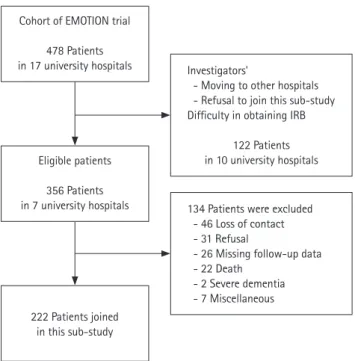
Seven of 17 hospitals that had previously participated in the EMOTION trial were included in this sub-study. The other cen- ters could not perform this study because of the investigators being transferred to other hospitals, loss of interest, or practi- cal difficulties in performing the study (e.g., IRBs allowing di- rect but not telephone interviews). The seven hospitals had previously enrolled 356 patients in the EMOTION trial, 222 of whom consented to participate. The major reasons for non-participation were the inability to establish contact (46 patients, 34.3%), patients’ reluctance to participate (31 pa- tients, 23.1%), missing data (26 patients, 19.4%), and patients
Table 1. Baseline characteristics and clinical variables of participants and non-participants
Characteristic Participants (n=222) Non-participants (n=134) P
Age (yr) 63.0 (53.0–70.0) 70.5 (60.0–76.0) <0.01
Female sex 86 (38.7) 53 (39.6) 0.97
Hypertension 167 (75.2) 108 (80.6) 0.30
Diabetes 93 (41.9) 54 (40.3) 0.85
Hyperlipidemia 112 (50.5) 80 (59.7) 0.11
Coronary artery disease 35 (15.8) 16 (11.9) 0.40
Smoking 116 (52.3) 69 (51.5) 0.98
Family history of stroke 58 (26.1) 35 (26.1) 1.00
Lesion location 0.14
Anterior circulation 139 (62.6) 83 (61.9)
Posterior circulation 77 (34.7) 51 (38.1)
Both 6 (2.7) 0 (0)
Lesion side 0.06
Right 99 (44.6) 72 (53.7)
Left 107 (48.2) 59 (44.0)
Both 16 (7.2) 3 (2.2)
MADRS 9.3±8.0 11.8±9.1 0.01
PSD 113 (50.9) 78 (58.2) 0.22
PSEI 19 (8.6) 6 (4.5) 0.21
Anger score 22.9±5.5 23.9±5.3 0.09
NIHSS 4.0 (3.0–7.0) 5.0 (3.0–7.0) 0.04
mRS 4.0 (3.0–5.0) 5.0 (4.0–5.0) 0.16
Non-use of escitalopram 110 (49.5) 68 (50.7) 0.91
Values are presented as median (interquartile range), number (%), or mean±standard deviation.
MADRS, Montgomery-Åsberg depression rating scale; PSD, post-stroke depression; PSEI, post-stroke emotional incontinence; NIHSS, National Institutes of Health Stroke Scale; mRS, modified Rankin Scale.
Cohort of EMOTION trial 478 Patients in 17 university hospitals
Eligible patients 356 Patients in 7 university hospitals
Investigators'
- Moving to other hospitals - Refusal to join this sub-study Difficulty in obtaining IRB
122 Patients in 10 university hospitals
134 Patients were excluded - 46 Loss of contact - 31 Refusal
- 26 Missing follow-up data - 22 Death
- 2 Severe dementia - 7 Miscellaneous 222 Patients joined
in this sub-study
Figure 1. Study profile. EMOTION, Efficacy of Early Administration of Esci- talopram on Depressive and Emotional Symptoms and Neurologic Dysfunc- tion After Stroke; IRB, Institutional Review Board.
passing away (22 patients, 16.4%) (Figure 1).
Fifty-one of 222 patients were interviewed face-to-face at the outpatient clinic, and the others were interviewed via tele- phone by a trained investigator. The investigators obtained written consent (or verbal consent on the telephone) and in- terviewed them using a pre-established questionnaire. If possi- ble, relatives or caregivers were also interviewed to confirm the patient’s responses. All interviews were conducted between May 2017 and May 2018.
The duration from the index stroke to LTP ranged from 35 to 83 months (60 [range, 50 to 70]). All participants lived in their homes, except for four who were in the sanitarium. Nine of 222 patients (4.1%) experienced recurrent stroke. Twenty-nine of 222 (13.0%) were taking antidepressants, and 28 (12.6%) were regularly visiting psychiatric clinics. Of 99 patients with PSD at LTP, only 20 (20.2%) were being treated. A total of 78 patients (35.1%) had low social support. There were no signifi- cant differences in baseline characteristics between partici- pants and non-participants, except that non-participants were older and had higher MADRS and NIHSS scores (Table 1).
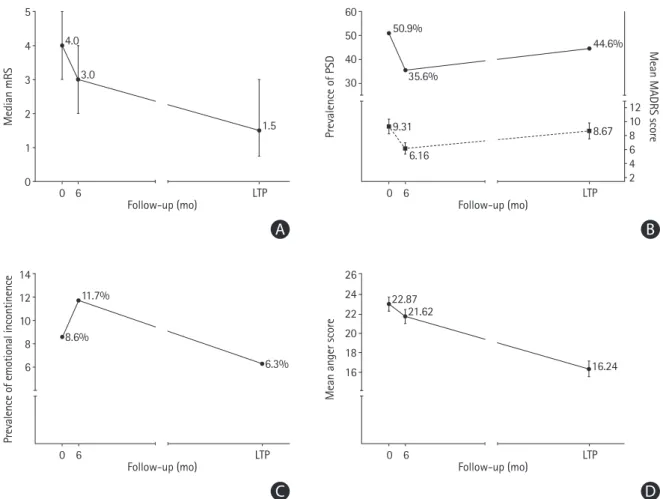
Compared to the mRS 6 months post-stroke (3.0 [2.0 to 4.0]), the median mRS at LTP (1.50 [0.75 to 3.00], P<0.01) de- creased (Figure 2A), whereas the prevalence of PSD (35.6% to 44.6%, P=0.03) and mean MADRS (6.2 to 8.7, P<0.01) in- creased (Figure 2B). The prevalence of PSEI (11.7% to 6.3%,
P=0.05) and mean anger score at LTP (21.6 to 16.2, P<0.01)decreased (Figure 2C and D).
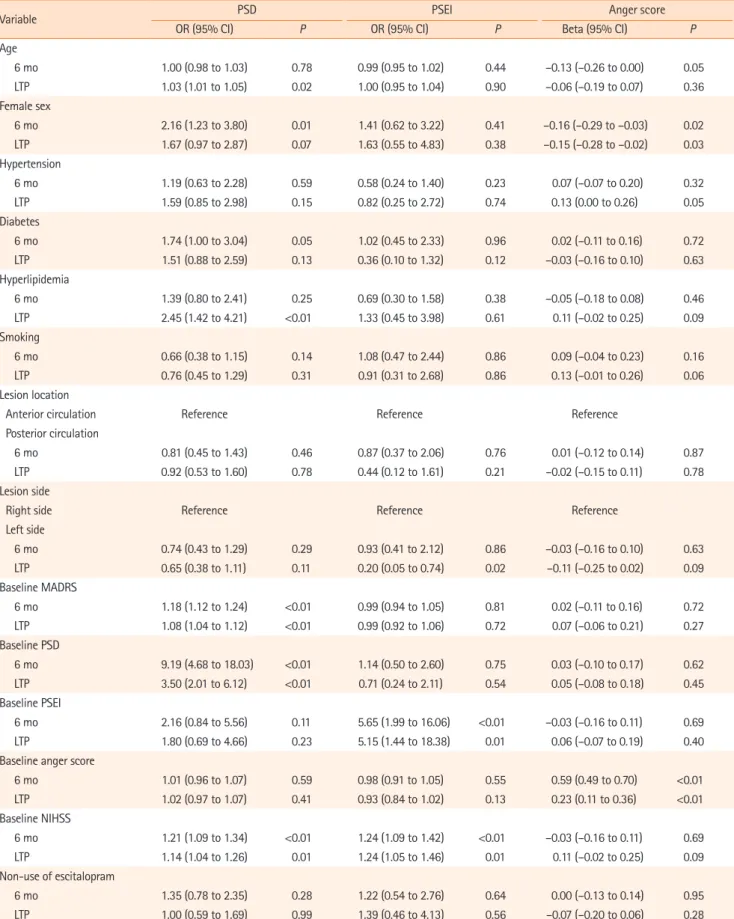
We studied the relationships between demographic and clin- ical factors, and the use of escitalopram, and PSD, PSEI, and anger score at 6 months and at LTP in a simple regression analysis (Table 2). Variables showing significant effects (P<0.05) were baseline PSEI and NIHSS for PSEI at 6 months;
left side lesion, baseline PSEI, and NIHSS for PSEI at LTP; and female sex, baseline anger score for PSA at both 6 months and LTP. Female sex, baseline MADRS, PSD, and NIHSS were signifi- cant factors for PSD at 6 months, while age, hyperlipidemia, baseline MADRS, PSD, and NIHSS were significantly associated with PSD at LTP.
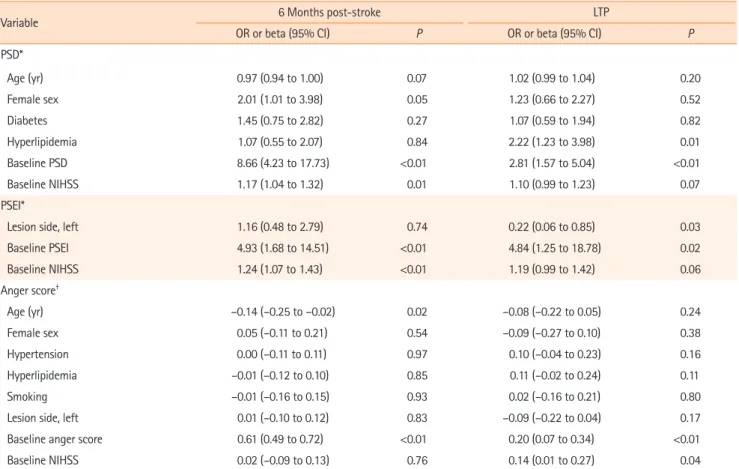
Multiple logistic regression analysis after adjustment for im- portant factors (P<0.1) showed that the following factors were
5 4 3 2 1 0
4.0 3.0
1.5
0 6 LTP
Median mRS
Follow-up (mo)
A B
60 50 40 30
12 10 8 6 4 2 50.9%
9.31 6.16
8.67 44.6%
35.6%
0 6 LTP
Prevalence of PSD Mean MADRS score
Follow-up (mo)
14 12 10 8 6
11.7%
8.6%
6.3%
0 6 LTP
Prevalence of emotional incontinence
Follow-up (mo)
C D
26 24 22 20 18 16
LTP
Mean anger score
Follow-up (mo) 0 6
22.87 21.62
16.24
Figure 2. (A) Median modified Rankin Scale (mRS) with interquartile range. (B) Prevalence of post-stroke depression (PSD) and mean Montgomery-Åsberg de- pression rating scale (MADRS) with 95% confidence interval (CI). (C) Prevalence of post-stroke emotional incontinence. Follow-up time is shown in month. (D) Mean anger score with 95% CI. LTP, long-term period.
Table 2. Simple regression test using PSD, PSEI, and anger score as outcomes
Variable PSD PSEI Anger score
OR (95% CI) P OR (95% CI) P Beta (95% CI) P
Age
6 mo 1.00 (0.98 to 1.03) 0.78 0.99 (0.95 to 1.02) 0.44 –0.13 (–0.26 to 0.00) 0.05
LTP 1.03 (1.01 to 1.05) 0.02 1.00 (0.95 to 1.04) 0.90 –0.06 (–0.19 to 0.07) 0.36
Female sex
6 mo 2.16 (1.23 to 3.80) 0.01 1.41 (0.62 to 3.22) 0.41 –0.16 (–0.29 to –0.03) 0.02
LTP 1.67 (0.97 to 2.87) 0.07 1.63 (0.55 to 4.83) 0.38 –0.15 (–0.28 to –0.02) 0.03
Hypertension
6 mo 1.19 (0.63 to 2.28) 0.59 0.58 (0.24 to 1.40) 0.23 0.07 (–0.07 to 0.20) 0.32
LTP 1.59 (0.85 to 2.98) 0.15 0.82 (0.25 to 2.72) 0.74 0.13 (0.00 to 0.26) 0.05
Diabetes
6 mo 1.74 (1.00 to 3.04) 0.05 1.02 (0.45 to 2.33) 0.96 0.02 (–0.11 to 0.16) 0.72
LTP 1.51 (0.88 to 2.59) 0.13 0.36 (0.10 to 1.32) 0.12 –0.03 (–0.16 to 0.10) 0.63
Hyperlipidemia
6 mo 1.39 (0.80 to 2.41) 0.25 0.69 (0.30 to 1.58) 0.38 –0.05 (–0.18 to 0.08) 0.46
LTP 2.45 (1.42 to 4.21) <0.01 1.33 (0.45 to 3.98) 0.61 0.11 (–0.02 to 0.25) 0.09
Smoking
6 mo 0.66 (0.38 to 1.15) 0.14 1.08 (0.47 to 2.44) 0.86 0.09 (–0.04 to 0.23) 0.16
LTP 0.76 (0.45 to 1.29) 0.31 0.91 (0.31 to 2.68) 0.86 0.13 (–0.01 to 0.26) 0.06
Lesion location
Anterior circulation Reference Reference Reference
Posterior circulation
6 mo 0.81 (0.45 to 1.43) 0.46 0.87 (0.37 to 2.06) 0.76 0.01 (–0.12 to 0.14) 0.87
LTP 0.92 (0.53 to 1.60) 0.78 0.44 (0.12 to 1.61) 0.21 –0.02 (–0.15 to 0.11) 0.78
Lesion side
Right side Reference Reference Reference
Left side
6 mo 0.74 (0.43 to 1.29) 0.29 0.93 (0.41 to 2.12) 0.86 –0.03 (–0.16 to 0.10) 0.63
LTP 0.65 (0.38 to 1.11) 0.11 0.20 (0.05 to 0.74) 0.02 –0.11 (–0.25 to 0.02) 0.09
Baseline MADRS
6 mo 1.18 (1.12 to 1.24) <0.01 0.99 (0.94 to 1.05) 0.81 0.02 (–0.11 to 0.16) 0.72
LTP 1.08 (1.04 to 1.12) <0.01 0.99 (0.92 to 1.06) 0.72 0.07 (–0.06 to 0.21) 0.27
Baseline PSD
6 mo 9.19 (4.68 to 18.03) <0.01 1.14 (0.50 to 2.60) 0.75 0.03 (–0.10 to 0.17) 0.62
LTP 3.50 (2.01 to 6.12) <0.01 0.71 (0.24 to 2.11) 0.54 0.05 (–0.08 to 0.18) 0.45
Baseline PSEI
6 mo 2.16 (0.84 to 5.56) 0.11 5.65 (1.99 to 16.06) <0.01 –0.03 (–0.16 to 0.11) 0.69
LTP 1.80 (0.69 to 4.66) 0.23 5.15 (1.44 to 18.38) 0.01 0.06 (–0.07 to 0.19) 0.40
Baseline anger score
6 mo 1.01 (0.96 to 1.07) 0.59 0.98 (0.91 to 1.05) 0.55 0.59 (0.49 to 0.70) <0.01
LTP 1.02 (0.97 to 1.07) 0.41 0.93 (0.84 to 1.02) 0.13 0.23 (0.11 to 0.36) <0.01
Baseline NIHSS
6 mo 1.21 (1.09 to 1.34) <0.01 1.24 (1.09 to 1.42) <0.01 –0.03 (–0.16 to 0.11) 0.69
LTP 1.14 (1.04 to 1.26) 0.01 1.24 (1.05 to 1.46) 0.01 0.11 (–0.02 to 0.25) 0.09
Non-use of escitalopram
6 mo 1.35 (0.78 to 2.35) 0.28 1.22 (0.54 to 2.76) 0.64 0.00 (–0.13 to 0.14) 0.95
LTP 1.00 (0.59 to 1.69) 0.99 1.39 (0.46 to 4.13) 0.56 –0.07 (–0.20 to 0.06) 0.28
Logistic regression test for binary variables (PSD, PSEI) and linear regression test for continuous variable (anger score). Beta refers to the standardized beta co- efficient of the linear regression test. The PSD, PSEI, and anger score at 6 months post-stroke were used to identify significant factors.
PSD, post-stroke depression; PSEI, post-stroke emotional incontinence; OR, odds ratio; CI, confidence interval; LTP, long-term period; MADRS, Montgomery- Åsberg depression rating scale; NIHSS, National Institutes of Health Stroke Scale.
significantly (P<0.05) associated: baseline PSD and NIHSS for PSD at 6 months, hyperlipidemia and baseline PSD for PSD at LTP, baseline PSEI and NIHSS for PSEI at 6 months, left-side le- sion and baseline PSEI at LTP, age and baseline anger score for PSA at 6 months, and baseline anger score and NIHSS for PSA at LTP (Table 3). There was no autocorrelation or multicol- linearity in the multiple regression test.
Figure 3 shows the relationships of ESSI with MADRS and with anger score at LTP. The correlation test showed a signifi- cant negative relationship between MADRS and ESSI (ρ=–
0.39, P<0.01) and between anger score and ESSI (ρ=–0.28,
P<0.01).Table 4 shows the effect of low social support and mRS at LTP on PSD, PSEI, and anger scores at LTP. In the simple regres- sion test, the effect of low social support and mRS on PSD was statistically significant. The significance remained in the multi- ple regression test after adjustment for age, sex, baseline PSD, baseline NIHSS, regular psychiatric clinic visits at LTP, antide- pressant use at LTP, and recurrent stroke at LTP. However, the
effect of low social support on PSD at LTP was greater than that of mRS. There was no interaction between low social support and mRS at LTP (P=0.53). Neither mRS nor low social support
Table 3. Multiple regression test using PSD, PSEI, and anger score at 6 months post-stroke and LTP as outcomesVariable 6 Months post-stroke LTP
OR or beta (95% CI) P OR or beta (95% CI) P
PSD*
Age (yr) 0.97 (0.94 to 1.00) 0.07 1.02 (0.99 to 1.04) 0.20
Female sex 2.01 (1.01 to 3.98) 0.05 1.23 (0.66 to 2.27) 0.52
Diabetes 1.45 (0.75 to 2.82) 0.27 1.07 (0.59 to 1.94) 0.82
Hyperlipidemia 1.07 (0.55 to 2.07) 0.84 2.22 (1.23 to 3.98) 0.01
Baseline PSD 8.66 (4.23 to 17.73) <0.01 2.81 (1.57 to 5.04) <0.01
Baseline NIHSS 1.17 (1.04 to 1.32) 0.01 1.10 (0.99 to 1.23) 0.07
PSEI*
Lesion side, left 1.16 (0.48 to 2.79) 0.74 0.22 (0.06 to 0.85) 0.03
Baseline PSEI 4.93 (1.68 to 14.51) <0.01 4.84 (1.25 to 18.78) 0.02
Baseline NIHSS 1.24 (1.07 to 1.43) <0.01 1.19 (0.99 to 1.42) 0.06
Anger score†
Age (yr) –0.14 (–0.25 to –0.02) 0.02 –0.08 (–0.22 to 0.05) 0.24
Female sex 0.05 (–0.11 to 0.21) 0.54 –0.09 (–0.27 to 0.10) 0.38
Hypertension 0.00 (–0.11 to 0.11) 0.97 0.10 (–0.04 to 0.23) 0.16
Hyperlipidemia –0.01 (–0.12 to 0.10) 0.85 0.11 (–0.02 to 0.24) 0.11
Smoking –0.01 (–0.16 to 0.15) 0.93 0.02 (–0.16 to 0.21) 0.80
Lesion side, left 0.01 (–0.10 to 0.12) 0.83 –0.09 (–0.22 to 0.04) 0.17
Baseline anger score 0.61 (0.49 to 0.72) <0.01 0.20 (0.07 to 0.34) <0.01
Baseline NIHSS 0.02 (–0.09 to 0.13) 0.76 0.14 (0.01 to 0.27) 0.04
Logistic regression test for binary variables (PSD, PSEI) and linear regression test for continuous variable (anger score). Beta refers to the standardized beta co- efficient of the linear regression test. The PSD, PSEI, and anger score at 6 months post-stroke were used to identify significant factors.
PSD, post-stroke depression; PSEI, post-stroke emotional incontinence; LTP, long-term period; OR, odds ratio; CI, confidence interval; NIHSS, National Insti- tutes of Health Stroke Scale.
*OR; †Beta.
50
40
30
20
10
00 10 20 30 40
ESSI at LTP
MADRS at LTP
(rho=−0.39, P<0.01, R2=0.13) Anger score at LTP (rho=−0.28, P<0.01, R2=0.07)
Figure 3. Correlation test results between Montgomery-Åsberg depression rating scale (MADRS) at long-term period (LTP) and enhancing recovery in coronary heart disease (ENRICHD) Social Support Instrument (ESSI), and between anger score at LTP and ESSI.
was significantly associated with PSEI at LTP. For PSA, the effect of low social support on the anger score at LTP was significant in the adjusted test. We additionally tested the relationship of ESSI or mRS with “PSD treatment” among patients with PSD at LTP. ESSI was positively associated with psychiatric clinic visits in the logistic regression test (odds ratio, 1.13; 95% confidence interval, 1.02 to 1.25; P=0.03), while mRS was not (P=0.11).
Discussion
To our knowledge, our study is the first to investigate the long- term (average 5 years) changes in PSD, PSEI, and PSA. We found that the prevalence of PSD and mean MADRS score gradually increased over time. We had previously found that the MADRS scores at the early stage of stroke decreased along
Table 4. Simple and adjusted regression test of low social support and mRS at LTP, using PSD, PSEI, and anger score at LTP as outcomesVariable Simple test Adjusted test
OR or beta (95% CI) P OR or beta (95% CI) P
PSD at LTP*
Age (yr) 0.98 (0.95 to 1.01) 0.23
Female sex 1.53 (0.74 to 3.18) 0.25
Baseline PSD 3.12 (1.56 to 6.24) <0.01
Baseline NIHSS 0.90 (0.79 to 1.03) 0.13
Regular clinic visit 3.50 (1.11 to 11.03) 0.03
Antidepressant use 3.38 (1.02 to 11.18) 0.05
Recurrent stroke 0.46 (0.09 to 2.42) 0.36
mRS 2.12 (1.67 to 2.70) <0.01 2.16 (1.54 to 3.02) <0.01
Low social support 3.46 (1.94 to 6.16) <0.01 4.12 (1.97 to 8.66) <0.01
PSEI at LTP*
Age (yr) 0.98 (0.92 to 1.04) 0.47
Female sex 1.51 (0.43 to 5.25) 0.52
Baseline PSEI 3.94 (0.92 to 16.85) 0.06
Baseline NIHSS 1.12 (0.90 to 1.40) 0.32
MADRS at LTP 1.07 (0.99 to 1.15) 0.08
Regular clinic visit 0.31 (0.03 to 3.61) 0.35
Antidepressant use 1.68 (0.34 to 8.22) 0.52
Recurrent stroke 0.52 (0.04 to 7.74) 0.64
mRS 1.39 (0.95 to 2.04) 0.09 0.96 (0.50 to 1.84) 0.90
Low social support 3.63 (1.17 to 11.23) 0.03 2.01 (0.53 to 7.69) 0.31
Anger score at LTP†
Age (yr) –0.10 (–0.23 to 0.03) 0.14
Female sex –0.06 (–0.18 to 0.07) 0.38
Baseline anger score 0.22 (0.10 to 0.34) <0.01
Baseline NIHSS 0.06 (–0.07 to 0.18) 0.39
MADRS 0.45 (0.31 to 0.59) <0.01
Regular clinic visit 0.11 (–0.01 to 0.23) 0.07
Antidepressant use 0.04 (–0.08 to 0.17) 0.52
Recurrent stroke 0.04 (–0.07 to 0.16) 0.48
mRS 0.11 (–0.02 to 0.24) 0.10 –0.14 (–0.30 to 0.02) 0.09
Low social support 0.25 (0.12 to 0.38) <0.01 0.14 (0.02 to 0.26) 0.03
Logistic regression test for binary variables (PSD, PSEI) and linear regression test for continuous variable (anger score). Beta refers to the standardized beta co- efficient of the linear regression test.
mRS, modified Rankin Scale; LTP, long-term period; PSD, post-stroke depression; PSEI, post-stroke emotional incontinence; OR, odds ratio; CI, confidence in- terval; NIHSS, National Institutes of Health Stroke Scale; MADRS, Montgomery-Åsberg de pression rating scale.
*OR; †Beta.
with improvement in neurological deficits, probably due to psychological responses associated with improving neurologi- cal deficits.
7Our results are not consistent with a previous lon- gitudinal study from the South London Stroke Register (SLSR).
In this study, the prevalence of PSD defined by depression sub- scale score >7 in the Hospital Anxiety and Depression Scale was stationary over time: 33% (30% to 36%), 28% (25% to 30%), and 31% (27% to 34%) at 3 months, 1 year, and 5 years after stroke, respectively.
17Direct comparisons should be made cautiously because our study and the SLSR study are method- ologically different. We conducted direct or phone interviews, whereas a postal interview was used in the SLSR study. While 222 of 356 patients (62.4%) were followed up at LTP in our study, only 585 out of 3,689 (15.9%) were followed up at 5 years in the SLSR study.
Nevertheless, the gradual increase in the degree and preva- lence of PSD over time in our study needs to be discussed. Al- though mRS scores were still independent factors associated with PSD at LTP (Table 4), they gradually decreased over time in our study (Figure 2). Thus, the increasing prevalence of PSD at LTP is unlikely to be attributed to worsening functional dis- ability.
18We found that low social support was significantly as- sociated with PSD at LTP. Although we did not investigate ESSI at earlier time points, the strong relationship between ESSI and MADRS at LTP (Figure 3) suggests that the lack of social sup- port may be one of the reasons for the persistent or increasing prevalence of PSD. We also found that only approximately 20%
of patients with PSD were under treatment. Although the treatment status was not described in the SLSR study, this fac- tor may have contributed to the difference. In Korea, some de- pressive patients do not visit psychiatric clinics because of the social stigma attached to psychiatric diseases.
19More elderly Koreans regard depression as a “personal weakness” or “normal aging” instead of a “disease” than Americans.
20It was reported that the use of antidepressants in Korea was one of the lowest among OECD countries.
21All these factors may have contribut- ed to the prevalent PSD at LTP in our cohort.
We noted that aside from baseline PSD and NIHSS scores, hyperlipidemia was a factor associated with PSD at LTP (Table 3). Although a study from Taiwan showed that patients with hyperlipidemia had a high risk of depression,
22a meta-analysis of the relationship between vascular risk factors and late-life depression did not show such an association.
23Further studies are required to confirm the relationship between PSD and hy- perlipidemia.
We found that the prevalence and severity of PSEI decreased from 6 months post-stroke to LTP (Figure 2). This result was consistent with a report that revealed that the prevalence of
PSEI decreased from 21% at 6 months post-stroke to 11% at 12 months post-stroke.
24Numerous studies have shown that PSEI is pathophysiologically closely associated with serotoner- gic system dysfunction in the brain in stroke patients.
1,25-28Thus, the decreasing prevalence of PSEI at LTP may be attribut- ed to the recovery of the damaged serotonergic system in the brain over time. Unlike PSD, PSEI was not associated with ESSI in our study. The anger score also decreased from 6 months post-stroke to LTP (Figure 2). This may also be explained by the improved brain serotonergic system over time. However, unlike PSEI, the anger score was associated with low social support (Figure 3), although the relationship was not as strong as that with PSD. It has been shown that although PSA is closely asso- ciated with brain serotonergic system dysfunction, it is also re- lated to depression and frustration.
3This study has a few limitations. First, since only Korean pa- tients were enrolled, it may be difficult to apply the results to other ethnicities. Second, as we examined social support only once at LTP, its impact on patients’ emotions at 6 months re- mains unknown. Third, we could not categorize lesion location precisely because the number of patients with PSD, PSEI, and high anger score were small. Fourth, since LTP was not pre-de- fined in this sub-study, the range of LTP was rather broad (35 to 85 months). Finally, many patients did not participate in the study. Compared with participants, non-participants were older and had higher initial MADRS and NIHSS scores (Table 1). In our study, multiple regression analysis showed that baseline PSD, but not MADRS score, was associated with PSD at LTP, and the initial NIHSS score was associated with PSA at LTP. Al- though it is difficult to precisely assess the possible impact of these differences on our results, the frequencies of post-stroke mood/emotional disturbances at LTP may have been underesti- mated in our study. This is an inherent problem in the research on depression; individuals with depression are more cautious and hesitant about clinical trial participation than those with- out.
29However, we do not think that this limitation greatly in- fluenced our main findings, as our primary aim was to observe the long-term change in post-stroke emotional disorders rather than assess the exact prevalence of these symptoms in a cer- tain period.
Despite these limitations, our data showed that the preva-
lence and degree of PSEI and anger score decreased, whereas
those of PSD increased at LTP in our cohort. Our results have
several practical implications. Physicians may consider cessa-
tion of medications for PSEI at LTP but need to be aware of the
increased prevalence of PSD. As PSD and PSA are associated
with a lack of social support, strategies to improve social sup-
port may have to be developed to prevent and manage PSD
and PSA at LTP.
Supplementary materials
Supplementary materials related to this article can be found online at https://doi.org/10.5853/jos.2020.04637.
Disclosure
This work was supported by grants from Dong-A Pharmaceuti- cal Company, who had no role in the design, analysis, interpre- tation, or publication of this study.
References
1. Kim JS, Choi S, Kwon SU, Seo YS. Inability to control anger or aggression after stroke. Neurology 2002;58:1106-1108.
2. Kim JS, Choi-Kwon S. Poststroke depression and emotional incontinence: correlation with lesion location. Neurology 2000;54:1805-1810.
3. Kim JS. Post-stroke mood and emotional disturbances: phar- macological therapy based on mechanisms. J Stroke 2016;
18:244-255.
4. Hackett ML, Pickles K. Part I: frequency of depression after stroke: an updated systematic review and meta-analysis of observational studies. Int J Stroke 2014;9:1017-1025.
5. Towfighi A, Ovbiagele B, El Husseini N, Hackett ML, Jorge RE, Kissela BM, et al. Poststroke depression: a scientific state- ment for healthcare professionals from the American Heart Association/American Stroke Association. Stroke 2017;
48:e30-e43.
6. Werheid K. A two-phase pathogenetic model of depression after stroke. Gerontology 2015;62:33-39.
7. Kim JS, Lee EJ, Chang DI, Park JH, Ahn SH, Cha JK, et al. Effi- cacy of early administration of escitalopram on depressive and emotional symptoms and neurological dysfunction after stroke: a multicentre, double-blind, randomised, place- bo-controlled study. Lancet Psychiatry 2017;4:33-41.
8. Montgomery SA, Asberg M. A new depression scale designed to be sensitive to change. Br J Psychiatry 1979;134:382-389.
9. Kearns NP, Cruickshank CA, McGuigan KJ, Riley SA, Shaw SP, Snaith RP. A comparison of depression rating scales. Br J Psy- chiatry 1982;141:45-49.
10. Kang HJ, Stewart R, Kim JM, Jang JE, Kim SY, Bae KY, et al.
Comparative validity of depression assessment scales for screening poststroke depression. J Affect Disord 2013;147:
186-191.
11. Lee EJ, Kim JS, Chang DI, Park JH, Ahn SH, Cha JK, et al. Dif-
ferences in therapeutic responses and factors affecting post- stroke depression at a later stage according to baseline de- pression. J Stroke 2018;20:258-267.
12. Brott T, Adams HP Jr, Olinger CP, Marler JR, Barsan WG, Biller J, et al. Measurements of acute cerebral infarction: a clinical examination scale. Stroke 1989;20:864-870.
13. Farrell B, Godwin J, Richards S, Warlow C. The United King- dom transient ischaemic attack (UK-TIA) aspirin trial: final results. J Neurol Neurosurg Psychiatry 1991;54:1044-1054.
14. Rao N. The clinical pharmacokinetics of escitalopram. Clin Pharmacokinet 2007;46:281-290.
15. Mitchell PH, Powell L, Blumenthal J, Norten J, Ironson G, Pit- ula CR, et al. A short social support measure for patients re- covering from myocardial infarction: the ENRICHD Social Support Inventory. J Cardiopulm Rehabil 2003;23:398-403.
16. ENRICHD Investigators. Enhancing recovery in coronary heart disease (ENRICHD): baseline characteristics. Am J Car- diol 2001;88:316-322.
17. Ayerbe L, Ayis S, Rudd AG, Heuschmann PU, Wolfe CD. Natu- ral history, predictors, and associations of depression 5 years after stroke: the South London Stroke Register. Stroke 2011;42:1907-1911.
18. Ayerbe L, Ayis S, Crichton S, Wolfe CD, Rudd AG. The long- term outcomes of depression up to 10 years after stroke: the South London Stroke Register. J Neurol Neurosurg Psychiatry 2014;85:514-521.
19. Ki M, Paik JW, Choi KS, Ryu SH, Han C, Lee K, et al. Delays in depression treatment among Korean population. Asia Pac Psychiatry 2014;6:414-424.
20. Turvey CL, Jogerst G, Kim MY, Frolova E. Cultural differences in depression-related stigma in late-life: a comparison be- tween the USA, Russia, and South Korea. Int Psychogeriatr 2012;24:1642-1647.
21. Organization for Economic Cooperation. Health at a glance 2015: OECD indicators. Paris: OECD; 2015.
22. Chuang CS, Yang TY, Muo CH, Su HL, Sung FC, Kao CH. Hy- perlipidemia, statin use and the risk of developing depres- sion: a nationwide retrospective cohort study. Gen Hosp Psy- chiatry 2014;36:497-501.
23. Valkanova V, Ebmeier KP. Vascular risk factors and depression in later life: a systematic review and meta-analysis. Biol Psy- chiatry 2013;73:406-413.
24. House A, Dennis M, Molyneux A, Warlow C, Hawton K. Emo- tionalism after stroke. BMJ 1989;298:991-994.
25. Andersen G, Ingeman-Nielsen M, Vestergaard K, Riis JO.
Pathoanatomic correlation between poststroke pathological crying and damage to brain areas involved in serotonergic neurotransmission. Stroke 1994;25:1050-1052.
26. Kim JM, Stewart R, Kang HJ, Bae KY, Kim SW, Shin IS, et al.
Associations of serotonergic genes with poststroke emotion- al incontinence. Int J Geriatr Psychiatry 2012;27:799-806.
27. Kim JS. Post-stroke emotional incontinence after small len- ticulocapsular stroke: correlation with lesion location. J Neu- rol 2002;249:805-810.
28. Murai T, Barthel H, Berrouschot J, Sorger D, von Cramon DY, Müller U. Neuroimaging of serotonin transporters in post- stroke pathological crying. Psychiatry Res 2003;123:207-211.
29. Leykin Y, Dunn LB, Muñoz RF. The effect of depression on the decision to join a clinical trial. J Consult Clin Psychol 2017;
85:751-756.
Supplementary Table 1. Criteria for post-stroke emotional incontinence and anger used in this study
Original definition Modified*
Kim’s criteria for post-stroke
emotional incontinence (PSEI)2 Patients and relatives were asked if the patient showed excessive or inappropriate laughing, crying, or both, as compared with the premorbid state.
PSEI was confirmed when both the patient and relatives agree that they occurred on more than two occasions.
Inappropriateness indicates laughing or crying that occurs while talking, listening, meeting people, or watching television, when the incident is not particularly
amusing or sad to ordinary people.
Same as the original definition, but relative’s confirmation was
not required
Spielberger trait anger-Kim’s scale for post-stroke anger (PSA)
Assessment of PSA† was supported by application of the 10-item Spielberger Trait Anger Scale.
For each question, patients were asked to use a numerical scale (1, almost never; 2, sometimes; 3, often; and 4, almost always) to best represent their pre-stroke and
current (post-stroke) statuses, separately. An overall anger score was obtained by summation of individual scores. PSA was defined to be present when (1) the sum of the PSA score was higher than that of pre-stroke score; (2) the patient felt that he or she had developed PSA; and (3) at least one of the relatives who lived with the patient agreed on number 2.
Same as the original definition, but relative’s confirmation was
not required and the PSA was not compared with the pre-stroke score.
*Originals were modified for clinical trials. By omitting “relative's confirmation” we were able to include patients who lived alone and could more easily per- form telephone or postal interview. We were also able to decrease the burden on investigators and patients in the trial; †The term “inability to control anger and aggression” was used in the original paper.