Article Info
Received September 10, 2019 Revised November 3, 2019 Accepted November 18, 2019 Published online February 3, 2020 Corresponding Author Chang Min Cho
ORCID https://orcid.org/0000-0002-9903-1282 E-mail [email protected]
The abstract of this study was presented as a poster at 24th United European Gastro- enterology Week 2016, on October 15-19, 2016, in Vienna, Austria.
Background/Aims: Recently, the European Society of Gastrointestinal Endoscopy (ESGE) pro- posed criteria for “difficult biliary cannulation” during endoscopic retrograde cholangiopancrea- tography (ERCP). This study aimed to investigate the clinical relevance of the ESGE criteria from the perspective of post-ERCP pancreatitis (PEP).
Methods: An ERCP database was prospectively maintained between November 2014 and De- cember 2015 across six teaching hospitals in South Korea. The ESGE criteria (biliary cannulation time, the number of cannulation attempts, and inadvertent pancreatic duct [PD] manipulation) were recorded in this database as well as other technical factors. Logistic regression analysis was used to identify risk factors for PEP. Then, the PEP prediction model was investigated using decision tree analysis.
Results: We analyzed 1,067 consecutive patients with naïve papilla. The overall rate of PEP was 6.6%. Multivariate analysis revealed that female sex (odds ratio [OR], 1.860; 95% confidence interval [CI], 1.124 to 3.078), a selective biliary cannulation duration >5 minutes (OR, 3.282; 95%
CI, 1.641 to 6.566), and inadvertent PD manipulation (OR, 2.614; 95% CI, 1.480 to 4.617) were significant factors affecting PEP. Decision tree analysis revealed that biliary cannulation time (χ2=49.857, p<0.001) and inadvertent PD manipulation (χ2=8.556, p=0.010) were decisive fac- tors. PEP occurred in 3.9%, 11.8%, and 16.2% of patients with biliary cannulation duration lasting 3 to 5 minutes, >5 minutes, and >5 minutes with inadvertent PD manipulation, respectively.
Conclusions: Biliary cannulation time and inadvertent PD manipulation could be relevant indica- tors of PEP, and 5 minutes might be used as a cutoff value for the implementation of the rescue cannulation technique. (Gut Liver 2021;15:459-465)
Key Words: Pancreatitis; Cholangiopancreatography, endoscopic retrograde; Risk factors; Deci- sion trees; Practice guideline
INTRODUCTION
Endoscopic retrograde cholangiopancreatography (ERCP) is a technically challenging procedure for several pancreatobiliary disorders. Reportedly, selective biliary cannulation, which is a prerequisite for successful ERCP, was difficult in 5% of cases even when performed by expe-
rienced endoscopists, and this rate rose to approximately 18% of cases when performed across low-volume centers.
1Difficult biliary cannulation associated with repeated and prolonged attempts increases the risks of ERCP-related adverse events, particularly the risk of post-ERCP pancre- atitis (PEP).
2,3Recently, the European Society of Gastroin- testinal Endoscopy (ESGE) defined “difficult biliary can-
Copyright © Gut and Liver.
This is an Open Access article distributed under the terms of the Creative Commons Attribution Non-Commercial License (http://creativecommons.org/licenses/by-nc/4.0) which permits unrestricted non-commercial use, distribution, and reproduction in any medium, provided the original work is properly cited.
pISSN 1976-2283 eISSN 2005-1212
Difficult Biliary Cannulation from the Perspective of Post-
Endoscopic Retrograde Cholangiopancreatography Pancreatitis:
Identifying the Optimal Timing for the Rescue Cannulation Technique
Yoon Suk Lee
1, Chang Min Cho
2, Kwang Bum Cho
3, Jun Heo
2, Min Kyu Jung
2, Sung Bum Kim
4, Kook Hyun Kim
4, Tae Nyeun Kim
4, Dong Wook Lee
5, Jimin Han
5, Ho Gak Kim
5, Daejin Kim
6, and Hyunsoo Kim
61Department of Internal Medicine, Inje University College of Medicine, Goyang, 2Department of Internal Medicine, School of Medicine, Kyungpook National University, 3Department of Internal Medicine, Keimyung University School of Medicine, 4Department of Internal Medicine, Yeungnam University College of Medicine, 5Department of Internal Medicine, Daegu Catholic University School of Medicine, and 6Department of Internal Medicine, Daegu Fatima Hospital, Daegu, Korea
Original Article
nulation” as any of the following factors: (1) more than five contacts with the papilla prior to successful cannulation;
(2) more than 5 minutes of cannulation time following visualization of the papilla; and (3) more than one inadver- tent pancreatic duct (PD) cannulation or opacification.
4,5However, the definition of “difficult biliary cannulation”
varies across studies and thus interstudy comparisons are impractical. Therefore, the aim of this study was to investi- gate the clinical relevance of the ESGE’s criteria for difficult cannulation from the perspective of post-ERCP pancreati- tis.
MATERIALS AND METHODS
ERCP database from six endoscopy centers in Daegu, South Korea (Kyungpook National University Chilgok Hospital, Kyungpook National University Hospital, Keimyung University Dongsan Medical Center, Yeungnam University Hospital, Daegu Catholic University Hospital, and Daegu Fatima Hospital) was prospectively maintained between November 2014 and December 2015. This data- base has been registered on the Clinical Research Informa- tion Service as clinical research (cris.nih.go.kr number, KCT0003606). All ERCP procedures performed with the intention of accessing the common bile duct to cannulate the naïve papilla were included in this study. However, patients with any of the following criteria were excluded from the study: pregnant women, age <18 years, underly- ing chronic pancreatitis, main PD dilatation measuring >5 mm, uncontrolled coagulopathy (international normalized ratio >1.5 or platelet count <50,000/mm
3), or medically un- stable cardiopulmonary disability for conscious sedation.
The study protocol conforms to the ethical guidelines of the 1975 Declaration of Helsinki as reflected in a priori approval by the Medicity Daegu Joint Institutional Review Board (IRB No. 2018-12-008). All authors had access to the study data and reviewed and approved the final manu- script.
1. Endoscopic procedure
ERCPs were performed at each participating hospital by experienced endoscopists who had performed >200 therapeutic ERCPs per year. Cannulation techniques (con- ventional catheter-first with subsequent sphincterotome or sphincterotome-first with/without a preloaded guide- wire) and the types of devices used for therapeutic proce- dures (balloon or basket for stone removal, plastic or self- expandable metal stent [covered or uncovered] for biliary drainage) were left to the endoscopist’s discretion. More- over, peri-procedural management such as the amount of
hydration or type of fluid and prophylactic drug was also left to the strategy of participant hospitals. Endoscopist- directed-nurse administered sedation with midazolam, fentanyl, and/or propofol was used at all participating hos- pitals.
2. Procedural outcomes and definitions
The ERCP database was maintained using a standard- ized reporting form at all six participating hospitals.
Indications, the cannulation technique, therapeutic inter- ventions, results, and adverse events related to the proce- dure were recorded in all cases. The following data were recorded upon completion of each ERCP: total procedure time, biliary cannulation time, cannulation attempts, con- tact with papilla, inadvertent PD catheter insertion, PD contrast injection, and PD guidewire passage. Procedure- related adverse events such as PEP, perforation, bleeding, or others were also recorded based on the definitions proposed by Cotton et al.,
6,7if these occurred within the index hospitalization period. PEP was defined as the oc- currence of new-onset abdominal pain that was associated with an increase in serum amylase at least three times the upper limit of normal at the next day after the procedure.
6ERCP-related bleeding was categorized into three sub- types: intraprocedural, immediate, and delayed bleeding.
Intraprocedural bleeding was defined when it occurred during the procedure and additional manipulation was required for hemostasis. Immediate bleeding was defined when a hemoglobin drop of at least 2 g/dL was observed within 24 hours after the procedure and delayed bleeding was defined when it occurred after 24 hours later. Biliary cannulation time was defined as the duration between the first visualization of the papilla and deep cannula- tion. Cannulation time was recorded using a built-in stop- watch in the endoscopy system. Cannulation contact was defined as each continuous contact with the papilla with the intention of deep biliary cannulation. Repositioning following a loss of contact with the papilla was defined as a fresh attempt, and the number of cannulation attempts was recorded. In case of inadvertent PD catheter and con- trast agent or guidewire passage into the PD occurred, the number of these events was also recorded. Furthermore, inadvertent PD catheter insertion, PD contrast injection, and PD guidewire passage were categorized as inadvertent PD manipulation because 2016 ESGE guidelines do not distinguish between these criteria in detail.
3. Statistical analysis
The independent t-test or the Mann-Whitney U-test
was used for continuous variables, and the chi-square or
the Fisher exact test was used for categorical variables. Uni-
variate and multivariate analyses with logistic regression were performed to evaluate patient- and procedure-related variables to determine the independent risk factors associ- ated with PEP. All variables showing a p-value <0.05 in the univariate analysis were subjected to multivariate analysis.
The results were expressed as odds ratios with 95% confi- dence intervals. All p-values were two-sided, and a p-value
< 0.05 was considered statistically significant. All statistical analyses were performed using the SPSS statistics software,
version 20.0 (IBM Corp., Armonk, NY, USA).
Furthermore, decision tree analysis with the Chi- squared Automatic Interaction Detector algorithm was conducted for the hierarchical evaluation of the risk factors of PEP including the criteria proposed by ESGE. In addi- tion to previously known risk factors for PEP including female sex, a history of precut sphincterotomy, and PD contrast injection, other factors that were observed to be significant on univariate analysis were included in the de- cision tree analysis.
RESULTS
1. Baseline characteristics and technical outcomes Table 1 summarizes the baseline, clinical, and proce- dural characteristics (clinical and technical aspects) of the 1,067 consecutive patients with naïve papilla who were included in this study. Common bile duct stones (73.0%) were the most common indication for ERCP in our study.
The second was malignant biliary stricture (238 patients, 22.1%), including cholangiocarcinoma (157 patients), pancreatic cancer (38 patients), gallbladder cancer (25 pa- tients), ampulla of Vater cancer (14 patients), and bile duct metastasis (four patients). Selective bile duct cannulation at the first attempt succeeded in 761 patients (70.4%). The overall success rate for biliary cannulation was 97.4% (1,040 patients; median time, 5 minutes; range, 1 to 65 minutes).
A periampullary diverticulum was identified in 29.5% of the patients. Precut sphincterotomy (5.6%) or infundibu- lotomy (7.6%) was performed as a rescue technique for selective bile duct cannulation. Procedure-related adverse events including PEP, post-ERCP bleeding, perforation, and cholangitis occurred in 70 (6.6%), 120 (11.2%), seven (0.6%), and 14 (1.3%) patients, respectively. The grade of
Table 1.
Table 1. Baseline Characteristics of All Enrolled Patients
Characteristic Value (n=1,067)
Age, yr 70 (19–101)
Female sex 451 (42.3)
Indication for ERCP
Choledocholithiasis 790 (73.0)
Malignant biliary stricture 238 (22.1)
Benign biliary stricture 20 (1.9)
Post-cholecystectomy bile leakage 11 (1.0)
Others 10 (0.9)
Presence of periampullary diverticulum 315 (29.5)
Type 1 46 (14.6)
Type 2 142 (45.1)
Type 3 127 (40.3)
Procedure time, min
Overall 16 (3–85)
Biliary cannulation 5 (1–65)
Bile duct access
Successful first attempt 761 (70.4)
Failed biliary cannulation 24 (2.2)
Contacts with papilla
None 597 (56.0)
<5 times 357 (33.5)
5–10 times 78 (7.3)
≥10 times 35 (3.3)
Inadvertent PD catheter insertion
None 860 (80.6)
<5 times 169 (15.8)
5–10 times 24 (2.2)
≥10 times 14 (1.3)
Inadvertent PD contrast injection
None 909 (85.2)
<5 times 149 (14.0)
5–10 times 9 (0.8)
≥10 times 0
Inadvertent PD guidewire passage
None 767 (71.9)
<5 times 258 (24.2)
5–10 times 30 (2.8)
≥10 times 12 (1.1)
Precut sphincterotomy 60 (5.6)
Infundibulotomy 81 (7.6)
Endoscopic papillary balloon dilation 131 (12.3)
Normal sphincterotomy 846 (79.3)
Prophylactic drugs 784 (73.5)
Nafamostat mesylate 362 (33.9)
Ulinastin 228 (21.4)
Gabexate mesylate 194 (18.2)
Table 1.
Table 1. Continued
Characteristic Value (n=1,067)
Post-ERCP adverse events 190 (17.8)
Pancreatitis 70 (6.6)
Mild 61 (87.1)
Moderate 7 (10.0)
Severe 2 (2.9)
Bleeding 120 (11.2)
Intraprocedural 114 (95.0)
Immediate 3 (2.5)
Delayed 3 (2.5)
Perforation 7 (0.6)
Cholangitis 14 (1.3)
Data are presented as median (range) or number (%).
ERCP, endoscopic retrograde cholangiopancreatography; PD, pan- creatic duct.
PEP was mild in 61 (87.1%), moderate in seven (10.0%), and severe in two (2.9%). Three subtypes of post-ERCP bleeding was as follows: intraprocedural bleeding was oc- curred in 114 (95%), immediate in three (2.5%), and de- layed in three (2.5%).
2. Risk factors for post-ERCP pancreatitis
According to PEP development, the enrolled patients were categorized into two groups (PEP and non-PEP group). Female sex, overall procedure time (>10 minutes), biliary cannulation time (>5 minutes), the number of contacts with the papilla (>5 times), inadvertent PD ma- nipulation (PD contrast injection, guidewire passage, and/
or cannulation), and PD stent placement were statistically significant on univariate analysis. However, overall proce- dure time (>10 minutes), the number of contacts with the papilla (>5 times) and PD stent placement turned out to be insignificant on multivariate analysis (Table 2).
3. Decision tree analysis for PEP prediction model Decision tree analysis showed that the biliary can- nulation time (χ
2=49.857, p<0.001) and inadvertent PD manipulation (χ
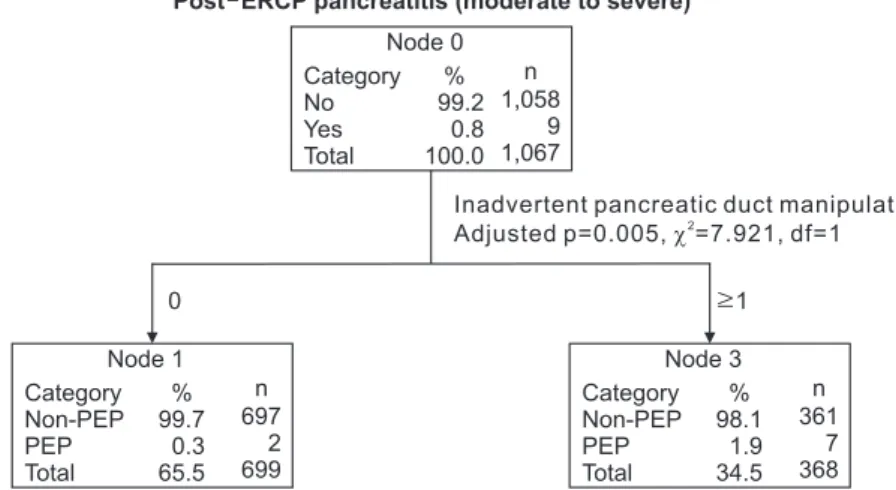
2=8.556, p=0.010) were significantly asso- ciated with PEP. However, the number of contacts with the papilla was not significant for discrimination. Moreover, the final decision tree model showed that the biliary can- nulation time was the most significant factor (Fig. 1).
We identified that 3 and 5 minutes of biliary cannula- tion time were the cutoff values for the development of
PEP (3.9% vs 11.8%, respectively). Furthermore, if inad- vertent PD manipulation occurred in a patient with biliary cannulation time of >5 minutes, the risk of PEP increased to 16.2% (Fig. 1). However, for the subgroup of moderate- to-severe grade PEP, inadvertent PD manipulation was the only significant factor with a 1.9% risk of moderate-to- severe PEP in the decision tree model (Fig. 2).
DISCUSSION
This study revealed that the biliary cannulation time and inadvertent PD manipulation were significant factors for PEP development among the 3 ESGE’s criteria for dif- ficult biliary cannulation (more than 5 minutes of cannula- tion time, more than five contacts with the papilla, and/
or more than one inadvertent PD cannulation/opacifica- tion).
4,5Furthermore, decision tree analysis showed that biliary cannulation time is the most relevant parameter of cannulation difficulty from the perspective of PEP devel- opment. PEP occurred in 11.8% of all cases when the bili- ary cannulation time was >5 minutes. Moreover, the risk of PEP increased to 16.3% in patients in whom inadvertent PD manipulation occurred when the biliary cannulation time was >5 minutes. However, the number of contacts with the papilla was not a significant factor for PEP in multivariate analysis and decision tree analysis. This result may be explained by the fact that the number of contacts with the papilla plays the role of a covariate associated
Table 2.
Table 2. Univariate and Multivariate Analyses of Risk Factors for Post-ERCP Pancreatitis (n=1,067) Variable
Univariate analysis Multivariate analysis
With PEP (n=70)
Without PEP
(n=997) p-value Odds ratio 95% CI p-value
Age (≤70 yr) 39 (55.7) 499 (50.1) 0.364
Female sex 39 (55.7) 412 (41.3) 0.018 1.860 1.124–3.078 0.016
Periampullary diverticulum 18 (25.7) 297 (29.8) 0.470
Failed BD access 3 (4.3) 21 (2.1) 0.220
Overall procedure time (>10 min) 66 (94.3) 755 (75.7) <0.001 1.916 0.615–5.973 0.262
BD cannulation (>5 min) 56 (80.0) 418 (41.9) <0.001 3.282 1.641–6.566 0.001
Contact with papilla (>5 times) 14 (20.0) 99 (9.9) 0.008 0.862 0.441–1.684 0.664
Inadvertent PD manipulation 46 (65.7) 322 (32.3) <0.001 2.614 1.480–4.617 0.001
PD catheter insertion (≥1 attempt) 26 (37.1) 181 (18.2) <0.001 PD contrast injection (≥1 event) 19 (27.1) 139 (13.9) 0.003 PD guidewire passage (≥1 event) 40 (57.1) 260 (26.1) <0.001
Precut sphincterotomy 5 (7.1) 55 (5.5) 0.568
EPBD 4 (5.7) 127 (12.7) 0.083
Mechanical lithotripsy 4 (5.7) 63 (6.3) 0.840
ERPD 9 (13.0) 54 (5.4) 0.010 0.963 0.430–2.153 0.926
Prophylactic drug 59 (84.3) 725 (72.7) 0.034 1.463 0.735–2.912 0.279
Data are presented as number (%).
ERCP, endoscopic retrograde cholangiopancreatography; PEP, post-ERCP pancreatitis; CI, confidence interval; BD, bile duct; PD, pancreatic duct;
EPBD, endoscopic papillary balloon dilation; ERPD, endoscopic retrograde pancreatic drainage.
with the biliary cannulation time. This finding is also sup- ported by the study of Tian et al.
8which demonstrated that there was a positive correlation between cannulation time and the number of attempts, and cannulation time was a more objective and accurate assessment tool for cannula- tion difficulty. Furthermore, the low number of contacts with papilla does not necessarily mean easy cannulation.
Therefore, among the 3 ESGE’s criteria for difficult cannu- lation proposed in 2016, the biliary cannulation time and inadvertent PD manipulation would be indicators of PEP
development; and then 5 minutes could be used as a cutoff value for the implementation of rescue cannulation tech- nique.
Recently, Mariani et al.
9reported that early precut sphincterotomy (in which rescue needle-knife sphincterot- omy was performed whenever bile duct cannulation failed after 5 minutes or after three passes of inadvertent PD can- nulation), reduced the incidence of PEP. This finding sug- gests that precut sphincterotomy by itself is not a risk fac- tor, but prolonged cannulation might be a more significant
Post ERCP pancreatitis Node 0
Category Non-PEP PEP Total
93.4 6.6 100.0
997 70 1,067
% n
3.0 5.0 min
Node 2 Category Non-PEP PEP Total
96.1 3.9 21.5
220 9 229
% n
Accuracy of classification=93.4%
Bile duct cannulation
Adjusted p=0.000, =49.857, df=2
3.0 min
Node 1 Category Non-PEP PEP Total
98.6 1.4 34.1
359 5 364
% n
1 Node 5 Category Non-PEP PEP Total
83.8 16.2 23.7
212 41 253
% n
0 Node 4 Category Non-PEP PEP Total
93.2 6.8 20.7
206 15 221
% n
5.0 min
Node 3 Category Non-PEP PEP Total
88.2 11.8 44.4
418 56 474
% n
Inadvertent pancreatic duct manipulation Adjusted p=0.010, =8.556, df=1
Fig. 1.
Fig. 1. A decision tree model for the prediction of post-ERCP pancreatitis generated by classification and regression tree analysis using our ERCP database.
ERCP, endoscopic retrograde cholangiopancreatography; PEP, post-ERCP pancreatitis.
Fig. 2.
Fig. 2. A decision tree model for the prediction of post-ERCP pancreatitis in the moderate-to-severe grade subgroup, generated by classifica- tion and regression tree analysis using our ERCP database.
ERCP, endoscopic retrograde chol- angiopancreatography; PEP, post- ERCP pancreatitis.
Accuracy of classification=99.2%
1
Node 3 Category Non-PEP PEP Total
98.1 1.9 34.5
361 7 368
% n
0
Node 1 Category Non-PEP PEP Total
99.7 0.3 65.5
697 2 699
% n
Post ERCP pancreatitis (moderate to severe) Node 0
Category No Yes Total
99.2 0.8 100.0
1,058 9 1,067
% n
Inadvertent pancreatic duct manipulation Adjusted p=0.005, 2=7.921, df=1
risk factor for PEP. These findings were in agreement with our study outcomes for reducing the cannulation time to prevent PEP. When decision tree analysis was performed only for moderate-to-severe PEP, inadvertent PD ma- nipulation was the only factor that showed statistical sig- nificance, which might indicate that instrumentation and manipulation-induced mechanical injury to the PD is the most important pathophysiological contributor to mod- erate-to-severe PEP rather than electrosurgery-induced thermal injury associated with sphincterotomy. Further- more, two recent meta-analyses of randomized controlled trials have also demonstrated the benefit of early precut sphincterotomy to prevent PEP.
10,11Therefore, endoscopists should try to reduce the time of selective biliary cannula- tion as short as possible and, if not, rescue techniques such as precut sphincterotomy or double guidewire technique should be considered in an early phase of the procedure in the case of difficult biliary cannulation.
Considering the association between inadvertent PD manipulation and PEP, which was also demonstrated in this study, the insertion of a prophylactic indwelling PD stent is a reasonable recommendation. However, pancreatic stent and drugs for PEP prophylaxis were ineffective in this study. This finding might be explained by the observational study design in that certain patients with a seemingly high probability for PEP might be more frequently treated with prophylactic medications or PD stent based on personal criteria.
The limitations of this study are as follows: (1) this study was designed as an observational study although the data were collected prospectively. However, we used a relatively large multicenter ERCP database containing detailed information and technical data regarding procedures performed by highly qualified and experienced endoscopists. (2) The method of and devices used for biliary cannulation as well as the strategy of peri-procedural management such as the amount of hydra- tion or type of fluid and prophylactic drug were not standard- ized across all participating hospitals and operators. However, all endoscopists who performed the procedures included in this study were highly experienced, which was reflected by the ERCP-related technical outcomes of this study (the success rate of biliary cannulation was 97.5%, and the median biliary cannulation time was 5 minutes). Therefore, the variability in cannulation techniques and devices might not have signifi- cantly affected our study results.
Nonetheless, the strength of our study is that multi- center ERCP registry from high-volume endoscopy cen- ters was used for the evaluation of difficult cannulation criteria. Thus, the results accurately reflect in detail the technical aspects of the procedure performed by experi- enced endoscopists. Furthermore, the use of decision tree
analysis to identify the risk factors for PEP provided a clear understanding of the hierarchy of the related variables.
12-14Decision tree analysis has been frequently used in many medical types of research because it provides an optimal prediction model with identifying relevant factors for pri- mary outcomes. Furthermore, the first discriminating vari- able of final decision tree model is considered to have the strongest statistical association with the primary outcome variable.
15,16In conclusion, among the 3 ESGE’s criteria for difficult cannulation, biliary cannulation time and inadvertent PD manipulation would be indicators of PEP development.
Furthermore, the biliary cannulation time was the most significant factor for PEP. Therefore, the cannulation time should be as short as possible for the prevention of PEP development; and then 5 minutes might be used as a cutoff value for the implementation of rescue cannulation tech- nique.
CONFLICTS OF INTEREST
C.M.C. is an editorial board member of the journal but did not involve in the peer reviewer selection, evaluation, or decision process of this article. No other potential con- flicts of interest relevant to this article were reported.
ACKNOWLEDGEMENTS
This work was supported by the National Research Foundation of Korea (NRF) grant funded by the Korea government (MSIP; Ministry of Science, ICT & Future Planning) (number: 2017R1C1B5018180).
AUTHOR CONTRIBUTIONS
Study conception and design: Y.S.L., C.M.C. Data col- lection: Y.S.L., C.M.C., K.B.C., J.H., M.K.J., S.B.K., K.H.K., D.W.L., J.H., D.K., H.K. Analysis and interpretation of the data: Y.S.L., C.M.C. Drafting of the article: Y.S.L., C.M.C.
Critical revision of the article for important intellectual content: C.M.C., K.B.C., D.K., H.K., T.N.K., H.G.K. Final approval of the article: all authors.
ORCID
Yoon Suk Lee https://orcid.org/0000-0002-5835-9417
Chang Min Cho https://orcid.org/0000-0002-9903-1282
Kwang Bum Cho https://orcid.org/0000-0003-2203-102X Jun Heo https://orcid.org/0000-0003-3180-1655 Min Kyu Jung https://orcid.org/0000-0001-8749-408X Sung Bum Kim https://orcid.org/0000-0001-8447-2176 Kook Hyun Kim https://orcid.org/0000-0001-7786-7882 Tae Nyeun Kim https://orcid.org/0000-0003-4178-2056 Dong Wook Lee https://orcid.org/0000-0002-1029-9064 Jimin Han https://orcid.org/0000-0001-8674-370X Ho Gak Kim https://orcid.org/0000-0003-3365-1662 Daejin Kim https://orcid.org/0000-0001-7554-1870 Hyunsoo Kim https://orcid.org/0000-0001-5572-5453
REFERENCES
1. Williams EJ, Taylor S, Fairclough P, et al. Are we meeting the standards set for endoscopy? Results of a large-scale prospec- tive survey of endoscopic retrograde cholangio-pancreatograph practice. Gut 2007;56:821-829.
2. Halttunen J, Meisner S, Aabakken L, et al. Difficult cannula- tion as defined by a prospective study of the Scandinavian Association for Digestive Endoscopy (SADE) in 907 ERCPs.
Scand J Gastroenterol 2014;49:752-758.
3. Freeman ML, DiSario JA, Nelson DB, et al. Risk factors for post-ERCP pancreatitis: a prospective, multicenter study.
Gastrointest Endosc 2001;54:425-434.
4. Dumonceau JM, Andriulli A, Elmunzer BJ, et al. Prophylaxis of post-ERCP pancreatitis: European Society of Gastroin- testinal Endoscopy (ESGE) guideline: updated June 2014.
Endoscopy 2014;46:799-815.
5. Testoni PA, Mariani A, Aabakken L, et al. Papillary cannula- tion and sphincterotomy techniques at ERCP: European So- ciety of Gastrointestinal Endoscopy (ESGE) clinical guide- line. Endoscopy 2016;48:657-683.
6. Cotton PB, Lehman G, Vennes J, et al. Endoscopic sphinc- terotomy complications and their management: an attempt at consensus. Gastrointest Endosc 1991;37:383-393.
7. Cotton PB, Garrow DA, Gallagher J, Romagnuolo J. Risk factors for complications after ERCP: a multivariate analysis of 11,497 procedures over 12 years. Gastrointest Endosc
2009;70:80-88.
8. Tian C, Gamboa A, Chaudhury B, Willingham FF, Keilin S, Cai Q. Cannulation time is a more accurate measure of can- nulation difficulty in endoscopic retrograde cholangiopan- creatography than the number of attempts. Gastroenterol Rep (Oxf) 2013;1:193-197.
9. Mariani A, Di Leo M, Giardullo N, et al. Early precut sphinc- terotomy for difficult biliary access to reduce post-ERCP pancreatitis: a randomized trial. Endoscopy 2016;48:530- 535.
10. Sundaralingam P, Masson P, Bourke MJ. Early precut sphincterotomy does not increase risk during endoscopic retrograde cholangiopancreatography in patients with diffi- cult biliary access: a meta-analysis of randomized controlled trials. Clin Gastroenterol Hepatol 2015;13:1722-1729.
11. Tang Z, Yang Y, Yang Z, Meng W, Li X. Early precut sphinc- terotomy does not increase the risk of adverse events for patients with difficult biliary access: a systematic review of randomized clinical trials with meta-analysis and trial se- quential analysis. Medicine (Baltimore) 2018;97:e12213.
12. Hess KR, Abbruzzese MC, Lenzi R, Raber MN, Abbruzzese JL. Classification and regression tree analysis of 1000 con- secutive patients with unknown primary carcinoma. Clin Cancer Res 1999;5:3403-3410.
13. Garzotto M, Beer TM, Hudson RG, et al. Improved detec- tion of prostate cancer using classification and regression tree analysis. J Clin Oncol 2005;23:4322-4329.
14. Austin PC. A comparison of regression trees, logistic regres- sion, generalized additive models, and multivariate adaptive regression splines for predicting AMI mortality. Stat Med 2007;26:2937-2957.
15. Rokach L, Maimon O. Data mining with decision trees:
theory and applications. Hackensack: World Scientific Pub- lishing, 2014.
16. De Melo NB, Bernardino ÍM, de Melo DP, Gomes DQC, Bento PM. Head and neck cancer, quality of life, and deter- minant factors: a novel approach using decision tree analysis.
Oral Surg Oral Med Oral Pathol Oral Radiol 2018;126:486- 493.