205
한국산 흑주름버섯속의 분류학적 연구
석순자*·진용주·권순우·김양섭·김완규
농촌진흥청 국립농업과학원 농업미생물과
A Taxonomic Study of Genus Melanophyllum in Korea
Soon Ja Seok*, Yong Joo Jin, Soon Woo Kwon, Yang Sup Kim and Wan Gyu Kim
Agricultural Microbiology Division, National Academy of Agricultural Science, Rural Development Administration, Suwon 441-707, Korea
ABSTRACT : For the study of species diversity and distribution of Melanophyllum in Korea, M. eyrei and M. haematospermum were identified with unrecorded species and reported species, respectively. Their identification were confirmed based on macro- and microscopic descriptions as well as ITS region sequence data. We give a Korean name ‘Cheongheukjureumbeoseot’ for M.
eyrei and provided full description for M. haematospermum due to incomplete previous description.
KEYWORDS : Genus Melanophyllum, Identification, Korean fungus flora mushrooms, Melanophyllum eyrei, Taxonomy
서 론
흑주름버섯속(genus Melanophyllum)은 담자균문(Basi- diomycota) 주름버섯목(Agaricales) 주름버섯과(Agarica- ceae)에 속하는 분류군이다(Singer, 1986). 국내에는 1종(M.
haematospermum)이 기록이 되어 있는 희귀종의 버섯류이 다. 흑주름버섯속은 갓버섯류 중에서 갓과 대의 표면이 구 형각피층(epithellium)으로 구성되어 있고, 주름살은 적색 을 띠거나 청록색을 띠며, 포자표면에 반점이 있고, 위아밀 로드가 아니며, 포자문은 신선할 때 청록색을 띠나 건조하 면 적갈색을 띠는 특징을 가진 분류군으로 처음 제안되었 다(Velenovsk´y, 1921), 그 이후 이 분류군은 각각 Chloros- perma속(Fink and Murrill, 1922)과 Glaucospora속(Rea, 1922)으로 제안하였으나 이후 본 속의 동속이명(synonym)
으로 확인되었다. 본 속은 갓버섯속(Lepiota)과 매우 유사 하나 갓버섯속은 포자가 흰색이라는 점에서 차이가 있다.
낭상체버섯속(Cystoderma)과는 갓과 대에 구형각피층이 있 다는 점에서 유사하나, 낭상체버섯속은 포자표면이 평활하 고, 떨어진 주름살이 아니란 점에서 구별된다. 국내에서는 최초로 유용균류자원개발(Kim et al., 1985)의 연구보고서 에 잔피막흑주름버섯 M. echinatum (Roth) Singer이 보고 되었고, 한국산 버섯류원색도감(1)(Park and Kim, 1987)과 한국산 버섯도감(Kim and Kim, 1990)에 흑주름버섯속이 기록되었다. 본 연구는 국내에 자생하는 주름버섯목 균류 의 종 다양성 조사와 분포상 조사를 위하여 국립농업과학 원 식물균류표본실(HCCN)에 보존된 표본을 동정하였다.
본 논문에서는 흑주름버섯속의 새로운 종인 Melanophyllum eyrei (Mass.) Sing.에 대한 동정을 하여 한국명을 신칭하고, 국내 자생하는 2종에 대한 종 특징기술을 하고 rDNA ITS 염기서열 정보 분석 결과를 보고하고자 한다.
재료 및 방법
한국에 자생하는 고등균류 다양성 및 분포상 조사를 위 하여 국립농업과학원식물균류표본보존센터(HCCN)에 보 존하고 있는 고등균류 중 흑주름버섯속으로 기록되어 있는 HCCN12069 등 8개 표본을 관찰하였다. 버섯류는 성숙단 계별로 모양이 다르므로 여러 개체의 자실체를 채집하였 고, 사진은 Cannon Power shot 650으로 생육지에서 촬영 하였다. 자실체의 동정을 위한 형태적인 특징조사(Largent
*Corresponding author E-mail: [email protected] Received November 17, 2013 Revised December 8, 2013 Accepted December 14, 2013
This is an Open Access article distributed under the terms of the Creative Commons Attribution Non-Commercial License (http://
creativecommons.org/licenses/by-nc/3.0/) which permits unrestricted non-commercial use, distribution, and reproduction in any medium, provided the original work is properly cited.
Kor. J. Mycol. 2013 December, 41(4): 205-211 http://dx.doi.org/10.4489/KJM.2013.41.4.205 pISSN 0253-651X
© The Korean Society of Mycology
et al., 1977; Kasuya and Knudsen, 2003)는 육안적인 특성 은 갓의 크기, 모양, 갓 표면의 구조와 색, 갓 끝의 특징 등 을 기술하였고, 주름살은 크기 색, 주름살날 특징 등, 대는 크기, 모양, 대표면의 상태, 색, 대기부의 특징과 포자문 등 을 기술하였다. 현미경적 미세구조의 특징 관찰을 위하여 건조 표본의 주름살이 부착되어 있는 갓 일부 절편을 물에 3분 정도 침적 후 70% 알코올에 옮겨 3분간 침적하였으며, 이를 6회 실시하여 시료를 원상태로 재생하였다. 재생된 절편을 수수깡 속에 끼우고 면도날로 얇게 절단한 후, 세 절편을 슬라이드글라스 위에 놓고 1% congo red용액이나 1% phloxine용액으로 염색한 후 cover glass를 덮고 즉시 3% KOH용액으로 세척한 후 관찰하였다. 현미경적인 구조 의 스케치는 드로잉튜브가 부착된 현미경(Leitz Diaplan)으 로 포자, 담자기, 시스티디아 등의 크기 모양, 표면의 구조 등을 조사하였고, 기부의 협구 유무, 자실층 조직, 표피상 층(pileipellis) 등 미세구조의 특징을 세밀하게 조사하였다.
모든 표본은 학술적 자료로 영구 보존하기 위하여 약 40oC 로 6~12시간 열풍 건조하여 상대습도 40±2%, 18~20oC, 암 실에 보존하고 있다. 색상은 Methuen Hand book of Color (Kornerup and Wanscher, 1983)을 참조하여 기술하였다.
분자생물학적인 동정을 위해 흑주름버섯속의 표본 2점 자 실체에서 직접 CTAB (cetyltrimethyl ammonium bromide) 방법으로 genomic DNA를 추출하였다. ITS (Internal Tran- scribed Space) 영역을 분석하기 위한 primer는 ITS1과 ITS4를 사용하였으며(Gardes and Bruns, 1993), ESCO Swift Maxpro (Bio-Rad, USA)를 이용하여 증폭하였다. 증 폭된 PCR 산물은 purification kit (AccuPrepPCR & Gel Extraction Kit, Bioneer, Korea)를 사용하여 정제한 후, ㈜ Macrogen에 염기서열 분석을 의뢰하였다. 또한, 계통학적 유연관계 분석을 위해 염기서열을 Clustal W2 프로그램으 로 multiple alignment를 하였고, MrBayes v3.1을 사용하여 phylogenetic tree를 그렸다. Phylogenetic tree는 MCMC
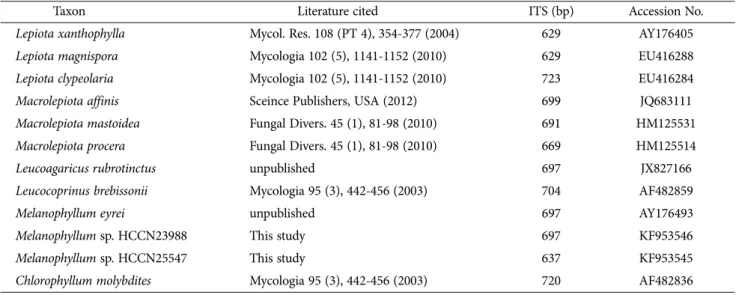
알고리즘을 사용하였고 branch에 대한 신뢰도를 얻기 위해 1000번 반복 분석을 수행하여 분석된 bootstrap 값을 사용 하였다. 이때 참고한 11개의 ITS rDNA 염기서열 정보는 Table 1과 같다.
결과 및 고찰
흑주름버섯속 Melanophyllum Velen., eskHouby 3: 569, (1921)
Syn.: Chlorosperma Murrill, Mycologia 14(2): 96, (1922) Chlorospora Massee, Bull. Misc. Inf., Kew: 136, (1898) Glaucospora Rea, Brit. basidiomyc. (Cambridge): 62, (1922)
Position in classification: Agaricaceae, Agaricales, Aga- ricomycetidae, Agaricomycetes, Agaricomycotina, Basidio- mycota, Fungi.
Characters: Carpophores pluteoid; pileus and stipe covered with epithelium; Lamellae free, brightly colored;
Spore print blue green, olive to green, later fuscous purple;
Stipe central, furfuraceous to shaggy at the lower portion, subannulate; Context fleshy, inamyloid, odor cucumbers;
Hyphae with clamp connection; Spores oblong-ellipsoid to ellipsoid, often angular, finely punctulate, without sup- rahilar depression, without germ pore, none pseudoamy- loid; Cystidia none; Hymenophoral trama regular. On various substrata, mostly on the earth or on manure piles, etc. Development of carpophores : pileostipitocarpous and bivelagiocarpous. Tree species are known worldly.
자실체는 난버섯형이고, 갓과 대는 구형각피층으로 구성 되어 있다. 주름살은 떨어진 주름살이고, 밝은 색을 띤다.
대는 중심형이고, 대하부 쪽은 비듬상-거친모가 있으며, 턱받이는 흔적만 있다. 조직은 육질형이고, 비아밀로이드 이며, 오이냄새가 난다. 균사에는 협구가 있다. 포자문은
Table 1. ITS rDNA sequence retrieved from GenBank
Taxon Literature cited ITS (bp) Accession No.
Lepiota xanthophylla Mycol. Res. 108 (PT 4), 354-377 (2004) 629 AY176405
Lepiota magnispora Mycologia 102 (5), 1141-1152 (2010) 629 EU416288
Lepiota clypeolaria Mycologia 102 (5), 1141-1152 (2010) 723 EU416284
Macrolepiota affinis Sceince Publishers, USA (2012) 699 JQ683111
Macrolepiota mastoidea Fungal Divers. 45 (1), 81-98 (2010) 691 HM125531
Macrolepiota procera Fungal Divers. 45 (1), 81-98 (2010) 669 HM125514
Leucoagaricus rubrotinctus unpublished 697 JX827166
Leucocoprinus brebissonii Mycologia 95 (3), 442-456 (2003) 704 AF482859
Melanophyllum eyrei unpublished 697 AY176493
Melanophyllum sp. HCCN23988 This study 697 KF953546
Melanophyllum sp. HCCN25547 This study 637 KF953545
Chlorophyllum molybdites Mycologia 95 (3), 442-456 (2003) 720 AF482836
신선할 때 청록색을 띠나 건조하면 적갈색을 띤다. 포자는 장방상타원형-타원형이고, 종종 각형이며, 세반점이 있고, 포자반은 없고, 발아공은 없으며, 위아밀로이드가 아니다.
시스티디아는 없다. 자실층조직은 평행형이다. 다양한 기 질위에 발생하며, 대부분 지상에 발생하고, 퇴비더미 등에 발생한다. 자실체발달은 내외피피질성 그리고 갓대상반피 실성이다. 현재까지 흑주름버섯속에는 2종 1변종이 기록 되어 있다.
Type species: Melanophyllum canali Velen
청흑주름버섯 (신칭) Melanophyllum eyrei (Mass.) Sing.
in Lilloa 22: 436, 1951
본 종은 흑주름버섯류 중에서 포자가 청색을 띠어서 한 국명을 ‘청흑주름버섯’으로 신칭하였다.
Basionym: Schulzeria eyrei Massee, Grevillea 22(no.
102): 38 (1893)
Synonym: Chlorospora eyrei (Massee) Massee, Trans.
Br. mycol. Soc. 2(5): 170 (1907) [1906] Cystoderma eyrei (Massee) Singer, Annls mycol. 41(1/3): 170 (1943) Glauco- spora eyrei (Massee) Rea, Brit. basidiomyc. (Cambridge):
62 (1922)Lepiota eyrei (Massee) J.E. Lange, Fl. Agaric.
Danic. 1: 27 (1935)
Macroscopic features (Fig. 1A and 1B)
Pileus: 8~25 mm across, convex to campanulate, margin incurved when young, then expanded to somewhat slightly upturned, broadly umbonate to umbo around center, sur- face white, later somewhat cream to ochraceous, especially pale ochraceous brown at umbo, white to ochraceous granular to fibril~floccose, margin with the remnants of the veil when young. Context white in pileus, cream to brownish in stipe, thin, taste mild, odor indistinct.
Lamellae: free, pale green when young, later bluish∼
green, subdistant to close, edge smooth.
Stipe: 40~80×1.5~3 mm, cylindrical, equal, slightly en- larged downward, with a few white rhizoids at the base, surface white, in the whole length white pulverulent to floccose when young, ochraceous, somewhat smooth when old, hollow. Inner veil white, floccose to membranous, usually appendiculate at pileal margin in mature and with some remnants of veil on the stipe.
Spore print: olivaceous green.
Fig. 1. Photographs of basidiocarps of the genus Melanophyllum; A and B, Melanophyllum eyrei; C and D, Melanophyllum haematospermum.
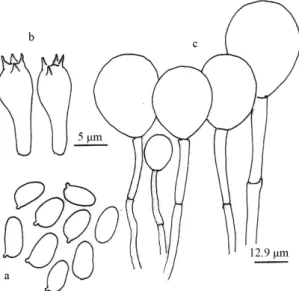
Microscopic features (Fig. 2)
Spores: 4.5~4.7×2.5~3.5 µm, elliptical to broadly ellip- tical, thick~walled, without germ pore and supra hilar depression, non dextrinoid.
Basidia: 15~24×5.5~8 µm, clavate, 4~spored, basal clamps not seen. Hymenophoral trama regular. Cheilocystidia and Pleurocystidia absent. Pileipellis 12~45µm diam, isodia- matic globose, subglobose to sphaerocysts, thin~walled, with sometimes brownish pigments at membrane. Hyphae with clamp connections.
Edibility: unknown.
Habits & Habitats: solitary sometimes few gregarious on the rich humus soils or among grasses in the forests, or along the road side and paths in the forests or park, summer to fall. Saprophytic fungi.
Distribution: Korea, Japan, Europe, North America, Asia and North Africa. Rare in Korea.
Materials examined: Donggurung, Guri-si, Gyeonggi-do, September 21. 2012 (HCCN 23988), Coll. by S. J. Seok.
Remarks: This species described here is characterized by the greenish lamellae and a whitish pileus and stipe, and also very rare species in Korea. However, M. haema- tospermum is characterized by the surface of the pileus and stipe farinose-granulose, spores fine warts (verrucose), thick-walled and the spore deposit olive green when fresh, and red brown when dry.
갓 : 크기가 8~25 mm로 성장초기에는 반반구형~종형이 고, 갓 끝은 안쪽으로 굽어 있으며, 성장하면 갓은 편평하 게 펴지며 종종 위로 반전되고, 중앙부위는 둥그스럼하거 나 약간 돌출되어 있다. 표면은 백색이나 성장하면 담황색
~담황토색을 띠고, 특히 중앙 돌출부위는 담황토갈색을 띠 며, 과립상 분질~면모상 분질은 백색~담황토색을 띠고, 갓 이 펴지면 갓 끝에 피막 잔유물이 부착되어 있다. 조직은 얇으며, 갓 부위는 백색이고 대는 담황색~담갈색이다. 냄 새는 불분명하고, 맛은 부드럽다.
주름살 : 떨어진 주름살이고, 약간 빽빽하거나 성글며, 어린시기에 담녹색을 띠나 후에 청록색을 띠고, 주름살날 은 평활하다.
대 : 크기가 40~80×1.5~3 mm로 원통형이고, 일반적으로 상하 굵기가 동일하나 아래쪽으로 약간 굵으며, 기부에 백 색의 가근(rhizoids)이 있다. 표면은 백색이고 어린시기에 는 전체에 백색 분질~면모상분질이 덮혀있으나 성장 후에 쉽게 소실되며, 담황토색을 띠며, 속은 비어 있다.
내피막 : 백색이고, 면모상~막질이며, 갓이 펴지면 대부 분 갓 끝에 부착되거나 일부는 대에 남에 턱받이 흔적이 있다. 포자문은 올리브녹색을 띤다.
포자 : 크기가 4.5~4.7×2.5~3.5 µm이고 모양은 타원형~
광타원형이고, 포자벽은 두꺼우며, 포자반(suprahilar dep- ression)과 발아공(germ pore)은 없고. 위아밀로이드가 아 니다.
담자기 : 크기가 15~24×5.5~8 µm이며, 곤봉형이고, 4포 자형이며, 기부에 협구가 없다. 자실층조직은 평행형이다.
날시스티디아와 측시스티디아는 없다. 갓표피층은 폭이 12
~45µm인 구형, 유구형세포로 구성되어 있으며, 세포벽은 얇고, 세포벽에 종종 갈색색소가 있다. 균사에 협구가 있다.
식용가능성 : 불명.
발생시기 및 서식지 : 여름~가을에 숲속, 공원의 길옆에 잔디 또는 잡초사이 부식 질이 풍부한 토양에 단생, 드물게 는 소수 군생하는 분해균이다.
분포 : 한국, 일본, 유럽, 북미, 아시아와 북아프리카, 국 내 희귀 종이다.
시험재료 : 경기도 구리시 동구릉, 2012. 9. 21. (HCCN 23988), 채집자 석순자.
관찰 : 여기에 기술된 종은 주름살이 녹색이고, 갓과 대가 백색이란 점에서 특징적이다. 붉은흑주름버섯(M. haema- tospermum)은 갓과 대의 표면이 분질~과립상분질로 피복 되어 있고, 포자문은 신선할 때 올리브녹색을 띠나 건조하 면 적갈색으로 된다는 점에서 특징적이다.
잔피막흑주름버섯 Melanophyllum haematospermum (Bull.) Kreisel in Feddes Repert. Spec. Nov. Regni Veg.
95(9~10): 700 (1984)
Basionym: Agaricus haematospermum Bull. Herb. Fr.
13: Tab. 595 (1793)
[Synonym] (http://www.speciesfungorum.org/Names/
Names.asp.)
Agaricus echinatus Roth, Catal. Bot. 2: 255 (1800) Agaricus echinatus Roth, Catal. Bot. 2: 255 (1800) var.
Fig. 2. Microscopic structures of Melanophyllum. eyrei. a, spores (×1,000); b, basidia (×1,000); c, pileipellis (×400).
echinatusAgaricus haematophyllus Berk., Mag. Zool. Bot. 1:
507 (1837)Agaricus haematospermus Bull., Herb. Fr. 13: tab.
595, fig. 1 (1793)Agaricus haematospermus Bull., Herb. Fr.
13: tab. 595, fig. 1 (1793) var. haematospermusAgaricus hookeri Klotzsch, in Smith, Engl. Fl., Fungi (Edn 2) (Lon- don) 5(2): 97 (1836)Cystoderma echinatum (Roth) Singer, Annls mycol. 34(4/5): 338 (1936)Cystolepiota echinata (Roth) SingerFungus haematospermus (Bull.) Kuntze, Revis. gen.
pl. (Leipzig) 3(2): 480, (1898)Inocybe echinata (Roth) Sacc., Syll. fung. (Abellini) 5: 773 (1887)Lepiota echinata (Roth) Qul., Bull. Soc. bot. Fr. 26: 45 (1880) [1879]Lepiota hae- matosperma (Bull.) Boud., Bull. Soc. mycol. Fr. 9: 6 (1893) Melanophyllum canali Velen., eskHouby 3: 570 (1921) Mel- anophyllum echinatum (Roth) Singer, Lilloa 22: 436 (1951) [1949]Naucoria echinata (Roth) J. Schrt., in Cohn, Krypt.
-Fl. Schlesien (Breslau) 3.1(33-40): 607 (1889)Pratella echi- nata (Roth) Gillet, Hymnomyctes (Alenon): 565 (1878) Pra- tella haematosperma (Bull.) Gillet, Hymnomyctes (Alenon):
566 (1878)Psalliota echinata (Roth) P. Kumm., Fhr. Pilzk.
(Zwickau): 73 (1871)Psalliota haematosperma (Bull.) S.
Lundell &Nannf., Fungi Exsiccati Suecici: no. 341 (1935) Psathyra echinata (Roth) Overh., Mycologia 25(5): 428 (1933)
Macroscopic features (Fig. 1c, and 1d)
Pileus: 10~30 mm across, conical to subconical when young, convex to nearly plane when mature, surface when young densely covered with fine pyramidal warts, then later granulose~farinose, cinnamon, pale brownish gray to light grayish brown, margin incurved for a long time and hung with veil remnants. context white, reddening when bruised, later fading, thin, odor indistinct, taste mild.
Lamellae: cinnamon~red when young, later brown red, finally dark brown, somewhat broad, crowded, adnexed, edges smooth.
Stipe: 30~40×1.5~3 mm, cylindrical, the base usually en- larged to somewhat bulbous, surface densely covered with dingy gray~beige farinose~granulose on a wine~red back- ground. and wine~red above the annular zone, fragile, hollow.
Annulus: on the upper third, floccose, fugacious.
Microscopic features
Spores: 4~5.5×2~3 µm, cylindric~elliptic, fine warts (ver- rucose), thick~walled, without germ pore, spore print olive green when fresh, quickly turns red~brown when dry.
Basidia: 28~32×5.5~6.5 µm, cylindric~clavate, 4~spored, without basal clamp. Cheilocystidia and pleurocystidia
not seen.
Pileipelis: composed of pyriforme, vescicular to subglo- bose cells, 16~35×10~25 µm, thin~walled, deeper hyphae periclinal, 2.2~4.5µm across, some with clamp connec- tions.
Edibility: unknown.
Habits & Habitats: solitary to gregarious on the damp to moist rich humus soils in the forests, or along side forest road and paths, late summer to fall.
Distribution: Korea, Japan, Europe, North America, Asia and North Africa.
Materials examined: Donneco, Sanghyo-Dong, Seo- gwipo-si, Jeju-do, July 1. 2004 (HCCN12069), Coll. by Y.
S. Kim; Mt. Chiak, Wonju-si, Gangwon-do, August 16.
2004 (HCCN 12304), Coll. by S. J. Seok; Sangye-dong, Seogwipo-si, Jeju-do, July 1. 2006 (HCCN13643), Coll.
by Y. S. Kim; Mt. Deogyu Seolcheon-myeon, Muju-gun, Jeollabuk-do, July 6. 2006 (HCCN13735), Coll. by S. J.
Seok; Mt. Seorak, Inje-gun, Gangwon-do, September 28.
2012 (HCCN24180), Coll. by S. J. Seok; Donggurung, Guri-si, Gyeonggi-do, September 25. 2012 (HCCN24125), Coll. by S. J. Seok; Donggurung, Guri-si, Gyeonggi-do, October 3. 2013 (HCCN235547), Coll. by S. J. Seok.
Remarks: This tiny mushroom with red lamellae is a rare species in Korea, and reminds one of genus Dermo- cybe. But the former differs from genus Dermocybe by the farinose~granulose surface of the pileus and stipe, spores fine warts (verrucose), thick~walled and the spore deposit olive green when fresh, and red brown when dry. The another species of this genus, M. eyrei (Mass.) Sing. is characterized by blue~green lamellae and a whitish pileus and stipe.
갓 : 크기가 10~30 mm로 성장초기에 원추형~유원추형 이고 성장하면 반반구형~거의 편평형으로 된다. 표면은 어 린시기에 피라미드상 돌기가 밀포되어 있으나, 점차 과립 상분질~분질로 된다, 육계색담갈회색~맑은회갈색을 띠며, 갓 끝은 장기간 안쪽으로 굽어있으며, 갓이 펴지면 내피막 잔유물이 부착되어 있다. 조직은 얇고, 백색이나 상처 시 적변하나 점차 적색이 없어진다. 냄새는 불분명하고, 맛은 부드럽다.
주름살 : 빽빽하고(L=40~50), 끝붙은주름살이며, 폭이 다소 넓고, 어린시기에 황갈적색을 띠고, 성장하면서 갈적 색을 띠다가 암갈색을 띤다. 주름살날은 평활하다.
대 : 크기가 30~40×1.5~3 mm로 원통형이며, 대 기부는 대부분 팽대하여 구근형이다, 표면은 포도주적색 바탕에 거므스름한 베이지색의 분질~과립상분질로 피복되어 있 으며, 턱받이 상부는 포도주적색이고, 잘 부서지며, 속은 비 어있다. 턱받이는 대상부 1/3에 있으며, 면모상이나 쉽게
소실된다.
포자 : 크기가 4~5.5×2~3 µm로 원통상타원형이고, 세사 마귀상 돌기가 있으며, 포자벽은 두껍고, 발아공이 없다. 포 자는 28~32×5.5~6.5 µm, 포자문은 신선할 때 올리브녹색 을 띠다가 건조하면 적갈색으로 변한다. 담자기는 크기가 28~32×5.5~6.5 µm로 원통상곤봉형이고, 4포자형이며, 기 부에 협구가 없다. 날시스티디아와 측시스티디아는 없다.
갓표피상층 : 크기가 16~35×10~25 µm인 서양배, 세포형
~유구형세포로 구성되어 있으며, 세포벽은 얇고, 보다 내 쪽 균사는 폭이 2.2~4.5 µm로 사상형이며, 세포벽은 얇고, 갓표면과 평행이며, 종종 협구가 있다.
식용가능성 : 불명
서식지 : 늦여름~가을에 숲속 또는 공원이나 숲속길가에 부식질이 풍부한 지상에 단생~군생하는 분해균이다, 국내 다소 희귀종이다.
분포 : 한국, 일본, 유럽, 북미, 아시아, 북아프리카.
시험재료 : 제주도 서귀포시 돈네코, 2004. 7. 1. (HCCN 12069), 채집자 김양섭; 강원도 원주시 치악산, 2004. 8. 16.
(HCCN12304), 채집자 석순자; 제주도 서귀포시 예레동, 2006. 7. 1. (HCCN13643), 채집자 김양섭; 전라북도 무주 군 설면 덕유산, 2006. 7. 6. (HCCN13735), 채집자 석순자;
강원도 인제군 설악산, 2012. 9. 28. (HCCN24180), 채집자 석순자; 경기도 구리시 동구릉, 2012. 9. 25. (HCCN24125), 채집자 석순자; 경기도 구리시 동구릉, 2013. 10. 3. (HCCN 235547), 채집자 석순자.
관찰 : 적색 주름살을 가진 작은 버섯은 국내에 희귀종이 며, 특징상 자규버섯속(Dermocybe)를 연상케 한다. 그러나
전자는 갓과 대의 표면에 분질~과립상분질이고, 포자는 사 마귀상 돌기가 있으며, 포자벽은 두껍고, 포자문은 신선할 때 올리브녹색을 띠다가 건조하면 적갈색을 띤다는 점에서 구별된다. M. eyrei (Mass.) Sing.은 주름살이 청록색을 띠 며, 갓과 대는 백색을 띤다는 점에서 쉽게 구별된다.
분자생물학적인 동정 : 두 표본의 계통학적 유연관계를 분 석하기 위해 NCBI GenBank database의 Lepiota 속 3종, Macrolepiota 속 3종, Melanophyllum 속 2종, Chlorophyllum 속 1종, Leucocoprinus 속 1종, Leucoagaricus 속 1종의 rDNA ITS 염기서열 data를 이용하여 Mrbayes v3.1로 Phy- logenetic tree를 그렸다(Fig. 3). 분석 결과, Melanophyllum 속 group에 포함되어 있는 것을 확인할 수 있었다. HCCN 23988은 M. eyrei (Vellinga, E. C., 2012; Accession No.
AY176493)와 98%의 상동성을 보였고 HCCN25547은 M.
haematospemum (Vellinga, E. C., 2012; Accession No. AY 176494)과 91%의 상동성을 보였다.
적 요
한국산 흑주름버섯속(Melanophyllum)의 종 다양성과 분 포상을 조사하는 과정에서 2종이 확인되었고, M. eyrei는 국내 미기록종과 M. haematospermum은 기존 보고된 종이 었다. 종 동정은 형태학적 현미경적 특징을 기초로 이루어 졌고, 또한 ITS 염기서열 분석을 통해 이루어졌다. 미기록 종은 ‘청흑주름버섯’으로 신칭하고, 기록종인 잔피막흑주름 버섯은 종의 특징을 보완하였다.
Fig. 3. Phylogenetic tree based on the ITS rDNA region (ITS1-ITS4) through Bayseian analysis of 1×10⁶ generations with branch lengths of a 50% majority rule consensus tree.
감사의 글
본 연구는 농촌진흥청 국립농업과학원 농업과학기술 연 구개발사업(과제번호: PJ008676)의 지원에 의해 이루어진 것이며, 이에 감사드립니다.
참고문헌
Fink, B. and Murrill, W. A. 1922. Notes and brief articles. My- cologia. 14(2):90-98.
Gardes, M. and Bruns, T. 1993. ITS primers with enhanced specificity for basidiomycetes: application to the identification of mycorrhizae and rusts. Mol. Ecol. 2:113-118.
Kasuya, T. and Knudsen, H. 2003. Two new records for Japan, Lepiota calcicola and Melanophyllum eyrei (Agaricaceae), My- coscience, 44: 327-329.
Kim, S. S. and Kim, Y. S. 1990. Korean mushrooms. 1-391. Yu-
poong Publishing Co., Seoul. (in Korean).
Kim, Y. S., Jung, H. C., Cha, D. Y. and Kim, D. S. 1985. Synthetic management of wild mushroom resourses, Agricultural Sci- ence Institute. 1-534. RDA. (in Korean).
Kornerup, A. and Wanscher, J. H. 1983. Methuen handbook of colour, 3rd. 1-252. Fletcher and Son Ltd. Norwich.
Largent, D. L., Johnson, D. and Watling, R. 1977. How to identify mushrooms to genus. 3:1-147. Mad River Press.
Park, J. S. and Kim, Y. S. 1987. Colored mushrooms in Korean (1). 1-304, Hanjin Publishing Co. Seoul. (in Korean).
Rea, C. 1922. British Basidiomycetae: A handbook to the larger British fungi. 1-799. Cambridge University.
Singer, R. 1986. Agaricales in modern taxonomy, Fourth edition, pp. 1-981. Koeltz Scientific Books, Koenigstein.
Velenovsk´y, J. 1921. Cˇeské Houby. 3: Cˇeská Botanická Spolecˇnost:
Prague. 425-632.
Index Fungorum [Internet]. Index fungorum; c2008 [cited 2013 Oct. 10]. Available from: http://www.indexfungorum.org/
Nmes/Names.asp