• 검색 결과가 없습니다.

Morphological and Phylogenetic Characteristics of Tuber himalayense Collected from Rhizosphere of Quercus dentata in Korea

N/A
N/A
Protected

Academic year: 2021

Share "Morphological and Phylogenetic Characteristics of Tuber himalayense Collected from Rhizosphere of Quercus dentata in Korea"

Copied!
8
0
0

로드 중.... (전체 텍스트 보기)

전체 글

(1)

This is an Open Access article distributed under the terms of the Creative Commons Attribution Non-Commercial License (http: //creativecommons.org/licenses/by- nc/4.0/) which permits unrestricted non-commercial use, distribution, and reproduction in any medium, provided the original work is properly cited.

© 2021 THE KOREAN SOCIETY OF MYCOLOGY.

Accepted: March 29, 2021 Revised: March 22, 2021 Received: February 26, 2021 https://doi.org/10.4489/KJM.20210010 Kor. J. Mycol. 2021 March , 49(1): 101-108

OPEN ACCESS pISSN : 0253-651X eISSN : 2383-5249

RESEARCH ARTICLE

Morphological and Phylogenetic

Characteristics of Tuber himalayense Collected from Rhizosphere of Quercus dentata in Korea

Hyeok Park

1

, Ju-Hui Gwon

1

, Jong-Chul Lee

1

, Hyun Suk Kim

2

, Geon-Sik Seo

3

, and Ahn-Heum Eom

1,*

1

Department of Biology Education, Korea National University of Education, Cheonju 28173, Korea

2

Jellanamdo Forest Resources Research Instutute, Naju 58213, Korea

3

Department of Mushroom Science, Korea National College of Agriculture and Fisheries, Jeonju 54874, Korea

*
Corresponding Author: [email protected]

ABSTRACT

We collected the ascomata of Tuber species from the rhizosphere of Quercus dentata in Danyang, Korea. We observed the morphological characteristics of ectomycorrhizal roots and ascomata, and identified the species based on the results of the phylogenetic analysis conducted using the DNA sequences of an internal transcribed spacer, a large-subunit rDNA, translation elongation factor 1-α DNA (TEF1), and MAT. Finally, we identified the fungal species as Tuber himalayense B.C. Zhang & Minter, which has not been recorded previously in Korea. We evaluated the morphological characteristics and conducted phylogenetic analysis of the ascoma and mycorrhiza (associated with Q. dentata) of T. himalayense.

Keywords: Ascoma, Ectomycorrhiza, Fruiting body, Truffle, Tuber himalayense

INTRODUCTION

Truffles are a group of fungi that produce hypogeous ascocarps; they belong to the genus Tuber (Ascomycota, Pezizales) [1]. Tuber spp. have ectomycorrhizal (ECM) associations with woody plants such as Quercus, Pinus, and Corylus [2,3]. Truffles have been widely used as edible mushrooms in Europe for a long time owing to their unique fragrance and flavor [1].

Tuber himalayense B.C. Zhang & Minter was first reported in 1988 [4] and its morphological characteristics were largely consistent with those of T. indicum, known as Asian black truffle; furthermore, it shared morphological and phylogenetical similarities with European black truffle Tuber melanosporum.

However, the fruiting bodies of T. himalayense are smaller than those of T. indicum and polygonal warts

attached to the outer side of the peridium has been recorded to be regular compared to those of T. indicum

[3,4] . As T. himalayense and T. indicum are systematically very close, their taxonomic distinction has not

been clarified and the two species have been considered as one or as T. indicum complex [5]. Recently, T.

(2)

himalayense and T. indicum have been distinguished at the species level using DNA sequences of the MAT genes, which determine the mating type of Tuber spp. [6,7].

The ascoma of only two Tuber spp. (Tuber aestivum subsp. uncinatum and Tuber huidongense) have been reported in Korea [8, 9]. Herein, we describe the morphological characteristics of the fruiting bodies of T. himalayense found in the rhizosphere of Quercus dentata Thunb. (an oak tree) in Korea and their mycorrhizal roots. We determined whether T. himalayense systematically differs from T. indicum using several molecular markers, including the MAT genes.

MATERIALS AND METHODS

The ascomata of T. himalayense were collected from the rhizosphere of Q. dentata in Danyang, Korea.

The morphological characteristics of ascoma, asci, and ascospores were examined under a light microscope.

For molecular identification, genomic DNA was extracted from the ascoma and ITS1/ITS4 primers [10]

and LR0R/LR16 primers were used to amplify internal transcribed spacer (ITS) regions and large subunits (LSU) of ribosomal DNA (rDNA) [11], respectively. EF1α Tuber-f and EF1α Tuber-r, and Tuber-r [12]

were also used to amplify the translation elongation factor 1-α. Additionally, the i3/il2 primers and i5/

il3 primers [7] were used to amplify MAT 1-1-1 and MAT 1-2-1 DNA for phylogenetic analysis with T.

indicum. After PCR amplification, DNA sequences were analysed (SolGent Co., Ltd., Daejeon, Korea).

Sequence similarities were determined using BLAST available from the National Center for Biological Information (NCBI). Phylogenetic trees were constructed using the neighbor-joining method with MEGA7 software [13].

The roots of Q. dentata were collected from the same sites in Danyang where the ascoma were collected.

The morphological and anatomical characteristic of ECM were examined under a stereomicroscope and light microscopes. Genomic DNA was extracted from the ECM root tips using DiaStar

TM

Direct Lysis Buffer (SolGent Co., Ltd., Daejeon, Korea). The ITS region of the rDNA was amplified using the ITS1F/

ITS4 primers and identified through phylogenetic analysis of the sequences.

RESULTS AND DISCUSSION

Taxonomy

Tuber himalayense B.C. Zhang & Minter, Transactions of the British Mycological Society 91 (4): 595

(1988) [MB#134661] (Fig. 1; Table 1)

(3)

Table 1. Morphological characteristics of Tuber himalayense ascoma from Danyang, Korea.

Characteristics T. himalayense CB20001 T. himalayense [3,4]

Shape Globose to subglobose, black to blackish

brown, irregular polygonal ornament Irregular but globose, lobed surface, black, polygonal wart

Size (20-35)×(17-28) mm in diameter 20-25 mm in diam.

Asci (2-4) spored, hyaline, irregular, with rounded margin, ellipsoidal to conical,

(48.33-)61.07(-76.28)×(32.09-)49.72(-62.20) μm in diam.

(1-)2-4(-5) spored, mostly globose, colourless, 55-70 μm in diam.

Ascospores Yellowish brown to dark brown, ellipsoid or fusiform, (16.89-)25.37(35.79)×(12.78-)18.00(-24.24) μm in diam.

Brown to dark reddish brown, ellipsoid to subglobose, 28-45(-50)×23-40(-45) μm in diam.

Spines Straight but sometimes curved,

(2.68-)4.47(-6.75) μm in high Up to 6 μm in high

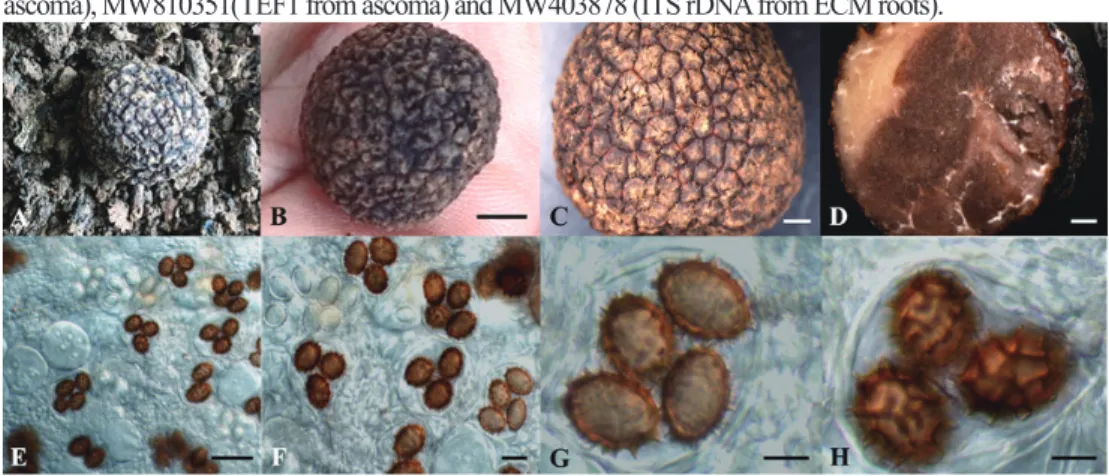
Fig. 1. Morphological characteristics of Tuber himalayense. Ascoma (A, B), surface ornament (C), peridium and gleba (D) asci (E, F), and ascospores (G, H) Scale bars: B=5,000 μm, C, D=2,000 μm, E=50 μm, F=20 μm, G, H=10 μm.

with rounded margin, ellipsoidal to conical, differing with the number of ascospores (2-4) in each ascus, (48.33-) 61.07 (-76.28) × (32.09-) 49.72 (-62.20) μm in diam. (Figs. 1E and 1F). Ascospore yellowish brown to dark brown, ellipsoid or fusiform, and (16.89-) 25.37 (-35.79) × (12.78-) 18.00 (-24.24) μm in diameter (Figs. 1G and 1H). The reticular structure on the surface of the mature ascospore resembles a turtle shell, with several spines on the external surface. These spines narrowed away from the basal structure and were usually straight although a few were curved, and (2.68-) 4.47 (-6.75) μm in length.

Specimen examined. Maepo-eup, Danyang-gun, Chungcheongbuk-do, Korea, October 16, 2020, Tuber himalayense B.C. Zhang & Minter, isolated from the rhizosphere of Quercus dentata, strain CB20001.

GenBank accession numbers, MW393547 (ITS rDNA from ascoma), MW386847 (LSU rDNA from

ascoma), MW810351(TEF1 from ascoma) and MW403878 (ITS rDNA from ECM roots).

(4)

Phylogenetic analysis

The phylogenetic analysis showed that the ascoma of CB20001 shared similarity of 98.87% with T.

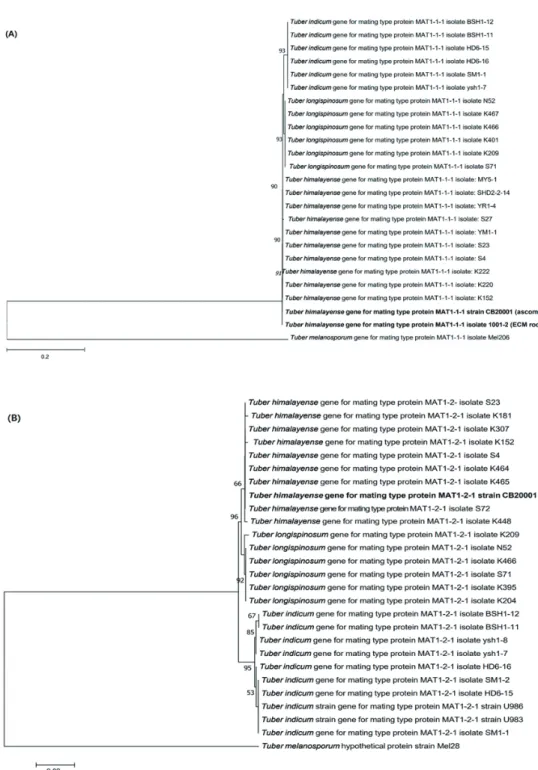
himalayense AB553388.1 for the ITS regions, 98.68% with T. himalayense AB553517.1 for the LSU regions, and 99.88% with T. himalayense AB553537.1 for the TEF1 regions. Phylogenetic analysis showed that the sequences for CB20001 was included in the same clade as T. himalayense (Fig. 2). Additionally, the sequence analysis of the MAT genes showed 100% similarity with T. himalayense LC312350.1 for the MAT 1-1-1 region and 100% similarity with T. himalayense LC312317.1 for the MAT 1-2-1 region.

The phylogenetic analysis confirmed that these sequences formed a distinct clade with the sequences of T.

indicum (Fig. 3).

Ectomycorrhiza of T. himalayense x Q. dentata

The ECM root tips were straight, velvety and brown to reddish brown (rarely red) (Figs. 4A-C). The

cross section of the ECM showed the fungal mantle and Hartig net (Figs. 4D and 4E). The fungal mantle

layer had an interlocking irregular synenchyma (Fig. 4F). The BLAST results showed that the ITS sequence

of the ECM root tip is closely related to that of T. himalayense AB553393.1 (99.66% similarity); thus, it

was identified as T. himalayense (Fig. 5).

(5)

Fig. 3. Neighbor-joining phylogenetic tree of T. himalayense based on the alignment of MAT 1-1-1 (A) and MAT 1-2-1 (B) sequences. Tuber melanosporum was used as the outgroup in both (A) and (B).

Numbers on branches indicate bootstrap values (1,000 replicate). The sequences from the present study

are shown in bold.

(6)

Fig. 4. Morphological characteristics of ectomycorrhiza colonized by Tuber himalayense from root of Quercus dentata. Mycorrhizal root tips (A-C); Transverse section of root tips stained with lactophenol cotton blue (D), outer mantle layer (E, F) Scale bars: A-C=500 μm, D=100 μm, E=50 μm, F=20 μm.

Fig. 5. Neighbor-joining phylogenetic tree of T. himalayense based on the alignment of internal

transcribed spacer (ITS) rDNA sequences obtained from ectomycorrhizal root tips (MW403878) and

(7)

The phylogenetic position of T. himalayense has not been clear due to its highly similar morphological characteristic with T. indicum. Chen et al. [14] classified T. himalayense and T. indicum into a T. indicum complex based on the phylogenetic analysis of LSU rDNA and beta-tubulin (TUB) DNA, whereas Qiao et al. [15] suggested classifying T. indicum and T. himalayense into different groups based on the analysis using simple sequence marker (SSRs). Recently, phylogenetic analysis using ITS, TUB, TEF1, and mating genes, MAT1-1-1 and MAT1-2-1, showed that the two species can be divided into separate clades and a new species, T. longispinosum was positioned between the clades Kinoshita et al. [9]. The ascoma of CB20001 collected from the rhizosphere of the oak tree was identified in this study using the ITS, LSU, and TEF1 regions and MAT genes, and the phylogenetic analysis validated the identification of CB20001 as T.

himalayense. Additionally, the morphological characteristics of mycorrhizas of T. himalayense associated with Q. dentata were confirmed. The host plants of T. himalayense include Quercus acutissima Carruth., Quercus serrata Thunb. ex. Murray, and Pinus densiflora Siebold & Zucc. [9], however, in this study, Q.

dentata was confirmed as a host plant of T. himalayense.

ACKNOWLEDGEMENT

This work was supported by the Korea Institute of Planning and Evaluation for Technology in Food, Agriculture, Forestry and Fisheries (IPET) funded by the Ministry of Agriculture, Food and Rural Affairs (MAFRA) (IPET319106052HD050).

REFERENCES

1. Trappe JM. The orders, families, and genera of hypogeous Ascomycotina (truffles and their relatives). Mycotaxon 1979;9:297-340.

2. Benucci GMN, Csorbai AG, Falini LB, Bencivenga M, Di Massimo G, Donnini D.

Mycorrhization of Quercus robur L., Quercus cerris L. and Corylus avellana L. seedlings with Tuber macrosporum Vittad. Mycorrhiza 2012;22:639-46.

3. García-Montero LG, Díaz P, Di Massimo G, García-Abril A. A review of research on Chinese Tuber species. Mycol Prog 2010;9:315-35.

4. Zhang B, Minter D. Tuber himalayense sp. nov. with notes on Himalayan truffles. Trans Brit Mycol Soc 1988;91:593-7.

5. Wang YJ, Tan ZM, Zhang DC, Murat C, Jeandroz S, Le Tacon F. Phylogenetic and populational study of the Tuber indicum complex. Mycol Res 2006;110:1034-45.

6. Belfiori B, Riccioni C, Paolocci F, Rubini A. Mating type locus of Chinese black truffles reveals heterothallism and the presence of cryptic species within the T. indicum species complex. Plos One 2013;8:e82353.

7. Kinoshita A, Nara K, Sasaki H, Feng B, Obase K, Yang ZL, Yamanaka T. Using mating-type loci to improve taxonomy of the Tuber indicum complex, and discovery of a new species, T.

longispinosum. Plos One 2018;13:e0193745.

(8)

8. Shin KS, Park JS, Yoshimi S. Note on Tuber aestivum subsp. uncinatum newly recorded in Korea. Kor J Mycol 1995;23:10-3.

9. Park H, Gwon JH, Lee JC, Kim HS, Oh DS, Eom AH. Report on Tuber huidongense, a truffle species previously unrecorded in Korea. Kor J Mycol 2020;48:505-10.

10. Gardes M, Bruns TD. ITS primers with enhanced specificity for basidiomycetes-application to the identification of mycorrhizae and rusts. Mol Ecol 1993;2:113-8.

11. Moncalvo JM, Lutzoni FM, Rehner SA, Johnson J, Vilgalys R. Phylogenetic relationships of agaric fungi based on nuclear large subunit ribosomal DNA sequences. Syst Biol 2000;49:278- 305.

12. Bonito G, Smith ME, Nowak M, Healy RA, Guevara G, Cázares E, Kinoshita A, Nouhra ER, Domínguez LS, Tedersoo L, et al. Historical biogeography and diversification of truffles in the Tuberaceae and their newly identified Southern Hemisphere sister lineage. Plos One 2013;8:e52765.

13. Kumar S, Stecher G, Tamura K. MEGA7: Molecular evolutionary genetics analysis version 7.0 for bigger datasets. Mol Biol Evol 2016;33:1870-4.

14. Chen J, Guo SX, Liu PG. Species recognition and cryptic species in the Tuber indicum complex. Plos One 2011;6:e14625.

15. Qiao P, Tian W, Liu Pg, Yu FQ, Chen J, Deng XJ, Wan SP, Wang R, Wang Y, Guo H.

Phylogeography and population genetic analyses reveal the speciation of the Tuber indicum

complex. Fungal Genet Biol 2018;113:14-23.

수치

Table 1. Morphological characteristics of Tuber himalayense ascoma from Danyang, Korea.
Fig. 3. Neighbor-joining phylogenetic tree of T. himalayense based on the alignment of MAT 1-1-1 (A)  and MAT 1-2-1 (B) sequences
Fig. 4. Morphological characteristics of ectomycorrhiza colonized by Tuber himalayense from root of  Quercus dentata

참조

관련 문서

MP Yousef Al-Fadalah, Supervisor of Parliament Business Environment Committee declared that the Public Institution for Housing Care intends to dedicate nearly 150

Due to the heavy downpours during the coming few hours, and anticipations of Meteorological Department that weather fluctuation shall continue, it has been decided

Kuwait Direct Investment Promotion Authority (KDIPA) said the 2019 Doing Business Report of the World Bank Group, came in recognition of the reforms made between June 2, 2017, and

The main objective of the Bi Regional Center for SMES Development is oriented towards generating the conditions of cooperation among the countries which

Current Tokyo is rich in green compared to other metro cities. In some parts, the greenery has been contributed by the many inherited gardens from the Edo era to today which

In a statement to Kuwait News Agency (KUNA) on the sidelines of a meeting of the Arab Parliament's Foreign Affairs Political and National Security

The meeting was attended by Assistant Foreign Minister for GCC Affairs, Ambassador, Nasser Al-Muzayyen, and Deputy Assistant Foreign Minister for the Office of the

“ Sheikh Nasser has a written message from HH the Amir, Sheikh Sabah Al-Ahmad Al-Jaber Al-Sabah to the Chinese President, Chi Gen Beng related to enhancing mutual