Journal of the Korea Institute for Structural Maintenance and Inspection Vol. 19, No. 4, July 2015, pp.025-034
http://dx.doi.org/10.11112/jksmi.2015.19.4.025
pISSN 2234-6937 eISSN 2287-6979
확률 기반의 신뢰도를 이용한 비파괴 압축강도 추정식 평가
The Evaluation of Non-Destructive Formulas on Compressive Strength Using the Reliability Based on Probability
박 진 우1)* 추 진 호2) 박 광 림3) 황 인 백4) 신 용 석5) Jin-Woo Park Jin-Ho Choo Gwang-Rim Park In-Baek Hwang Yong-Suk Shin
Abstract
Proposed equation is used many time in calculation of concrete compressive strength using the non-destructive testing at precision safety diagnosis. Most of proposed equation is suggested in abroad and have an error to estimate concrete compressive strength in the domestic. Therefor, proposed equation is low reliability to estimate concrete compressive and it has a significant effect in reliability of precision safety diagnosis. Nevertheless, It is possible to increase the reliability through a number of experiments from this problem that occurs in some localized part. This paper is proposed assessment formula of reliability related core compressive strength to increase the reliability. It is verified that reliability of proposed assessment formula is useful by probabilistic techniques. It is compared with each graphs of concrete compressive strength of proposed equation. It has been found that the present methods are very efficient.
Keywords : Standard Deviation, Reliability, Concrete Compressive Strength, Non-Destructive Testing
1) 정회원, 한국시설안전공단 사원, 교신저자 2) 정회원, 한국시설안전공단 차장 3) 정회원, 한국시설안전공단 부장 4) 정회원, 한국시설안전공단 실장 5) 정회원, 한국시설안전공단 실장
* Corresponding author : [email protected]
• 본 논문에 대한 토의를 2015년 8월 31일까지 학회로 보내주시면 2015년 9월호에 토론결과를 게재하겠습니다.
Copyright Ⓒ 2015 by The Korea Institute for Structural Maintenance and Inspection. This is an Open Access article distributed under the terms of the Creative Commons Attribution Non-Commercial License (http://creativecommons.org/licenses/by-nc/3.0)which permits unrestricted non-commercial use, distribution, and reproduction in any medium, provided the original work is properly cited.
1. 서 론
콘크리트 구조물을 사용 중이거나 기존구조물의 내력을 판단하기 위하여 콘크리트 압축강도는 중요한 요소로 정밀 안전진단시 반드시 측정된다. 이러한 목적을 달성하기 위하 여 구조물의 콘크리트 압축강도 측정방법으로 구조체에 손 상을 끼치지 않은 비파괴시험의 유용성에 대하여 다양한 방 법이 제안되었다.(Oh et al, 2001; Kim, 2000; Lim, 2001)
비파괴 시험은 반발경도법 및 초음파법등의 간접적인 방 법으로 접근하기 때문에 그 정확도 면에서 파괴시험인 일축 압축강도와 차이가 발생하며 비파괴 시험을 이용한 측정값 과 구조물의 상태에 있어서의 불확실성은 정밀한 상태진단 에 큰 영향을 미친다.(Shim, 2009)
초음파에 의한 압축강도 추정은 콘크리트의 내부 상태에
따라 초음파 전달속도는 달라질 수 있으며 고강도 콘크리트 의 경우 초음파 전달속의 차이가 미미해져 강도의 추정이 어 려워진다.(Cho, 2009; Kim, 2007)
강도를 추정하기 위한 방법으로 강도추정식을 이용한 방 법이 많이 사용되고 있으며 이 경우 이용되는 강도추정식은 외국에서 이미 제안된 식이 그대로 사용되고 있는데, 대부분 일본에서 제안된 강도추정식을 적용하고 있을 뿐만 아니라 적용되는 추정식에 따라서 추정강도의 차이가 심하게 발생 하는 등 전체적으로 강도추정의 신뢰도가 낮고 이에 따라 안 전진단 결과의 신뢰성에도 상당한 영향을 미친다.(Lim, 2007;
No, 2001; Ra, 1998; Kim, 2007)
이런 문제점은 일부 국한된 부분에서 발생하게 되어 다수 의 실험을 통해 신뢰도를 높일 수 있는 것으로 확인되었다. 이와 같은 필요성을 포괄하기 위해 각 시험별 상관관계를 확
Data Collect
Estimating Compressive Strength of Each Existing Equation
Evaluation Correlation Coefficient
Probability Distribution Drawing
Reliability Estimation
Overlapping Probability Calculation
Modification Factor
Selecting Equation
Comparative Analysis
Fig. 1 Proposed method based on reliability of flow chart
Table 1 Standard of a correlation coefficient
Correlation Coefficient Note
> 0.9 more higher
0.7∼0.9 higher
0.4∼0.7 be correlation
0.2∼0.4 lower
< 0.2 more lower
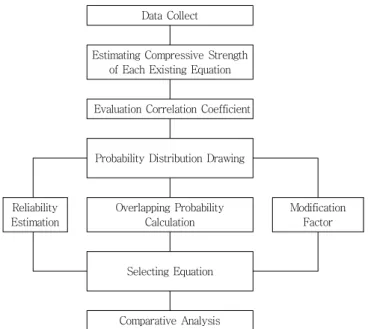
인하고 인과관계를 규명하기위해 확률론적 신뢰도 기법을 활용하여 신뢰도 평가가 실시되면 공학적 의사결정을 위한 지표로 활용될 수 있으며 그 절차는 Fig. 1과 같다.
2. 확률론적 신뢰도 기반의 압축강도 평가방법
2.1 평정자간 신뢰도(Inter-rater Reliability)
평정자란 평가를 정의하는 사람을 말하며, 평정자간 신뢰도 는 한 평가자가 다른 평가자와 얼마나 유사하게 평가하였는 가를 나타내는 지수이다. 평정자간 신뢰도를 추정하는 일반적 인 방법으로는 Pearson의 단순적률상관계수를 이용하는 것과 평가자간의 분류일치도를 분석하는 일치도 통계(agreement statistics), 일치도 통계에서 우연에 의한 확률을 제거하고 평 정자간의 일치도를 추정하는 Kappa 계수, 그리고 일반화가 능도 이론이 사용되고 있다.(Yi, 2007)
따라서, 본 연구의 평가는 연속변수이므로 Pearson의 단순 적률상관계수와 일반화가능도 이론을 사용할 수 있으나, 압 축강도만을 가지고 분석하였으므로 Pearson의 단순적률상관 계수만을 이용하였다. Pearson의 단순적률상관계수를 산출하 는 공식은 다음과 같다.
(2.1)여기서, : 피험자 수
: 한 평가방법으로 평가한 강도
: 다른 평가방법으로 평가한 강도
상관계수의 상관정도는 일반적으로 Table 2와 같다.(Kwak, 2013)
2.2 구조물 신뢰성 이론 고찰
토목구조물의 신뢰성 공학의 도입은 구조물의 안정성 평 가에 적용되어 왔다. 구조물의 안정성 측면에서 바라 볼 때 신뢰성 공학을 살펴보면 구조물에 가해지는 하중(하중 요소, load factor) L과 그에 저항하는 구조물의 저항 요소(resistance) R로 표시되어 있으며 구조물의 안전(safety 또는 success)과 파괴(failure)를 판단할 수 있는 설계 기준(design criterion) Z는 식(2.2)과 같다.
(2.2)
식(2.2)과 같은 설계기준식은 대부분 해석 대상이 되는 구 조물의 파괴 양식(failure mode)에 따라 유도된 식이므로 파 괴 방정식(failure equation), 한계 상태 방정식(limit state equation) 또는 안전 여유(safety margin) 등으로 불려진다.
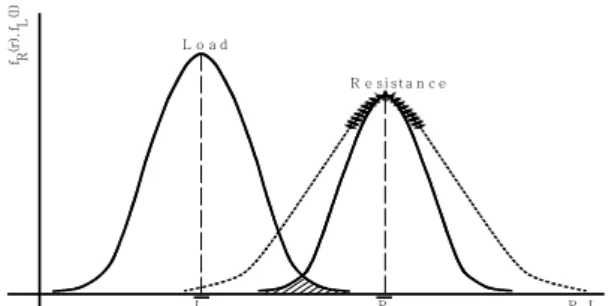
기존의 결정론적인 방법에서는 R과 L의 분산 특성을 무시 하고 대푯값 과 만을 고려하여 적당한 안전 계수 값 즉, 항상 이 보다 큰 상태가 유지되는 수준을 택하여 파괴 에 대한 안전 여유를 두어 왔다. 이와 같은 방법은 R과 L의 분산 특성을 고려하는 확률론적인 입장에서도 Fig. 2에서 확 인할 수 있듯이 대푯값 을 증가시키면 파괴 확률과 관계가 있는 R과 L의 밀도 함수가 겹쳐지는 부분의 면적이 감소하 게 되는 사실로도 그 유효성을 설명할 수 있다.
또한, Fig. 3에서 확인할 수 있듯이 R과 L의 대푯값 과
이 일정하게 유지되어 동일한 안전 계수를 갖는 경우라 하 더라도, R이나 L의 분산 특성이 변함에 따라 파괴 확률도
L o a d
R e si st a n c e
L R R ' R , L
f R(r), f L
(l)
Fig. 2 Change of probability of failure due to change of mean
L o a d
R e s i s t a n c e
L R R , L
f R
(r),
f L
(l)
Fig. 3 Change of probability of failure due to change of variance
N N,C
Non- Destructive compressive strength
Core compressive strength
C f N(n),
f C(c)
Fig. 4 The Change of overlapping probability due to change of mean(Compressive Strength)
=
Non- Destructive compressive strength
Core compressive strength
N C N,C
f N(n), f C
(c)
Fig. 5 The Change of overlapping probability due to change of variance(Compressive Strength)
달라질 수 있다.
따라서, 구조물의 신뢰도를 합리적으로 평가하기 위해서는 단순히 설계 변수들의 대푯값만을 고려한 안전 계수 개념을 이용하는 것보다는 설계 변수들의 통계적인 분산 특성까지 도 고려한 파괴 확률의 개념을 이용하는 것이 더욱 설득력을 갖는다고 할 수 있다.
즉, 평균뿐만 아니라 분산의 영향도 구조물의 신뢰도를 결 정하는데 중요한 인자인 것이다. 따라서 구조물의 안정성 평 가를 하기위한 신뢰도 평가를 위한 식은 식(2.3)와 같다.
(2.3)
여기서, 는 신뢰도, ,,는 각각 설계기준, 저항요 소, 하중요소의 확률분포 평균, ,,는 각각 설계기준, 저항요소, 하중요소의 표준편차 임.
2.3 압축강도 신뢰도 평가
압축강도의 신뢰성 공학은 실제 구조물이 가지고 있는 압 축강도와 비파괴 추정에 따른 압축강도의 유사성 평가에 적 용된다. 콘크리트 구조물의 실제 압축강도는 실내시험을 통
해 얻어지는 코아압축강도로 대변되며 안정성 측면을 고려 한 구조물 신뢰성 이론과 달리 유사성을 근간으로 콘크리트 의 실제 압축강도(코아압축강도, Core compressive strength)
와 비파괴 시험에 의해 추정되는 압축강도(Non-Destructive compressive strength) 으로 표시하며 코아압축강도와 비 파괴압축강도가 서로 일치한다고 가정하여 표현하면 식(2.4) 과 같다.
≈ (2.4)
기존의 결정론적인 방법에서는 와 의 분산 특성을 무 시하고 대푯값 와 만을 고려하여 보정 계수가 1에 가까 운 값을 택하여 왔다. 이와 같은 방법은 와 의 분산 특 성을 고려하는 확률론적인 입장에서도 Fig. 3에서 확인할 수 있듯이 대푯값 이 감소하면 유사확률과 관계가 있는 와
의 밀도 함수가 겹쳐지는 부분의 면적이 감소하게 되는 사 실로도 그 유효성을 설명할 수 있다.
그러나, Fig. 4에서 확인할 수 있듯이 와 의 대푯값 와 이 일정하게 유지되어 동일한 보정 계수를 갖는 경우
라 하더라도, 이나 의 분산 특성이 변함에 따라 유사 확 률도 달라질 수 있다.
구조물의 신뢰도를 합리적으로 평가하기 위해서는 단순히 압축강도의 평균값만을 고려한 보정 계수 개념을 이용하는 것보다는 압축강도의 통계적인 분산 특성까지도 고려한 유 사 확률의 개념을 이용하는 것이 더욱 설득력을 갖는다고 할 수 있다.
따라서 본 연구는 앞에서 압축강도의 확률론적 신뢰성 이 론을 살펴 본바와 같이 콘크리트의 일축압축강도(Unconfined compressive strength) 와 비파괴 시험에 의해 추정되는 압 축강도(Non-Destructive compressive strength) 의 관계성 을 식(2.5)와 같이 나타낼 수 있다.
≈ (2.5)
즉, 콘크리트의 실제 압축강도(코아압축강도, Core compressive strength) 와 비파괴 시험에 의해 추정되는 압축강도(Non- Destructive compressive strength) 의 함수가 유사하면 유 사 할수록 1에 가까워진다.
따라서 이를 고려하여 평균과 표준편차를 재구성하여 다 음과 같은 유사 신뢰도(Similar reliability, )를 제안하며
의 범위를 갖는다.
(2.6)3. 일축압축강도 및 비파괴 3.1 콘크리트 일축압축강도 시험
콘크리트의 압축강도용 코어공시체는 Ø150×300㎜를 기 준으로 하며, Ø100×200㎜의 코어 공시체의 경우에는 강도 보정계수 0.97을 곱하여 보정하였다.
3.2 비파괴 강도
3.2.1 반발경도법
반발경도(Ro)와 타격방향에 따른 보정계수(ΔR), 재령계수 (α)를 이용하여 콘크리트 압축강도를 추정하기 위해 주로 적 용되는 제안식은 다음과 같다.(KISTEC, 2011; Ra, 1998)
Table 2 List of suggestion formula (Rebound Hardness)
Researcher Suggestion formula
Materials Science Society
of Japan Architecture Institute of
Japan ×
KISTEC(Box)
KISTEC(Tunnel)
Tokyo building materials
laboratory ×
US army ×
SeoulMetro(Box) SeoulMetro(Tunnel)
Kimura × ×
Linear regression equation ∙
여기서, : 추정강도 (MPa)
: 반발경도 측정값
: 타격각도에 의한 보정값
: 각각 기울기 및 상수
: 구조물 경과 년수
3.2.2 초음파 전달속도시험
콘크리트의 강도를 조사하기 위해서는 초음파의 전파시간 을 표면법으로 측정한 후 전파속도를 구하여 다음 식으로부 터 콘크리트의 강도를 추정하였다.(KISTEC, 2011)
Table 3 List of suggestion formula (Ultrasonography)
Researcher Suggestion formula
Materials Science Society of
Japan ×
Architecture Institute of Japan ×
J.Pysiak ×
Tanigawa ×
Linear regression equation ∙
여기서, : 추정강도 (MPa)
: 초음파 속도
3.3 비파괴강도 보정계수(Modification Factor)
신뢰성있는 비파괴강도 추정을 위해서는 실제구조물에서 채취한 코어강도를 고려할 필요가 있으며, 이를 위하여 선정 된 비파괴강도 제안식에 아래와 같이 보정계수를 산출한 후,
Table 5 Correlation coefficient to Non-Destructive estimating
Classifying Rebound Hardness Ultrasonography
CASE 1 0.315 0.570
CASE 2 0.266 0.590
CASE 3 0.558 0.022
CASE 4 0.321 0.727
CASE 5 0.361 0.607
CASE 6 0.621 0.631
CASE 7 0.185 0.109
CASE 8 0.307 0.964
Fig. 6 Correlation coefficient graph (Non-Destructive) 보정계수를 제안식에 곱하여 대상 시설물의 콘크리트 비파
괴강도를 추정하는 것이 바람직하다.(KISTEC, 2011)
보정계수(Modification Factor) :
여기서, : 코아 압축강도 (MPa)
: 추정된 비파괴강도(MPa)
: 자료의 개수
4. 신뢰성 평가
본 구조물은 지중 구조물로서 박스와 터널로 구성되어 있 으며 각 표본의 비파괴 시험법(반발경도법, 초음파 전달속도 법)에 따른 제안식(반발경도법 10개, 초음파 전달속도법 5개) 을 실내압축강도와 비교하여 평가하였다.
4.1 표본현황
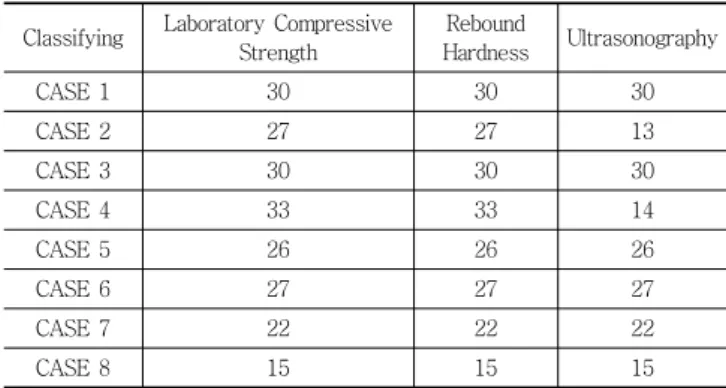
본 연구의 표본 대상은 지하철 및 철도의 지중 구조물로서 표본의 비교 분석을 고려하여 동일장소의 데이터를 추출하 여, CASE당 일축압축강도 및 반발경도법는 각15~33개, 초 음파 전달시험법은 13~30개를 그 대상으로 하였다.
Table 4 Number of sample Classifying Laboratory Compressive
Strength
Rebound
Hardness Ultrasonography
CASE 1 30 30 30
CASE 2 27 27 13
CASE 3 30 30 30
CASE 4 33 33 14
CASE 5 26 26 26
CASE 6 27 27 27
CASE 7 22 22 22
CASE 8 15 15 15
4.2 평정자간 신뢰도 분석
평정자간 신뢰도 분석 결과 ‘일축압축강도’와 ‘비파괴시험’
의 CASE별 상관관계는 CASE7을 제외한 모든 CASE에서 서로 상관관계가 있는 것으로 나타났고, ‘반발경도법’은 CASE3
에서 ‘초음파 전달속도법’은 CASE3,7을 제외한 모든 CASE 에서 상관관계를 보여 관계비도로 볼 때 ‘초음파 전달속도 법’이 ‘일축압축강도’와 우세한 관계성을 나타냈다.
4.3 신뢰성 분석
4.3.1 CASE1(○○지하철1호선)
Table 6 Unconfined compressive strength of CASE1
Classifying Mean[MPa] StDev[MPa]
Unconfined Compressive Strength 33.01 6.41
Table 7 Reliability analysis result of CASE1 Classifying Mean
[MPa]
StDev [MPa]
Overlapping Probability
Modification Factor linear regression
equation (Ultrasonography)
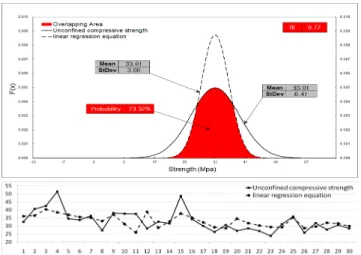
33.01 3.66 0.77 73.52% 1.001
일축압축강도와 추정식간의 신뢰도 분석결과 선형회귀식 (초음파)이 채택되었으며, 유사확률은 73.52%로 나타났다.
Fig. 7 Reliability probability distribution and trend (UCS-Linear regression(Ultrasonography))
4.3.2 CASE2(○○지하철3호선 터널구간) Table 8 Unconfined compressive strength of CASE2
Classifying Mean[MPa] StDev[MPa]
Unconfined Compressive Strength 25.71 6.60
Table 9 Reliability analysis result of CASE2 Classifying Mean
[MPa]
StDev [MPa]
Overlapping Probability[%]
Modification Factor linear regression
equation (Ultrasonography)
24.97 4.52 0.78 75.07% 1.001
Fig. 8 Reliability probability distribution and trend (UCS-Linear regression(Ultrasonography))
일축압축강도와 추정식간의 신뢰도 분석결과 선형회귀식 (초음파)이 채택되었으며, 유사확률은 75.07%로 나타났다.
4.3.3 CASE3(○○지하철3호선 박스구간) Table 10 Unconfined compressive strength of CASE3
Classifying Mean[MPa] StDev[MPa]
Unconfined Compressive Strength 31.41 6.12
Table 11 Reliability analysis result of CASE3 Classifying Mean
[MPa]
StDev [MPa]
Overlapping Probability[%]
Modification Factor Architecture
Institute of Japan (Rebound Hardness)
28.82 4.27 0.75 75.37% 1.095
linear regression equation (Ultrasonography)
35.16 0.12 0.71 5.67% 1.000
Fig. 9 Reliability probability distribution and trend (UCS-Architecture institute of Japan(Rebound))
Fig. 10 Reliability probability distribution and trend (UCS-Linear regression(Ultrasonography))
신뢰성 분석결과 ‘유사확률’과 ‘유사신뢰도’는 일본건축학 회(반발경도)식을 ‘보정계수’는 선형회귀식(초음파)을 각각 채택하였으며, 유사확률은 가각 일본건축학회식(반발경도)이 75.37%, 선형회귀식(초음파)이 5.67%로 나타났다.
4.3.4 CASE4(○○지하철4호선 터널구간) Table 12 Unconfined compressive strength of CASE4
Classifying Mean[MPa] StDev[MPa]
Unconfined Compressive Strength 24.00 5.05
Table 13 Reliability analysis result of CASE4 Classifying Mean
[MPa]
StDev [MPa]
Overlapping Probability[%]
Modification Factor linear regression
equation (Ultrasonography)
25.31 3.27 0.75 76.74% 0.989
Fig. 11 Reliability probability distribution and trend (UCS-Linear regression(Ultrasonography))
일축압축강도와 추정식간의 신뢰도 분석결과 선형회귀식 (초음파)이 채택되었으며, 유사확률은 76.74%로 나타났다.
4.3.5 CASE5(○○지하철4호선 박스구간) Table 14 Unconfined compressive strength of CASE5
Classifying Mean[MPa] StDev[MPa]
Unconfined Compressive Strength 32.38 6.51
Table 15 Reliability Analysis Result of CASE5 Classifying Mean
[MPa]
StDev [MPa]
Overlapping Probability[%]
Modification Factor linear regression
equation (Ultrasonography)
32.38 3.95 0.78 76.29% 1.000
Fig. 12 Reliability probability distribution and trend (UCS-Linear regression(Ultrasonography))
일축압축강도와 추정식간의 신뢰도 분석결과 선형회귀식 (초음파)이 채택되었으며, 유사확률은 76.74%로 나타났다.
4.3.6 CASE6(○○지하철5호선)
Table 16 Unconfined compressive strength of CASE6
Classifying Mean[MPa] StDev[MPa]
Unconfined Compressive Strength 29.77 5.30
Table 17 Reliability analysis result of CASE6 Classifying Mean
[MPa]
StDev [MPa]
Overlapping Probability[%]
Modification Factor linear regression
equation (Ultrasonography)
29.77 3.34 0.79 78.08% 1.000
Fig. 13 Reliability probability distribution and trend (UCS-Linear regression(Ultrasonography))
일축압축강도와 추정식간의 신뢰도 분석결과 선형회귀식 (초음파)이 채택되었으며, 유사확률은 78.08%로 나타났다.
4.3.7 CASE7(○○터널)
Table 18 Unconfined compressive strength of CASE7
Classifying Mean[MPa] StDev[MPa]
Unconfined Compressive Strength 36.58 3.50
Table 19 Reliability analysis result of CASE7 Classifying Mean
[MPa]
StDev [MPa]
Overlapping Probability[%]
Modification Factor Architecture
Institute of Japan (Rebound Hardness)
33.90 1.55 0.69 49.40% 1.082
linear regression equation (Ultrasonography)
36.58 0.38 0.71 21.57% 1.000
Fig. 14 Reliability probability distribution and trend (UCS-일본건축학회(반발))
Fig. 15 Reliability probability distribution and trend (UCS-Linear regression(Ultrasonography))
신뢰성 분석결과 ‘유사신뢰도’와 ‘보정계수’는 선형회귀식 (초음파)식을 ‘유사확률’은 일본건축학회(반발경도)을 각각 채택하였으며, 유사확률은 선형회귀식(초음파)이 49.40%, 선 형회귀식(초음파)이 21.57%로 비교적 낮게 나타났다. 이는 상관관계가 ‘초음파 전달속도 시험법’이 0.185(more lower),
‘반발경도법’이 0.109(more lower)로 매우 낮기 때문이다.
4.1.8 CASE8(○○터널)
Table 20 Unconfined compressive strength of CASE8
Classifying Mean[MPa] StDev[MPa]
Unconfined Compressive Strength 30.69 3.70
Table 21 Reliability analysis result of CASE8 Classifying Mean
[MPa]
StDev [MPa]
Overlapping Probability[%]
Modification Factor linear regression
equation (Ultrasonography)
30.69 3.57 0.97 98.21% 1.000
Fig. 16 Reliability probability distribution and trend (UCS-Linear regression(Ultrasonography))
일축압축강도와 추정식간의 신뢰도 분석결과 선형회귀식 (초음파)이 채택되었으며 유사확률 98.21%, 상관관계 0.97(more higher)로 CASE중 가장 높게 나타났다.
5. 결 론
평정자간 신뢰도 분석 결과 ‘초음파 전달속도법’이 ‘반발 경도법’보다 ‘일축압축강도’와의 관계성이 더 높은 것으로 나타났다.
CASE7의 경우 평정자간 신뢰도 분석에서 도출된 상관계 가 낮으면 신뢰성 평가가 불합리하게 나타나 평정자간 신뢰 도 분석이 선행되어야 함을 알 수 있었다.
CASE3경우 기존 평가방법인 보정계수에 의해 채택된 선 형회귀식(초음파)에 비해 유사 신뢰도()에 의해 채택된 일 본건축학회식(반발경도)이 ‘일축압축강도’와 보다 유사한 것 으로 나타나 유사신뢰도에 의한 판별력이 효과적임을 확인 하였다.
CASE8 경우 가장 높은 상관성 및 유사성을 가진 ‘선형회 귀식(초음파)’이 채택되어 본 연구의 평가가 효과적임을 확 인할 수 있었다.
본 연구는 산출된 신뢰도에 대한 상대적 평가만 이루어진 상태이므로 향후 더 많은 CASE에 대한 분석을 통해 등급별 신뢰수준 지표가 제안되어야 할 것이다.
References
1. Cho, C. H. (2008), Calculation of Aging Effects of Ultrasonic Pulse Velocity in Concrete by Non-Destructive Test, Journal of Korea Institute of Safety Inspection, KSMI, 12(6), 173-179.
2. H-S, A., Ang, W. H., Tang, (2007), Probability Concepts In Engineering, John Wiley, New York, 361-438
3. Jeong, J. H. (1999), Reliability-Based Highway Geometric Design, KICT, Ilsan, 27-43.
4. Kim, J. S., Shin, Y. S., Kim, P. S., Cho, C. H.,(2005), A Study on the Estimation of Strength Nondestructive Test of the Admixture Concrete, Journal of Korea Institute of Safety Inspection, KSMI, 9(4), 217-226.
5. Kim, M. S., Baek, D. I., Youm, C. S. (2007), A Study on the Strength Prediction of Crushed Sand Concrete by Ultra-sonic Velocity Method, Journal of Korea Institute of Safety Inspection, KSMI, 5(3), 123-130
6. Kim, G. H. (2007), The reliability for the estimated strength by the ultrasonic pulse velocity, Hanyang University, Seoul, 31-43.
7. Kim, S. B. (2000), A Study Estimation of Compressive Strength for concrete by Non- Destructive Tests, Kyungil University, Gyeongsan, 1-5.
8. KISTEC (2011), Guideline of Precise Inspection for Safety and Diagnosis, Common, 12-56 (in Korean).
9. Kwak, J. M. (2013), Research and Statistical Analysis, Informa, Seoul, 197-203
10. Kwon, S. J., Park, S. S., Nam, S. H., Lho, B. C. (2008), A
Service Life Prediction for Unsound Concrete Under Carbonation Through Probability of Durable Failure, Journal of Korea Institute of Safety Inspection, KSMI, 12(2), 49-58
11. Lee, Y. H., Mun, M. S. (1998), A Study on Safety Evaluation of Structures based on Reliability Analysis, Land
& Housing Institute, 9-26.
12. Lim, S. H., Kang, H. S. (2001), Estimating Compressive Strength of High Strength Concrerte by Ultrasonic Pulse Velocity Method, Journal of Korea Institute of Safety Inspection, KSMI, 11(4), 71-78
13. Lim, S. Y. (2007), A Study on the Estimation of Compressive Strength of Concrete by Non-Destructive Test, Daegu University, Daegu, 1-2.
14. No, Y. K. (2001), A Study on Non-Destructive Testing Equation for Estimation of Compressive Strength of Concrete, Dankook University, Yongin, 4-6.
15. Oh, B. H., Kim, D. W., Lee, S. S. (2001), Prediction Formulas for Nondestructive Strength of Quartzite Aggregate Concrete, Journal of Korea Institute of Safety Inspection, KSMI, 5(2), 137-146.
16. Pack, S. W., Jung, M. S. (2011), Time Dependent Evaluation of Corrosion Free Life of Concrete Tunnel Structures Based on the Reliability Theory, Journal of Korea Institute of Safety Inspection, KSMI, 13(5), 142-154.
17. Phoon, K. K. (1995), Reliability-Based Design of Foundations for Transmission Line Structures, Cornell University, New York, 1-45(Section 2).
18. Ra, C. G. (1998), A Study on the Estimation of Concrete Compressive Strength for Existing Structures by Non-Destructive Tests, Konkuk University, Seoul, 1-19.
19. Shim, H. S., Kang, B. S. (2007), Performance Evaluation of NDE Methods in Condition Assessment of Structural Elements, Journal of Korea Institute of Safety Inspection, KSMI, 15(3), 101-108.
20. Shim, H. S. (2009), Inspection of Structural Elements Using NDE, Journal of Korea Institute of Safety Inspection, KSMI, 11(3), 167-175.
21. Yang, Y. S., Seo, Y. S., Lee, J. O. (1999), Structural Reliability Engineering, Seoul National University Press, Seoul, 47-68
22. Yi, O. S. (2007), An Item Analysis of Scientific Essay for Science and Engineering Courses, Seoul National University, Seoul, 22-24.
Received : 12/11/2014 Revised : 01/26/2015 Accepted : 04/17/2015
요 지
정밀안전진단시 콘크리트 강도를 추정하기 위한 방법으로 강도추정식을 이용한 방법이 많이 사용되며, 이용되는 추정식은 외국에서 이 미 제안된 식이 대부분이고, 적용되는 추정식에 따라서 추정강도의 차이가 심하게 발생하며, 전반적으로 강도추정의 신뢰도가 낮아져 정밀 안전진단 결과의 신뢰성에도 상당한 영향을 미친다. 이런 문제점은 일부 국한된 부분에서 발생하게 되어 다수의 실험을 통하여 신뢰도를 높일 수 있다. 본 논문은 이와 같은 필요성을 포괄하기 위해 실내압축강도와 관련된 신뢰도 평가식을 제안하였다. 확률론적 기법을 이용하 여 신뢰도 평가식의 유용성을 검증하였으며 실내압축강도와 추정압축강도의 추이 그래프를 비교하였다. 비교결과, 본 연구에서 제시된 신 뢰도 평가식의 유용성을 확인하였다.
핵심 용어 : 표준편차, 상관계수, 신뢰도, 일축압축강도, 비파괴 시험