Econ. Environ. Geol., 53(2), 133-145, 2020 http://dx.doi.org/10.9719/EEG.2020.53.2.133
133
This is an Open Access article distributed under the terms of the Creative Commons Attribution Non-Commercial License (http://creativecommons.org/licenses/by-nc/3.0) which permits unrestricted non-commercial use, distribution, and reproduction in any medium, provided original work is properly cited.
*Corresponding author: [email protected]
Distribution of Metallic Elements Contamination in River Deposits and Farmland in the Vicinity of an Abandoned Korean Mine
Hwan Lee
1and Yoonjin Lee
2*
1SG Institute of Environment Science and Technology, Gunsan, Jeonbuk 54012, Korea
2Department of General Education, Konyang University, Daejeon 35365, Korea
폐광산 인근 농경지 및 하천 퇴적토의 중금속 오염 특성
이환
1· 이윤진
2*
1SG 환경기술연구원 연구본부, 2건양대학교 휴머니티 칼리지
(Received: 23 September 2019 / Revised: 06 March 2020 / Accepted: 20 March 2020)
본 연구는 대한민국 충청도에 위치한 폐광산을 대상으로 오염경로를 분석하기 위해 갱구, 하천 퇴적토 및 인근 농경 지의 중금속 오염 확산 특성을 조사하였다. 연구대상지역에서 갱내수 유출지점으로부터 약 61 m까지 적화현상이 관찰되 었고 총 1800 m3의 폐석 유실구간이 확인하였다. 갱내수는 우기기간동안 pH 4.9, 황산염의 농도 1557.8 mg/L를 나타냈 다. 동일한 기간에 황산염 농도는 하천시료에서 평균 773.6 mg/L으로 나타났다. 하천에서 채취한 황갈색 시료를 분석한 결과 침철석과 페리하이드라이트(ferrihydrite)로 나타났다. 본 연구지역의 주요 오염원은 폐석 손실에 의한 것으로 여겨 지며 토양오염우려기준을 초과한 오염 필지는 총 10,297 m2로 산정되었다.
주요어 : 중금속 오염, 폐광산, 산성광산배수, 토양오염
Soil in mine waste-rock fields, and at the pithead, sediments and farmlands around an abandoned mine in the Chungc- heong Province of South Korea were investigated to assess the distribution of metallic elements and to understand the scope of the pollution. Reddening was observed from the mine up to a distance of 61 m. Losses of waste rock around the mine were assessed over a section of 1800 m3. Yellowish precipitates on the bottom of a stream were identified as ferrihydrite and goethite. For anions, a mean sulfate ion level over 773.6 mg/L was found during August in the river water samples. Mine drainage at the site was shown to have a pH of 4.9 and a sulfate concentration of 1557.8 mg/L during the August rainy season. A possible cause of the metallic element contamination in the mine is waste-rock loss, because mine waste-rock is located on the slope in this area. In conclusion, the total soil area to be treated, based on the amount that exceeded the recommended Korean soil pollution levels, was assessed to be 10,297 m2.
Key words :metallic element contamination, abandoned mine, acid mine drainage, soil contamination
1. Introduction
Over a thousand abandoned mines are scattered across Korea as the consequence of reduced profitability and the exhaustion of reserves since
1980 (Jung et al., 2005). Some of them have
environmental pollution control facilities but in
others mine waste has been left without any
treatment. Abandoned mines can be classified as
producing nonpoint source pollution. High grade
ores buried underground at the mine are smelted through mining and dressing, while low grade ores are generally in the areas neighboring the mine.
Mine waste is classified as waste rock, tailings, or mine drainage; these can move downstream and pollute sediment and farmland (Lee et al., 2003).
Drinking water and farm crops can be polluted by the abandoned mines and therefore their remediation and management are currently of great interest (the Ministry of the Environment in Korea, 2004;
Mavrommatic and Menegaki, 2017; Medas et al., 2017; Arefieva et al., 2019).
Various harmful metal and nonmetal components are contained in mine waste. The health of neighboring areas can be affected by waste that is moved to the area by the wind, rain, or runoff.
These components also affect the ground and surface water (Hwang et al., 2000; Jung and Jung, 2006).
Acidic mine drainage originating from the drainage of abandoned mines is known to cause permanent damage. When pits and tailings of an abandoned mine are exposed to oxygen and water, the oxidation of sulfide minerals occurs and, consequently, hydrogen ions increase while the pH decreases. Harmful metals such as arsenic and lead are eluted when the acidic water reacts with nearby minerals such as arsenopyrite and galena;
thus, acidic mine drainage is polluted with metallic elements. Neighboring soils and sediments are polluted through the natural water cycle by acidic mine drainage, leading to deterioration in water quality, and yellow boy symptoms can also occur (Barnes and Romberger, 1968; Baker and Banfield, 2003; Rybnikova and Rybnikov, 2017). Oxidation of pyrite is known to be accelerated by microorganisms;
those living in habitats with high acidity are called acidophiles (Clark and Norris, 1996; Jordan et al., 1996; Jonsson et al., 2005).
Due to farmland being downstream of a mine and water carrying acid waste, the spread of metallic elements from an abandoned mine can directly affect human health and cause the accumulation of metallic elements and growth disorders in crops.
(Ma and Rao, 1997). Polluting behaviors of metallic elements in an ecological system are due to site- specific conditions including the type of mine and mining production, geology, hydraulic characteristics, and farming activity (Choi et al., 2004; Jung et al.,
2004; Lee et al., 2010). The leaching and mobility of metallic elements in the tailings are affected by factors such as soil pH, oxygen-reduction potential, and amount of clay (Jurjovec et al., 2002; Moon et al., 2003; Vega et al., 2003; Vega et al., 2004). The factors pH, clay contents, and organic and cation exchange capacity are affected by the elution and mobility of metallic elements in the tailings (Jurjovec et al., 2002; Vega et al., 2004). Water ecology is affected by acid drainage; the condition of water quality can grow worse during the dry season and during temporal downpours as part of climate change (Nordstrom, 2007).
Mine waste-rock piles are generally composed of particulates: coarse grained rock and a partially water-saturated porous medium (Ko and Kim, 2005). Neglected tailings and waste ore piles can be exposed to the processes of mechanical and chemical weathering, and this waste could flow directly to farmland or into surface water systems.
Mine wastes or tailings containing heavy metals from rainfall in domestic mines flow into the ground- water. Various chemical reactions and pollution of the stream sedimentation and of the neighboring soil occur through the circulation process. Ann (2008) reported that the content of metallic elements in plants in the abandoned mine was related to those in the neighboring soil and stream sediments. Mine pollution left without environmental remediation moves and contamination consistently occurs, medi- ated by the water-atmosphere-soil environmental system.
The water system gradually becomes contaminated by acid drainage containing heavy metals and sulfide as it disperses and moves downstream of the mine. Contamination by heavy metals has a detrimental effect on human health and harms agricultural crops and the water ecology system.
Investigation of the contaminants’ distribution in the neighboring soil and water systems and farmlands is crucial for producing safe agricultural products.
The pollution routes and the possibilities for contamination by the movement of metallic elements should be identified around the abandoned mine.
In this investigation, the effects of mine debris
and acid drainage on the neighboring farmland and
water systems were evaluated for the Boeun mine
located in Korea’s Chungcheong Province. In addition,
the possibility of the pollutants’ movement and the
existence of metallic elements were investigated in order to provide useful data for future remedial countermeasures.
2. Material and Methods 2.1. Research Area
The Boeun mine is located in South Korea’s Chungcheong Province (Fig. 1). Mining rights lapsed in 1990. The general geology of the area is an Ogcheon system of metasedimentary rocks, mainly composed of the Hyangsanri and Munjuri formations. The main geological structure is parallel to the general direction of the Ogcheon belt: the distribution direction is northeast-southwest with three developed faults.
2.2. Sampling and Analysis
The pH, dissolved oxygen (DO), and electrical conductivity (EC) were measured with a Horiba D-55 portable multi-parameter meter (USA) on the spot to analyze the water. Levels of metallic elements (Cd, Cu, Pb, Zn, Ni, and As) were analyzed via Inductively coupled plasma-optical
emission spectrometry (ICP-OES, PerkinElmer Optima 4300DV, USA). A sample of 3 g was placed in a vessel and distilled water was added to it. Then, 21 mL of hydrochloric acid and 7 mL of nitric acid were added and left for 2 hours after connecting a reflux condenser, and the temperature of the mixtures was increased. They were filtered through a 0.45 µm filter after the decomposition reaction, and a 100 mL sample with nitric acid was subjected to analysis by ICP-OES. The coefficient of determination was over 0.98 in all metal analyses.
The reliability was checked with ERA D091-160, ERA D090-541, and ERA D090-921 in every 50 samples. The reliability was within 70–130%.
Cr
6+was analyzed with a UV-VIS spectro- photometer
.A soil sample of 2.5 g was placed in a conical beaker, heated, and agitated. A reddish- purple color resulted and was analyzed at 540 nm with a Shimadzu UV-1800.
A sample of 5 g was pulverized through 45 mesh
using agate mortar and pestle for X-ray diffraction
(XRD) analysis. Then, 3 g of that was mixed with
ethanol and ground under a 10 µm diameter with
a vibration pulverizer. An XRD analysis was
Fig. 1. Location of sampling sites in the study area; (a) water and (b) soil and sediment.performed under the following conditions: copper K-α at 1.5418Å, an acceleration voltage of 40 kV, a current of 30 mA, a divergent-receiving-antiscatter slit of 2/3
o-0.15mm-2/3
o, a count time of 2 seconds/
step, and a scan range of 3
o–65
o.
Mercury was analyzed with a Teledyne mercury analyzer (Hydra II, Varian 240FS). Sulfate was analyzed with a Personal 790 (Metrohm). Water samples were taken at MW-1 and MW-2 for mine drainage and at SW-1, SW-2, SW-4, SW-6, SW-7, and SW-8 for stream water, respectively; ground- water samples were taken at GW-1 and preserved at 4
oC. Sampling of the water quality was carried out in August (the rainy season) and November (the dry season).
Soil samples were taken with a hand auger (Eijkelkamp) 2 km downstream from the Boeun mine. Sites M-1, M-2, M-3, M-4, M-5 and M-6 were located in the pithead. T-1 and T-2 were located in a mine waste-rock field. Fifteen sites (S- 1, S-2, S-3, S-4, S-6, S-9, S-10, S-12, S-13, S-14, S-15, S-18, S-19, S-20, and S-21) for the analysis of neighboring farmland at distances between 148 m and 1382 m were selected.
Three control areas at the ground level of the soil were sampled and analyzed. Sampling sites for the sediment were the same locations as the stream sites. Soil samples for the farmland were taken at a depth of 0–30 cm (surface), 30–60 cm (intermediate soil), and 60–100 cm (subsoil). Soil samples were transferred to the laboratory and dried. Over 2 mm of soil was eliminated after putting through 2 mm standard test sieve. The remaining soil was placed in polyethylene bags and preserved at room temperature after pH and EC analyses. Sediments were pulverized in a mortar and the powdered samples were analyzed with a Rigaku Ultima IV. These solids were then allowed to air dry and analysis was performed with a Leica DM 2700P microscope.
3. Results and Discussion
3.1. Overview of Pollution due to Mining Metasedimentary rocks of the Ogcheon system are distributed in the vicinity of the Boeun mine.
The Munjuri formation is composed of dark gray and green earth, black slate or phylite, dark gray or black metasandstone, a small quantity of coaly
shale, and medium texture or coarse-grained meta- sandstone.
The coal in the Boeun mine is in the Munjuri formation, and coaly shale and limestone are intercalated. The upper layer was the main coal mine and coal was selectively collected from the intercalated coal layer in the lower layers.
Six mine heads existed in this mine. One point had been opened horizontally and the other five points had already been crushed. The mine waste- rock fields were located on the slope. The total amount of debris was 1800 m
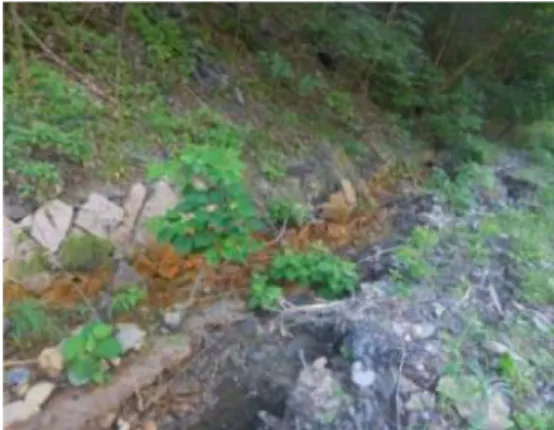
3for both mine waste-rock fields. Reddening was observed at two sections (Fig. 2). These are distributed through the 52 m and 61 m sections from the starting discharge points of the mine drainage.
The Boeun Mine was mainly developed around Jogong-ri. No measures were taken for mine waste- rock loss after the lapse of mining rights. Mining residue was visible to the naked eye and has been carried into the water system. Mining residue, which is toxic, was known to be a potential pollutant.
This residue can flow into neighboring farmland by migration and flying and pollute the sediments of streams.
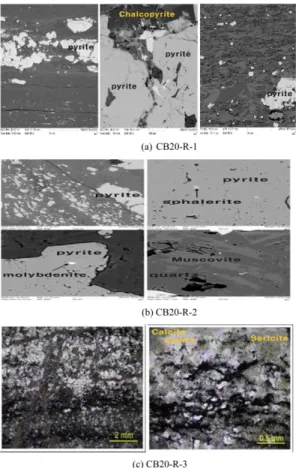
3.2. Chemical Analysis of Mine Waste-rock Mine waste-rock sample CB20-R-1, which was taken from the mine waste-rock field, was identified as silty shale; the main minerals were quartz and dolomite, while pyrite was distributed according to the stratification. A small amount of chalcopyrite (CuFeS
2) was also observed (Fig. 3).
Fig. 2. Reddening caused by the discharged of pit water around Boeun Mine.
The main substances were quartz, pyrite, and muscovite for sample CB20-R-1. Small particles of sphalerite and molybdenite were found in the pyrite. Sample CB20-R-3 was a fine-textured sandstone composed of quartz, muscovite, chlorite, calcite, and carbonitride. The XRD analysis showed that the sample contained 25–52% quartz, 22–64%
muscovite, and 1–33% pyrite. The percentages of
calcite, chlorite, ankerite, and plagioclase were 6%, 6%, 9%, and 2%, respectively (Fig. 4).
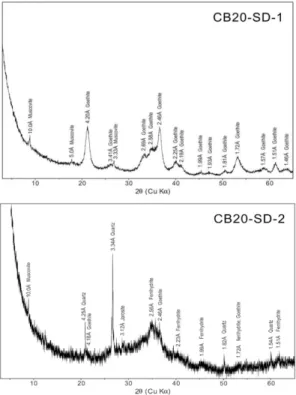
CB20-SD-1 was a sample taken from the bottom of the stream, where yellowish precipitates coated the gravels. This was identified as pure goethite.
Sample CB20-SD-2 was taken from flowing water near the mine waste-rock field. Two broad peaks around 2.56Å and 1.51Å, and small peaks at 2.23Å, 1.99Å, and 1.72Å, were observed. The mineral was identified as ferrihydrite (Fig. 5). Park et al.
(2000) reported that yellowish-brown precipitate material from abandoned drainage in the Hwason area of Korea was iron hydroxide with a high amount of iron.
Pyrite was found in three debris samples. Chal- copyrite (the sulfide mineral of Cu) and molybdenite and sphalerite (the sulfide minerals of Mo and Zn, respectively) were found in CB20-R-1 and CB20- R-2. These seemed to be the sources of pollution in the soil and the neighboring water system. In addition, ferrihydrite, which precipitates from acidic mine drainage, occurred where the weathering of sulfide minerals was often found.
3.3. Analysis of the Sediment from the Stream The chemical composition of the bottom sedi- ments in a neighboring stream are presented in Table 1. The ranking, based on the absolute amounts of metals in the sediments, from highest to lowest, was Fe, Al, Zn, Mn, Ni, Cu, Cd and Pb. The amount of Fe present decreased the further the samples were taken from the mine area.
The results indicate that sediments were polluted with Zn, Ni, and Cd, which are metallic elements mentioned in the published rulings on stream sediments in Korea (NIER). The values of lead were highest upstream from this area, near the abandoned mine. The analyzed amounts of Zn, Ni,
Fig. 3. SEM analysis of mine waste-rocks taken from themine waste field near the mine.
Table 1. The chemical composition of subsurface river deposits SSample. pH Cd
(mg/kg) Cu (mg/kg)
As (mg/kg)
Hg (mg/kg)
Pb (mg/kg)
Cr6+
(mg/kg) Zn (mg/kg)
Ni (mg/kg)
Fe (mg/kg)
Al (mg/kg)
Mn (mg/kg) SS-1 5.15 10.35 451.88 N.D. 0.07 36.7 0.55 1,122.7 314.5 84944 18446 991 SS-2 6.22 26.15 170.12 N.D. 0.03 20.8 0.69 2,373.4 563.0 60110 22252 1010 SS-3 6.30 41.39 209.27 N.D 0.04 15.8 0.60 3,316.0 713.4 52784 25053 671 SS-4 6.43 44.46 693.34 N.D 0.08 6.8 N.D. 9,047.0 159.4 51992 47782 490 SS-5 6.42 23.92 494.47 N.D. 0.07 7.4 N.D. 4,072.3 829.1 46575 44652 1222 SS-6 6.92 25.90 32.29 54.08 0.05 13.1 N.D 249.4 45.8 37884 22895 324 Background
Soil 6.17 N.D 36.95 27.67 0.03 10.77 N.D. 88.75 29.77 43303 38131 466
and Cd were over the limit set out in the standards of the Korean soil pollution counterplan. The amount of Zn was over the limit at SS-2, SS-3, SS- 4, and SS-5, and Cd exceeded the limit at SS-2, SS-3, SS-4, SS-5, and SS-6. The Ni content was over the limit at sample sites SS-2, SS-3, and SS- 5. Sediments in the stream were polluted by Zn, Ni, and Cd across all sample sites regardless of the distance from the mine.
The highest levels of Cu, Cd, Zn, and Ni
observed from the investigated areas were 693.34, 44.46, 9047.0, and 829.1 mg/kg, respectively. These values qualify as 4th grade according to the rulings on stream sediments published in Korea, indicating that there is a very high possibility of toxicity to benthic macroinvertebrates.
The highest levels of Cd, Cu, and Zn were found
at SS-4. For the stream sediment, the pH increased
the further the distance from the mine. The lowest
pH (5.15) was observed at site SS-1. The highest
Fig. 4. XRD analysis of mine waste-rock samples from the mine waste field.levels of Fe, Al, and Mn were 84,944, 47,782, and 1,222 mg/kg, respectively. The amounts of Zn, Ni, Cu, Cd, and Pb were shown to be high compared to the background level.
3.4. The Influence of Mine Drainage on the Neighboring Stream
The chemical characteristics of eight samples of stream water and one groundwater sample are presented in Table 2 and Table 3. These were obtained to determine the variation in concentration
of the individual elements across the dry and rainy seasons.
During the August rainy season, reddening was observed at MW-1 and MW-2. The pH was 4.94, which means that the mine drainage was acidic at MW-1, and the sulfate was 1557.8 mg/L. The source of the sulfate seemed to be pyrite weathering. This might originate from sulfate minerals such as gypsum (CaSO
4·2H
2O) and anhydrite (CaSO
4).
The DO did not change much between the mine drainage and the water downstream.
The pH at MW-1 during November was higher than during August. Jung (2003) reported that conditions of low pH, high TDS (total dissolved solids), and large amounts of anions/cations were present because iron-oxidizing bacteria were active;
in addition, water-rock reactions accelerate during rainy days. The pH and the concentration of pollutants analyzed in the stream water during the rainy season (August) tended towards higher sulfate levels and a lower pH compared with those in the samples taken during the dry season (November).
The mean level of EC during the dry season in the stream water was 7.9 times higher than during the August rainy season. The concentration of Cd and Ni decreased in the samples taken further from the mine. Groundwater, which currently is the water used by households, did not appear to be affected by the pollution from the mine. The results of the water samples met the standard for drinking water because the levels of As, Cd, Cu, Pb, Hg, Ni, Cr, and Al were under the detection level. During the dry season, downstream water was shown to be polluted only by sulfates. A reduction in metals was reported as the distance from the mine increased and this was due to chemical causes, such as precipitation and absorption,
Fig. 5. XRD analysis of precipitation sampled aroundBoeun mine.
Table 2. The water quality at the monitoring points at the study site Samples Distance from
the Mine (m)
pH Temp. (oC) Conductivity (µS/cm) DO (mg/L)
Nov. Aug. Nov. Aug Nov. Aug. Nov. Agu.
MW-1 500 6.53 4.94 6.53 21.26 11.20 1.78 232 10.59
MW-2 568 - 6.06 - 16.55 - 1.30 - 10.46
SW-1 653 6.18 6.01 6.18 19.87 10.07 1.59 323 9.58
SW-2 889 6.64 6.24 6.64 20.33 10.49 1.63 305 10.88
SW-4 1,083 6.87 6.85 6.87 21.32 11.18 1.60 313 10.56
SW-6 1,362 7.13 6.63 7.13 25.54 11.12 0.77 330 10.82
SW-7 1,402 6.68 6.63 6.68 24.19 10.42 1.26 362 9.83
SW-8 1,577 6.77 6.95 6.77 26.88 10.80 1.22 359 9.61
GW-1 890 6.62 6.60 6.62 16.5 9.52 0.18 143 10.85
and to physical causes, such as dilution when joining unpolluted water (Ki et al., 2007). Lin et al. (2007) reported that biological toxicity is high about 3.5 km downstream of water systems.
Lead was below the detection limit. The substance with the highest level in the mine drainage was sulfates at MW-1 during both the rainy and dry seasons.
3.5. Metal Soil Pollution at the Pithead and in the Mine Waste-rock Field
In these areas, the level of lead at M-1 was found to be 9.18 and 20.50 mg/L for the surface soil and intermediate soil, respectively. All samples taken from a forested area 501 m from the mine were below the limit for lead (400 mg/kg). Soils were from taken around the pithead (M) and the mine waste-rock field (T) in the forested area (Table 4). The highest levels of lead in the forest area were 87.08 and 69.19 mg/kg for surface soil
and intermediate soils at sample sites M-3-1 and M-2-2, respectively. For the mine waste-rock field, the mean lead levels in the surface soil and intermediate soils were 57.99 and 62.04 mg/kg, respectively. These measurements are under the threshold of the standards in the Korean soil pollution counterplan.
The levels of arsenic for the pit head were considerably higher in the intermediate soils than in the surface soil. At four sample points (M-2-2, T-1-1, T-2-1, and T-2-2), arsenic was over the limits in the standards in the Korean soil pollution counterplan (30 mg/kg). Three out of the four site samples were taken at the mine waste-rock field.
The average levels of arsenic in the forested area near the pithead were 33.31 and 75.67 mg/kg in the surface soil and intermediate soil; those at the mine waste-rock field were 212.68 and 110.55 mg/kg in the surface soil and intermediate soil. The highest levels of arsenic were found at site T-2 for both the
Table 3. The chemical composition of the mine drainage and stream water in the Boeun mine area (unit: mg/kg)Items Sampling Season MW-1 MW-2 SW-1 SW-2 SW-4 SW-6 SW-7 SW-8 GW-1
As Nov. N.D. - N.D. N.D. N.D. N.D. N.D. N.D. N.D.
Aug. N.D. N.D. N.D. N.D. N.D. N.D. N.D. N.D. N.D.
Cd Nov. 0.028 - 0.019 0.012 0.011 N.D. 0.006 N.D. N.D.
Aug. 0.024 0.011 0.013 0.018 0.014 N.D. 0.006 0.004 N.D.
Cu Nov. N.D. - N.D. N.D. N.D. N.D. N.D. N.D. N.D.
Aug. N.D. N.D. N.D. N.D. N.D. N.D. N.D. N.D. N.D.
As Nov. N.D. - N.D. N.D. N.D. N.D. N.D. N.D. N.D.
Aug. N.D. N.D. N.D. N.D. N.D. N.D. N.D. N.D. N.D.
Hg Nov. N.D. - N.D. N.D. N.D. N.D. N.D. N.D. N.D.
Aug. N.D. N.D. N.D. N.D. N.D. N.D. N.D. N.D. N.D.
Pb Nov. N.D. - N.D. N.D. N.D. N.D. N.D. N.D. N.D.
Aug. N.D. N.D. N.D. N.D. N.D. N.D. N.D. N.D. N.D.
Cr Nov. N.D. - N.D. N.D. N.D. N.D. N.D. N.D. N.D.
Aug. N.D. N.D. N.D. N.D. N.D. N.D. N.D. N.D. N.D.
Zn Nov. 1.520 - 0.629 0.547 0.408 N.D. 0.241 0.097 0.036
Aug. 1.219 1.575 1.23 0.744 0.554 0.019 0.247 0.128 0.027
Ni Nov. 0.392 - 0.249 0.246 0.203 N.D. 0.134 0.071 N.D.
Aug. 0.414 0.799 0.696 0.349 0.292 0.035 0.139 0.099 N.D.
Cr Nov. N.D. - N.D. N.D. N.D. N.D. N.D. N.D. N.D.
Aug. N.D. N.D. N.D. N.D. N.D. N.D. N.D. N.D. N.D.
Fe Nov. 2.121 - 0.932 0.065 0.040 0.031 0.025 0.050 1.346
Aug. 1.239 0.48 0.272 0.061 0.028 0.82 0.214 0.125 2.005
Al Nov. 1.14 - 0.29 0.02 0.02 N.D. 0.02 N.D. N.D.
Aug. 0.68 0.05 0.11 0.03 0.02 0.38 0.1 0.05 N.D.
Mn Nov. 0.162 - 0.137 0.074 0.040 0.002 0.006 0.010 0.122
Aug. 0.12 0.123 0.108 0.114 0.077 0.06 0.048 0.048 0.142
SO42- Nov. 1829.4 - 795.6 810.8 782.2 12.3 617.6 737.1 30.7
Aug. 1557.8 657.6 940.4 1004.2 990.6 334.1 705.1 667 33.5
surface soil and intermediate soils. Although a significant level of arsenic (27.67 mg/kg) was also found in the background soil, the levels at the mine waste-rock field were 7.7 times higher in the surface soil. These values indicated that the mine waste-rock field was a main pollution source in this area.
Cadmium and zinc are known to mostly originate from minerals or rocks, and the elements are supposed to be related to sphalerite. The mean levels of zinc for the surface soil and intermediate soil were 1362.8 and 1447.9 mg/kg at the pithead, respectively, and 2810.5 and 2283.3 mg/kg for the mine waste-rock field, respectively. The levels at the pithead and the mine waste-rock field are 15.4 and 31.7 times higher, respectively, than that of the background soil. The highest values for the surface soil and intermediate soil were found at M-3-1 and M-2-2 in the forested area; the levels recorded were 7134.1 and 7509.0 mg/kg, respectively. Cadmium and zinc at T-2 were both over the limit of the levels stated in the standards of the Korean soil pollution counterplan. In addition, significant concentrations of cadmium and zinc were observed in the both the subsurface soil and intermediate soil.
The highest nickel levels were found at M-3-1 on the pithead, namely, 47 times higher than that of the background soil. The mean levels of nickel for the surface soil and intermediate soil in the mine waste-rock field were 994.0 and 923.9 mg/
kg, respectively. The highest level of nickel at the
mine waste-rock field was 1784.7 mg/kg; this was detected at site T-2 in the intermediate soil. The mean level of Hg was 0.06 mg/kg, which was a little higher than the background soil level (0.03 kg/kg). The highest Hg levels observed were 0.15 and 0.15 mg/kg for the surface soil and intermediate soil, respectively, at M-2-1 and M-2-2 at the pithead.
The mean levels of copper were 164.1 and 147.2 mg/kg for the surface soil and intermediate soil, respectively. The highest levels of copper were 788.94 and 684.58 mg/kg in the surface soil and the intermediate soil at the pithead, respectively.
The highest level of copper (1556 mg/kg) at the pithead was found at T-2-1. The mean levels of copper were 164.12 and 933.75 mg/kg in the surface soil at the pithead and in the mine waste- rock field, respectively; these are respectively 4.4 and 25.3 times higher than the level of the back- ground soil.
The pH at the pithead ranged between 4.59 and 6.74, and the pH value showed acidic to slightly acidic conditions. The lowest pH (4.59) was found at site M-6.
Therefore, pollution by metals such as Cd, As, Ni, and Zn at T-2 were all over the limits set out in the standards of the Korean soil pollution counterplan. In this experiment, the highest level of the absolute amount of metal was for Zn, followed, in order of amount, by Ni, Cu, As, Pb, and Cd. Jung et al. (2005) have investigated residual tailings near 25 abandoned mines in Korea and the
Table 4. The metal concentration in the soil at the pithead and in the mine waste-rock field (unit: mg/kg)Site Sample pH Cd Cu As Hg Pb Cr6+ Zn Ni
M-1 M-1-1 6.65 N.D. 31.53 3.41 0.04 9.18 0.74 101.74 35.29
M-1-2 6.36 4.23 18.50 14.93 0.03 20.50 N.D 168.14 40.17
M-2 M-2-1 6.74 N.D. 23.09 16.84 0.15 8.06 1.93 206.10 40.15
M-2-2 6.56 116.18 684.58 210.13 0.15 69.19 1.27 7,509.00 160.01 M-3 M-3-1 6.46 104.60 788.94 143.44 0.06 87.08 0.53 7,134.06 1,399.19
M-3-2 6.44 228.67 46.45 148.59 0.06 31.71 N.D 314.84 139.04
M-4 M-4-1 6.11 2.23 49.69 9.51 0.02 17.40 N.D 305.22 84.01
M-4-2 5.78 N.D. 10.82 2.00 0.01 14.95 N.D 98.37 6.39
M-5 M-5-1 5.35 N.D. 11.04 2.18 0.03 16.03 N.D 99.94 7.25
M-5-2 4.97 N.D. 28.55 8.47 0.05 10.63 N.D 97.17 31.48
M-6 M-6-1 4.59 2.20 80.44 24.48 0.08 15.92 N.D 329.60 89.64
M-6-2 4.63 3.72 94.52 68.09 0.08 33.76 N.D 499.85 153.01
T-1 T-1-1 5.11 15.21 311.63 88.83 0.02 29.43 N.D 1,243.59 417.08
T-1-2 5.29 1.13 48.12 7.59 0.03 27.05 N.D 274.63 63.03
T-2 T-2-1 5.16 74.27 1,555.87 336.52 0.19 86.55 1.23 4,377.45 1,570.83 T-2-2 6.29 61.31 964.99 213.50 0.13 97.03 2.24 4,292.00 1,784.74
highest level of water-soluble metallic elements was for Zn in mine tailings, followed, in order of amount, by Pb, Cd, As, Ni, and Cr. They added that large amounts of sulfur ions were observed in most tailings found near abandoned mines in Korea (Jung et al., 2005).
3.6. The Impact of Mine Pollutants on the Farmland
Environmental pollution of the neighboring farmland caused by mining is displayed in Table 5.
At these 15 farmland sites, crops are currently grown that were selected for the area 2 km downstream from the mine that is possibly affected by the contamination. In this experiment, the subsoil was additionally evaluated.
The levels of lead measured in the arable land were distributed between 9.11 and 20.55 mg/kg in the surface soil. In the intermediate soil, the levels of lead detected were between 9.14 and 18.02 mg/kg;
lead is found in the subsoil at levels between 6.26 and 16.67 mg/kg. The highest levels of lead were
Table 5. The metal concentration in the farmland soil (unit: mg/kg)Site Sample Crops pH Cd Cu As Pb Zn Ni
S-1 S-1-1 Jujube 5.4 N.D. 25.68 3.19 12.51 92.28 28.91
S-1-2 Jujube 5.4 N.D. 26.06 2.82 12.09 85.53 29.72
S-2 S-2-1 Sesame 6.4 N.D. 24.01 2.86 10.68 83.81 28.34
S-2-2 Sesame 6.0 N.D. 23.01 2.84 9.14 77.81 28.34
S-3
S-3-1 Sesame 5.9 N.D. 25.85 2.47 12.38 86.20 28.55
S-3-2 Sesame 6.0 N.D. 26.89 2.39 11.40 83.87 28.62
S-3-3 Sesame 5.9 N.D. 29.68 3.18 11.96 96.64 43.77
S-4 S-4-1 Jujube 5.1 N.D. 28.89 2.23 9.63 85.21 28.59
S-4-2 Jujube 5.3 N.D. 40.31 2.52 12.13 98.37 33.12
S-6
S-6-1 Jujube 6.0 0.63 40.49 3.50 13.46 142.84 42.22
S-6-2 Jujube 6.2 0.57 37.94 2.90 12.70 136.81 41.87
S-6-3 Jujube 6.1 N.D. 32.17 3.23 11.72 113.61 37.06
S-9
S-9-1 Jujube 6.1 1.07 38.34 3.28 13.48 189.87 50.17
S-9-2 Jujube 6.2 1.40 39.15 3.79 13.29 204.00 52.61
S-9-3 Jujube 6.0 1.37 41.29 4.26 13.85 198.25 55.11
S-10 S-10-1 Jujube 6.0 0.93 46.27 8.51 11.00 132.45 40.15
S-10-2 Jujube 6.4 6.23 83.31 19.94 17.69 503.53 128.05
S-12
S-12-1 Omija (Maximowiczia chinensis) 6.73 2.56 99.56 8.90 9.11 677.03 27.62
S-12-2 Omija 6.98 1.76 84.51 7.30 8.21 624.61 22.87
S-12-3 Omija 6.66 1.47 77.12 3.00 6.26 781.47 12.02
S-13 S-13-1 Omija 6.58 3.07 67.63 16.88 17.05 522.47 53.83
S-13-2 Omija 6.48 3.06 44.96 22.63 16.92 297.89 63.66
S-14 S-14-1 Green Onion 6.05 N.D. 38.68 2.33 11.70 106.54 34.39
S-14-2 Green Onion 6.28 N.D. 38.93 10.61 13.41 123.87 35.76
S-15
S-15-1 Soy Bean 5.55 0.90 41.81 8.42 12.91 130.52 38.58
S-15-2 Soy Bean 5.98 0.66 32.89 9.79 10.84 115.26 36.12
S-15-3 Soy Bean 6.07 0.70 36.51 15.66 11.28 124.96 37.71
S-18
S-18-1 Jujube 6.38 N.D. 28.99 8.04 14.41 113.59 33.45
S-18-2 Jujube 6.48 N.D. 29.08 8.46 14.52 112.43 32.80
S-18-3 Jujube 6.53 N.D. 29.03 20.56 13.94 94.27 33.29
S-19 S-19-1 Yacon (Smallanthus sonchifolius) 5.80 3.69 47.03 25.46 15.34 319.72 88.65
S-19-2 5.70 3.00 48.14 34.45 14.20 305.32 88.56
S-20 S-20-1 Omija 5.99 1.73 39.58 21.72 17.16 211.91 58.91
S-20-2 Omija 5.78 1.83 34.50 19.65 18.02 221.08 62.29
S-21
S-21-1 Omija 5.52 N.D. 29.85 41.90 20.55 109.51 26.22
S-21-2 Omija 5.62 N.D. 27.08 35.21 17.34 105.41 25.82
S-21-3 Omija 5.62 N.D. 28.59 54.44 16.67 102.96 24.50
Mean 6.06 1.11 42.88 13.26 13.47 220.38 43.85
S.D. 0.43 1.40 18.39 12.73 3.04 182.17 22.01
found at sites S-21-1, S-20-2, and S-21-3 for the surface soil, intermediate soil, and subsoil, respec- tively. Site S-21 is 1.38 km away from the mine and on land growing Schisandra chinensis. The mean level of lead in the background soil was 10.8 mg/kg. The mean levels of lead in the surface soil, intermediate soil, and subsoil were 13.42, 13.46, and 12.24 mg/kg, respectively. Lead pollution of the surface and intermediate soil was a little greater than in the subsoil.
Cadmium in the neighboring farmland was measured as being between 0 and 6.23 mg/kg. The mean levels in the surface soil, intermediate soil, and subsoil were 0.97, 1.23, and 0.51 mg/kg, respectively. The highest level was found at S-10- 2, which is a site growing jujube. The mean levels of arsenic observed were 10.65, 12.35, and 14.90 mg/L for surface soil, intermediate soil, and subsoil, respectively. The highest level of arsenic was found at S-21 in the surface soil, intermediate soil, and subsoil.
The mean zinc levels observed were 200.3, 206.4, and 216.0 mg/kg for the surface soil, intermediate soil, and subsoil, respectively, for the 15 farmlands.
The highest levels of zinc were 677.03, 624.61, and 781.47 mg/kg at sites S-12-1, S-12-2, and S- 12-3, respectively. The area of S-12 is land cultivated with schisandra chinensis. Seven out of 37 samples were over the level of the domestic standard for a soil pollution warning (300 mg/kg). The amount of zinc in the surface soil was greater than the mean background level for surface soil (88.8 mg/kg).
Nickel levels ranged between 37.06 and 55.11 mg/kg for the subsoil. The mean levels of nickel were 34.46, 35.71, and 45.31 mg/kg for the surface soil, intermediate soil, and subsoil, respectively.
These levels indicated that nickel found in the surface soil was greater than the background level (29.77 mg/kg).
The mean levels of copper were 41.51, 41.12, and 39.20 mg/kg for the surface soil, intermediate soil, and subsoil, respectively. The level of copper in the subsurface soil was higher than that in the subsoil and was higher than that of the background soil (36.95 mg/kg).
The average pH values for the neighboring farmland around the abandoned mine were 5.97, 6.05, and 6.13 for the surface soil, intermediate soil, and subsoil, respectively. The lowest pH was
5.4 at sites S-1-1 and S-1-2, which is the closest farmland (148 m) to the mine.
The linear relationship of metal substances in the soil was analyzed by correlation coefficient.
The pH levels were not closely related to the metal levels. However, the pH was shown to have a positive correlation with Zn, Cu, and Cd: pH- Zn(r=0.60)>pH-Cu(r=0.57)> pH-Cd (r=0.34).
The following metals were shown to have positive correlations: Cu-Zn(r=0.94)>Cd-Ni(r=0.83)>Cu- Cd(r=0.71)>As-Pb(r=0.69)=Zn-Cd(r=0.69). Corre- lations for other elements were very low.
The metals in order of highest to lowest levels observed were: zinc, copper, nickel, lead, arsenic, and cadmium in the surface soil and zinc, nickel, copper, lead, arsenic, and cadmium in the inter- mediate soil. In the subsoil layer, this ranking was:
zinc, copper, nickel, arsenic, lead, and cadmium.
Fourteen samples were over the standard Korean soil pollution warning levels for the elements of cadmium, arsenic, zinc, and nickel. In addition, the amounts of zinc, nickel, lead, copper, and cadmium present were greater than the background levels found in the soil.
The soils in samples S-10, S-12, S-13, S-19, and S-21 were over the limit for the standard Korean soil pollution warning; these sites were farmlands for jujube, Schisandra chinensis, and yacon. The soil ranged from slightly acidic to neutral. The amounts of zinc detected in the subsurface soil, of arsenic, cadmium, zinc, and nickel in the inter- mediate soil, and of zinc in the subsoil were found to be significantly over the limit for the standard Korean soil pollution warning. However, Choi et al. (2012) suggested that the current policy should be changed from a concentration-based approach to a risk-based approach by reporting that human risks still exist even though the soil may meet the standards for soil (Choi et al., 2012).
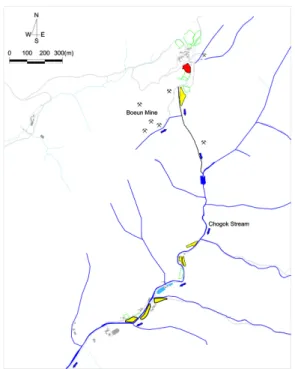
Based on the results, farmland was expected to be polluted over an area up to 10,297 m
2around the abandoned mine (Fig. 6). Metallic element pollution in soil is not easy to remediate naturally, Processes such as covering it up with unpolluted soil, phytoremediation, and soil flushing could be options to remediate these soils.
Crops should be carefully selected to suit the
polluted area. Arsenic accumulates at high levels
in Pteridaceae. Growing crops such as Napa cabbage,
lettuce, and chili peppers should be avoided around the mine area (Baker and Banfield, 2003). It is also known that the accumulation of metallic elements in crops is due to a direct reaction between the roots and the soil as well as to the amounts of metallic elements in the soil. The farmland environment, such as soil characteristics, farming methods, and cultivated plants, should be considered in the assessment of soil pollution.
Mining residues polluted the downstream area.
However, the influence range exceeded the range of flooding and can affect the stream area. Minerals in mine waste-rock decompose by weathering and increased mobility. Also, sedimented mining residue is thought to flow into farmland while supplying agricultural water or flooding.
In this area, the main route of contaminants was from the abandoned mine and spreads to neighboring down-stream areas through via pollutant routes.
Therefore, possible pollution sources along in the contamination route in this research, were evaluated.
The process of contaminant circulation consists of the formation of pollutants, movement, and accumulation; however, other research has mainly focused on pollutants’ areas. Pollutant routes and
the possibility of contamination have not been significantly evaluated in abandoned mines.
Therefore, in this research, contamination of the neighboring farmland and of the stream’s water system as well as of the mine area in the Boeun Mine was evaluated. Also, the potential for the continual migration of pollution sources was assessed.
4. Conclusion
This research was undertaken at Korea’s aban- doned Boeun mine to assess the source of pollutants and the distribution of metallic elements in the neighboring water system and farmland.
Based on the results of this research, the following conclusions were drawn.
Yellowish precipitates in the stream were iden- tified as goethite and ferrihydrite. Minerals such as quartz, muscovite, pyrite, ankerite, calcite, and chlorite were found in the mine waste-rock samples.
The amount of Cu, Zn, and Ni found are extremely toxic to benthic macroinvertebrates, according to the rulings on stream sediments published by the National Institute of Environmental Research in Korea. The amounts of Cu, Zn, and Ni in the surface soil in the mine waste-rock field were found to be 25.3, 31.7, and 33.4 times higher than the background levels. Therefore, remediation should be performed to prevent the further contamination of the sedimentation in the stream. Polluted farmland requiring remediation was assessed to be 10,297 m
2in this investigation.
The metallic elements detected downstream in the neighboring water were not serious pollutants.
However, farmland could be affected by the migra- tion of mine waste-rock around the abandoned mine, in particular, by the amount of Zn, Ni, Cd, and As in the mine waste-rock field samples. In this area, mine waste-rock was piled at the cutting side or valley. Preventing the migration of mine waste-rock or and/or disposing of mine waste-rock should be managed as in addition to treating the mine drainage.
Acknowledgments
This research was funded by the Ministry of Environment in Korea.
Fig. 6. Estimation of remediation area (That’s read and yellow area).
References
Arefieva, O., Nazarkina, A., Gruschakova, N.V., Skurikh- ina, J.E. and Kolycheva, V.B. (2019) Impact of mine waters on chemical composition of soil in the Partizansk Coal Basin, Russia, Int. Soil. Water Conserv. Res. v.7, p.57-63.
Baker, B.J. and Banfield, J.F. (2003) Microbial commu- nities in acid mine drainage. FEMS Microbiol. Ecol.
v.44, p.139-152.
Barnes, H.L. and Romberger, S.B. (1968) Chemical aspects of acid mine drainage. Wat. Pollut. Cont. Fed. v.40, p.371-384.
Choi, J.W., Yoo, K.J., Koo, M.S. and Park, J.H. (2012) Comparison of heavy metal pollutant exposure and risk assessments in an abandoned mine site. J. Kor. Soc.
Civil. Eng. v.32, p.261-266.
Choi, S.G., Park, S.K., Lee, P.K. and Kim, C.S. (2004) An overview of geoenvironmental implications of mineral deposits in Korea, Econ. Environ. Geol. v.37, p.1-19.
Clark, D.A. and Norris, P.R. (1996) Acidimicrobium fer- rooxidans gen. nov., sp. nov.: mixed-culture ferrous iron oxidation with Sulfobacillus species, Microbiol. v.142, p.785-790.
Faure G. (1991). Inorganic Geochemistry, Macmillan, Inc.
Hwang, E.H., Wee, S.M., Lee, P.K. and Choi, S.H. (2000) A study on the heavy metal contamination of paddy soil in the vicinity of the seosung Pb-Zn mine. J. Soil Groundwat. Environ. v.5, p.67-85.
Jonsson, J., Persson, P., Sjoberg, S. and Lovgren, L. (2005) Schwertmannite precipitated from acid mine drainage:
phase transformation, sulphate release and surface prop- erties. Appl. Geochem. v.20, p.179-191.
Jordan, M.A. McGinness S and Phillips, C. V. (1996) Aci- dophilic bacteria-their potential mining and environ- mental applications. Miner. Eng. v.9, p.169-181.
Jung, G.B., Kim, W.I., Lee, J.S., Lee, J.S., Park, C.W. and Koh, M.H (2005) Characteristics of heavy metal con- tamination in residual mine tailings near abandoned metalliferous mines in Korea. Korean J Environ Agric.
v.24, p. 222-231.
Jung, M.C. (2003) Environmental assessment of mine drainage from abandoned coal mines in the Mungyung area, Korea, J. Kor. Soc. Geosy. Eng. v.40, p.429-437.
Jung, M.C. and Jung, M.Y. (2006) Evaluation and man- agement method of environmental contamination from abandoned metal mines in Korea. J Kor. Soc Mineral Energy Res. v.43, p.383-394.
Jung, M.C., Jung, M.Y. and Choi, Y.W. (2004) Environ- mental assessment of heavy metals around abandoned metalliferous mine in Korea, Econ. Environ. Geol. v.37, p.21-33.
Jurjovec, J., Ptacek, C.J. and Blowers, D.W. (2002) Acid neutralization mechanisms and metal release in mine tailings; a laboratory column experiment, Geochimica et Cosmochimica Acta. v.66, p.1511-1523.
Ki, M. J. Lee, P. G. and Choi, S. H. (2007) Seasonal vari- ation and natural attenuation of trace elements in the stream water affected by mine drainage from the aban- doned Indae mine areas, Econ. Environ. Geol. v.40, p.
277-293.
Ko, J.I. and Kim, S.K. (2005) The Study on characteri- zation through the temperature and oxygen concentra- tion profiles in AMD producing waste rock pile. J Kor.
Soc Mineral Energy Res. v.42, p.552-565.
Kwon, J.C., Jung, M.C. and Kang, M.H. (2013) Contents and seasonal variations of arsenic in paddy soils and rice crops around the abandoned metal mines, Econ. Envi- ron. Geol. v.46, p.329-338.
Lee, J.S., Kim, Y.N. and Kim, K.H. (2010) Suitability Assessment for Agriculture of Soils Adjacent to Aban- doned Mining Areas Using Different Human Risk Assessment Models, Korean J. Environ. Agric. v.43, p.552-561.
Lee, M.H., Choi, J.C. and Kim, J.W. (2003) Distribution and remediation design of heavy metal contamination in farm-land soils and river deposits in the vicinity of the Goro abandoned mine. Econ, Environ. Geol. v. 36, p.89- 101.
Lin, C., Wu, Y., Lu, W., Chen, A. and Liu, Y. (2007) Water chemistry and ecotoxicity of an acid mine drainage- affected stream in subtropical China during a major flood event. J. Haz. Mat. v.142, p.199-207.
Ma, L.Q. and Rao, G.N. (1997) Chemical fractionation of cadmium, copper, nickel, and zinc in contaminated soils. J. Environ. Qual. v.26, p.259-264.
Mavrommatic, E. and Menegaki, M. (2017) Setting reha- bilitation priorities for abandoned mines of similar char- acteristics according to their visual impact: The case of Milos Island, Greece, J. Sust. Min., v.16, p.104-113.
Medas, D., Cidu, R., De Giudici, G. and Podda, F. (2019) Chemical data on environmental matrices from an aban- doned mining site, Data in Brief, v.23, p. 1-10.
Ministry of Environment in Korea. (2004) Investigation of soil contamination in abandoned mine, Ministry of Environment in Korea.
Moon, Y.H., Moon, H.S., Park, Y.S., Moon, J.W., Song, Y.G. and Lee, J.C. (2003) Mobility of transition metals by change of redox condition in dump tailings from the Dukum mine, Korea, Econ. Environ. Geol. v.36, p.285- 293.
NIER, Available from: http://www.law.go.kr/LSW/
Nordstrom, D.K. (2007) Effects of seasonal and climatic change on water quality from acid rock drainage in the Western United States. In: IMWA Symposium 2007:
Water in Mining Environments; 27th-31st May 2007, Cagliari, Italy, p.11-16.
Park, C.Y., Jeong, Y.J. and Kang, J.S. (2000) Geochemistry and mineralogy of mine drainage water precipitate and evaporite minerals in the Hwasoon area. Econ. Environ.
Geol. v.33, p.391-404.
Rybnikova, L.S. and Rybnikov, P.A. (2017) Hydrogeo- chemistry of the Abandoned Sulfide Mines of the Mid- dle Urals (Russia), Procedia Earth Planet. Sci. v.17, p.849-852.
Vega, F.A., Covelo, E.F., Andrade, M.I. and Marcet, P.
(2004) Relationships between heavy metals content and soil properties in mine soils. Analytica Chimica Acta.
v.524, p.141-150.