1. INTRODUCTION
Oil palm has developed into one of the most economically important plantation crops in Southeast Asia (Koh and Wilcove, 2007).
Among countries in this region, oil palm in-
dustry in Indonesia was able to grow rapidly with the plantation expanding at an annual rate of more than 12% from 1990 to 2005 (Hashim et al., 2012). In 2013, the total oil palm planta- tion in Indonesia stands at 10.46 million hec- tares, with more than 63% of the oil palm plan-
Original Article
Effect of Phenol Formaldehyde Impregnation on The Physical and Mechanical Properties of Soft-Inner Part of Oil Palm Trunk
1Rudi Hartono
2,†⋅Wahyu Hidayat
3,4⋅Imam Wahyudi
5⋅Fauzi Febrianto
5⋅ Wahyu Dwianto
6⋅Jae-Hyuk Jang
3⋅Nam-Hun Kim
3,†ABSTRACT
The objective of this study was to improve physical and mechanical properties of soft-inner part of oil palm trunk (S-OPT) after impregnation with phenol formaldehyde (PF) resin and densification by close system com- pression (CSC) method. Effect of different methods of PF resin impregnation (i.e., no vacuum-pressure, vacuum, and vacuum-pressure) was evaluated. The results showed that PF resin impregnation and CSC significantly im- proved the physical and mechanical properties of S-OPT up to: (1) 176% in density; (2) 309% in modulus of rupture (MOR); (3) 287% modulus of elasticity (MOE); and (4) 191% in the compressive strength. Physical and mechanical properties of S-OPT showed their best performances when PF resin impregnated with vac- uum-pressure method as shown by higher weight gain, density, MOR, MOE, compressive strength, and lower recovery of set due to better penetration of PF resin into S-OPT. Combining PF resin impregnation and densifi- cation by CSC method could be a good method to improve physical and mechanical properties of S-OPT.
Keywords : close system compression, phenol formaldehyde impregnation, physical and mechanical properties, soft-inner part of oil palm trunk
1Date Received August 23, 2016, Date Accepted October 12, 2016 2Faculty of Forestry, University of Sumatera Utara, Indonesia
3Department of Forest Biomaterials Engineering, College of Forest and Environmental Sciences, Kangwon National University, Republic of Korea
4Department of Forestry, Faculty of Agriculture, Lampung University, Indonesia
5Department of Forest Products, Faculty of Forestry, Bogor Agricultural University, Indonesia 6Research Center for Biomaterials, Indonesian Institute of Sciences, Indonesia
†Corresponding author: Nam-Hun Kim (e-mail: [email protected])
†Corresponding author: Rudi Hartono (e-mail: [email protected])
tations located in Sumatera Island and 30% are planted in Kalimantan Island (Directorate General of Estate Crops, 2014). The crude palm oil (CPO) production in 2013 peaked at 27.78 million tons, contributing to more than 50% of world production and positioned the country as the world’s biggest producer of palm oil.
Oil palm trees have an economic life span of 24-26 years (Ismail and Mamat, 2002). After this age, it is usually felled for replanting due to decreased oil productivity. In Indonesia, 450,000 ha of oil palm plantation area are ex- pected to be replanted annually during the next 25 years. Such large area will generate large amount of potential biomass particularly in the form of trunks. During replantation the land owners are face with a big problem of disposal of felled oil palm trunks (OPT). These bio- masses are commonly dumped off by burning or lands filling which put signi ficant negative impact on the environment due to pollution created. Therefore, the potential utilizations of OPT should be explored to develop productive uses for OPT and mitigating environmental problems from waste biomass.
Previous studies have reported properties of various panel products from OPT, such as sawntimber (Bakar et al., 2006), particleboard (Nadhari et al., 2013; Lamaning et al., 2014), medium density fiberboard (Ibrahim et al., 2014), laminated veneer lumber (Sulaiman et al., 2009), and plywood (Abdul Khalil et al., 2010a; Feng et al., 2011; Hoong et al., 2012).
However the utilization of OPT as raw materi- als for such products limited by abrupt differ-
ences in physical and mechanical properties be- tween the outer parts and inner parts of OPT.
For example, Bakar et al. (1998) reported that the green moisture content (MC) of outer part was 258%, while the inner part was as high as 575%. Lim and Khoo (1986) stated that the density of OPT decreases linearly towards the center of the trunk, showing density values over twice those of the inner part. Previous studies revealed that only one-third of the OPT diame- ter and three-fourths of the height could be po- tentially used for light-weight building materials and furniture, while the remaining inner two-thirds of the trunk generally becomes waste due to its low dimensional stability (high mois- ture content, high shrinkage-swelling), low strength, low durability, and low machining properties (Bakar et al., 2006; Erwinsyah, 2008;
Iswanto et al., 2010).
Densification by compression method is a promising method to improve the properties of the soft-inner part of oil palm trunk (S-OPT).
In previous work, we have studied the densifi- cation of the inner part of S-OPT by close sys- tem compression (CSC) under different temper- ature and duration (Hartono et al., 2011;
Hartono et al., 2016). The results showed that
compression by the CSC method successfully
increased the density, modulus of elasticity
(MOE), modulus of rupture (MOR), and com-
pressive strength of S-OPT up to 90%, 190%,
155%, and 120%, respectively (Hartono et al.,
2016). The impregnation of phenol form-
aldehyde (PF) resin into OPT and wood has
been reported to improve dimensional stability
(Furuno et al., 2004; Rowell, 2005), physical and mechanical properties (Shams et al., 2006;
Bakar et al., 2013), and increased the resistance against fungal decay and termites attack (Nabil et al., 2016). The use of PF resin for OPT im- pregnation has many advantages, such as low viscosity, lack of odor, low volatility, less heat generation at polymerization, good polymer- ization completion, and low in price (Abdul Khalil et al., 2010b). To further improve the physical and mechanical properties of S-OPT, in this study we attempted to apply hybrid methods through the combination of PF resin impregnation and compression by CSC method.
2. MATERIALS AND METHODS 2.1. Materials
OPT was collected from 40-year-old planta- tion in Bogor, Indonesia. The samples of S-OPT were sawn into pieces of lumbers hav- ing dimensions of 150 mm × 50 mm × 20 mm in length, width, and thickness, respectively. To determine their initial density, samples were dried at 60 ℃ until they reached a constant weight, and then the weight and dimensions
were measured. The average density of the samples after drying was 0.34 ± 0.01 g/cm
3.
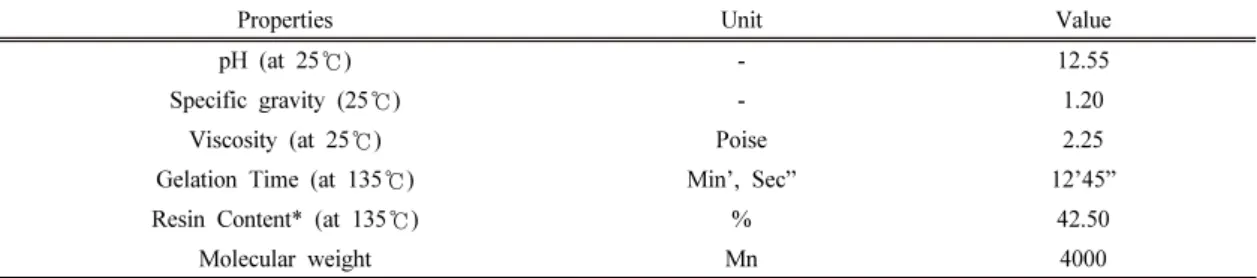
Phenol formaldehyde (PF) resin was impreg- nated into the cell lumen of S-OPT. The PF resin was purchased from the Palmolite Adhesive Company in Indonesia. The properties of the PF resin used in this study are shown in Table 1.
2.2. Methods
2.2.1. PF resin impregnation and densification by CSC method
Before PF resin impregnation, a group of samples were hot-pressed to a compression ratio of 50% at 100 ℃ for 4 h and another group of samples were not hot-pressed for comparison.
Aqueous solution of 20% PF resin was pre- pared for impregnation. Three methods of PF resin impregnation were applied, including:
1. No vacuum-pressure method: samples were soaked in the PF resin solution for 24 h, no vacuum or pressure was applied, 2. Vacuum method: samples were soaked in
the PF resin solution and vacuumed at 600 mmHg for 1 h,
3. Vacuum-pressure method: samples were
Properties Unit Value
pH (at 25℃) - 12.55
Specific gravity (25℃) - 1.20
Viscosity (at 25℃) Poise 2.25
Gelation Time (at 135℃) Min’, Sec” 12’45”
Resin Content* (at 135℃) % 42.50
Molecular weight Mn 4000
* Non-volatile solid content
Table 1. Properties of PF Resin
soaked in the PF resin solution and vac- uumed at 600 mmHg for 1 h. Pressure of 1 N/mm
2for 30 min was then applied.
Four samples were used for each treatment.
After PF resin impregnation, curing was per- formed in an oven-dryer at 60 ℃ for 15 hours.
The samples were then compressed by CSC method. CSC is a compression method to im- prove permanent fixation of compressive de- formation in a short time by hygrothermal treat- ment using moisture in wood or other ligno- cellulosic materials (Inoue et al., 1993). Detail description of the CSC method can be seen in our previous publication (Hartono et al., 2016).
The samples were compressed with a target compression ratio of 50% at 135 ℃. After 10 min, hot water vapor inside CSC frame was re- leased and then the compression process was continued for another 10 min. After com- pression by CSC method, the samples were conditioned under a relative humidity of 70 ± 5% at 25 ± 2 ℃ for 2 weeks before further testing. The final size of the samples after com- pression was 150 mm × 50 mm × 10 mm in length, width, and thickness, respectively.
2.2.2. Physical properties evaluation
The air-dry density of samples after PF resin impregnation and compressed by CSC method was determined by measuring their air-dry weight and volume using sample dimensions of 20 mm × 20 mm × 10 mm. Weight gain per- centage (WG%) was determined by measuring samples weight before impregnation ( w
o) and weight after PF resin impregnation ( w
i), and
then calculated using the equation:
WG (%) = w
i- w
o× 100%
w
o··· (1)
The anatomical structure after PF resin im- pregnation and compression by CSC was observed. Sliding microtome was used to make sections with 30 µm in thickness. The sections were stained with Safranin-Astra blue, dehy- drated in a graded series of alcohol solutions (50%, 70%, 90%, 95%, and 99%), mounted in Canada balsam, and observed with an optical microscope (Nikon Eclipse E600, Japan).
The recovery of set (RS) was obtained using samples with dimensions of 30 mm × 20 mm × 10 mm by soaking the samples in room-temper- ature water (20 ± 3 ℃) for 24 h and then in hot water (100 ± 3 ℃) for 30 min (Dwianto et al., 1999). The RS was calculated as follows:
RS (%) = T
r− T
c× 100%
T
o− T
c··· (2)
where T
ois the initial thickness, T
cis the thick- ness after compression, and T
ris the thickness after recovery. All the dimensions of the sam- ples were measured in the oven-dry condition.
2.2.3. Mechanical properties evaluation
Modulus of rupture (MOR), modulus of elas-
ticity (MOE), and compressive strength tests
were conducted using a universal testing ma-
chine (Model 4482, Instron, USA). The sample
dimensions for the MOR and MOE tests were
150 mm × 10 mm × 10 mm. Three-point bend-
ing was applied over an effective span of 100
mm at a loading speed of 5 mm/min. The
dimensions of the samples for the compressive strength test were 40 mm × 10 mm × 10 mm.
The MOR, MOE, and compressive strength ( R) were calculated as follows:
MOR (N/mm
2) = 3 × P × L
2 × b × t
2 ··· (3)MOE (N/mm
2) = P
p× L
34 × Y
p× b × t
3 ··· (4)R (N/mm
2) = P
b × t ··· (5) where P is the maximum load (N), P
pis the load at the proportional limit (N), Y
pis the de- flection (mm), L is the span length (mm), b is the sample width (mm), and t is the sample thickness (mm).
2.2.4. Data analysis
The experimental design was a completely randomized design (CRD). The results of the properties tested were submitted to an overall analysis of variance (ANOVA) using SPSS ver- sion 16.0. The homogeneity of the means among combinations was tested using the Duncan’s Multiple Range Tests.
3. RESULTS AND DISCUSSION 3.1. Physical properties
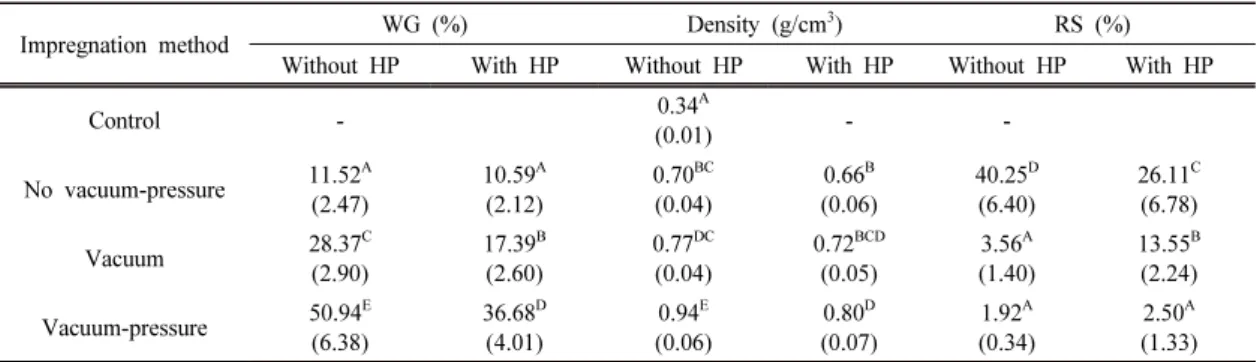
Physical properties of S-OPT before and after PF resin impregnation and CSC are shown in Table 2. The results showed that the WG and density of samples without hot pressing was significantly higher than samples with hot pressing prior to PF resin impregnation, and the results were consistent for all three im- pregnation methods. Hot pressing prior to PF resin impregnation made the S-OPT structure become more compact, resulting in the diffi- culty for PF resin to penetrate. For im- pregnation method with no vacuum-pressure, samples with hot pressing showed lower RS compared to samples without hot pressing prior to PF resin impregnation. However, when using vacuum and vacuum-pressure impregnation methods, the samples with hot-pressing showed significantly higher RS than samples without hot pressing. Lower RS indicated better dimen- sional stability and better fixation.
The combination of PF resin impregnation
Impregnation method WG (%) Density (g/cm3) RS (%)
Without HP With HP Without HP With HP Without HP With HP
Control - 0.34A
(0.01) - -
No vacuum-pressure 11.52A (2.47)
10.59A (2.12)
0.70BC (0.04)
0.66B (0.06)
40.25D (6.40)
26.11C (6.78)
Vacuum 28.37C
(2.90)
17.39B (2.60)
0.77DC (0.04)
0.72BCD (0.05)
3.56A (1.40)
13.55B (2.24)
Vacuum-pressure 50.94E (6.38)
36.68D (4.01)
0.94E (0.06)
0.80D (0.07)
1.92A (0.34)
2.50A (1.33) Notes: HP: hot pressing prior to PF resin impregnation; means within a parameter (two columns) followed by the same capital letter are not
significantly different at 1% significance level using Duncan’s multiple range test. Numbers in parenthesis are standard deviations.
Table 2. Physical properties of S-OPT after impregnation with PF and compression by CSC method
and CSC of S-OPT resulted in higher density achieved compared to only CSC. The combi- nation of PF resin impregnation and CSC in- creased the S-OPT density by 94-176%, sig- nificantly higher than the increase of density by using only CSC of 3-90% (Hartono et al., 2016).
The PF resin impregnation method ( i.e., with- out hot-pressing and with vacuum-pressure) of S-OPT resulted in the highest WG and density with the lowest RS. The values indicated that the treatment resulted in a better the PF resin penetration, higher compression ratio, better di- mensional stability, and better fixation.
Vacuum-pressure method resulted in better WG, density, and RS in both samples without and with hot-pressing prior to PF resin impregnation. In addition, statistical analyses showed that WG and density of S-OPT treated without hot-pressing prior to PF resin im- pregnation were significantly higher than S-OPT treated with hot-pressing, while RS values showed no significantly different.
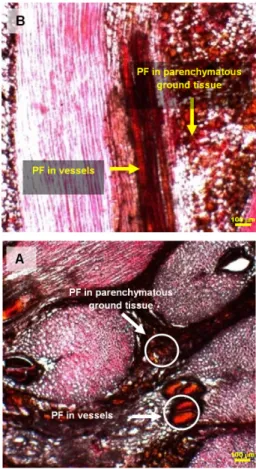
During vacuum-pressure, vacuum could evac- uate the air inside of S-OPT, and pressure forced PF resin to penetrate into S-OPT. The pressure may opened up parenchyma and ves- sel, and it makes PF resin easier to enter, hence the WG value was the higher. Vessels and parenchyma cells filled out with PF resin and after compression by CSC method can be seen in Fig. 2.
Similar to wood, OPT is a hygroscopic material. The hydrophilic properties of OPT
Fig. 1. Soft-inner part of oil palm trunk (S-OPT)used for this study.
Fig. 2. Micrographs of S-OPT at (A) transverse sec- tion and (B) radial section: PF impregnated paren- chymatous ground tissue and vessels of S-OPT (20×
magnification).
may be caused by its thin cell walls and large lumens (Erwinsyah ,2008, Abdul Khalil et al., 2008). The S-OPT became moisture-resistant by the polymerization of the cured resins; hence more PF resin penetration or higher WG re- sulted in the increase of dimensional stability as shown by an increase of density and reduction of RS. The results were in agreement with pre- vious studies. Furuno et al. (2004) reported an increase of dimensional stability of wood and bamboo after impregnation of PF resin.
Gabrielli and Kamke (2008) stated that PF resin impregnation contributed to an increase of di- mensional stability and reduction of thick- ness-swelling of wood.
3.2. Mechanical properties
The control sample of S-OPT had MOE of 12.08 N/mm
2and compressive strength of 7.8 N/mm
2and classified as very poorly strong (Strength Class V) according to Indonesian Standard SNI 01-0608-1989 (BSN, 1989). The
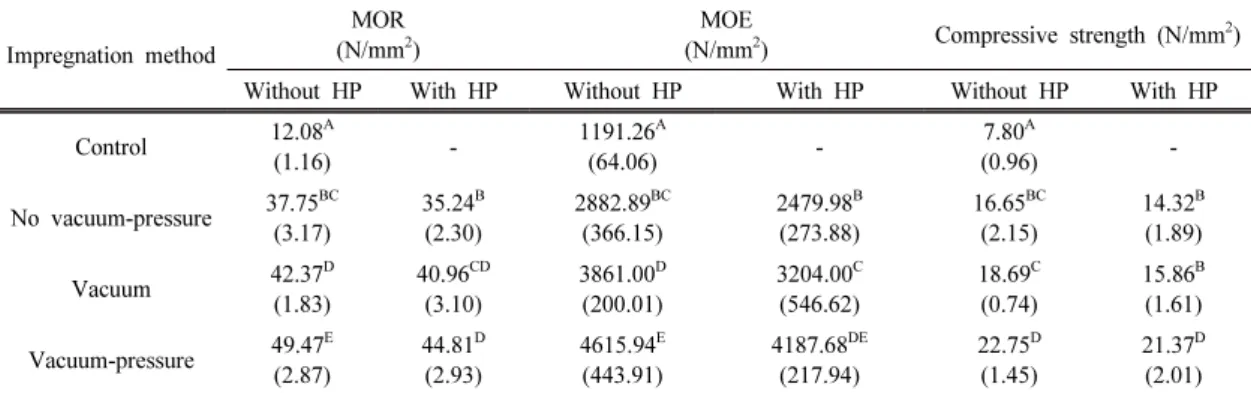
PF resin impregnation with vacuum-pressure method could increase the MOR strength class into Strength Class III (moderately strong) and compressive strength into Strength Class IV (poorly strong). Overall results showed that the impregnation of PF resin and compression by CSC method significantly increased mechanical properties of S-OPT by 191-309%, 108-287%, and 83-191% for MOR, MOE, and compressive strength, respectively (Table 3). The increase of mechanical properties using the combination of PF resin impregnation and CSC of S-OPT was higher than that using only CSC with MOE, MOR, and compressive strength of 43-192%, 14-155%, 19-123%, respectively (Hartono et al., 2016).
Table 3 shows that S-OPT treated without hot-pressing prior to PF resin impregnation had better mechanical properties than that of S-OPT treated with hot-pressing. The MOR, MOE, and compressive strength increased in order after the sample treated with no vacuum-pressure, vacuum, and vacuum-pressure, respectively with
Impregnation method
MOR (N/mm2)
MOE
(N/mm2) Compressive strength (N/mm2)
Without HP With HP Without HP With HP Without HP With HP
Control 12.08A
(1.16) - 1191.26A
(64.06) - 7.80A
(0.96) -
No vacuum-pressure 37.75BC (3.17)
35.24B (2.30)
2882.89BC (366.15)
2479.98B (273.88)
16.65BC (2.15)
14.32B (1.89)
Vacuum 42.37D
(1.83)
40.96CD (3.10)
3861.00D (200.01)
3204.00C (546.62)
18.69C (0.74)
15.86B (1.61)
Vacuum-pressure 49.47E (2.87)
44.81D (2.93)
4615.94E (443.91)
4187.68DE (217.94)
22.75D (1.45)
21.37D (2.01) Notes: HP: hot pressing prior to PF resin impregnation; means within a parameter (two columns) followed by the same capital letter are not
significantly different at 1% significance level using Duncan’s multiple range test. Numbers in parenthesis are standard deviations.
Table 3. Mechanical properties of OPT after impregnation with PF and compression by CSC method
the highest value achieved by S-OPT treated with vacuum-pressure method.
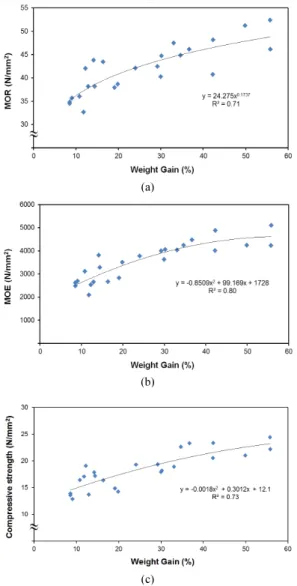
Mechanical properties were attributable to WG value. The higher WG resulted in the higher MOR, MOE, and compressive strength.
Fig. 3 shows the relationship between WG with
mechanical properties. The regression analysis showed that the correlation between WG and MOR could be described by power fit, while the relationship between WG and MOE, WG and compressive strength could be described by a second-order polynomial.
4. CONCLUSION
The S-OPT was impregnated by PF resin and compressed by CSC method. PF resin im- pregnation by no vacuum-pressure, vacuum, and vacuum-pressure method significantly improved physical and mechanical properties of com- pressed OPT. The assessed physical and me- chanical properties showed their best perform- ances when PF resin impregnated with vac- uum-pressure method. Combining PF resin im- pregnation and compression by CSC method could be a good method to improve physical and mechanical properties of soft inner part of OPT.
ACKNOWLEDGEMENT
This work was supported by the fund under the framework of international cooperation program man- aged by National Research Foundation of Korea (2015K2A1A2070699).
REFERENCES
Abdul Khalil, H.P.S., Nurul Fazita, M.R., Bhat, A.H., Jawaid, M., Nik Fuad, N.A. 2010a.
Development and material properties of new hy- brid plywood from oil palm biomass. Materials and Design 31: 417∼424.
(a)
(b)
(c)
Fig. 3. Weight gain of S-OPT after PF resin im- pregnation and compression by CSC versus: (a) MOR, (b) MOR, and (c) compressive strength.
Abdul Khalil, H.P.S., Bhat, A.H., Jawaid, M., Amouzgar, P., Ridzuan, R., Said, M.R. 2010b.
Agro-wastes: Mechanical and physical properties of resin impregnated oil palm trunk core lumber.
Polymer Composites 31(4): 638∼644.
BSN (Badan Standarisasi Nasional). 1989. Physical and mechanical properties requirement of wood for furniture. Jakarta, Indonesia. National Standardization Agency.
Bakar, E.S., Rachman, O., Hermawan, D., Karlinasari, L., Rosdiana, N. 1998. Utilization of oil palm tree as building and furniture materials (1): Physical and chemical properties and dura- bility of oil palm wood. Jurnal Teknologi Hasil Hutan 11(1): 1∼12.
Bakar, E.S., Febrianto, F., Wahyudi, I., Ashaari, Z.
2006. Polygon sawing: An optimum sawing pat- tern for oil palm stems. J. Biol. Sci. 6(4): 734∼ 749.
Bakar, E.S., Tahir, P.M., Sahri, M.H., Mohd Noor, M.S., Zulkifli, F.F. 2013. Properties of Resin Impregnated Oil Palm Wood (Elaeis Guineensis Jack). Pertanika J. Trop. Agric. Sci. 36(S): 93∼ 100.
Directorate General of Estate Crops. 2014. Tree crop estate statistics of Indonesia 2013-2015: Palm oil. Directorate General of Estate Crops. Jakarta, Indonesia. http://ditjenbun.pertanian.go.id/tinymc puk/gambar/file/statistik/2015/SAWIT%202013%
20-2015.pdf
Dwianto, W., Morooka, T., Norimoto, M., Kitajima, T. 1999. Stress relaxation of Sugi (Cryptomeriajaponica D. Don) wood in radial compression under high-temperature steam.
Holzforschung 53(5): 541∼546.
Erwinsyah. 2008. Improvement of Oil Palm wood properties using bioresin. PhD thesis. Technische Universität Dresden.
Feng, L.Y., Tahir, P.M., Hoong, Y.B. 2011. Density
distribution of Oil Palm stem veneer and its in- fluence on plywood mechanical properties.
Journal of Applied Sciences 11(5): 824∼831.
Furuno, T., Imamura, Y., Kajita, H. 2004. The mod- ification of wood by treatment with low molec- ular weight phenol-formaldehyde resin: a proper- ties enhancement with neutralized phenolic-resin and resin penetration into wood cell walls.
Wood Science and Technology 37(5): 349∼361.
Gabrielli, C., Kamke, F.A. 2008. Treatment of chem- ically modified wood with VTC process to im- prove dimensional stability. Forest Product Journal 58(12): 82∼86.
Hartono, R., Wahyudi, I., Febrianto, F., Dwianto, W.
2011. Maximum compression level measurement of oil palm trunk. Jurnal Ilmu dan Teknologi Kayu Tropis 9(2): 173∼183.
Hartono, R., Wahyudi, I., Febrianto, F., Dwianto, W., Hidayat, W., Jang, J.H., Lee, S.H., Park, S.H., Kim, N.H. 2016. Quality Improvement of Oil Palm Trunk Properties by Close System Compression Method. Journal of the Korean Wood Science and Technology 44(2): 172∼183.
Hashim, K., Tahiruddin, S., Asis, A.J. 2012. Palm and palm kernel oil production and processing in Malaysia and Indonesia, in: Palm Oil:
Production, Processing, Characterization, and Uses, Lai, O.M., Tan, C.P., Akoh, C.C. (eds.), AOCS Press, Urbana, IL.
Hoong, Y.B., Loh, Y.F., Nor hafizah, A.W., Paridah, M.T., Jalaluddin, H. 2012. Development of a new pilot scale production of high grade oil palm plywood: Effect of pressing pressure.
Materials and Design 36: 215∼219.
Ibrahim, Z., Aziz, A.A., Ramli, R., Mokhtar, A., Omar, R., Lee, S.J. 2014. Production of Medium Density Fibreboard (MDF) from Oil Palm Trunk (OPT). Journal of Applied Sciences 14: 1174∼ 1179.
Inoue, M., Kadokawa, N., Nishio, J., Norimoto, M.
1993. Permanent fixation of compressive de- formation by hygro-thermal treatment using moisture in wood. Wood Res Bull. 29: 54∼61.
Ismail, A., Mamat, M.N. 2002. The optimal age of oil palm replanting. Oil Palm Industry Economic Journal 2(1): 11∼18.
Iswanto, A.H., Sucipto, T., Azhar, I., Coto, Z., Febrianto, F. 2010. Physical and Mechanical Properties of Palm Oil Trunk from Aek Pancur Farming-North Sumatera. Jurnal Ilmu dan Teknologi Hasil Hutan 3(1): 1∼7.
Koh, L.P., Wilcove, D.S. 2007. Cashing in palm oil for conservation. Nature 448: 993∼994.
Lamaning, J., Hashim, R., Sulaiman, O., Sugimoto, T., Sato, M., Hiziroglu, S. 2014. Measurement of some properties of binderless particleboards made from young and old oil palm trunks.
Measurement 47: 813∼819.
Lim, S.C., Khoo, K. 1986. Characteristic of oil palm trunk and its potential utilization. Malaysian Forester 49(1): 3∼22.
Nabil, F.L, Zaidon, A., Anwar, U.K.M., Bakar, E.S., Lee, S.H., Paridah, M.T. 2016. Impregnation of
Sesenduk (Endospermum diadenum) Wood with Phenol Formaldehyde and Nanoclay Admixture:
Effect on Fungal Decay and Termites Attack.
Sains Malaysiana 45(2): 255∼262.
Nadhari, W.N.A.W., Hashim, R., Sulaiman, O., Sato, M., Sugimoto, T., Selamat, M.E. 2013. Utilization of Oil Palm trunk waste for manufacturing of binderless particleboard: Optimization study.
BioResources 8(2): 1675∼1696.
Rowell, R. 2005. Chemical Modification of Wood. In:
Rowell RM (ed.) Handbook of Wood Chemistry, Wood Composites, Chap. 14. CRC Press, Boca Raton, p. 381∼420.
Shams, M.I., Yano, H., Endou, K. 2006.
Compressive Deformation of Wood Impregnated with Low Molecular Weight Phenol Formaldehyde (PF) Resin III: effects of sodium chlorite treatment. J. Wood Sci. 51: 234∼238.
Sulaiman, O., Salim, N., Hashim, R., Yusof, L.H.M., Razak, W., Yunus, N.Y.M., Hashim, W.S., Azmy, M.H. 2009. Evaluation on the suitability of some adhesives for laminated veneer lumber from oil palm trunks. Materials and Design 30(9): 3572∼3580.