유익하게 인체에 작용하는 균(유인균)을 이용한 인삼발효식초 제조과정에 대한 특성연구
A Study on the Vinegar Fermentation Processes of Fresh Korean Ginseng Extract Using Mix Microbial Yinkin
황세란, 데스티아니 수페노, 권순홍, 정성원, 권순구, 박종민, 김종순, 최원식*
Hwang Se Ran, Destiani Supeno, Kwon Soon Hong, Chung Sung Won, Kwon Soon Goo, Park Jong Min, Kim Jong Soon, Choi Won Sik*
<Abstract>
Saponin is the most pharmaceutical active ingredients of the ginseng plant, it was called “Ginsenoside” which means the Glycoside of ginseng that composed glycosides and aglycones. The human body will absorb the saponin easily if these substrate was decomposed by active microorganism. Fermentation is the most convenient technique to decompose this active ingredients. The purpose of this research was to study the sugar content, pH and acidity development during the ginseng fermentation process.
Fresh Korean ginseng and red ginseng extract was used as the main ingredient. The concentrated of pure ginseng extract was added to increase the saponin extract.
Furthermore, the mix microbial powder was added as starter to increase the fermentation efficiency. The ginseng was fermented in fermentation chamber at temperature 37℃ during 70 days. In the end of experiment the sugar content was decreased from 24% to 7.65%, The pH was decreased from 6.5 to 3.4, and the acidity level was incresed from 0% to 1.2%.
Keywords : Ginseng, Fermentation, Red ginseng, vinegar manufacturing
* 최원식, 바이오 산업 기계 공학과, 부산대학교 경상남도 밀양시 삼랑진읍 삼랑진로 1268-50, 우편번호 50463
E-mail: [email protected] Tel: +82-55-350-5425
* Corresponding Author, Professor, Dept. of Bio-Industrial Machinery Eng.,Pusan Natl. Univ
Gyeongsangnam-do Miryang-si Sangnamjin-eub Sangnamjin-ro 1268-50, 50463 REPUBLIC OF KOREA
1. Introduction
Korean ginseng and red ginseng (Panax ginseng C. A. Meyer) has been know as medicinal plant with mysterious powers in the Orient, this plant have been known as the most valuable medicine of all medicinal herbs [1]. The fresh ginseng, which has undergone a steaming and drying process, results in the production of ginsenosides, which are the major components of ginseng that exert beneficial effects on human health in terms of quality, safety, and efficacy [2].
Red ginseng not only reinstates the body’s liveliness, decreases stress and fatigue, and elevates blood circulation, but also improves brain function. In addition, it enhances the activity of the immune system, maintains homeostasis, combats aging, and has proven beneficial against diabetes and cancers [3-5].
Red ginseng was produced by a repeated process of steaming at standart boiling temperatures of 100℃, and then dried or sun-dried of fresh ginseng. It is frequently marinated in an herbal brew which results in the root becoming extremely brittle[6].
Previous studies have investigated the conversion of ginsenosides using various microorganisms, including Saccharomyces cerevisiae, Bacillus subtilis, Aspergillus sp., Lactobacillus sp., and Bifidobacterium longum.
It has been described that fermentation is an ideal process of biochemical alteration using microbial enzymes and microorganisms.
Fermentation is conducted to improve the
storage period, nutrition, and sensory characteristics related to foods [7]. Previous research proved that the multiple prebiotics in fermented ginseng change the chemical compounds of rare ginsenosides through biological transformation [8]. The Korean ginseng fermented with mushroom mycelium bred by solid culture contained significantly more crude fat (4.66-12.02%) than raw Korean ginseng (white ginseng: 1.61%). Nevertheless, the effects of fermented ginseng on mitogenic activity were much greater than those of white ginseng [9].
2. Material and methods
2.1. Sampling preparation
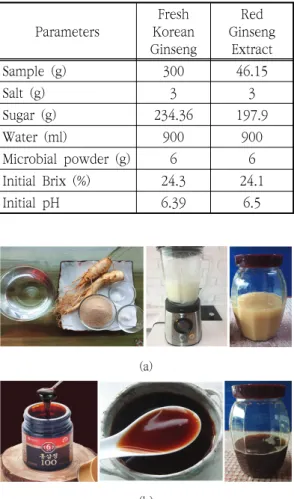
In fresh Korean ginseng vinegar fermentation 300g of fresh Korean ginseng was used as main ingredient, washed with tap water, 400ml of water was added and then blended. In red ginseng vinegar fermentation 46.15g red ginseng extract manufactured by Chongkundang Pharm’s company, South Korea was added to 900ml of water and then mixed. The fermentation process for both samples were done after 70 days in 37℃. The initial sugar content or brix (%) was set to 24% by manipulate the sugar added into the sample. The utilities and equipment that used during experiment such as fermentation jar, knife etc. were sterilize
using boiling water for 15 minute. Table 1 shows the ingredient and initial condition of fermentation process. Figure 1. shows the sample preparation for fresh Korean ginseng and red ginseng extract fermentation.
Parameters
Fresh Korean Ginseng
Red Ginseng
Extract
Sample (g) 300 46.15
Salt (g) 3 3
Sugar (g) 234.36 197.9
Water (ml) 900 900
Microbial powder (g) 6 6 Initial Brix (%) 24.3 24.1
Initial pH 6.39 6.5
Table 1. The experimental ingredient and initial pH level and sugar content (%)
(a)
(b)
Fig. 1 Sample preparation; (a) the preparation of fresh Korean ginseng fermentation, (b) the preparation of red ginseng extract fermentation
2.2. Instrument analysis
The pH level measurement was done using pH-meter (SATO, Japan). The device used is pH meter type sk-620PH, this device can measure the pH with a value of 0-14. Sugar content in this research was measured using a refractometer type: Master-53M, capacity:
0.0-53%, ATAGO, Japan. Refractometer was designed to measure the refractive index of a solution. The Brix scale based on sucrose (sugar) and water solution. Total acidity of ginseng fermentation was measured using titration method. 1ml of sample was mixed with 0.1ml of phenolphthalein solution then sodium hydroxide was added until the sample solution change into purple color solution (Figure 2.). The total acidity was expressed as percenty (%) of acetic acid contain in the sample per ml.
Fig. 2 Titration process with phenolphthalein indicator
3. Result and discussion
The experimental preparation was done by using two different kind of ginseng, such as
fresh Korean ginseng and red ginseng extract.
Based on the Table 1. the initial sugar content of tha sample was set to ±24% and fermentation temperature was 37℃. The experimental result for sugar content, total acid and pH development during fermentation period are shown in the Table 2 and 3. In the fresh Korean ginseng and red ginseng extract fermentation, sugar content was decreasing from ±24% to ±7.65% at 70 days of fermentation process as shown as in the Figure 3.
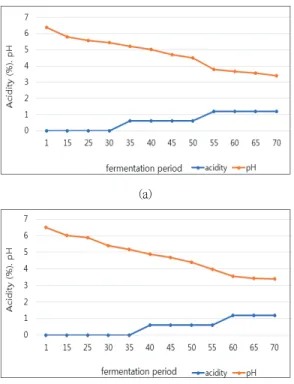
Total acidity, and pH level were also slightly different at final fermentation process, 1.2%; 3.41pH for fresh Korea ginseng and 1.2%; 3.39pH for red ginseng extract as shown in Figure 4. The decrement of sugar content was caused by the degradation of sugar to alcohol during alcoholic fermentation by acid bacteria. The alcohol content in the sample was evaporate as a result of stirring process during fermentation. The increment of acidity level. It is proven by the decrement of pH value. The decrement of sugar content was caused by the degradation of sugar to alcohol during alcoholic fermentation by acid bacteria. The alcohol content in the sample was evaporate as a result of stirring process during fermentation.
The decrement of alcohol resulting on the increment of acidity level. It is proven by the decrement of pH value.
Time (day)
Fresh Korean Ginseng Brix
(%)
Total Acidity
(%) pH
1 24.3±0.00 0±0.00 6.39±0.00 15 16.5±0.00 0±0.00 5.98±0.00 25 12.5±0.00 0±0.00 5.8±0.00 30 9.4±0.00 0±0.00 5.43±0.00 35 8.9±0.00 0.6±0.00 5.21±0.00 40 8.2±0.00 0.6±0.00 5.02±0.00 45 8.4±0.00 0.6±0.00 4.7±0.00 50 8.1±0.00 0.6±0.00 4.51±0.00 55 7.8±0.00 1.2±0.00 3.78±0.00 60 8.1±0.00 1.2±0.00 3.67±0.00 65 7.7±0.00 1.2±0.00 3.57±0.00 70 7.5±0.00 1.2±0.00 3.41±0.00 Table 2. Changes in sugar content, total acidity
and pH during fermentation period in fresh Korean ginseng
Time (day)
Red Ginseng Extract Brix
(%)
Total Acidity
(%) pH
1 24.1±0.00 0±0.00 6.5±0.00 15 17.4±0.00 0±0.00 6.03±0.00 25 13.1±0.00 0±0.00 5.9±0.00 30 9.8±0.00 0±0.00 5.42±0.00 35 9.1±0.00 0±0.00 5.17±0.00 40 8.9±0.00 0.6±0.00 4.9±0.00 45 9±0.00 0.6±0.00 4.7±0.00 50 8.9±0.00 0.6±0.00 4.41±0.00 55 8.5±0.00 0.6±0.00 3.98±0.00 60 8.3±0.00 1.2±0.00 3.57±0.00 65 7.9±0.00 1.2±0.00 3.43±0.00 70 7.8±0.00 1.2±0.00 3.39±0.00 Table 3. Changes in sugar content, total acidity
and pH during fermentation period in red ginseng extract
Fig. 3 Sugar content (%) development during fermentation period
(a)
(b)
Fig. 4 Total acidity (%) and pH development during fermentation period; (a) Fresh Korean Ginseng, (b) Extract Red Ginseng
Figure 5. was shows the samples color changing during fermentation process. The initial color of fresh Korean ginseng fermentation was yellowy milky color then change into crystal clear yellowish liquid at
the final fermentation period. Red ginseng extract liquid color was dark brownish initially, then at the final fermentation period it was changed into clear brownish liquid.
Fig. 5 Color changes during fermentation period; (a) fresh Korean ginseng fermentation, (b) red ginseng extract fermentation
4. Conclusion
1) From this experimental result we can conclude that;
2) The experimental result shows that the manufacturing of fresh Korean ginseng and red ginseng vinegar fermentation with microbial powder addition as starter was possible.
3) Sugar content was decreasing from
±24% to ±7.65% at 70 days of fermentation process.
4) Total acidity, and pH level were also slighly different at final fermentation process, 1.2%; 3.41pH for fresh Korea ginseng and 1.2%; 3.39pH for red ginseng extract.
References
[1] Kim, J. H., Kim, M. K., Wang, Hongtao, Lee, H. N., Jin, C. G., Kwon, W. S., Yang, D. C..
“Discrimination of Korean ginseng (Panax ginseng Meyer) cultivar Chunpoong and American ginseng (Panax quinquefolius) using auxin repressed protein gene”, J. Ginseng Res., Vol. 40, pp. 395-399, 2016.
[2] Helms S.. “Cancer prevention and therapeutics:
Panax ginseng.” Altern Med Rev, Vol. 9, pp.
259-274, 2004.
[3] Christensen LP. “Ginsenosides chemistry,
biosynthesis, analysis, and potential health effects,” Adv Food Nutr Res., Vol. 55, pp.
1-99, 2009.
[4] Choi S. S., Lee J. K., Suh H. W., “Effect of ginsenosides administered intrathecally on the antinociception induced by cold water swimming stress in the mouse.”, Biol Pharm Bull, Vol.
26, pp. 858-861, 2003.
[5] Deyama T, Nishibe S, Nakazawa Y.
“Constituents and pharmacological effects of Eucommia and Siberian ginseng.”, Acta Pharmacol Sin, Vol. 22, pp. 1057-1070, 2001.
[6] Cho J. S., Han Y. N., Oh H. I., Park H., Sung H. S., Park J. H., “Understanding of Korean ginseng.” Seoul; The Society for Korean Ginseng, 2005.
[7] Jung, J., Jang, H. J., Eom, S. J., Choi, N. S., Lee, N. K., Paik, H. D., “Fermentation of red ginseng extract by the probiotic Lactobacillus plantarum KCCM 11613P: ginsenoside conversion and antioxidant effects”, J. Ginseng Res., pp. 1-7, 2017.
[8] Xiao Dan, Xiu Yang, Yue Hao, Sun Xiuli, Zhao Huanxi, Liu Shuying. “A comparative study on chemical composition of total saponins extracted from fermented and white ginseng under the effect of macrophage phagocytotic function.”, J Ginseng Res, Vol. 41, pp. 379-385, 2017.
[9] Rae S. H., Lee H. S., Kim M. R., Kim S. Y., Kim J. M., Suh H. J.. “Changes of ginsenoside content by mushroom mycelial fermentation in Red ginseng extract.”, J Ginseng Res, Vol. 42, pp. 235-242, 2011
(접수: 2017.08.21. 수정: 2017.09.07. 게재확정: 2017.09.12.)