• 검색 결과가 없습니다.

A Study on Real Time Working Path Control of Vertical Type Robot System for the Forging and Casting Process Automation

N/A
N/A
Protected

Academic year: 2021

Share "A Study on Real Time Working Path Control of Vertical Type Robot System for the Forging and Casting Process Automation"

Copied!
12
0
0

로드 중.... (전체 텍스트 보기)

전체 글

(1)

Casting Process Automation

A Study on Real Time Working Path Control of Vertical Type Robot System for the Forging and

Casting Process Automation

O-Deuk Lim

1

, Min-Seong Kim

2*

, Yang-Geun Jung

3

, Jung-Suk Kang

4

, Jong-Bum Won

4

, Sung-Hyun Han

5

<Abstract>

In this study, we describe a new approach to real-time implementation of working path control for the forging and casting manufacturing process by vertical type articulated robot system. The proposed control scheme is simple in structure, fast in computation, and useful for real-time control of factory automation based on robot system. Moreover, this scheme does not require any accurate parameter information, nor values of the uncertain parameters and payload variations. Reliability of the proposed controller is proved by simulation and experimental results for robot manipulator consisting of arm with six degrees of freedom under the variation of payloads and tracking trajectories in Cartesian space and joint space. The vertical type articulated robot manipulator with six axes made in SMEC Co., Ltd. has been used for real-time implementation test to illustrate the enhanced working path control performance for unmanned automation of the forging and casting manufacturing process.

Keywords : Forging and Casting, Vertical Articulated Robot, Working Path Control, Unmanned Automation, Payload Variations

1. Naval Shipyard

2*. Corresponding Author, M.S. Course, Graduate School Kyungnam Univ. (e-mail : [email protected]) 3. PhD. Course, Graduate School Kyungnam Univ.

4. SMEC Co., Ltd.

5. Dept. of Mechanical Engineering, Kyungnam University.

(2)

1. INTRODUCE

The convergence of the fields of robotics and automation in many industrial applications is well established. During the execution of many industrial automation tasks, the robot manipulator is often in contact with its environment (either directly or indirectly via an end-effector payload). For purely positioning tasks such as spray painting that have negligible force interaction with the environment, controlling the manipulator end-effector position results in satisfactory performance. However, in applications such as the process automation of forging or casting, the manipulator end effector will be taken an interaction forces from the environment. Furthermore, due to contact with the environment, the motion of the end effector in certain directions is restricted. In the field of robotics, this resulting motion is often referred to as constrained motion or compliant motion. This chapter focuses on the control strategies of manipulators for constrained motion. While there are many techniques that may be used to design controllers for constrained motion, a popular active compliant approach is the use of force control. The fundamental philosophy is to regulate the contact force of the environment. This is often supplemented by a position control objective that regulates the orientation and the location of the end effector to a desired configuration in its environment.[1-3]

For example, in the case of grinding applications, the motion of the manipulator arm is constrained by The grinding surface. It can easily be seen that it is vital to control not only the position of the manipulator end effector to ensure contact with the grinding surface but also the interaction forces to ensure sufficient contact force to enable grinding action.[4-6]

At recent there are mach advanced techniques that are suitable for servo control of a large class of nonlinear systems including robotic manipulators. Since the pioneering work of Dubowsky and DesForges, the interest in adaptive control of robot manipulators has been growing steadily. This growth is largely due to the fact that adaptive control theory is particularly well-suited to robotic manipulators whose dynamic model is highly complex and may contain unknown parameters. However, implementation of these algorithms generally involves intensive numerical computations.[7-9]

Current industrial approaches to the design

of robot arm control systems treat each joint

of the robot arm as a simple

servomechanism. This approach models the

time varying dynamics of a manipulator

inadequately because it neglects the motion

and configuration of the whole arm

mechanism. The changes in the parameters of

the controlled system are significant enough

to render conventional feedback control

strategies ineffective. This basic control

system enables a manipulator to perform

(3)

simple positioning tasks such as in the pick-and-place operation. However, joint controllers are severely limited in precise tracking of fast trajectories and sustaining desirable dynamic performance for variations of payload and parameter uncertainties. In many servo control applications the linear control scheme proves unsatisfactory, therefore, a need for nonlinear techniques is increasing.[10-12]

If a robot manipulator is required to draw multiple instances of one shape in the process. The end-effector position must follow a specific trajectory while ensuring that the user applies a certain amount of force on the manufacturing line. We know that if the force is too small, the drawing may not be visible; however, if the force is too large, the chalk will break. Moreover, as multiple instances of shapes are drawn, the length of the obsticles. Thus, one can appreciate complexities and intricacies of simple tasks such as drawing/writing. This example clearly illustrates the need for desired force trajectory in addition to a desired position trajectory. Another example that motivates the use of a position/force control strategy is the pick-and-place operations using grippers for glass tubes.

Clearly, if the gripper closes too tight, the glass may shatter, and if it is too lose, it is likely the glass may slip. The above examples establish the motivation for position and force control.[13-15]

In many applications, the position/force

control objectives are considerably more intertwined than in the examples discussed thus far. Consider the example of a circular diamond-tipped saw cutting a large block of metal, wherein the saw moves from one end to the other. The motion from one end to the other manifests itself as the position control objective, whereas cutting the block of metal without the saw blade binding is the force control objective. The speed of cutting (position control objective) depends on many parameters, such as geometric dimensions and material composition. For example, for a relatively softer metal such as aluminum, the saw can move safely from one end to the other much faster than in the case of a relatively harder material such as steel. It is obvious that the cutting speed would be much faster for thinner blocks of metal.[16]

To achieve control objectives such as those discussed above, the controller must be designed to regulate the dynamic behavior between the force exerted on the environment and the end effector motion.

2. MODELING

This section presents the formulation of the manipulator dynamics that facilitates the design of strategies to control robot arms.

First, the widely known joint-space model is

presented. Next, we define some notation for

the contact forces (sometimes referred to as

(4)

interactive forces) exerted by the manipulator on the environment by employing a coordinate transformation.[17-18]

2.1 Joint-Space Model

The dynamics of motion for an n-link robotic manipulator are constructed in the Euler-Lagrange form as follows:

   

     

  (1)

Where

       (2)

  ∈ 

 ×

denotes the inertia matrix,

 ∈ 

 ×

contains the centripetal and Coriolis terms,  ∈ 

contains the static (Coulomb) and dynamic (e.g., viscous) friction terms,  ∈ 

is the gravity vector,

∈ 

represents the joint-space end- effector forces exerted on the environment by

the end-effector, ∈ 

represents the joint-space variable vector, and ∈

is the torque input vector.[18-19]

2.2 Joint-Space Model

In order to facilitate the design of force controllers, the forces are commonly transformed into the task-space via a Jacobian matrix by using a coordinate transformation. [20-21] Note that this Jacobian matrix is defined in terms of the task-space coordinate system and dependent on the robot application. Specifically, depending on the type of application, the axes of force control and motion may vary and are captured by the definition of the Jacobian.[22] Toward formulating the task- space dynamics, we define a task-space vector  ∈ 

as follows:

   (3)

Where  is obtained from the manipulator kinematics and the joint and task-space relationships. The derivative of the task-space vector is defined as follows :

    (4)

Where the task-space jacobian matrix

 ∈ 

 ×

is defined as [23-24]

   

  

 

 

  



(5)

Fig.1 Link coordinates of robot manipulator

with 6-D.O.F

(5)

With  being the identity matrix,  being the zero matrix, and the transformation matrix  is used to convert joint velocities to derivatives of roll, pitch, and yaw angles associated with end-effector orientation.[22] It should be noted that the joint-space representation of the force exerted on the environment can be rewritten as

   

     

   (6)

Where  ∈ 

denotes the vector of forces and torques exerted on the environment in task-space.[23]

3. CONTROLLER DESIGN

An important disadvantage of the stiffness controller discussed in the previous section is that the desired manipulator position and the desired force exerted on the environment are constants. That is, the controller is restricted to a constant set point regulation objective.

In applications such as polishing and deburring, the end effector must track a prescribed path while tracking some desired force trajectory on the environment. In such a scenario, the stiffness controller will not achieve satisfactory results.[23-24]

To that end, another approach that simultaneously achieves position and force tracking objectives is used. The hybrid position/force controller developed in decouples the position and force control problems into

subtasks via a task-space formulation. This formulation is critical on determining the directions in which force or position should be controlled. Once these subtasks are identified, separate position and n-link manipulator and then discuss this control strategy with respect to the 6-DOF Cartesian manipulator shown in Fig. 1.

The following hybrid position/force controller first uses feedback-linearization to globally linearize the robot manipulator dynamics and then employs linear controllers to track the desired position and force trajectories. To that end, by using the task-space transformation of Equation (3) to decompose the normal and tangential surface motions and after some mathematical manipulation, the robot dynamics can be expressed as

  

 

    

   

 

   (7)

Based on the structure of Equation (7) and the control objectives, a feedback-linearizing controller for the above system can be constructed as follows:

    

 

     



    

 (8)

Where  ∈ 

denotes the linear position

and force control strategies. Note that from

Equation (7) and Equation (8), we have

(6)

   (9)

Given that the system dynamics in Equation (9) have been decoupled in the task-space into tangential and normal components denotes by subscripts T and N, respectively, we can design separate position and force control algorithms.[25]

The tangential task-space components of 

can be represented as follows:





  



(10)

Where



denotes the th linear tangential task-space position controller. The corresponding tangential task-space tracking error is defined as follows:

 



 



 



(11)

Where 



represents the desired position trajectory. Based on the controller objective and the structure of Equation (11), we can design the following linear algorithm:

 



 



 



  



 



 



  (12)

where 



and 



are the th positive control gains. After substituting this controller defined in Equation (12) into Equation (10), we obtain the following closed-loop dynamics as follow:

 



 



  



 



 



  ( 13)

Given that 



and 



are positive, an asymptotic position tracking result is obtained as follow:

lim

→

 



  (14)

The normal task-space components of 

can be represented as follows:





  



(15)

Where



denotes the th linear normal task-space force controller. The corresponding normal task-space tracking error is defined as follows:



 







 



 (16)

Where the environment is modeled as a spring, 



denotes the th component of the environmental stiffness, and 



represents the static location of the environment in the normal direction. The force dynamics can be formulated by taking the second time derivative of Equation (16) as follows:





    





  



(17)

Which relates the acceleration in the

normal direction to the second time

(7)

derivative of the force. To facilitate the construction of a linear controller, we define the following force tracking error as follow:

 



 



 



(18)

Where  



denotes the th of the desired force trajectory in the normal direction. A linear controller that achieves the force tracking control objective is defined as follow:

 



  



 



 



  



 



 



 (19)

Where 



and 



are th positive control gains. After substituting the controller into Equation (17), we obtain the following closed-loop dynamics equation as follows:

  



 



  



 



 



  (20)

From equation (20), asymptotic force tracking is defined as follows:

lim

→∞

 



  (21)

4. SIMULATION AND EXPERIMENT 4.1 Simulation

This section represents the simulation results of the position and velocity control for a robotic manipulator with 6 degree of

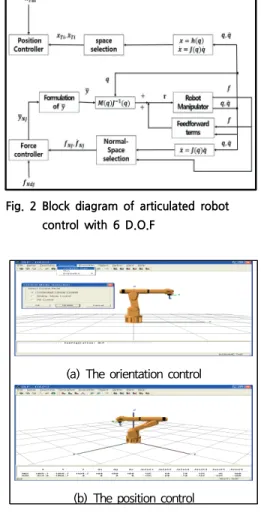
freedom by the proposed control algorithm as shown in Fig.3. The simulation test of proposed controller. The proposed control scheme in this paper has been applied for a vertical type articulated robot with six axes.

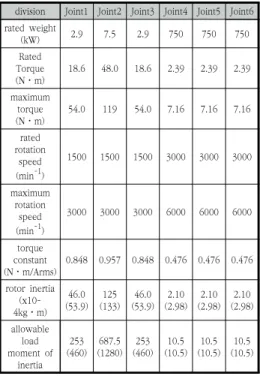
Table.1 represents the specification of robot actuators with 6-D.O.F.

Fig. 2 Block diagram of articulated robot control with 6 D.O.F

(a) The orientation control

(b) The position control

Fig. 3 The simulation results of working path

control for robot with 6-D.O.F

(8)

division Joint1 Joint2 Joint3 Joint4 Joint5 Joint6 rated weight

(kW) 2.9 7.5 2.9 750 750 750

Rated Torque (N⋅m)

18.6 48.0 18.6 2.39 2.39 2.39

maximum torque (N⋅m)

54.0 119 54.0 7.16 7.16 7.16

rated rotation

speed (min

-1

)

1500 1500 1500 3000 3000 3000

maximum rotation

speed (min

-1

)

3000 3000 3000 6000 6000 6000

torque constant (N⋅m/Arms)

0.848 0.957 0.848 0.476 0.476 0.476

rotor inertia (x10- 4kg⋅m)

46.0 (53.9)

125 (133)

46.0 (53.9)

2.10 (2.98)

2.10 (2.98)

2.10 (2.98)

allowable load moment of

inertia 253 (460)

687.5 (1280)

253 (460)

10.5 (10.5)

10.5 (10.5)

10.5 (10.5) Table 1 The specification of robot actuators with

6-D.O.F

4.2 Experiments and results

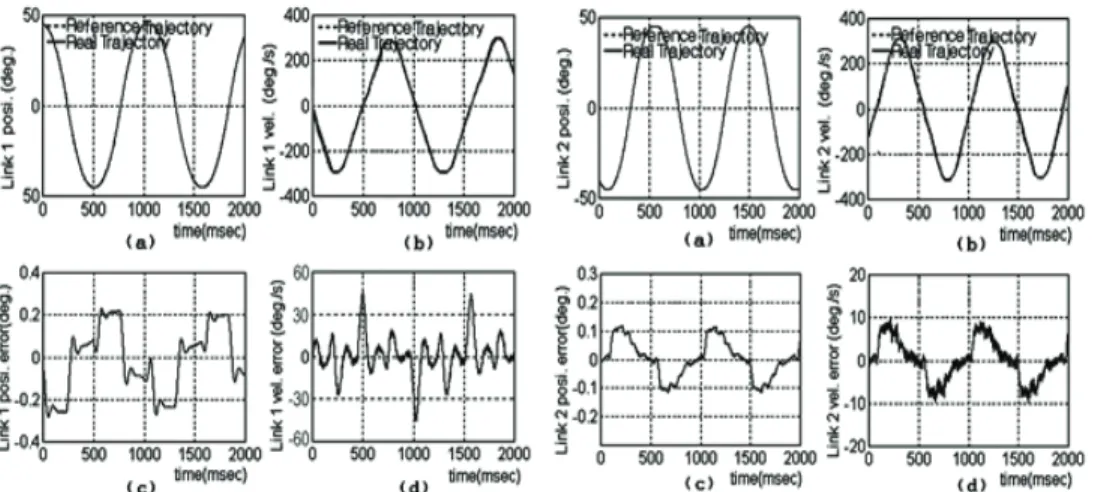
Fig. 4 shows the experimental results of the position and velocity control at the first joint with payload 20 kg and the change of reference trajectory. Fig. 5 shows the proposed control scheme. Fig. 6 represents the experimental results for the position and velocity control at the second joint with 20 kg payload. Fig.’s 7 and 8 show the experimental results for the position and velocity control of the PID controller with 20 kg payload. As can be seen from these results, the proposed controller shows

extremely good control performance with some external disturbances. It is illustrated that this control scheme shows better control performance than the exiting PID controller, due to small tracking error and fast adaptation for disturbance.

Fig. 4 Experimental set-up of robot system

Fig. 5 The proposed control scheme of robot system

Fig.9 represents the experiment results of

PID controller for the position and velocity

tracking at the second joint with 20kg

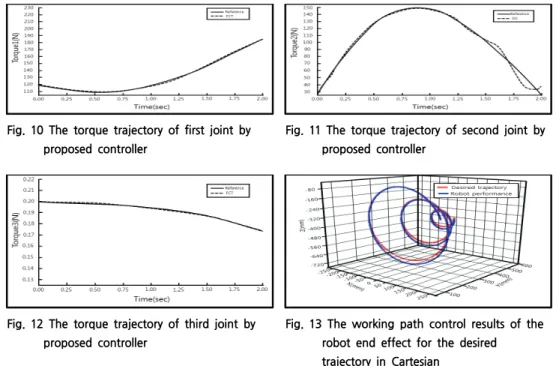
payload. Fig.10 shows the torque trajectory of

first joint by proposed controller. Fig.11

shows the torque trajectory of second joint

by proposed controller. Fig.12 shows the

torque trajectory of third joint by proposed

controller. Fig.13 represents the tracking

(9)

results of the robot end effect for the desired trajectory in Cartesian.

Fig. 6 (a)-(d) Experimental results for the position and velocity tracking of adaptive controller at the first joint with 20kg payload.

Fig. 7 (a)-(d) Experimental results for the position and velocity tracking of adaptive controller at the second joint with 20kg payload.

Fig. 8 (a)-(d) Experimental results of PID controller for the position and velocity tracking at the first joint with 20kg payload.

Fig. 9 (a)-(d) Experimental results of PID

controller for the position and velocity

tracking at the second joint with 20kg

payload.

(10)

5. CONCLUSIONS

In this study, we presented a new approach to implement the real-time control of vertical type robot manipulator with 6-D.O.F for the forging and casting. From the simulation and experimental results, it is illustrated that the proposed controller is robust to the payload variation and change of reference trajectory. This controller has been verified that it is useful to the real-time control of robot system. An important focus of the proposed control scheme is the utilization of a time-varying feedforward controller and a feedback controller for good performance of working path control.

Another attractive point of this control scheme is that it neither requires an accuracy dynamics nor any information of the uncertain parameters and payload variation.

The other attractive feature of this control action is to use a simple information from the actual manufacturing environment, and to be extremely robust for parameter variations.

Until now, many practical issues on the application of robot manipulator control in a very noisy environment has been discussed, and some attempts were also made to provide the remedies of the problem discussed. Nevertheless we feel that proposed control scheme in this study should be analyzed more rigorously including with some nonlinear parameter effects of robot system.

Fig. 10 The torque trajectory of first joint by proposed controller

Fig. 11 The torque trajectory of second joint by proposed controller

Fig. 12 The torque trajectory of third joint by proposed controller

Fig. 13 The working path control results of the

robot end effect for the desired

trajectory in Cartesian

(11)

References

[1] Wenting Zha, Junyong Zhai*, and Shumin Fei,

“Global Adaptive Control for a Class of Uncertain Stochastic Nonlinear Systems with Unknown Output Gain”, Control Theory and Applications, Vol. 15, No. 3, pp.1125-1133, (2017)

[2] Seyed Hamid Hashemipour, Nastaran Vasegh*, and Ali Khaki- Sedigh, “Decentralized Model Reference Adaptive Control for Interconnected Time Delay Systems with Delay in State and Compensation of Long Delay in Input by Nested Prediction”, Control Theory and Applications, Vol. 15, No. 3, pp.1198-1206, (2017)

[3] Ping Yuan, Bi Zhang*, and Zhi-Zhong Mao, “A Robust Adaptive Controller for Hammerstein Nonlinear Systems”, Control Theory and Applications, Vol. 15, No. 2, pp.656-667, (2017) [4] Xia Liu*, Wei Jiang, and Xiu-Cheng Dong,

“Nonlinear Adaptive Control for Dynamic and Dead-zone Uncertainties in Robotic Systems”, Control Theory and Applications, Vol. 15, No.

2, pp.875-882, (2017)

[5] Mehrnoosh Asadi* and Heydar Toossian Shandiz, “Adaptive Control of Pure-feedback Systems with Nonlinear Parameterization via Time-scale Separation”, Control Theory and Applications, Vol. 15, No. 1, pp.196-204, (2017) [6] Shafiqul Islam*, Peter X. Liu, Jorge Dias, and

Lakmal D. Seneviratne, “Adaptive Control for Robot Manipulators using Multiple Parameter Models”, Robot and Applications, Vol. 14, No.

5, pp.1365-1375, (2016)

[7] Hao-Bo Kang* and Jian-Hui Wang, “Adaptive Robust Control of 5 DOF Upper – limb Exoskeleton Robot”, Robotics and Automation, Vol. 13, No.3, pp.773-741, (2015)

[8] Spandan Roy*, Sambhunath Nandy, Ranjit Ray, and Sankar Nath Shome, “Robust Path Tracking Control of Nonholonomic Wheeled Mobile

Robot: Experimental Validation”, Robotics and Automation, Vol. 13, No.4, pp.897-905, (2015) [9] Yuhanes Dedy Setiawan, Trong Hai Nguyen,

Pandu Sandi Pratama, Hak Kyeong Kim, and Sang Bong Kim*, “Path Tracking Controller Design of Four Wheel Independent Steering Automatic Guided Vehicle”, Robot and Applications, Vol. 14, No. 6, pp.1550-1560, (2016)

[10] Mohammad Keshmiri, Wen-Fang Xie*, and Ahmad Ghasemi, “Visual Servoing Using an Optimized Trajectory Planning Technique for a 4 DOFs Robotic Manipulator”, Robot and Applications, Vol. 15 No. 3, pp.1362-1373, (2016)

[11] H. Berghuis, R.Orbega, and H.Nijmeijer, 1993,

“A Robust Adaptive Robot controller,” IEEE Trans., Robotics and Automation, Vol. 9, No.

6, pp. 825-830.

[12] P. Tomei, Aug. 1991, “Adaptive PD Controller for Robot Manipulators,” IEEE Trans. Robotics and Automation, Vol.7, No.4.

[13] N. Sadegh and R. Horowitz, Aug. 1990, “An Exponentially Stable Adaptive Control Law for Robot Manipulators,” IEEE Trans. Robotics and Automation, Vol. 9, No. 4.

[14] Z. Ma, J. shen, A. Hug, and K. Nakayama, October 1995, “Automatic optimum Order Assignment in Adaptive Filters,” international conference on signal Processing Applications

& Technology, Boston pp.629-633.

[15] T. A. Lasky and T. C. Hsia, July 1994,

“Application of a Digital Signal Processor in Compliant Control of an Industrial Manipulator,” Proceedings of American Control Conference.

[16] K. Michael and P. Issa, June 1995, “Digital Signal Processor : A Control Element,” In Proceedings of American Control Conference, Seatle, pp. 470-474.

[17] S. A. Bortoff, Feb. 1994, “Advanced Nonlinear

Robotic Control Using Digital Signal

Processing,” IEEE Trans. Indust. Elect., Vol.

(12)

41, No. 1.

[18] F. Mehdian and M. Wirth, June 1995,

“Adaptive Control of Robotic Manipulators Using DSPs,” In Proceedings of American Control Conference, Seatle, pp.480-481.

[19] S. H. Han, J. Lee, D. Ahn, M. Lee, and K.

Son, July 1996, “Implementation of Robust Adaptive Controller of Robotic Manipulator using DSPs, ”In Proceedings of Eleventh International Conference on System engineering, Lasvegas, pp. 668-673.

[20] T. H. Akkermans and S. G. Stan, 2001,

“Digital servo IC for optical disc drives”, Contr. Eng. Pract., vol. 9, no. 11, pp.

1245-1253.

[21] P. Bhatti and B. Hannaford, 1997, “Single-chip velocity measurement system for incremental optical encoders”, IEEE Trans. Contr. Syst.

Techn., vol. 5, no. 6, pp. 654-661.

[22] Astrom, K. J., “Theory and Application of adaptive Control-A Survey”, Automation, Vol.

19, No. 7, pp.471-481, 1983 [23] Wittenmark, B., “Adaptive Control :

Implementation and Application Issues”, Lecture Notes in Control and Information Sciences, Adaptive Control Strategies for Industrial Use, Proc. Of a Workshop, Canada, pp. 103-120, 1988.

[24] Mohammad Bagher Abolhasani Jabali and Mohammad Hosein Kazemi*, “Uncertain Polytopic LPV Modelling of Robot Manipulators and Trajectory Tracking”, Robot and Applications, Vol. 15, No.2, pp.883-891, 2017

[25] Hyunjin Choi, Sehoon Oh, and Kyoungchul Kong*, “Control of a Robotic Manipulator in the Polar Coordinate System using a Biarticular Actuation Mechanism”, Robot and Applications, Vol. 14, No.4, pp.1095-1105, 2016

[25] Ho Ju Lee, Jae-Kwan Ryu, Jongwon Kim, Young June Shin, Kyung-Soo Kim*, and Soohyun Kim, “Design of Modular Gripper for Explosive Ordinance Disposal Robot Manipulator

Based on Modified Dual-Mode Twisting Actuation”, Robot and Applications, Vol. 14, No. 5, 2016.

(Manuscript received May 15, 2017; revised June 5, 2017;

accepted June 12, 2017.)

수치

Fig.  3  The  simulation  results  of  working  path  control  for  robot  with  6-D.O.F
Fig.  4  shows  the  experimental  results  of  the  position  and  velocity  control  at  the  first  joint  with  payload  20  kg  and  the  change  of  reference  trajectory
Fig.  6  (a)-(d)  Experimental  results  for  the  position  and  velocity  tracking  of  adaptive  controller  at  the  first  joint  with  20kg  payload.
Fig.  10  The  torque  trajectory  of  first  joint  by  proposed  controller

참조

관련 문서

After first field tests, we expect electric passenger drones or eVTOL aircraft (short for electric vertical take-off and landing) to start providing commercial mobility

1 John Owen, Justification by Faith Alone, in The Works of John Owen, ed. John Bolt, trans. Scott Clark, &#34;Do This and Live: Christ's Active Obedience as the

Wald-Type Tests for Detecting Breaks in The Trend Function of a Dynamic

Just as we achieved good control with a joint-based controller that was based on a linearizing and decoupling model of the arm, we can do the same for the Cartesian case.

In wireless sensor networks (WSNs), a transport protocol plays an important role of reliable transmission and congestion control.. The efficient design of

In order to derive a new fuzzy controller, a fixed design-parameter fuzzy PID controller was surveyed in view of deriving a control law based on the

In this thesis, P controller for pitch controller of outer loop control system and PD controller for fin controller of inner loop control system are

This thesis presents a nonlinear PID controller that can enhance the tracking performance of the conventional linear PID controller to achieve a