• 검색 결과가 없습니다.

Success Factors Analysis of Domestic Franchise Business - A Study on the CEO of Kwangju and Jeonnams -

N/A
N/A
Protected

Academic year: 2021

Share "Success Factors Analysis of Domestic Franchise Business - A Study on the CEO of Kwangju and Jeonnams -"

Copied!
11
0
0

로드 중.... (전체 텍스트 보기)

전체 글

(1)

Success Factors Analysis of Domestic Franchise Business - A Study on the CEO of Kwangju and Jeonnams -

1)

Ji-Hyun Song*, Gye-Beom Jo**

Abstract

In this paper, We conducted to find out what factors may affect the development of franchise businesses by reviewing the success factors of the domestic franchise business. The research was conducted by the CEOs of Gwangju and Jeonnam Franchise Business and a total of 137 items were used in the empirical analysis. Factors influencing success of the franchise business were designed in five areas : ability of the franchise CEO, franchise system, brand management, capacity of the parent store, and product differentiation. We conducted multiple regression analysis and simple regression analysis for the research assumptions, Validation of the relationship between variables revealed that the ability of the franchise CEOs, franchise systems, brand management, and product differentiation did not significantly affect the increase in member sales, so the ability of the shareholders to increase their sales was important. However, the impact on revenue growth at franchise headquarters has all been significant, The increase in sales of franchises has a significant influence on the increase in profits of franchise headquarters, the report said. It was also found that an increase in the sales of franchises has a significant influence on the success of franchises. Finally, it was revealed that increasing profits at franchise headquarters significantly affects the success of the franchise business.

▸Keyword: Franchise, success, Factor analysis, Franchise business

I. Introduction

2014년 산업통상자원부의 프랜차이즈 산업 실태조사에 의 하면, 2014년 기준 국내 가맹본부 총 등록 수는 3,360개, 브랜 드(영업표지) 총 등록 수 4,199개, 임직원 수는 174,542명, 브 랜드 총 점포 수 212,758개, 가맹점 수는 197,858개, 직영점 수는 14,900개이며, 가맹본부 총 매출액은 50조 992억 원이 며, 가맹본부 영업이익의 총액은 2조 4,726억 원이었다.

가맹본부 매출액(비중)의 총액은 1위 도,소매업 32.4조원, 2 위 외식업12.6조원, 3위 서비스업 5.1조원으로 국내 프랜차이 즈 산업의 전체 시장규모는 약 100조원대로 추정된다[1].

2017년 최근 공정거래위원회 정보공개서 통계를 기초 조사 하여 분석하면 2017년 프랜차이즈 가맹본부 수는 4,554개,

브랜드 수는 5574개, 직·가맹점수는 249,314개로 조사 되었다 [2]. 이는 국내 프랜차이즈 시장이 길지 않은 역사임에도 불구 하고 급성장하였는지 그리고, 최소한 양적인 측면에서 보더라 도 프랜차이즈 사업의 성장가능성을 증명하는 것이다.

프랜차이즈 사업은 예비 창업자들에게 선호되는 이유가 편 의성, 일관성, 소자본 창업 등이 가능하기 때문이다. 그러나 최 근에는 프랜차이즈의 수가 급격히 증가되었으나 경험 및 작은 자본 때문에 실패하는 수도 그만큼 늘어났다.

대부분의 창업자가 프랜차이즈 본부의 브랜드 파워에 의존 하며 창업하지만 본인의 경영능력 부족과 가맹본부의 지원 미 흡으로 좋은 성과를 얻지 못하였다[3].

∙First Author: Ji-Hyun Song, Corresponding Author: Gye-Beom Jo

*Ji-Hyun Song ([email protected]), Dept. of Franchise start-up management , Chosun College of Science & Technology

**Gye-Beom Jo ([email protected]), Business administration, Honam University

∙Received: 2018. 02. 26, Revised: 2018. 03. 09, Accepted: 2018. 04. 12.

(2)

Sortation 2012Year 2013Year 2014Year 2015Year 2016Year

Number of member headquarters 2,678 2,973 3,482 3,910 4,268

Brand number 3,311 3,691 4,288 4,844 5,273

Number of member stores 176,788 190,730 194,199 208,104 218,997

Number of stores directly operated 11,326 12,619 12,869 15,459 16,854

Table 1. General status of franchise businesses in Korea

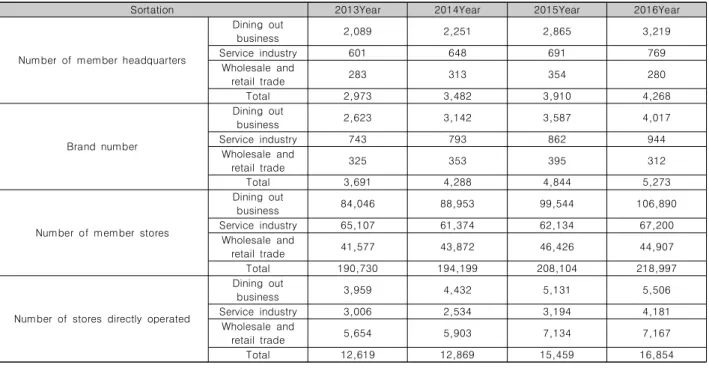
Sortation 2013Year 2014Year 2015Year 2016Year

Number of member headquarters

Dining out

business 2,089 2,251 2,865 3,219

Service industry 601 648 691 769

Wholesale and

retail trade 283 313 354 280

Total 2,973 3,482 3,910 4,268

Brand number

Dining out

business 2,623 3,142 3,587 4,017

Service industry 743 793 862 944

Wholesale and

retail trade 325 353 395 312

Total 3,691 4,288 4,844 5,273

Number of member stores

Dining out

business 84,046 88,953 99,544 106,890

Service industry 65,107 61,374 62,134 67,200

Wholesale and

retail trade 41,577 43,872 46,426 44,907

Total 190,730 194,199 208,104 218,997

Number of stores directly operated

Dining out

business 3,959 4,432 5,131 5,506

Service industry 3,006 2,534 3,194 4,181

Wholesale and

retail trade 5,654 5,903 7,134 7,167

Total 12,619 12,869 15,459 16,854

Table 2. Status of franchise headquarters and franchises in Korea by industry

본 연구의 경우에 있어서도 많은 프랜차이즈 연구가 가맹점 을 중점으로 가맹 본부에 대한 인적 서비스, 만족도, 브랜드 등 가맹점에 대해서만 중심적으로 관련연구가 진행되어 왔다.

프랜차이즈사업의 경우에 있어서 물론 가맹점도 중요하지만, 가맹본부는 가맹 사업의 중심적 역할을 한다고 볼 때 가맹 사 업의 성공요인에 있어서는 가맹 본부에 대한 성공 요인 분석 연구가 더 많이 필요하다고 할 수 있다.

가맹본부에 대한 경영노하우, 브랜드, 인적서비스 등 다양한 방면에 대한 노력이 필요하다고 본다. 특히 가맹본부의 운영시 스템이나 브랜드에 대한 홍보시스템 등은 가맹본부의 성공과 실패에 상당한 영향을 미친다고 할 수 있다[4][5].

따라서 본 연구는 광주, 전남 프랜차이즈 경영자 대상으로설 문조사를 통해 프랜차이즈사업의 성공요인을 분석하고 더

나아가 프랜차이즈 사업의 효율적인 운영방안을 제시하고 가맹사 업을 성공적으로 이끌기 위한 기초적 전략 방안을 수립하고자 한다.

II. Preliminaries

1. Domestic trend

공정거래위원회 가맹사업거래 홈페이지 통계자료(2012~2016)

에 의한 국내 프랜차이즈의 가맹사업 일반현황 및 국내 프랜차이즈의 업종별 가맹본부, 가맹점 수 추이 현황은 아래 <Table 1>, <Table 2>와 같다.

2. Related works

프랜차이즈사업의 선행연구로는 주로 성공요인, 분석 등에 관한 연구가 대부분이다. 변수는 가맹점의 특성에 초점을 맞춘 연구, 가맹본부의 특성에 초점을 맞춘 연구, 가맹본부-가맹점-소비자 등 3자간 관계특성에 초점을 맞춘 연구, 가맹본부와 가맹점간의 관계특성에 초점을 맞춘 연구, 그리고 가맹점 특성, 가맹본부 특성, 가맹본부와 가맹점간의 관계특성 등을 전체적으로 고려한 다섯 가지 연구가 주로 구성되어졌다.

첫째, 가맹본부의 특성에 중점을 다룬 연구는 가맹본부의 존속기 간, 가맹본부의 규모, 그리고 사회 내 행위자들의 인정에 초점을 맞춘 연구, 외식 프랜차이즈 가맹본부의 중앙 생산, 공급 시스템에 대한 가맹점의 만족도에 초점을 맞춘 연구, 가맹사업 전 직영점 운영의 중요성을 강조한 연구, 가맹본부 CEO의 리더십에 초점을 맞춘 연구 등이 있다[6].

Shane and Foo(1999)는 성공한 프랜차이즈 시스템이 성공할 가능성이 계속 높으며 오랜동안 시스템 일 경우 더 많은 가맹점을 가지고 있으며 확실한 경쟁력을 가지고 있을 가능성이 높다고 했다.

가맹점의 입장에서는 성공적인 시스템에 가입하는 것은 실패의

(3)

위험은 줄이지만 많은 로열티와 가맹비를 지불해야 하는 문제점도 있다[7][8].

프랜차이즈 본사의 선택 결정요인인 기업가정신, 표준화, 교육 지원, 브랜드명성, 마케팅지원, 메뉴관리, 신뢰, 갈등관리, 지식공유 의 9가지 요인은 가맹점의 경영성과에 중요한 영향을 미치며, 재계 약 의도에 영향을 미친다고 하였다[9].

이러한 연구들을 통해서 가맹본부의 특성에 초점을 맞춘 성공요 인으로는 본부 운영의 표준화, 효율화, 직영점포 운영, 물류시스템, 가맹본부의 규모, CEO의 리더십, 존속기간 등이 중요하다.

둘째, 가맹점 특성에 중점을 다룬 연구는 가맹점의 기업가 정신 및 입지에 초점을 맞춘 연구가 있다. 가맹점의 입지가 가맹점의 성과에 미치는 영향이 크다며, 점포입지를 선정할 때에는 점포가 입점할 상권이 크기와 해당상권 혹은 몰(mall)내 점포의 위치 등 2개의 요소를 고려해야 한다고 말했다[10].

가맹점의 진취성과 혁신성이 본사의 시장지향성에 영향을 미치 며, 이는 가맹점과의 높은 관계몰입을 형성해 가맹점의 경영성과의 높은 관계몰입을 형성해 가맹점의 경영성과에 긍정적인 영향을 미친다고 말했다[11]. 따라서 가맹 점주에 대한 기업가정신 교육, 실무교육 등 교육관련 지원과 상권분석이나 점포임대차에 관한 법제도적 보호 점포관련 지원 등이 주요 정책 과제임을 시사 한다고 할 수 있다.

가맹본사가 가맹점의 자기개발 욕구를 충족시켜 준다면, 가맹점 은 더욱 책임감을 가지고 가맹점경영에 임해 더 높은 이윤을 창출할 뿐 아니라 자체적으로 위험에 대처할 능력도 증가하고, 긍정적이고 친밀한 관계 유지가 가능하다고 주장했다[12].

셋째, 가맹본부와 가맹점간의 관계특성에 중점을 다룬 연구는, 적당한 수준의 가맹비와 royalty의 지불을 강조한 연구, 가맹본부에 서 안정된 물류지원 및 상품은 공급에 중점을 둔 연구, 프랜차이즈 종속수준 등 관계특성에 초점을 맞춘 연구, 가맹점과의 커뮤니케이 션, 가맹점의 통제 전략을 강조한 연구 등이 있다.

가맹비가 크면 가맹본부는 기회가 있을 때마다 기존 계약을 해지하고, 새로운 계약을 체결하려 할 것이기 때문에 가맹비는 크지 않아야 하며, 로열티는 가맹본부의 가장 중요한 수입원이자 향후 투자 자금원이기 때문에, 프랜차이즈 사업성공을 위해 로열티 부과가 필요하다고 말했다[13]. 가맹점에 대한 다양한 자원과 더불 어 체계적인 관리와 통제를 기해야 가맹점의 안정적인 수익을 보장 하면서도 가맹본부의 성공도 동시에 달성할 수 있음을 알 수 있다 프랜차이즈 본사와 가맹점의 관계의 질 결속에는 커뮤니케이션, 문제해결지원, 정보제공, 상품, 규모, 의사소통은 프랜차이즈 관계 의 질에서 신뢰와 결속을 높인다고 하였다[14].

넷째, 가맹점, 가맹본부, 소비자 간의 관계특성에 초점을 맞춘 연구로는 외식 프랜차이즈기업의 브랜드 지향성, 시장지향적 지식 에 초점을 맞춘 연구가 있다.

고객 지향적 지식은 신상품개발, 차별성, 고객의 신뢰에 영향을 미쳐 가맹점의 경영성과에 긍정적인 영향을 미치고, 가맹본부의 브랜드 지향성 활동은 차별성과 가맹점의 신뢰를 확보해 가맹점의 경영성과에 긍정적인 영향을 미친다고 말했다[15].

브랜드 자산과 고객만족과의 관계에서는 브랜드 인지와 브랜드 품질, 브랜드 신뢰가 고객만족에 영향을 미친다고 했다[16].

다섯째, 가맹본부, 가맹점, 가맹본부와 가맹점간의 관계, 고객, 입지, 경쟁은 프랜차이즈사업의 3자 구도 특성을 모두 고려한 연구 들이 있다.

가맹본부의 영업지원이 많을수록, 가맹점의 재무능력이 클수록, 가맹본부와 가맹점간의 협력관계가 높을수록, 고객의 수요가 많을 수록, 그리고 가맹점간의 상호경쟁 및 동종업종 점포와의 상호경쟁 이 적을수록 가맹점의 경영성과가 높아진다고 말했다[17].

환경 불확실성이 증가할수록 가맹점은 프랜차이즈 사업의 서비 스산업 특성상의 획일화가 환경에 유연하게 대처하는데 도움이 되지 않는다고 인식하고, 이는 가맹점의 신뢰를 저하시켜 거래성과 에 부정적인 영향을 미친다고 하였다[18].

프랜차이즈 창업 단계의 성공요인은 첫째, 사회적 환경에 부합하 는 사업 아이템의 선정 둘째, 창업의 성공을 위한 철저한 사업 준비 셋째, 창업자의 성격 및 태도, 적성과 같은 인성적인 측면과 사회성 측면에서 사업에 대한 적합성이 중요하며 넷째, 대외 환경에 대한 분석을 통해 자사 사업 아이템의 경쟁력이 중요하며 다섯째, 사회 환경과 법과 제도 그리고 고객의 성향에 부합하는 업종 선택과 창업이전에 마케팅, 재무, 인사 및 향후 운영 능력이 중요하다고 할 수 있다[19].

가맹본부, 가맹점 그리고 소비자의 삼자구도의 측면에서 가맹본 부 측면의 가장 중요한 항목은 가맹본부 CEO의 역량 및 경영철학이 었고, 물류장악력이 2위를 기록했으며 본부직원의 능력, 가맹본부 의 해외진출 전략, 공격적인 출점전략, 가맹본부의 규모 등이 그 뒤를 따랐다. 가맹점측면의 중요한 항목은 가맹점주의 능력 및 태도였고, 가맹점의 상권 및 입지가 2위를 기록했으며 가맹점 개설 수익(비용), 가맹본부의 지원, 가맹본부의 감독·통제가 그 뒤를 이었다. 소비자(시장) 측면에서의 중요한 항목은 브랜드 자산이었 고, 트랜드 포착능력(적응성)이 근소한 차이로 그 뒤를 이었다[20].

프랜차이즈 시스템에서는 가맹본부 관리자의 변혁적 리더십이 거래적 리더십보다 가맹본부에 대한 신뢰도와 감정적인 몰입, 경영 성과, 만족도에 큰 영향을 끼친다. 이는 일반적인 리더십 연구에서 보여지는 결과와는 달리 프랜차이즈 시스템에서 거래적 리더십은 가맹점의 가맹본부에 대한 계산적인 몰입 외에 가맹점의 가맹본부 에 대한 신뢰와 감정적 몰입, 그리고 가맹점의 경영성과, 만족에 유리한 영향을 미치지 않는다고 여겨진다는 점을 시사한다[21].

미용실 프랜차이즈의 중요 성공 요소로서는 먼저, 성취욕과 리더 십, 교육욕에 관한 경영자의 특성이 필요하며 품질관리, 자금관리, 운영관리, 시설관리 능력, 조직의 체계적 운영을 위한

경영관리 능력 등을 꼽았다.

그리고 본부의 지원 활동은 가맹점의 성공여부에 중요한 요인이 었으며, 브랜드 이미지가 가맹점의 성과와 만족에 매우 중요한 요인으로 나타났다[22].

프랜차이즈산업에서 가맹점주의 경영관리능력, 및 기업가 자질

그리고, 프랜차이즈 본부의 직간접 적인 지원 등이 가맹점의 경영성

과에 영향을 미치는가를 알아보는 연구를 하였다. 이종업종간 경쟁

(4)

Fig. 1. System Architecture

Fig. 2. Research Model 수준 결과 성취욕, 운영관리요인이 유의한 정의 차이를 보이고, 유사업종간 경쟁수준 결과 성취욕, 운영관리, 직접지원, 간접지원의 4개 요인이 유의한 정의 차이를 보이고, 창업경험의 유무에서는 도전적 요인이 재무성과와 만족성과간의 상관관계는 측정변수간의 유의한 정의 관계가 존재한다고 주장했다[23].

가맹점 성공에 영향을 미치는 요인 중에서 운영시스템요인, 브랜 드요인, 지역환경요인, 교육훈련요인, 가맹점활동요인으로 나누어 분석한 결과 시스템요인, 브랜드요인, 지역환경요인, 교육요인,

가맹점 활동요인들 중에서 일부변수만이를 제외되고 모든 변수들 이 종속변수인 투자수익율, 매출이익률, 시장점유율에 유의한 정 (+)의 영향을 미치는 것으로 나타났다. 그리고 위와 같은 가맹점 성과는 가맹점의 사업지속기간에 영향을 미치며 나아가 가맹산업 의 안정적인 발전에 유의한 영향을 미치는 것으로 분석되었다[24].

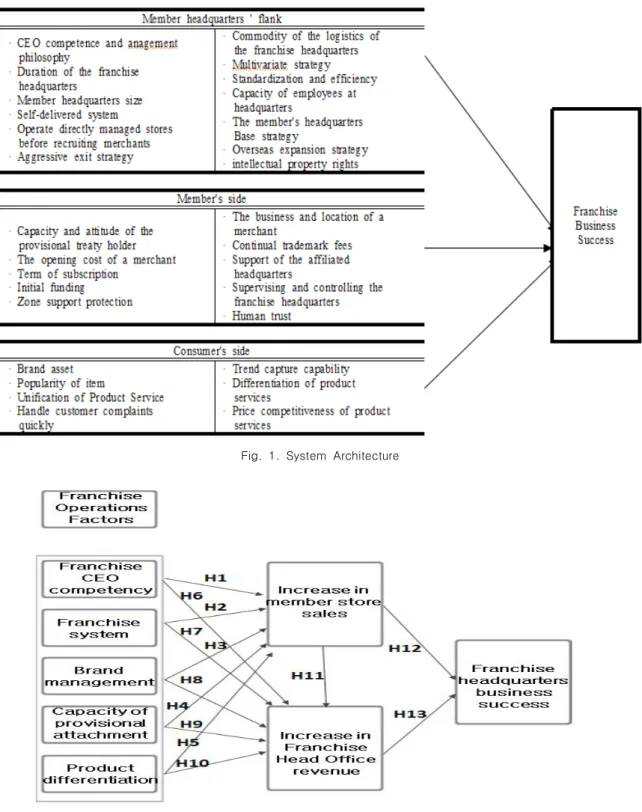
프랜차이즈 사업의 성공요인을 포괄적으로 정리하면 아래 Fig 1과

같다[25].

(5)

III. Research Method

1. Related works

본 연구의 목적을 달성하기 위해서 프랜차이즈사업의 성공 에 주된 영향을 미치는 성공요인이 무엇인지 알아보고 아울러 프랜차이즈의 운영 요인을 프랜차이즈 CEO의 역량요인, 프랜 차이즈 시스템 구축 요인, 브랜드 관리 요인, 가맹점주의 역량 요인, 상품의 차별화 요인 등 5개 부문으로 나누어 이 운영 요 인들이 가맹점 매출증가와 프랜차이즈본사 수익증가에 유의한 영향을 미치는지를 분석하고, 이들 각각의 성과들이 프랜차이 즈 사업에 성공으로 나타나는 지 분석하고자 Figure 2와 같이 연구모형을 설계하였다.

2. ReSearch Hypotheses Generating

프랜차이즈 운영 요인들에 대해 선행 연구를 통해 프랜차이 즈 CEO역량, 프랜차이즈 시스템, 브랜드 관리, 가맹점주 역량, 상품 차별화 등이 프랜차이즈 사업의 성공에 영향을 주는 선행 요인변수라고 가정하고 이들 요인들이 가맹점 매출증가, 프랜 차이즈 본사 수익증가 및 프랜차이즈 사업의 성공에 있어서 관 계를 알아보고자 하는 것이다. 이 모든 가설들은 광주·전남 지 역 프랜차이즈사업을 운영하는 CEO 및 임원, 본부장을 대상으 로 설정하였다. 가설내용은 다음과 같이 정리하였다.

가맹 본부의 프랜차이즈 운영요인은 가맹점 매출증가에 정 (+)의 영향을 미칠 것이다.

<가설 H1> 프랜차이즈 CEO역량은 가맹점 매출증가에 정 (+)의 영향을 미칠 것이다.

<가설 H2> 프랜차이즈 시스템은 가맹점 매출증가에 정(+) 의 영향을 미칠 것이다.

<가설 H3> 브랜드관리는 가맹점 매출증가에 정(+)의 영향 을 미칠 것이다.

<가설 H4> 가맹점주 역량은 가맹점 매출증가에 정(+)의 영 향을 미칠 것이다.

<가설 H5> 상품차별화는 가맹점 매출증가에 정(+)의 영향 을 미칠 것이다.

가맹 본부의 프랜차이즈 운영요인은 프랜차이즈 본사 수익 증가에 정(+)의 영향을 미칠 것이다.

<가설 H6> 프랜차이즈 CEO역량은 프랜차이즈 본사 수익증 가에 정(+)의 영향을 미칠 것이다.

<가설 H7> 프랜차이즈 시스템은 프랜차이즈 본사 수익증가 에 정(+)의 영향을 미칠 것이다.

<가설 H8> 브랜드관리는 프랜차이즈 본사 수익증가에 정 (+)의 영향을 미칠 것이다.

<가설 H9> 가맹점주 역량은 프랜차이즈 본사 수익증가에 정(+)의 영향을 미칠 것이다.

<가설H10> 상품차별화는 프랜차이즈 본사 수익증가에 정

(+)의 영향을 미칠 것이다.

<가설H11> 가맹점 매출증가는 프랜차이즈 본사 수익증가에 정(+)의 영향을 미칠 것이다.

<가설H12> 가맹점 매출증가는 프랜차이즈 사업성공에 정 (+)의 영향을 미칠 것이다.

<가설H13> 프랜차이즈 본사 수익증가는 사업성공에 정(+) 의 영향을 미칠 것이다.

3. Sample selection and data collection

본 연구의 기초적인 자료로 모집단은 광주·전남 지역 프랜차이즈 사업을 운영하는 대표이사, 임원, 또는 본부장을 대상으로 표본은 편의표본 추출법을 활용하여 추출하였고 설문조사를 진행하였다.

설문지는 2017년 11월 01일부터 11월 30일까지 약 4주간 에 걸쳐 실시하였으며, 조사방법은 직접 설문방법으로 총 150 부를 배포하여, 미회수 및 불성실한 응답을 한 13부를 제외시 키고 실증분석에서 137부가 사용되었다. 표본 설계 내용은 다 음 <Table 3>와 같다.

설문결과를 토대로 한 실증분석은 분석의 대상과 연구목적에 따라 SPSS통계 패키지 20.0을 이용하여 통계적 유의성을 검증 하였다. 설문문항간의 신뢰성, 타당성을 검증하기 위해 분석방 법은 신뢰도분석(Reliability Analysis), 요인분석(Factor Analysis)을 각각 실시하였다. 표본의 특성을 알아보기 위하여 빈도분석(Frequencies Analysis)을 실시하였다. 그리고 연구 가설들을 검증하기 위해서, SPSS 18.0을 이용하여 다중회귀분 석과 단순회귀분석을 실시하였다. 이 모든 실증분석방법들은 관련선행연구 결과들을 그 기초로 하였고, 설정된 연구모형에 대한 변수간의 관계 특성을 알아보기 위해서 진행되었다.

Sortation content

Parent group Ceo runs a franchise business in Gwangju and Jeonnam

Method of

investigation A self-administered questionnaire

Research period 2017Year 11Month 01Day - 11Month 30Day

Sample size

Total Distribution questionnaire 150 145 copies of the retrieval questionnaire Ineffective questionnaires 8

137 final valid questionnaires Table 3. Sample audience and content

4. Organize the questionnaire

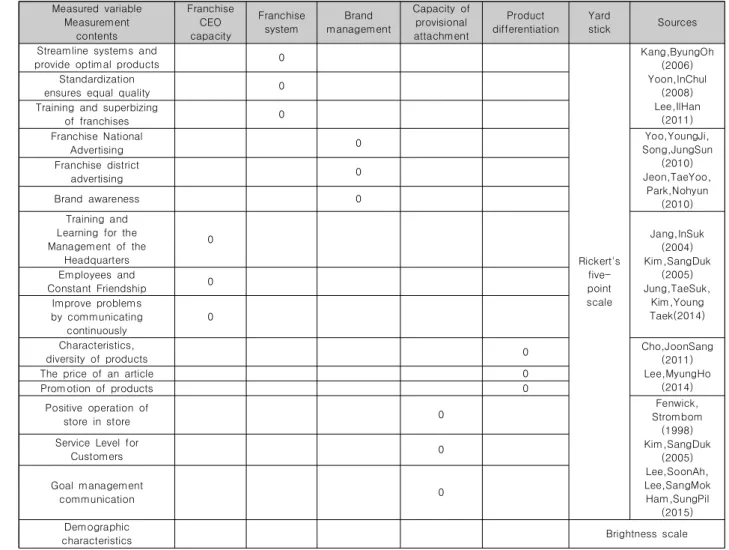
본 연구의 전체적인 설문지 구성은 선행연구, 기존문헌 등을 기초자료로 활용하였고, 신뢰도가 없는 일부항목은 제외시켰다.

인구통계학적 특성 변수는 명도척도를 사용하였고, 총 29개 설

문지 항목은 리커트 5점 척도법을 통해 측정하였다. 설문지 구

성내용은 아래 <Table 4>와 같다.

(6)

Measured variable Measurement

contents

Franchise CEO capacity

Franchise system

Brand management

Capacity of provisional attachment

Product differentiation

Yard

stick Sources

Streamline systems and

provide optimal products 0

Rickert's five- point scale

Kang,ByungOh (2006) Yoon,InChul

(2008) Lee,IlHan

(2011) Standardization

ensures equal quality 0

Training and superbizing

of franchises 0

Franchise National

Advertising 0 Yoo,YoungJi,

Song,JungSun (2010) Jeon,TaeYoo,

Park,Nohyun (2010) Franchise district

advertising 0

Brand awareness 0

Training and Learning for the Management of the

Headquarters

0 Jang,InSuk

(2004) Kim,SangDuk

(2005) Jung,TaeSuk,

Kim,Young Taek(2014) Employees and

Constant Friendship 0 Improve problems

by communicating continuously

0

Characteristics,

diversity of products 0 Cho,JoonSang

(2011) Lee,MyungHo

(2014)

The price of an article 0

Promotion of products 0

Positive operation of

store in store 0

Fenwick, Strombom

(1998) Kim,SangDuk

(2005) Lee,SoonAh, Lee,SangMok Ham,SungPil

(2015) Service Level for

Customers 0

Goal management

communication 0

Demographic

characteristics Brightness scale

Table 4. Organize the questionnaire

IV. Research Result

1. Domographic Characteristics

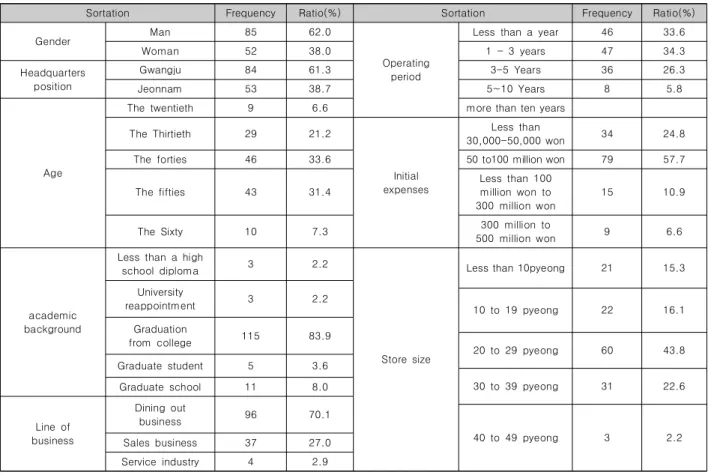
자료 수집을 위한 설문조사는 2017년 11월 01일부터 11월30일 까지 약 4주간 실시되었으며, 광주·전남 지역 프랜차이즈사업을 운영하는 CEO를 대상으로 총 150부를 배포하여 145부가 회수되었 고, 그 중에서 응답에 일체성이 없거나 정확치 않다고 확인되는 설문지 8부를 제외한 총 137부가 실증분석에 사용되었다. 표본의 인구통계학적 특성은 아래 <Table 5>와 같다.

2. Domographic Characteristics

본 연구에서는 측정항목들에 대한 신뢰성 검증을 위해 Cronbach's a값으로 검정하였다. 타당성 분석은 요인추출방법으로 주성분 분석을 실시하였으며, 요인적재치의 단순화를 위해서 직교회 전방식으로써 고유치가 1이상인 요인 값만을 채택하였다. 분석결과 독립변수인 프랜차이즈 운영요인의 상품차별화 요인의 두 번째 문항 인 ‘경쟁업체와 비교해 볼 때 상품의 가격은 적절하다.’는 요인 값이 수렴되지 않아 제외하고 14문항이 최종분석에 사용되었다.

요인분석결과 프랜차이즈 운영요인은 프랜차이즈CEO역량, 프 랜차이즈 시스템, 브랜드관리, 가맹점주 역량, 상품차별화 등 5개의

요인으로 나타났으며, 가맹점 매출증가, 프랜차이즈 본사 수식증가, 프랜차이즈 사업성공은 각각 단일요인으로 추출되었다. 각 변수별 분석 결과는 <Table 6>, <Table 7>과 같다.

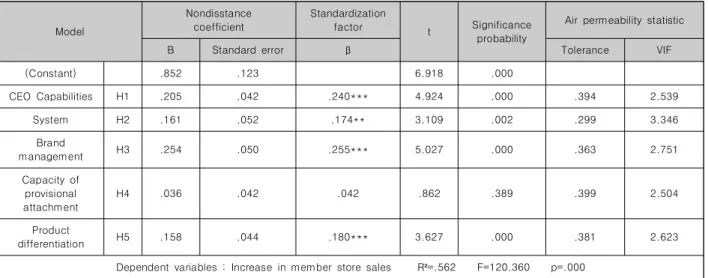
3. Testing and analysis of research hypotheses 프랜차이즈 운영요인이 가맹점 매출증가에 미치는 인과관계 분석을 위한 가설은 전체 회귀모형의 설명력인 R²값이 0.562로 분석되어 56.2%의 설명력을 가지고 있으며, F변화량이 120.360으로 .000의 유의확률을 나타냈으며, Durbin-Watson 값은 1.718, 공차한계가 모두 0.1이상의 수치를 나타내어 독립 변수 간 다중공선성에는 문제 없는 것으로 확인되었다.

프랜차이즈 운영요인과 가맹점 매출증가 간의 영향관계를 파악한 결과, H1, CEO역량(β=.240, t=4.924), H2, 프랜차이즈 시스템(β=.174, t=3.109), H3, 브랜드관리(β=.255, t=5.027), H5, 상품차별화(β=.180, t=3.627)가 모두 유의한 정(+)의 영 향을 미치는 것으로 나타났다. 그러나 H4, 가맹점주 역량은 유 의하지 않은 것으로 나타나 [가설 H4]는 기각되었다.

프랜차이즈 운영요인이 프랜차이즈 본사 수익 증가에 미치는

인과관계 분석을 위한 가설은 전체 회귀모형의 설명력인 R²값이

0.632로 분석되어 63.2%의 설명력을 가지고 있으며, F변화량이

(7)

Sortation Measurement items Factor value

Eigen value

Cumulative total distributed

description

Cronbach‘α

CEO Capabilities

Relevant education and learning related to the operation of

franchise headquarters are regularly provided. .836

2.979 21.276 .885

The company is discussing ways to develop the franchise

headquarters through ongoing consultations with employees. .786 We are improving problem through continuous communication with

member store. .812

Franchise system

Through the rationalization of our distribution system, provides

the best products. .701

2.892 41.936 .835

The quality is maintained by the merchant through standardization

of the menu and the products sold. .693

The institution periodically provides the member store education

and supervising. .590

Brand management

Local advertising is being carried out to increase brand awareness. .810

2.471 59.587 .844

Local advertising is being carried out to increase brand awareness. .772 Through brand management, the company raises the public

awareness of menus and products. .634

Capacity of provisional attachment

The owners are very aggressive about running the store. .751

1.868 72.933 .853

The service levels of shop owners are high. .827 The provisional controlling point is in constant communication with

the staff to manage the target. .884

Product differentiation

Sales menu and product are distinctive compared to other brands. .669

1.274 82.035 .801

Product promotion is carried out regularly. .717

KMO=.935, Bartlett's Spheroidness Test value=4966.717, Significance probability=.000 Table 6. Feasibility Study & Reliability Analysis Results for Franchise Operations Factors

Sortation Frequency Ratio(%) Sortation Frequency Ratio(%)

Gender Man 85 62.0

Operating period

Less than a year 46 33.6

Woman 52 38.0 1 - 3 years 47 34.3

Headquarters position

Gwangju 84 61.3 3-5 Years 36 26.3

Jeonnam 53 38.7 5~10 Years 8 5.8

Age

The twentieth 9 6.6 more than ten years

The Thirtieth 29 21.2

Initial expenses

Less than

30,000-50,000 won 34 24.8

The forties 46 33.6 50 to100 million won 79 57.7

The fifties 43 31.4

Less than 100 million won to 300 million won

15 10.9

The Sixty 10 7.3 300 million to

500 million won 9 6.6

academic background

Less than a high

school diploma 3 2.2

Store size

Less than 10pyeong 21 15.3

University

reappointment 3 2.2

10 to 19 pyeong 22 16.1

Graduation

from college 115 83.9

20 to 29 pyeong 60 43.8

Graduate student 5 3.6

30 to 39 pyeong 31 22.6

Graduate school 11 8.0

Line of business

Dining out

business 96 70.1

40 to 49 pyeong 3 2.2

Sales business 37 27.0

Service industry 4 2.9

Table 5. Demographic characteristics

160.980으로 .000의 유의확률을 나타냈으며, Durbin-Watson값 은 1.805, 공차한계는 모두 0.1이상의 수치값을 나타내어 독립변수

간 다중공선성에는 문제가 없는 것으로 확인되었다. 프랜차이즈

운영요인과 프랜차이즈 본사 수익 증가 간의 영향관계를 파악한

(8)

Sortation Measurement items Factor value

Eigen value

Cumulative total distributed description

Cronbach‘α

Increase in member store sales

Continuous management of the merchant's business at the member's headquarters helps the merchant increase sales. .742

4.248 30.346 .804

The company contributes to the activation of the merchant through product development at the member headquarters. .746 Consumer awareness is rising through continued promotional marketing

efforts. .730

The family manager agrees positively and cooperate with the decision

of the company. .649

Franchise headquarters

revenue

Quality of products and services plays an important role in increasing

profits. .789

3.348 54.262 .900

Consumer brand preference plays an important role in revenue growth. .768 The satisfaction level with the head office of the parent store plays an important role in increasing the profits .820 The number of member stores plays an important role in increasing

profits. .766

2.471 59.587 .844

Franchise Business Success

The entrepreneurship of the franchise headquarters ’ CEO has a

significant influence on the growth of the headquarters. .764 The relationship between franchise headquarters and merchants and

trust will be a win-win situation. .865

Franchise headquarters are seeing a lot of publicity and promotion

for the franchises. .789

1.868 72.933 .853

Persistent business wind development may increase the satisfaction

of the family and consumers. .878

Positive results can be achieved by establishing an effective logistics

system. .604

Through continued training at franchise headquarters, the capacity of

the provisional owners can be enhanced. .793 1.274 82.035 .801

KMO=.930, Bartlett's Spheroidness Test value=4571.101, Significance probability=.000

Table 7. Results of feasibility analysis on increased franchise sales, increased franchise headquarters revenue, and successful franchise business variables

Model

Nondisstance coefficient

Standardization

factor t Significance

probability

Air permeability statistic

B Standard error β Tolerance VIF

(Constant) .852 .123 6.918 .000

CEO Capabilities H1 .205 .042 .240*** 4.924 .000 .394 2.539

System H2 .161 .052 .174** 3.109 .002 .299 3.346

Brand

management H3 .254 .050 .255*** 5.027 .000 .363 2.751

Capacity of provisional attachment

H4 .036 .042 .042 .862 .389 .399 2.504

Product

differentiation H5 .158 .044 .180*** 3.627 .000 .381 2.623

Dependent variables : Increase in member store sales R²=.562 F=120.360 p=.000

*: p<0.05, **: p<0.01, ***: p<0.001

Table 8. Causal Relationships Between Franchise Operations Factors and Increase in Merchant Sales

결과, H6, CEO역량(β=.219, t=4.902), H7, 프랜차이즈 시스템(β

=.261, t=5.085), H8, 브랜드관리(β=.349, t=7.515), H9, 가맹주 역량(β=.114, t=2.563), H10, 상품차별화(β=.163, t=3.599)가 모두 유의한 정(+)의 영향을 미치는 것으로 나타나 [가설 H6-10]

은 모두 채택 되었다.

가맹점 매출증가가 프랜차이즈 본사 수익증가에 미치는 인

과관계 분석을 위한 가설은 전체 회귀모형의 설명력인 R²값이

0.516로 분석되어 51.6%의 설명력이 있으며, F변화량이

(9)

Model

Nondisstance coefficient

Standardization

factor t Significance

probability

Air permeability statistic

B Standard error β Tolerance VIF

(Constant) .881 .106 8.330 .000

CEO Capabilities H6 .175 .036 .219*** 4.902 .000 .394 2.539

System H7 .226 .045 .261*** 5.085 .000 .299 3.346

Brand

management H8 .326 .043 .349*** 7.515 .000 .363 2.751

Capacity of provisional attachment

H9 .092 .036 .114* 2.563 .011 .399 2.504

Product

differentiation H10 .135 .037 .163*** 3.599 .000 .381 2.623

Dependent variables : Franchise headquarters revenue R²=.632 F=160.980 p=.000

*: p<0.05, **: p<0.01, ***: p<0.001

Table 9. Causal Relationships between Franchise Operations Factors and Revenues in Franchise Head Office

Model

Nondisstance

coefficient Standardization factor

t Significance

probability

B Standard error β

(Constant) 1.141 .166 6.870 .000

Increase in member

store sales H12 .581 .043 .527*** 13.472 .000

Dependent variables : Franchise Business Success R²=.277 F=181.491 p=.000

*: p<0.05, **: p<0.01, ***: p<0.001

Table 11. A Causal Relationship between the Sales Growth of Merchant and the Success of Franchise Business

Model

Nondisstance

coefficient Standardization factor

t Significance

probability

B Standard error β

(Constant) 1.322 .180 7.324 .000

Franchise headquarters

revenue H13 .545 .048 .463 11.374 .000

Dependent variables : Franchise Business Success R²=.215 F=129.369 p=.000

*: p<0.05, **: p<0.01, ***: p<0.001

Table 12. The Causal Relationships between Franchise Head Office Income and Franchise Business Model

Nondisstance

coefficient Standardization factor

t Significance

probability

B Standard error β

(Constant) 1.156 .116 10.009 .000

Increase in member

store sales H11 .673 .030 .718*** 22.447 .000

Dependent variables : Franchise headquarters revenue R²=.516 F=503.878 p=.000

*: p<0.05, **: p<0.01, ***: p<0.001

Table 10. A Causal Relationship between the Increase in Merchant Sales and the Increase in Franchise Head Office Revenue

Hypothesis of research Dismissal/adoption

CEO Capabilities H1

Increase in member store sales

adoption

System H2 adoption

Brand management H3 adoption

Capacity of provisiona attachment H4 Dismissal

Product differentiation H5 adoption

CEO Capabilities H6

Increase in Franchise Head Office revenue

adoption

System H7 adoption

Brand management H8 adoption

Capacity of provisional

attachment H9 adoption

Product differentiation H10 adoption

Increase in member sales H11 Increase in Franchise Head Office revenue adoption

Increase in member sales H12 Franchise Business Success adoption

Increase in Franchise Head

Office revenue H13 Franchise Business Success adoption

Table 13. Impeller of Research Scholars and Results of Adoption

160.980으로 .000의 유의확률을 나타냈으며, H11, 가맹점 매 출증가(β=.718, t=22.447)가 프랜차이즈 본사 수익증가에 유

(10)

의한 정(+)의 영향을 미치는 것으로 나타났다. 따라서 [가설 H11]은 채택 되었다.

가맹점 매출증가가 프랜차이즈 사업성공에 미치는 인과관계 분석을 위한 가설은 전체 회귀모형의 설명력인 R²값이 0.277로 분석되어 27.7%의 설명력을 가지고 있으며, F변화량이 181.491로 .000의 유의확률을 나타냈으며, H12, 가맹점 매출 증가(β=.527, t=13.472)가 프랜차이즈 사업성공에 유의한 정 (+)의 영향을 미치는 것으로 나타났다. 따라서 [가설 H12]는 채택 되었다.

마지막으로 프랜차이즈 본사 수익이 프랜차이즈 사업성공에 미치는 인과관계 분석을 위한 가설은 전체 회귀모형의 설명력 인 R²값이 0.215로 분석되어 21.5%의 설명력이 있으며, F변화 량이 129.369로 .000의 유의확률을 나타냈으며, H13, 프랜차 이즈 본사 수익(β=.463, t=11.374)이 프랜차이즈 사업성공에 유의한 정(+)의 영향을 미치는 것으로 나타났다. 따라서 [가설 H13]은 채택 되었다.

연구 가설 기각 및 채택에 대한 결과를 정리하면 다음

<Table 13>와 같다.

IV. Conclusions

본 연구는 국내 프랜차이즈 사업 성공요인 분석을 위해서 현 황조사와 설문분석을 토대로 실시하였으며, 프랜차이즈사업의 성공요인에 대한 보다 많은 연구가 계속 진행되어 프랜차이즈 산업의 발전에 적극 활용되어야 할 것이다. 서론에서는 지금까 지 대부분 프랜차이즈 관련연구가 가맹점을 중심으로 진행되어 왔다면 가맹본부측면에서의 성공요인분석에 대한 연구가 더 필 요함을 제시하였고, 프랜차이즈사업 성공 요인에 대한 선행연 구로는 가맹점의 특성에 중점을 맞춘 연구, 가맹본부의 특성에 중점을 맞춘 연구, 가맹본부와 가맹점간의 관계특성에 중점을 맞춘 연구, 가맹본부, 가맹점, 소비자등 3자간 관계특성에 중점 을 맞춘 연구를 살펴보았다. 프랜차이즈사업의 성공에 영향을 미치는 운영요인을 프랜차이즈 CEO역량, 프랜차이즈 시스템 구축, 브랜드 관리, 가맹점주 역량, 상품의 차별화요인 5개 부 문으로 나누어 구분하였고, 이 운영요인들이 가맹점 매출 증가 및 프랜차이즈 본사 수익증가에 유의한 정(+)의 영향을 미치는 지 알아보았다. 본 연구에서 제시했던 가설에 대한 검증결과 CEO역량(β=.240, t=4.924), 프랜차이즈 시스템(β=.174, t=3.109), 브랜드 관리(β=.255, t=5.027), 상품 차별화(β

=.180, t=3.627)는 가맹점 매출증가에 유의한 정(+)의 영향을 미치는 것으로 가맹점주 역량(β=.042, t=0.863)은 유의한 영향 을 나타내지 못하는 것으로 나타났다. 하지만 프랜차이즈 본사 수익증가에 대한 영향은 CEO역량(β=.219, t=4.902), 프랜차이 즈 시스템(β=.261, t=5.085), 브랜드관리(β=.349, t=7.515), 가맹주역량(β=.114, t=2.563), 상품차별화(β=.163, t=3.599)

모두 유의한 정(+)의 영향을 미치는 것으로 나타났으며 가맹점 매출증가(β=.718, t=22.447)는 프랜차이즈 본사 수익증가에 유의한 정(+)의 영향을 미치는 것으로 나타났다. 또한 가맹점 매출증가(β=.527, t=13.472)는 프랜차이즈 사업성공에 유의한 정(+)의 영향을 미치는 것으로 나타났다. 끝으로 프랜차이즈 본사 수익(β=.463, t=11.374)증가는 프랜차이즈 사업성공에 유의한 정(+)의 영향을 미치는 것으로도 나타났다. 본 연구에 서는 프랜차이즈의 운영요인을 5개 부문으로 나누어 프랜차이 즈본사 수익증가, 가맹점 매출증가, 프랜차이즈 사업성공에 대 한 영향을 조사, 분석하였는데 좀 더 세분화되고 보다 구체적인 다양한 운영요인들을 적용할 필요가 있다. 연구가 지역적인 한 계는 있었지만, 기존의 많은 프랜차이즈본사의 가맹점 전국 확 산전략이 실패로 돌아가는 이유들을 본 연구와의 결과를 토대 로 부분 활용 되었으면 한다. 중앙형 프랜차이즈와 지역형 프랜 차이즈의 차이가 다름을 서로 잘 활용하고, 기존의 서울 수도권 중심에 대한 연구뿐만 아니라, 각 지자체마다의 세부적인 특색 은 요인 분석을 적용하는 연구는 전국형 프랜차이즈의 사업전 개방식에 있어서 활용하는 기초자료가 될 수 있을 것이다. 아울 러, 프랜차이즈사업특징중 하나는 표준화, 시스템으로 그동안 많은 시행착오 속에서도 성공 또는 실패했던 프랜차이즈본부에 대한 계속적인 성공과 실패 요인분석에 대한 연구가 계속되어 잘 활용된 최적화된 모델들이 프랜차이즈산업으로 적용 되어야 할 것이다.

REFERENCES

[1] https://www.motie.go.kr [2] https://franchise.ftc.go.kr

[3] M. S. Kim, and U. J. Park, “Analysis of Succss Factor of Domestic restaurant business franchise,” Journal of Cultural Industry Studies, Vol. 2010, No. 2, pp. 101-118, 2010.

[4] Dant. R. P, N. I. Nasr, “Control Techniques and Upward Flow of InFormation in Franchising Markets:

Conceptualization and Preliminary Evidence.” Journal of Business Venturing, Vol. 13, No. 1, pp. 3-28, 1998.

[5] K. I. Kim, “A Study on the success Factors of the Foodservice Franchise Business,”Culinary science and hospitality research, Vol. 15, No. 2, pp. 219-230, 2009.

[6] S. C. Han, “Jeju Franchise Industry Promotion Plan,”Jeju Research Institute, Vol. 2011, No. 4, pp. 88-89, 2011.

[7] Shane. S, Foo. M, “New Firm survival: An institutional explanation for Franchisor mortality.” Management Science, Vol. 45, No. 2, pp. 142-159, 1999.

[8] S. I. Park, and C. H. Park, “The Study on the Success

Factors for Starting Korean Franchises Business,” Global

(11)

Business Administration Review, Vol. 6, No. 2, pp. 63-82, 2009.

[9] A. Y. Jeong, J. H. Lee, “The effects of determinant factors of selecting food service franchisor on management performance and intention of recontract,” Korean Journal of Hospitality and Tourism, Vol. 25, No. 2, pp. 107-124, 2016.

[10] Fenwic. G. D, Strombom. M, “The Determinants of Franchise Performance: An Empirical Investigation.”

International small Business Journal, Vol. 16, No 4, pp.

28-45, 1998.

[11] S. W. Youn, and siPark, “The Impact of Entrepreneurship of Franchisees on Their Business Performance : Mediation Effects of Market Orientation and Relationship Commitment,” Journal of Channel and Retailing, Vol. 13, No. 3, pp. 101-126, 2008.

[12] S. H Park, T. H. Kim, et al., “The Effect of Franchisees' Attitude Toward Business on Satisfaction with Franchise decision and Intention to Remain in the Franchise System,” Korean Journal of Hospitality and Tourism, Vol. 17, No. 1, pp. 119-135, 2008.

[13] Shane, Scott A, “From Ice Cream to the Internet;

Franchising to Drive the Growth and Profits of Your Company, London: PEARSON Prentice Hall, 2005.

[14] H. J. Lee, Y. K. Lee, “The Effect of Franchising Supports and Features of the Relationship on Quality of the Relationship in Korean travel industry,” Korean Journal of Hospitality and Tourism, Vol. 17, No. 6, pp. 169-189, 2008.

[15] E. Y. Lee, S. B. Lee, “The effects of franchisor`s market oriented intelligence and brand orientation on new product development, differentiation, trust and performance in the foodservice industry,” Korean Journal of Hospitality and Tourism, Vol. 18, No. 2, pp.

109-129, 2009.

[16] Y. G. Jeon, and Y. K. Park, “The effect of brand equity of foodservice franchise firms to customer satisfaction and customer loyalty,” Korean Journal of Hospitality and Tourism, Vol. 26, No. 4, pp. 191-205, 2017.

[17] C. L. Shin, “A Study on Performance Determinants of Franchise Franchisees,” Kuk-Min University Doctoral degree, 1993.

[18] S. L. Han, M. Y. Baek, “Effects of Environmental Uncertainty on Transaction and Industry Characteristics in the Franchising Markets,” Journal of Channel and Retailing, Vol. 13, No. 3, pp. 55-77, 2008.

[19] S. I. Park, C. H. Park, “The Study on the Success Factors for Starting Korean Franchises Business,” Global Business Administration Review, Vol. 6, No. 2, pp.

63-82, 2009.

[20] B. O. Kang, J. H. Lee, et al., “Franchise Industry Promotion Policy through Analysis of Success Factors of Franchise Business,” Journal of Channel and Retailing, Vol. 14, No. 5, pp. 153-179, 2009.

[21] H. N. Lee, “Influence of the Leadership of Franchise Supervisor on Franchisee Satisfaction and Performance,” Kuk-Min University Doctoral degree, 2008

[22] J. H. Ji, “The Comparative Research on Factors of Business Revitalization by Beauty Franchise Brands in Korea,” Journal of Cultural Product & Design, Vol. 15, No. 2, pp. 460-475, 2009.

[23] Y. J. Kim, “A study on the factors of successful in food franchisee,” Kyung-Sung University Doctoral degree, 2006

[24] M. H. Ryu, “A Study on the Franchisee Success Factors as Franchise Perceived by the Franchisor,” Kyung-Won University Doctoral degree, 2006

[25] S. C. Han, “Jeju Franchise Industry Promotion Plan,”Jeju Research Institute, Vol. 2011, No. 4, pp. 88-89, 2011.

Authors

Ji Hyun Song received the B.S. degree in Mechanical engineering and from Sunchon national University, Korea, in 1995. He received the M.S. and the Ph.D. degrees in Design Management from Chosun University, Korea, in 2005 and 2015. He is Currently a Professor in the Chosun College of Science &

Technology. He is interested in management information system, Franchise Business, and Mibile system.

Gye Beom Jo received the B.S. degree in

Biology from Chosun University, Korea, in

2003. He received the M.S. degrees in Food

Science from Daegu Catholic University,

Korea, in 2015. He is studing the Doctoral

program of Bussiness administration at

Honam University. He is currently a Professor in the

Department of Franchise system, in the Chosun College of

Science & Technology. He is interested in management

information system, Franchise Business, and Franchise

system.

수치

Table  2.  Status  of  franchise  headquarters  and  franchises  in  Korea  by  industry
Fig.  1.  System  Architecture
Table  4.  Organize  the  questionnaire
Table  5.  Demographic  characteristics
+3

참조

관련 문서

The data analysis methods were, the t-test to verify the relationship between variables using SPSS for Windows 18.0 program and a simple regression analysis and

His current research interests include supply chain management, IT service operations management, and DEA (data envelopment analysis). Soo Wook

According to multiple regression analysis, the factors affecting the level of depression were chosen as significant variables, such as academic achievement,
Multiple regression analysis of relationship between changes of baPWV and other associated variables shows that improvement of baPWV was significantly positively associated

Principal component analysis, factor analysis and cluster analysis have been performed to analyze the relationship between air pollutants and meteorological

Multiple linear regression analysis is employed, and Table 5 indicates that the adjusted R 2 has a value of 76.5%, reflecting that the independent variables included in

균의 차이가 통계적으로 유의미한가를 검정하기 위해 일원배치 분산분석 (One-way ANOVA) 을 하였으며 성 공요인과 지원요인이 마을기업 육성을 위한 목표에 미치는

According to multiple regression analysis, the factors affecting the level of depression were chosen as significant variables, such as academic achievement,