Print ISSN: 2288-4637 / Online ISSN 2288-4645 doi:10.13106/jafeb.2021.vol8.no5.1129
The Effect of Emotional Intelligence on Job Satisfaction:
A Case Study of SME Management Consultants in Korea
Dae Kyoo KIM
1, Bo Young KIM
2Received: February 10, 2021 Revised: April 05, 2021 Accepted: April 15, 2021
Abstract
SMEs are constantly demanded of changes in the rapidly-evolving business environment, which involves the fourth industrial revolution and the COVID-19 pandemic. In this period, management consulting service becomes more in demand to provide technical and strategic solutions for management problems. This study aimed to empirically analyze the direct effects of emotional intelligence on job satisfaction and the indirect effects of such parameters as learning agility and self-efficacy on job satisfaction in management consultants. On the basis of a literature review, inter-variable association was designed in the research model. Based on an online survey of those in the Korean SME management consultants, this study collected 221 questionnaires then used structural equation modeling for statistical analysis.
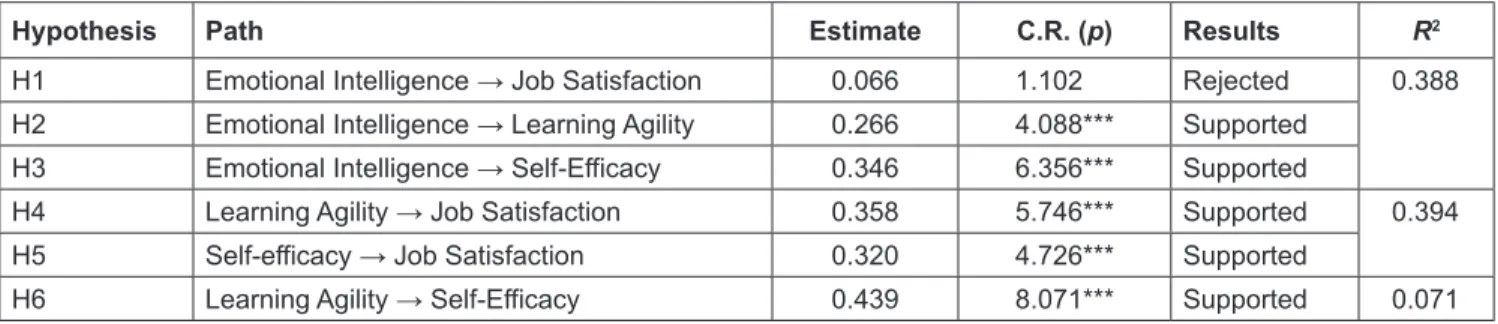
The results reveal that emotional intelligence significantly affected job satisfaction and, also significantly positively affected learning agility and self-efficacy. In addition, a significant indirect correlation could be found between learning agility and self-efficacy. Meanwhile, if learning agility and self-efficacy mediated job satisfaction, emotional intelligence had no significant effect on job satisfaction and fully mediated learning agility and self-efficacy. It is necessary to develop an emotional intelligence education program that can help management consultants improve their emotional intelligence with the objective of giving successful management consulting services.
Keywords: SME Management Consultant, Emotional Intelligence, Job Satisfaction, Learning Agility, Self-efficacy JEL Classification Code: I31, J44, L84, M11
increased on the basis of the knowledge-based businesses in the global economy since the 1990s, emphasis has been placed on the importance of the management consulting industry (Berry et al., 2006; Albats et al., 2020).
In particular, management consulting, which is a strategic means of coping with the rapidly-changing management environment and maintaining a competitive edge, has become a crucial management value creation activity in small- and medium-sized enterprises (SMEs) (Deshpande, 1996). Contrary to large companies, SMEs operate management consulting in the form of policy- based support by the government in many cases (Ezell
& Atkinson, 2001; Spharira et al., 2011). Consultants participating in the process become keenly aware of the limitations in the restrictions, including low wage and short duration, which characterize consulting in public sectors and SMEs, who are recipients. These indicate problems with the quality and competitiveness of consulting service SMEs, which are constantly demanded to change in the rapidly- changing business environment, which involves the fourth industrial revolution and the COVID-19 pandemic (Jatmiko et al., 2021).
1
First Author. Ph.D. Candidate, Seoul Business School, aSSIST University, Korea. Email: [email protected]
2
Corresponding Author. Associate Professor, Seoul Business School, aSSIST University, Korea [Postal Address: 46, Ewhayeodae-2gil, Seodaemungu, Seoul, 03767, Korea] Email: [email protected]
© Copyright: The Author(s)
This is an Open Access article distributed under the terms of the Creative Commons Attribution Non-Commercial License (https://creativecommons.org/licenses/by-nc/4.0/) which permits unrestricted non-commercial use, distribution, and reproduction in any medium, provided the original work is properly cited.
1. Introduction
Management consulting refers to “an independent type of professional service to help managers and organizations achieve their goals by solving problems in management and by detecting and using new opportunities in an effort to achieve the organizational goal” Kubr (2002). Yeo and Lim (2016) defined a consultant who gives consulting service as
“a person who diagnoses problems in business management,
provides solutions to them, and gives consulting service,
contributing to the achievement of a managerial goal.” As
value-added creation and inter-industrial synergy effects have
In this period, management consulting services become more in demand to offer technical and strategic solutions to the management problems (Deshpande, 1996). For this reason, what is most of all-important is to consider providing high-quality management consulting and generating good management consultants. Still, government-led management consulting services for SMEs in each country actually lack legal and institutional support for its advancement and efforts to improve the quality of consulting, which involve specialization in each area and strategic partnership (Demartini & Beretta, 2020; Sahela et al., 2021).
As for the existing research in the area of management consulting and the analysis of the research trend, the majority of them addressed technical factors affecting management consulting performance, including consulting performance measurement, methodology, policies, directions, and the government’s policies for SMEs (Harvey et al., 2017;
Heusinkveld & Visscher, 2012). In particular, while studies have been conducted on capabilities or competition factors for successful consulting services, empirical research has rarely been conducted on the job factors, such as job satisfaction or commitment, taking consultants’ personal situation into account.
2. Literature Review and Hypothesis Development
2.1. Emotional Intelligence and Job Satisfaction Hoopock (1935) defined job satisfaction as a combination of the psychological and environmental factors for employees to say “I am satisfied with my job.” Vroom (1964) defined job satisfaction as attitude toward the current job; Spector (1997) has described that it is individuals’ emotional attitude toward the current working role. Ultimately, job satisfaction is positive job attitude of employees and affects job commitment or performance. Management consultants also see their job satisfaction positively affect immediate performance.
Yousef (2016) has demonstrated that social support is one of the factors significantly affecting job satisfaction of SME management consultants. Churchill et al. (2018) have indicated that bosses, jobs, colleagues, and wages affect job satisfaction.
The majority of previous studies have found that emotional intelligence also positively affects job satisfaction (Kerr et al., 2006; MacCann et al., 2020; Malik & Shujja, 2013).
Goleman (1996) defined it as “an ability to motivate themselves even in a difficult situation, suppress any impulsive emotion, and empathize with others”; Wong and Law (2002) put emphasis on the importance of emotional intelligence as ‘a key factor affecting performance of leaders.’
They also indicated that emotional intelligence positively affected job satisfaction, irrespective of job characteristics.
Mayer and Salovey (1993) observed emotions of themselves and others, differentiated them, and described them as the ability to use emotional information in their own thinking and behavior. They presented such components of emotional intelligence as self-emotion awareness, other emotion aware- ness, emotion control, motivation, and emotion application.
Many studies have empirically demonstrated that emotional intelligence is correlated with job satisfaction of employees. Greiner and Ennsfellner (2010) indicated that SME employees have turnover intention correlated with job satisfaction. Sarinnapakorn and Sucaromana (2013) showed that emotional intelligence positively affected job satisfaction and customer satisfaction among employees of consulting companies. Psilopanagioti et al. (2012) indicated that emotional intelligence affected burnout. In short, emotional intelligence can affect job satisfaction and job activity of those engaged in management activity. Such a trend can be found among SME management consultants as well. This study postulated Hypothesis 1 as follows:
H1: SME management consultants’ emotional intelli- gence will positively affect their job satisfaction.
2.2. Emotional Intelligence and Learning Agility Individuals’ psychological variables, including perso- nality, values, attitudes, and motives, can lead to diverse responses to the same stimulus. Human feelings and emotions can affect a variety of interpersonal relationships, collective actions, decision-making, and consumers’ choices (Robbins
& Judge, 2011). In particular, employees’ emotional intelligence in the process of organizational and management activity can affect learning agility (Lombardo & Eichinger (2000) and improvement in self-efficacy (Bandura, 1993).
As De Meuse et al. (2017) indicated, self-awareness is included in people agility among the components of learning agility. Individuals with high learning agility actively pursue personal growth and development, have strong needs for new experiences and learning, are very curious and inquisitive, and are open to a new situation (Dries et al., 2012).
Olderbak et al. (2019) indicated that emotional intelligence could affect empathy and interpersonal relationships and reinforce people agility among the sub-areas of learning agility.
Alhashemi (2014) described that emotional intelligence could affect empathy, reliance, confidence, and responsiveness and positively affect mental agility and change agility among the sub-areas of learning agility. Ultimately, emotional intelligence positively affects personal growth, experiences, and learning, and also affects learning agility. Based on these findings, Hypothesis 2 is formulated as follows:
H2: SME management consultants’ emotional intelli-
gence will positively affect their learning agility.
2.3. Emotional Intelligence and Self-Efficacy
Like learning agility, emotional intelligence also affects self-efficacy. Humans have the ability to control their own emotions, thinking, and actions. One of the strongest self-controllers is self-efficacy. It has been contended that individuals’ self-efficacy is generated from mastery experiences or performance outcomes, vicarious experience or social role model, verbal persuasion, and physiological feedback Bandura (1993). In addition, self-efficacy is the belief in one’s own ability to perform and organize a certain job, is exerted through the process of choosing cognitive, behavioral, and emotional resources, and is inevitably affected by emotional intelligence.
There are previous studies on the association between emotional intelligence and self-efficacy. Wright et al.
(2012) noted that the higher emotional intelligence, the higher self-efficacy and emphasized that self-efficacy was an important factor for emotional labor. Wu et al.
(2019) empirically demonstrated significant relations between emotional intelligence and self-efficacy among knowledge service providers. Asumeng (2013) indicated that emotional intelligence affected self-efficacy and job stress. Ugwuanyi et al. (2020) noted that emotional intelligence meaningfully affected self-efficacy and self- esteem. On the basis of the literature review, this study formulated Hypothesis 3:
H3: SME management consultants’ emotional intelli- gence will positively affect their self-efficacy.
2.4. Emotional Intelligence and Learning Agility Learning agility is a concept used to find out a highly potential leader and is defined as the will and ability to apply experience-based learning through flexible thinking in pursuit of success in a new environment or condition (De Meuse, 2017). Learning agility is divided into people agility, results agility, mental agility, and change agility.
Dries et al. (2012) described that individuals with high learning agility might actively pursue personal growth and development, have strong needs for new experiences and learning, be very curious and inquisitive, and be open to a new situation.
Individuals’ learning agility may ultimately have a positive impact on their job satisfaction (Randhawa, 2007; Reukauf, 2018). Edwards and Bell (2008) contended that learning agility had a stronger impact on job satisfaction than expertise did. Jiusto and Dibiasio (2013) indicated that learning agility in addition to positive psychological capital had a crucial impact on job satisfaction. Tripathi et al. (2020) noted that learning agility was significantly positively effective in reducing turnover intention
and was strongly correlated with job satisfaction. On the basis of the literature review, Hypothesis 4 was postulated:
H4: SME management consultants’ learning agility will positively affect their job satisfaction.
2.5. Self-Efficacy and Job Satisfaction
Self-efficacy refers to judgment of individuals’ ability to decide on motivational, cognitive, and behavioral directions necessary for job performance (Gist & Mitchell, 1992).
Bandura and McClelland (1977) defined self-efficacy as personal belief that one could successfully perform a task.
As a result, the higher level of self-efficacy, the higher level of job satisfaction, based on more successful task performance (Spieker & Hinsz, 2004).
Chen and Liu (2012) indicated that service providers had their job stress and self-efficacy affect their job satisfaction;
Elci et al (2007) noted that self-efficacy and emotional intelligence affected job satisfaction, even forming organizational civil behaviors. Hong (2018) empirically demonstrated that management consultants’ self-efficacy directly affected their job satisfaction. Alonderiene (2010) indicated that self-efficacy as positive psychological capital positively affected job satisfaction. On the basis of the literature review, Hypothesis 5 is proposed as follows:
H5: SME management consultants’ self-efficacy will positively affect their job satisfaction.
2.6. Learning Agility and Self-Efficacy
Qureshi et al. (2019) noted that the sources of self- efficacy were mastery experience through challenging job performance, vicarious experience through others’ success, social persuasion given by others, and contemplation on action and were revealed through cognitive, motivational, affective, and selective processes, which were not independent from one another but overlapped and interactive.
Self-efficacy as the experience of achievement is the
ability and will to learn from experiences and is affected by
learning agility, which is the ability to practice and apply
learning quickly and flexibly in an unfamiliar situation and
condition (DeRue et al., 2012). Learning agility refers to
learning speed and cognitive flexibility and Schmidt and
Hunter (1998) have contended that the most reliable tool to
measure knowledge acquisition and performance prediction
is ‘general mental ability.’ Ultimately, individuals’ learning
agility within experiences and performance is exerted as the
ability to acquire and apply necessary knowledge quickly
in a new environment and condition and may lead to high
performance (De Meuse, 2017).
Fry and Kim (2012) contended that the emphasis and level of self-efficacy could depend on the degree of learning agility. Yakin and Erdil (2012) indicated that learning agility might lead to quick learning and flexible application, improving self-efficacy and positively affecting potential reinforcement of leadership. The same effect is expected to be found among SME management consultants. On the basis of the contention in the literature review that learning agility could contribute to improvement in self-efficacy, Hypothesis 6 is postulated:
H6: SME management consultants’ learning agility would positively affect their self-efficacy.
3. Research Methods 3.1. Research Model
This study aimed to empirically analyze the direct effects of emotional intelligence on job satisfaction and the indirect effects of such parameters as learning agility and self-efficacy on job satisfaction in management consultants.
On the basis of literature review, inter-variable association
was designed in the model shown in Figure 1 and six hypotheses were postulated.
3.2. Variables and Data Collection
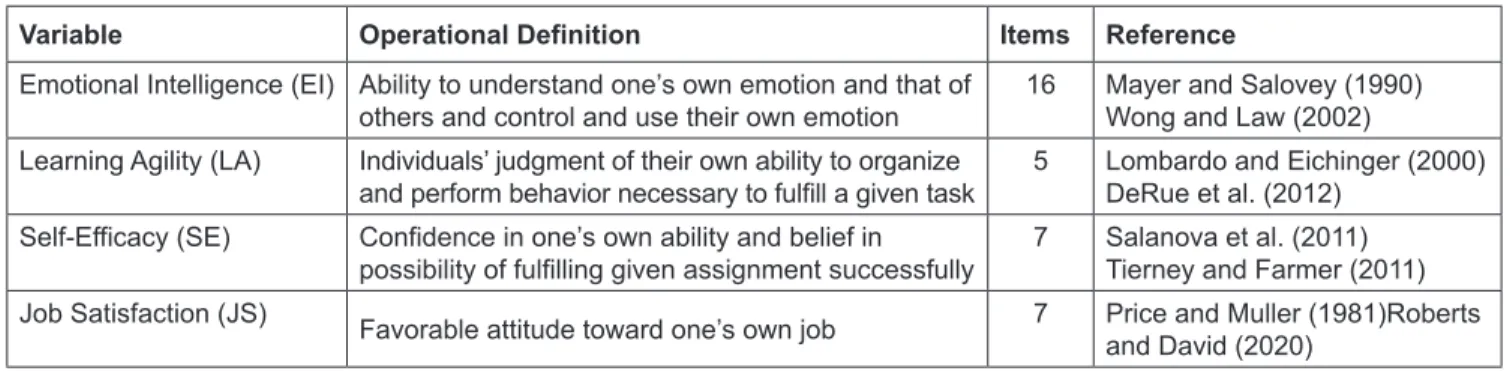
According to the research model, the four manipulative variables were defined as presented in Table 1. Emotional intelligence means an ‘ability to understand one’s own emotions and those of others and control and apply one’s own emotions’ (Mayer & Salovey, 1997). This study used the Wong and Law Emotional Intelligence Scale (WLEIS) developed by Wong and Law (2002), which contained a total of 16 items, with four item in each of four sub-factors:
self-awareness, social awareness, self-management, and relationship management. Learning agility refers to an ‘ability to practice and apply learning quickly and flexibly even in a new or unfamiliar situation’ (Lombardo & Eichinger, 2000).
Self-efficacy means general belief in one’s own ability to perform and organize a certain kind of task (Bandura, 1993) and management consultants’ self-efficacy can be defined as belief in successful performance of an assigned task. In this study, a total of seven items were made on the basis of Salanova et al. (2011) and Tierney and Farmer (2011) Lastly, job satisfaction refers to favorable attitude individuals have toward their own job. In this study, a total of seven items were made on the basis of Price and Muller (1981) and Roberts and David (2020).
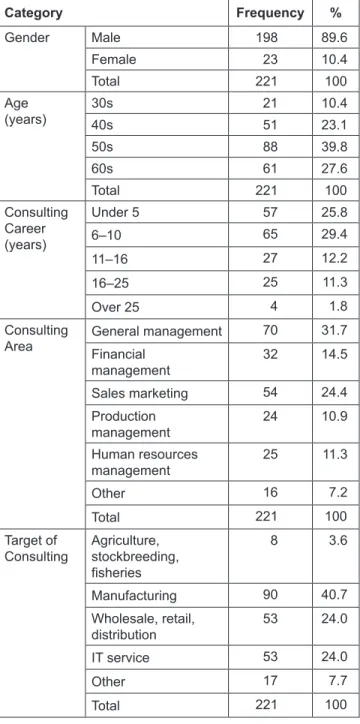
Google-based online questionnaires were distributed from November 19 to December 26, 2020, to 985 persons – management and technology consultants registered in the Ministry of SMEs and Startups and consultants, with membership of the International Council of Management Consulting Institutes and were registered in the Korea Management and Technology Consultant Association.
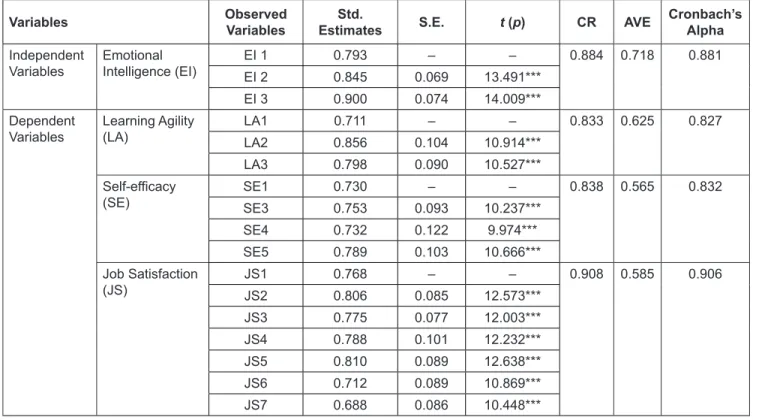
A total of 237 questionnaires (24.0%) were returned, of which 221 were valid and empirically analyzed. Mastery Validity of AMOS25 Plugins (James et al., 2019) was used along with supplementary SPSS 25, which involved Cronbach’s Alpha.
Figure 1: Research Model
Emotional Intelligence Job
Satisfaction Learning
Agility
Self-Efficacy H2
H3
H4
H5 H1
H6