Received: June 22, 2021 Revised: July 23, 2021 Accepted: July 27, 2021
symptoms in youths of multicultural families
Sin-Young Park
Department of Dental Hygiene, Songwon University
Corresponding Author: Sin-Young Park, Department of Dental Hygiene, Songwon University, 73, Songamro, Nam- gu, Gwangju, 61756, Korea. Tel : +82-62-360-5728, Fax : +82-62-360-5967, E-mail : [email protected]
ABSTRACT
Objectives: This study aimed to determine the relationship between mental health and oral symptoms in the youths of multicultural families. Methods: Our data source was from an online survey on youth health behaviors, mental health-examined stress, depression, and suicidal ideation, and oral symptoms-examined trauma, pain, and bleeding general characteristics, and the relationship between mental health and oral symptoms was analyzed using complex sample logistic regression. Results: Stress and depression were associated with pain and bleeding, and suicidal ideation was associated with trauma. Conclusions: Oral health plans should be prepared based on the mental health of adolescents from multicultural families.
Key Words: Mental health, Multicultural, Oral symptoms, Youth
Introduction
With the increase in the number of multicultural families, the number of children born in these families is also increasing; the youth population of general families is gradually decreasing, whereas the number of youths in multicultural families continues to increase, exceeding 100,000 in 2017 [1].
Although adolescence is more important than other periods because physical and emotional
changes are evident and youths undergo many changes [2], adolescents from multicultural families
often drop out because of cultural adjustment stress, negative school adjustment, and bad school
experiences, such as prejudice and bullying among students [3]; these negative events lead to critical
psychological problems [4]. Lim et al. [5] reported that mental health issues such as depression and
suicidal ideation among adolescents from multicultural families were approximately 10% higher
than among adolescents from general families, and the happiness index was lower at 3.06 points
among adolescents from multicultural families than among adolescents (3.38 points) from general
families [6]. Thus, attention should be paid to the mental health of adolescents from multicultural
families.
In addition, poor mental health during adolescence has a negative effect on oral health by increasing the morbidity of oral diseases and risk behaviors of oral health [7,8]. Negative mental health leads to poor eating habits and worsening oral hygiene, and causes various oral diseases such as gum swelling, bad breath, and oral mucosa disease [9]. In particular, adolescents had worse mental and oral health than other age groups [9,10]. Since adolescents from multicultural families have worse mental and oral health than adolescents from general families [10], it seems necessary to identify the relationship between oral health and mental health of adolescents from multicultural families, as management of both oral and mental health was judged necessary.
However, most previous studies were conducted on adolescents from general families [11] or investigated stress only in the context of mental health [12], and few studies have been reported on adolescents from multicultural families. As a result, various aspects of mental health have not been addressed.
Adolescents who have correctly formed knowledge, behaviors, and perceptions of oral health can continue into subsequent periods and have good oral health throughout their lives [13]. Hence, adolescence is a critical period for developing the ability to maintain a healthy oral cavity.
Based on the data of the Korea Youth Risk Behavior Web-based Survey, this study aims to develop plans and measures for improving oral health among adolescents from multicultural families by investigating the mental health of adolescents from multicultural families in various ways and determining the relationship between stress, depression and suicidal ideation, and self-perceived oral symptoms.
Methods
1. Study subject
This study used data from the 15th Korea Youth Risk Behavior Web-based Survey (2019). Among the 57,303 students who participated in the survey from 800 schools (400 middle schools and 400 high schools), 749 adolescents, either of whose parents was not of Korean nationality, were classified as adolescents from multicultural families and selected as subjects for this study. The Korea Youth Risk Behavior Web-based Survey is a government-approved statistical survey (approval number 117,058) conducted on the basis of the National Health Promotion Act (Article 19).
2. Survey variables
In general characteristics, gender was classified into ‘male’ and ‘female’, and grade was classified
into ‘middle school’ and ‘high school’. Both academic achievement and economic status were
reclassified as ‘upper’ for upper and upper-middle, ‘middle’ for middle, and ‘lower’ for lower-
middle and lower, and residence type was reclassified as ‘with family’ and ‘others’ for a relative's
house, boarding house, single-person household, dormitory, and nursery facilities. In the category
of mental health, stress was reclassified as ‘yes’ if the person often or occasionally felt extreme
stress, and ‘no’ if the person did not feel stress much and not at all with respect to the prevalence of perceived usual stress. Depression experiences were classified as ‘yes’ if the person had felt sad or hopeless enough to interrupt their daily life for two weeks in the previous 12 months, and ‘no’ if they had not, and suicidal ideation was classified as ‘yes’ if the person had had severe suicidal ideation in the previous 12 months and ‘no’ if they had not. Self-perceived oral symptoms, subjective symptoms in the previous 12 months, were classified as ‘trauma’ when teeth cracked or broke;
‘pain’ when teeth hurt while drinking or eating cold or hot drinks or food; ‘ulorrhagia’ when gums hurt or bled; ‘yes’ if the person had experienced trauma, pain, and ulorrhagia; and ‘no’ if not.
3. Data analysis
In this study, using the complex sample analysis method, which is the sample design of the Korea Youth Risk Behavior Web-based Survey, a complex sample chi-square test was conducted for mental health and self-perceived oral symptoms according to general characteristics. After adjusting for the subject's confounding variables (general characteristics), a complex sample logistic regression analysis was performed to identify the relationship between mental health and self-perceived oral symptoms. IBM SPSS Statistics 21.0 was used for the analysis, with a significance level of 0.05 for the statistical test.
Results
1. Mental health according to general characteristics
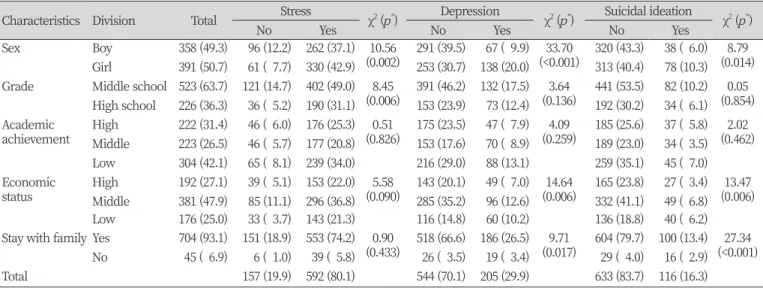
With respect to mental health according to general characteristics, stress was higher among women, and lower grades, depression experiences, and suicidal ideation were higher among women, the middle class, and those living with family <Table 1>.
Table 1. Mental health according to characteristics of subject Unit : N(%)
Characteristics Division Total Stress χ
2( p
*) Depression χ
2(p
*) Suicidal ideation χ
2( p
*)
No Yes No Yes No Yes
Sex Boy 358 (49.3) 96 (12.2) 262 (37.1) 10.56
(0.002) 291 (39.5) 67 ( 9.9) 33.70
(<0.001) 320 (43.3) 38 ( 6.0) 8.79 (0.014) Girl 391 (50.7) 61 ( 7.7) 330 (42.9) 253 (30.7) 138 (20.0) 313 (40.4) 78 (10.3) Grade Middle school 523 (63.7) 121 (14.7) 402 (49.0) 8.45
(0.006) 391 (46.2) 132 (17.5) 3.64
(0.136) 441 (53.5) 82 (10.2) 0.05 (0.854) High school 226 (36.3) 36 ( 5.2) 190 (31.1) 153 (23.9) 73 (12.4) 192 (30.2) 34 ( 6.1) Academic
achievement High 222 (31.4) 46 ( 6.0) 176 (25.3) 0.51
(0.826) 175 (23.5) 47 ( 7.9) 4.09
(0.259) 185 (25.6) 37 ( 5.8) 2.02 (0.462) Middle 223 (26.5) 46 ( 5.7) 177 (20.8) 153 (17.6) 70 ( 8.9) 189 (23.0) 34 ( 3.5) Low 304 (42.1) 65 ( 8.1) 239 (34.0) 216 (29.0) 88 (13.1) 259 (35.1) 45 ( 7.0) Economic
status High 192 (27.1) 39 ( 5.1) 153 (22.0) 5.58
(0.090) 143 (20.1) 49 ( 7.0) 14.64
(0.006) 165 (23.8) 27 ( 3.4) 13.47 (0.006) Middle 381 (47.9) 85 (11.1) 296 (36.8) 285 (35.2) 96 (12.6) 332 (41.1) 49 ( 6.8) Low 176 (25.0) 33 ( 3.7) 143 (21.3) 116 (14.8) 60 (10.2) 136 (18.8) 40 ( 6.2) Stay with family Yes 704 (93.1) 151 (18.9) 553 (74.2) 0.90
(0.433) 518 (66.6) 186 (26.5) 9.71
(0.017) 604 (79.7) 100 (13.4) 27.34 (<0.001) No 45 ( 6.9) 6 ( 1.0) 39 ( 5.8) 26 ( 3.5) 19 ( 3.4) 29 ( 4.0) 16 ( 2.9)
Total 157 (19.9) 592 (80.1) 544 (70.1) 205 (29.9) 633 (83.7) 116 (16.3)
Table 3. Related of oral symptoms and mental health
Characteristics Division Trauma Pain Bleeding
OR 95% Cl OR 95% Cl OR 95% Cl
Stress No Ref. Ref. Ref.
Yes 0.65 0.35-1.20 2.09 1.32-3.31 1.94 1.12-3.38
Depression No Ref. Ref. Ref.
Yes 1.31 0.72-2.37 1.52 1.00-2.30 1.61 1.06-2.44
Suicidal ideation No Ref. Ref. Ref.
Yes 2.40 1.28-4.47 1.07 0.62-1.84 1.47 0.90-2.41
*
Multiple logistic regression analysis adjusted for sex, grade, academic achievement, economic status, stay with family
OR: odds ratio , Cl: confidence interval
2. Self-perceived oral symptoms according to general characteristics
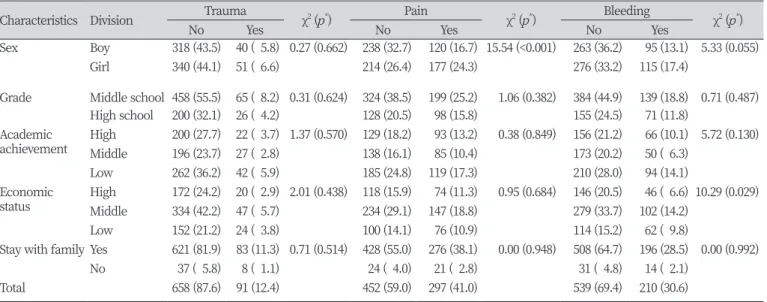
Trauma and pain were higher among women in the category of self-perceived oral symptoms according to general characteristics, and ulorrhagia was the highest among the middle class
<Table 2>.
3. Relationship between mental health and self-perceived oral symptoms
Regarding the relationship between mental health and self-perceived oral symptoms, the group with stress suffered pain levels that were 2.09 times higher and ulorrhagia levels that were 1.94 times higher than the group without stress. The group with depression experiences suffered pain levels that were 1.52 times and ulorrhagia levels that were 1.61 times higher than the group without depression experiences. The group with suicidal ideation suffered trauma levels that were 2.40 times higher than those of the group without suicidal ideation <Table 3>.
Table 2. Oral symptoms according to characteristics of subject Unit : N(%)
Characteristics Division Trauma
χ
2(p
*) Pain
χ
2( p
*) Bleeding
χ
2(p
*)
No Yes No Yes No Yes
Sex Boy 318 (43.5) 40 ( 5.8) 0.27 (0.662) 238 (32.7) 120 (16.7) 15.54 (<0.001) 263 (36.2) 95 (13.1) 5.33 (0.055)
Girl 340 (44.1) 51 ( 6.6) 214 (26.4) 177 (24.3) 276 (33.2) 115 (17.4)
Grade Middle school 458 (55.5) 65 ( 8.2) 0.31 (0.624) 324 (38.5) 199 (25.2) 1.06 (0.382) 384 (44.9) 139 (18.8) 0.71 (0.487) High school 200 (32.1) 26 ( 4.2) 128 (20.5) 98 (15.8) 155 (24.5) 71 (11.8)
Academic
achievement High 200 (27.7) 22 ( 3.7) 1.37 (0.570) 129 (18.2) 93 (13.2) 0.38 (0.849) 156 (21.2) 66 (10.1) 5.72 (0.130)
Middle 196 (23.7) 27 ( 2.8) 138 (16.1) 85 (10.4) 173 (20.2) 50 ( 6.3)
Low 262 (36.2) 42 ( 5.9) 185 (24.8) 119 (17.3) 210 (28.0) 94 (14.1)
Economic
status High 172 (24.2) 20 ( 2.9) 2.01 (0.438) 118 (15.9) 74 (11.3) 0.95 (0.684) 146 (20.5) 46 ( 6.6) 10.29 (0.029)
Middle 334 (42.2) 47 ( 5.7) 234 (29.1) 147 (18.8) 279 (33.7) 102 (14.2)
Low 152 (21.2) 24 ( 3.8) 100 (14.1) 76 (10.9) 114 (15.2) 62 ( 9.8)
Stay with family Yes 621 (81.9) 83 (11.3) 0.71 (0.514) 428 (55.0) 276 (38.1) 0.00 (0.948) 508 (64.7) 196 (28.5) 0.00 (0.992)
No 37 ( 5.8) 8 ( 1.1) 24 ( 4.0) 21 ( 2.8) 31 ( 4.8) 14 ( 2.1)
Total 658 (87.6) 91 (12.4) 452 (59.0) 297 (41.0) 539 (69.4) 210 (30.6)
*