랜딩기어의 구조적 내구성 해석에 의한 융합 연구
오범석, 조재웅
*
공주대학교 기계자동차공학부 교수
Convergent Study by the Structural Durability Analysis of Landing Gear
Bum-Suk Oh, Jae-Ung Cho
*
Professor, Division of Mechanical & Automotive Engineering, Kongju National University
요 약 본 연구에서는 랜딩기어의 길이에 따른 3가지 형상을 가진 모델링으로서 내구성을 해석하였다. 전반적으로 랜딩 기어의 상부로 갈수록 변형량이 많이 발생하나 등가응력의 경우는 하부 바로 윗부분에서 응력이 많이 작용하는 것을 알 수 있었다. Model 3는 Model 2에 비하여 최대의 등가응력은 4배 이상이 나오고 최대의 전변형량은 24배이상 나타 남을 알 수 있었다. Model 3는 하단부에서 항복응력을 넘어서 파손이 발생할 수 있음을 알 수 있었다. 상단부가 하단부 보다 긴 Model 2는 3가지 모델들 중 최대의 등가응력과 전변형량이 가장 적게 나타남을 알 수 있었다. 따라서 구조적 인 면에서 Model 2가 착륙시에 가장 내구성이 있고 Model 3가 내구성 면에서는 가장 저하됨을 알 수 있었다. 본 연구 의 설계 및 해석 결과는 실제적으로 랜딩기어의 구조적 내구성을 파악하는 데에 효율적으로 적용할 수 있다. 랜딩기어의 구조적 내구성 해석을 적용함으로서, 본 논문이 미적인 설계에 부합된 융합 연구라고 보여진다.
주제어 : 랜딩기어, 구조적 내구성, 등가 응력, 전변형량, 파손, 융합
Abstract In this study, the durability was analyzed as the models with three shapes depending on the length of the landing gear. Overall, the upper part of the landing gear produced a greater amount of deformation, but the equivalent stress was shown to be high in the upper part just above the lower part. Model 3 shows that the maximum equivalent stress is more than 4 times and the maximum total deformation is more than 24 times compared to model 2. Model 3 showed that the damage could occur beyond the yield stress at the lower end. Model 2 with the upper part longer than the lower part showed the lowest equivalent stress and total deformation among the three models. Therefore, from a structural standpoint, it was shown that model 2 was the most durable at landing and model 3 was the most degraded in terms of durability. The design and analysis results of this study can be effectively applied at grasping the structural durability of landing gear. By applying the structural durability analysis of landing gear, this paper is seen as the convergence study that conforms to aesthetic design.
Key Words : Landing gear, Structural durability, Equivalent stress, Total deformation, Damage, Convergence
*Corresponding Author : Jae-Ung Cho([email protected]) Received March 4, 2020
Accepted June 20, 2020 Revised May 21, 2020
Published June 28, 2020
1. 서론
항공기 사고는 매우 사망률이 높고, 그에 따라 항공기 는 안전성을 매우 중요시하는 경우가 많다. 하지만 요즘 항공기 착륙사고가 많이 들려오고 있으면서, 국민들의 안 전에 대한 인식이 한층 더 높아진 추세이고 공기의 크기 가 점점 커지면서 착륙장치들이 받는 부담도 높아지고 있다. 그러므로 항공기의 착륙장치인 랜딩기어의 개발도 많이 진행되어 왔다. 많은 연구들은 재질에 따른 연구, 형 상에 따른 연구들이 진행되어지고 있다[1-8]. 그 중에서 본 연구는 형상의 변화에 따른 내구성 중 특히 길이에 따 른 내구성 변화를 파악하기 위하여 랜딩기어의 전체를 상단부, 중간부, 하단부로 나누어서 Model 1, 2, 3의 상 단부, 하단부의 길이 각각 다르게 설정하여, 어떠한 형상 이 가장 내구성이 좋은지 파악하기 위하여 CATIA 프로 그램으로 모델링하였고, ANSYS 프로그램을 사용하여 랜딩기어의 구조해석[9-12]을 진행하였다. 따라서 본 연 구에서는 랜딩기어의 구조를 상단부, 중간부, 하단부 3부 분으로 나누고, 중간부는 상단부와 하단부를 연결해주는 몸체로 설정하였다. Model 1은 상단부와 하단부의 길이 를 1:1에 가깝게 하고, Model 2는 상단부가 모델 1보다 더 길고 하단부에서는 그 길이를 모델 1보다 짧게 설정 했고, Model 3에서는 상단부는 모델 1보다 더 짧게 하 고 하단부에서는 그 길이를 모델 1보다 길게 설정하여, 각 모델에 따라서 구조해석을 하였다. 그에 따른 결과로 는 구조해석 측면에서는 모델 2가 가장 좋은 내구성 [13-16]을 보여주었다. 본 연구의 설계 및 해석 결과는 실제적으로 랜딩기어에 대한 실험을 하지 않고서도 그 구조적 내구성을 파악하는 데에 효율적으로 적용할 수 있다. 랜딩기어의 구조적 내구성 해석을 적용함으로서 본 논문이 미적인 설계에 부합된 융합 연구라고 보여진다.
2. 본론 2.1 연구 모델
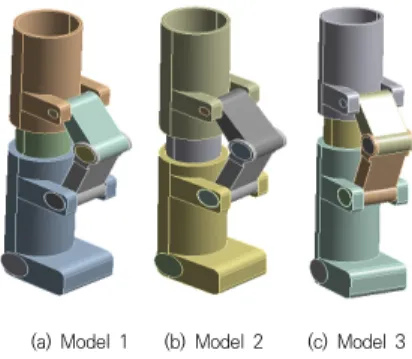
본 연구에서는 랜딩기어를 CATIA를 사용하여 Model 1, Model 2, Model 3의 3가지 모델을 만들었다. 연구 모델의 형상들은 Fig. 1과 같다.
(a) Model 1 (b) Model 2 (c) Model 3
Fig. 1. Shapes of models핀부분은 구조용 강이고 핀 부분을 제외한 모든 부분 은 알루미늄 합금으로 되어 있다. 이 재질들의 물성치들 은 Table 1에서와 같다. Model 1은 상단부와 하단부의 비율이 거의 1:1에 가까운 모델링을 한 모델이다, Model 2는 상단부가 길고 하단부가 그만큼 짧은 모델이다.
Model 3은 상단부가 짧고 그만큼 하단부가 긴 모델이며 세 가지 모델 전부가 랜딩기어의 전체 길이는 똑같으며 모델의 길이만 다른 형태이다. Table 1은 각 모델의 Mesh를 표로 나타낸 것이다.
Type
Model Elements Nodes
Model 1 44047 80575
Model 2 44123 78906
Model 3 44105 78832
Table 1. Mesh informations of models
(a) Pins(Structural steel) (b) Body parts(Aluminum alloy)
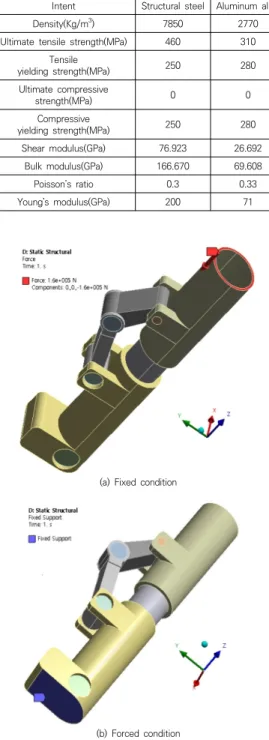
Fig. 2. Pins and body parts of modelFig. 2에서와 같이 핀부분은 구조용 강이고 핀 부분을 제외한 모든 부분은 알루미늄 합금으로 되어 있다. 이 재 질들의 물성치들은 Table 2에서와 같다. Fig. 3(a)는 구 조해석 모델의 고정조건을 나타내는 것으로, Model 1, 2, 3의 가장 상단부에서 –Z축 방향으로 힘을 가하였다.
또한 Fig. 3(b)에서와 같이, 하단부의 가장 아래 부분의
면을 고정시켰다. 160000 N을 최대 이륙 중량은 320톤 으로서 1초로 0.5m/s로 지면에 충돌한다고 가정하면 –Z 축 방향으로 작용된 힘인 충돌력은 160000N이 된다.
Intent Structural steel Aluminum alloy
Density(Kg/m
3) 7850 2770
Ultimate tensile strength(MPa) 460 310 Tensile
yielding strength(MPa) 250 280
Ultimate compressive
strength(MPa) 0 0
Compressive
yielding strength(MPa) 250 280
Shear modulus(GPa) 76.923 26.692
Bulk modulus(GPa) 166.670 69.608
Poisson’s ratio 0.3 0.33
Young’s modulus(GPa) 200 71
Table 2. Material properties
(a) Fixed condition
(b) Forced condition
Fig. 3. Constraint conditions of model2.2 구조해석 결과
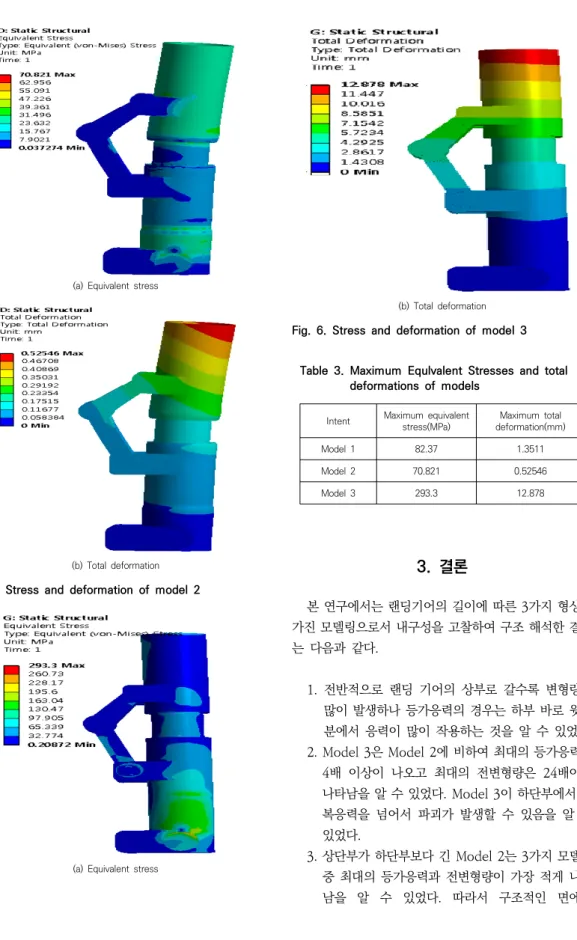
본 연구는 랜딩기어 Model 1, 2, 3에 대한 구조변형 을 비교하여 내구성을 확인하였다. Fig. 4, 5 및 6은 Model 1, 2 및 3에 대한 등가응력과 전변형량들의 등고 선들을 나타낸다. 전반적으로 랜딩 기어의 상부로 갈수록 변형량이 많이 발생하나 등가응력의 경우는 하부 바로 윗부분에서 응력이 많이 작용하는 것을 알 수 있었다.
Table 3에서는 Model 1, 2, 3 각 모델들에 대한 최대의 등가 응력과 최대의 변형량을 보인 것이다. Model 3는 Model 2에 비하여 최대의 등가응력은 4배 이상이 나오 고 최대의 전변형량은 24배 이상 나타남을 알 수 있었다.
Model 3는 하단부에서 항복응력을 넘어서 파괴가 발생 할 수 있음을 알 수 있었다. 또한 상단부가 하단부보다 긴 Model 2는 3가지 모델들 중 최대의 등가응력과 전변 형량이 가장 적게 나타남을 알 수 있었다. 따라서 구조적인 면에서 Model 2가 착륙시에 가장 내구성이 있고 Model 3이 내구성 면에서는 가장 저하됨을 알 수 있었다.
(a) Equivalent stress
(b) Total deformation
Fig. 4. Stress and deformation of model 1(a) Equivalent stress
(b) Total deformation
Fig. 5. Stress and deformation of model 2(a) Equivalent stress
(b) Total deformation
Fig. 6. Stress and deformation of model 3Intent Maximum equivalent
stress(MPa) Maximum total deformation(mm)
Model 1 82.37 1.3511
Model 2 70.821 0.52546
Model 3 293.3 12.878
Table 3. Maximum Equlvalent Stresses and total deformations of models
3. 결론
본 연구에서는 랜딩기어의 길이에 따른 3가지 형상을 가진 모델링으로서 내구성을 고찰하여 구조 해석한 결과 는 다음과 같다.
1. 전반적으로 랜딩 기어의 상부로 갈수록 변형량이 많이 발생하나 등가응력의 경우는 하부 바로 윗부 분에서 응력이 많이 작용하는 것을 알 수 있었다.
2. Model 3은 Model 2에 비하여 최대의 등가응력은 4배 이상이 나오고 최대의 전변형량은 24배이상 나타남을 알 수 있었다. Model 3이 하단부에서 항 복응력을 넘어서 파괴가 발생할 수 있음을 알 수 있었다.
3. 상단부가 하단부보다 긴 Model 2는 3가지 모델들 중 최대의 등가응력과 전변형량이 가장 적게 나타 남을 알 수 있었다. 따라서 구조적인 면에서
Model 2가 착륙시에 가장 내구성이 있고 Model 3이 내구성 면에서는 가장 저하됨을 알 수 있었다.
랜딩기어의 구조적 내구성 해석을 적용함으로서 본 논문이 미적인 설계에 부합된 융합 연구라고 보여 진다.
REFERENCES
[1] J. I. Lee. (2017). The Convergence Design for Stiffness and Structure Advancement of Automotive Body.
Journal of the Korea Convergence Society, 8(4), 189-197.
Doi : 10.15207/JKCS.2017.8.4.189
[2] J. S. Lee. (2018). Structural Analysis of a 24 Person Elevator Emergency Brake. Journal of the Korea Convergence Society, 9(12), 189-194.
Doi : 10.15207/JKCS.2018.9.12.189
[3] J. H. Lee & J. U. Cho. (2015). Study on Convergence Technique through Structural Analysis due to the Height of the Walker. Journal of the Korea Convergence Society, 6(2), 19-24.
Doi : 10.15207/jkcs.2015.6.2.019
[4] D. H. Lee & J. U. Cho. (2018). Convergence Study on Damage of the Bonded Part at TDCB Structure with the Laminate Angle Manufactured with CFRP. Journal of the Korea Convergence Society, 9(12), 175-180.
Doi : 10.15207/JKCS.2018.9.12.175
[5] J. H. Lee & J. U. Cho. (2015). Study on the Convergent Life Evaluation due to the Bumper Configuration of Multipurpose Vehicle. Journal of the Korea Convergence Society, 6(5), 85-90.
Doi : 10.15207/JKCS.2015.6.5.085
[6] J. U. Cho. (2014). Analytical Study on Durability due to the Load of Artificial Knee Joint. Journal of the Korea Convergence Society, 5(2), 7-11.
Doi : 10.15207/JKCS.2014.5.2.007
[7] J. W. Park, J. U. Cho. (2017). Convergence Study on Composite Material of Unidirectional CFRP and SM 45C Sandwich Type that Differs in Stacking Angle.
Journal of the Korea Convergence Society, 8(7), 231-236.
Doi : 10.15207/JKCS.2017.8.7.231
[8] J. U. Cho. (2015). Study on Convergence Technique through Strength Analysis of Stabilizer Link by Type.
Journal of the Korea Convergence Society, 6(1), 57-63.
Doi : 10.15207/JKCS.2015.6.1.057
[9] Y. K. Park & B. G. Lee. (2018). A Study on the Structural Analysis of the Spindle of Swiss Turn Type Lathe for Ultra Precision Convergence Machining.
Journal of the Korea Convergence Society, 9(5), 145-150.
Doi : 10.15207/JKCS.2018.9.5.145
[10] J. W. Park. (2017). Structural Analysis of a Tractor Cabin Considering Structure Production Error. Journal of the Korea Convergence Society, 8(5), 155-160.
Doi : 10.15207/JKCS.2017.8.5.155
[11] J. H. Lee & J. U. Cho. (2015). Study on Convergence Technique through Structural Analysis due to the Height of the Walker. Journal of the Korea Convergence Society, 6(2), 19-24.
Doi : 10.15207/jkcs.2015.6.2.019
[12] J. H. Lee & J. U. Cho. (2015). Study on Convergence Technique due to the Shape of Cruiser Board through Structural Analysis. Journal of the Korea Convergence Society, 6(4), 99-105.
Doi : 10.15207/jkcs.2015.6.4.099
[13] Y. Y. Her & Y. J. Yang. (2017). Structural Analysis on Development of Roller Jig for Peeling Machine.
Journal of the Korean Society of Mechanical Technology, 19(2), 242-248.
Doi : 10.17958/ksmt.19.2.201704.242
[14] J. M. Cha, S. J. Byun, Z. H. Wang & Y. C. Kwon. (2017).
Study on Structural and Fatigue Analysis according to Shape change of Automatic Press. Journal of the Korean Society of Mechanical Technology, 19(2), 156-161.
Doi : 10.17958/ksmt.19.2.201704.156
[15] S. W. Choo & S. H. Jeong. (2017). Structural and Dynamic Characteristic Analysis of a Feeder for an Automatic Assembly System of an LED Convergent Lighting Module. Journal of the Korean Society of Manufacturing Process Engineers, 16(1), 124-133.
Doi : 10.14775/ksmpe.2016.16.1.124
[16] J. Y. Kim, K. J. You, J. C. Gao & Y. S. Jung. (2017). A Study on the Structural Analysis of Fiber Guide accept to 4C MM Optical Fiber. Journal of the Korean Society of Manufacturing Process Engineers, 16(6), 75-80.
Doi : 10.14775/ksmpe.2017.16.6.075
오 범 석(Bum-Suk Oh) [정회원]
․ 1980년 2월 : 인하대학교 기계공학과 (공학사)
․ 1982년 2월 : 인하대학교 기계공학과 (공학석사)
․ 1987년 2월 : 인하대학교 기계공학과 (공학박사)
․ 1989년 3월 ~ 현재 : 공주대학교 기 계ㆍ자동차공학부 교수
․ 관심분야 : 기계 및 자동차 부품 의 강도평가 및 파손해석
․ E-Mail : [email protected]
조 재 웅(Jae-Ung Cho) [종신회원]