1. Introduction
The purpose of this study was to examine associations among family economic status,
social relationships and the career identity in adolescence. In particular, the study assessed the mediating effect of social relationships on the association between family economic status and
Effects of Social Relationships on the Association between Family Economic Status and Adolescents’ Career Identity
Ji Young Won
Professor, Division of Social Welfare, Kangnam University
가족 경제 상황과 청소년의 진로정체감과의 관계에서 사회관계의 매개 효과에 대한 연구
원지영
강남대학교 사회복지학부 교수
Abstract This study aimed to examine the associations between family economic status, social relationships, and the career identity of adolescents. The study assessed the mediating effects of social relationships on the relationship between economic status and the career identity of adolescents, utilizing data from the Korean Children and Youth Panel Survey (KCYPS). The result indicated that family economic status was related to the quality of the social relationships that significantly affected the career identity of adolescents. These findings suggested that the inequality in career development of adolescents due to family economic status could be reduced by promoting positive social relationships. Convergent interventions that help adolescents to build positive social relationships would be necessary to improve the career outcomes of those from low-income families.
Key Words : Social relationship, Family economic status, Adolescent, Career identity, Career development
요 약 본 연구는 가족의 경제적 상황과 청소년의 사회적 관계 및 진로정체감 간의 상관관계를 규명하는 것을 목적으로 한다. 본 연구는 한국아동·청소년 패널데이터를 활용하여 가정의 경제적 상황과 청소년의 진로정체감 간의 관계를 확인 하고, 사회관계의 매개 효과를 검증하고자 하였다. 연구 결과, 가족의 경제 상황이 사회관계의 질적인 측면과 상관관계 를 가지며, 이러한 청소년의 긍정적인 사회관계는 진로정체감에 유의미한 영향을 미치는 것으로 나타났다. 이러한 연구 결과는 가정의 소득 수준에 따른 청소년의 진로발달 격차를 긍정적인 사회관계의 증진을 통해 완화할 수 있다는 가능 성을 보여준다. 저소득 가정 청소년들의 진로 성과를 향상시키기 위해서 긍정적인 사회관계의 형성을 돕는 융합된 진로 지도 개입이 요구된다.
주제어 : 사회관계, 가족의 경제 상황, 청소년, 진로정체감, 진로발달
*Corresponding Author : Ji Young Won([email protected]) Received January 28, 2019
Accepted July 20, 2019
Revised June 28, 2019 Published July 28, 2019
the career identity of adolescents. Career identity formation is one of the central developmental tasks that adolescents must achieve[1]. Holland[2]
defined career identity as the possession of a clear and stable picture of one’s goals, interests, personality, and talents[3]. Individuals who have a concrete career identity have a clear sense of their interests, talents, and personality characteristics and thereby have the confidence to make informed career decisions[1]. The failure to form a clear and stable career identity often results in career indecision[1,4].
Career maturity is considered as a major outcome of high school education. High-school students are required to decide whether they wish to pursue post-secondary education or enter the labor market after graduation. The direction of an individual’s career and life can be determined by the level of career decision-making while in high school[5]. Therefore, it is very important for high-school students to form a clear and stable career identity. However, many college students reported that they had difficulties in deciding their major when entering college because of their lack of confidence in their capacity and aptitude[5]. Therefore, this study examined the career identity of high-school students who were at a crucial phase of career exploration.
Social relationships refer to the connections that exist between people who have recurring interactions that are perceived by the participants to have personal meaning[6]. Intimate social relationships and social supports would contribute to the formation of career identity in adolescence.
Previous studies consistently found that close relationships with friends and family members affected the wellbeing of adolescents[7,8]. For example, family cohesion and parental attachment helped adolescents develop career identity and make proper career decisions[9-12].
Economic status is considered a significant factor that affects adolescents’ career identity
formation. Previous research suggests that the educational attainment of parents and their income are significantly related to the career identity of their offspring[13,14]. Individuals with higher economic backgrounds tend to be more successful in developing their career aspirations and are generally better prepared for the world of work[15].
However, some findings suggest that the socioeconomic status of parents does not directly affect the career identity of youth. Kim[16] found that economic wealth positively affected the career identity of adolescents only when high levels of social capital existed among family members. This finding suggests a possible mediating effect of social relationships on the correlation between family economic status and career development of adolescents. For example, improvements in family income may be beneficial for parent-child relationships[17-19], and thereby positively affect the career development of youth.
Conger, Conger, and Martin[20] reviewed previous studies and suggested the family stress model as theoretical frameworks that might explain the associations among family wealth or income, parent-child relationships, and children’s development. According to the family stress model, family economic hardship results in parents’ emotional and behavioral problems and thereby adversely affects parenting behaviors[20].
It has been observed that harsh, inconsistent, and uninvolved parenting has a detrimental effect on children’s development.
On the other hand, according to the investment model, economic resources increase the investments that parents make for their children’s development, thus promoting a wide range of academic and social competencies in children[21,22].
Therefore, economic resources can contribute directly to the career development of adolescents by providing various career-related activities and private educational opportunities.
In contrast, some studies proposed that high socioeconomic status might not be beneficial to the career development of children. According to Kim and Ahn’s findings[23], parental socioeconomic status affected career decision making through achievement pressure. The high expectations of parents can burden their children and thereby deteriorate children’s career decision-making efficacy. Therefore, there is a possibility that the high socioeconomic status of parents can affect the career development of adolescents adversely by imposing excessive pressure on their children to obtain high academic achievement.
Beyond parent-child relationships, socioeconomic status is related to the structure and quality of social relationships. People with high socioeconomic status are likely not only to engage with more people but also to gain more resources from their social network[24,25]. On the contrary, people with low socioeconomic status are more likely to experience social exclusion and thereby are less likely to mobilize adequate resources and opportunities from their social ties[26–29].
In adolescence, young people spend more time outside the home, and their social network is extended to include people outside the family.
Social relationships with peers and teachers come to have important effects on adolescents.
Peer attachment has been found to be a significant factor in the formation of career identity during adolescence. According to previous studies, adolescents who had close relationships with their friends tended to report high levels of career maturity[30]. In addition, adolescents who developed good relationships with teachers tended to report a higher level of career maturity compared to those who did not[31].
Overall, the present study aimed to examine if social relationships would mediate the association between the economic status and the career identity of adolescents. Social bonds with parents, friends, and teachers may be important
sources of support in developing stable career goals and making career decisions.
The study addressed the following research hypotheses:
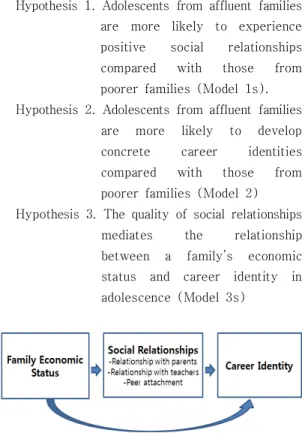
Hypothesis 1. Adolescents from affluent families are more likely to experience positive social relationships compared with those from poorer families (Model 1s).
Hypothesis 2. Adolescents from affluent families are more likely to develop concrete career identities compared with those from poorer families (Model 2) Hypothesis 3. The quality of social relationships
mediates the relationship between a family’s economic status and career identity in adolescence (Model 3s)
Fig. 1. Research model
2. Research Methods
2.1 Data and sample
The study analyzed the data from the middle-school student panel in the Korean Children and Youth Panel Survey (KCYPS) collected by the National Youth Policy Institute. The first set of data from the KCYPS was collected in 2010, when members of this panel were in the first grade of middle school. At the time of the sixth survey, they were third-grade high school students. The study utilized the data collected in the sixth survey.
The dataset contained information from 2,351 individuals.
2.2 Measurement
2.2.1 Family economic status
Family economic status was reported by the respondents, who evaluated their economic status by choosing one of five alternatives indicating economic condition, from very poor to very rich.
2.2.2 Parent-child relationship
Parent-child relationship was evaluated on the basis of parental behaviors. The parental behavior scale consisted of six dimensions: parental monitoring, warmth and support, inductive reasoning, over-expectation, over-interference, and inconsistency. The result of factor analysis indicated that parental behaviors could be further reduced to three factors: (1) parental monitoring and warmth, (2) inductive reasoning.
and (3) negative parenting behaviors (over-expectation, over-interference, inconsistency). Values for Cronbach’s alpha were 0.83, 0.83, and 0.85, respectively.
2.2.3 Peer attachment
Peer attachment was measured with a nine-item self-report scale that asked to what degree the respondents communicated with, felt close to, and trusted his or her friends.
Cronbach’s alpha was 0.84 for the scale of peer attachment.
2.2.4 Social relationship with teachers Respondents’ relationships with teachers were measured with a five-item scale that asked to what degree the respondents felt close to their teachers. Survey respondents indicated how much they agreed with each item using a four-point Likert scale (1-disagree, 2-somewhat disagree, 3-somewhat agree, 4-agree).
Cronbach’s alpha was 0.84.
2.2.5 Career identity
Adolescents’ career identity was measured by the total scores of eight items, with higher scores indicating a more concrete career identity. The total scores were divided by the number of items.
Each item of the scale asked respondents whether they had a job field that they wanted to pursue in the future and how much their decisions were specific and concrete. Cronbach’s alpha was 0.89 for the scale of career identity.
2.3 Data Analysis
A three-step regression analysis proposed by Baron and Kenny[32] was conducted to assess the mediating effect of social relationships. The first step of regression analyses used economic status as an independent variable that predicted the social relationships of adolescents (Model 1s).
The second regression model (Model 2) employed economic status as the independent variable that predicted career identity. For the third step, the regression model (Model 3s) used family economic status and the quality of social relationship as predictors of career identity. If the quality of social relationships remained a significant predictor of career identity while family economic status no longer predicted the career identity of adolescents, the mediating effect was supported[33]. The variables of sex, school types, and academic achievement were included in the analysis models as control variables.
In addition, the Sobel test was used to test the statistical significance of the mediating effect, as suggested by MacKinnon[34].
Research models were proven to satisfy the assumptions of regression analyses such as linear relationships, multivariate normality, no multicollinearity, and homoscedasticity.
3. Results
3.1 Results of Descriptive Statistics
Table 1 below shows the characteristics of the respondents. About half (50.5%) were boys.
Eighteen percent of respondents were enrolled in career high schools. More than one third of respondents evaluated their academic achievement as satisfactory. Seventy respondents evaluated their academic achievement as excellent while 47 respondents evaluated their academic achievement as unacceptable. About two thirds of respondents perceived their economic status as neither poor nor rich. Respondents reported a higher level of peer attachment than positive parent-child relationships (e.g., parental monitoring, warmth, and inductive reasoning).
Variables Frequency (%)
Sex Boys 1014 (50.5)
Girls 994 (49.5)
Type of school General 1637 (81.5)
career 371 (18.5)
Academic achievement
7-Excellent 70 (3.5)
6-Very Good 185 (9.2)
5-Good 390 (19.4)
4-Satisfactory 791 (39.4)
3-Acceptable 340 (16.9)
2-Barely
acceptable 183 (9.1)
1-Unacceptable 47 (2.3)
Economic status
Poor 100 (5.0)
Somewhat poor 261 (18.0)
Neither poor nor
rich 1269 (63.2)
Somewhat rich 247 (12.3)
Rich 131 (6.5)
Variables Mean SD Min Max
Peer attachment 3.11 0.43 1 4
Relationship with teachers 2.95 0.59 1 4
Parenting behaviors
Parental monitoring and
warmth
3.05 0.47 1 4
Negative parenting behaviors
2.82 0.53 1 4
Inductive
reasoning 2.77 0.61 1 4
Career identity 3.02 0.59 1 4
Table 1. Results of descriptive statistics
3.2 Economic status and social relationships
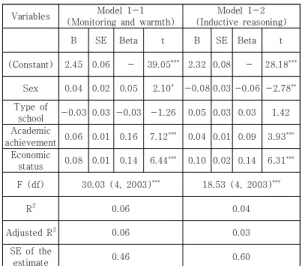
Table 2 below shows that Adolescents reporting lower economic status were less likely to experience positive parenting behaviors, such as parental monitoring, warmth and support, and inductive reasoning
Variables Model 1-1 (Monitoring and warmth)
Model 1-2 (Inductive reasoning)
B SE Beta t B SE Beta t
(Constant) 2.45 0.06 - 39.05*** 2.32 0.08 - 28.18***
Sex 0.04 0.02 0.05 2.10* -0.08 0.03 -0.06 -2.78**
Type of
school -0.03 0.03 -0.03 -1.26 0.05 0.03 0.03 1.42 Academic
achievement 0.06 0.01 0.16 7.12*** 0.04 0.01 0.09 3.93***
Economic
status 0.08 0.01 0.14 6.44*** 0.10 0.02 0.14 6.31***
F (df) 30.03 (4, 2003)*** 18.53 (4, 2003)***
R2 0.06 0.04
Adjusted R2 0.06 0.03
SE of the
estimate 0.46 0.60
*p< .05; **p< .01; ***p< .001
Table 2. Associations between the economic status and positive parenting behaviors
However, as shown in Table 3, family economic status was not correlated to negative parenting behaviors such as over-expectation, over-interference, and inconsistency. Overall, family economic status affected positive parenting behaviors, but not negative parenting behaviors. Parents with high socioeconomic status tend to be warm and supportive, be aware their offsprings’ whereabouts, conduct and companions and help their offsprings understand the effect of their behaviors on others. However, high economic status does not reduce the negative parenting behaviors such as imposing excessive pressure on their children’s achievement.
Variables Mode1-3 (Negative parenting behaviors)
B SE Beta t
(Constant) 2.55 0.07 - 35.72***
Sex 0.11 0.02 0.10 4.68***
Type of school 0.06 0.03 0.05 2.10* Academic achievement 0.02 0.01 0.05 2.18* Economic status 0.00 0.01 0.01 0.25
F (df) 7.88 (4, 2003)***
R2 0.02
Adjusted R2 0.01
SE of the estimate 0.53
*p< .05; **p< .01; ***p< .001
Table 3. Associations between the economic status and negative parenting behaviors
As shown in Table 4, adolescents who perceived themselves to be "very rich" also had stronger attachment to their peers. These findings suggest that family economic status is positively related to the quality of social relationships with peers.
Variables Model 1-4 (Relationship with peers)
B SE Beta t
(Constant) 2.77 0.06 - 47.75***
Sex 0.01 0.02 0.01 0.63
Type of school -0.02 0.02 -0.02 -0.76 Academic achievement 0.04 0.01 0.11 4.89***
Economic status 0.04 0.01 0.09 4.10***
F (df) 12.76 (4, 2003)***
R2 0.03
Adjusted R2 0.02
SE of the estimate 0.43
*p< .05; **p< .01; ***p< .001
Table 4. Associations between the economic status and peer attachment
However, as shown in Table 5, family economic status was not related to adolescents’
relationships with teachers significantly. Levels of academic achievement is the most significant predictor of adolescents’ relationships with their teachers(t=7.00, p<0.001). In addition, boys seem to have better relationships with their teachers than girls (t=-3.76, p<0.01).
Variables Model 1-4
(relationship with teachers)
B SE Beta t
(Constant) 2.75 0.08 - 34.68***
Sex -0.10 0.03 -0.08 -3.76***
Type of school 0.04 0.03 0.03 1.22 Academic achievement 0.07 0.01 0.16 7.00***
Economic status 0.01 0.02 0.02 0.77
F (df) 16.73 (4, 2003)***
R2 0.03
Adjusted R2 0.03
SE of the estimate 0.58
*p< .05; **p< .01; ***p< .001
Table 5. Associations between the economic status and relationships with teachers
3.3 Economic status, social relationships, and career identity formation
Least squares regression analyses were conducted to further unpack the relationship between adolescents’ economic status and their career identity. Two steps of analysis were conducted to examine whether social relationships mediated the correlation between the economic status and career identity
Variables Model 2
B SE Beta t
(Constant) 21.94 0.56 - 38.87
Sex -0.18 0.21 -0.02 -0.89
Type of school -1.17 0.27 -0.10 -4.36***
Academic achievement 0.48 0.08 0.13 5.85***
Economic status 0.25 0.12 0.04 1.97*
F (df) 16.08 (4, 2001)***
R2 0.03
Adjusted R2 0.03
SE of the estimate 4.63
*p< .05; **p< .01; ***p< .001
Table 6. Associations between the economic status and career identity
Model 2 in Table 6 included the economic status as an explanatory variable affecting career identity. The result indicated that family economic status was positively related to the
development of career identity. Adolescents from families with high economic status were more likely to develop concrete career identity than those from families with low economic status. In addition, types of schools and levels of academic achievement were significant predictors of the career development of adolescents. Adolescents who were in academic high schools and with high academic achievement had more concrete career identity than those in vocational high schools and with low academic achievement
Model 3s added the variables of social relationships (i.e., relationships with peers and parents,) as an explanatory variable in Model 2.
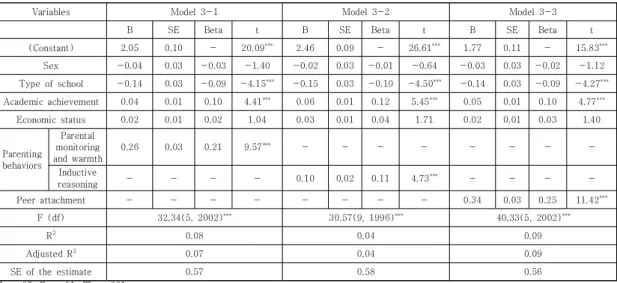
Table 7 shows that the economic status was significantly related to the development of career identity among adolescents. However, after adding the variables regarding social relationships, economic status ceased to be a significant predictor of career identity (p>0.05).
According to the results of Model 3-1 and Model 3-2 in Table 7, the variable of parental monitoring and warmth and the variable of inductive reasoning were positively related to the development of career identity even after controlling for family economic status. This
findings suggested the mediating effect of positive parenting on the association between family economic status and career development in adolescence.
In addition, as shown in Table 7, the variable of peer attachment was positively related to career identity of adolescents after controlling for economic status. This finding suggests that peer attachment would be a significant factor explaining a correlation between economic status and career development in adolescence.
The results of Sobel test confirmed that family economic status indirectly affected youth’s career identity through positive parent-child relationships. Sobel test statistic was 5.88 for parental monitoring and warmth (p<0.001) and 3.54 for inductive reasoning (p<0.001). In addition, peer attachment significantly carried the influence of family economic status to the youth’s development of career identity (Z=3.77, p<0.001).
Overall, adolescents from affluent families tend to have secure attachment relationships with parents and friends and thereby develop concrete career identities.
Table 7. Associations among the economic status, social relationships, and career identity
Variables Model 3-1 Model 3-2 Model 3-3
B SE Beta t B SE Beta t B SE Beta t
(Constant) 2.05 0.10 - 20.09*** 2.46 0.09 - 26.61*** 1.77 0.11 - 15.83***
Sex -0.04 0.03 -0.03 -1.40 -0.02 0.03 -0.01 -0.64 -0.03 0.03 -0.02 -1.12 Type of school -0.14 0.03 -0.09 -4.15*** -0.15 0.03 -0.10 -4.50*** -0.14 0.03 -0.09 -4.27***
Academic achievement 0.04 0.01 0.10 4.41*** 0.06 0.01 0.12 5.45*** 0.05 0.01 0.10 4.77***
Economic status 0.02 0.01 0.02 1.04 0.03 0.01 0.04 1.71 0.02 0.01 0.03 1.40
Parenting behaviors
Parental monitoring and warmth
0.26 0.03 0.21 9.57*** - - - - - - - -
Inductive
reasoning - - - - 0.10 0.02 0.11 4.73*** - - - -
Peer attachment - - - - - - - - 0.34 0.03 0.25 11.42***
F (df) 32.34(5, 2002)*** 30.57(9, 1996)*** 40.33(5, 2002)***
R2 0.08 0.04 0.09
Adjusted R2 0.07 0.04 0.09
SE of the estimate 0.57 0.58 0.56
*p< .05; **p< .01; ***p< .001
4. Conclusion
Previous research found that high school students who had concrete ideas of what jobs they wanted in the future tended to well adapt to college lives and be satisfied with their major, which resulted in the successful transition from school to work[35]. In addition, the development of career identity was an important predictor of the labor market outcomes in the future[36].
According to this analysis, adolescents from low income families were less likely to experience positive relationships with parents and peer attachment bonds. A lack of positive social relationships could be related to unstable career identity and could thereby negatively impact the future careers of adolescents. These results suggested that adolescents from low-income families might have insufficient opportunities to explore and consider various available career options and prepare for finding a desirable job. As a result, adolescents from low-income families might easily end up in unsatisfactory careers for reasons not directly related to economic resources. The development of positive social relationships could play a role in helping to clarify an adolescent’s career identity, possibly through social comparison and exposure to novel ideas, and improve the career outcomes of individuals from low-income families.
Overall, we may need to innovate our typical way of career guidance that provides job-related information and conducts psychological tests.
Career guidance practice in the classroom by teachers as a part of the curriculum has no significant effect on the career development[37].
Convergent interventions that help youth to develop and maintain positive social relationships would be necessary to improve the career outcomes of those from low-income families.
Career guidance programs for adolescents from underprivileged families may need to encourage
the involvement of parents in the career development of their offsprings and actively use peer groups in the process of career exploration activities. This approach would contribute to achieving overall development tasks of adolescents as well as their career maturity.
The research models in this study explained only about 10 percent of the variation in the scores of career identity. Previous research indicated that personal characteristics such as self-esteem, self-efficacy, and competence were significant factors affecting the development of career identity[38]. Future study will therefore need to assess the career development of adolescents using research models considering social, familial, and personal factors. In addition, in-depth research will be needed on the associations between close social relations and career development.
REFERENCES
[1] J. L. Holland, D. Daiger, & P. Power. (1980). My Vocational Situation: Description of an Experimental Diagnostic Form for the Selection of Vocational Assistance. Palo Alto, CA: Consulting Psychologists Press.
[2] J. L. Holland. (1997). Making Vocational Choices: A Theory of Vocational Personalities and Work Environments (3rd ed.).Odessa, FL: Psychological Assessment Resources.
[3] J. A. Galles & J. G. Lenz. (2013). Relationships among career thoughts, vocational identity, and calling:
Implications for practice. The Career Development Quarterly, 61, 240–248.
[4] D. E. Super, M. L. Savickas, & C. M. Super.(1996). The life-span, life-space approach to careers. In D.
Brown, L. Brooks, & Associates (Eds), Career Choice and Development. San Francisco, CA: Jossey-Bass.
[5] Y. Y. Ran. (2009). Impact of career identity on career decision-making level in high school students. Journal of Education & Culture, 15(1),91–106.
[6] K. J. August & K. S. Rook. (2013). Social Relationships.
In M. D. Gellman & J. R. Turner (Eds.) Encyclopedia of Behavioral Medicine. New York, NY: Springer.
[7] Y. B. Almquist, V. Östberg, M. Rostila, C. Edling & J.
Rydgren. (2014). Friendship network characteristics
and psychological well-being in late adolescence:
exploring differences by gender and gender composition. Scandinavian Journal of Public Health, 42(2), 146-154.
[8] T. M. Phillips. (2012). The influence of family structure vs. family climate on adolescent well being.
Child and Adolescent Social Work Journal, 29(2), 103–
110.
[9] S. K. Kim. (2008). Factors affecting career maturity and of Korean high school students: On the basis of the comparisons by students' sex and school-type.
Korean Journal of Youth Studies, 15(6), 145–170.
[10] A. A. Helwig. (2008). From childhood to adulthood: A 15-year longitudinal career development study. The Career Development Study, 51(1), 38–50.
[11] F. G. Lopez. (1989). Current family dynamics, trait anxiety, and academic adjustment: Test of a family-based model of vocational identity. Journal of Vocational Behavior, 35, 76–87.
[12] M. R. Kim & S. J. Han. (2018). The effect of personal, social factors, and school career experience on high school students' self-efficacy and career maturity.
Journal of the Korea Convergence Society, 9(9), 399–
405.
[13] H. Ro. (2006). The relationship between the career maturity levels to adolescent and SES variables.
Korean Journal of Youth Studies, 13(6), 306–328.
[14] J. C. Heo. (2016). A convergence study the effect of the social capital discovery program on empowerment and career preparation activity of female college students. Journal of the Korea Convergence Society, 7(6), 219–228.
[15] M. A. Diemer & S. R. Ali. (2009). Integrating social class into vocational psychology: Theory and practice implications. Journal of Career Assessment, 17(3), 247 –265.
[16] S. K. Kim (2015). The effects of family and school social capital on youths' career identity. Journal of the Korean Society of Child Welfare, 51, 23–46.
[17] A. C. Huston, G. J. Duncan, V. C. McLoyd, D. A.
Crosby, M. N. Ripke, T. S. Weisner, & C. A. Eldred.
(2005). Impacts on children of a policy to promote employment and reduce poverty for low-income parents: New hope after 5 years. Developmental Psychology, 41, 902–918.
[18] T. Leventhal, R. C. Fauth, & J. Brook-Gunn. (2005).
Neighborhood poverty and public policy: A 5-year follow-up of children's educational outcomes in the New York City Moving to Opportunity demonstration.
Developmental Psychology, 41, 933–952.
[19] P. Morris, G. J. Duncan, & E. Clark-Kauffman. (2005).
Child well-being in an era of welfare reform: The sensitivity of transitions in development to policy change. Developmental Psychology, 41, 919–932.
[20] R. D. Conger, K. J. Conger, & M. J. Martin. (2010).
Socioeconomic status, family processes and individual development. Journal of Marriage and Family, 72, 685 –704.
[21] R. H. Bradley & R. F. Corwyn. (2002). Socioeconomic status and child development. Annual Review of Psychology, 53, 371–399.
[22] S. Mayer. (1997). What Money Can't Buy: Family Income and Children's Life Chances. Cambridge, MA:
Harvard University Press.
[23] Y. H. Kim & H. N. Ahn. (2014). Mediating effects of achievement pressure and career decision-making self-efficacy on the relationships between parent-child bonding, parental socioeconomic status, and college students' career decisions. The Korean Journal of Counseling and Psychotherapy, 26(3), 657–
682.
[24] J. S. House, D. Umberson, & K. R. Landis. (1988).
Structures and processes of social support. Annual Review of Sociology, 14(1), 293–318.
[25] S. E. Taylor & T. E. Seeman. (1999). Psychosocial resources and the SES-health relationship. Annual of the New York Academy of Science, 896, 210–225.
[26] E. Y. Cornwell & B. Cornwell. (2008). Access to expertise as a form of social capital: an examination of race-and class-based disparities in network ties to experts. Sociological Perspectives, 51(4), 853–876.
[27] S. McDonald. (2011). What’s the "old boys"network?
Accessing social capital in gendered and racialized networks. Social Networks, 33(4), 317–330.
[28] L. Song & N. Lin. (2009). Social capital and health inequality: Evidence from Taiwan. Journal of Health and Social Behavior, 50(June), 149–163.
[29] L. M. Tigges, L. Browne, & G. P. Green. (1998). Social isolation of the urban poor: race, class, and neighborhood effects on social resources. The Sociological Quarterly, 39(1), 53–77.
[30] W. S. Park. (2007). The longitudinal study of factors effect on career maturity for secondary students. The Journal of Career Education Research, 20(4), 87–101.
[31] Y. K. Chung & S. E. Lee. (2005). Factors related to the career maturity of Korean adolescents: Focusing on individual, family, and school characteristics.
Conference of Korean Education and Employment Panel Survey, 259–305.
[32] R. M. Baron & D. A. Kenny. (1986). The Moderator-Mediator Variable Distinction in Social Psychological Research: Conceptual, Strategic, and Statistical Consideration. Journal of Personality and Social Psychology, 51, 1171-1182.
[33] Statistic Solution. (2013). Data analysis plan, Mediation analysis [Online].
http://www.statisticssolutions.com/academic-solution s/member-resources/member-profile/data-analysis-pl
an-templates/data-analysis-plan-mediation-analysis/
[34] D. P. MacKinnon, C. M. Lockwood, J. M. Hoffman, S.
G. West, & V. Sheets. (2002). A comparison of methods to test mediation and other intervening variable effects. Psychological Methods, 7, 83-104.
[35] K. A. Chung & J. H. Cho. (2015). Differences between major satisfaction, university life adjustment, self-esteem and career identity according to the time of department selection of students in the department of occupational therapy at one university. Journal of the Korea Convergence Society, 6(5), 143–155 [36] D. A. Jepsen & G. L. Dickson. (2003). Career
exploration as a precursor to career establishment.
The Career Development Quarterly, 51(3), 217-233.
[37] H. Kim & S. Yang. (2012). The effect of high school and students’ characteristics on career maturity in Seoul: Using multi-level model. The Journal of Vocational Education Research, 31(1), 57-74.
[38] V. Emmanuelle. (2009). Inter-relationships among attachment to mother and father, self-esteem, and career indecision. Journal of Vocational Behavior, 75, 91-99.
원 지 영(Ji-Young Won) [정회원]
․ 1997년 2월 : 이화여자대학교 사회 복지학과 (문학사)
․ 2003년 6월 : 펜실베이니아대학교 사 회복지대학원 (사회복지학석사)
․ 2008년 12월 : 시카고대학교 사회서 비스행정대학원 (문학박사)
․ 2010년 3월 ~ 현재 : 강남대학교 사회 복지학부 교수
․ 관심 분야 : 아동·청소년복지정책, 청소년진로발달, 청년 고 용, 사회관계망
․ E-Mail : [email protected]