219
Design of Cooled Infrared Optical System Considering Narcissus
Su Seong Jeong
1† , Young Soo Kim
1, Jin Suk Hong
2, Kyoung Muk Lee
2, and Jee Yeon Yoon
31
Electro-Optics 1 Team, Hanwha Systems, 188, Pangyoyeok-ro, Bundang-gu, Seongnam 13524, Korea
2
Electro-Optics 4 Team, Hanwha Systems, 491-23, Gyeonggidong-ro, Namsa-myeon, Cheoin-gu, Yongin 17121, Korea
3
Satellite R&D Head Office/Satellite Payload Development Division, Korea Aerospace Research Institute,
169-84, Gwahak-ro, Yuseong-gu, Daejeon 34133, Korea
(Received November 14, 2019; Revised November 24, 2019; Accepted November 25, 2019)
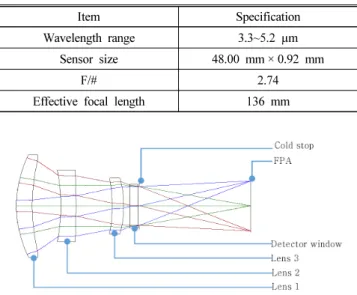
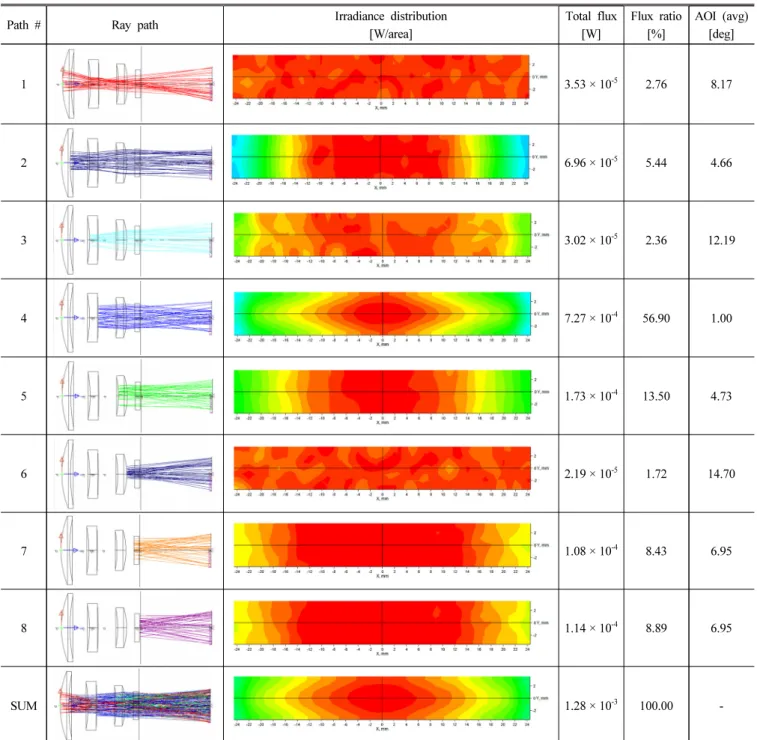
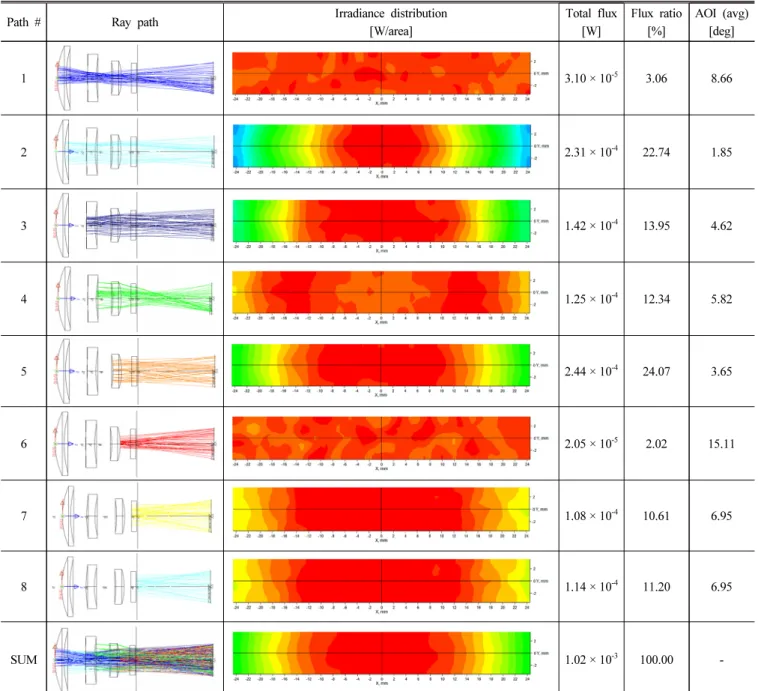
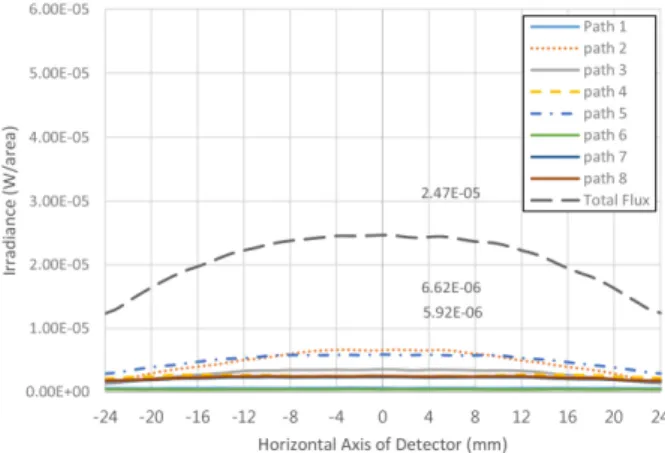
In an infrared optical system, using a cooled detector generates a phenomenon called a narcissus, in which the focal-plane array cooled to very low temperatures is reflected at the lens surface and detected. The narcissus can be removed by non-uniformity correction of the detector pixel, so narcissus is generally ignored in infrared optics. However, non-uniformity correction reduces the sensitivity of the system. Also, as the housing temperature varies due to an environmental temperature change, or a lens is moved for focusing or athermalization purposes, a narcissus may occur even after non-uniformity correction. To minimize such a narcissus, the amount of the effect must be controlled in the lens-design stage. In this paper we designed a midinfrared optical system and analyzed the narcissus by setting the lens surface reflectance to 1%. In addition, the design was divided into stages of an initial design, an improved design, and a minimum design, and the narcissus was improved to about 56% of that in the initial design.
Keywords: Infrared, Infrared camera
OCIS codes: (040.3060) Infrared; (110.3080) Infrared imaging
나르시서스를 고려한 냉각형 적외선 광학계 설계
정수성
1† ㆍ김영수
1ㆍ홍진석
2ㆍ이경묵
2ㆍ윤지연
31
한화시스템 전자광학1팀
우
13524 경기도 성남시 분당구 판교역로 188
2
한화시스템 전자광학4팀
우
17121 경기도 용인시 처인구 남사면 경기동로 491-23
3
한국항공우주연구원 위성연구본부/탑재체개발부
우
![Fig. 1. Typical atmospheric transmittance over a 1 km path length with major absorbers listed [3] .](https://thumb-ap.123doks.com/thumbv2/123dokinfo/5525091.461107/2.892.88.411.647.853/fig-typical-atmospheric-transmittance-length-major-absorbers-listed.webp)