dimension is a characteristic property of the number-size distribution of fragments as a mass of material is broke down. According to the model proposed by Turcotte (1986), the number-size distribution of fragments is given by Ni= cxi-Df, where Niis the cumulative number of fragments in the number-size distribution, obtaining subsequent to fragmentation, up to the ith size class, xiis the mean size of the objects in the ith class, c is a constant, and D is fractal dimension. In practice, size distribution data for soil aggregate fragmentation is usually obtained on a mass-size basis. Assuming scale- invariant aggregate bulk density and shape factor s, Perfect et al. (1992) derived the following equation for the estimation of D from mass-size distribution data.
In above equation, miis oven-dry mass of aggregates and Dfis independent of the geometry and of fragments and k=c for cubic objects. For objects other than cubes, k=c s.
The objectives of this study were to investigate the aggregate fragmentation in wet-sieving and to evaluate the relationship between the aggregate fragmentation fractal dimension and macro-porosity of upland soils.
Materials and Methods
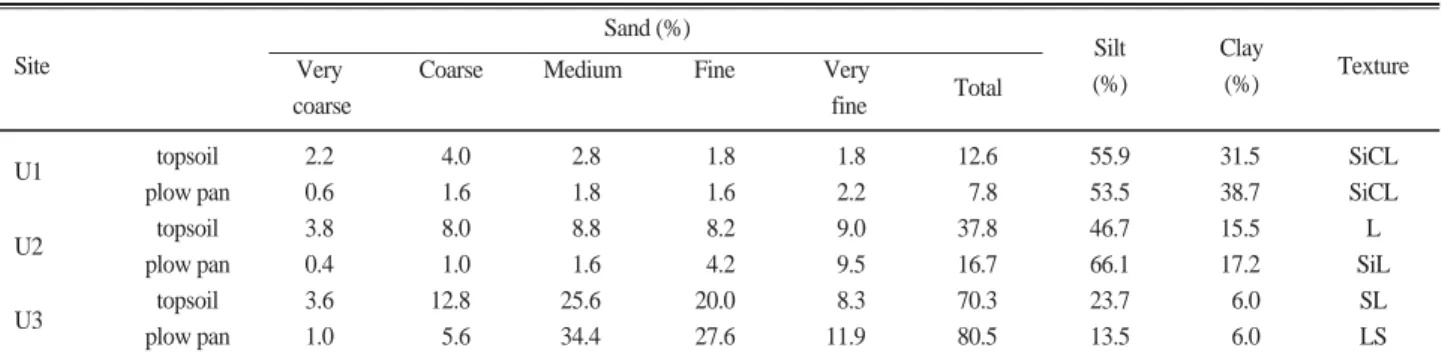
Soil sampling Soil sampling sites with different textural types were selected as Table 1, including U1 (Gopyeong, Fine, Typic Hapludalfs), U2 (Gyuam, Fine silty over coarse silty, Fluvaquentic Eutrudepts), and U3 (Jungdong, Coarse loamy, Typic Udifluvents) located in Gyeonggi province. Undisturbed soil samples with five replicates were sampled at soil surface with block type, topsoil and plow pan layer with 3 inches cores, as shown in figure 1 and table 2.
Fractal theory A fractal object appears morphologically the same, regardless of the scale of observation. Mandelbrot (1993) describes fractals as
"shapes whose roughness and fragmentation neither tend to vanish, nor fluctuate up and down, but remain essentially unchanged as one zooms in continually and examination is refined". This is known as scale invariance or scaling. Although natural objects are not fractals in the strict mathematical sense, they often have similar features over a range of scales.
The soil fragmentation mechanism such as water stability of aggregate can be described as fractals, i.e., scale-invariant and power law distribution, when zones of weakness exist at all scales.
x = x i
Σ [ mi/xi3] = kxi-Df x = x max
Fig. 1. Discrimination between topsoil and plow pan layer and sampling depths of soils.
Site Soil series (Soil Taxonomy)
Gopyeong (Fine, Typic Hapludalfs)
Gyuam (Fine silty over coarse silty, Fluvaquentic Eutrudepts) Jungdong (Coarse loamy, Typic Udifluvents)
Corn Sesame Red pepper U1
U2 U3
Crop Location
Table 1. Description of study sites.
Suwon, Gyeonggi Icheon, Gyeonggi Suwon, Gyeonggi
Water stable aggregate measurement Aggregate fragmentation in wet-sieving was used with Yoder's sieve shaker (Daiki, Japan), following the method of Rasiah et al. (1995). After a set with 2, 1, 0.5, 0.25 mm sieves was set in the shaker, 10 g air-dry aggregate with diameter 2~4 mm put into the upmost sieve and was saturated with water for five minutes. After up and down shaking for 10 minutes, the sieve with aggregate was dried and weighed.
The sand correction was done with sieving, drying and weighing after dispersing the aggregate with 10 mL of 5% sodium hexametaphosphate (Kemper and Koch, 1966; USDA, 1999). Corrected aggregate mass in each sieve was used in calculating aggregate stability indices such as mean weight diameter and geometric mean diameter and fragmentation fractal dimension.
The calculation of water stable aggregates The aggregate stability in wet-sieving was digitalized as three types of fragmentation fractal dimension (Df), geometric mean diameter (GMD), and mean weight diameter (MWD).
·Mean weight diameter (MWD)
where xiand wiindicate the mean diameter of each size fraction and the proportion of total sample weight, occurring in the corresponding size fraction, respectively.
·Geometric mean diameter (GMD)
·Fragmentation fractal dimension (Df)
Hydraulic properties Soil 3 inches cores (diameter, 7.6 cm and height, 7.6 cm) were saturated from the
bottom with a 0.01 N CaCl2solution and were left under conditions for more than 24 h. The saturated hydraulic conductivity Ks of the cores was determined by constant head method or falling head method. And then, retention curves were measured using the intact 3 inches soil samples. Pore water pressures from -5 cm to -100 cm were measured using sand box equipment. Mean pore diameter (dp, μm) at a given soil water tension was estimated from water-retention using the following equation (Danielson and Sutherland, 1986):
dp=4σ×105/ pwgh (4) where is surface tension of water (0.0724 J m-2at 25 ), w is density of water (1 Mg m-3), g is gravitational acceleration (9.8 N kg-1), and h is the soil water tension expressed in cm of water.
Soil physico-chemical properties Particle size distribution was measured with hydrometer method, organic matter content with Tyurin method (NIAST, 2000), exchangeable cation with 1N NH4OAc extraction method, pH (H2O, 1:5) with a pH meter (Orion, USA), EC(1:5) with a EC meter (EcoScan, Japan) as described in Sparks (1996).
Results and Discussion
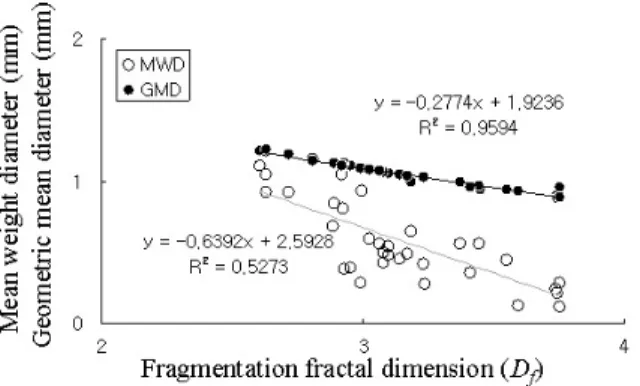
Fragmentation fractal dimension compared with aggregate stability indices Fragmentation fractal dimensions (Df) in aggregate wet-sieving of upland topsoil had a range from 2.5 to 3.8, geometric mean diameter (GMD) from 0.9 mm to 1.2 mm, and mean weight diameter (MWD) from 0.1 mm to 1.1mm (fig. 2).
Generally, mass fractal dimension is defined as less than 3, but the values of Df> 3.00 is theoretically possible if the fragmentation process exhibits multifractal behavior (Rasiah et al., 1995). Our result also showed multifractal behavior with the values of Df> 3.00, which relatively
Texture Clay
(%) Silt
Total (%) Very
fine Fine
Medium Coarse
Very coarse
Sand (%)
topsoil plow pan
topsoil plow pan
topsoil plow pan
2.2 0.6 3.8 0.4 3.6 1.0
4.0 1.6 8.0 1.0 12.8 5.6
2.8 1.8 8.8 1.6 25.6 34.4
1.8 1.6 8.2 4.2 20.0 27.6
1.8 2.2 9.0 9.5 8.3 11.9
12.6 7.8 37.8 16.7 70.3 80.5
55.9 53.5 46.7 66.1 23.7 13.5
31.5 38.7 15.5 17.2 6.0 6.0
SiCL SiCL L SiL
SL LS U1
U2
U3 Site
Table 2. Soil particle distribution in study sites on the basis of USDA classification.
x = x i
Σ [ wi/xi3] = kxi-Df (3)
x = x max
n
MWD = Σ xi wi (1)
i=1
n n
GMD = exp ( Σ wilog xi/ Σ wi) (2)
i=1 i=1
showed low stability in water compared to Df< 3.00.
Fragmentation fractal dimension had higher correlation with geometric mean diameter (GMD) than with mean weight diameter (MWD) (fig. 2). This is probably because GMD is induced from the fragment distribution using exponential function, similar to power function.
GMD and MWD had a dimension, length (mm), depending on sizes of chosen aggregate and sieve. On the contrary, Dfhas no-dimensional process-based property, and thereby could relatively reduce the error induced from chosen aggregate size and pre-treatment. Therefore, it could be thought that Dfwould be relatively proper as the general characterization of the aggregate stability in wet-sieving rather than GMD and MWD.
Aggregate stability and its seasonal variation in upland soils Aggregate stability in different soil layers was shown in fig. 3. Soil surface and topsoil layer had similar fragmentation fractal dimension (Df), but the plow pan layer had higher values. The higher values of Df
means lower water stability of aggregate, because it has more fragments. The Dfvalues of plow pan layer were near 4, and thereby most of aggregates fragmented in wet-sieving. This is probably due to low organic matter content and soil compaction induced from agro- machinery work such as tillage (Kay, 1989). U2, having more silt content, had lower aggregate stability in wet- sieving, compared to other soils.
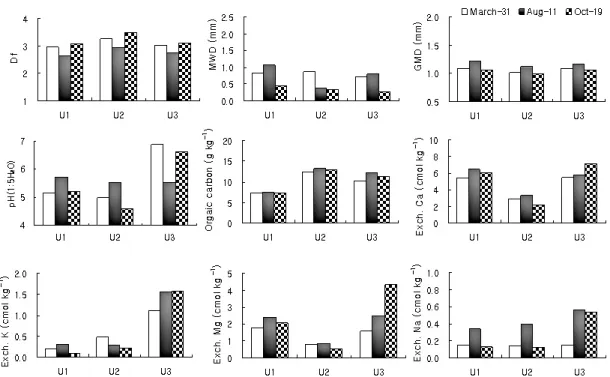
Seasonal aggregate stability had highest in summer, and decreased in the order of spring and autumn, shown in Df
and GMD (fig. 4). In case of U2 soil, MWD, unlike Df
and GMD using geometric or power functional calculation, had highest in spring, and decreased in the order of summer and autumn. This indicated that same measurement data could result in different stabilities with different indices. In other words, the difference is probably because the application of power function or geometric mean is focused on fragmentation process rather than arithmetic calculation.
In summer, soil biota including plant root and microorganism have high activity, and so enhance aggregation (Tisdall and Oades, 1982; Oades, 1984: Six et al., 2004). Spring is relatively dry season in Korea.
Drier soil can result in more shrinking and hardening of clay, as well as enhancing water-repellency of hydrophobic group in organic matter, which can promote water stability of aggregate (Kay, 1989). On the other hand, in autumn season, biological activity in soils decreases with decreasing temperature, and then aggregate stability in wet-sieving could decrease together (Bronick and Lal, 2005).
Aggregate stability can change with different soil physico-chemical properties, including soil organic matter and exchangeable cation content (Bronick and Lal, 2005; Han et al., 2007). Figure 4 shows the seasonal changes of soil physico-chemical properties. pH and organic carbon content were generally higher values in summer than other seasons, whereas the exchangeable cation content were different with different soils. The seasonal change of physico-chemical properties had no significant effect on aggregate stability. U1 soil with high clay content, relatively had low organic carbon and high exchangeable Ca and Mg content. In spite of the low clay content, U3 soils had relatively high aggregate stability, which is probably due to high exchangeable cation content. U2 soil with high silt content had lowest aggregate stability of three soils regardless of season.
Fig. 2. The relationship between fragmentation fractal dimension (Df) and water stability indices of aggregate including mean weight diameter (MWD) and geometric mean diameter (GMD).
Fig. 3. Water stability of aggregate as affected by different soil layers at study sites; s, t, and p indicate surface(depth 0-5cm), topsoil, and plow pan, respectively. Sampled at March, 31.
Macroporosity and its seasonal variation in upland soils The macro-pore size distributions in soils, in summer and autumn, were shown in fig. 5. Upland cultivation commonly has a raised ridge with crop planting point, and thereby ridge and row has different soil structure. Overall, the macro-porosity had higher in topsoil, in autumn, and in ridge, than in plow pan layer, in summer, and row, respectively. Especially, the macroporosity more than 99 m had higher difference than other size groups. The macroporosity more than 296 m was higher in U1 soil with relatively high clay content
than in other soils. The porosity between 296 m and 99 m was higher U2 and U3. U3 soil had relatively high porosity between 99 m and 30 m.
Summer in Korea is rainy season. Impact of rain drops on soil surfaces could cause compacting soils, and successively saturation and drainage of water enhance the soil compaction. This process could be stronger in row than in ridge, covering with crop canopy. Compared to summer, autumn is relatively dry season, and harvesting could make soil structure loose.
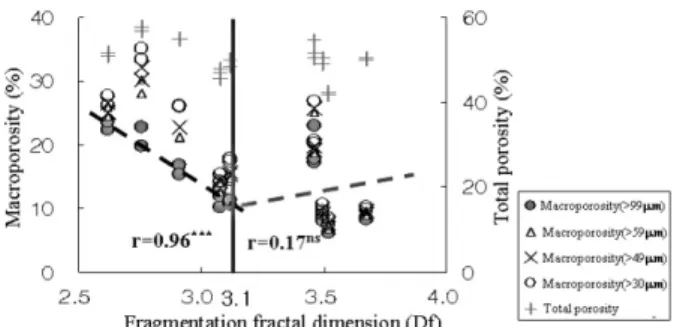
Relationship between Df and macroporosity Fragmentation fractal dimension of aggregate stability in wet-sieving and macroporosity showed in graphic form at fig. 6. The graph showed that the fractal dimension less than 3.1 had high correlation with macroporosity, especially more than 99 m. Besides, in the soils with the fractal dimension less than 3.1, the power function relation between saturated hydraulic conductivity and macroporosity more than 99 m had relatively high determinant coefficient, and vice versa. In other words, saturated hydraulic conductivity could be estimated from macroporosity in soils with water stable aggregate.
Higher Df means lower water stability of aggregate. In other words, soils with Df less than 3.1 are more aggregated than soils with Dfmore than 3.1. Therefore, only aggregated soil had a relationship with Fig. 4. Temporal variation of water stability of aggregate and soil properties including organic carbon content, pH, and exchangeable cations; Df, MWD, and GMD indicate fragmentation fractal dimension, mean weight diameter, and geometric mean diameter, respectively.
Fig. 5. Macropore size distribution as affected by different sampling times, layers, and positions, i.e., ridge or row of upland soils. Soil core samples of topsoil were sampled at 11 August, and 19 October, and those of plow pan at 19 October.
macroporosity and successively could cause a macroporous flow. Actually, Df has been used as indicator of fragmentation caused by different tillage operations or as a result of different cropping strategies (Crawford et al., 2000; Perfect et al., 1992; Perrier and Bird, 2003; Rasiah et al., 1995). This study suggested that Df might indicate the possibility of a macroporous flow.
The aggregate-based process models has a clear distinction between macropores and fine structured matrix. Inter-aggregate pores, macropores, act as the external world for the processes taking place in the soil matrix (White, 1985; Han et al., 2008). Preferential flow in macropores could be faster than in soil matrix. And the flow can include surface-applied nutrients or pesticides such as nitrate and atrazine, whereas solute in soil matrix can be protected from the flow (Young et al, 2001). On the contrary, if no distinction is possible between macropores and soil matrix, there is no boundary between the two types of media. Without such a boundary, the soil structure lacks an aggregate level at which aggregate models are meaningful. Particularly, there were many artificial disturbance such as tillage and compost application in arable soils, which could clear the boundary between macropores and soil matrix (Kay, 1989). Nevertheless, a newly generating structure after physical disturbance, could depend on water stable aggregate, which do not easily disintegrate against external forces such as rain drops (Six and Paustian, 2000). Figure 6 showed the possibility that aggregate stability in wet-sieving in upland arable soil may have strong correlation with macropores.
Conclusion
Fragmentation fractal dimension (Df) would be relatively proper as the general characterization of the aggregate stability in wet-sieving rather than GMD and
MWD, because Dfhas no-dimensional process-based property. The relationship between Dfand macroporosity, especially more than 99 m, showed high correlation only in soils with Dfless than 3.1, which means more aggregated soils compared to soils with Dfmore than 3.1. Besides, in the soils with the fractal dimension less than 3.1, the power function relation between saturated hydraulic conductivity and macroporosity more than 99 μm had relatively high determinant coefficient, and vice versa. Therefore, it could be thought that fragmentation fractal dimension is available for confirming macroporosity induced from aggregation.
References
Bronick, C.J. and R. Lal. 2005. Soil structure and management: a review. Geoderma 124: 3-22.
Crawford, J. M., Ya. A. Pachepsky, and W. J. Rawls. 2000.
Integrating processes in soils using fractal models. In: Crawford, J.
M., Ya. A. Pachepsky, and W. J. Rawls. Fractals in Soil Science.
Developments in Soil Science 27. Elsevier.
Dalal, R. C., and B. J. Bridge. 1996. Aggregation and organic matter storage in sub-humid and semi-arid soils. In: Carter, M. R., and B.
A. Stewart, Structure and Orgainc Matter Storage in Agricultural Soils. CRC Press, Boca Raton, FL, pp. 263-307.
Danielson, R. E. and P. L. Sutherland. 1986. Porosity. In: Klute, A.
1986. Method of soil analysis. Part 1. Physical and Mineralogical methods, 2nd edn. ASA and SSSA, Madison, WI.
Han, K. H., H. M. Ro, H. J. Cho, L.Y. Kim , S. W. Hwang, H. R.
Cho, and K. C. Song. 2008. Mobility of nitrate and phosphate through small lysimeter with three physico-chemically different soils. Korean J. Soil Sci. Fert. 41:260-266.
Han, K. H.,H. J. Cho, H. S. Lee, D. S. Oh., and L.Y. Kim. 2007.
Stable macro-aggregate in wet sieving and soil properties. Korean J. Soil Sci. Fert. 40:255-261.
Kay, B.D. 1989. Rates of change of soil structure different cropping system. Adv. Soil Sci. 12: 1-52.
Mandelbrot. 1993. The fractal geometry of nature. Freeman, New York.
Marshall, T. J. 1959. Relations between water and soil. Tech.
Comm. 50, Commonwealth Bur. Soils, Harpenden, U.K.
Fig. 6. The relationship between fragmentation fractal dimension (Df) and macroporosity of upland soils.
Fig. 7. The estimation of saturated hydraulic conductivity by macroporosity in different ranges of fragmentation fractal dimension (Df) in upland soils.
McDonald, P. M. 1967. Disposition of soil moisture held in temporary storage in large pores. Soil Sci. 103(2):139-143.
McLaren, R .G. and K. C. Cameron. 1996. Soil Science. 2nd edition. Oxford University Press.
Mosley, M. P. 1979. Streamflow generation in a forested watershed, New Zealand. Water Resour. Res. 15(4):795-806.
NIAST. 2000. Method of soil and plant analysis. Published by National Institute of Agricultural Science & Technology. Suwon, Korea.
Oades, J. M. 1984. Soil organic matter and structural stability:
mechanisms and implications for management. Plant Soil 76:319- 337.
Perfect, E., V. Rasiah, and B. D. Kay. 1992. Fractal dimension of soil aggregate-size distributions calculated by number and mass.
Soil Sci. Soc. Am. J. 56:1407-1409.
Perrier, E. M. A, and N. R. A. Bird. 2003. The PSF model of soil structure: A multiscale approach. In: Pachepsky, Ya. A., D. E.
Radcliffe, H. M. Selim. Scaling Methods in Soil Physics. CRC Press LLC.
Rasiah, V., E. Perfect, and B. D. Kay. 1995. Linear and nonlinear estimates of fractal dimension for soil aggregate fragmentation.
Soil Sci. Soc. Am. J. 59:83-87.
Six, J., E.T. Elliott, and K. Paustian. 2000. Soil macroaggregate turnover and microaggregate formation: a mechanism for C sequestration under no-tillage agriculture. Soil Biol. Biochem.
32:1350-1358.
Six, J., H. Bossuyt, S. Degryze, and K. Denef. 2004. A history of research on the link between (micro)aggregates, soil biota, and soil organic matter dynamics. Soil & Tillage Research 79:7-31.
Sparks, D. L. 1996. Method of soil analysis. part 3. Chemical methods, 3rd edn. ASA and SSSA, Madison, WI.
Tisdall, J. M. and J. M. Oades. 1982. Organic matter and water- stable aggregates. J. Soil Sci. 62:141-163.
Turcotte, D. L. 1986. Fractals and fragmentation. J. Geophys. Res.
91:1921-1926.
White, R. E.. 1985. The influence of macropores on the transport of dissolved and suspended matter through soil. Adv. Soil Sci. 3:95- 120.
Young, I. M., J. W. Crawford, and C. Rappoldt. 2001. New methods and models for characterizing structural heterogeneity of soil. Soil
& Tillage Research 61:33-45.
본 연구는 밭토양 내수성입단의 계절별 특성을 밝히고 파쇄프랙탈차원을 이용하여 대공극률과의 관계를 구명 코자 수행하였다. 대상 토양은 토성이 다른 세 지점으로 고평통 (Fine, Typic Hapludalfs), 규암통 (Fine silty over coarse silty, Fluvaquentic Eutrudepts), 중동통(Coarse loamy, Typic Udifluvents)으로 경기도에 위치하였다.
봄, 여름, 가을에 불교란 시료를 채취하고 내수성입단과 대공극률, 토양이화학성을 측정하였다. 내수성입단은 파 쇄프랙탈차원(Df), 기하평균지름(GMD), 중량평균지름(MWD)의 세 가지로 계수화하였다. Df는 MWD보다 GMD와 상관이 높게 나타났고, 무차원의 입단파쇄과정에 근거하여서 실험에 사용한 입단크기와 전처리과정의 영향을 덜 받아 내수성입단의 계수화에 적절하다고 판단할 수 있었다. 계절적으로 내수성입단은 여름>봄>가을 순으로 나타났고 생물활성과 토양수분의 영향으로 파악할 수 있었다. Df 3.1이하의 토양에서 Df와 대공극률과 역의 상관관계를 나타냈으며 특히 99 ㎛ 이상의 공극률과 상관이 높았으며 Df 3.1이상의 토양에서는 상관이 나 타나지 않았다. 또한 Df 3.1이하의 토양에서는 대공극률과 포화수리전도도의 누승함수 적합도가 높게 나타났다.
따라서 내수성입단의 파쇄프랙탈차원은 입단화에 의한 대공극형성과 해석에 유용하다고 판단할 수 있었다.
파쇄프랙탈차원을 이용한 밭토양 내수성입단과 대공극률의 관계 평가
한경화·조현준·이협성·허승오*·하상건 농촌진흥청 국립농업과학원