• 검색 결과가 없습니다.

Functional Endoscopic Sinus Surgery for a Patient with Maxillary Sinusitis Occurring after Implant Placement

N/A
N/A
Protected

Academic year: 2021

Share "Functional Endoscopic Sinus Surgery for a Patient with Maxillary Sinusitis Occurring after Implant Placement"

Copied!
6
0
0

로드 중.... (전체 텍스트 보기)

전체 글

(1)

Case Report

RECEIVED June 20, 2013, REVISED July 29, 2013, ACCEPTED September 21, 2013 Correspondence to Su-Gwan Kim

Department of Oral and Maxillofacial Surgery, School of Dentistry, Chosun University 309 Pilmun-daero, Dong-gu, Gwangju 501-759, Korea

Tel: 82-62-220-3819, Fax: 82-62-228-7316, E-mail: [email protected]

CC

This is an open access article distributed under the terms of the Creative Commons Attribution Non-Commercial License (http://creativecommons.org/licenses/

by-nc/3.0) which permits unrestricted non-commercial use, distribution, and reproduction in any medium, provided the original work is properly cited.

Functional Endoscopic Sinus Surgery for a Patient with Maxillary Sinusitis Occurring after Implant Placement

Jae-Seek You, Su-Gwan Kim, Ji-Su Oh, Gyeong-Dal Jeong, Deuk-Hyun Mah

Department of Oral and Maxillofacial Surgery, School of Dentistry, Chosun University

Abstract

Maxillary sinus membrane elevation and bone graft have been performed routinely in alveolar bone with insufficient residual bone height. There are a number of causes for development of maxillary sinusitis after these procedures. When maxillary sinusitis is caused by sinus membrane elevation, bone graft, and implant placement, various treatment such as medication, incision and drainage (I&D), implant removal, and the Caldwell-Luc procedure can be considered. Removal of an implant or the Caldwell-Luc procedure can be harmful if inflammation is not present in the oral cavity and survival of grafted bone and implant osseointegration can be expected despite the presence of maxillary sinusitis. In this case, functional endoscopic sinus surgery, which was often used in the otorhinolaryngology department, was performed without removal of the implant for a patient with maxillary sinusitis after one month following implant placement. Thus, we report on this case with a review of the literature.

Key words: Functional endoscopic sinus surgery, Maxillary sinusitis

Introduction

Implant placement is becoming a more common treat- ment for reconstruction of functional defects in edentulous patients. Maxillary sinus membrane elevation and bone graft are often necessary for implant placement in maxillary posterior teeth. When maxillary sinus membrane elevation and bone graft are performed, a window is created in the alveolar bone on the buccal side in order to access the maxillary sinus. The sinus membrane is then carefully ele- vated and bone graft is performed[1]. These procedures have been recognized as being very reliable; therefore, their use has been widely accepted in dentistry for vertical

augmentation. However, maxillary sinusitis can be caused by undetected preoperative sinus disease, a poor oper- ation, or infection. According to one study, the occurrence of maxillary sinusitis was reported to range from 0% to 20% after maxillary sinus membrane elevation[2].

Patients with maxillary sinusitis visited the hospital with

various symptoms, including headache, nasal congestion,

and rhinorrhea[3]. In these patients, radiographs should

be taken in addition to clinical examination for an accurate

diagnosis. Use of computed tomography (CT) scans can

provide the precise anatomical location and blockage of

maxillary ostium, which can be helpful in determination

of whether or not to use a surgical approach[4]. Decongestants

(2)

Fig. 1. Computed tomography image showing radiopacification

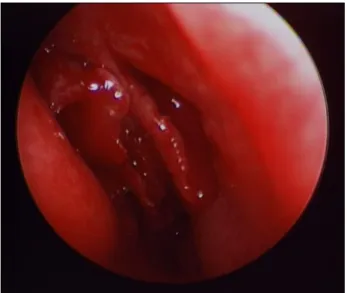
of the left maxillary sinus and blockage of ostiomeatal unit. Fig. 2. Endoscopic image of the uncinate process, which was incised and elevated.

ly used procedure for chronic maxillary sinusitis that does not respond to medication such as antibiotics[5].

In case of maxillary sinusitis occurring after implant placement with maxillary sinus membrane elevation and bone graft, relief of symptoms was provided by use of FESS without removal of the implant. Therefore, we intend to report on this case with a review of the literature.

Case Report

A 34-year-old man visited the ENT department because of headache, nasal congestion, and rhinorrhea. Five weeks before his ENT visit, implant placement with maxillary si- nus membrane elevation and bone graft was performed, therefore, he was referred to undergo oral and maxillofacial surgery. Clinical examination did not show facial edema but nasal obstruction and headache. The site of implant placement had healed well and no signs of inflammation,

through the left nostril before placement of the implant and he had learned about infection of the left sinus in the ENT department. It was considered that implant place- ment and maxillary sinus membrane elevation would cause aggravation of the condition, which could be judged from the fact that the symptoms worsened after those procedures.

No signs of inflammation were observed in the site of im- plant placement, and he did not want to remove the implant, therefore, we decided to perform FESS.

First, a cottonoid soaked with 2% lidocaine (with 1:100,000 epinephrine) was left in the left middle turbinate and middle meatus. A polyp in the middle turbinate dis- covered during endoscopic observation was removed.

Then, using a freer elevator, the middle turbinate was

placed toward the nasal septum and an incision was made

in the uncinate process and it was elevated (Fig. 2). At

(3)

Fig. 5. Computed tomography image showing significantly reduced radiopacification after the ostium was widened.

Fig. 4. Endoscopic image of the widened ostium.

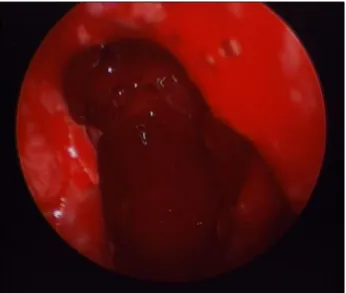
Fig. 3. Ethmoidal cells after ethmoidectomy was performed.

that time, a discharge of pus and exudates was observed.

When the discharge disappeared, using a shaver and a suction tip, inferior ethmoidal bulla was opened and eth- moidectomy was performed (Fig. 3). Then, the ostium of the left maxillary sinus was identified, and, using a cutting forcep and a shaver, this ostium was widened (Fig. 4).

In the area where surgery was performed, Merocel

(Medtronic Xomed, Jacksonville, FL, USA) packing was performed to prevent bleeding and closure of the ostium.

The packing was removed after approximately five days, and daily dressing was performed for approximately two weeks. He was discharged two weeks after surgery. One

month later, no signs of inflammation were observed in the oral cavity, and symptoms such as headache, nasal congestion, and rhinorrhea were not observed (Fig. 5).

Discussion

Chronic maxillary sinusitis is a chronic disease caused by odontogenic infection, systemic factors, and extrinsic sources such as implant placement. The most common cause is an infection, which is related to the ciliary move- ment of the maxillary sinus. In general, maxillary mucocili- ary transport releases mucus and foreign bodies to the nasal cavity depending on the physiological condition.

However, persistent infection causes impairment of sinus ventilation, which creates an acidic anaerobic condition[6].

Eventually, ciliary damage and ineffective mucus clearance

create a vicious circle[6]. Infection from extrinsic sources

such as maxillary sinus membrane elevation, bone graft,

and implant placement could be caused by a lack of aseptic

treatment and operation skill. However, recently, as a result

of development of aseptic treatment, infection is frequently

caused by already having had problems in the maxillary

sinus before surgery or growth of bacteria due to occlusion

of maxillary ostium after maxillary sinus membrane

elevation. In addition, allergy or bleeding can stimulate

the mucous membranes and mucosal thickness increases

in spite of minimizing damage to the mucous membranes

during surgery, therefore, maxillary sinusitis may occur due

to reduction in size of maxillary sinus ostium. Efforts are

(4)

in the left maxillary molar area after maxillary sinus mem- brane elevation using the lateral approach technique and bone graft using autograft and xenograft. Perforation of maxillary sinus membrane did not occur at the time of surgery, but 10 days later, when the patient showed swel- ling and pain of the facial region and symptoms of maxillary sinusitis such as pus and an odor, therefore, I&D was performed. After that, the symptoms did not disappear;

therefore, the window opening technique was performed between orbital nerve and the window which was previous performed, and then drainage and administration was per- formed through the window newly performed. As a result, 6 months later, the implant placement had a good result.

It is thought that a fast initial treatment helped not to re- move the implant. However, if the symptoms of maxillary sinusitis worsened over time after implant placement, in- traoral symptoms didn’t be caused in the area of implant placement or bone graft and alveolar bone problems did not be shown in radiographs as in our case, it would be difficult to decide what to perform any approach.

In the past, Caldwell-Luc procedure was chosen as the treatment of chronic maxillary sinusitis. But this procedure is an aggressive procedure to; use of this technique has a major disadvantage which is that the normal mucosal function and ciliary action cannot be restored. Using this procedure, other paranasal sinuses cannot be treated and many complications can occur[8]. Therefore, a modified Caldwell-Luc procedure with minimal removal of maxillary mucosa was proposed, however, these procedures also had disadvantages and complications[9]. Using these pro- cedures, an opening at the inferior meatus was created to prevent obstruction between nasal cavity and maxillary sinus, however, it did not appear to be useful because

more effective than inferior meatal antrostomy. Repeating the studies through the nasal cavity, maxillary surgery was developed by using an endoscope through the nasal cavity.

Stammberger and Posawetz[12] performed FESS, in which the osteomeatal complex was removed under guidance of an endoscope in order to restore sinus ventilation and drainage through normal mucosal movement. With under- standing of the physiology of the mucous membrane of the maxillary sinus, FESS has recently been used for treat- ment of maxillary sinusitis instead of the Caldwell-Luc pro- cedure in the ENT department[5]. Penttilä[13] reported the results of comparison of FESS with the Caldwell-Luc procedure. FESS showed better results in improvement of symptoms and FESS with middle meatal antrostomy main- tained the opening well at a high rate. Lopatin et al .[14]

performed FESS in 70 patients with chronic maxillary sinus- itis, and 39 patients with an oro-antral fistula. Additional FESS was performed in these patients, and, after surgery, there were three patients with recurrence of a fistula and one patient with blockage of maxillary sinus ostium.

However, the reported overall recovery rate was 94.7%.

Costa et al .[15] performed FESS in 17 patients with chronic maxillary sinusitis of dental origin, including five patients with an oro-antral fistula. As a result, they reported that the oro-antral fistula was completely recovered, and that the symptoms of maxillary sinusitis showed improvement.

In addition, they emphasized that the surgery time for FESS

was approximately 25 minutes; therefore, FESS was not

time-consuming. Andric et al .[16], who also performed

FESS in patients with chronic maxillary sinusitis with an

oro-antral fistula, reported that the fistula had healed well

and no complications occurred. This resulted indicated that

if sinus ventilation and drainage through maxillary sinus

(5)

ostium was facilitated, normal mucosal ciliary movement would be possible and the symptoms of maxillary sinusitis would be reduced. It also showed that if a previously-exist- ing cyst of the maxillary sinus or bone graft materials blocked the maxillary sinus ostium in patients who under- went maxillary sinus membrane elevation or bone graft, adequate treatment of maxillary sinusitis through admin- istration or intraoral I&D would be difficult without ap- proach to the maxillary sinus ostium using FESS.

In this case, maxillary sinusitis occurred after placement of an implant with maxillary sinus membrane elevation and bone graft. Although the symptoms worsened due to implant placement, judging from the history of frequent visits to the ENT department and patient’s recognition of chronic sinusitis it could be inferred that he had already developed maxillary sinusitis. It was thought that maxillary sinus membrane elevation, bone graft, and implant place- ment had a bad influence on OMU and that maxillary sinus- itis had worsened, so that the symptoms the patient felt increased. Preoperative facial CT would have been helpful for accurate diagnosis. Performance of a CT scan is im- portant in order to check the condition of the maxillary sinus when dental treatments such as maxillary sinus mem- brane elevation and bone graft are performed, due to the difficulty of making accurate judgments using panoramic radiographs. Despite accurate diagnosis, maxillary sinusitis can occur after sinus maxillary membrane elevation or im- plant placement. If maxillary sinusitis occurs, rapid early treatment is needed. Rapid early treatment can increase the survival rate of grafted bone and implant. In this case, we decided to restore sinus ventilation and drainage through clearance of OMU using FESS for survival of grafted bone and implant. If inflammatory findings such as pus or redness were observed in the oral area of bone graft or implant placement, we would administer treatment through an intraoral approach. However, the fact that the intraoral approach may also cause side effects such as leak- age of grafted bone and interference of implant osseointe- gration should be kept in mind. In this case, FESS was considered first because the oral treatment area had healed well and there had not been any oral symptoms. During FESS and the following month, symptoms such as head- ache, nasal congestion, and rhinorrhea were not demon- strated and radiopacification had disappeared on CT scan.

However, since then, he has not visited, therefore, long term evaluation was impossible. In conclusion, FESS can be an effective treatment for patients with maxillary sinus membrane elevation and implant placement in suspected cases of blockage of OMU. In addition, we would be able to obtain excellent results if the surgery was performed under close cooperation with the ENT department.

References

1. Raghoebar GM, Brouwer TJ, Reintsema H, Van Oort RP.

Augmentation of the maxillary sinus floor with autogenous bone for the placement of endosseous implants: a prelimi- nary report. J Oral Maxillofac Surg 1993;51:1198-203.

2. Timmenga NM, Raghoebar GM, Boering G, van Weissenbruch R. Maxillary sinus function after sinus lifts for the insertion of dental implants. J Oral Maxillofac Surg 1997;55:936-9.

3. Kang MJ, Lee DK, Yim CJ. Clinical study of odontogenic max- illary sinusitis. J Korean Assoc Oral Maxillofac Surg 1990;16:

123-9.

4. Maillet M, Bowles WR, McClanahan SL, John MT, Ahmad M. Cone-beam computed tomography evaluation of maxil- lary sinusitis. J Endod 2011;37:753-7.

5. Busaba NY, Kieff D. Endoscopic sinus surgery for in- flammatory maxillary sinus disease. Laryngoscope 2002;112:

1378-83.

6. Aust R, Drettner B. Oxygen tension in the human maxillary sinus under normal and pathological conditions. Acta Otolaryngol 1974;78:264-9.

7. Hong SR, Lee YW, Yoon KS, et al . Sinusitis managment as- sociated with maxillary sinus augmentation: case report. J Korean Assoc Maxillofac Plast Reconstr Surg 2010;32:558-62.

8. Murray JP. Complications after treatment of chronic maxillary sinus disease with Caldwell-Luc procedure. Laryngoscope 1983;93:282-4.

9. Al-Belasy FA. Inferior meatal antrostomy: is it necessary af- ter radical sinus surgery through the Caldwell-Luc approach?

J Oral Maxillofac Surg 2004;62:559-62.

10. Lund VJ. Fundamental considerations of the design and function of intranasal antrostomies. Rhinology 1985;23:231-6.

11. Lavelle RJ, Harrison MS. Infection of the maxillary sinus: the case for the middle meatal antrostomy. Laryngoscope 1971;

81:90-106.

12. Stammberger H, Posawetz W. Functional endoscopic sinus surgery. Concept, indications and results of the Messerklinger technique. Eur Arch Otorhinolaryngol 1990;247:63-76.

13. Penttilä MA. Endoscopic findings after functional and radical sinus surgery: a prospective randomized study. Am J Rhinol 1994;8:71-6.

14. Lopatin AS, Sysolyatin SP, Sysolyatin PG, Melnikov MN.

Chronic maxillary sinusitis of dental origin: is external surgical approach mandatory? Laryngoscope 2002;112:1056-9.

15. Costa F, Emanuelli E, Robiony M, Zerman N, Polini F, Politi

M. Endoscopic surgical treatment of chronic maxillary sinus-

itis of dental origin. J Oral Maxillofac Surg 2007;65:223-8.

(6)

수치

Fig. 1. Computed tomography image showing radiopacification
Fig. 5. Computed tomography image showing significantly  reduced radiopacification after the ostium was widened.

참조

관련 문서

Experimental alveolar ridge augmentation by distraction osteogenesis using a simple device that permits secondary implant placement. Anteroinferior distraction of

The OSFE (osteotome sinus floor elevation) technique has been used for maxillary sinus augmentation.. The implants were clinically and radiographically followed

This study is an analysis of distribution of patient who installed Endopore Ⓡ at maxilla in Chosun University Dental hospital and types of implant for about 4

Histologic evaluation of early human bone response to different implant surfaces2. Histologic evaluation of human bone integration on machined and

Patient had laparoscopic surgery on the adnexal tumor and excised tissue was removed through Douglas pouch incision by single surgeon.. Results: The mean age

Higher power view of the box area of the left figure showed poor new-bone formation around the implant (asterisk) and low BIC. Villanueva

The average position of the posterior superior alveolar artery, the wall thickness of the lateral wall, and the average volume of the maxillary sinus will

The result of using PLGA nanofiber membrane with bone graft material showed that the PLGA nanofiber membrane in the experimental group of 2 weeks were ten times more new