• 검색 결과가 없습니다.

Hepatitis C Virus Core Protein Activates p53 to Inhibit E6-associated Protein Expression via Promoter Hypermethylation

N/A
N/A
Protected

Academic year: 2021

Share "Hepatitis C Virus Core Protein Activates p53 to Inhibit E6-associated Protein Expression via Promoter Hypermethylation"

Copied!
9
0
0

로드 중.... (전체 텍스트 보기)

전체 글

(1)

Hepatitis C Virus Core Protein Activates p53 to Inhibit E6-associated Protein Expression via Promoter Hypermethylation

Juri Kwak and Kyung Lib Jang*

Department of Microbiology, College of Natural Science, Pusan National University, Busan 46241, Korea Received June 5, 2018 /Revised August 30, 2018 /Accepted September 17, 2018

The E6-associated protein (E6AP) is known to induce the ubiquitination and proteasomal degradation of HCV core protein and thereby directly impair capsid assembly, resulting in a decline in HCV replication. To counteract this anti-viral host defense system, HCV core protein has evolved a strategy to inhibit E6AP expression via DNA methylation. In the present study, we further explored the mech- anism by which HCV core protein inhibits E6AP expression. HCV core protein upregulated both the protein levels and enzyme activities of DNA methyltransferase 1 (DNMT1), DNMT3a, and DNMT3b to inhibit E6AP expression via promoter hypermethylation in HepG2 cells but not in Hep3B cells, which do not express p53. Interestingly, p53 overexpression alone in Hep3B cells was sufficient to acti- vate DNMTs in the absence of HCV core protein and thereby inhibit E6AP expression via promoter hypermethylation. In addition, upregulation of p53 was absolutely required for the HCV core protein to inhibit E6AP expression via promoter hypermethylation, as evidenced by both p53 knockdown and ectopic expression experiments. Accordingly, levels of the ubiquitinated forms of HCV core protein were lower in HepG2 cells than in Hep3B cells. Based on these observations, we conclude that HCV core protein evades ubiquitin-dependent proteasomal degradation in a p53-dependent manner.

Key words : DNA methylation, E6-associated protein, HCV core protein, p53, ubiquitin-proteasome system

*Corresponding author

*Tel : +82-51-510-2178, Fax : +82-51-514-1778

*E-mail : [email protected]

This is an Open-Access article distributed under the terms of the Creative Commons Attribution Non-Commercial License (http://creativecommons.org/licenses/by-nc/3.0) which permits unrestricted non-commercial use, distribution, and reproduction in any medium, provided the original work is properly cited.

Journal of Life Science 2018 Vol. 28. No. 9. 1007~1015 DOI : https://doi.org/10.5352/JLS.2018.28.9.1007

Introduction

HCV is estimated to infect about 170 million people worldwide, which corresponds to roughly 3% of the global population [1]. In approximately 80% of cases, acute HCV infection leads to chronic infection, which is accompanied by chronic hepatitis and fibrosis with an increased risk of developing liver cirrhosis and hepatocellular carcinoma (HCC) [21]. As a member of the Flaviviridae family, HCV contains a positive-stranded RNA genome of approximately 9.5 kb, encoding a large polyprotein that is proteolytically cleaved into 10 individual proteins by cellular and viral pro- teases [14]. HCV core protein has attracted particular atten- tion in several fields of HCV-related studies. In addition to its role as a major component of the viral capsid, HCV core protein has been strongly implicated in HCV pathogenesis

and HCC development owing to its roles in the alteration of diverse signaling pathways, modulation of immune re- sponses, apoptosis, and lipid metabolism, and transcrip- tional regulation of cellular gene expression [5, 6]. Despite our increasing understanding of its role in HCV patho- genesis, the role of HCV core protein as a regulator of HCV propagation remains poorly understood.

The ubiquitin (Ub)-proteasome system (UPS) degrades

short-lived, damaged, or unneeded proteins, and thus main-

tains protein homeostasis, which is essential for the regu-

lation of fundamental cellular processes, including growth,

cell signaling, and immune system functions [22, 27]. In ad-

dition, the UPS can negatively regulate the propagation of

foreign invaders like viruses, serving as an effective host

protection system against pathogens. There is growing evi-

dence showing that the UPS restricts HCV replication by

degrading viral proteins, including the HCV core, E2, p7,

NS2, NS5A, and NS5B proteins [3, 8, 12, 15, 29]. Among

these proteins, HCV core protein has attracted particular in-

terest because its loss can directly impair capsid assembly,

which leads to a decline in HCV replication. The E6-associated

protein (E6AP), first identified as an E3 ligase responsible

for the Ub-dependent degradation of p53 in conjunction with

the E6 protein of human papillomavirus types 16 (HPV-16)

(2)

and 18 [9], is known to induce the ubiquitination and protea- somal degradation of HCV core protein [3, 15, 29]. In addi- tion, its role as a negative regulator of HCV propagation was verified by the knockdown of endogenous E6AP, which leads to an increased production of infectious HCV particles [3, 15].

As an obligate intracellular parasite, HCV may have evolved strategies to block or redirect the UPS to maximize the chance to produce progeny virions. Indeed, according to our recent report, HCV core protein inhibits E6AP ex- pression via DNA methylation to evade Ub-dependent pro- teasomal degradation and stimulate virus propagation [18].

In the present study, we further explored the mechanism by which HCV core protein inhibits E6AP expression. For this purpose, we first examined whether HCV core protein differentially affects E6AP levels in HepG2 and Hep3B cells and investigated whether this difference is due to the pres- ence of p53 in HepG2 cells and the absence of p53 in Hep3B cells. Second, we investigated whether p53 activation alone in the absence of HCV core protein is sufficient to activate DNA methyltransferases (DNMTs) and subsequently inhibit E6AP expression via promoter hypermethylation. Third, we attempted to confirm that activation of p53 by HCV core protein is responsible for the inhibition of E6AP expression via DNA methylation. Finally, we investigated whether the HCV core protein evades Ub-dependent proteasomal degra- dation by inhibiting E6AP expression in a p53-dependent manner.

Materials and Methods

Plasmids

The plasmid pCMV-3 × HA1-Core, encoding the full- length HCV core protein (genotype 1b) downstream of three copies of the influenza virus hemagglutinin (HA) epitope, has been described previously [13]. The E6AP-luc construct contains a portion of the human E6AP promoter (-274 to +907) in pGL2-basic (Promega) [18]. Plasmid pCMVT N-HA- hE6AP, encoding the HA-tagged full-length human E6AP, and plasmid pCH110, encoding the Escherichia coli β-galacto- sidase (β-Gal) gene under the control of the SV40 promoter, were obtained from Addgene and Pharmacia, respectively.

Both the p53 small hairpin RNA (shRNA) and E6AP shRNA plasmids were purchased from Santa Cruz Biotechnology.

Plasmids pHA-Ub and pCMV-p53-WT were gifts from Dr.

Y. Xiong (University of North Carolina, Chapel Hill, NC)

and Dr. C. W. Lee (Sungkyunkwan University, Korea), re- spectively.

Cell culture and luciferase assay

HepG2 (KCLB No. 88065) and Hep3B (KCLB No. 88064) cells were purchased from the Korean Cell Line Bank. For transient expression, 2×10

5

cells per 60-mm dish were trans- fected with 1 μg of the appropriate plasmid(s) using Turbo Fect transfection reagent (Thermo Scientific) according to the manufacturer’s instructions. Stable cell lines, HepG2-vector, Hep3B-vector, HepG2-Core, and Hep3B-Core, were estab- lished by transfection with pCMV-3 × HA1 and pCMV-3

× HA1-Core, respectively, followed by selection with 500 μ g/ml G418 (Gibco) [20]. For the luciferase assay, either an empty vector or an effector plasmid was cotransfected with E6AP-luc under the indicated conditions. As an internal con- trol, 100 ng of pCH110 (Pharmacia) was included. Luciferase activity was measured at 48 hr post-transfection using the Luciferase Assay System (Promega), and the values obtained were normalized to β-Gal activity measured in the corre- sponding cell extracts.

Western blot analysis

Cells were lysed in buffer (50 mM Tris-HCl, pH 8.0, 150 mM NaCl, 0.1% SDS, and 1% NP-40) supplemented with protease inhibitors. Protein samples were separated by SDS-PAGE and transferred to a nitrocellulose membrane (Amersham). The membranes were incubated with anti- bodies to p53, DNMT1, DNMT3a, and DNMT3b (Santa Cruz Biotechnology); E6AP and HCV core protein (Thermo Scientific); HA (Roche); or γ-tubulin (Sigma), and then sub- sequently incubated with a horseradish peroxidase-con- jugated secondary antibody (anti-mouse, anti-goat, or an- ti-rabbit IgG (H+L)-HRP; Bio-Rad). The ECL kit (Amersham) was used to visualize protein bands on the membrane with a ChemiDoc XRS imaging system (Bio-Rad).

Immunofluorescence analysis

Cells grown on glass coverslips were fixed in 4% form-

aldehyde at room temperature for 15 min, permeabilized in

methanol at -20℃ for 10 min, and then incubated with an-

ti-HCV core and anti-E6AP antibodies (Thermo Scientific)

for 3 hr at 20℃. Cells were then incubated with anti-mouse

IgG-FITC and anti-rabbit IgG-rhodamine antibodies (Santa

Cruz Biotechnology) at 20℃ for 1 hr to detect HCV core

(green) and E6AP (red), respectively. Slides were prepared

(3)

using UltraCruz mounting medium (Santa Cruz Biotechnol- ogy) and then observed under an Eclipse fluorescence micro- scope (Nikon).

Immunoprecipitation (IP)

An IP assay was performed using the Classic Magnetic IP/Co-IP assay kit (Pierce) according to the manufacturer’s instructions. Briefly, cells were transfected with pHA-Ub for 48 hr along with the indicated plasmid. Then, whole cell lysates were incubated with anti-HCV core antibody (Thermo Scientific) overnight at 4℃. The cell lysates were then mixed with protein A/G magnetic beads (Pierce) and incubated for 1 hr. The beads were collected from the mix- ture using a magnetic stand (Pierce) and the antigen/anti- body complexes eluted from the beads were subjected to Western blotting.

DNMT activity assay

DNMT activity was measured using the EpiQuick DNMT Activity/Inhibition Assay Ultra Kit (Epigentek) according to the manufacturer’s instructions. Briefly, nuclear extracts (5 μg) prepared from the cells were incubated with a universal DNMT substrate coated on microplate wells for 2 hr at 37℃.

After adding a capture antibody (anti-5-methylcytosine anti- body), a detection antibody, and then a color developing sol- ution in sequence, the amount of methylated DNA was measured by reading the optical density at a wavelength of 450 nm in a microplate reader (Bio-Rad).

Methylation-specific PCR (MSP)

Genomic DNA denatured in 50 μl of 0.2 N NaOH was modified by treatment with 30 μl of 10 mM hydroquinone (Sigma) and 520 μl of 3 M sodium bisulfite (pH 5.0; Sigma) at 50℃ for 16 hr. The modified DNA (0.1 μg) was subjected to MSP using a methylated primer pair, E6AP-Me-1F (5'-TTT TTA ATG GTT TGT GTG TC-3') and E6AP-Me-1R (5'-TAC AAA CAA CGC ACA CCG-3'), and an unmethylated primer pair, E6AP-Un-1F (5'-TTT TTA ATG GTT TGT GTG TT-3') and E6AP-Un-2R (5'-CAC ACA AAT CTC ACA ACC A-3'), as previously described [18].

Statistical analysis

The values shown are the mean ± standard deviation (SD) of four independent experiments. The two-tailed Student’s t-test was used for all statistical analyses. A P value less than 0.05 was considered statistically significant.

Results

HCV core protein downregulates E6AP levels via activation of p53

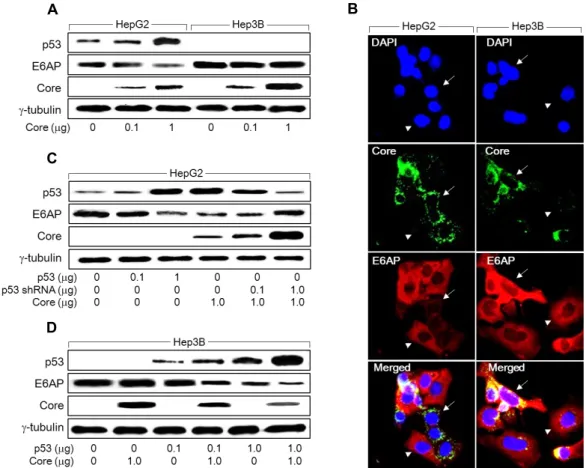
Initially, we examined whether the HCV core protein dif- ferentially affects E6AP levels in human hepatocytes de- pending on p53 status by examining the effects of HCV core protein on E6AP levels in HepG2 cells, which contain p53, and Hep3B cells, which do not contain p53. Ectopic ex- pression of HCV core protein in HepG2 cells upregulated p53 levels but downregulated E6AP levels in a dose-depend- ent manner (Fig. 1A, lanes 1 to 3). In contrast, E6AP levels were slightly affected by HCV core protein in Hep3B cells, which do not express p53 (Fig. 1A, lanes 4 to 6). Data from the immunofluorescence assay also showed that HCV core protein severely lowered E6AP levels in HepG2 cells but not in Hep3B cells (Fig. 1B). In addition, the basal level of E6AP in HepG2 cells was much lower than the level in Hep3B cells (Fig. 1A), suggesting that p53 acts as a negative regu- lator of E6AP expression in human hepatocytes. Indeed, ec- topic p53 expression in the absence of HCV core protein downregulated E6AP levels in HepG2 cells (Fig. 1C, lanes 1 to 3). Based on these results, we assumed that HCV core protein inhibits E6AP expression via activation of p53. To support this hypothesis, we first attempted to knockdown p53 in HCV core protein-expressing HepG2 cells using a specific p53 shRNA plasmid. As a result, we found that the E6AP level was inversely proportional to the p53 level (Fig.

1C, lanes 4 to 6). In addition, ectopic expression of p53 dose-dependently downregulated E6AP levels in Hep3B cells without HCV core protein (Fig. 1D, lanes 1, 3, and 5), and this effect was augmented in Hep3B cells expressing HCV core protein (Fig. 1D, lanes 2, 4, and 6), due to the upregulation of p53 levels by HCV core protein. Taken to- gether, we conclude that HCV core protein downregulates E6AP levels via activation of p53.

Activation of p53 by HCV core protein is respon- sible for the inhibition of E6AP expression via DNA methylation

Next, we explored the mechanism by which HCV core

protein lowers E6AP levels via activation of p53. According

to a recent report, HCV core protein inhibits E6AP ex-

pression via DNA methylation [18]. Therefore, we first in-

vestigated whether p53 activates DNA methyltransferases

(DNMTs). Both the protein levels and enzyme activities of

(4)

A B

C

D

Fig. 1. HCV core protein downregulates E6AP levels via activation of p53. (A) HepG2 and Hep3B cells were transiently transfected with increasing amounts of HCV core expression plasmid, followed by Western blotting. (B) HepG2 and Hep3B cells grown on coverslips were transiently transfected with HCV core expression plasmid for 48 hr, fixed, and processed for double-label indirect immunofluorescence to detect HCV core protein (green) and E6AP (red). Cells were stained with DAPI to show nuclei (blue). One of the untransfected cells and a cell expressing HCV core protein are indicated with an arrow head and an arrow, respectively. (C) HepG2 cells were transfected with increasing amounts of p53 expression plasmid and p53 shRNA plasmid in the absence and presence of HCV core expression plasmid, followed by Western blotting. (D) Hep3B cells were cotransfected with increasing amounts of p53 expression plasmid and either an empty vector or HCV core expression plasmid, followed by Western blotting.

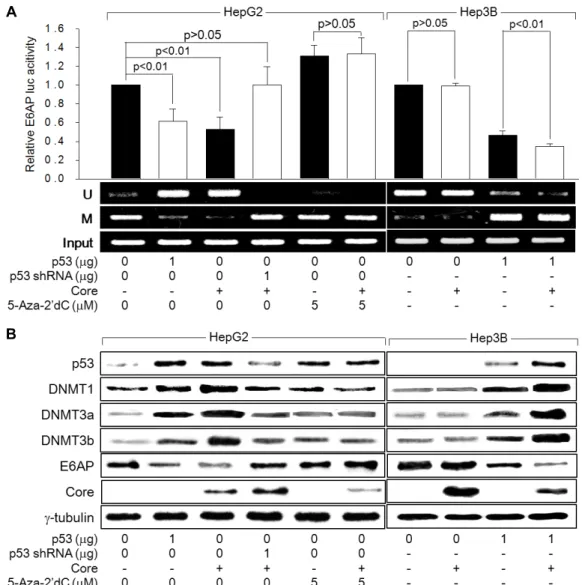
DNMT1, 3a, and 3b were higher in HepG2 cells than in Hep3B cells (Fig. 2A, Fig. 2D). In addition, knockdown of p53 in HepG2 cells downregulated both the protein levels and enzyme activities of these DNMTs (Fig. 2B, Fig. 2E), whereas ectopic p53 expression in Hep3B cells upregulated them (Fig. 2C, Fig. 2F). Moreover, ectopic p53 expression induced hypermethylation of the E6AP promoter in both HepG2 and Hep3B cells, decreasing E6AP promoter activity and protein levels in these cells (Fig. 3A, Fig. 3B, lanes 5 and 9). Therefore, p53 can activate DNMT to inhibit E6AP expression via promoter hypermethylation in human hepatocytes.

Next, we investigated whether HCV core protein activates p53 to inhibit E6AP expression via DNA methylation.

Knockdown of p53 in HepG2-Core cells impaired the ability

of the HCV core protein to upregulate DNMT1, 3a, and 3b levels and induce hypermethylation of the E6AP promoter, thus restoring both E6AP promoter activity and protein lev- els to those in the control cells (Fig. 3A, Fig. 3B, lane 4).

Treatment with a universal DNMT inhibitor, 5-Aza-2′dC, also almost completely abolished the potential of HCV core protein to inhibit E6AP expression via DNA methylation (Fig. 3A, Fig. 3B, lanes 3 and 6). Notably, both the promoter activity and protein levels of E6AP were slightly affected by HCV core protein in the presence of 5-Aza-2′dC (Fig.

3A, Fig. 3B, lanes 5 and 6), indicating that the potential of

HCV core protein to inhibit E6AP expression depends en-

tirely on DNA methylation. In addition, HCV core protein

augmented the potential of ectopic p53 to upregulate

DNMT1, 3a, and 3b and induce E6AP promoter hyper-

(5)

A B C

D E F

Fig. 2. Activation of DNMT by p53 in human hepatocytes. (A) Protein levels of DNMT1, 3a, and 3b in HepG2 and Hep3B cells were compared by Western blotting. (B) HepG2 cells were transfected with increasing amounts of p53 shRNA plasmid to knockdown p53 expression, followed by Western blotting. (C) Hep3B cells were transfected with increasing amounts of p53 expression plasmid, followed by Western blotting. (D–F) DNMT activity was measured in the cells prepared in (A–C).

Data are the mean ± SD of four independent experiments (n=4).

methylation in Hep3B cells, further decreasing E6AP pro- moter activity and protein levels in these cells (Fig. 3A, Fig.

3B, lanes 9 and 10). Based on these results, we conclude that HCV core protein inhibits E6AP expression through activa- tion of p53 via DNA methylation.

HCV core protein evades Ub-dependent proteaso- mal degradation by inhibiting E6AP expression in a p53-dependent manner

Finally, it was investigated whether the p53-dependent inhibition of E6AP expression affects the Ub-dependent pro- teasomal degradation of HCV core protein. Levels of the ubiquitinated forms of HCV core protein were lower in HepG2-Core cells than in Hep3B-Core cells (Fig. 4A, lanes 2 and 5), as a result of the p53-dependent inhibition of E6AP expression in the former (Fig. 1A). Ectopic E6AP expression increased the ubiquitinated forms of HCV core protein and thereby decreased core protein levels in HepG2-Core cells whereas E6AP knockdown decreased the ubiquitinated forms of HCV core protein and increased core protein levels in Hep3B-Core cells (Fig. 4A, Fig. 4B). In addition, treatment with the proteasomal inhibitors MG132 and epoxomicin up- regulated HCV core protein levels in both HepG2 and

Hep3B cells (Fig. 4C), indicating that E6AP-mediated ubiq- uitination and proteasomal degradation of HCV core protein is functional in both cell lines. Interestingly, ectopic E6AP expression in HepG2-Core cells downregulated p53 levels in a dose-dependent manner (Fig. 4B, lanes 3 and 4), possibly as a result of the reduced ability of HCV core protein to upregulate p53 levels. Therefore, we propose a model for the regulation of HCV core protein via a positive feedback loop involving HCV core protein, p53, DNMT, and E6AP.

Discussion

Considering the intrinsic properties of viruses as obligate

intracellular parasites, it is not surprising that the UPS inter-

feres with virus propagation, serving as an effective host de-

fense system against virus infection. The UPS can directly

impairs virus replication by degrading viral proteins that are

essential for virion assembly. For example, E6AP, which was

first identified as an E3 ligase involved in the ubiquitination

of p53 [9], induces ubiquitination and degradation of HCV

core protein [3, 15, 29]. The present study also showed that

E6AP induces ubiquitination and proteasomal degradation

of HCV core protein, resulting in downregulation of its pro-

(6)

A

B

Fig. 3. HCV core protein activates p53 to inhibit E6AP expression via DNA methylation. (A) HepG2-vector, HepG2-Core, Hep3B-vec- tor, and Hep3B-Core cells were transfected with E6AP-luc with or without either p53 expression plasmid or p53 shRNA plasmid for 48 hr, followed by luciferase assay (n=4; upper panel). For lanes 5 and 6, cells were treated with 5 μM 5-Aza-2'dC for 24 hr before harvesting. Methylation-specific PCR analysis was performed to determine whether the CpG sites within the E6AP promoter were unmethylated (U) or methylated (M) (lower panels). (B) Protein extracts from the cells prepared as in (A) were analyzed by Western blotting.

tein levels. In addition, reduction of HCV core protein by E6AP leads to a decrease in virus propagation, as evidenced by the E6AP overexpression and knockdown experiments [3, 15]. However, HCV may have evolved strategies to evade E6AP-mediated degradation of HCV core protein to max- imize the production of progeny virions. The first evidence for this came from our recent report demonstrating that HCV core protein inhibits E6AP expression via DNA meth- ylation, thereby evading Ub-dependent proteasomal degra- dation and stimulating HCV propagation [18]. In the present study, we further explored the mechanism by which HCV core protein inhibits E6AP expression via DNA methylation.

Previous reports have demonstrated that HCV core pro-

tein activates DNMT to inactivate tumor suppressor genes,

including p16 and E-cadherin [13, 25], via DNA methylation

and subsequently alters diverse cellular processes associated

with HCC development. Consistently, the present study also

showed that HCV core protein elevates the protein levels

of all three DNMT enzymes (DNMT1, 3a, and 3b) that are

responsible for de novo and maintenance DNA methylation

[17] to increase DNMT activity, resulting in inhibition of

E6AP expression via promoter hypermethylation (Fig. 3), as

previously demonstrated [18]. In addition, the present study

provides several lines of evidence that these effects are medi-

(7)

A

B

C

Fig. 4. HCV core protein evades E6AP-mediated ubiquitination and proteasomal degradation. (A) An HA-tagged Ub expression plasmid was cotransfected with either E6AP expression plasmid or E6AP shRNA plasmid into HepG2-Core or Hep3B-Core cells, respectively. Total HCV core proteins were immunoprecipitated with anti-HCV core antibody and then analyzed by Western blotting using anti-HA antibody to detect Ub-complexed HCV core protein. (B) HepG2-Core and Hep3B-Core cells were transfected with increasing amounts of E6AP expression plasmid and E6AP shRNA plasmid, respectively. (C) HepG2-Core and Hep3B-Core cells were either mock-treated or treated with the indicated proteasomal inhibitors for 4 hr before harvesting.

ated by p53, which is activated by HCV core protein. First, HCV core protein could induce these effects in HepG2 cells, in which HCV core protein upregulated p53 levels, as pre- viously demonstrated [16, 23], whereas these effects were not observed in Hep3B cells, in which p53 is absent (Fig.

3). Second, p53 alone, in the absence of HCV core protein, could induce these effects, as demonstrated by the knock- down and overexpression of p53 in HepG2 and Hep3B cells, respectively (Fig. 2). Third, knockdown of p53 in HepG2- Core cells almost completely abolished the ability of HCV core protein to induce these effects, whereas ectopic p53 ex- pression in Hep3B-Core cells restored its ability to induce these effects (Fig. 3). Therefore, it is likely that HCV core

protein activates p53 to inhibit E6AP expression via DNA methylation.

The mechanism by which p53 activates DNMT to induce E6AP promoter hypermethylation in human hepatocytes re- mains unclear. According to a previous report, p53 binds to DNMT1 to induce DNMT1-mediated methylation of the survivin gene and inhibit its expression [7]. A similar inter- action has been reported between DNMT3a and p53 to in- hibit p53-mediated activation of p21 [26]. In addition, it has been suggested that p53 inhibits p14ARF expression via DNA methylation [19]. However, an opposite role for p53 in the regulation of DNMT has also been reported [4].

Previous reports have demonstrated that HCV core protein

(8)

activates DNMT1 expression via upregulation of AP-1 activ- ity [18, 28], suggesting possible crosstalk between AP-1 and p53. However, it might be not easy to verify the interactions between p53 and AP-1, considering the diverse roles of p53 and the intricate relationships among different Jun isomers [15]. Earlier studies have demonstrated that the growth-pro- moting activity of c-Jun is largely mediated by the inhibition of tumor suppressors, including p53 [2]. However, func- tional synergism between p53 and c-Jun also has been re- ported [11]. The present study may provide an ideal model system to study the relationship between AP-1 and p53 in the regulation of DNMTs.

According to the present report, the actual level of HCV core protein was higher in Hep3B cells, which expressed higher levels of E6AP due to a lack of p53 expression (Fig.

1). In addition, p53 knockdown upregulated both the HCV core protein and E6AP levels in HepG2 cells, whereas ec- topic p53 expression downregulated both HCV core protein and E6AP levels in Hep3B cells (Fig. 1). Moreover, treatment with proteasomal inhibitors led to a more dramatic accumu- lation of HCV core protein in HepG2 cells (Fig. 4C). These results were unexpected considering the role of p53 as a pos- itive regulator of HCV core protein by inhibition of E6AP expression. These contradictory results suggest the presence of another regulator(s) involved in the p53-dependent pro- teasomal degradation of HCV core protein. Indeed, PA28γ acts as a negative regulator of HCV core protein by inducing its Ub-independent proteasomal degradation [3, 10, 14].

Moreover, HCV core protein activates PA28γ expression via upregulation of p53 levels in HepG2 cells [24]. Therefore, activation of p53 by HCV core protein results in down- regulation of E6AP levels and upregulation of PA28γ. Under our experimental conditions, negative regulation via activa- tion of PA28γ appears to be dominant over positive regu- lation via inhibition of E6AP in the p53-mediated regulation of HCV core protein. However, the outcomes can be re- versed depending on several factors, including variations in HCV core protein, intrinsic p53 protein levels and activities, and other physiological conditions, which may affect the amount of HCV core protein and the rate of HCV prop- agation.

Acknowledgment

This work was supported by a two-year Research Grant from Pusan National University.

References

1. Alter, M. J. 1997. Epidemiology of hepatitis C. Hepatology 26, 62S-65S.

2. Arora, P., Kim, E. O., Jung, J. K. and Jang, K. L. 2008.

Hepatitis C virus core protein downregulates E-cadherin ex- pression via activation of DNA methyltransferase 1 and 3b.

Cancer Lett. 261, 244-252.

3. Bestor, T. H. 2000. The DNA methyltransferases of mam- mals. Hum. Mol. Genet. 9, 2395-2402.

4. Caselmann, W. H. and Alt, M. 1996. Hepatitis C virus in- fection as a major risk factor for hepatocellular carcinoma.

J. Hepatol. 24, 61-66.

5. Esteve, P. O., Chin, H. G. and Pradhan, S. 2005. Human maintenance DNA (cytosine-5)-methyltransferase and p53 modulate expression of p53-repressed promoters. Proc. Natl.

Acad. Sci. USA. 102, 1000-1005.

6. Glickman, M. H. and Ciechanover, A. 2002. The ubiq- uitin-proteasome proteolytic pathway: destruction for the sake of construction. Physiol. Rev. 82, 373-428.

7. Haqshenas, G. 2013. The p7 protein of hepatitis C virus is degraded via the proteasome-dependent pathway. Virus Res. 176, 211-215.

8. Hou, W., Tian, Q., Zheng, J. and Bonkovsky, H. L. 2010.

Zinc mesoporphyrin induces rapid proteasomal degrada- tion of hepatitis C nonstructural 5A protein in human hep- atoma cells. Gastroenterology 138, 1909-1919.

9. Koike, K. 2007. Hepatitis C virus contributes to hep- atocarcinogenesis by modulating metabolic and intracellular signaling pathways. J. Gastroenterol. Hepatol. 22 Suppl 1, S108-111.

10. Kwak, J., Shim, J. H., Tiwari, I. and Jang, K. L. 2016. Hepatitis C virus core protein inhibits E6AP expression via DNA methylation to escape from ubiquitin-dependent proteaso- mal degradation. Cancer Lett. 380, 59-68.

11. Kwak, J., Tiwari, I. and Jang, K. L. 2016. Hepatitis C virus Core activates proteasomal activator 28 gamma expression via upregulation of p53 levels to control virus propagation.

J. Gen. Virol. 98, 56-67.

12. Lecker, S. H., Goldberg, A. L. and Mitch, W. E. 2006. Protein degradation by the ubiquitin-proteasome pathway in nor- mal and disease states. J. Am. Soc. Nephrol. 17, 1807-1819.

13. Liang, T. J. and Heller, T. 2004. Pathogenesis of hepatitis C-associated hepatocellular carcinoma. Gastroenterology 127, S62-71.

14. Lim, J. S., Park, S. H. and Jang, K. L. 2012. Hepatitis C virus Core protein overcomes stress-induced premature sen- escence by down-regulating p16 expression via DNA meth- ylation. Cancer Lett. 321, 154-161.

15. Lin, R. K. and Wang, Y. C. 2014. Dysregulated transcrip- tional and post-translational control of DNA methyltransfer- ases in cancer. Cell Biosci. 4, 46.

16. Lu, W., Lo, S. Y., Chen, M., Wu, K., Fung, Y. K. and Ou, J. H. 1999. Activation of p53 tumor suppressor by hepatitis C virus core protein. Virology 264, 134-141.

17. Moriishi, K., Okabayashi, T., Nakai, K., Moriya, K., Koike,

(9)

초록:C형 간염바이러스 코어 단백질에 의한 p53 활성화와 프로모터 과메틸화를 통한 E6AP 발현 억제

곽주리․장경립*

(부산대학교 미생물학과)

E6AP (E6-associated protein)는 C형 간염바이러스(hepatitis C virus, HCV)의 코어 단백질 유비퀴틴화와 프로 테오좀 분해를 유도하여 캡시드 조립을 저해함으로써 HCV 복제를 억제하는 것으로 알려져 있다. 반면에 HCV 코어 단백질은 숙주의 항바이러스 방어계에 대항하고 자신의 유비퀴틴-의존적 프로테아좀 분해를 막기 위하여 DNA 메틸화를 통하여 E6AP 발현을 저해하는 전략을 진화과정에서 획득하였다. 본 연구에서는 HCV 코어 단백 질이 E6AP 발현을 저해하는 기전을 밝혀내고자 하였다. HCV 코어 단백질은 HepG2 세포에서 DNA 메틸화 효소 들인 DNMT1, 3a 및 3b의 단백질 수준과 효소 활성을 증가시켜 프로모터 과메틸화를 통하여 E6AP 발현을 저해하 였지만 p53를 발현하지 않는 Hep3B 세포에서는 이러한 효과들이 관찰되지 않았다. 흥미롭게도 Hep3B 세포에 p53만 과발현시키면 HCV 코어 단백질이 없더라도 DNMT가 활성화되고 프로모터 과메틸화를 통하여 E6AP 발현 이 저해되었다. 또한 p53 녹다운 및 과발현 실험을 통하여 p53 활성화가 HCV 코어 단백질의 효과에 필수적임을 알 수 있었다. 이로 인하여 Hep3B 보다 HepG2 세포에서 낮은 수준의 유비퀴틴화된 HCV 코어 단백질이 검출되 었다. 따라서 HCV 코어 단백질은 p53-의존적으로 자신의 유비퀴틴-매개성 프로테아좀 분해를 저해한다.

K., Murata, S., Chiba, T., Tanaka, K., Suzuki, R., Suzuki, T., Miyamura, T. and Matsuura, Y. 2003. Proteasome activa- tor PA28gamma-dependent nuclear retention and degrada- tion of hepatitis C virus core protein. J. Virol. 77, 10237- 10249.

18. Park, J. and Jang, K. L. 2014. Hepatitis C virus represses E-cadherin expression via DNA methylation to induce epi- thelial to mesenchymal transition in human hepatocytes.

Biochem. Biophys. Res. Commun. 446, 561-567.

19. Park, S. H., Lim, J. S., Lim, S. Y., Tiwari, I. and Jang, K. L.

2011. Hepatitis C virus Core protein stimulates cell growth by down-regulating p16 expression via DNA methylation.

Cancer Lett. 310, 61-68.

20. Robertson, K. D. and Jones, P. A. 1998. The human ARF cell cycle regulatory gene promoter is a CpG island which can be silenced by DNA methylation and down-regulated by wild-type p53. Mol. Cell. Biol. 18, 6457-6473.

21. Scheffner, M., Huibregtse, J. M., Vierstra, R. D. and Howley, P. M. 1993. The HPV-16 E6 and E6-AP complex functions as a ubiquitin-protein ligase in the ubiquitination of p53.

Cell 75, 495-505.

22. Scherer, S. J., Maier, S. M., Seifert, M., Hanselmann, R. G., Zang, K. D., Muller-Hermelink, H. K., Angel, P., Welter, C.

and Schartl, M. p53 and c-Jun functionally synergize in the regulation of the DNA repair gene hMSH2 in response to UV. J. Biol. Chem. 275, 37469-37473.

23. Seo, Y. L., Heo, S. and Jang, K. L. 2015. Hepatitis C virus core protein overcomes H2O2-induced apoptosis by down-

regulating p14 expression via DNA methylation. J. Gen.

Virol. 96, 822-832.

24. Shaulian, E. and Karin, M. 2001. AP-1 in cell proliferation and survival. Oncogene 20, 2390-2400.

25. Shirakura, M., Murakami, K., Ichimura, T., Suzuki, R., Shimoji, T., Fukuda, K., Abe, K., Sato, S., Fukasawa, M., Yamakawa, Y., Nishijima, M., Moriishi, K., Matsuura, Y., Wakita, T., Suzuki, T., Howley, P.M., Miyamura, T. and Shoji, I. 2007. E6AP ubiquitin ligase mediates ubiquitylation and degradation of hepatitis C virus core protein. J. Virol.

81, 1174-1185.

26. Shoji, I. 2012. Roles of the two distinct proteasome pathways in hepatitis C virus infection. World J. Virol. 1, 44-50.

27. Suzuki, R., Moriishi, K., Fukuda, K., Shirakura, M., Ishii, K., Shoji, I., Wakita, T., Miyamura, T., Matsuura, Y. and Suzuki, T. 2009. Proteasomal turnover of hepatitis C virus core protein is regulated by two distinct mechanisms: a ubiquitin-dependent mechanism and a ubiquitin-in- dependent but PA28gamma-dependent mechanism. J. Virol.

83, 2389-2392.

28. Suzuki, T. Aizaki, H. Murakami, K. Shoji, I. and Wakita, T. 2007. Molecular biology of hepatitis C virus. J. Gastroen- terol. 42, 411-423.

29. Wang Y. A., Kamarova, Y. Shen, K. C. Jiang, Z. Hahn, M.

J. Wang, Y. and Brooks, S. C. 2005. DNA methyltransfer-

ase-3a interacts with p53 and represses p53-mediated gene

expression. Cancer Biol. Ther. 4, 1138-1143.

수치

Fig.  1.  HCV  core  protein  downregulates  E6AP  levels  via  activation  of  p53.  (A)  HepG2  and  Hep3B  cells  were  transiently  transfected  with  increasing  amounts  of  HCV  core  expression  plasmid,  followed  by  Western  blotting
Fig.  2.  Activation  of  DNMT  by  p53  in  human  hepatocytes.  (A)  Protein  levels  of  DNMT1,  3a,  and  3b  in  HepG2  and  Hep3B  cells  were  compared  by  Western  blotting
Fig.  3.  HCV  core  protein  activates  p53  to  inhibit  E6AP  expression  via  DNA  methylation
Fig.  4.  HCV  core  protein  evades  E6AP-mediated  ubiquitination  and  proteasomal  degradation

참조

관련 문서