논문 2012-50-6-8
N-스크린 기반 인터렉티브 멀티 비전 시스템 제어 구조
( Control Architecture for N-Screen Based Interactive Mutli-Vision System )
굴람 사와*, 파만 울라*, 윤 장 우**, 이 성 창****
( Ghulam Sarwar, Farman Ullah, Changwoo Yoon, and Sungchang Lee
ⓒ)
요 약
본 논문에서는 기존 Multi-Vision System(MVS)에서 지원되지 않았던 N-스크린 서비스를 구현하기 위한 시스템 구조와 시 스템과 사용자간의 인터랙션 방안을 제안한다. MVS의 N-스크린 서비스는 사용자가 다양한 단말들을 사용하여 자유로운 위치 에서 MVS 디스플레이를 제어하고 MVS의 컨텐츠를 연속성 있게 공유할 수 있게 한다. 본 논문에서는 MVS에서 N-Screen Service 의 인터랙션 서비스를 지원하기 위해 관리 서버와 에이젼트를 도입한 서비스 방안을 제안한다. 그리고, 어플리케이션 실행, 서비스 제어를 위한 사용자 인터렉션 그리고 N-스크린 서비스를 지원하기 위한 비주얼 캐스팅 등을 위한 몇 가지 프로 토콜의 예를 제시한다. 추가적으로, N-스크린 세션 분할, 그리고, 위치에 구애 받음 없이 사용 중인 사용자의 다양한 단말을 사용한 메타데이타 컨텐츠 실행 등을 위한 프로토콜을 사용한 N-스크린 서비스 시나리오도 예로서 기술한다. 시뮬레이션 결 과는 제안 된 메커니즘의 적합성과 성능개선을 보여준다.
Abstract
In this paper, we propose the architecture and user interaction mechanism to implement N-Screen services on Multi-Vision System (MVS) that are not supported in existing systems. N-Screen services enable users to control the MVS displays through any of their devices and share contents among MVS displays and user's active-devices with service continuation at any location. We provide N-Screen interactive services on MVS by introducing N-Screen interaction & session management server and agent. Furthermore, we present some examples of the protocols such as application launching, user interaction for service control and visualcasting to support N-Screen services. In addition, we explain the N-Screen service scenarios for providing split sessions on user's active-devices and launching metadata content on any of his devices at any location supported by these protocols. The simulation result demonstrates the feasibility and performance improvement of the proposed visualcasting mechanisms.
Keywords : N-Screen, Mutli-Vision System, Tiled-Display, Interactive Services
Ⅰ. Introduction
The exponential growth in the field of computing,
* 학생회원, *** 평생회원, 한국항공대학교 정보통신공 학과
(Dept of Information and Communication, Korea Aerospace University, Korea)
** 정회원, 한국전자통신연구원
(Electrical and Telecommunication Research Institute)
ⓒ Corresponding Author(E-mail: [email protected]) 접수일자 2013년2월27일, 수정완료일 2013년5월20일
multimedia broadcasting and high resolution graphics technologies allow to handle large scale data visualization on tiled displays. The display size is increasing rapidly, but the disadvantage of the single display is to provide high resolution data using single high speed bandwidth channel. The multi-vision system combines several single displays (tiles) having separate sessions for a single source and synchronizes the tiles to display simultaneously. MVS has been used in many research fields like geographic information display, medical research,
smart meeting rooms, public displays and is a key tool to represent Big Data. The bandwidth cost is declining much faster than computing and storage. It becomes more cost effective to use a third party computing and storage resources connected through the ultra high speed networks rather than having their personal large computing, storage and visualization systems[10].
The MVS provides high resolution graphic data to tiled displays and can be used for information and advertisements in public places. The conventional MVS uses either touch screen, laser beam or mouse/keyboard for interaction[1∼3], which restrict interacting device and user free movement around display. In this paper, we propose N-Screen based interactive MVS which allows a user to interact with displays through any device and access network.
N-Screen means multi-screen or multiple devices belong to a user such as I-Pad, smart phone, smart TV, IP based multimedia system, PC and laptop etc.
N-Screen service enables a user to share or transfer sessions among devices. Jaewoo et al.[13] proposed architecture to share user sessions among multiple devices and mechanisms for dynamic addition and deletion of devices to a user session. We present protocols for connecting a user device with the MVS, launching application, sharing the MVS data with any of his active devices.
A large scale single graphic display has the issues of higher color distribution, jitter and power control.
It is also an issue to provide a higher resolution content using a single stream. So it is more cost effective to use networked-tiled-displays instead of expensive single screen. Thanks to the high-speed broadband technologies that enable streaming of raw pixel screens of multiple applications to remote tiled displays. The system decouples application logic from the display component that thins the client side[8]. We provide architecture to run computation intensive task on remote computing cluster and send pixel stream to the client device.
Ebara et al.
[1] andLUC et al.
[6] proposed architecture of MVS consists of display LCDs,display-nodes, display-controller, user interface (UI), rendering-cluster (RC) and management server. The management server is responsible for registration and management of the tiled displays. The rendering-cluster runs application and provides RGB pixel streams to target display-nodes. The display-nodes render pixel streams for one or more tiles of the display wall. The main functions of display-controller are synchronization and laser or touch based interaction with tiled display wall. It also consists of user interface for interaction with the MVS. We propose control architecture to support N-Screen based interaction mechanism and allow free movement around display.
Visualcasting replicates the whole or partial session by maintaining separate sessions to multiple devices or tiled-displays. In multicasting, we group the devices according to their specification and enable multicast based protocol i.e. IGMP. SAGE-Bridge architecture provides visualcasting from the same bridge node and does not support multicasting to N-Screen . We provide visualcasting from the same bridge node if the participating displays belong to same NSCA and from different bridge nodes if they belong to different NSCAs.
We organize the paper as follows: section II is about the related work. In section III, we describe the propose N-Screen based interactive Multi-Vision system architecture. Section IV is about the protocols and N-Screen scenarios, and section V explains the comparison result. In the last section, we conclude the paper.
Ⅱ. Related Work
The previous related research work includes the digital signage (DS) and tiled display systems. These systems use parallel or remote rendering schemes to support high quality visualization. The display-cluster renders the graphic pixel stream over network either with dedicated graphics hardware or software. The RC generates raw RGB-pixel streams and provides them to the corresponding display nodes.
Remote Desktop Protocols[4] and Virtual Network Computing[5] are event driven, and can transmit single desktop screen to remote display. These protocols have issues to support real time rendering of scientific visualization to tiled display systems.
Choe et al.
[2]proposed a real-time video player on
tiled display system. The system sends whole session data to all slave nodes, and imposes large buffer size and processing requirements which are not appropriate for large scale visualization. Chromium[3]and Aura[12] provide high resolution streaming to tiled displays having the limitations of static layout and single application support on each tile. IBM developed Scalable Graphics Engine (SGE), is a hardware buffer for parallel computers and can support up to 16 displays. SGE has the issue of scalability and does not support protocols for streaming over wide-area networks[23]. The Scalable Adaptive Graphics Environment (SAGE) streams RGB pixels from remote rendering-cluster to the display-cluster[6∼7]. This architecture can support multiple applications on each tile from local or remote RC. The SAGE architecture[6] does not support visualcasting to replicate the same pixel streams to multiple tiled displays to improve the system scalability.
SAGE-Bridge architecture[8] provides visualcasting from the same bridge node and does not support multicasting to N-Screen. The existing MVS systems do not support N-Screen services to allow users to share contents among MVS displays and user's active-devices. We provide control architecture to support N-Screen based services and interaction on MVS.
Syed et al.
[14]used SIP signaling to share or
transfer sessions among devices for collaboration.Chen et al.
[15∼16] used Refer, INVITE, Nested-Refer and mobility-header to split or retrieve multimedia session over multiple devices. SIP does not maintain the static and dynamic profiles of active devices and leads to more delay for session setup, device discovery and capabilities negotiation. The disadvantage of SIP based session spilt is that there is no standard way to associate multiple sessions aspart of a single call in SIP. Therefore, each session between CN and local device (devices on which we want to split user session) will be treated as a new call/session. Shacham et al.[21~22] proposed the concept of "virtual device" to address a group of local devices by a single SIP URI. This approach can split a session over the virtual device but does not consider efficient sharing with multiple devices and dynamic addition and deletion of devices to the session. Emina
et al.
[11] presented a scheme for group-oriented communication by introducing session agent for replicating the same packets to multiple receivers.The session agent cannot add or remove end users to the session dynamically. Jaewoo et al.[13] introduced global information & control server (GICS) and group agent (GA) to enable dynamic addition and deletion of devices in N-Screen environment. The GA works as a proxy server which receives contents on behalf of users and manages sessions to share or transfer contents among user's active devices. We added N-Screen interaction and session management server
& agent to support N-Screen services on MVS. The system decouples the signaling flow from data flow and is different from the previous proxy based approaches. The server assigns appropriate agent to user during the registration process. The agent associates devices to group-address to share or split a session among the group devices. We assume that these nodes maintain the dynamic and static profiles of user's active-devices and MVS displays to provide adaptive and QoS aware streaming as proposed in [9~
24].
To detect and identify users in the vicinity of display, many researchers used short range communication interfaces of smart phone and the point of access of WiFi/Femto cell. Hiroyuki et al.
used contactless smart card to transport access number to user smart phone for interaction with digital signage. Hyun et al.[18] and Jorge et al.[19]
detect and identify visitors through smart phone based short range communication like RFID, NFC, Bluetooth or Infrared rays to update signage content accordingly. These approaches restrict user location
for interaction with the display. The sender side connects a user through the coverage of POAs (Point of Access) which are, Wi-Fi, 3G/4G, WiMAX femtocell or IPTV STB equipped with Wi-Fi[20].
We can summarize the contribution of our research as follows: (1) we propose N-Screen service implementation on MVS to enable users to share MVS contents with any of their active devices at any location. (2) We present N-Screen based interaction mechanisms which allow multiple users to interact with the MVS system and free movement around the display. (3) The system addresses multiple devices participating in a session by a single group address for efficient multi-device session management. (4) The architecture provides efficient session management by maintaining the static and dynamic profiles of N-Screen and MVS displays to reduce session setup time, device discovery time and efforts for device capabilities negotiation. (5) The system efficiently supports local and global visualcasting and improves the scalability, network latency and application throughput.
Ⅲ. N-Screen Based Interactive MVS
The existing MVS and digital signage system do not support N-Screen services. N-Screen service implementation on MVS enables users to share its content with any of their active devices irrespective of their capabilities. N-Screen-based interaction gives free choice of interacting device and user movement.
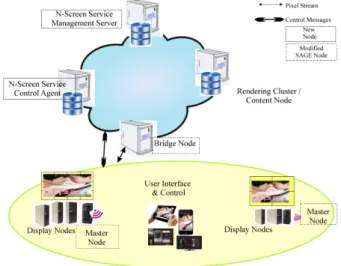
We provide N-Screen service on MVS by introducing N-Screen Service Management Server (NSMS) and N-Screen Service Control Agent (NSCA) as shown in Fig. 1.
The rendering-cluster (RC), bridge-node, display nodes and master node have the same basic functions as SAGE architecture[6]. We enhance the functions of master and bridge node. The master node sends advertisements to detect and connect a user device with the MVS. The bridge-node performs visualcasting as SAGE architecture and multicasting to N-Screen.
그림 1. N- 스크린 기반의 인터렉티브 MVS 구조 Fig. 1. Architecture for N-Screen based Interactive MVS
1. N-Screen Service Management Server The N-Screen Service Management Server (NSMS) is the central control unit. It maintains lists of registered-users, user's devices, registered-sites, running application on each site, contents, group-addresses and IP-addresses of RC and NSCA.
NSMS assigns the appropriate NSCA to a user during the registration process. It assigns group-address and selects the appropriate RC/CN to launch content. It also provides support for global visualcasting to share the same content with devices registered in different groups.
2. N-Screen Service Control Agent
The N-Screen Service Control Agent (NSCA) interacts with user interface on the N-Screen to control and share the display contents with any of the user's active-devices. The NSCA can dynamically add/remove devices to a group (addressed by group-address) to share or split-share the session with the group devices. It maintains dynamic profile of registered devices and minimizes service disruption during the inter-device session mobility. The NSCA can dynamically select the optimum bridge node to perform tiling and replication during visualcasting to multiple sites/devices. In future work, we will provide algorithms for the optimum bridge node selection and bridge node
movement with the dynamic addition and deletion of participating sites.
3. Bridge Node
The SAGE-Bridge provides high resolution streams to the tiled-display while N-Screen have limited screen resolution and access network speed.
So we need adaption function for content replication to N-Screen. The primary functions of bridge node are visualcasting and multicasting to display sites and N-Screen respectively to improve scalability and network latency.
4. Master Node
Master node sends advertisements to users in the proximity of display for interaction with the MVS.
The other functions of the master node are synchronization and management of multiple applications, and laser or mouse-keyboard based interaction with the display.
5. Rendering-Cluster
The NSMS selects appropriate rendering-cluster (RC) to execute user application. The RC runs SAGE Application Interface Library (SAIL) application to generate raw pixel stream of the application content and sends them to the target bridge-bode.
6. Display-Nodes
The MVS tiled display wall consists of display LCD/monitors (tiles) having same or different attributes. The display node receives pixel streams from bridge node, manages the data sessions and contents-display of the associated tiles.
7. User Interface
UI resides on N-Screen and connects a user to the MVS. UI enables a user to control, share, store and playback display contents. UI can connect a user to multiple display sites simultaneously.
Ⅳ. Protocols and Service Scenarios
This section explains N-Screen based interaction mechanisms and service scenarios.
1. Procedure and Protocols
We provide mechanisms for launching an application on the display, connecting a user with the display and visualcasting.
(1) Registration and launching application For launching an application on the tiled-display;
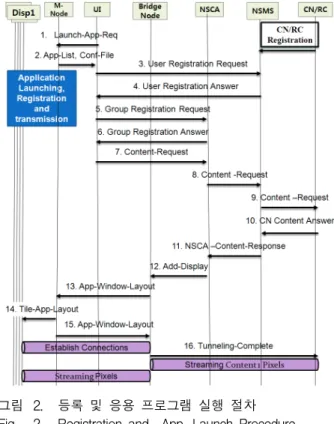
the site manager (advertiser) registers his display site with the NSMS and NSCA. Fig. 2 shows the procedure and the main steps are as follows:
그림 2. 등록 및 응용 프로그램 실행 절차 Fig. 2. Registration and App. Launch Procedure.
a. UI gets the display configuration file and application list from the master node.
b. The user performs registration with the NSMS.
NSMS authenticates the user and assigns NSCA IP-address for group registration.
c. Then, user performs group registration with the NSCA.
d. User sends content request to the NSCA with
content-title, display-ID and IP-address of the master node.
e. NSCA forwards the content request to NSMS.
f. NSMS assigns group-address and sends content request to appropriate CN/RC to receive its parameters.
g. NSMS sends content-answer to the NSCA with the CN's parameter and group-address.
h. NSCA provides CN's parameters, display-ID, group-address and IP-address of the master node to bridge node.
i. The bridge node sends App-Window-Layout request to the master node to receive the display configuration file and layout. The bridge node establishes connections with the target displays nodes and sends tunneling-Complete request to the CN.
j. Then, CN starts streaming to the bridge node destined to the group address.
(2) Connecting a User with MVS
For connecting a user with the MVS display, we use similar approach as in [20]. When a user enters into the coverage of an access point i.e. WiFi, 3G/4G/WiMAX, Femtocell or IPTV STB equipped with WiFi, receives advertisements from the master node. We can use PUSH or PULL method to get connected to the display site. In PUSH method, the master node sends the advertisement messages to user devices. In PULL method, UI displays the available DS to pull information as user preference.
We use PULL method, in which the master nodes broadcast advertisements, and UI displays list of DS and their contents to the user.
a. The master node broadcast advertisement messages in its vicinity.
b. Accepting an advertisement, user requests master node to provide the display configuration file and content list.
c. Master node provides the configuration file and content list to the user.
d. User performs registration with the NSMS and NSCA to control the display or share its content with
any of user's active-devices.
(3) Protocol for Visualcasting
A user can add N-Screen or display site to his existing session. In existing systems, the same bridge node shares the data with N-Screen or display site which leads to increase latency. We register displays and user's N-Screen with different NSCA nodes according to their location. Fig. 3 shows the example of local and global visualcasting. We assign same
그림 3. 로컬 및 글로벌 비주얼캐스팅의 예제 Fig. 3. Local and Global Visualcasting in MVS.
그림 4. 다른 그룹에서 단말 추가 위한 프로토콜 Fig. 4. Protocol for adding site in different Group.
bridge node when the participating devices belong to same NSCA and different bridges when the devices belong to different NSCA nodes. When user sends Add-Device-Request to NSCA to share a session with his other active device or display site. NSCA checks to determine whether the display/device is registered in its database or not? If the display belongs to the same group, then NSCA provides its static and dynamic profile to bridge node for replication. Fig. 4 shows the procedure when the participating devices belong to different NSCA nodes.
2. N-Screen Service Scenarios
The proposed architecture can support all N-Screen based services and interactions on MVS.
We pick two scenarios to explain how we provide N-Screen services on MVS.
(1) Sharing Display Audio Stream with N-Screen A user watches advertisements on display site; he wants to transfer the audio stream to his device.
User receives contents list from the master node.
Then, he registers the display site with NSMS and NSCA. This enables him to treat the display site as his N-Screen. He sends Split-Share request to the NSCA with Tile, Stream-ID and Display-IP. The
그림 5. N-스크린에서 오디오 스트림을 공유하는 시나 리오
Fig. 5. Scenario for sharing Audio Stream with N-Screen.
NSCA provides the device parameters, Title, and stream-ID to the bridge node to stream the split session according to device capabilities. The bridge node establishes tunneling with the user's device and replicates the content to both sites. We consider that the device on which user want to share the split session belongs to the same NSCA. The solid line in Fig. 5 shows the scenario for sharing audio stream with N-Screen.
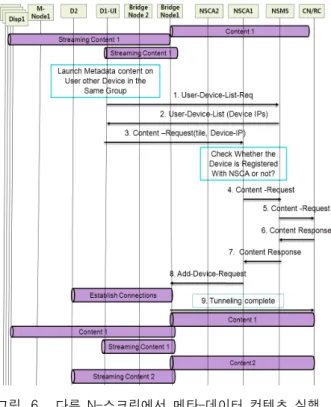
(2) Launch Meta Content on any active device In this scenario, we consider that a user has already performed registration and receiving the display contents on one of his devices. The service provider adds metadata information with the A/V streams for additional information i.e. location information or similar contents. The user wants to establish a new session for the metadata content on his other active device as shown by the dashed-lines in Fig. 5. Fig. 6 shows the whole procedure in detail.
We consider that both devices belong to same group.
User can launch the contents on any of his active devices or displays at any location. The main steps are as follows:
그림 6. 다른 N-스크린에서 메타-데이터 컨텐츠 실행 Fig. 6. Launching Meta-Data Content on N-Screen.
a. User receives the list of his active devices from NSMS.
b. Then, he sends content request including the title and device-IP address to the NSCA.
c. NSCA forwards the request to the NSMS.
NSMS selects a CN having the requested content and provides the CN's parameters and group-address to NSCA.
. NSCA forwards CN's parameter, group-address and device profile to bridge node to bridge the content to the device.
e. The bridge node establishes tunneling with the device and sends the tunneling-complete request to CN. CN starts content streaming to the bridge node destined to the group-address.
V. Simulation and Comparison
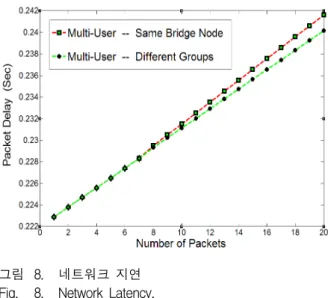
In this section, we compare network latency with similar SAGE visualcasting architecture. We use Omnetpp for simulation. The network delay is the packet transmission time from CN to Device. Fig. 7 shows the simulation environment.
SAGE performs visualcasting from the same bridge-node which increases the network latency. We register devices/displays in groups based on their location. Fig. 4 shows the protocols for visualcasting,
그림 7. 네트워크 구성도 제안
Fig. 7. Proposed Network Composition.
그림 8. 네트워크 지연 Fig. 8. Network Latency.
which improves the latency as shown in Fig. 8. We add the second display after receiving 6 packets to the session. We are sharing the contents with two display sites for comparison. If we increase the number of participating displays to the visualcasting session, then the proposed scheme will show more effective result.
VI. Conclusion
N-Screen services implementation on MVS enable multiple users to control the MVS displays through any device. Users can share MVS display content with any of their active-devices at any location. It gives free choice of interacting device and allows free movement around display. The proposed architecture gives efficient control over multi-devices session management. It maintains static and dynamic profiles of registered devices to minimize service disruption during session mobility. Some of the key technology requirements for N-Screen services are User Profile and Authentication Control, Adaptive Media Support and Seamless Session Mobility. We introduce NSMS and NSCA to enable N-Screen service on MVS.
NSMS is the central control and information unit and NSCA is responsible for user interaction and session management. The existing visualcasting architecture provides content replication from the same bridge node that leads to long packet route and
synchronization delay. The proposed visualcasting mechanism gives high application throughput and minimizes the network latency. We will provide optimum bridge selection algorithm to enhance the system performance in future work.
REFERENCES
[1] Y. Ebara, and Y. Shibata, “Experiment on Tele-immersive Communication with Tiled Display Wall over Wide Area Network”, Advances in Computing, pp. 35—41, 2012.
[2] Choe Giseok, Yu Jeongsoo, Choi Jeonghoon, and Nang Jongho, “Design and Implementation of a Real-Time Video Player on Tiled-Display System,” in proceedings of the 7th International Conference on Computer and Information Technology, pp. 621-26, 2007.
[3] Greg Humphreys, Mike Houston, Ren Ng, Randall Frank, Sean Ahern, Peter D. Kirchner, and James T. Klosowski, “Chromium: A Stream-Processing Framework for Interactive Rendering on Clusters,” in proceedings of the 29th annual conference on Computer graphics and interactive techniques (San Antonio, Texas:
ACM, pp. 693-702, 2002.
[4] Wu Shann-Chiuen, Chu Shih-Jen, and Lee Tzao-Lin, “Remote Screen Recording and Playback,” in proceedings of ICSNC, pp. 35-35, 2006.
[5] T. Richardson, Q. Stafford-Fraser, K. R. Wood, and A. Hopper, “Virtual Network Computing,”
IEEE Internet Computing, vol 2, pp. 33-38, 1998.
[6] Ranabot LUC, Rao, and Arun, “SAGE: the Scalable Adaptive Graphics Environment,” In proceedings of WACE, 2004.
[7] Byungil Jeong, Luc Renambot, R. Jagodic, R.
Singhm, J. Aguilera, A. Johnson, and J. Leigh,
”High-Performance Dynamic Graphics Streaming for Scalable Adaptive Graphics Environment,“ in proceedings of the ACM/IEEE conference on supercomputing, SC'2006. pp. 24-33, 2006.
[8] Luc Renambot, Byungil Jeong, Hyejung Hur, Andrew Johnson, and Jason Leigh, “Enabling high resolution collaborative visualization in display rich virtual organizations,” Future Generation Computer Systems, vol. 25, pp.
161-68, 2008.
[9] Jong-soon Park, Dong-hwan Kim, Tae-gyu Chang, “Implementation of Scalable video for adaptive streaming,” in the proceedings of the
IEEK conference, pp. 525-28, 2005.
[10] Jeong-SAGE-dissertation-March2009.pdf
[11] H. Emina, Y. Sugio, H. Koga, M. Shimamura, and T. Ikenaga, “Split Connection Scheme for Session-Based Group Communication,” PacRim, pp. 612-17, 2009.
[12] Desmond Germans, Hans J.W. Spoelder, Luc Renambot, and Henri E. Bal, “VIRPI: A High-Level Toolkit for Interactive Scientific Visualization in Virtual Reality,” IPT/SGVE, pp 109-20, 2001.
[13] Kim Jae Woo, F. Ullah, Lee Sung Chang, Jo Seng Kyoun, Lee Hyun Woo, and Ryu Won,
“Dynamic Addition and Deletion of Device in N-Screen Environment,” ICUFN pp. 118-22, 2012.
[14] S. Husain, S. Isobe, K. Mahdi, et al. “3gpp Ims-Based Inter-Device Collaboration,” in the proceedings of Internation Conference on New Technologies, Mobility and Security (NTMS), pp. 1-6, 2011.
[15] Min-Xiou Chen, and Fu-Ju Wang, “Session Mobility of Sip over Multiple Devices,” ICST, pp. 1-9, 2008.
[16] Min-Xiou Chen, Chen-Jui Peng, and Ren-Hung Hwang, “Ssip: Split a Sip Session over Multiple Devices,” Computer Standards & Interfaces, pp.
531-45, 2007.
[17] H. Sato, M. Urata, K. Yoguchi, N. Arakawa, N.
Kanamaru, and N. Uchida, “Linking Digital Signage with Mobile Phones,” ICIN, pp. 86-91, 2011.
[18] Wook Hyun, MiYoung Huk, SeungHei Kim and ShinGak Kang, “Considerations on Audience Measurement in procedures for Digital Signage Service,“ International Journal of Control &
Automation, IJCA, vol. 5, issue 2, pp. 123-31, 2012.
[19] JorgeC S. Cardoso, and Rui José, “A Framework for Context-Aware Adaptation in Public Displays”, Otm Workshops, pp. 118-27, 2009.
[20] Yoon Changwoo, Lee Hoyeon, Jeon Seung Hyun, and Lee Hyunwoo, “Mobile Digital Signage System Based on Service Delivery Platform Location Based Targeted Advertisement Service”, ICTC, pp. 582-86, 2011.
[21] R. Shacham, Henning Schulzrinne, S. Thakolsri, and W. Kellerer, “The Virtual Device: Expanding Wireless Communication Services through Service Discovery and Session Mobility”, in the proceedings of IEEE WiMob'2005, vol. 4, pp.
73-81, 2005.
저 자 소 개 Ghullam Sarwar(학생회원)
2007년 B.Sc Computer Systems Enginineering, UET Peshawar, Pakistan.
2011년~현재 한국항공대학교 정보통신공학과 박사과정 재학중
<주관심분야 : N-Screen Services, Multi-Vision Sytems and Content Delivery Networks>
Farman Ullah(학생회원)
2006년 B.Sc Computer Systems Engineering, UET
Peshawar, Pakistan 2011년 M.S Computer Engineering, CASE Pakistan
2011년~현재 한국항공대학교 정보통신공학박사 과정재학중
<주관심분야 : Recommender Systems, Machine learning and N-Screen Services>
윤 장 우(정회원) 1990년 서강대학교 학사 1992년 포항공과대학교 석사 2005년 University of Florida 컴퓨터공학 공학박사 1992년~현재 한국전자통신연구원 책임연구원
2008년~현재 UST 광대역네트워크공학 겸임교수
<주관심분야 : Cloud computing, SOA, , Service creation/delivery technology and information retrieval>
이 성 창(정회원)-교신저자 1976~1983년 경북대학교 전자공학과 공학사 1983~1985년 한국과학기술원 전기및전자공학과 공학석사
1987년~1991년 Texas A&M University 전기전자공학과 공학박사
1985년~1987년 한국과학기술원 시스템공학센터 1992년~1993년 한국전자통신연구원
1993년~현재 한국항공대학교 항공전자및정보통 신공학부 교수
<주관심분야 : 방송통신융합, 클라우드 컴퓨팅>
[22] R. Shacham, Henning Schulzrinne, S. Thakolsri, and W. Kellerer, “Session Initiation Protocol (SIP) Session Mobility,” RFC 5631, Oct. 2009.
[23] K. A. Perrine,and D. R. Jones, “Parallel Graphics and Interactivity with the Scaleable Graphics Engine”,' in proceedings fo ACM/IEEE conference on Supercomputing, pp. 3-3, 2001.
[24] Duck Yeon Kim, Tae Meon Bae, et al. “A Study of Real-time SVC Bitstream Extraction for QoS quaranteed Streaming”, in proceedings of IEEK conference, pp. 513-16, 2005.