INTRODUCTION
As of 2015, 96.6% of Korean teenagers are using the Inter- net at least once a day, and the average usage time is 14.5 hours a week.1) However, as problems related to the use of the Internet have become increasingly evident, the term ‘In- ternet addiction’ has received much attention. The term ‘In- ternet addiction’ was coined by Goldberg2) and was defined as the pathological and compulsive use of the Internet. Young proposed diagnostic criteria for problematic Internet use according to the Diagnostic and Statistical Manual of Men- tal Disorders-fourth edition (DSM-IV)3) pathological gam- bling diagnostic criteria.4) However, the definition of prob-
lematic Internet use remains controversial, and the DSM-5, which is currently being revised, does not have problematic Internet use diagnostic criteria because it is difficult to define as a disease. Only Internet gaming disorder has been catego- rized as a diagnosis requiring further study.
In a number of studies, problematic Internet use has been associated with depression, anxiety disorders, social phobia, substance-related disorders, obsessive-compulsive disorder, attention deficit hyperactivity disorder, and impulse control disorder.5-7) Problematic Internet use is particularly serious in children and adolescents. According to the Internet ad- diction survey in 2014, 12.5% of adolescents were found to be at risk of Internet addiction,8) and the problematic Inter- net use of children and adolescents is known to negatively affect academic achievement and family relationships.9,10)
As demonstrated by definitions of Internet addiction,4)
This is an Open Access article distributed under the terms of the Creative Commons Attribution Non-Commercial License (http://creativecommons.org/licenses/by-nc/4.0) which permits unrestricted non-commercial use, distribution, and reproduction in any medium, provided the original work is properly cited.
The Effects of Group Cognitive Behavioral Therapy on the Improvement of Depression and Anxiety
in Adolescents with Problematic Internet Use
Sang-Hyun Kim1, Hyeon-Woo Yim2, Sun-Jin Jo2, Kyu-In Jung3, Kina Lee4, and Min-Hyeon Park3
1Department of Psychiatry, Uijeongbu St. Mary’s Hospital, The Catholic University of Korea College of Medicine, Uijeongbu, Korea
2Department of Preventive Medicine, The Catholic University of Korea College of Medicine, Seoul, Korea
3Department of Psychiatry, St. Paul’s Hospital, The Catholic University of Korea College of Medicine, Seoul, Korea
4Seoul St. Mary’s Hospital, The Catholic University of Korea, Seoul, Korea
Objectives: The overuse of the Internet among adolescents has increased dramatically in recent years, leading to pathological or problematic Internet use. Cognitive behavioral therapy (CBT) is known to be effective for the treatment of problematic Internet use, particularly for adolescents. The aim of the present study was to evaluate the therapeutic efficacy of group CBT for problematic Inter- net use in adolescents.
Methods: A total of 17 patients aged 12–17 years who met Young’s diagnostic questionnaire criteria of problematic Internet use par- ticipated in a school-based eight-session group CBT program. The level of problematic Internet use among participating students was measured using Young’s Internet Addiction Scale (IAS). Depression and anxiety levels were evaluated using the Children’s Depression Inventory (CDI) and the State-Trait Anxiety Inventory (STAI), respectively. Each construct was assessed at baseline, immediately after the intervention, and at a one-month follow-up visit. Statistical significance was based on a p-value of <0.05.
Results: Immediately after the program, the IAS, CDI, and State Anxiety Inventory (SAI) scores were significantly lower than be- fore the program. At the one-month follow-up assessment, the IAS scores remained low, and the CDI and SAI scores were even low- er than immediately after the program.
Conclusion: Group CBT was effective for adolescents with problematic Internet use, and was also demonstrated to improve depres- sion and anxiety.
Key Words: Problematic Internet use; Depression; Anxiety; Group cognitive behavioral therapy.
Received: October 16, 2017 / Revision: December 19, 2017 / Accepted: January 12, 2018
Address for correspondence: Min-Hyeon Park, Department of Psychiatry, The Catholic University of Korea, St. Paul’s Hospital, 180 Wangsan-ro, Dongdae- mun-gu, Seoul 02559, Korea
Tel: +82-2-958-2153, Fax: +82-31-847-3630, E-mail: [email protected]
problematic Internet use is also understood to be a behavioral addiction with ‘tolerance’ and ‘withdrawal’ symptoms, and has neuropsychological and pathological mechanisms simi- lar to those of other substance use disorders or gambling disorders.11-13) Alcohol use disorder and gambling disorder treatment programs are primarily based on cognitive behav- ioral models.14) Through cognitive behavioral therapy (CBT), patients become more aware of addictive behaviors and emotions, and the thoughts that cause them, and realize that they are repeating their addictive behaviors in certain dy- namics. Therefore, CBT can be introduced to treat problem- atic Internet use. In particular, group interventions are ad- vantageous in terms of efficiency, provision of alternative learning opportunities, and peer feedback when there are many subjects with relatively homogeneous characteris- tics,15,16) and are practiced universally for the treatment of problematic Internet use.17) In addition, the subjects will deal with their emotional state by examining the causes of the Internet use in the treatment process. Therefore, it is thought that emotions will also be affected.
Therefore, this study applied group CBT for treatment of problematic Internet use among Korean adolescents who have easy access to the Internet, and attempted to identify as- sociated depression and anxiety symptoms along with strat- egies for mitigation and maintenance of effects.
METhODs
Subjects
This study was conducted as part of a project for the Pro- motion of Child and Adolescent Mental Health in the men- tal health center of Seocho-gu district. The Korean Internet addiction self-report test18) was administered to 389 students (40 female students) in the first and second grade of one in- dustrial high school and 253 students in the first grade of one female middle school, and a high-risk group and a po- tential risk group were selected. A psychiatrist conducted 1:1 interviews using Young’s Diagnostic Questionnaire to ex- clude false positives from the 48 selected industrial high school students (12.34%) and 13 female middle school stu- dents (5.14%). Exclusion criteria included the following: 1) no problematic Internet use, as determined in an interview with a psychiatrist, 2) treatment for a psychiatric disorder, 3) currently receiving treatment for problematic Internet use, 4) unwillingness to participate or unwillingness of the stu- dents’ parents to enroll them in the program, and 5) opposed to participation due to problems such as school classes. A to- tal of 17 students (7 industrial high school students and 10 fe- male middle school students) participated in the program.
Procedures, contents, and operation of group programs Consent was provided by each student and their parents prior to the program, and the study was approved by the In- stitutional Review Board of the Catholic University (CUM- C09U133). The group CBT program consisted of eight ses- sions, with two sessions per week, and details of each session are included in Appendix.
Screening scale and effect evaluation scale Screening scale
Korean Internet addiction self-report test (K-scale)
This is a self-diagnostic scale for measuring tendencies for addiction to Internet use in adolescents, and was devel- oped for Korean adolescents by the National Information Society Agency under the Ministry of Information and Communication.
Young’s Diagnostic Questionnaire (YDQ)
This is a diagnostic questionnaire composed of eight items modified from the DSM-IV’s pathological gambling model.
If five or more answers are “yes”, respondents are classified as problematic Internet users, and if fewer than five answers are
“yes”, respondents are classified as normal Internet users.4) Effect evaluation scale
Young’s Internet Addiction Scale (IAS)
The Young’s Internet Addiction Scale (IAS) is a self-report 20-item scale with responses of 1 to 5 points for each item.
An IAS score of 40-69 points indicates that problems with Internet use are occasional or frequent. A score of ≥70 points is considered to indicate serious problems with Internet use.19) Children’s Depression Inventory (CDI)
This is a self-report scale that evaluates the cognitive, emo- tional, and behavioral symptoms of childhood depression.20) A score of 22-25 points indicates mild depression, 26-28 points indicates moderate depression, and ≥29 points indi- cates severe depression.
State-Trait Anxiety Inventory (STAI)
This measure is composed of 20 items of the State Anxi- ety Inventory (SAI), which evaluates current anxiety, and 20 items of Trait Anxiety Inventory (TAI), which evaluates anxiety tendency.21) The SAI indicates that a score of 41- 44 points indicates slightly high current anxiety levels, 45- 48 points indicates moderately high current anxiety levels, and ≥49 points indicates extremely high current anxiety
levels. In the TAI, the anxiety tendency is indicated to be slightly high at a score of 39-42 points, moderately high at 43-46 points, and extremely high at ≥47 points.
Statistical analysis
The differences in the baseline and post-intervention eval- uation scores of the intervention program were analyzed by paired t-tests, and the differences in the pre- and post-follow- up evaluation indices were analyzed by repeated measures analysis of variances. The differences in the Internet use of the industrial high school students and the female middle school students were analyzed using Fisher’s exact test. Sta- tistical significance was based on a p-value of <0.05. All statisti- cal analyses were performed using SPSS 20.0 for Windows (IBM Corp., Armonk, NY, USA).
REsULTs
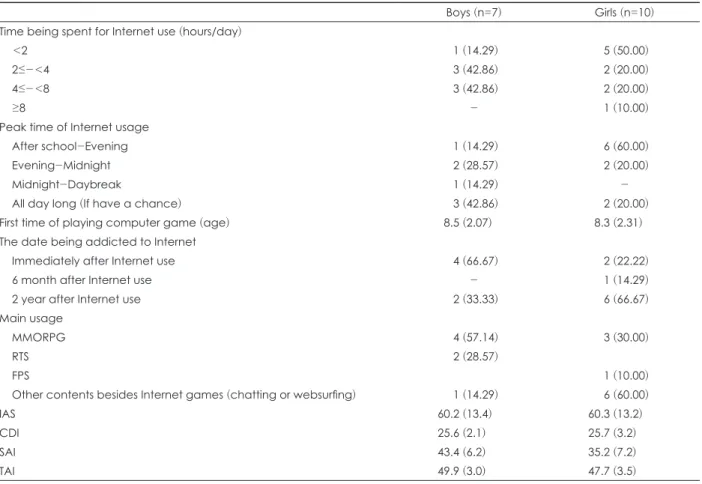
Clinical characteristics and characteristics related to Internet use (Table 1)
There was no difference in time between the first use of the
Internet and the start of problematic Internet use (p=0.287).
The mean Children’s Depression Inventory (CDI) total scores for the two schools were indicative of mild depression. The SAI total scores were higher among industrial high school students, while the scores of female middle school students were within the normal range. The mean TAI total scores of the subjects in the two schools indicated that the level of anxiety tendency was very high.
The effect of program intervention (Table 2)
A total of 17 students participated until the end of the ses- sion, without any dropouts during the 8th session.
The IAS total score decreased significantly in the post-in- tervention evaluation compared to the baseline evaluation total score (p<0.001). CDI and SAI total scores also signifi- cantly decreased in the post-intervention evaluation (p=0.006 and p<0.0001, respectively). There was no significant change in the TAI total score (p=0.122). Thirteen out of 17 students reported a reduction in the amount of time spent using the Internet after the program. Among the students who re- ported a reduction in Internet usage, the mean Internet us-
Table 1. Internet use pattern of subjects and initial score of rating scales
Boys (n=7) Girls (n=10)
Time being spent for Internet use (hours/day)
<2 1 (14.29) 5 (50.00)
2≤-<4 3 (42.86) 2 (20.00)
4≤-<8 3 (42.86) 2 (20.00)
≥8 - 1 (10.00)
Peak time of Internet usage
After school-Evening 1 (14.29) 6 (60.00)
Evening-Midnight 2 (28.57) 2 (20.00)
Midnight-Daybreak 1 (14.29) -
All day long (If have a chance) 3 (42.86) 2 (20.00)
First time of playing computer game (age) 8.5 (2.07) 8.3 (2.31)
The date being addicted to Internet
Immediately after Internet use 4 (66.67) 2 (22.22)
6 month after Internet use - 1 (14.29)
2 year after Internet use 2 (33.33) 6 (66.67)
Main usage
MMORPG 4 (57.14) 3 (30.00)
RTS 2 (28.57)
FPS 1 (10.00)
Other contents besides Internet games (chatting or websurfing) 1 (14.29) 6 (60.00)
IAS 60.2 (13.4) 60.3 (13.2)
CDI 25.6 (2.1) 25.7 (3.2)
SAI 43.4 (6.2) 35.2 (7.2)
TAI 49.9 (3.0) 47.7 (3.5)
Data present number (percent) or mean (standard deviation). CDI: Children’s Depression Inventory, FPS: first person shooting, IAS: Young’s Internet Addiction Scale, MMORPG: massive multiplayer online role playing game, RTS: real-time strategy, SAI: State Anxiety Inventory, TAI: Trait Anxiety Inventory
age time before the program was 4.75 hours (±1.94), while the average Internet usage time after the program was 2.77 hours (±1.92) (p<0.0001). After the program, eight students reported an increase in the amount of time spent studying, and nine students reported no change. There were two stu- dents who felt that their Internet habits were not harmful after the program, and there were ten students who knew that their Internet usage habits were harmful, but found them hard to correct. A total of five students were advised to cor- rect the harmful Internet habits after the program.
Follow-up evaluation
A total of seven students among the ten female middle school students who participated in the program performed follow-up evaluations 1 month after the end of the program.
There were no significant differences in the IAS (pre p=0.814, post p=0.723), CDI (pre p=0.127, post p=0.601), SAI (pre p=
0.076, post p=0.482), and TAI scores (pre p=0.422, post p=
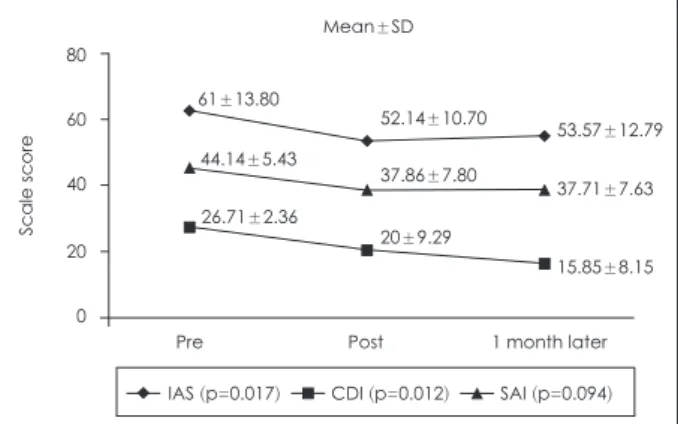
0.731) before and after the follow-up evaluation. Fig. 1 pres- ents the comparison of the baseline and post-intervention scores.
Compared to the IAS, CDI, and SAI pre-intervention scores, the corresponding follow-up scores were low (p=0.054, 0.015, 0.058, respectively). The IAS and SAI scores did not signifi- cantly differ between the post-intervention and the follow- up evaluations (p=0.664, 0.961, respectively). The CDI scores were not significantly different, but the follow-up scores were lower than the post-intervention scores (p=0.093).
The CDI and SAI scores decreased overall in the follow-up evaluation. The changes in the number of students assigned to each severity category over the three evaluations are pre- sented in Figs. 2 and 3.
DIsCUssION
In the present study, the IAS scores after the program were significantly lower than the scores before the program, and this effect was maintained in the follow-up evaluation 1 month later. The program allowed the participants to think about alternative activities to using the Internet, and to improve their self-regulation abilities. This finding is consistent with previous studies, indicating a significant decrease in the In- ternet addiction scores via problematic Internet use group therapy.17)
This study also demonstrated that the scores on the CDI, a measure related to depression, were reduced despite the fact that the treatment targeted problematic Internet use.
Table 2. Comparision of pre-and post intervention effect
Variables Pre Post
p-value Mean±SD
IAS 59.88±12.48 50.71±10.75 <0.0001
CDI 25.65±2.71 19.00±7.87 0.006
TAI 39.06±7.62 36.65±8.18 <0.0001
SAI 47.71±5.00 36.06±6.20 0.122
CDI: Children’s Depression Inventory, IAS: Young’s Internet Ad- diction Scale, SAI: State Anxiety Inventory, TAI: Trait Anxiety In- ventory
6 5 4 3 2 1 0
Pre-intervention Post-intervention 1 month later
Number of students
Severe Moderate MildMild Normal
Fig. 2. Number of students according to Children’s Depression Inventory score.
6 5 4 3 2 1 0
Pre-intervention Post-intervention 1 month later
Number of students
Severe Moderate MildMild Normal
Fig. 3. Number of students according to State Anxiety Inventory score.
80 60 40 20
0
Pre Post 1 month later 61±13.80
44.14±5.43
52.14±10.70 37.86±7.80 20±9.29
53.57±12.79 37.71±7.63 15.85±8.15 26.71±2.36
Mean±SD
Scale score
IAS (p=0.017) CDI (p=0.012) SAI (p=0.094) Fig. 1. Score comparison between pre, post intervention and one month later. CDI: Children’s Depression Inventory, IAS:
Young’s Internet Addiction Scale, SAI: State Anxiety Inventory.
These scores were further reduced in the follow-up evalua- tion 1 month after the program was completed. In another study, the subscale related to the emotional symptoms of the Strength and Difficulties Questionnaire after group therapy for adolescents with problematic Internet use also reported that the effect size was larger in the 6 month follow-up evalua- tion than at the end of the program.22) Other problematic Internet use group therapy studies also reported a decrease in depression after treatment.17) Yen et al.23) reported that problematic Internet use and depression increased mutual vulnerability and shared genetic and environmental risk factors. Young suggested that problematic Internet users may forget their stress during Internet access hours, which is similar to drinking alcohol as a form of escape.4) Therefore, depression is the leading cause of problematic Internet use.
In addition, the use of the Internet as an compulsive behav- ior for solving social isolation, loneliness, or negative and nervous emotional states was observed in Internet addiction patients.24) Therefore, CBT is used to restore the emotional state, and the use of the Internet as a compulsive behavior is replaced by a new healthy method to prevent recurrence.
Similar to depression, in relation to anxiety, SAI scores were significantly lower after the program, and the effect was main- tained at the 1 month follow-up evaluation. TAI scores did not significantly decrease after the program, which is consistent with the findings of previous studies.14) Previous studies have demonstrated a high level of social anxiety among adoles- cents with problematic Internet use.25) In addition, loneli- ness, shyness, and avoidance of social relationships are as- sociated with problematic Internet use.26,27) Finally, to reduce anxiety, socially unstable individuals prefer to communicate via the Internet with a low risk of social communication and therefore exhibit vulnerability to problematic Internet use.28) Thus, it is assumed that these individuals have ad- dressed the mutual improvement result by not only reduc- ing Internet use via group CBT, but also by experiencing posi- tive social communication opportunities.
In this study, participants in the program and their parents were very receptive, as observed by the absence of any drop- outs. The reason for the lack of dropouts is that the defini- tion of ‘Internet addiction’ itself is vague, and a definite di- agnostic system has not been established,29,30) which makes it less important to stigmatize the psychiatric illness. There- fore, in the case of patients with depressive disorder or anxi- ety disorder who have problematic Internet use simultane- ously, a therapeutic approach based on problematic Internet use treatment, which is relatively less resistant, can be con- sidered.
In this study, the treatment effect was maintained when the IAS, CDI, and State-Trait Anxiety Inventory were evalu-
ated at the 1 month follow-up. It seems that a follow-up evalu- ation study will be needed at several time points in the future, given the results of a study in China wherein the treatment effect in the Internet addiction group was maintained even after 6 months, based on scores on the scales measuring In- ternet addiction, depression, and anxiety.22)
The limitations of this study are as follows. First, it is dif- ficult to generalize these conclusions to all students because it is a program implemented in one specific female middle school and one industrial high school. Second, there was no control group; therefore, the possibility of changing the score of the evaluation tool by the group variable was not correct- ed. Third, we relied on self-report evaluation scales and did not seek evaluations from teachers, parents, or clinicians.
Fourth, only voluntary participants with a willingness to de- crease problematic Internet use participated in the study.
Therefore, it is possible that the Pygmalion effect might have affected the outcome from the expectation that the subjects should improve. However, the prevalence of these prejudices seems to be low, given that the TAI scores were almost un- changed before and after the program.
CONCLUsION
In this study, students who were assessed as problematic Internet users attended group CBT to improve Internet ad- diction. As a result, students’ time spent on the Internet de- creased and the degree of addiction improved. In addition, group CBT was effective in alleviating concurrent depression and anxiety symptoms, and the treatment efficacy up to 1 month was considered to be maintained. Larger-scale, long- term studies should be conducted in the future.
Acknowledgments
This work was supported by the National Research Foundation of Korea (NRF) grant funded by the Korean Government (NRF- 2014R1A1A2057866 and 2017R1D1A1B03031680).
Conflicts of Interest
The authors have no financial conflicts of interest.
REFERENCEs
1) Ministry of Science ICT and Future Planning, Korea Internet &
Security Agency. 2015 Survey on the Internet usage. Seoul: Korea Internet & Security Agency;2015.
2) Goldberg I. Internet addiction disorder (1996) [cited 2004 Nov 24].
Available from: http://users.rider.edu/~suler/psycyber/supportgp.
html.
3) American Psychiatric Association. Diagnostic and Stastical Man- ual of Mental Disorders. 4th ed. Washington, DC: American Psy- chiatric Association Publishing;1994.
4) Young KS. Internet addiction: the emergence of a new clinical dis- order. Cyberpsychol Behav 1998;1:237-244.
5) Petersen KU, Weymann N, Schelb Y, Thiel R, Thomasius R. [Path-
ological Internet use--epidemiology, diagnostics, co-occurring dis- orders and treatment]. Fortschr Neurol Psychiatr 2009;77:263-271.
6) Ha JH, Yoo HJ, Cho IH, Chin B, Shin D, Kim JH. Psychiatric co- morbidity assessed in Korean children and adolescents who screen positive for Internet addiction. J Clin Psychiatry 2006;67:821-826.
7) Ko CH, Yen JY, Yen CF, Chen CS, Chen CC. The association be- tween Internet addiction and psychiatric disorder: a review of the literature. Eur Psychiatry 2012;27:1-8.
8) Ministry of Science ICT and Future Planning, National Informa- tion Society Agency. Survey on Internet Addiction, 2014. Seoul:
Ministry of Science ICT and Future Planning, National Informa- tion Society Agency;2015.
9) Parker JD, Taylor RN, Eastabrook JM, Schell SL, Wood LM. Prob- lem gambling in adolescence: relationships with Internet misuse, gaming abuse and emotional intelligence. Pers Individ Dif 2008;45:
174-180.
10) Young KS. Internet addiction: a new clinical phenomenon and its consequences. Am Behav Sci 2004;48:402-415.
11) Ko CH, Liu GC, Yen JY, Chen CY, Yen CF, Chen CS. Brain corre- lates of craving for online gaming under cue exposure in subjects with Internet gaming addiction and in remitted subjects. Addict Biol 2013;18:559-569.
12) Ko CH, Liu GC, Hsiao S, Yen JY, Yang MJ, Lin WC, et al. Brain ac- tivities associated with gaming urge of online gaming addiction. J Psychiatr Res 2009;43:739-747.
13) Grant JE, Potenza MN, Weinstein A, Gorelick DA. Introduction to behavioral addictions. Am J Drug Alcohol Abuse 2010;36:233-241.
14) Lee HC. A study on developing the Internet game addiction diagnos- tic scale and the effectiveness of cognitive-behavioral therapy for Internet game addiction [dissertation]. Seoul: Korea Univ.;2001.
15) Craig SD, Driscoll DM, Gholson B. Constructing knowledge from dialog in an intelligent tutoring system: Interactive learning, vicar- ious learning, and pedagogical agents. J Educ Multimed Hypermed 2004;13:163-183.
16) Northen H. Clinical social work: knowledge and skills. 2nd ed.
New York, NY: Columbia University Press;1995.
17) Winkler A, Dörsing B, Rief W, Shen Y, Glombiewski JA. Treatment of Internet addiction: a meta-analysis. Clin Psychol Rev 2013;33:317-
18) Kang MC, Oh IS. Development of Korean Internet addiction scales. 329.
Korean J Youth Counsel 2001;9:114-135.
19) Young KS. Caught in the net: how to recognize the signs of Inter- net addiction--and a winning strategy for recovery. New York, NY:
John Wiley & Sons;1998.
20) Smucker MR, Craighead WE, Craighead LW, Green BJ. Norma- tive and reliability data for the Children’s Depression Inventory. J Abnorm Child Psychol 1986;14:25-39.
21) Spielberger CD, Gorsuch RL, Lushene RE. The State-Trait Anxiety Inventory. Palo Alto, CA: Consulting Psychologists Press;1970.
22) Du YS, Jiang W, Vance A. Longer term effect of randomized, con- trolled group cognitive behavioural therapy for Internet addiction in adolescent students in Shanghai. Aust N Z J Psychiatry 2010;44:
129-134.
23) Yen JY, Ko CH, Yen CF, Chen SH, Chung WL, Chen CC. Psychiat- ric symptoms in adolescents with Internet addiction: comparison with substance use. Psychiatry Clin Neurosci 2008;62:9-16.
24) Young KS. Cognitive behavior therapy with Internet addicts: treat- ment outcomes and implications. Cyberpsychol Behav 2007;10:671- 25) Yen JY, Ko CH, Yen CF, Wu HY, Yang MJ. The comorbid psychiat-679.
ric symptoms of Internet addiction: attention deficit and hyperac- tivity disorder (ADHD), depression, social phobia, and hostility. J Adolesc Health 2007;41:93-98.
26) Yuen CN, Lavin MJ. Internet dependence in the collegiate popula- tion: the role of shyness. Cyberpsychol Behav 2004;7:379-383.
27) Ceyhan AA, Ceyhan E. Loneliness, depression, and computer self- efficacy as predictors of problematic Internet use. Cyberpsychol Be- hav 2008;11:699-701.
28) Weinstein A, Dorani D, Elhadif R, Bukovza Y, Yarmulnik A, Dan- non P. Internet addiction is associated with social anxiety in young adults. Ann Clin Psychiatry 2015;27:4-9.
29) Pies R. Should DSM-V designate “Internet Addiction” a mental disorder? Psychiatry (Edgmont) 2009;6:31-37.
30) Frances AJ, Widiger T. Psychiatric diagnosis: lessons from the DSM-IV past and cautions for the DSM-5 future. Annu Rev Clin Psychol 2012;8:109-130.
▒ Appendix ▒
Program contents per session
Session Content
Composition 2 hrs per session and progress by each school Pre evaluation: conduct before the 1st session Post evaluation: conduct after the 8th session
Follow-up evaluation: conduct effectiveness assessment tool 1 month after the end of program T herapist (All therapists have experience in group therapy for at least 3 years and more than
10 groups. In particular, the main therapist is an expert who has conducted the problematic Internet use group program several times.)
- Main therapist: 1 clinical psychologist
- Assistant therapist: 1 clinical psychologist course trainee
- 2 social workers belonging to the mental health center of Seocho-gu district 1st session
Build intimacy
- Build intimacy through self-introductions and games
- Form the group’s common expectation from the program through the process of introducing the reasons for participating in the program
- Make rules and write a pledge - Play game
2nd session
Understand the advantages and disadvantages of using the Internet/look back at your Internet habits
- Brainstorm about Internet - Draw mind map about Internet - Share the thoughts on your mind map
- Understand the advantages and disadvantages of using the Internet - Check one’s own usual Internet usage habits
- Score risk for Internet use - Wrap up and feedback 3rd session
Identify the patterns of problematic Internet use and the reasons for it
- Warm-up
- Understand Internet game addiction through game quizzes - Check the statistics for problematic Internet use
- Check one’s own Internet usage pattern (think about when you use the Internet more than usual and when you do not.)
4th session
Work on self-reviews about Internet use
- Understand problematic Internet use
- Learn about Internet usage habits by time zone - Review and share solutions you have tried so far - Explore the causes of success and failure in the solution 5th session
Monitor your Internet usage through analyzing your time usage diary
- Warm-up game - Check homework
- Understand my time usage through time diary analysis
- Check the priority of time usage and check personal satisfaction level - Find alternative activity instead of Internet use
- Calculate personal losses due to Internet usage 6th session
Set target time for Internet usage
- Find meaning in my time use - Set target time
- Find alternative activities other than the Internet - Promise for oneself
7th session
Practical application of time reduction on Internet
- Recreation
- Present your impressions of the Internet usage diary - Present the most disturbing point
- Find complement point 8th session
Practical application of time reduction on Internet/set goals to prevent recurrence
- Recreation
- Creating a recurrence prevention table for Internet use - Learn priorities and rewrite timetables
- Learn the traffic light program - Finalization and awards