• 검색 결과가 없습니다.

고도산화공정 처리가 페니실린의 생독성, 생분해도 및 생물학적 분해에 미치는 영향

N/A
N/A
Protected

Academic year: 2021

Share "고도산화공정 처리가 페니실린의 생독성, 생분해도 및 생물학적 분해에 미치는 영향"

Copied!
6
0
0

로드 중.... (전체 텍스트 보기)

전체 글

(1)

Article https://doi.org/10.14478/ace.2018.1079

1)

1. Introduction

The presence of antibiotic compounds in livestock runoff or in dis-

† Corresponding Author: Myongji University,

Department of Environmental Engineering and Energy, Yongin 17058, Korea Tel: +82-31-330-6689 e-mail: [email protected]

pISSN: 1225-0112 eISSN: 2288-4505 @ 2018 The Korean Society of Industrial and Engineering Chemistry. All rights reserved.

charges from pharmaceutical manufacturers and hospitals can cause the occurrence of antibiotic-resistant microorganisms that threaten normal functions of ecosystem. The proper treatments of antibiotic compounds in wastewater treatment systems have become the subject of growing concern and scientific interests.

However, many of antibiotics are not metabolized completely in the body of human and animals, but also not completely removed in con-

고도산화공정 처리가 페니실린의 생독성, 생분해도 및 생물학적 분해에 미치는 영향

루흐엔뜨랑*,**⋅밍당낫*⋅이기세*,†

*명지대학교 환경에너지공학과, **베트남 자원환경부

(2018년 7월 31일 접수, 2018년 8월 14일 심사, 2018년 8월 21일 채택)

Effects of Advanced Oxidation of Penicillin on Biotoxicity, Biodegradability and Subsequent Biological Treatment

Huyen Trang Luu

*,**

, Dang Nhat Minh

*

, and Kisay Lee

*,

*

Department of Environmental Engineering and Energy, Myongji University, Yongin 17058, Korea

**

Vietnam Environment Administration Magazine, Ministry of Natural Resources and Environment, Ha Noi, Vietnam (Received July 31, 2018; Revised August 14, 2018; Accepted August 21, 2018)

초 록

페니실린(PEN) 항생제의 분해를 위하여 오존, 과산화수소, 자외선으로 구성된 고도산화공정(AOP)을 적용하였다. 항생 물질 분해효율은 흡광도(ABS) 및 총유기탄소(TOC) 분석으로 평가하였다. O

3

/H

2

O

2

/UV와 O

3

/UV 조합이 ABS (9 min 동안 100%) 및 TOC 감소(60 min 동안 70%)에 가장 효과가 좋았으나 사용한 실험조건에서 항생제의 무기질화 및 독성 제거는 완전하지 않았다. 항생물질에 의한 생독성은 Escherichia coli 민감도 및 Vibrio fischeri 생체형광 활성평가를 이용하였으며 O

3

/UV에 의해 민감도는 9 min 동안 100% 감소, O

3

/H

2

O

2

/UV에 의한 생체형광에 대한 독성은 60 min 동안 57% 감소하였다. 생물학적 분해를 위한 AOP 조합으로 O

3

/UV 조합을 선정하였으며 BOD

5

/COD 비율로 생분해도 의 개선 여부를 간접 측정한 결과 O

3

/UV로 30 min 처리함으로 BOD

5

/COD 비율이 약 4배 증가하였다. 페니실린 20 mg/L를 포함하는 인공폐수에 대하여 AOP 처리 후 Pseudomonas putida를 이용하여 호기적 생물학적 분해를 진행한

결과, O

3

/UV 전처리한 경우 페니실린의 완전 무기질화가 가능하였으며 전처리하지 않은 경우에 비하여 분해속도가

55% 증진되었다. 결론으로, 호기성 생물학적 처리를 위한 AOP 전처리로써 O

3

/UV 조합이 추천되며 페니실린의 완전

분해를 촉진할 수 있다.

Abstract

Advanced oxidation processes (AOPs) composed of O

3

and UV were applied to degrade penicillin (PEN). The degradation efficiency was evaluated in terms of changes in the absorbance (ABS) and total organic carbon (TOC). The combination of O

3

/H

2

O

2

/UV and O

3

/UV showed the best performance for the reduction of ABS (100% for 9 min) and TOC (70% for 60 min) values, although the mineralization was uncompleted under the experimental condition in this study. The change in bio- toxicy was monitored with Escherichia coli susceptibility and Vibrio fischeri biofluorescence. The E. coli susceptibility was eliminated completely for 9 min by O

3

/UV, and the toxicity to V. fischeri biofluorescence was 57% reduced by O

3

/H

2

O

2

/UV.

For the ultimate treatment of PEN, it is suggested that an AOP using O

3

/UV is followed by biological treatment, utilizing the enhanced biodegradability by the AOP. During 30 min of O

3

/UV treatment, the BOD

5

/COD ratio as an indication of bio- degradability showed about 4-fold increment, compared to that of using a non-treated sample. TOC removal rate for AOP-pre- treated PEN wastewater increased 55% compared to that of using the non-pretreated one through an aerobic biological treat- ment by Pseudomonas putida for artificial wastewater containing 20 mg/L of PEN. In conclusion, O

3

/UV process is recom- mended as a pretreatment step prior to an aerobic biological process to improve the ultimate degradation of penicillin.

Keywords: Advanced oxidation, biodegradability, biological treatment, biotoxicity, penicillin

(2)

ventional wastewater treatment processes. These compounds are hardly biodegradable in usual biological processes due to their antibacterial nature[1,2]. In spite of anaerobic-aerobic combined biological treatment processes, the removal efficiency of antibiotic compounds are usually not satisfactory[3]. Physico-chemical methods such as direct and in- direct photolysis and hydrolysis also showed a low efficiency of degra- dation[4].

Advanced oxidation processes (AOPs), which are characterized by the generation of radical species including hydroxyl radical, have proved to be effective in the removal of antibiotic compounds. Among the available AOP techniques, ozone-base advanced oxidation is con- sidered as a prospective candidate because ozone itself is a good oxi- dation agent and also a source of hydroxyl radical when it is coupled with ultraviolet (UV) irradiation or hydrogen peroxide[5,6].

However, even though advanced oxidation processes (AOPs) includ- ing ozone or UV are an effective option for the degradation of anti- biotics like penicillin[7,8], the treatment of antibiotics-containing wastewater by AOP alone is costly compared to the treatment by bio- logical processes. One way to reduce the treatment cost is treating the antibiotic wastewater firstly by an AOP to degrade the targets partially and to enhance biodegradability, before sending it to biological proc- ess, or vice versa[9,10].

The objective of the present study was to evaluate the capability of O

3

or UV-based AOP to enhance biodegradability of penicillin (PEN) and the efficiency of biological treatment. Penicillin-family antibiotics (penicillin, ampicillin and amoxicillin) are the widely used class of an- tibiotic compounds as human and veterinary medicine. The effective- ness of the various AOP combinations using O

3

, UV and H

2

O

2

was as- sessed for the mineralization and detoxification of penicillin. The changes in biotoxicity during AOP treatment were evaluated though Escherichia coli susceptibility test and Vibrio fischeri biofluorescence test. The enhancement of biodegradability was assessed and, in order to confirm the possible merits of enhanced biodegradability, an aerobic biological treatment of AOP-treated PEN was carried out using Pseudomonas putida. The results and suggested strategy of this study are applicable to decide what kind of pretreatment process should be selected and how to evaluate its achievable potential advantages to im- prove overall removal efficiency of biological processes to treat anti- biotics-containing wastewater.

2. Materials and Methods

2.1. Reagents and microorganisms

Penicillin G potassium salt was purchased from Sigma-Aldrich (P7794). Escherichia coli (ATCC 25922) and Pseudomonas putida (ATCC 17514) were grown in LB broth (25 g/L) at 37 ℃ and in soy- bean-casein digest (30 g/L) at 35 ℃, respectively. Vibrio fischeri (NRRL-B-11177), the marine photobacterium, was cultivated at 25 ℃ in the medium containing 10 g/L tryptone, 5 g/L yeast extract and 25 g/L NaCl.

2.2. AOP system

The AOP reactor system used in this study was described previously [11]. Ozone was produced by an ozone generator (LAB2B, Degremont Technologies, France) and injected to the reactor to make 1.5 mg/L of dissolved ozone concentration. A 15W low pressure mercury ultraviolet lamp (Kumho, Korea) was vertically installed inside the cylindrical AOP reactor with 2 cm of averaged irradiation distance. The lamp irra- diates a UV light of 254 nm. The temperature of the reactor was main- tained at 20 ℃ by circulating water using as water circulator through outside jacket. AOP experiments were conducted with initial PEN con- centration of 20 mg/L in deionized distilled water. One liter of PEN-containing solution was treated by different AOP schemes.

Hydrogen peroxide concentration was fixed at 100 mg/L. Immediately after withdrawing at designated time intervals, the samples were flush- ed with nitrogen for 3 min at 15 mL/min in order to remove residual ozone before analysis.

2.3. Biotoxicity tests

Antibiotic susceptibility tests were carried out with E. coli using the Kirby-Bauer disk diffusion method[12], in which the zone of inhibition was formed around the colony if the antibiotic toxicity existed. The toxicity of parent compounds and their oxidation by-products was also analyzed by the bioluminescence assay[13] with V. fischeri using TD-20/20 luminometer (Turner Designs, USA). The fluorescence light emitted from V. fischeri is the result of interaction of the luciferase en- zyme[14] and the inhibition of the biofluorescence of V. fischeri is considered as an indication of acute toxicity.

2.4. Biological treatment

O

3

/UV-treated PEN solution was added to artificial wastewater and treated by aerobic biological process using P. putida, which is a major culturable aerobic bacterium in activated sludge process. Biological treatment system is composed of three reactors in parallel; (i) control (no PEN addition), (ii) untreated sample (with 20 mg/L of raw PEN) and (iii) AOP-treated sample (with 20 mg/L PEN treated by O

3

/UV for 15 min). The initial cell concentration of P. putida was fixed at around 14 mg/L. Artificial wastewater has the ratio of BOD

5

: N : P = 100 : 20 : 1 and organic carbon was made of glucose as 350 mg/L[15].

During the course of experiments, pH was varied between 6 and 8 and dissolved oxygen (DO) was kept around 8 mg/L at 20 ℃.

2.5. Analysis methods

A UV-vis spectrophotometer (DR/4000-U HACH) was used to ana-

lyze PEN absorbance in aqueous solution at 272 nm. Total organic car-

bon (TOC) was analyzed with V-TOC Analyzer (Shimadzu). Dissolved

ozone concentration was determined by Indigo method[16]. The change

in biodegradability due to AOP treatment was evaluated by the changes

of the BOD

5

/COD. Before analyzing BOD, residual ozone was re-

moved by nitrogen gas purging.

(3)

3. Results and Discussion

3.1. AOP treatments of penicillin

The degradation of penicillin by various AOP combinations was in- vestigated and changes in absorbance (ABS) and TOC were shown in Figure 1. All combinations showed a substantial ABS reduction except H

2

O

2

and UV alone; the almost of absorbance of parent compounds was removed within 30 min. The combination of O

3

/H

2

O

2

/UV achieved the highest ABS reduction and then O

3

/UV was the second. It is noted that O

3

alone was very effective in absorbance reduction. The absorb- ance reduction can occur from the partial change or modification of light-absorbing functional groups in the PEN structure, and thus the ab- sorbance reduction is not considered as an evidence of complete degra- dation nor mineralization. Although oxidative degradation of organic pollutants can lead to the decomposition of structure and eventually to the mineralization sometimes, the complete mineralization of most anti- biotics is often difficult due to their structural stability[8,17].

In Figure 1, TOC reduction was 77% by O

3

/H

2

O

2

/UV, 70% by

O

3

/UV process and around 50% by H

2

O

2

/UV, in 1 h operation. It was also confirmed that TOC reduction by O

3

alone was much less than those by other AOP combinations, although its ABS reduction was significant. Dalmázio et al.[18] also indicated that the extent of PEN mineralization was low in spite of quick disappearance of the parent PEN molecules and the low degree of mineralization is probably due to the formation of stable intermediate products.

3.2. Changes in biotoxicity

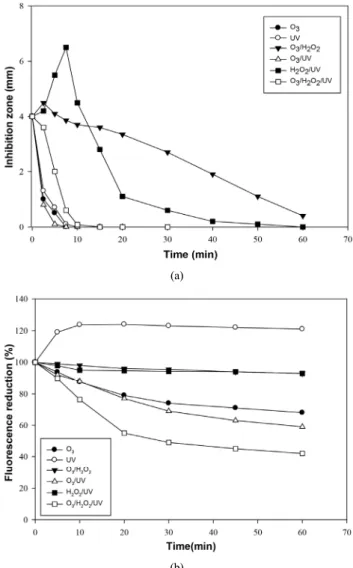
The partially oxidized (or partially degraded) intermediates during AOP treatment can influence toxicity and biodegradability. Figure 2 shows the changes in E. coli susceptibility and V. fischeri biofluorescence. Figure 2a shows that the diameter of inhibition zone, which is the relative extent of susceptibility to toxicity, was decreasing quickly by ozone alone and by O

3

/UV treatment, down to below de- tection limit after 5 min of treatment. O

3

/H

2

O

2

/UV and O

3

/H

2

O

2

also showed a substantial reduction of inhibition within 30 min. It was also observed that degradation products, especially in H

2

O

2

treatment, may (a)

(b)

Figure 1. Changes in absorbance and TOC during advanced oxidation of penicillin.

(a)

(b)

Figure 2. Changes in (a) E. coli susceptibility and (b) V. fischeri

bioluminescence during advanced oxidation of penicillin.

(4)

still possess antibacterial activity, even more susceptible with E. coli than parent compounds[19,20].

Figure 2b is the changes in biofluorescence of V. fischeri during var- ious AOP treatments. The degree of inhibition by untreated PEN was considered 100%. O

3

/UV and O

3

/H

2

O

2

/UV exhibited the best perform- ance overall in toxicity reduction. However, biotoxicity in terms of V.

fischeri fluorescence reduction was 57% reduced for 60 min, which in- dicated that the antibiotic toxicity to V. fischeri fluorescence lasted lon- ger than E. coli susceptibility.

Toxicity can even increase during AOP treatments sometimes.

Especially, in the cases of O

3

/H

2

O

2

and H

2

O

2

/UV, E. coli susceptibility increased temporarily at early stage of AOP treatment and then de- creased rapidly (Figure 2a). This is probably because the involvement of H

2

O

2

oxidation produces more toxic intermediates than the parent PEN, but they are soon degraded further although it was not ex- perimentally confirmed. Figure 2b also shows that V. fischeri bio- luminescence increased by UV alone and maintained constantly, imply- ing that stable intermediates against toxicity started increasing from the beginning and over 100% inhibition was maintained, implying that UV is responsible for generating stable intermediates or structural change which affects against V. fischeri luminescence. It was confirmed that an inappropriate AOP treatment can make toxicity worse than original compounds[7,21].

3.3. Changes in biodegradability during O

3

/UV process From the results in Figures 1 and 2, the treatments of O

3

/H

2

O

2

/UV and O

3

/UV showed the best performance in TOC reduction and tox- icity mitigation of penicillin solution. Since their performances were not different significantly, the O

3

/UV treatment was chosen for a se- lected combination for PEN treatment for later experiments.

Figure 3 shows the change of BOD

5

/COD ratio, which is an index of biodegradability, during O

3

/UV treatment for penicillin. It can be seen that the biodegradability of PEN was improved successfully by O

3

/UV application. The increase of BOD

5

/COD ratio was more than 4 folds until 30 min of the treatment. This increase in BOD

5

/COD ratio

indicates that the refractory PEN was changed more biodegradable by the O

3

/UV process due to its characteristics of oxidation reaction. It has been reported that some antibiotics become biodegradable after AOP, and the extent of biodegradability change depends upon the structure of parent molecule such as functional group and bonding characteristics[22-24]. The results of Figure 3 implied that PEN mole- cules which were treated by O

3

/UV could become sufficiently bio- degradable and ready for biological treatment processes.

3.4. Biological treatment with P. putida

The merit of the enhanced biodegradability (Figure 3) achieved by O

3

/UV application was proved through biological treatment using P.

putida (Figure 4). Control reactor contained artificial wastewater only, without PEN. The raw sample reactor contained 20 mg/L of untreated PEN, and the treated sample reactor contained 20 mg/L of PEN which was treated by O

3

/UV for 15 min.

TOC values showed an acclimating period at the beginning in bio- logical reactor and then decreased rapidly within 1-2 days. The reduc- tions in TOC are the results from the assimilation of organic carbons such as glucose and penicillin. Because the concentration of PEN was extremely small among total carbon constituents in wastewater, the ac- tual disappearance of PEN could not be identified by HPLC during treatment period. However, possible benefits of AOP treatment of PEN for biological treatment can be reflected in the differences of reduction rates of TOC values. By assuming the removal curves follow negative exponential decay before reaching stabilized phase (30-50 min) and comparing exponential coefficients, TOC removal rate in the raw PEN sample was 51.3% of that of control, while the removal rate in the treated PEN sample was up to 79.5% of control which was about 55%

higher than that in raw PEN sample.

The TOC values of O

3

/UV-treated sample were always lower than those of raw sample (that is, untreated sample), indicating that the bio- logical removal of treated sample occurred faster. In other words, treat- ed sample was less toxic to bacteria than raw sample. After 100 h of biological treatment, the TOC value of treated sample became com- Figure 3. The change in BOD

5

/COD ratio during O

3

/UV treatment of

penicillin.

Figure 4. TOC reduction by aerobic biological treatment of

penicillin-containing wastewater.

(5)

parable to that of the control reactor. Sometimes TOC value can in- crease slightly during the treatment in case that more complex com- pounds are generated from the reaction between AOP-treated inter- mediates and microorganism[9,25].

It can be concluded, from Figures 3 and 4, that O

3

/UV pretreatment was beneficial for aerobic biological process to accelerate the removal of TOC value compared to the direct supply of PEN, because O

3

/UV treatment allowed the increase of biodegradability of PEN molecule and the reduction of potential toxicity to the microorganisms in the bioreactor.

4. Conclusions

The degradation of penicillin was investigated by various combina- tions of O

3

, H

2

O

2

and UV. A complete degradation or mineralization was not guaranteed although ABS was reduced substantially by AOP because the reduction of ABS reflected the change in light-absorbing characteristics of the molecular structure of the compounds. TOC re- sults showed that the complete mineralization of the antibiotics did not occur under AOP conditions used in this study. Although O

3

/UV com- bination was best overall for ABS reduction, the TOC and toxicity re- ductions were not complete. However, the BOD

5

/COD ratio was in- creased substantially and thus O

3

/UV combination was considered as an optimal choice of AOP when it is combined with biological treatment. O

3

/UV pretreatment was indeed beneficial for aerobic bio- logical process using P. putida to accelerate TOC removal because O

3

/UV treatment allowed the increase in the biodegradability of PEN and the reduction of potential toxicity to the microorganisms in bioreactor. In conclusion, O

3

/UV process can be recommended as a pretreatment step prior to aerobic biological process to improve the ul- timate degradation of penicillin.

Acknowledgements

This work was supported by 2017 Research Fund of Myongji University.

References

1. R. J. Fair and Y. Tor, Antibiotics and bacterial resistance in the 21st century, Perspect. Medicin. Chem., 6, 25-64 (2014).

2. A. J. Ebele, Mohamed A.-E. Abdallah, and S. Harrad, Pharmaceuticals and personal care products (PPCPs) in the fresh- water aquatic environment, Emerg. Contam., 3(1), 1-16 (2017).

3. P. Zhou, C. Su, B. Li, and Y. Qian, Treatment of high-strength pharmaceutical wastewater and removal of antibiotics in anaerobic and aerobic biological treatment processes, J. Environ. Eng., 132(1), 129-136 (2006).

4. C. Rering, K. Williams, M. Hengel, and R. Tjeerdema, Comparison of direct and indirect photolysis in imazosulfuron pho- todegradation, J. Agric. Food Chem., 65(15), 3103-3108 (2017).

5. J. L. Tambosi, R. F. Sena, W. Gebhardt, R. F. P. M. Moreira, H.

J. Jose, and H. F. Schroder, Physicochemical and advanced oxida-

tion processes: A comparison of elimination results of antibiotic compounds following an MBR treatment, Ozone Sci. Eng., 31, 428-435 (2009).

6. F. A. Almomani, M. Shawaqfah, R. R. Bhosale, and A. Kumar, Removal of emerging pharmaceuticals from wastewater by ozone-based advanced oxidation processes, Environ. Prog. Sustain.

Energy, 35(4), 982-995 (2016).

7. F. Yuan, C. Hu, X. Hu, D. Wei, Y. Chen, and J. Qu, Photodegradation and toxicity changes of antibiotics in UV and UV/H

2

O

2

process, J. Hazard. Mater., 185, 1256-1263 (2001).

8. G. Lofrano, R. Pedrazzani, G. Libralato, and M. Carotenuto, Advanced oxidation processes for antibiotics removal: A review, Curr. Org. Chem., 21, 1-14 (2017).

9. I. Oller, S. Malato, and J. A. Sanchez-Perez, Combination of ad- vanced oxidation processes and biological treatments for waste- water decontamination: A review, Sci. Total Environ., 409, 4141-4166 (2011).

10. S. Yahiat, F. Fourcade, S. Brosillon, and A. Amrane, Removal of antibiotics by an integrated process coupling photocatalysis and bi- ological treatment: Case of tetracycline and tylosin, Int.

Biodeterior. Biodegradation, 65, 997-1003 (2012).

11. I. Lee, E. Lee, H. Lee, and K. Lee, Removal of COD and color from anaerobic digestion effluent of livestock wastewater by ad- vanced oxidation using microbubbled ozone, Appl. Chem. Eng., 22(6), 617-622 (2011).

12. A. W. Bauer, W. M. M. Kirby, J. C. Sherris, and M. Turck, Antibiotic susceptibility testing by a standardized single disk meth- od, Am. J. Clin. Pathol., 36, 493-496 (1996).

13. V. L. K. Jennings, M. H. Rayner-Brandes, and D. J. Bird, Assessing chemical toxicity with the bioluminescent photo- bacterium (Vibrio fischeri), Water Res., 35, 3448-3456 (2001).

14. G. M. Robinson, K. Tonks, R. M. S. Thorn, and D. M. Reynolds, Application of bacterial bioluminescence to assess the efficacy of fast-acting biocides, Antimicrob. Agents Chemother., 55(11), 5214-5219 (2011).

15. H. T. Luu, Degradation and Changes in Toxicity and Biodegradability of Antibiotics during Advanced Oxidation Processes, MS Thesis, Myongji University, Korea (2013).

16. APHA-AWWA-WEF, Standard Methods for the Examination of Water and Wastewater, 21st ed., American Public Health Association, Washington DC, USA (2005).

17. H. T. Luu and K. Lee, Degradation and changes in toxicity and biodegradability of tetracycline during ozone/ultraviolet-based ad- vanced oxidation, Water Sci. Technol., 70(7), 1229-1235 (2014).

18. I. Dalmázio, M. O. Almeida, R. Augusti, and T. M. A. Alves, Monitoring the degradation of tetracycline by ozone in aqueous medium via atmospheric pressure ionization mass spectrometry, J.

Am. Soc. Mass Spectrom., 18, 679-687 (2007).

19. B. De Witte, H. V. Langenhove, K. Demeestere, K. Saerens, P. D.

Wispelaere, and J. Dewulf, Ciprofloxacin ozonation in hospital wastewater treatment plant effluent: Effect of pH and H

2

O

2

, Chemosphere, 78, 1142-1147 (2010).

20. O. S. Keen and K. G. Linden, Degradation of antibiotic activity during UV/H

2

O

2

advanced oxidation and photolysis in wastewater effluent, Environ. Sci. Technol., 47(22), 13020-13030 (2013).

21. A. M. Parker, Y. Lester, E. K. Spangler, U. von Gunten, and K.

G. Linden, UV/H

2

O

2

advanced oxidation for abatement of organo-

phosphorous pesticides and the effects on various toxicity screen-

(6)

ing assays, Chemosphere, 182, 477-482 (2017).

22. A. I. Alaton and A. E. Caglayan, Toxicity and biodegradability as- sessment of raw and ozonated procaine penicillin G formulation effluent, Ecotoxicol. Environ. Saf., 63, 131-140 (2006).

23. J. Jeong, W. Song, J. C. William, J. Jung, and J. Greaves, Degradation of tetracycline antibiotics: Mechanisms and kinetic studies for advanced oxidation/reduction processes, Chemosphere, 78, 533-540 (2010).

24. A. L. Estrada and Y.-Y. Li, and A. Wang, Biodegradability en- hancement of wastewater containing cefalexin by means of the electro-Fenton oxidation process, J. Hazard. Mater., 227-228, 41-48 (2012).

25. A. Alaton, S. Dogruel, E. Baykal, and G. Gerone, Combined

chemical and biological oxidation of penicillin formulation efflu-

ent, J. Environ. Manag., 73, 155-163 (2004).

수치

Figure 1. Changes in absorbance and TOC during advanced oxidation  of penicillin.
Figure 2b is the changes in biofluorescence of V. fischeri during var- var-ious AOP treatments

참조

관련 문서

The removal efficiency of nitrate was increased with increasing of dosage of adsorbents. The NO 3 - -N removal was not affected by the pH under the experiment range of pH. The

Thus, by developing high quality and high value added injection molds, the final products can be widely applied to all parts of the vehicle exterior, and it

Within the limitations of this study, it is concluded that pretreatment of desensitizing agent (Seal&Protect) reduced the bond strength of two-step self-etch adhesive

Within the limitation of this study, it can be concluded that pretreatment with EDTA or phosphoric acid have negative effect in apical part on push out bond strength of fiber

Figure 1 UV-Vis absorption and fluorescence spectra of Compound 4 Figure 2 UV-Vis absorption and fluorescence spectra of 2-Aminopyridine Figure 3 UV-Vis absorption

Biochemical markers of bone turnover can be classified according to the process that underlie in markers of bone formation, products of the osteoblast

In the POLARIS-2 and POLARIS-3 studies 14 , it was not determined that SOF/VEL/VOX for 8 weeks was non-inferior to SOF/VEL for 12 weeks for the treatment of non-cirrhotic

In this study, it can be seen that sex and metabolic syndrome are important for biological factors, and occupation, smoking, and exercise are important